water pump JAGUAR XJ6 1994 2.G User Guide
[x] Cancel search | Manufacturer: JAGUAR, Model Year: 1994, Model line: XJ6, Model: JAGUAR XJ6 1994 2.GPages: 521, PDF Size: 17.35 MB
Page 67 of 521
Cooling System (VI 2)
0
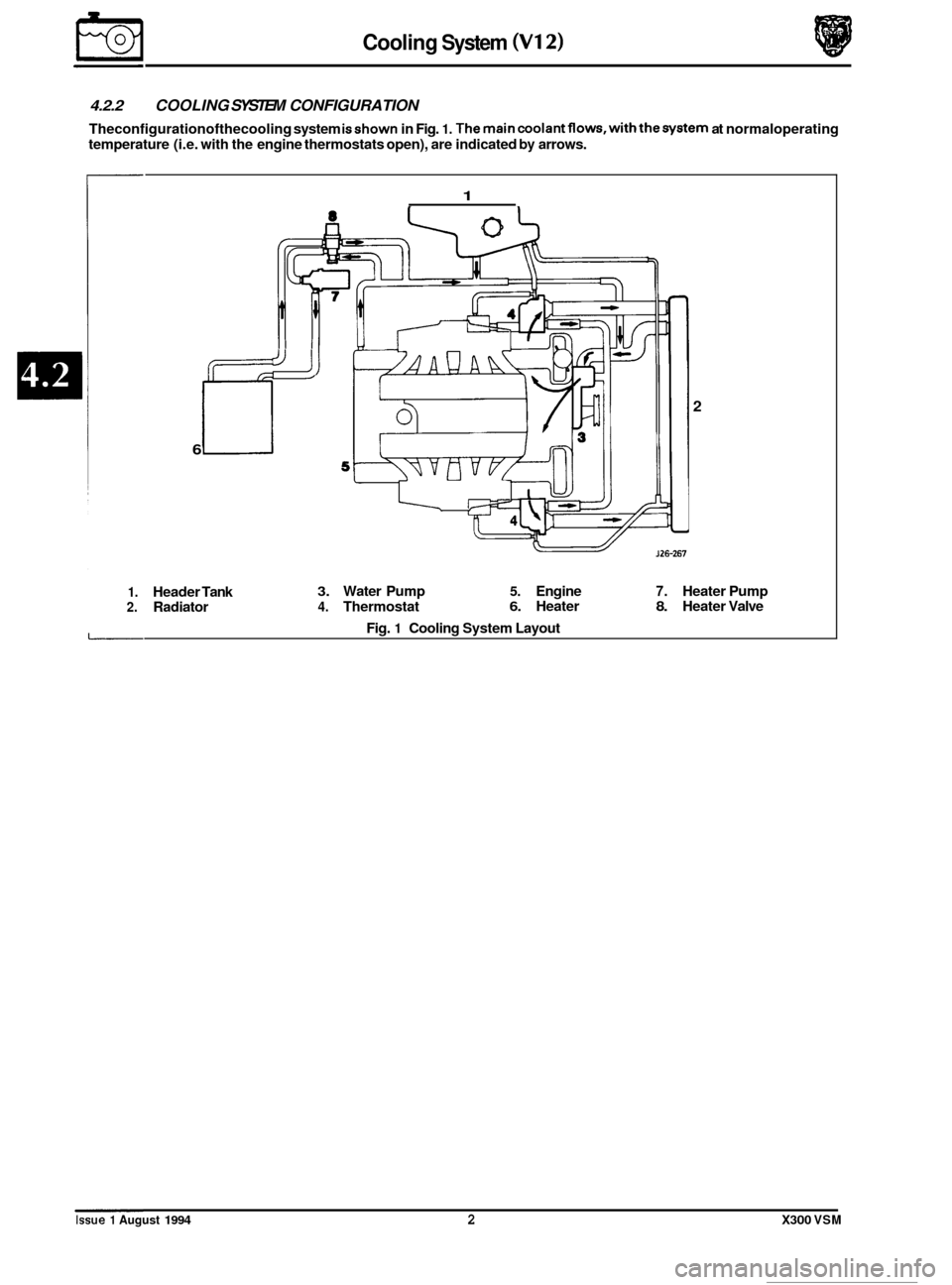
4.2.2 COOLING SYSTEM CONFIGURATION
Theconfigurationofthecooling system isshown in Fig. 1. Themaincoolantflows,withthesystem at normaloperating
temperature (i.e. with the engine thermostats open), are indicated
by arrows.
6 rr
1
2
1. Header Tank 3. Water Pump 5. Engine 7. Heater Pump
2. Radiator 4. Thermostat 6. Heater 8. Heater Valve
Fig.
1 Cooling System Layout
Issue 1 August 1994 2 X300 VSM
Page 68 of 521
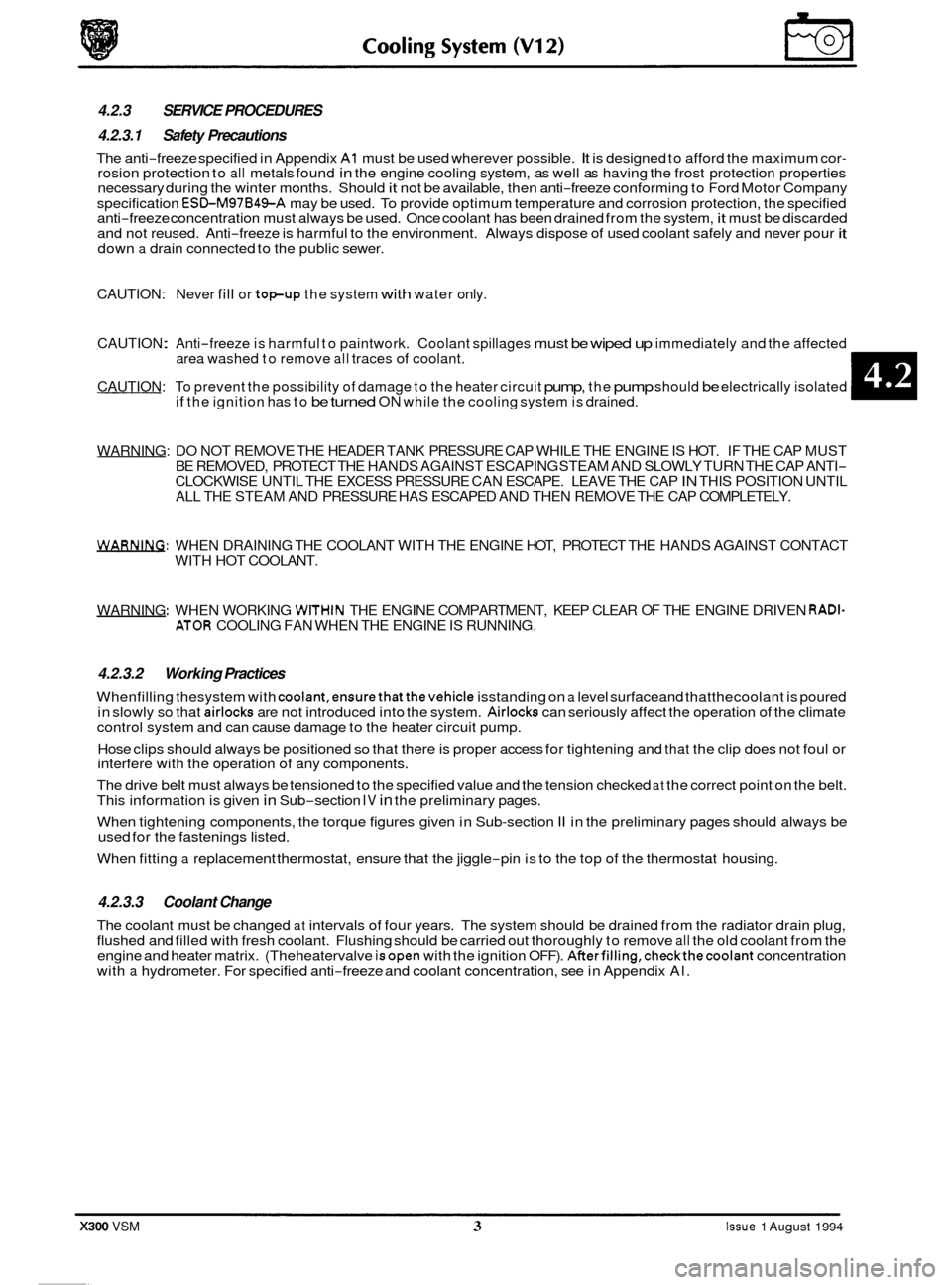
WARNING: DO NOT REMOVE THE HEADER TANK PRESSURE CAP WHILE THE ENGINE IS HOT. IF THE CAP MUST
BE REMOVED, PROTECT THE HANDS AGAINST ESCAPING STEAM AND SLOWLY TURN THE CAP ANTI- CLOCKWISE UNTIL THE EXCESS PRESSURE CAN ESCAPE. LEAVE THE CAP IN THIS POSITION UNTIL
ALL THE STEAM AND PRESSURE HAS ESCAPED AND THEN REMOVE THE CAP COMPLETELY.
WARNING: WHEN DRAINING THE COOLANT WITH THE ENGINE HOT, PROTECT THE HANDS AGAINST CONTACT
WITH HOT COOLANT.
WARNING
: WHEN WORKING WITHIN THE ENGINE COMPARTMENT, KEEP CLEAR OF THE ENGINE DRIVEN RADI- ATOR COOLING FAN WHEN THE ENGINE IS RUNNING.
4.2.3.2 Working Practices
Whenfilling thesystem with coolant,ensurethatthevehicle isstanding on a level surfaceand thatthecoolant is poured
in slowly so that airlocks are not introduced into the system. Airlocks can seriously affect the operation of the climate
control system and can cause damage to the heater circuit pump.
Hose clips should always be positioned
so that there is proper access for tightening and that the clip does not foul or
interfere with the operation of any components.
4.2.3 SERVICE PROCEDURES
4.2.3.1 Safety Precautions
The anti-freeze specified in Appendix A1 must be used wherever possible. It is designed to afford the maximum cor- rosion protection to all metals found in the engine cooling system, as well as having the frost protection properties
necessary during the winter months. Should it not be available, then anti-freeze conforming to Ford Motor Company
specification
ESBM97B49-A may be used. To provide optimum temperature and corrosion protection, the specified
anti-freeze concentration must always be used. Once coolant has been drained from the system, it must be discarded
and not reused. Anti-freeze is harmful to the environment. Always dispose of used coolant safely and never pour it down a drain connected to the public sewer.
CAUTION: Never fill or topup the system with water only.
CAUTION
: Anti-freeze is harmful to paintwork. Coolant spillages must be wiped up immediately and the affected
area washed to remove all traces of coolant.
CAUTION: To prevent the possibility of damage to the heater circuit
pump, the pump should be electrically isolated if the ignition has to be turned ON while the cooling system is drained.
The drive belt must always be tensioned to the specified value and the tension checked at the correct point on the belt.
This information is given in Sub-section IV in the preliminary pages.
When tightening components, the torque figures given in Sub
-section II in the preliminary pages should always be
used for the fastenings listed.
When fitting a replacement thermostat, ensure that the jiggle-pin is to the top of the thermostat housing.
4.2.3.3 Coolant Change
The coolant must be changed at intervals of four years. The system should be drained from the radiator drain plug,
flushed and filled with fresh coolant. Flushing should be carried out thoroughly to remove all the old coolant from the
engine and heater matrix. (The heatervalve isopen with the ignition OFF). AfterfilIing,checkthecoolant concentration
with a hydrometer. For specified anti-freeze and coolant concentration, see in Appendix Al.
X300 VSM 3 Issue 1 August 1994
Page 70 of 521
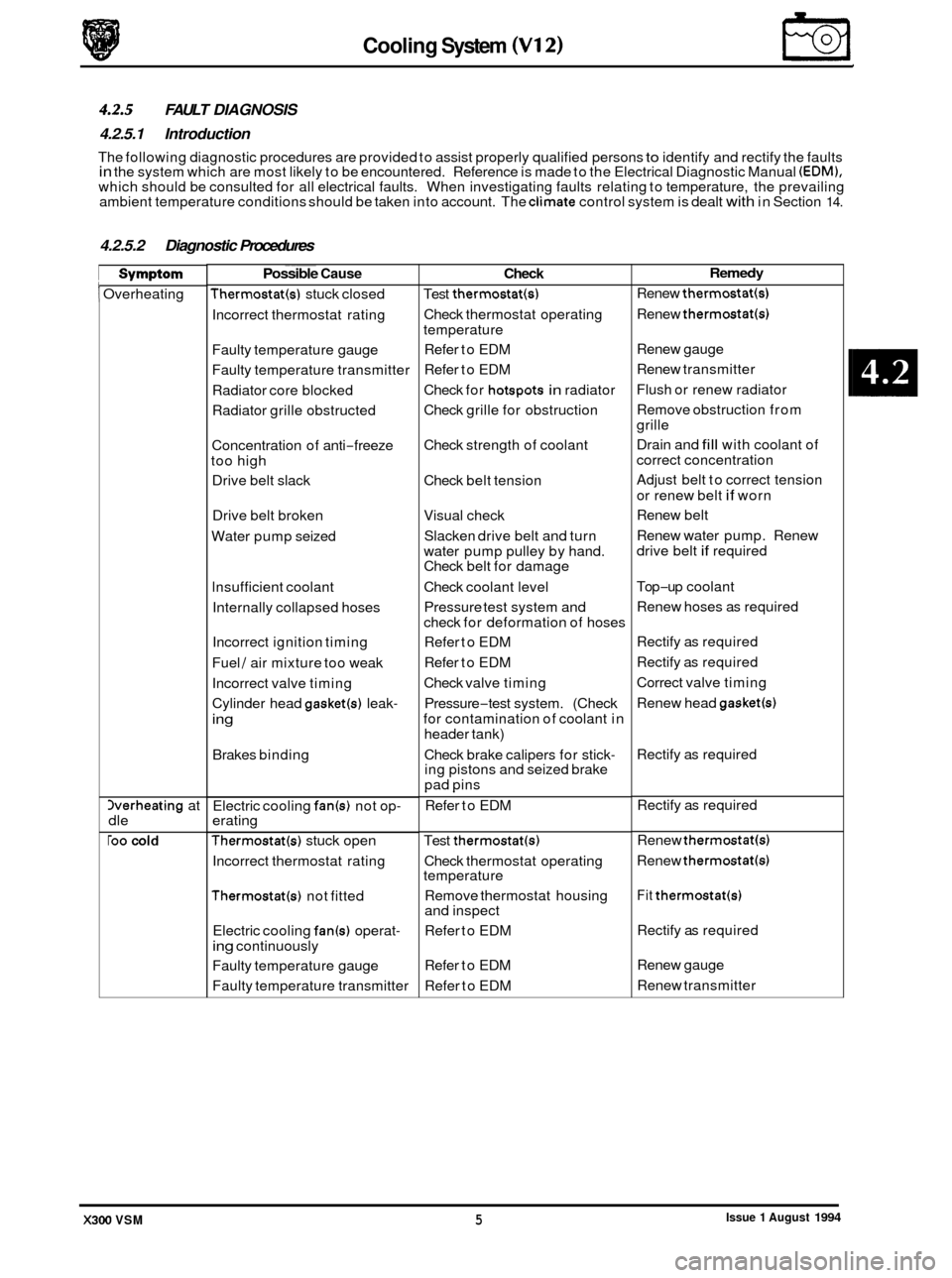
4.2.5.2 Diagnostic Procedures
1
I Symptom ..
Overheating
herheating at
dle
roo cold ~~~
Possible Cause
Thermostat(s) stuck
closed
Incorrect thermostat rating
Faulty temperature gauge
Faulty temperature transmitter
Radiator core blocked
Radiator grille obstructed
Concentration of anti
-freeze
too high
Drive belt slack
Drive belt broken
Water pump seized
lnsuff icient coolant
Internally collapsed hoses
Incorrect ignition timing
Fuel
/ air mixture too weak
Incorrect valve timing
Cylinder head
gasket(s) leak-
ing
Brakes binding
Electric cooling
fan(s) not op- erating
Thermostat(s) stuck open
Incorrect thermostat rating
Thermostatb) not fitted
Electric cooling
fan(s) operat-
ing continuously
Faulty temperature gauge
Faulty temperature transmitter
Check
Cooling System (V12)
4.2.5 FAULT DIAGNOSIS
4.2.5.1 Introduction
The following diagnostic procedures are provided to assist properly qualified persons to identify and rectify the faults in the system which are most likely to be encountered. Reference is made to the Electrical Diagnostic Manual (EDM), which should be consulted for all electrical faults. When investigating faults relating to temperature, the prevailing
ambient temperature conditions should be taken into account. The climate control system is dealt with in Section 14.
Test thermostat(s)
Check thermostat operating
temperature
Refer to EDM
Refer to EDM
Check for
hotspots in radiator
Check grille for obstruction
Check strength of coolant
Check belt tension
Visual check Slacken drive belt and turn
water pump pulley by hand.
Check belt for damage
Check coolant level
Pressure test system and
check for deformation of hoses
Refer to EDM
Refer to EDM
Check valve timing
Pressure
-test system. (Check
for contamination of coolant in
header tank)
Check brake calipers for stick
- ing pistons and seized brake
pad pins
..
Refer to EDM
Test
thermostat(4
Check thermostat operating
temperature
Remove thermostat housing
and inspect
Refer to EDM
Refer to EDM
Refer to EDM
Remedy
Renew thermostat(s)
Renew thermostat(s1
Renew gauge
Renew transmitter
Flush or renew radiator
Remove obstruction from
grille
Drain and
fill with coolant of
correct concentration
Adjust belt to correct tension
or renew belt
if worn
Renew belt
Renew water pump. Renew
drive belt
if required
Top
-up coolant
Renew hoses as required
Rectify as required
Rectify as required
Correct valve timing
Renew head
gasket(s)
Rectify as required
Rectify as required
Renew
thermostat(s1
Renew thermostatb)
Fit thermostat(s)
Rectify as required
Renew gauge
Renew transmitter
Issue 1 August 1994 X300 VSM 5
Page 71 of 521
rn Cooling System (VI 2)
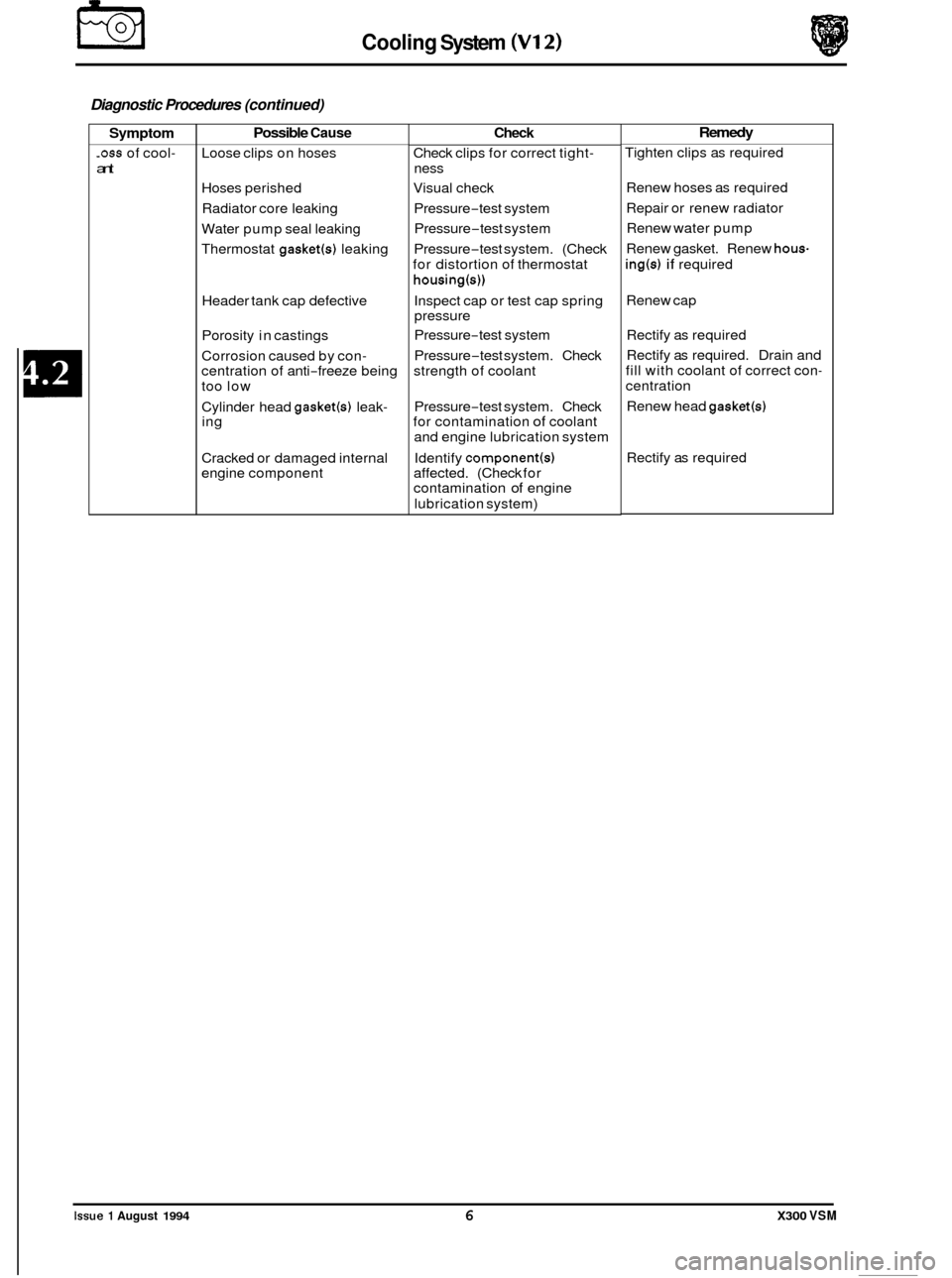
Diagnostic Procedures (continued)
Symptom
-0ss of cool-
ant
Possible Cause
Loose clips on hoses
Hoses perished
Radiator core leaking
Water pump seal leaking
Thermostat
gasket(s) leaking
Header tank cap defective
Porosity in castings
Corrosion caused by con
- centration of anti-freeze being
too low
Cylinder head
gasket(4 leak- ing
Cracked or damaged internal
engine component
Check
Check clips for correct tight-
ness
Visual check
Pressure
-test system
Pressure
-test system
Pressure
-test system. (Check
for distortion of thermostat
housing(s))
Inspect cap or test cap spring
pressure
Pressure
-test system
Pressure
-test system. Check
strength of coolant
Pressure
-test system. Check
for contamination of coolant
and engine lubrication system
Identify
component(s) affected. (Check for
contamination of engine
lubrication system)
Remedy
Tighten clips as required
Renew hoses as required
Repair or renew radiator
Renew water pump
Renew gasket. Renew
hous-
ing(s) if required
Renew cap Rectify as required
Rectify as required. Drain and
fill with coolant of correct con
-
centration
Renew head
gasket(s)
Rectify as required
Issue 1 August 1994 6 X300 VSM
Page 207 of 521
@ Steering
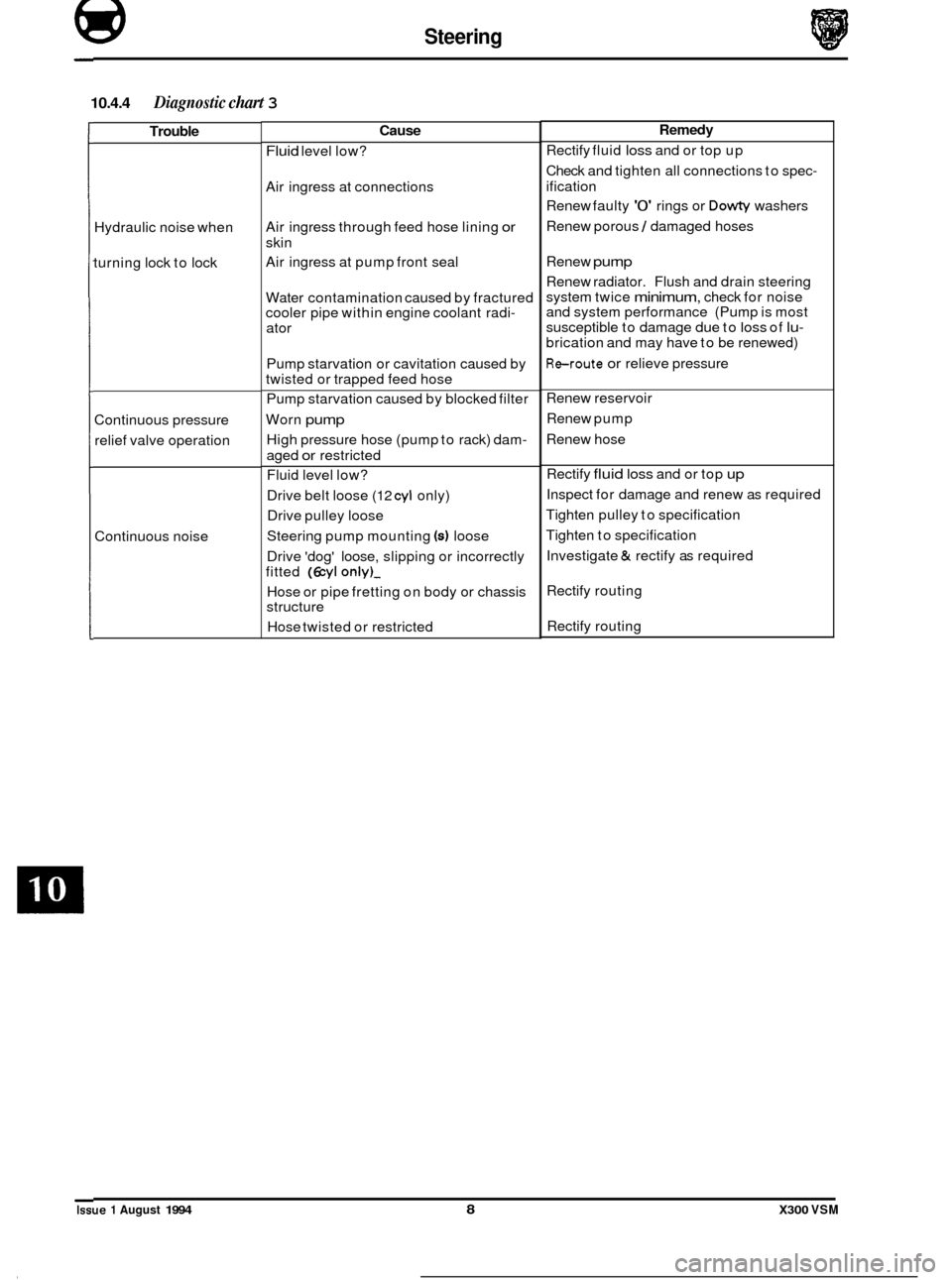
10.4.4 Diagnostic chart 3
Trouble
Hydraulic noise when
turning lock to lock
Continuous pressure
relief valve operation
Continuous noise
Cause
Fluid level low?
Air ingress at connections
Air ingress through feed hose lining
or
skin
Air ingress at pump front seal
Water contamination caused by fractured
cooler pipe within engine coolant radi
-
ator
Pump starvation or cavitation caused by
twisted or trapped feed hose
Pump starvation caused by blocked filter
Worn
pump
High pressure hose (pump to rack) dam-
aged or restricted
Fluid level low?
Drive belt loose
(12 cyl only)
Drive pulley loose
Steering pump mounting
(4 loose
Drive 'dog' loose, slipping or incorrectly
fitted
(6 cyl only)-
Hose or pipe fretting on body or chassis
structure
Hose twisted or restricted
Remedy
Rectify fluid loss and or top up
Check and tighten all connections to spec
-
ification
Renew faulty
'0' rings or Dowty washers
Renew porous
1 damaged hoses
Renew
pump
Renew radiator. Flush and drain steering
system twice
minimum, check for noise
and system performance (Pump is most
susceptible to damage due to
loss of lu-
brication and may have to be renewed)
Reroute or relieve pressure
Renew reservoir
Renew pump
Renew hose
Rectify
fluid loss and or top up
Inspect for damage and renew as required
Tighten pulley to specification
Tighten to specification
Investigate
& rectify as required
Rectify routing
Rectify routing
Issue 1 August 1994 8 X300 VSM
Page 312 of 521
Climate Control Systems
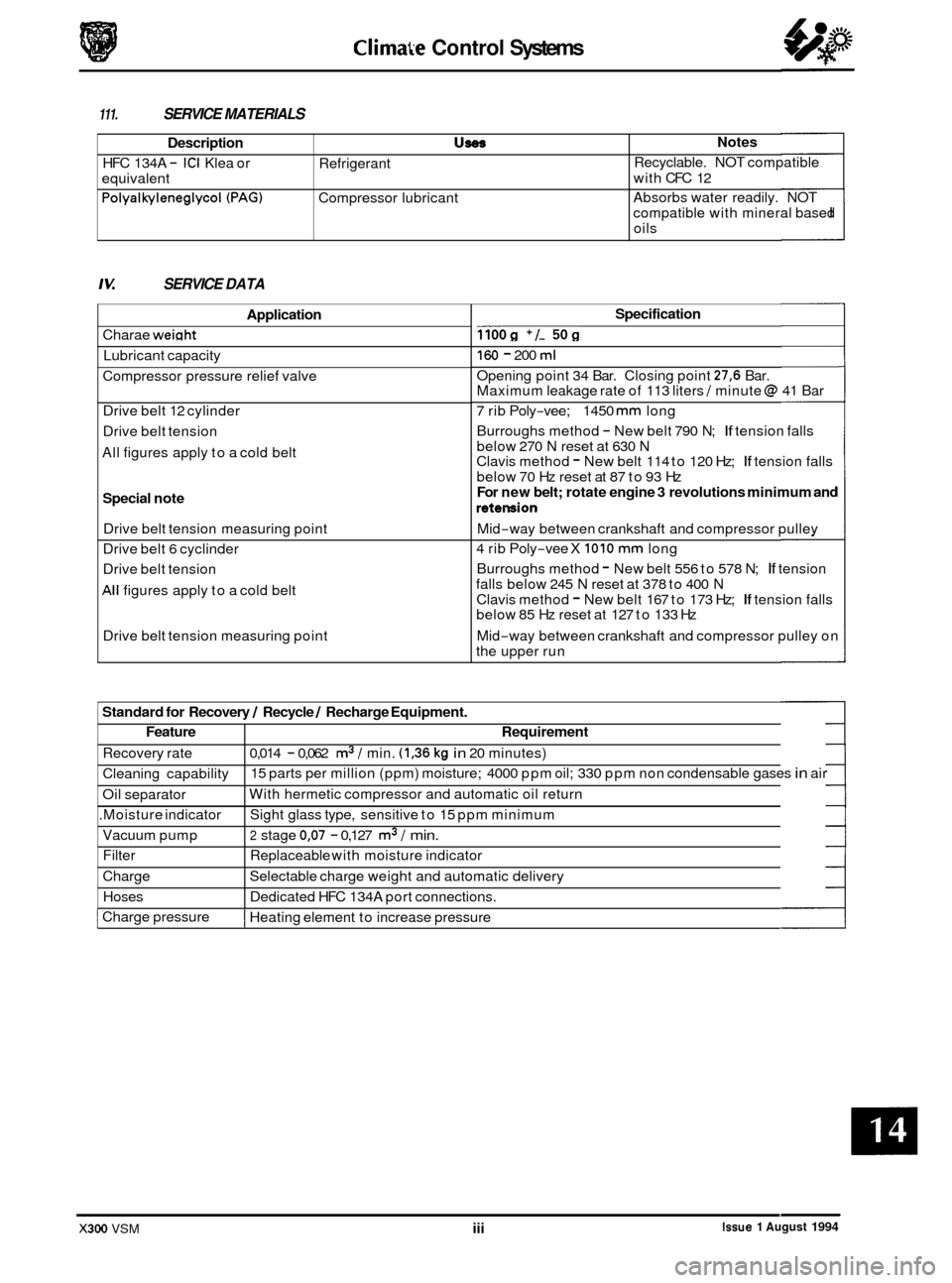
Description U-
HFC 134A - ICI Klea or
equivalent
Polyalkyleneglycol (PAG) Compressor lubricant
Refrigerant
111.
Notes
Recyclable. NOT
compatible
with CFC 12
Absorbs water readily. NOT
compatible with mineral based
oils
SERVICE MATERIALS
Standard for Recovery I Recycle 1 Recharge Equipment.
Recovery rate
Cleaning capability
Oil separator
.Moisture indicator
Vacuum pump
Filter Replaceable with moisture indicator
Charge Hoses
Feature Requirement
0,014 - 0,062 m3 / min. (1,36 kg in 20 minutes)
15 parts per million (ppm) moisture; 4000 ppm oil; 330 ppm non condensable gases
in air
With hermetic compressor and automatic oil return
Sight glass type, sensitive to 15 ppm minimum
2 stage 0,07 - 0,127 m3 I min.
Selectable charge weight and automatic delivery
Dedicated HFC 134A port connections.
Iv. SERVICE DATA
Application
Charae weight
Lubricant capacity
Compressor pressure relief valve
Drive belt 12 cylinder
Drive belt tension
All figures apply to a cold belt
Special note
Drive belt tension measuring point
Drive belt 6 cyclinder
Drive belt tension
All figures apply to a cold belt
Drive belt tension measuring point
Specification
160 - 200 ml
Opening point 34 Bar. Closing point 27,6 Bar.
Maximum leakage rate of 113 liters 1 minute @ 41 Bar
7 rib Poly
-vee; 1450 mm long
Burroughs method
- New belt 790 N; If tension falls
below 270 N reset at 630 N
Clavis method
- New belt 114 to 120 Hz; If tension falls
below 70 Hz reset at 87 to 93 Hz
For new belt; rotate engine 3 revolutions minimum and
retension
Mid-way between crankshaft and compressor pulley ~
4
rib Poly-vee X 1010 mm long
Burroughs method
- New belt 556 to 578 N; If tension
falls below 245 N reset at 378 to 400
N
Clavis method - New belt 167 to 173 Hz; If tension falls
below 85 Hz reset at 127 to 133 Hz
Mid
-way between crankshaft and compressor pulley on
the upper run
1 Charge pressure I Heating element to increase pressure
Issue 1 August 1994 X300 VSM iii
Page 329 of 521
Climate Control Systems
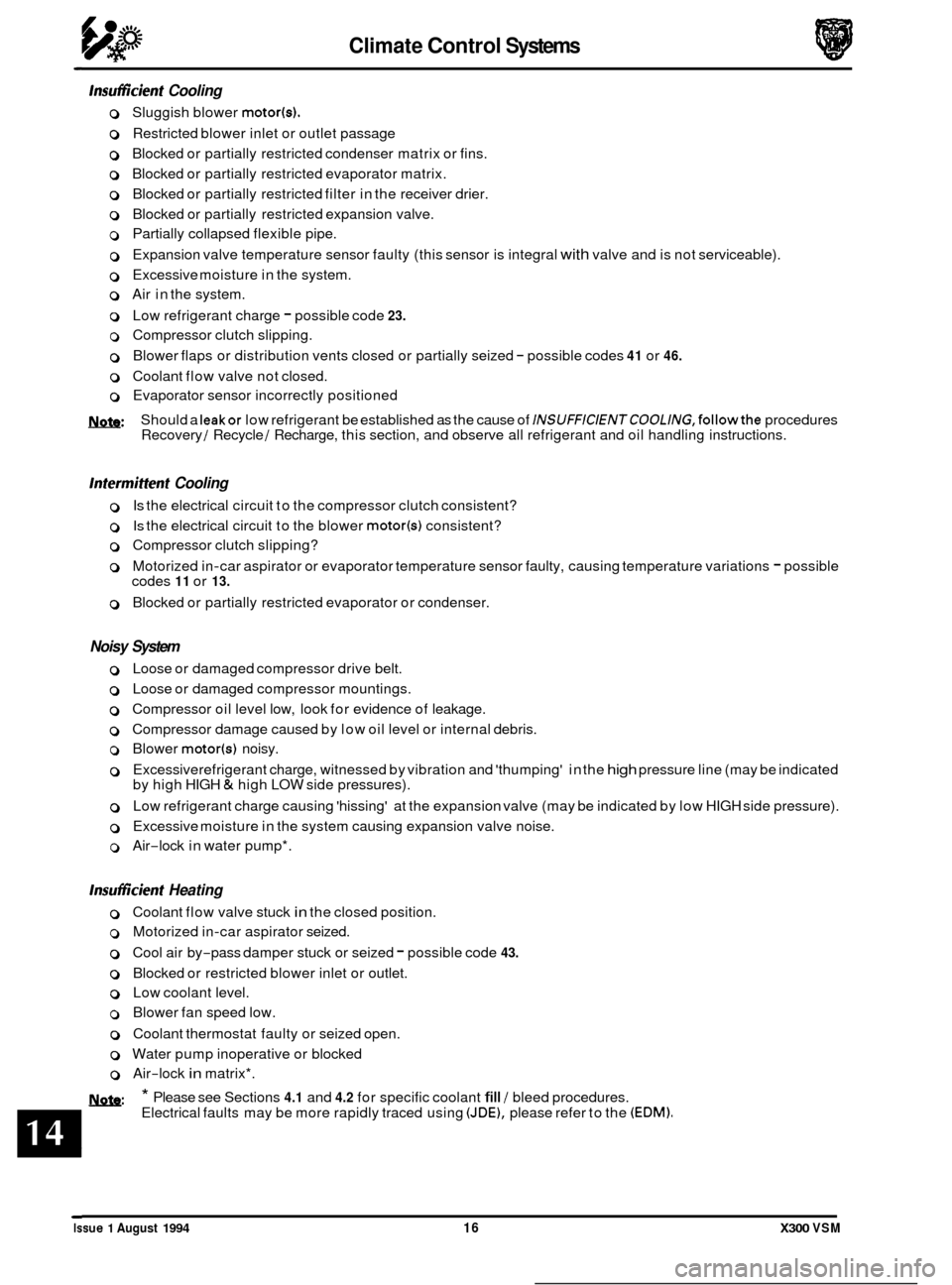
lnsufficent Cooling
0 Sluggish blower motor(s).
0 Restricted blower inlet or outlet passage
0 Blocked or partially restricted condenser matrix or fins.
0 Blocked or partially restricted evaporator matrix.
0 Blocked or partially restricted filter in the receiver drier.
0 Blocked or partially restricted expansion valve.
0 Partially collapsed flexible pipe.
0 Expansion valve temperature sensor faulty (this sensor is integral with valve and is not serviceable).
0 Excessive moisture in the system.
0 Air in the system.
0 Low refrigerant charge - possible code 23.
0 Compressor clutch slipping.
0 Blower flaps or distribution vents closed or partially seized - possible codes 41 or 46.
0 Coolant flow valve not closed.
0 Evaporator sensor incorrectly positioned
m: Should a leakor low refrigerant be established as the cause of /NSUff/C/€NTCOOL/NG,followthe procedures
Recovery / Recycle / Recharge, this section, and observe all refrigerant and oil handling instructions.
lntermiffent Cooling
0 Is the electrical circuit to the compressor clutch consistent?
0 Is the electrical circuit to the blower motor(s) consistent?
0 Compressor clutch slipping?
0 Motorized in-car aspirator or evaporator temperature sensor faulty, causing temperature variations - possible
codes 11 or 13.
0 Blocked or partially restricted evaporator or condenser.
Noisy System
0 Loose or damaged compressor drive belt.
0 Loose or damaged compressor mountings.
0 Compressor oil level low, look for evidence of leakage.
0 Compressor damage caused by low oil level or internal debris.
0 Blower motor(s) noisy.
0 Excessive refrigerant charge, witnessed by vibration and 'thumping' in the high pressure line (may be indicated
by high HIGH & high LOW side pressures).
0 Low refrigerant charge causing 'hissing' at the expansion valve (may be indicated by low HIGH side pressure).
0 Excessive moisture in the system causing expansion valve noise.
0 Air-lock in water pump*.
lnsufficent Heating
0 Coolant flow valve stuck in the closed position.
0 Motorized in-car aspirator seized.
0 Cool air by-pass damper stuck or seized - possible code 43.
0 Blocked or restricted blower inlet or outlet.
0 Low coolant level.
0 Blower fan speed low.
0 Coolant thermostat faulty or seized open.
0 Water pump inoperative or blocked
0 Air-lock in matrix*.
m: * Please see Sections 4.1 and 4.2 for specific coolant fill / bleed procedures.
Electrical faults may be more rapidly traced using
(JDE), please refer to the (EDM).
Issue 1 August 1994 16 X300 VSM
Page 331 of 521
Climate Control Systems
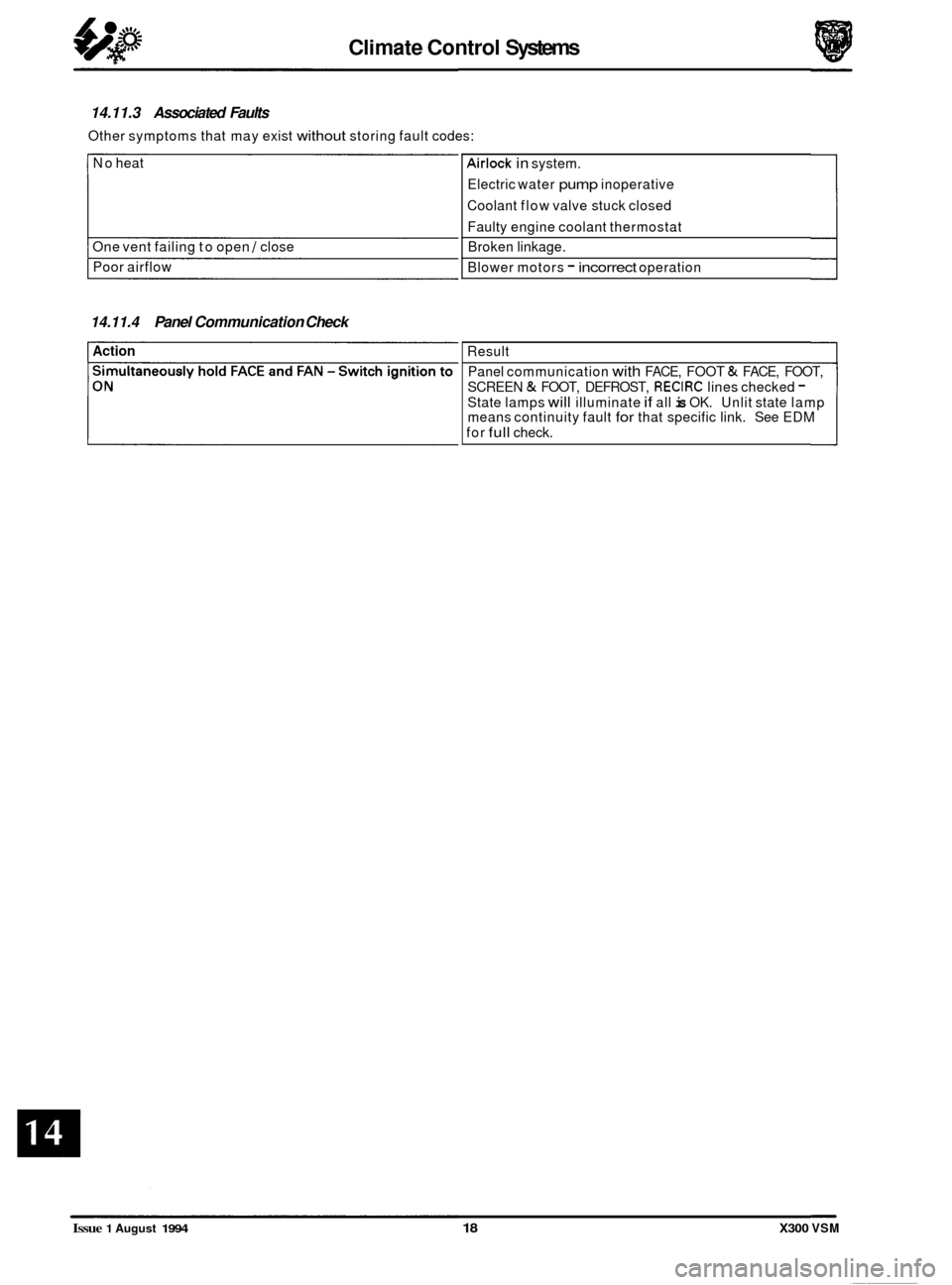
No heat
One vent failing to open
/ close
Poor airflow
14.11.3 Associated Faults
Other symptoms that may exist without storing fault codes:
Airlock in system.
Electric water
pump inoperative
Coolant flow valve stuck closed
Faulty engine coolant thermostat
Broken linkage.
Blower motors
- incorrect operation
14.11.4 Panel Communication Check
Action Result
Panel communication
with FACE, FOOT & FACE, FOOT,
SCREEN
& FOOT, DEFROST, RECIRC lines checked - State lamps will illuminate if all is OK. Unlit state lamp
means continuity fault for that specific link. See EDM
for
full check.
0
0
0
Issue 1 August 1994 18 X300 VSM
Page 357 of 521
15.6
15.6.1
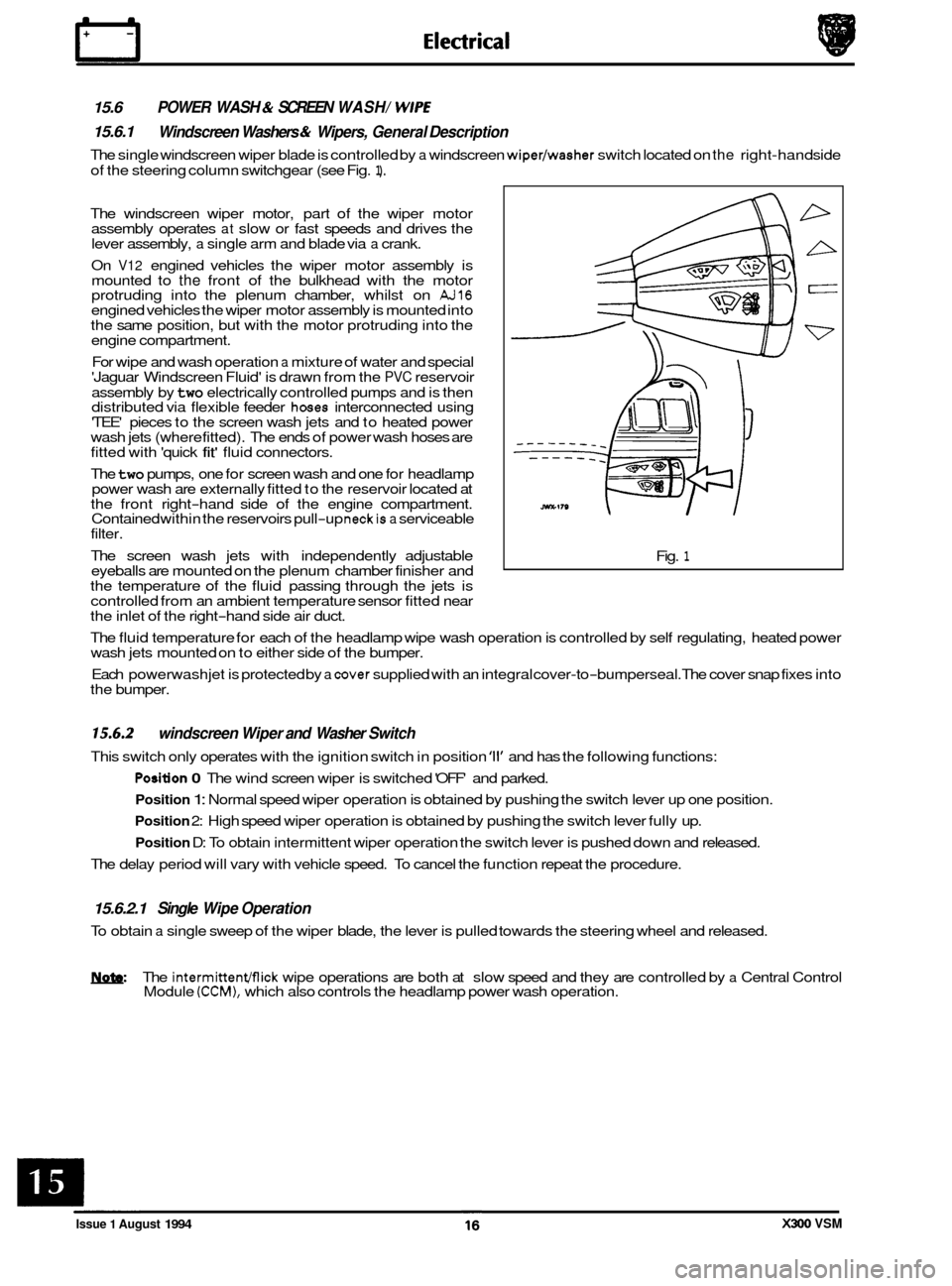
The single windscreen wiper blade is controlled by a windscreen wiper/washer switch located on the right-hand side
of the steering column switchgear (see Fig.
1).
POWER WASH & SCREEN WASH/ WlPE
Windscreen Washers & Wipers, General Description
The windscreen wiper motor, part of the wiper motor
assembly operates at slow or fast speeds and drives the
lever assembly, a single arm and blade via a crank.
On
V12 engined vehicles the wiper motor assembly is
mounted to the front of the bulkhead with the motor
protruding into the plenum chamber, whilst on AJ16 engined vehicles the wiper motor assembly is mounted into
the same position, but with the motor protruding into the
engine compartment.
For wipe and wash operation
a mixture of water and special
'Jaguar Windscreen Fluid' is drawn from the PVC reservoir
assembly by
two electrically controlled pumps and is then
distributed via flexible feeder hoses interconnected using
'TEE' pieces to the screen wash jets and to heated power
wash jets (where fitted). The ends of power wash hoses are
fitted with 'quick
fit' fluid connectors.
The
two pumps, one for screen wash and one for headlamp
power wash are externally fitted to the reservoir located at
the front right
-hand side of the engine compartment.
Contained within the reservoirs pull-up neckis a serviceable
filter.
The screen wash jets with independently adjustable
eyeballs are mounted on the plenum chamber finisher and
the temperature of the fluid passing through the jets is
controlled from an ambient temperature sensor fitted near
the inlet of the right
-hand side air duct. Fig.
1
The
fluid temperature for each of the headlamp wipe wash operation is controlled by self regulating, heated power
wash jets mounted on to either side of the bumper.
Each powerwash jet is protected by
a cover supplied with an integral cover-to-bumperseal. The cover snap fixes into
the bumper.
15.6.2
This switch only operates with the ignition switch in position '11' and has the following functions:
windscreen Wiper and Washer Switch
Position 0 The wind screen wiper is switched 'OFF' and parked.
Position 1: Normal speed wiper operation is obtained by pushing the switch lever up one position.
Position 2: High speed wiper operation is obtained by pushing the switch lever fully up.
Position D: To obtain intermittent wiper operation the switch lever is pushed down and released.
The delay period will vary with vehicle speed. To cancel the function repeat the procedure.
15.6.2.1 Single Wipe Operation
To obtain a single sweep of the wiper blade, the lever is pulled towards the steering wheel and released.
W The intermittenmick wipe operations are both at slow speed and they are controlled by a Central Control
Module (CCM), which also controls the headlamp power wash operation.
Issue 1 August 1994 X300 VSM
Page 374 of 521
Black
Black
Black All
models
All Models
All Models
Black
Black All
Models
All Models
Black/
White Stripe
Black/
White Stripe
Black Non
Aircon.
Models
only
Non Power
Wash Models
only
Optional
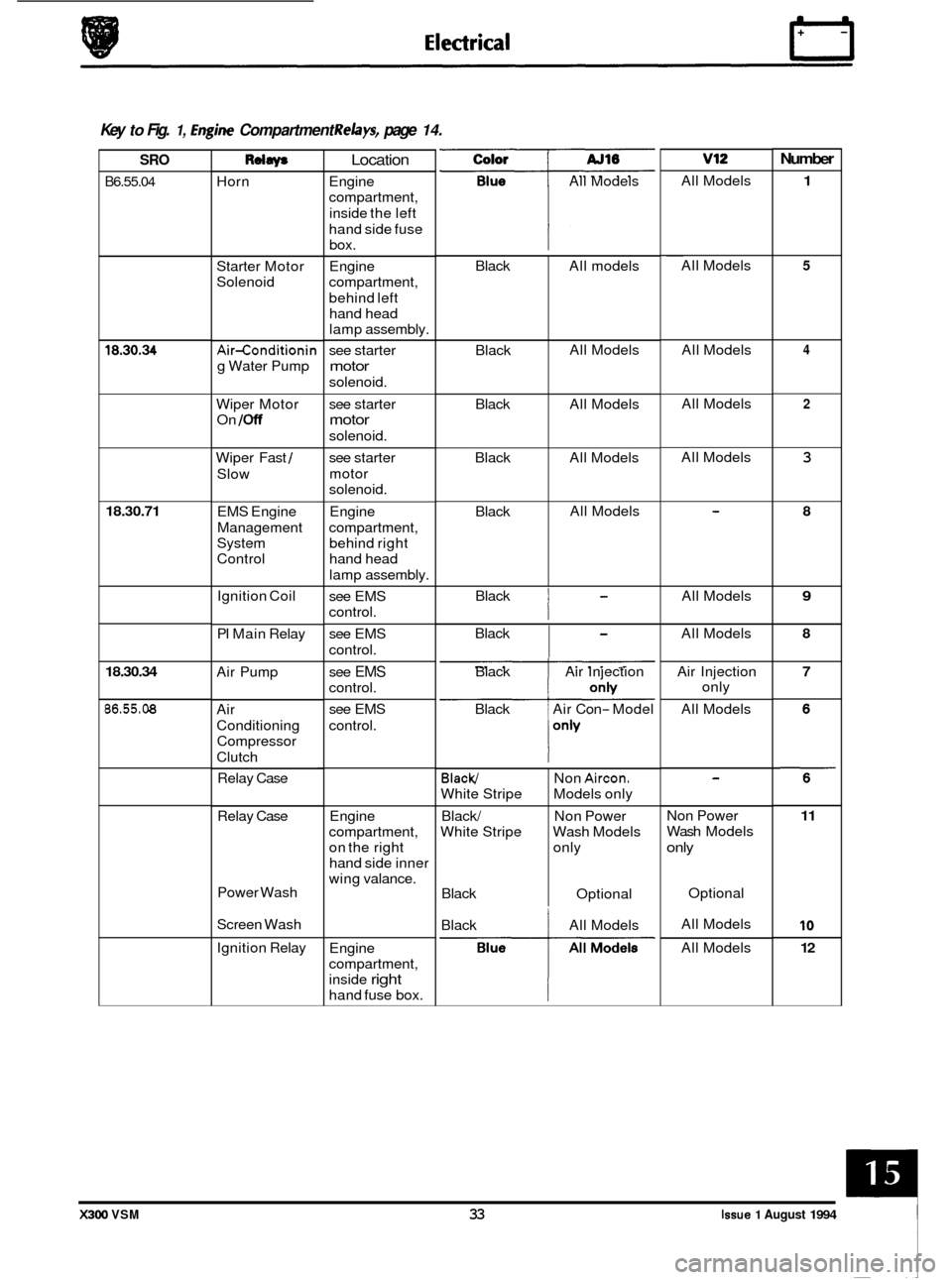
0 Key to Fig. 1, hgine Compartment Relays, page 14.
Number v12 Color
All Models
SRO
B6.55.04
Rdaw
Horn
Location
Engine
compartment,
inside the left
hand side fuse box.
Engine
compartment,
behind left hand head
lamp assembly.
see starter
motor
solenoid. All
Models
1 ~~
All
Models 5 Starter Motor
Solenoid
4 All Models
All Models 18.30.34 Air-conditionin
g Water Pump
Wiper Motor
On
/Off
2 see starter
motor
solenoid.
see starter
motor
solenoid. All
Models
3 Wiper Fast /
Slow
18.30.71 Engine
compartment, behind right
hand head
lamp assembly. 8 EMS Engine
Management
System
Control
Black
I
All Models 9 Ignition Coil
PI Main Relay see
EMS
control.
see EMS
control. Black
I
All
Models 8
Air Pump 7 see EMS
control.
see EMS
control. Black
Air Injection
Black Air Con
- Model Air
Injection
only
All Models
18.30.34
86.55.08 Air
Conditioning
Compressor
Clutch
Relay Case
Engine
compartment,
on the right
hand side inner
wing valance.
Relay
Case Non Power
Wash
Models
only
11
10
12
Power Wash
Screen Wash Optional
All Models
All Models
Black
All Models
Ignition Relay
Engine
compartment,
inside
right
hand fuse box.
X300 VSM 33 Issue 1 August 1994