automatic transmission JAGUAR XJ6 1994 2.G Repair Manual
[x] Cancel search | Manufacturer: JAGUAR, Model Year: 1994, Model line: XJ6, Model: JAGUAR XJ6 1994 2.GPages: 521, PDF Size: 17.35 MB
Page 176 of 521
Pamrtrain Automatic Transmission (V12 & AJl6 Supercharged)
8.2.20
SRO 44.24.21 INTERNAL
L UBRICATION PIPE, RENEW
(4,OL SC AND 6,011
. Open
the hood and fit a suitable fender cover.
. Raise the vehicle on a ramp.
Drain the transmission lubrication system, see
Sub-sec- tion 8.2.13.
. Remove the fluid pan, see Subsection 8.2.14 (4,OL SC) or Sub-section 8.2.15 (6,OL).
Release and remove the internal lubrication pipe retainer to valve body securing bolt.
. Remove the lubrication pipe retainer.
. Release and remove the lubrication pipe clamp to valve
. Remove the lubrication pipe clamp.
. Displace and remove the lubrication pipe from the trans-
. Drain any residualfluidfromthe lubrication pipe and place
. Clean the relevant parts.
0 Fitandfullyseata newlubricationpipetothetransmission
body securing nut.
mission unit.
the pipe aside.
unit.
. Fit the lubrication pipe clamp.
. Fit and tighten the lubrication pipeclamptovalve bodyse-
. Fit the lubrication pipe retainer.
. Refit the fluid pan, see Sub-section 8.2.14 (4,OL SC) or
. Lower the vehicle on the ramp.
Refill the transmission unit with fluid, see Sub-section
8.2.13.
9 Remove the fender cover and close the hood.
curing
bolt.
Subsection
8.2.15 (6,OL).
X300 VSM Issue 1 August 1994
Page 178 of 521
Pomrtrain Automatic Transmission (V12 & AJ16 Supercharged)
8.2.22 MANUAL DETENT SPRING, RENEW
SRO 44.26.10
9 Open the hood and fit a suitable fender cover.
. Raise the vehicle on a ramp.
. Drain the transmission lubrication system, see Sub-sec-
. Remove the fluid pan, see Subsection 8.2.14 (4,OL SC) or
. Remove the fluid filter, see Subsection 8.2.18.
. Select 'P (Park) and ensure that the pawl is engaged.
Release and remove the manual valve detent spring and
Remove the detent spring assembly and place aside.
. Clean the relevant parts.
Fit a new detent spring assembly to the valve body.
Fit but do not fully tighten the detent spring assembly to
the valve body securing bolts.
. Align the detent spring tocentralize the roller with the det- ent lever in the 'P' (Park) position.
. Check that in 'N' (Neutral), the shift lever is properly in
position. It is essential that the detent spring within the
transmission unit dictates to the shift lever and not the
other way around.
Finally tighten the detent spring assembly to valve body
securing bo
I ts .
(4,OL SC AND 6,011
tion 8.2.13.
Sub
-section 8.2.15 (6,OL).
roller assembly to valve body securing bolts.
. Refit the fluid filter, see Subsection 8.2.18.
Refit the fluid pan, see Subsection 8.2.14 (4,OL SC) or
. Lower the vehicle on the ramp.
. Refill the transmission unit with fluid, see Subsection 8.2.13.
. Remove the fender cover and close the hood.
Sub
-section
8.2.15 (6,OL).
X300 VSM 23 Issue 1 August 1994
Page 216 of 521
may include:
0
0
Loose or worn wheel bearings.
Loose or worn suspensions or steering components.
0 Worn or damaged drive shaft slip yoke joint.
0 Front disc rotor runout.
o Loose engine or transmission supports.
0 Driveline alignment.
0 Engine driven accessories.
Suspension Systems
11.4 DIAGNOSIS AND TESTING
' 11.4.1 Tire Wear
Tires should be inspected as abnormal or excessive wear may becaused by incorrect wheel alignment, wheelbire im- balance, or incorrect tire pressure.
1 1.4.2 vibration and Roughness
Vibration, roughness, and shimmy conditions may be caused by excessive tire or wheel runout, worn or cupped tires,
or wheel and tire unbalance.
Most of these conditions are due to irregularities in the road surface, hence driving the vehicle on different types of
road surface will often indicate the cause of the condition.
Do not automatically suspect the tires when attempting to diagnose a vibration concern as other sources of vibration
Before investigating any other vibration concerns,
a roaG &est and a customer inter\,.dw (if possible) should be carried
out. This can provide much of the information needed to find the source of vibration.
Drive the vehicle on a road that is preferably smooth and free of undulation and
if vibration is apparent note, the speed at which thevibration occurs, whattype of vibration occurs in each speed range (mechanical or audible), howthevibra- tion is affected by changes in vehicle speed , engine speed and engine torque, and the type of vibration sensitivity
(torque sensitive, vehicle speed sensitive, or speed sensitive).
Some of the condition terms used when describing sources of vibration are explained as follows:
0 Torque Sensitive
This condition can be improved or worsened by accelerating, decelerating, coasting, maintaining
a steady
vehicle speed and application of engine torque.
0 Vehicle Speed Sensitive
This means that the vibration always occurs at the same vehicle speed and is not affected by engine torque,
engine rpm, or transmission gear selection.
B
0 Engine Speed Sensitive
This means that the vibration occurs
at varying vehicle speeds when a different transmission gear is selected.
It can sometimes be isolated by increasing or decreasing engine speed with the transmission in 'NEUTRAL', or
by stall testing with the engine in gear. If the condition is enginesensitive, the condition is not related to tires.
If the road tests indicates that the vibration is related to the tires or wheels,use a 'lire Wear Diagnosis Chart' to
investigate the cause of concern. Should the road test indicate that there is tire whine, but noshake or vibration,
the noise originates from the contact between the tire and the road surface.
X300 VSM 3 Issue 1 August 1994
Page 238 of 521
Brakes
The pressure at the inlet valves corresponds to the opening pressure of the relief valve (item 15) incorporated in the
isolation valve. Excess brake fluid is drained to the suction side of the pump via the relief valve and returns either to
the TMC secondary circuit and on to the
fluid reservoir, or is directly drawn on by the pump.
As soon as the spinning wheel has been braked down into the normal range of wheel spin, the NO valves (items
16 or 17) close to prevent any further increase in brake pressure. Depending upon the acceleration of the wheel, the NC
valve (item
20 or 21) may open to decrease thesecondary circuit brake pressure. NCvalves (item 17 or 18) may remain
closed in orderto achieve a brake pressure holding phase. If the pressure in the secondarycircuit needs to be increased
again, the NC valve closes again (if open) and the NO valve opens, diverting the necessary volume flow. This control
action, keeps the wheel in the range of optimum slip until the spinning tendency ceases.
The NO isolation valve
(14) remains closed throughout the traction control cycle.
An actuation of the brake, sensed by the control module, causes the traction control mode to be terminated and the
isolation valve (item
14) to be opened. The TMC pressure simultaneously closes the hydraulic inlet valve (item 13) so that the pump can no longer draw fluid from it. The ABS / TC CM now operates in normal ABS mode.
m: When traction control is initiated, speed control is deactivated (if in operation) and requires re-setting after
the traction control mode has terminated. Gear shift is inhibited on automatic transmission vehicles; no down- shifts are allowed and upshifts occur at 4800 RPM.
X300 VSM 15 Issue 1 August 1994
Page 382 of 521
Snecif icat ion W -I- ..........
e
0
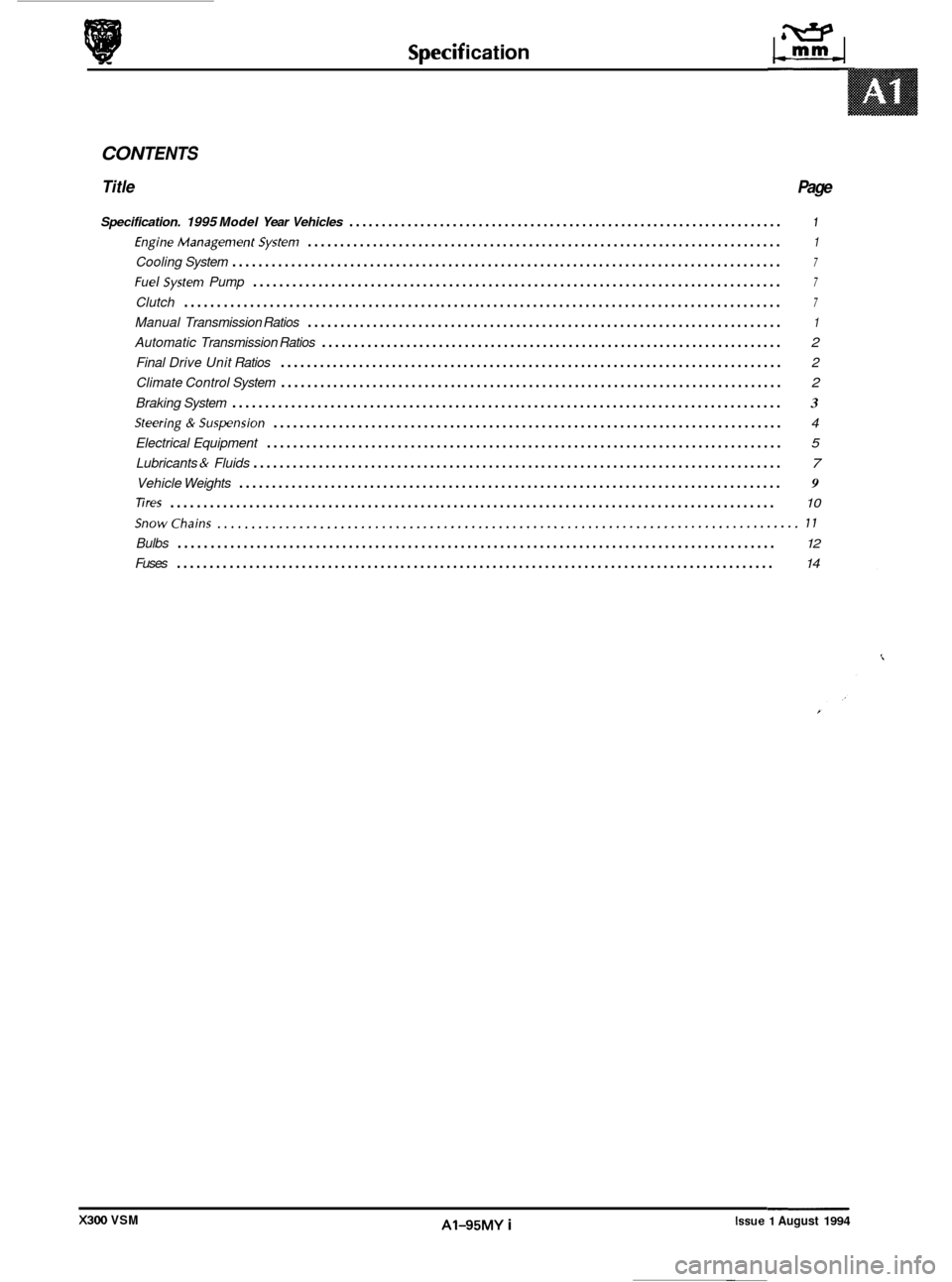
CON TENTS
Title Page
Specification. 1995 Model Year Vehicles ................................................................... 1
EngineManagementSystem ........................................................................\
. 1
Cooling System ........................................................................\
............ 7
Fuelsystem Pump ........................................................................\
......... 7
Clutch ........................................................................\
................... 7
Manual Transmission Ratios ........................................................................\
. 1
Automatic Transmission Ratios ....................................................................... \
2
Final Drive Unit Ratios ........................................................................\
..... 2
Climate Control System ........................................................................\
..... 2
Braking System ........................................................................\
............ 3
Steering&Suspension ........................................................................\
...... 4
Electrical Equipment ........................................................................\
....... 5
Lubricants & Fluids ........................................................................\
......... 7
Vehicle Weights ........................................................................\
........... 9
Tires ........................................................................\
.................... 10
Snowchains ........................................................................\
............. 17
Bulbs ........................................................................\
................... 12
Fuses ........................................................................\
................... 14
Issue 1 August 1994 AI-95MY i X300 VSM
Page 385 of 521

Specification
W
. fmmJ
Automatic Transmission Ratios (ZF)
First .............................................................. 2. 48. 1
Second ............................................................ 1. 48.1
Third
.............................................................. 1. 00. 1
Fourth ............................................................. 0. 73.1
Reverse
........................................................... 2.09:l
Automatic Transmission Ratios (Powertrain)
First ............................................................. 2. 482. 1
Second ........................................................... 1. 482. 1
Third ............................................................ 1. 000. 1
Fourth ........................................................... 0. 750.1
Reverse
......................................................... 2. 077 : 1
Final Drive Unit Ratios
3.2 liter Manual .................................................... 3. 77:1
3.2 liter Automatic
.................................................. 4. 08:1
4.0 liter Automatic
.................................................. 3. 54:1
4.0 liter Manual
.................................................... 3. 54:1
4.0 liter Supercharged
.............................................. 3. 27:1
6.0 liter ........................................................... 3. 54:1
Climate Control (air condit;oning) System
Compressor ....................................................... Nippondenso 1OPA17C
Compressor lubricant .............................................. ND Oil 8
Refrigerant ........................................................ R134A
Refrigerant Charge Weight .......................................... 1100g
X300 VSM Issue 1 August 1994 A1-95MY 2
Page 399 of 521
Specification
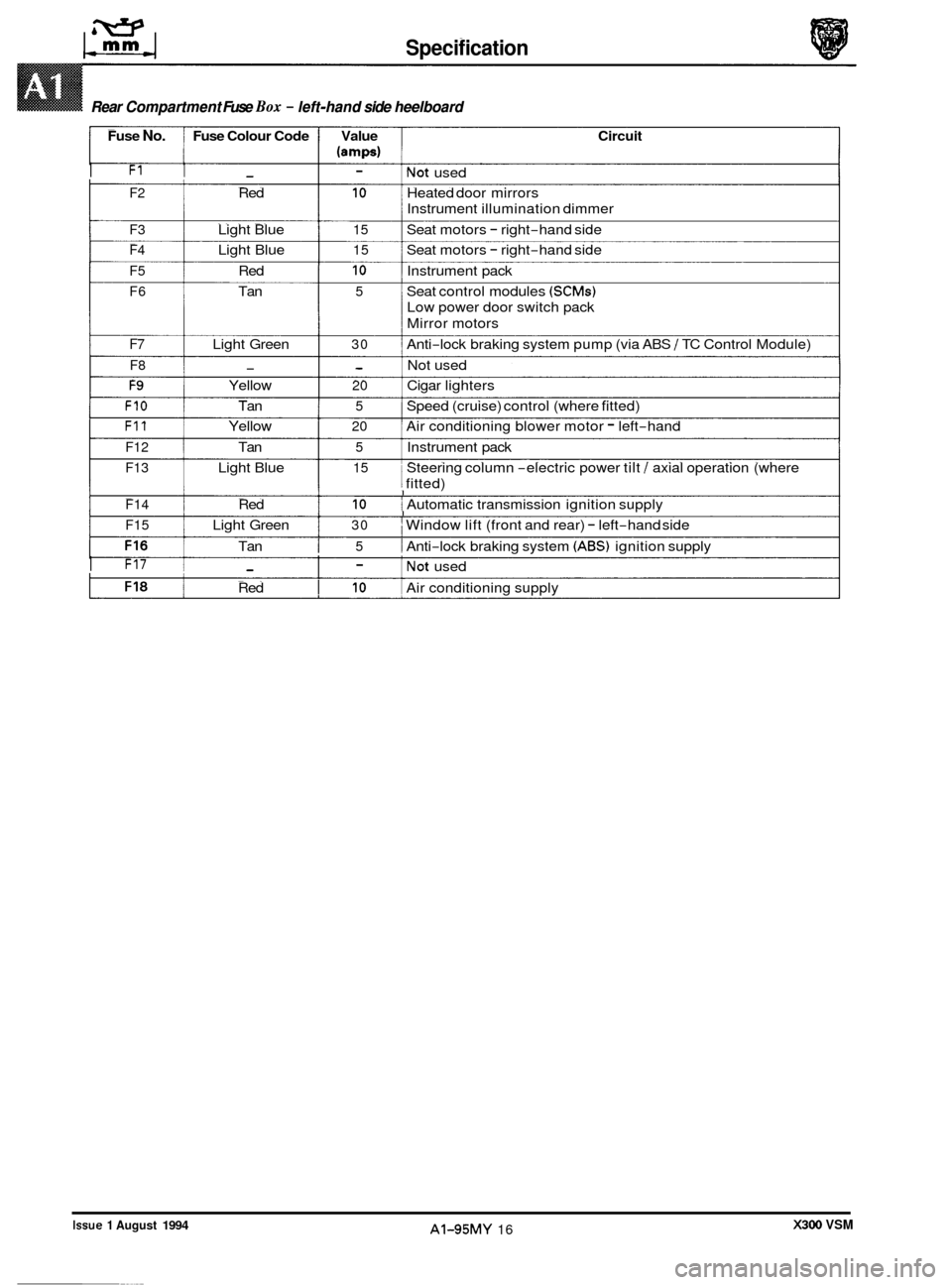
Rear Compartment Fuse Box - left-hand side heelboard
Fuse No. Fuse Colour Code Value Circuit
(amps)
I F1 I - I - lNot used
F2 Red 10 Heated door mirrors
F3 Light Blue 15 Seat motors - right-hand side
F4 Light Blue 15 Seat motors - right-hand side
F5 Red 10 Instrument pack
F6 Tan 5 Seat control modules (SCMs)
Low power door switch pack
Mirror motors
Instrument
illumination dimmer
F7 Light Green 30 Anti-lock braking system pump (via ABS / TC Control Module)
F8 - - Not used
F9 Yellow 20 Cigar lighters
FIO Tan 5 Speed (cruise) control (where fitted)
F11 Yellow 20 Air conditioning blower motor - left-hand
F12 Tan 5 Instrument pack
F13 Light Blue 15 Steering column -electric power tilt / axial operation (where
j fitted) 1 I I F14 Red 10 i Automatic transmission ignition supply I I I F15 Light Green 30 I Window lift (front and rear) - left-hand side
Tan
I 5 1 Anti-lock braking system (ABS) ignition supply
I F17 1 - I - lNot used
Red
I 10 I Air conditioning supply
Rear Compartment Fuse Box - left-hand side heelboard ~~
X300 VSM Issue 1 August 1994 AI-95MY 16
0
0
0
Page 400 of 521
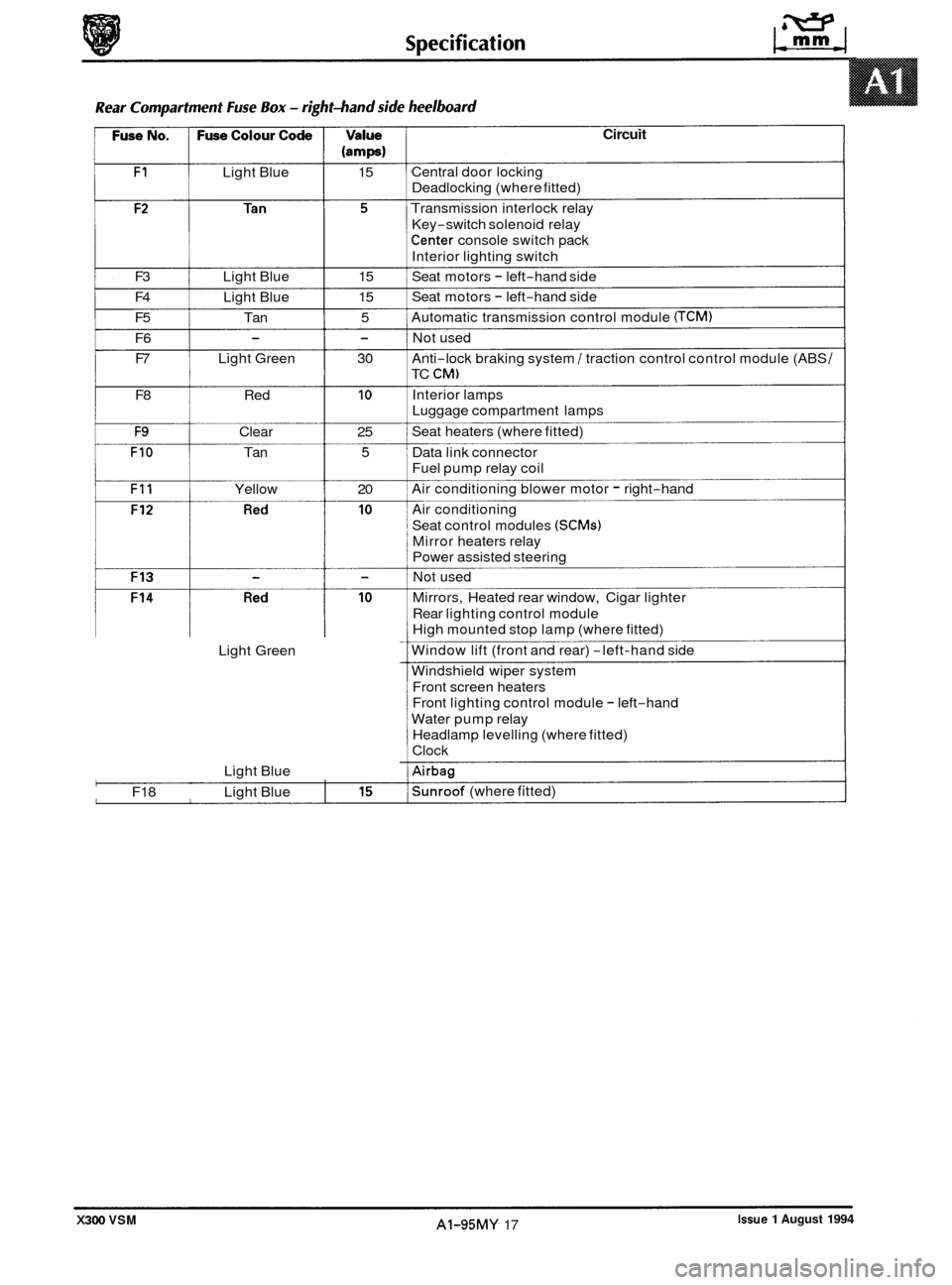
(amps)
F1 Light Blue 15
F3 Light Blue 15
F4 Light Blue 15
F5 Tan 5
F6 F7 Light Green 30
- -
F8 Red 10
F9 Clear 25
FIO Tan 5
F11 Yellow 20 0
Light Green
Light Blue
F18 Light Blue
0'
I
Circuit
Central door locking
Deadlocking (where fitted)
Transmission interlock relay
Key
-switch solenoid relay
Center console switch pack
Interior lighting switch
Seat motors
- left-hand side
Seat motors
- left-hand side
Automatic transmission control module
(TCM)
Not used
Anti
-lock braking system / traction control control module (ABS /
TC CM)
Interior lamps
Luggage compartment lamps
Seat heaters (where fitted)
Data link connector
Fuel pump relay coil
Air conditioning blower motor
- right-hand
Air conditioning
Seat control modules
(SCMs)
Mirror heaters relay
Power assisted steering
Not used
Mirrors, Heated rear window, Cigar lighter
Rear lighting control module
High mounted stop lamp (where fitted)
Window lift (front and rear)
-left-hand side
Windshield wiper system Front screen heaters
Front lighting control module
- left-hand
Water pump relay
Headlamp levelling (where fitted)
Clock
Airbag
Sunroof (where fitted)
Issue 1 August 1994 AI-95MY 17 X300 VSM
Page 408 of 521
j
8
9
10
13 I
18
19
23
24
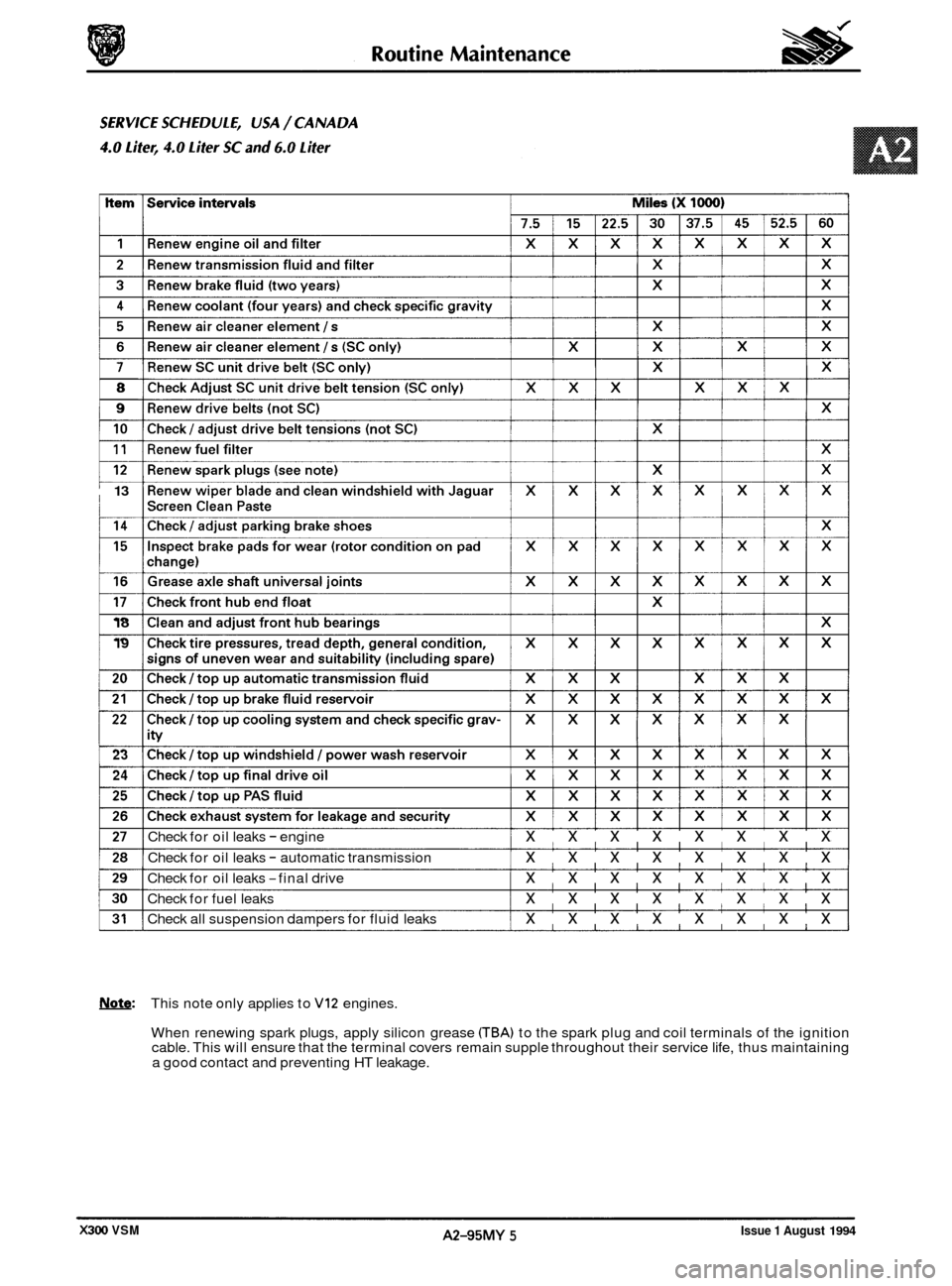
Check for oil leaks - engine xxxxxxxx
Check for oil leaks - automatic transmission xxxxxxxx
Check for oil leaks -final drive xxxxxxxx
Check for fuel leaks xxxxxxxx
Check all suspension dampers for fluid leaks xxxxxxxx
Note: This note only applies to VI2 engines.
When renewing spark plugs, apply silicon grease
CTBA) to the spark plug and coil terminals of the ignition
cable. This will ensure that the terminal covers remain supple throughout their service life, thus maintaining
a good contact and preventing HT leakage.
Issue 1 August 1994 A2-95MY 5 X300 VSM