bulb JAGUAR XJ6 1997 2.G User Guide
[x] Cancel search | Manufacturer: JAGUAR, Model Year: 1997, Model line: XJ6, Model: JAGUAR XJ6 1997 2.GPages: 227, PDF Size: 7.2 MB
Page 172 of 227
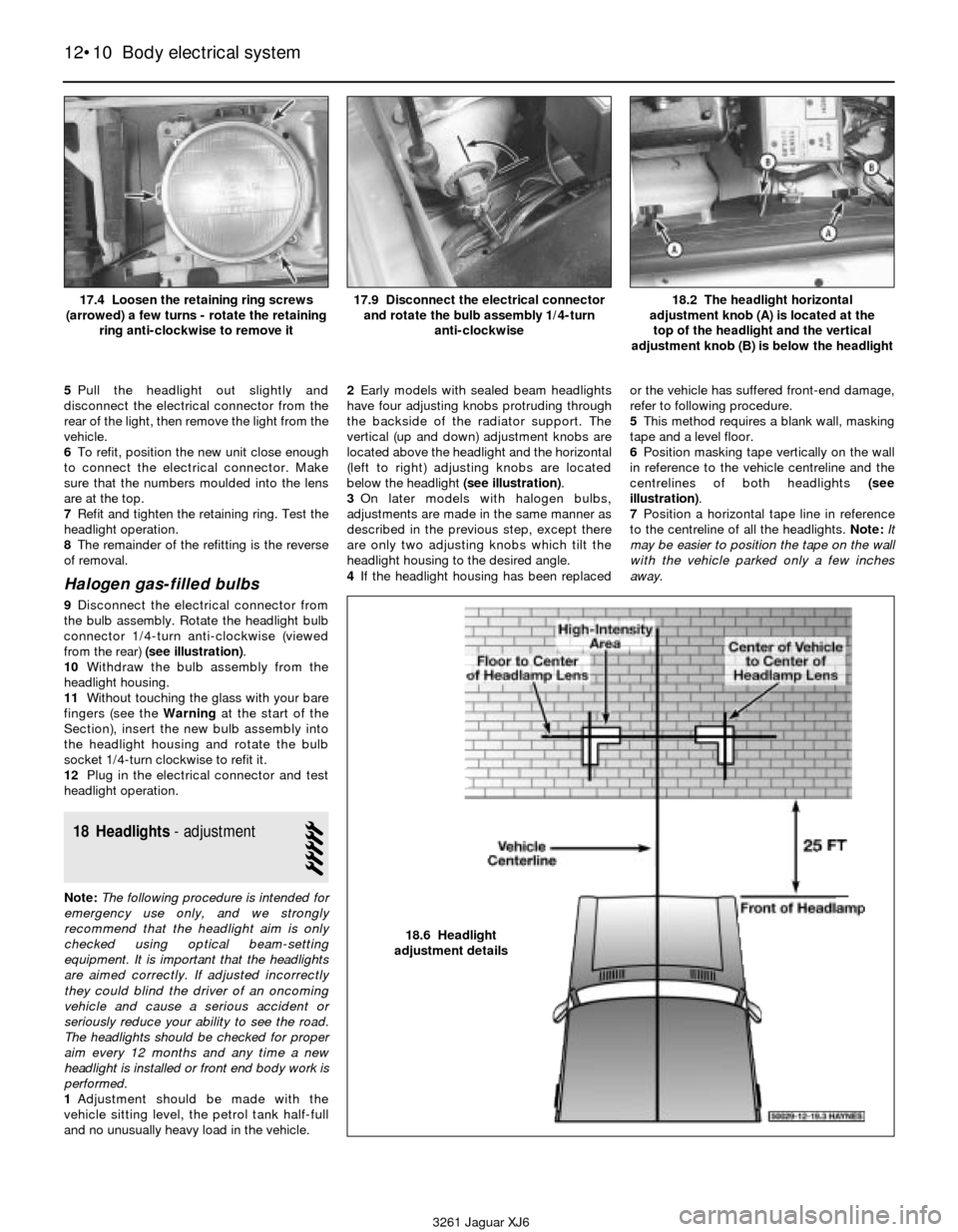
5Pull the headlight out slightly and
disconnect the electrical connector from the
rear of the light, then remove the light from the
vehicle.
6To refit, position the new unit close enough
to connect the electrical connector. Make
sure that the numbers moulded into the lens
are at the top.
7Refit and tighten the retaining ring. Test the
headlight operation.
8The remainder of the refitting is the reverse
of removal.
Halogen gas-filled bulbs
9Disconnect the electrical connector from
the bulb assembly. Rotate the headlight bulb
connector 1/4-turn anti-clockwise (viewed
from the rear) (see illustration).
10Withdraw the bulb assembly from the
headlight housing.
11Without touching the glass with your bare
fingers (see the Warningat the start of the
Section), insert the new bulb assembly into
the headlight housing and rotate the bulb
socket 1/4-turn clockwise to refit it.
12Plug in the electrical connector and test
headlight operation.
18 Headlights- adjustment
5
Note:The following procedure is intended for
emergency use only, and we strongly
recommend that the headlight aim is only
checked using optical beam-setting
equipment. It is important that the headlights
are aimed correctly. If adjusted incorrectly
they could blind the driver of an oncoming
vehicle and cause a serious accident or
seriously reduce your ability to see the road.
The headlights should be checked for proper
aim every 12 months and any time a new
headlight is installed or front end body work is
performed.
1Adjustment should be made with the
vehicle sitting level, the petrol tank half-full
and no unusually heavy load in the vehicle.2Early models with sealed beam headlights
have four adjusting knobs protruding through
the backside of the radiator support. The
vertical (up and down) adjustment knobs are
located above the headlight and the horizontal
(left to right) adjusting knobs are located
below the headlight (see illustration).
3On later models with halogen bulbs,
adjustments are made in the same manner as
described in the previous step, except there
are only two adjusting knobs which tilt the
headlight housing to the desired angle.
4If the headlight housing has been replacedor the vehicle has suffered front-end damage,
refer to following procedure.
5This method requires a blank wall, masking
tape and a level floor.
6Position masking tape vertically on the wall
in reference to the vehicle centreline and the
centrelines of both headlights (see
illustration).
7Position a horizontal tape line in reference
to the centreline of all the headlights. Note:It
may be easier to position the tape on the wall
with the vehicle parked only a few inches
away.
12•10 Body electrical system
3261 Jaguar XJ618.2 The headlight horizontal
adjustment knob (A) is located at the
top of the headlight and the vertical
adjustment knob (B) is below the headlight
17.4 Loosen the retaining ring screws
(arrowed) a few turns - rotate the retaining
ring anti-clockwise to remove it17.9 Disconnect the electrical connector
and rotate the bulb assembly 1/4-turn
anti-clockwise
18.6 Headlight
adjustment details
Page 173 of 227
8Adjustment should be made with the
vehicle parked 25 feet from the wall, sitting
level, the petrol tank half-full and no unusually
heavy load in the vehicle.
9Starting with the low beam adjustment,
position the high intensity zone so it is two
inches below the horizontal line and two
inches to the right of the headlight vertical
line. Adjustments are made by turning the
knobs located behind the headlight housings
(see illustration 18.2).
10With the high beams on, the high intensity
zone should be vertically centred with the
exact centre just below the horizontal line.
Note:It may not be possible to position the
headlight aim exactly for both high and low
beams. If a compromise must be made, keep
in mind that the low beams are the most used
and have the greatest effect on safety.
11Have the headlights adjusted by a dealer
service department or service station at the
earliest opportunity.
19 Headlight housing
(1992 to 1994 models)-
removal and refitting
1
Warning: These vehicles are
equipped with halogen gas-filled
headlight bulbs which are under
pressure and may shatter if the
surface is damaged or the bulb is dropped.
Wear eye protection and handle the bulbs
carefully, grasping only the base whenever
possible. Do not touch the surface of the
bulb with your fingers because the oil from
your skin could cause it to overheat and
fail prematurely. If you do touch the bulb
surface, clean it with rubbing alcohol.
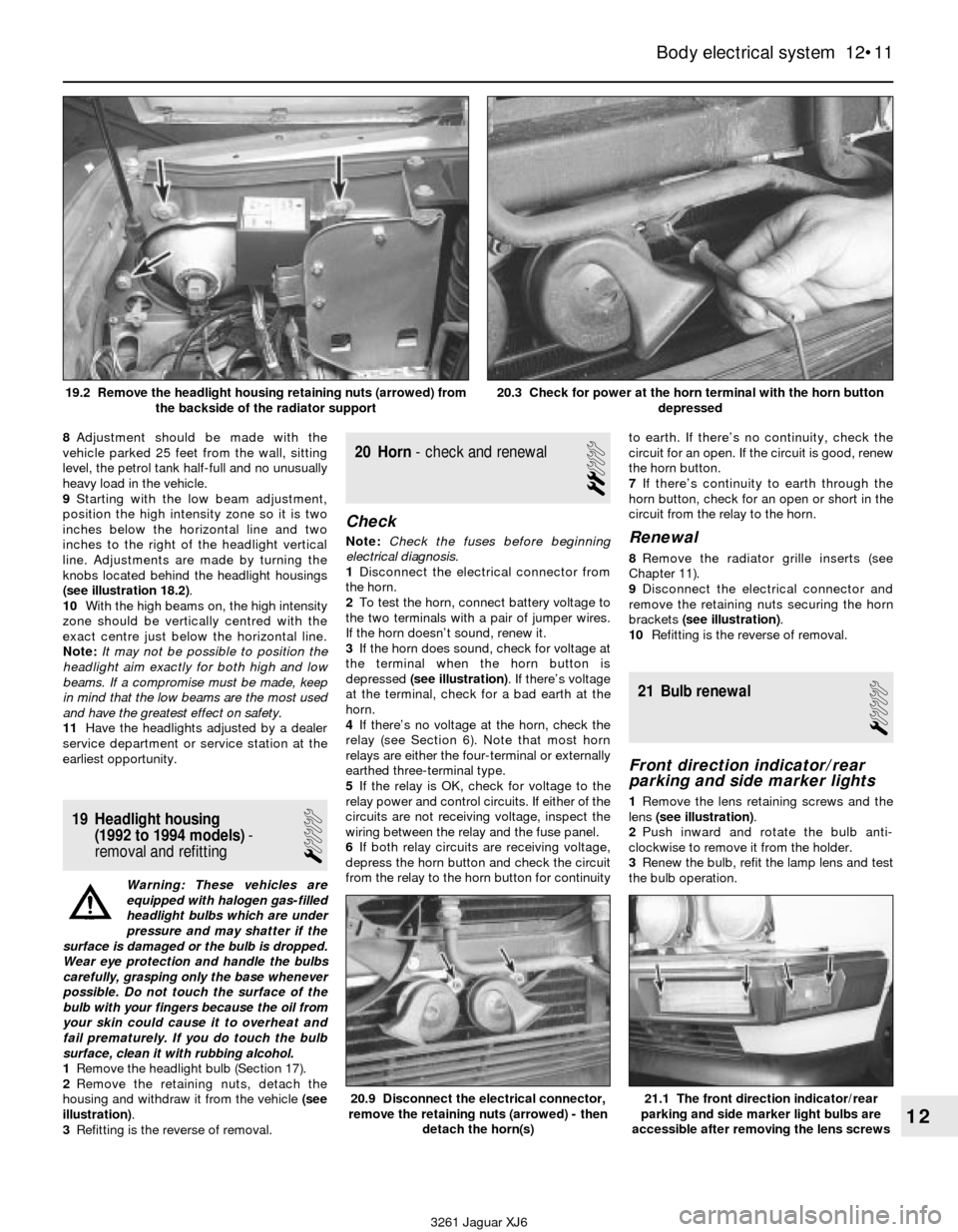
1Remove the headlight bulb (Section 17).
2Remove the retaining nuts, detach the
housing and withdraw it from the vehicle (see
illustration).
3Refitting is the reverse of removal.
20 Horn- check and renewal
2
Check
Note:Check the fuses before beginning
electrical diagnosis.
1Disconnect the electrical connector from
the horn.
2To test the horn, connect battery voltage to
the two terminals with a pair of jumper wires.
If the horn doesn’t sound, renew it.
3If the horn does sound, check for voltage at
the terminal when the horn button is
depressed (see illustration). If there’s voltage
at the terminal, check for a bad earth at the
horn.
4If there’s no voltage at the horn, check the
relay (see Section 6). Note that most horn
relays are either the four-terminal or externally
earthed three-terminal type.
5If the relay is OK, check for voltage to the
relay power and control circuits. If either of the
circuits are not receiving voltage, inspect the
wiring between the relay and the fuse panel.
6If both relay circuits are receiving voltage,
depress the horn button and check the circuit
from the relay to the horn button for continuityto earth. If there’s no continuity, check the
circuit for an open. If the circuit is good, renew
the horn button.
7If there’s continuity to earth through the
horn button, check for an open or short in the
circuit from the relay to the horn.Renewal
8Remove the radiator grille inserts (see
Chapter 11).
9Disconnect the electrical connector and
remove the retaining nuts securing the horn
brackets (see illustration).
10Refitting is the reverse of removal.
21 Bulb renewal
1
Front direction indicator/rear
parking and side marker lights
1Remove the lens retaining screws and the
lens (see illustration).
2Push inward and rotate the bulb anti-
clockwise to remove it from the holder.
3Renew the bulb, refit the lamp lens and test
the bulb operation.
Body electrical system 12•11
12
20.9 Disconnect the electrical connector,
remove the retaining nuts (arrowed) - then
detach the horn(s)21.1 The front direction indicator/rear
parking and side marker light bulbs are
accessible after removing the lens screws
3261 Jaguar XJ6 19.2 Remove the headlight housing retaining nuts (arrowed) from
the backside of the radiator support
20.3 Check for power at the horn terminal with the horn button
depressed
Page 174 of 227
Rear direction indicator,
brake, tail and reversing lights
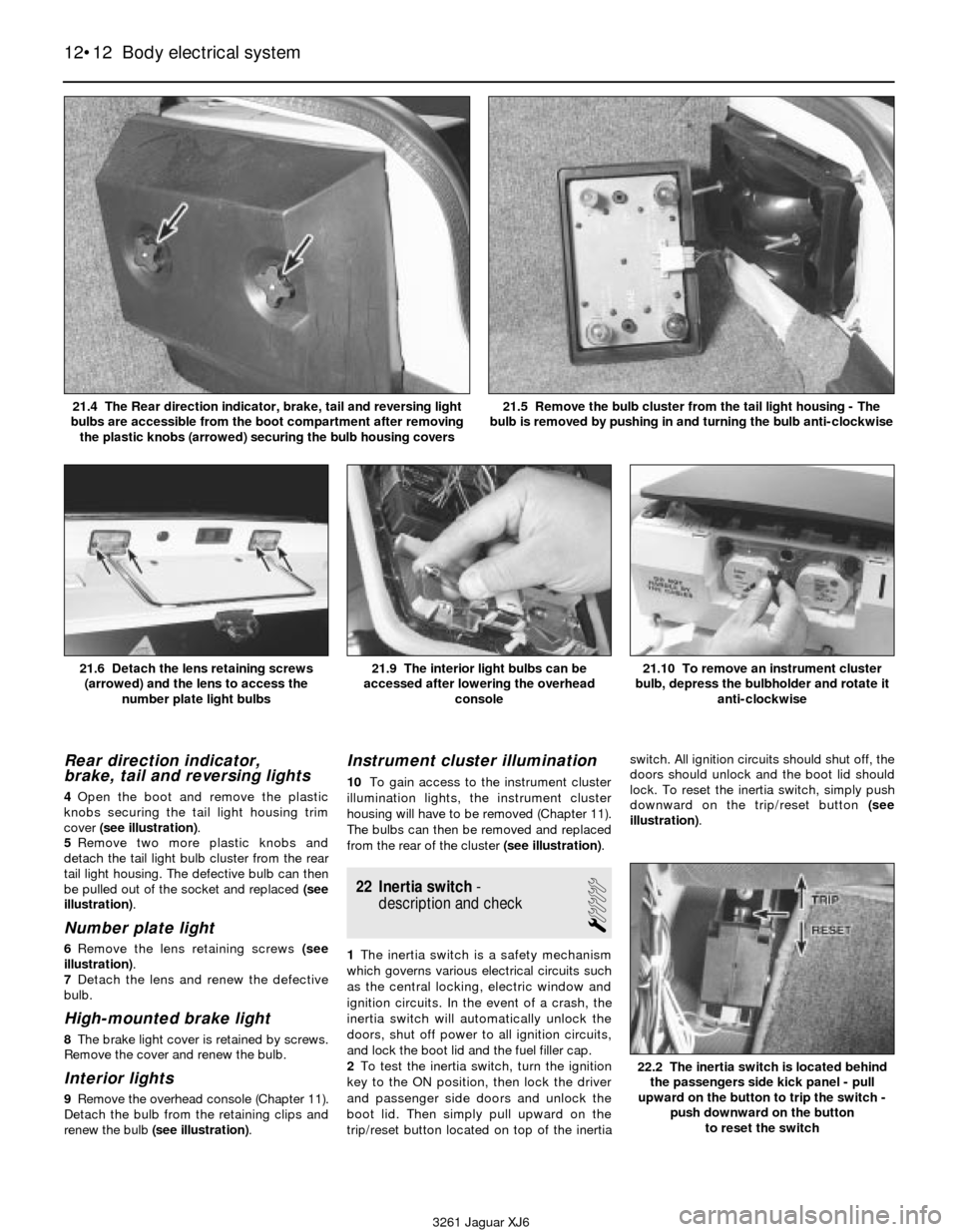
4Open the boot and remove the plastic
knobs securing the tail light housing trim
cover (see illustration).
5Remove two more plastic knobs and
detach the tail light bulb cluster from the rear
tail light housing. The defective bulb can then
be pulled out of the socket and replaced (see
illustration).
Number plate light
6Remove the lens retaining screws (see
illustration).
7Detach the lens and renew the defective
bulb.
High-mounted brake light
8The brake light cover is retained by screws.
Remove the cover and renew the bulb.
Interior lights
9Remove the overhead console (Chapter 11).
Detach the bulb from the retaining clips and
renew the bulb (see illustration).
Instrument cluster illumination
10To gain access to the instrument cluster
illumination lights, the instrument cluster
housing will have to be removed (Chapter 11).
The bulbs can then be removed and replaced
from the rear of the cluster (see illustration).
22 Inertia switch-
description and check
1
1The inertia switch is a safety mechanism
which governs various electrical circuits such
as the central locking, electric window and
ignition circuits. In the event of a crash, the
inertia switch will automatically unlock the
doors, shut off power to all ignition circuits,
and lock the boot lid and the fuel filler cap.
2To test the inertia switch, turn the ignition
key to the ON position, then lock the driver
and passenger side doors and unlock the
boot lid. Then simply pull upward on the
trip/reset button located on top of the inertiaswitch. All ignition circuits should shut off, the
doors should unlock and the boot lid should
lock. To reset the inertia switch, simply push
downward on the trip/reset button (see
illustration).
12•12 Body electrical system
21.6 Detach the lens retaining screws
(arrowed) and the lens to access the
number plate light bulbs21.9 The interior light bulbs can be
accessed after lowering the overhead
console21.10 To remove an instrument cluster
bulb, depress the bulbholder and rotate it
anti-clockwise
3261 Jaguar XJ6 21.4 The Rear direction indicator, brake, tail and reversing light
bulbs are accessible from the boot compartment after removing
the plastic knobs (arrowed) securing the bulb housing covers
21.5 Remove the bulb cluster from the tail light housing - The
bulb is removed by pushing in and turning the bulb anti-clockwise
22.2 The inertia switch is located behind
the passengers side kick panel - pull
upward on the button to trip the switch -
push downward on the button
to reset the switch
Page 205 of 227
3261 Jaguar XJ6
REF•4Buying spare parts
Spare parts are available from many
sources, including maker’s appointed
garages, accessory shops, and motor factors.
To be sure of obtaining the correct parts, it
will sometimes be necessary to quote the
vehicle identification number. If possible, it
can also be useful to take the old parts along
for positive identification. Items such as
starter motors and alternators may be
available under a service exchange scheme -
any parts returned should be clean.
Our advice regarding spare parts is as
follows.
Officially appointed garages
This is the best source of parts which are
peculiar to your car, and which are not
otherwise generally available (eg, badges,
interior trim, certain body panels, etc). It is
also the only place at which you should buy
parts if the vehicle is still under warranty.
Accessory shops
These are very good places to buy
materials and components needed for themaintenance of your car (oil, air and fuel
filters, light bulbs, drivebelts, greases, brake
pads, touch-up paint, etc). Components of
this nature sold by a reputable shop are
usually of the same standard as those used
by the car manufacturer.
Besides components, these shops also sell
tools and general accessories, usually have
convenient opening hours, charge lower
prices, and can often be found close to home.
Some accessory shops have parts counters
where components needed for almost any
repair job can be purchased or ordered.
Motor factors
Good factors will stock all the more
important components which wear out
comparatively quickly, and can sometimes
supply individual components needed for the
overhaul of a larger assembly (eg, brake seals
and hydraulic parts, bearing shells, pistons,
valves). They may also handle work such as
cylinder block reboring, crankshaft regrinding,
etc.
Tyre and exhaust specialists
These outlets may be independent, or
members of a local or national chain. They
frequently offer competitive prices when
compared with a main dealer or local garage,
but it will pay to obtain several quotes before
making a decision. When researching prices,
also ask what “extras” may be added - for
instance fitting a new valve and balancing the
wheel are both commonly charged on top of
the price of a new tyre.
Other sources
Beware of parts or materials obtained from
market stalls, car boot sales or similar outlets.
Such items are not invariably sub-standard,
but there is little chance of compensation if
they do prove unsatisfactory. In the case of
safety-critical components such as brake
pads, there is the risk of financial loss, and
also of an accident causing injury or death.
Second-hand parts or assemblies obtained
from a car breaker can be a good buy in some
circumstances, but this sort of purchase is
best made by the experienced DIY mechanic.
Vehicle identification
Modifications are a continuing and
unpublicised process in vehicle manufacture,
quite apart from major model changes. Spare
parts manuals and lists are compiled upon a
numerical basis, the individual vehicle
identification numbers being essential to
correct identification of the part concerned.
When ordering spare parts, always give as
much information as possible. Quote the car
model, year of manufacture and registration,
chassis and engine numbers as appropriate.
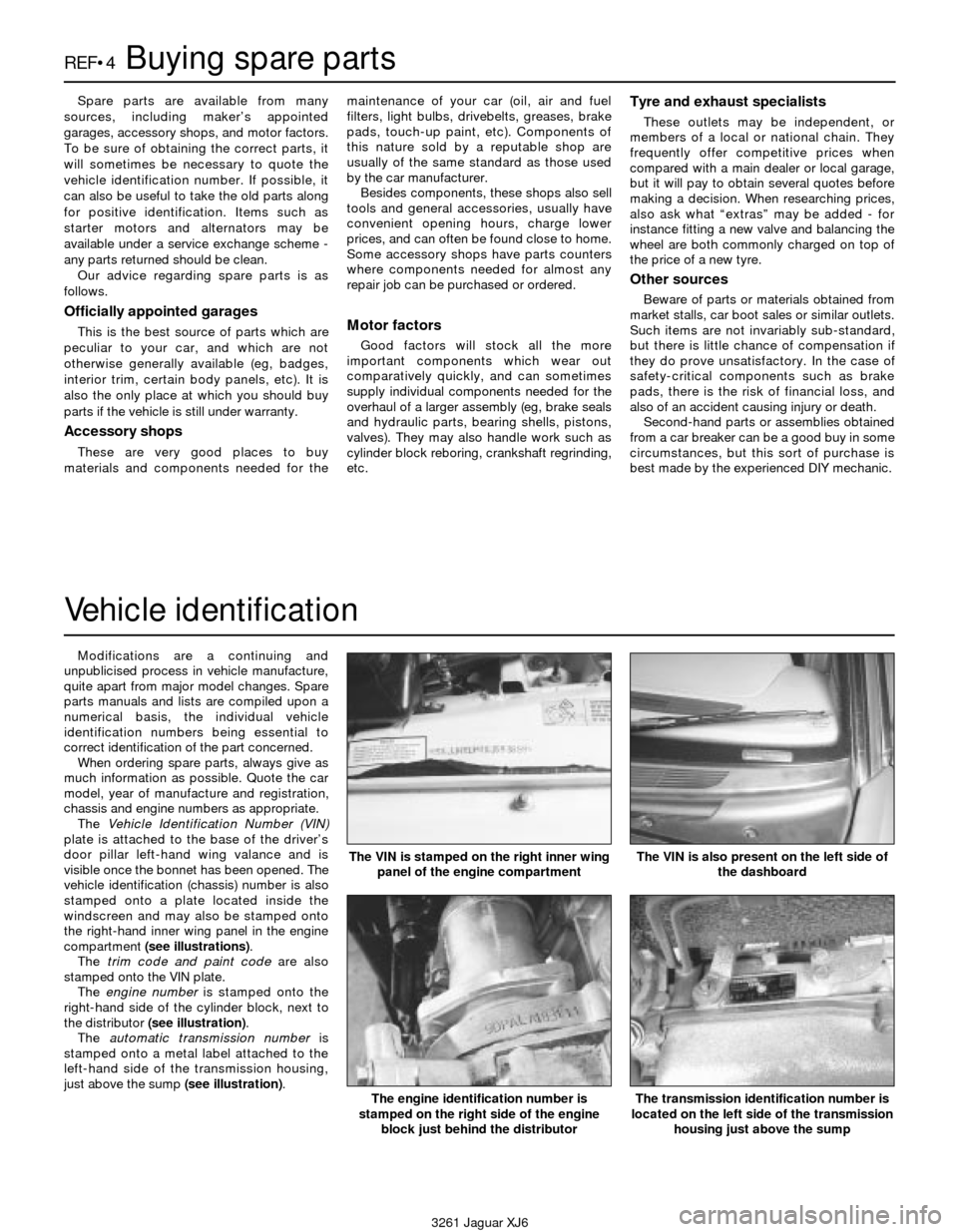
The Vehicle Identification Number (VIN)
plate is attached to the base of the driver’s
door pillar left-hand wing valance and is
visible once the bonnet has been opened. The
vehicle identification (chassis) number is also
stamped onto a plate located inside the
windscreen and may also be stamped onto
the right-hand inner wing panel in the engine
compartment (see illustrations).
The trim code and paint codeare also
stamped onto the VIN plate.
The engine numberis stamped onto the
right-hand side of the cylinder block, next to
the distributor (see illustration).
The automatic transmission numberis
stamped onto a metal label attached to the
left-hand side of the transmission housing,
just above the sump (see illustration).The VIN is stamped on the right inner wing
panel of the engine compartment
The engine identification number is
stamped on the right side of the engine
block just behind the distributorThe transmission identification number is
located on the left side of the transmission
housing just above the sump
The VIN is also present on the left side of
the dashboard
Page 218 of 227

3261 Jaguar XJ6
Fault findingREF•17
6 Suspension and steering systems (continued)
Tyre tread worn in one place
m mTyres out-of-balance.
m mDamaged or buckled wheel. Inspect and replace if necessary.
m mDefective tyre (Chapter 1).
Excessive play or looseness in steering system
m
mWheel bearing(s) worn (Chapter 10.m mTie-rod end loose or worn (Chapter 10).
m mSteering gear loose or worn (Chapter 10).
Rattling or clicking noise in rack-and-pinion
m
mInsufficient or improper power steering fluid in steering system
(Chapter 10).
m mSteering gear mounts loose (Chapter 10).
7 Electrical system
Battery will not hold a charge
m
mAlternator drivebelt defective or not adjusted properly (Chapter 1).
m mElectrolyte level low (Chapter 1).
m mBattery terminals loose or corroded (Chapter 1).
m mAlternator not charging properly (Chapter 5).
m mLoose, broken or faulty wiring in the charging circuit (Chapter 5).
m mShort in vehicle wiring (Chapters 5 and 12).
m mInternally defective battery (Chapters 1 and 5).
m mDamaged left rear window harness shorting against glass rail
inside door, causing battery to drain (Chapter 12).
Charge warning light fails to go out
m mFaulty alternator or charging circuit (Chapter 5).
m mAlternator drivebelt defective or out of adjustment (Chapter 1).
m mAlternator voltage regulator inoperative (Chapter 5).
Charge warning light fails to come on
when key is turned on
m mWarning light bulb defective (Chapter 12).
m mFault in the printed circuit, dash wiring or bulb holder (Chapter 12).
Page 223 of 227

3261 Jaguar XJ6
REF•22Index
AABS fault finding -9•2
Accelerator cable -4•8
Acknowledgements -0•4
Aerial - 12•8
Air cleaner -1•14, 4•7
Air conditioning -3•2, 3•7, 3•10, 3•11, 3•13, 3•14
Air induction system -4•9
Air Injector Reactor (AIR) system -6•8
Air intake plenum -4•13
Airbag - 0•5, 12•14
Alternator -5•6
Amplifier -5•3
Anti-lock Brake system (ABS) -9•2
Anti-roll bar - 10•3
Anti-theft system - REF•1
Antifreeze -0•11, 0•16, 1•2, 1•20, 3•2
Asbestos -0•5
ATF -0•16
Automatic transmission-7•1et seq
fault finding - 7•1, REF•15
fluid - 0•16, 1•2, 1•11, 1•19
filter - 1•19
Auxiliary shaft -2A•8
BBalljoints - 10•4
Battery -0•5, 0•15, 1•9, 5•1, 5•1
Big-end bearings -2B•13, 2B•17
Bleeding
brake system - 9•10
power steering - 10•11
Block -2B•10, 2B•11
Blower motors -3•7
Body corrosion - REF•11
Body electrical system- 12•1et seq
Bodywork and fittings- 11•1et seq
Bonnet - 11•3, 11•4
Boot - 11•7
lid - 11•3, 11•6, 11•7,
Boots (steering) - 10•9
Brake fluid -0•12, 0•16, 1•20
Brake lights - 12•12
switch - 9•13
Brake servo -1•12
Braking system-1•12, 9•1et seq
fault finding - REF•15, REF•16
MOT checks - REF•8 to REF•10
Bulbs -0•15, 12•11
Bumpers - 11•5
Burning -0•5
CCables -4•8, 5•2, 7•2, 7•4, 9•10, 9•11, 11•4, 11•10
Calipers -9•3
Camshafts -2A•9
Capacities -1•2
Carpets - 11•1
Cassette - REF•1
Catalytic converter -6•12
Central locking - 12•13
Centre console - 11•11
Charcoal canister -6•11
Charging -1•10
Charging system -5•5
Circuit breakers - 12•3
CO emissions (mixture) - REF•11
Coil (HT) -5•3
Coil spring - 10•5, 10•6
Compression check -2B•3
Compressor -3•13
Condenser -3•13
Connecting rods -2B•9, 2B•12, 2B•17, 2B•18
Console - 11•11, 11•12
Continuity check - 12•2
Control arms - 10•5, 10•6, 10•8
Conversion factors - REF•2
Coolant -0•11, 0•16, 1•2, 1•20, 3•2
Coolant reservoir -3•4, 3•5
Coolant temperature sensor -6•3
Cooling fans -3•3
Cooling system fault finding - REF•14
Cooling,heating and air conditioning systems-3•1et seq
Courtesy lights - 12•12
Cowl cover - 11•14
Crankcase ventilation system -1•16, 6•11
Crankshaft -2A•5, 2A•17, 2B•10, 2B•13, 2B•16
position sensor - 6•7
Cruise control - 12•13
Crushing -0•5
Cylinder head -2A•13, 2B•6, 2B•7, 2B•8
Cylinder honing -2B•12
DDashboard - 11•13
Dents - 11•2
Differential -8•1, 8•5
oil - 1•2, 1•11, 1•20
Dimensions - REF•1
Direction indicators - 12•4, 12•11, 12•12
Discs -9•4
Distributor -5•4
Doors - 11•7, 11•8, 11•9, 11•10, 11•10, REF•9
Drivebelt -1•16
Driveplate -2A•16
Driveshafts -8•1, 8•4, 8•5, REF•10
Drivetrain-1•14, 8•1et seq
Note:References throughout this index are in the form - “Chapter number” • “page number”