door lock JAGUAR XJ6 1997 2.G User Guide
[x] Cancel search | Manufacturer: JAGUAR, Model Year: 1997, Model line: XJ6, Model: JAGUAR XJ6 1997 2.GPages: 227, PDF Size: 7.2 MB
Page 155 of 227
8Loosen the bolts or nuts and move the boot
lid into correct alignment. Move it only a little
at a time. Tighten the hinge bolts or nuts and
carefully lower the boot lid to check the
alignment.
9If necessary after refitting, the entire boot
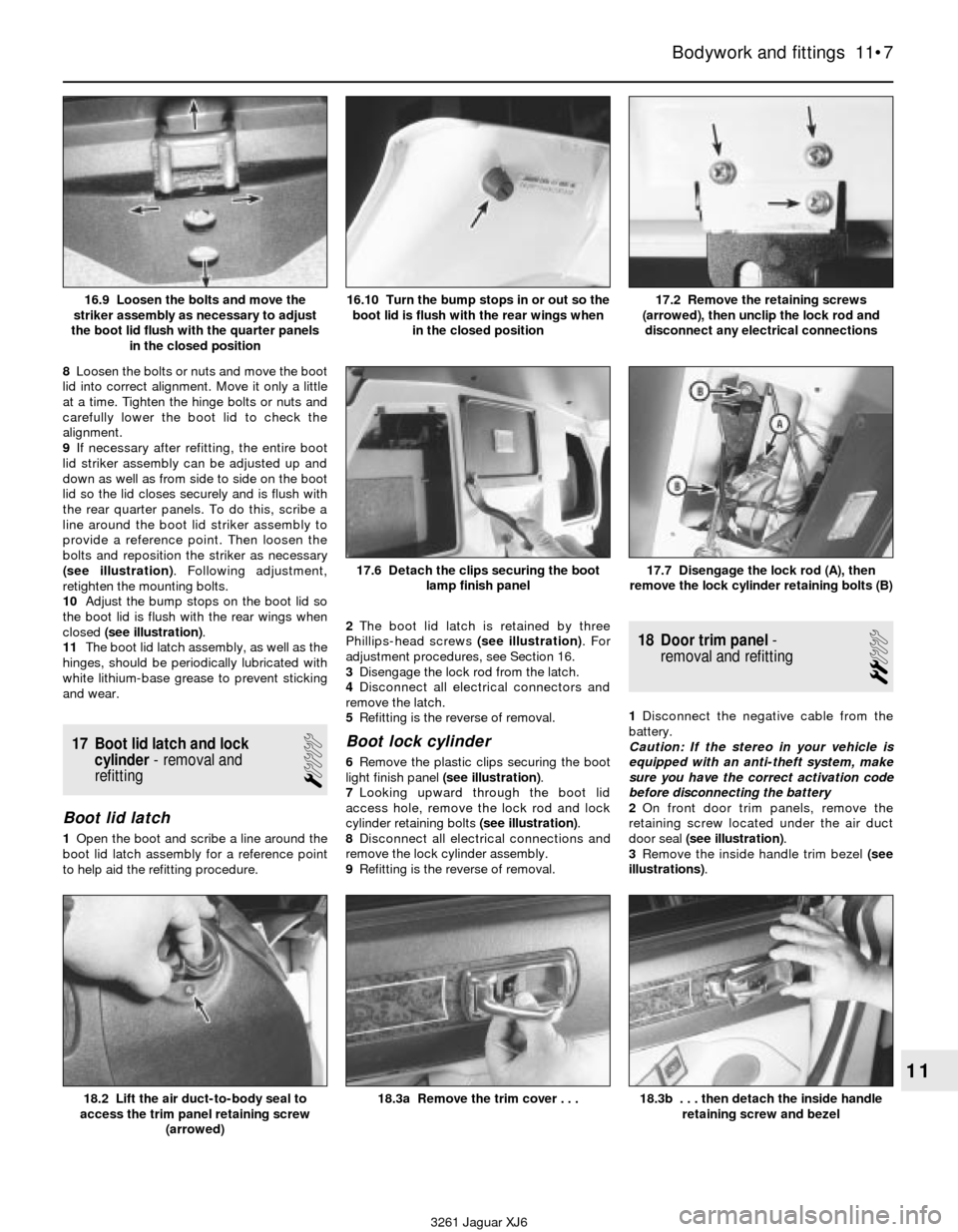
lid striker assembly can be adjusted up and
down as well as from side to side on the boot
lid so the lid closes securely and is flush with
the rear quarter panels. To do this, scribe a
line around the boot lid striker assembly to
provide a reference point. Then loosen the
bolts and reposition the striker as necessary
(see illustration). Following adjustment,
retighten the mounting bolts.
10Adjust the bump stops on the boot lid so
the boot lid is flush with the rear wings when
closed (see illustration).
11The boot lid latch assembly, as well as the
hinges, should be periodically lubricated with
white lithium-base grease to prevent sticking
and wear.
17 Boot lid latch and lock
cylinder- removal and
refitting
1
Boot lid latch
1Open the boot and scribe a line around the
boot lid latch assembly for a reference point
to help aid the refitting procedure.2The boot lid latch is retained by three
Phillips-head screws (see illustration). For
adjustment procedures, see Section 16.
3Disengage the lock rod from the latch.
4Disconnect all electrical connectors and
remove the latch.
5Refitting is the reverse of removal.
Boot lock cylinder
6Remove the plastic clips securing the boot
light finish panel (see illustration).
7Looking upward through the boot lid
access hole, remove the lock rod and lock
cylinder retaining bolts (see illustration).
8Disconnect all electrical connections and
remove the lock cylinder assembly.
9Refitting is the reverse of removal.
18 Door trim panel-
removal and refitting
2
1Disconnect the negative cable from the
battery.
Caution: If the stereo in your vehicle is
equipped with an anti-theft system, make
sure you have the correct activation code
before disconnecting the battery
2On front door trim panels, remove the
retaining screw located under the air duct
door seal (see illustration).
3Remove the inside handle trim bezel (see
illustrations).
Bodywork and fittings 11•7
11
17.6 Detach the clips securing the boot
lamp finish panel17.7 Disengage the lock rod (A), then
remove the lock cylinder retaining bolts (B)
18.2 Lift the air duct-to-body seal to
access the trim panel retaining screw
(arrowed)18.3b . . . then detach the inside handle
retaining screw and bezel18.3a Remove the trim cover . . .
3261 Jaguar XJ6 16.9 Loosen the bolts and move the
striker assembly as necessary to adjust
the boot lid flush with the quarter panels
in the closed position
17.2 Remove the retaining screws
(arrowed), then unclip the lock rod and
disconnect any electrical connections16.10 Turn the bump stops in or out so the
boot lid is flush with the rear wings when
in the closed position
Page 156 of 227
4Detach the wood finishing panel (see
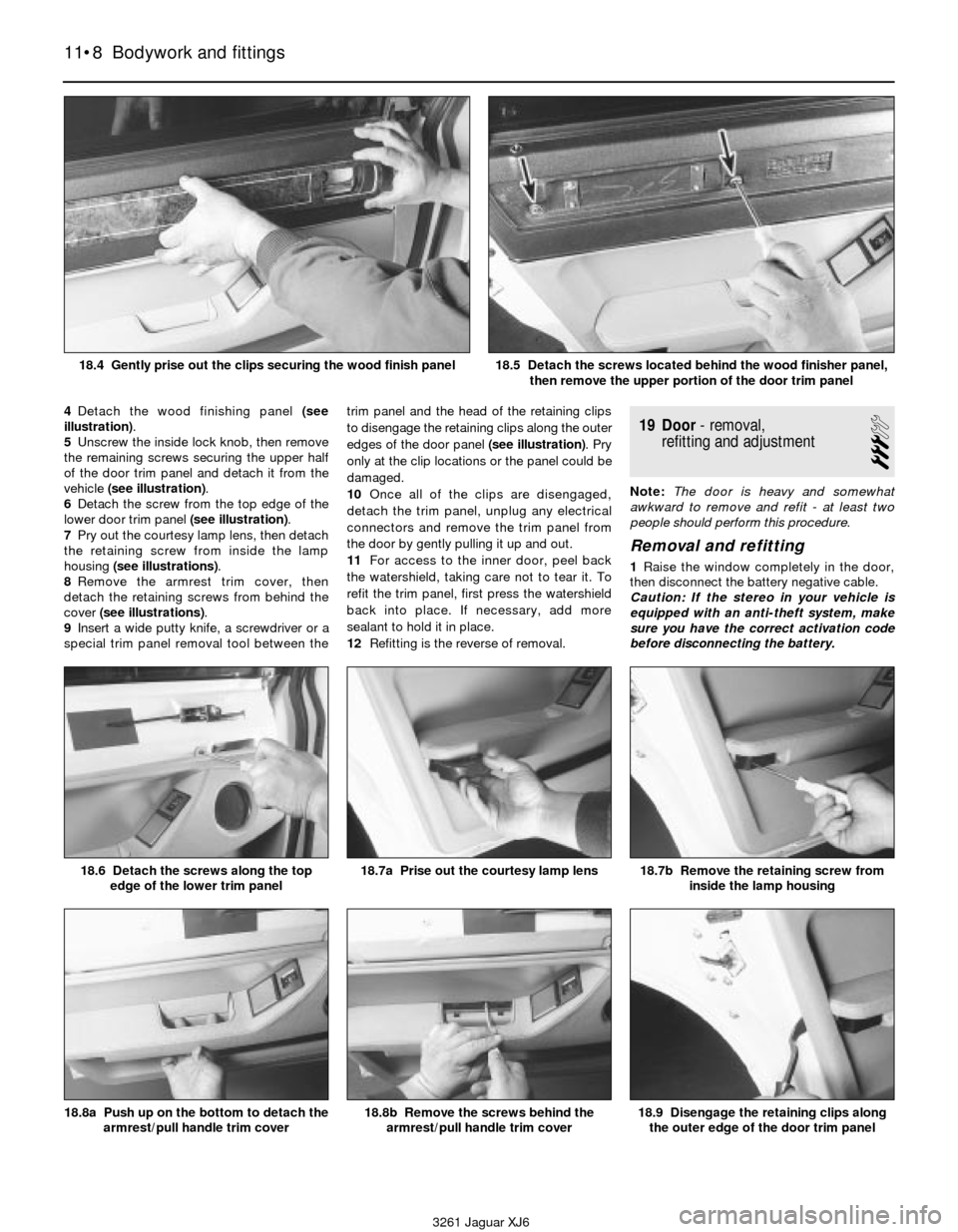
illustration).
5Unscrew the inside lock knob, then remove
the remaining screws securing the upper half
of the door trim panel and detach it from the
vehicle (see illustration).
6Detach the screw from the top edge of the
lower door trim panel (see illustration).
7Pry out the courtesy lamp lens, then detach
the retaining screw from inside the lamp
housing (see illustrations).
8Remove the armrest trim cover, then
detach the retaining screws from behind the
cover (see illustrations).
9Insert a wide putty knife, a screwdriver or a
special trim panel removal tool between thetrim panel and the head of the retaining clips
to disengage the retaining clips along the outer
edges of the door panel (see illustration). Pry
only at the clip locations or the panel could be
damaged.
10Once all of the clips are disengaged,
detach the trim panel, unplug any electrical
connectors and remove the trim panel from
the door by gently pulling it up and out.
11For access to the inner door, peel back
the watershield, taking care not to tear it. To
refit the trim panel, first press the watershield
back into place. If necessary, add more
sealant to hold it in place.
12Refitting is the reverse of removal.19 Door- removal,
refitting and adjustment
3
Note:The door is heavy and somewhat
awkward to remove and refit - at least two
people should perform this procedure.
Removal and refitting
1Raise the window completely in the door,
then disconnect the battery negative cable.
Caution: If the stereo in your vehicle is
equipped with an anti-theft system, make
sure you have the correct activation code
before disconnecting the battery.
11•8 Bodywork and fittings
18.6 Detach the screws along the top
edge of the lower trim panel18.7a Prise out the courtesy lamp lens18.7b Remove the retaining screw from
inside the lamp housing
18.8a Push up on the bottom to detach the
armrest/pull handle trim cover18.8b Remove the screws behind the
armrest/pull handle trim cover18.9 Disengage the retaining clips along
the outer edge of the door trim panel
3261 Jaguar XJ6 18.4 Gently prise out the clips securing the wood finish panel
18.5 Detach the screws located behind the wood finisher panel,
then remove the upper portion of the door trim panel
Page 157 of 227
2Open the door all the way and support it on
jacks or blocks covered with rags to prevent
damaging the paint.
3Remove the door trim panel and water
deflector as described in Section 18.
4Unplug all electrical connections, ground
wires and harness retaining clips from the
door. Note:It is a good idea to label all
connections to aid the reassembly process.
5From the door side, detach the rubber
conduit between the body and the door, then
carefully pull the wiring harness through the
conduit hole and remove it from the door.
6Mark around the door hinges with a pen or
a scribe to ease alignment during reassembly.
7On front doors, work through the door
access hole to remove the hinge-to-door
nuts. On rear doors the hinge-to-body bolts
are more accessible and can be removed by
simply opening the front door and removing
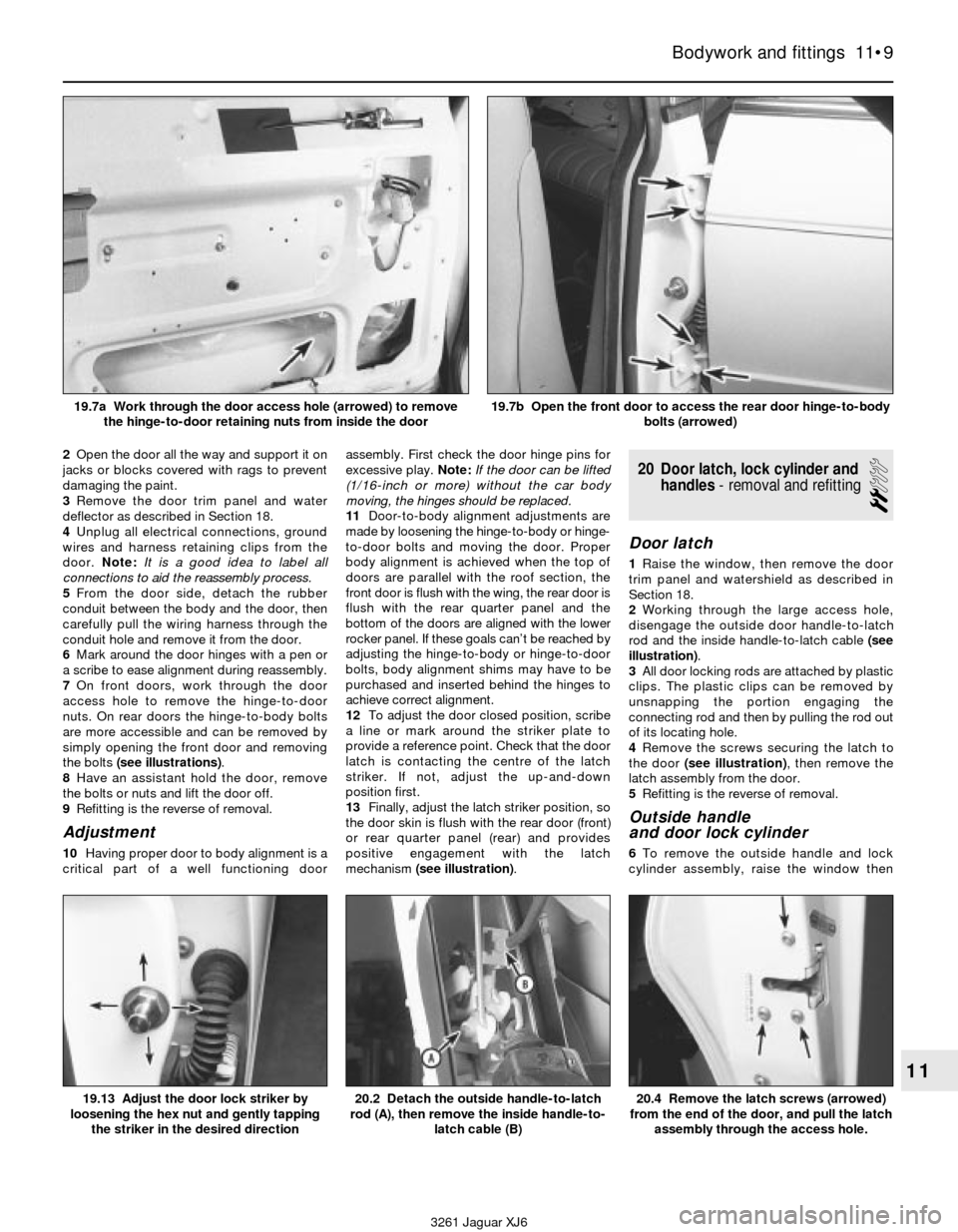
the bolts (see illustrations).
8Have an assistant hold the door, remove
the bolts or nuts and lift the door off.
9Refitting is the reverse of removal.
Adjustment
10Having proper door to body alignment is a
critical part of a well functioning doorassembly. First check the door hinge pins for
excessive play. Note: If the door can be lifted
(1/16-inch or more) without the car body
moving, the hinges should be replaced.
11Door-to-body alignment adjustments are
made by loosening the hinge-to-body or hinge-
to-door bolts and moving the door. Proper
body alignment is achieved when the top of
doors are parallel with the roof section, the
front door is flush with the wing, the rear door is
flush with the rear quarter panel and the
bottom of the doors are aligned with the lower
rocker panel. If these goals can’t be reached by
adjusting the hinge-to-body or hinge-to-door
bolts, body alignment shims may have to be
purchased and inserted behind the hinges to
achieve correct alignment.
12To adjust the door closed position, scribe
a line or mark around the striker plate to
provide a reference point. Check that the door
latch is contacting the centre of the latch
striker. If not, adjust the up-and-down
position first.
13Finally, adjust the latch striker position, so
the door skin is flush with the rear door (front)
or rear quarter panel (rear) and provides
positive engagement with the latch
mechanism (see illustration).
20 Door latch, lock cylinder and
handles- removal and refitting
2
Door latch
1Raise the window, then remove the door
trim panel and watershield as described in
Section 18.
2Working through the large access hole,
disengage the outside door handle-to-latch
rod and the inside handle-to-latch cable (see
illustration).
3All door locking rods are attached by plastic
clips. The plastic clips can be removed by
unsnapping the portion engaging the
connecting rod and then by pulling the rod out
of its locating hole.
4Remove the screws securing the latch to
the door (see illustration), then remove the
latch assembly from the door.
5Refitting is the reverse of removal.
Outside handle
and door lock cylinder
6To remove the outside handle and lock
cylinder assembly, raise the window then
Bodywork and fittings 11•9
11
19.13 Adjust the door lock striker by
loosening the hex nut and gently tapping
the striker in the desired direction20.2 Detach the outside handle-to-latch
rod (A), then remove the inside handle-to-
latch cable (B)20.4 Remove the latch screws (arrowed)
from the end of the door, and pull the latch
assembly through the access hole.
3261 Jaguar XJ6 19.7a Work through the door access hole (arrowed) to remove
the hinge-to-door retaining nuts from inside the door
19.7b Open the front door to access the rear door hinge-to-body
bolts (arrowed)
Page 158 of 227
remove the door trim panel and watershield
as described in Section 18.
7Working through the access hole, detach
the outside handle retaining nuts (see
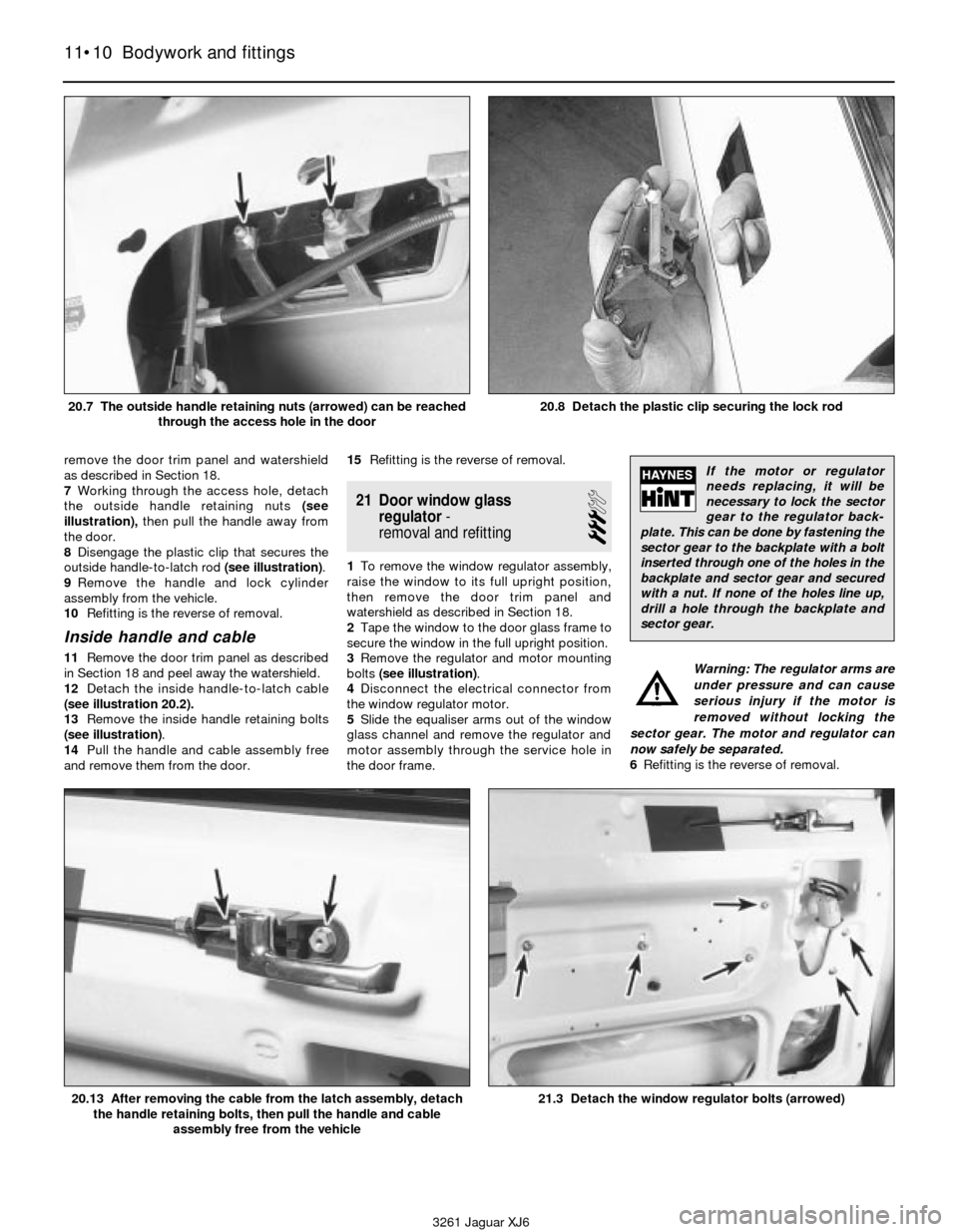
illustration),then pull the handle away from
the door.
8Disengage the plastic clip that secures the
outside handle-to-latch rod (see illustration).
9Remove the handle and lock cylinder
assembly from the vehicle.
10Refitting is the reverse of removal.
Inside handle and cable
11Remove the door trim panel as described
in Section 18 and peel away the watershield.
12Detach the inside handle-to-latch cable
(see illustration 20.2).
13Remove the inside handle retaining bolts
(see illustration).
14Pull the handle and cable assembly free
and remove them from the door.15Refitting is the reverse of removal.
21 Door window glass
regulator-
removal and refitting
3
1To remove the window regulator assembly,
raise the window to its full upright position,
then remove the door trim panel and
watershield as described in Section 18.
2Tape the window to the door glass frame to
secure the window in the full upright position.
3Remove the regulator and motor mounting
bolts (see illustration).
4Disconnect the electrical connector from
the window regulator motor.
5Slide the equaliser arms out of the window
glass channel and remove the regulator and
motor assembly through the service hole in
the door frame.Warning: The regulator arms are
under pressure and can cause
serious injury if the motor is
removed without locking the
sector gear. The motor and regulator can
now safely be separated.
6Refitting is the reverse of removal.
11•10 Bodywork and fittings
3261 Jaguar XJ6 20.7 The outside handle retaining nuts (arrowed) can be reached
through the access hole in the door
20.8 Detach the plastic clip securing the lock rod
20.13 After removing the cable from the latch assembly, detach
the handle retaining bolts, then pull the handle and cable
assembly free from the vehicle21.3 Detach the window regulator bolts (arrowed)
If the motor or regulator
needs replacing, it will be
necessary to lock the sector
gear to the regulator back-
plate. This can be done by fastening the
sector gear to the backplate with a bolt
inserted through one of the holes in the
backplate and sector gear and secured
with a nut. If none of the holes line up,
drill a hole through the backplate and
sector gear.
Page 174 of 227
Rear direction indicator,
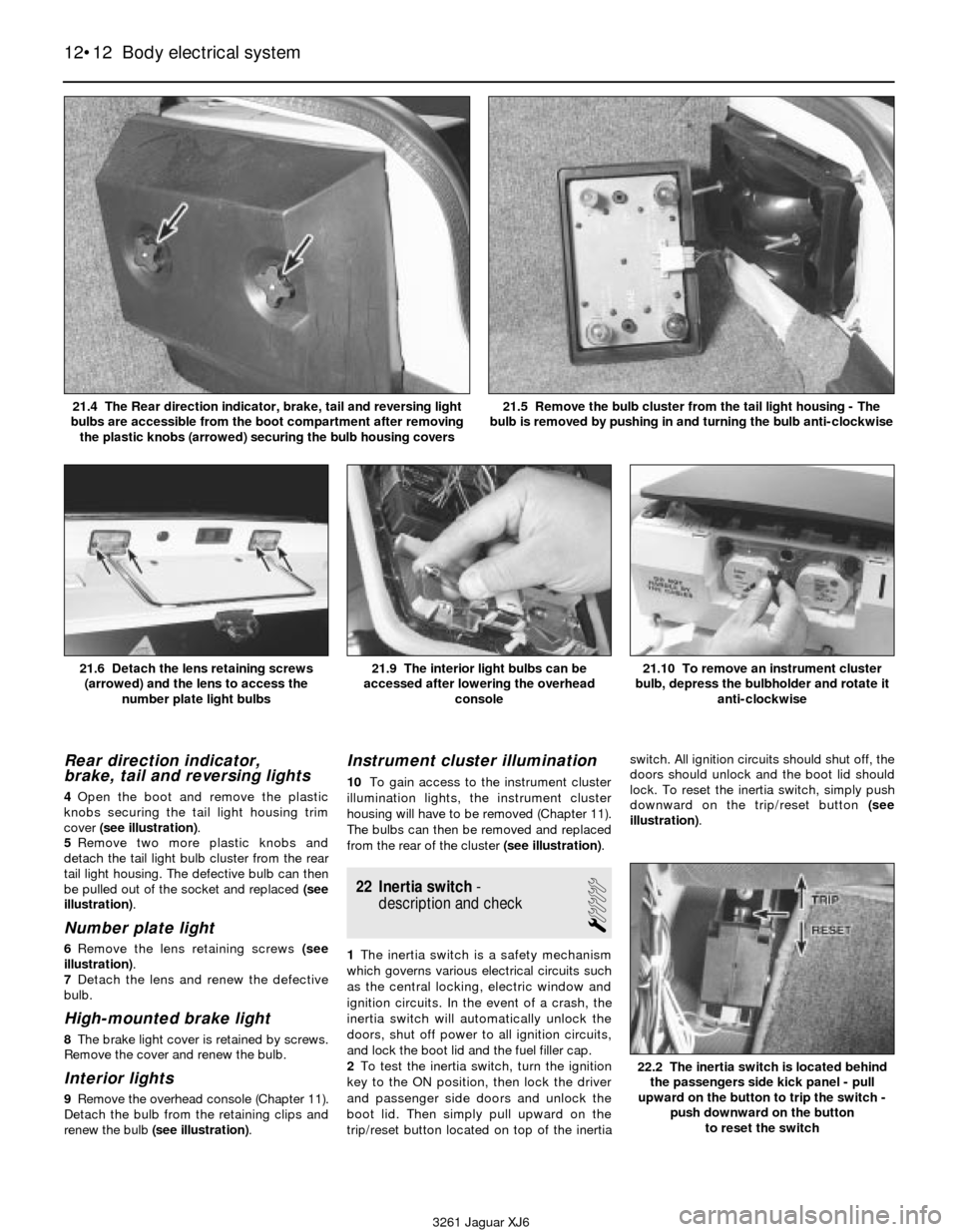
brake, tail and reversing lights
4Open the boot and remove the plastic
knobs securing the tail light housing trim
cover (see illustration).
5Remove two more plastic knobs and
detach the tail light bulb cluster from the rear
tail light housing. The defective bulb can then
be pulled out of the socket and replaced (see
illustration).
Number plate light
6Remove the lens retaining screws (see
illustration).
7Detach the lens and renew the defective
bulb.
High-mounted brake light
8The brake light cover is retained by screws.
Remove the cover and renew the bulb.
Interior lights
9Remove the overhead console (Chapter 11).
Detach the bulb from the retaining clips and
renew the bulb (see illustration).
Instrument cluster illumination
10To gain access to the instrument cluster
illumination lights, the instrument cluster
housing will have to be removed (Chapter 11).
The bulbs can then be removed and replaced
from the rear of the cluster (see illustration).
22 Inertia switch-
description and check
1
1The inertia switch is a safety mechanism
which governs various electrical circuits such
as the central locking, electric window and
ignition circuits. In the event of a crash, the
inertia switch will automatically unlock the
doors, shut off power to all ignition circuits,
and lock the boot lid and the fuel filler cap.
2To test the inertia switch, turn the ignition
key to the ON position, then lock the driver
and passenger side doors and unlock the
boot lid. Then simply pull upward on the
trip/reset button located on top of the inertiaswitch. All ignition circuits should shut off, the
doors should unlock and the boot lid should
lock. To reset the inertia switch, simply push
downward on the trip/reset button (see
illustration).
12•12 Body electrical system
21.6 Detach the lens retaining screws
(arrowed) and the lens to access the
number plate light bulbs21.9 The interior light bulbs can be
accessed after lowering the overhead
console21.10 To remove an instrument cluster
bulb, depress the bulbholder and rotate it
anti-clockwise
3261 Jaguar XJ6 21.4 The Rear direction indicator, brake, tail and reversing light
bulbs are accessible from the boot compartment after removing
the plastic knobs (arrowed) securing the bulb housing covers
21.5 Remove the bulb cluster from the tail light housing - The
bulb is removed by pushing in and turning the bulb anti-clockwise
22.2 The inertia switch is located behind
the passengers side kick panel - pull
upward on the button to trip the switch -
push downward on the button
to reset the switch
Page 175 of 227
23 Cruise control system-
description and check
5
1The cruise control system maintains vehicle
speed with an independently operated vacuum
motor located on the passenger’s side inner
wing in the engine compartment. When the
cruise control switch is turned on, a vacuum
actuator (connected the throttle linkage) is
activated by vacuum from the vacuum motor.
The system consists of the vacuum motor,
vacuum actuator, brake switch, control
switches, a relay and associated vacuum
hoses. Some features of the system require
special testers and diagnostic procedures
which are beyond the scope of this manual.
Listed below are some general procedures that
may be used to locate common problems.
2Locate and check the fuse (see Section 3).
3Have an assistant operate the brake lights
while you check their operation (voltage from
the brake light switch deactivates the cruise
control).
4If the brake lights don’t come on or don’t
shut off, correct the problem and re-test the
cruise control.
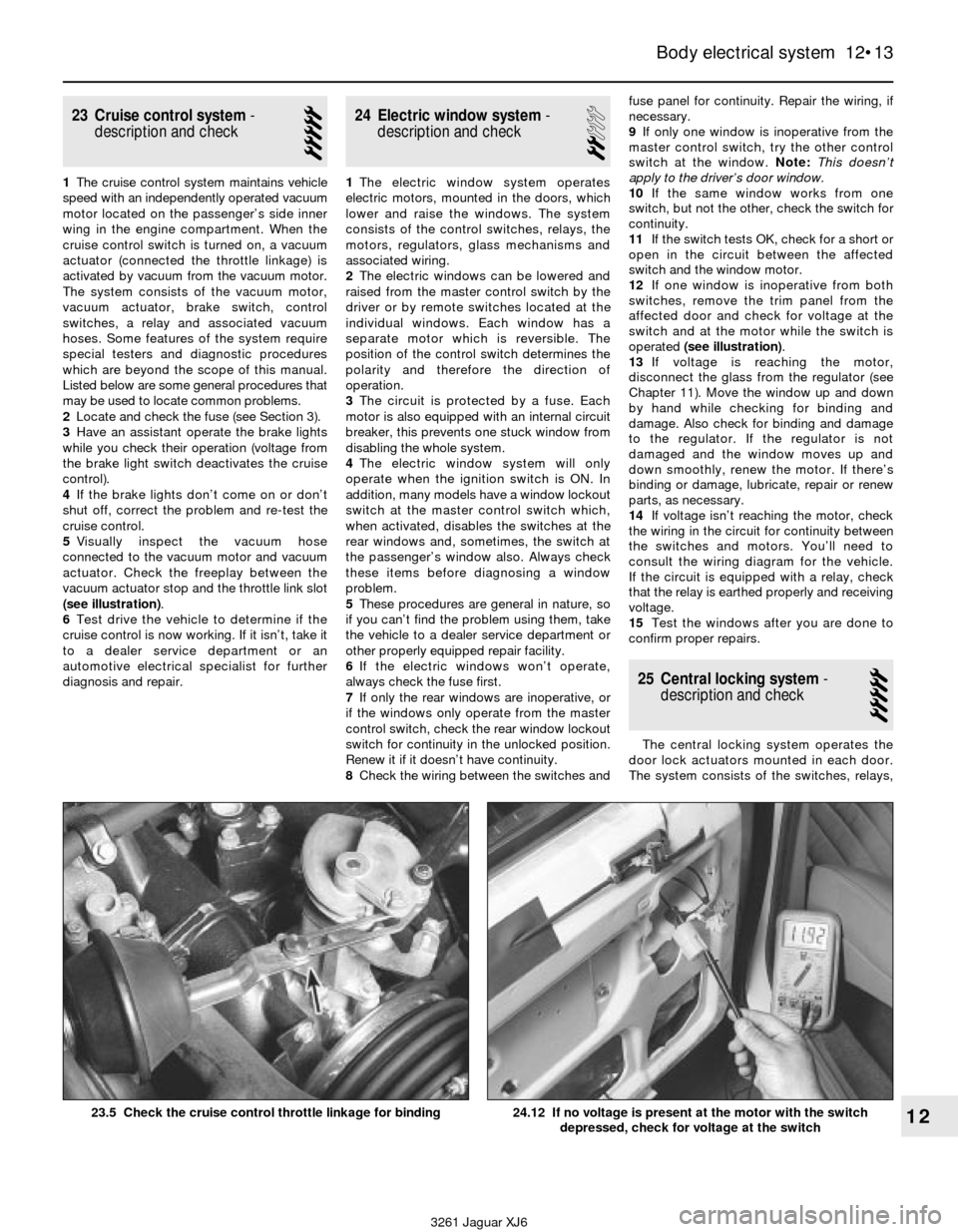
5Visually inspect the vacuum hose
connected to the vacuum motor and vacuum
actuator. Check the freeplay between the
vacuum actuator stop and the throttle link slot
(see illustration).
6Test drive the vehicle to determine if the
cruise control is now working. If it isn’t, take it
to a dealer service department or an
automotive electrical specialist for further
diagnosis and repair.
24 Electric window system-
description and check
2
1The electric window system operates
electric motors, mounted in the doors, which
lower and raise the windows. The system
consists of the control switches, relays, the
motors, regulators, glass mechanisms and
associated wiring.
2The electric windows can be lowered and
raised from the master control switch by the
driver or by remote switches located at the
individual windows. Each window has a
separate motor which is reversible. The
position of the control switch determines the
polarity and therefore the direction of
operation.
3The circuit is protected by a fuse. Each
motor is also equipped with an internal circuit
breaker, this prevents one stuck window from
disabling the whole system.
4The electric window system will only
operate when the ignition switch is ON. In
addition, many models have a window lockout
switch at the master control switch which,
when activated, disables the switches at the
rear windows and, sometimes, the switch at
the passenger’s window also. Always check
these items before diagnosing a window
problem.
5These procedures are general in nature, so
if you can’t find the problem using them, take
the vehicle to a dealer service department or
other properly equipped repair facility.
6If the electric windows won’t operate,
always check the fuse first.
7If only the rear windows are inoperative, or
if the windows only operate from the master
control switch, check the rear window lockout
switch for continuity in the unlocked position.
Renew it if it doesn’t have continuity.
8Check the wiring between the switches andfuse panel for continuity. Repair the wiring, if
necessary.
9If only one window is inoperative from the
master control switch, try the other control
switch at the window. Note:This doesn’t
apply to the driver’s door window.
10If the same window works from one
switch, but not the other, check the switch for
continuity.
11If the switch tests OK, check for a short or
open in the circuit between the affected
switch and the window motor.
12If one window is inoperative from both
switches, remove the trim panel from the
affected door and check for voltage at the
switch and at the motor while the switch is
operated (see illustration).
13If voltage is reaching the motor,
disconnect the glass from the regulator (see
Chapter 11). Move the window up and down
by hand while checking for binding and
damage. Also check for binding and damage
to the regulator. If the regulator is not
damaged and the window moves up and
down smoothly, renew the motor. If there’s
binding or damage, lubricate, repair or renew
parts, as necessary.
14If voltage isn’t reaching the motor, check
the wiring in the circuit for continuity between
the switches and motors. You’ll need to
consult the wiring diagram for the vehicle.
If the circuit is equipped with a relay, check
that the relay is earthed properly and receiving
voltage.
15Test the windows after you are done to
confirm proper repairs.
25 Central locking system-
description and check
5
The central locking system operates the
door lock actuators mounted in each door.
The system consists of the switches, relays,
Body electrical system 12•13
12
3261 Jaguar XJ6 23.5 Check the cruise control throttle linkage for binding
24.12 If no voltage is present at the motor with the switch
depressed, check for voltage at the switch
Page 176 of 227
actuators, a control unit and associated
wiring. Diagnosis can usually be limited to
simple checks of the wiring connections and
actuators for minor faults which can be easily
repaired. Since this system uses an electronic
control unit, in-depth diagnosis should be left
to a dealership service department.
Central locking systems are operated by bi-
directional solenoids located in the doors. The
lock switches have two operating positions;
Lock and Unlock. When activated, the switch
sends a signal to the door lock control unit to
lock or unlock the doors. Depending on which
way the switch is activated, the control unit
reverses polarity to the solenoids, allowing the
two sides of the circuit to be used alternately
as the feed (positive) and earth side.
Some vehicles may have an anti-theft
system incorporated into the locks. If you are
unable to locate the trouble using the following
general paragraphs, consult a dealer service
department or other properly equipped repair
facility.
1Always check the circuit protection first.
Some vehicles use a combination of circuit
breakers and fuses.
2Operate the door lock switches in both
directions (Lock and Unlock) with the engine off.
Listen for the click of the solenoids operating.
3Test the switches for continuity. Renew the
switch if there’s not continuity in both switch
positions.
4Check the wiring between the switches,
control unit and solenoids for continuity.
Repair the wiring if there’s no continuity.
5Check for a bad earth at the switches or the
control unit.
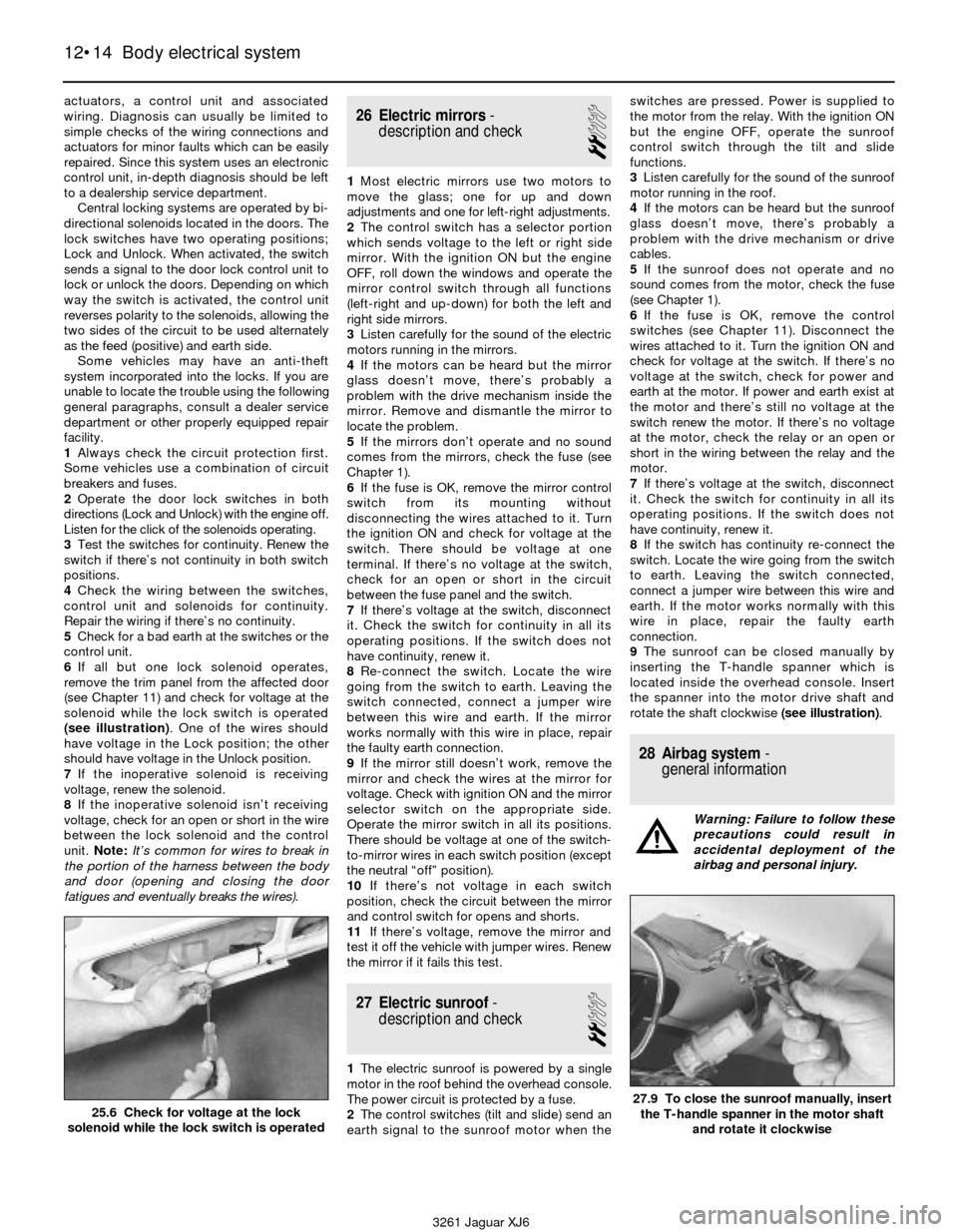
6If all but one lock solenoid operates,
remove the trim panel from the affected door
(see Chapter 11) and check for voltage at the
solenoid while the lock switch is operated
(see illustration). One of the wires should
have voltage in the Lock position; the other
should have voltage in the Unlock position.
7If the inoperative solenoid is receiving
voltage, renew the solenoid.
8If the inoperative solenoid isn’t receiving
voltage, check for an open or short in the wire
between the lock solenoid and the control
unit. Note:It’s common for wires to break in
the portion of the harness between the body
and door (opening and closing the door
fatigues and eventually breaks the wires).26 Electric mirrors-
description and check
2
1Most electric mirrors use two motors to
move the glass; one for up and down
adjustments and one for left-right adjustments.
2The control switch has a selector portion
which sends voltage to the left or right side
mirror. With the ignition ON but the engine
OFF, roll down the windows and operate the
mirror control switch through all functions
(left-right and up-down) for both the left and
right side mirrors.
3Listen carefully for the sound of the electric
motors running in the mirrors.
4If the motors can be heard but the mirror
glass doesn’t move, there’s probably a
problem with the drive mechanism inside the
mirror. Remove and dismantle the mirror to
locate the problem.
5If the mirrors don’t operate and no sound
comes from the mirrors, check the fuse (see
Chapter 1).
6If the fuse is OK, remove the mirror control
switch from its mounting without
disconnecting the wires attached to it. Turn
the ignition ON and check for voltage at the
switch. There should be voltage at one
terminal. If there’s no voltage at the switch,
check for an open or short in the circuit
between the fuse panel and the switch.
7If there’s voltage at the switch, disconnect
it. Check the switch for continuity in all its
operating positions. If the switch does not
have continuity, renew it.
8Re-connect the switch. Locate the wire
going from the switch to earth. Leaving the
switch connected, connect a jumper wire
between this wire and earth. If the mirror
works normally with this wire in place, repair
the faulty earth connection.
9If the mirror still doesn’t work, remove the
mirror and check the wires at the mirror for
voltage. Check with ignition ON and the mirror
selector switch on the appropriate side.
Operate the mirror switch in all its positions.
There should be voltage at one of the switch-
to-mirror wires in each switch position (except
the neutral “off” position).
10If there’s not voltage in each switch
position, check the circuit between the mirror
and control switch for opens and shorts.
11If there’s voltage, remove the mirror and
test it off the vehicle with jumper wires. Renew
the mirror if it fails this test.
27 Electric sunroof-
description and check
2
1The electric sunroof is powered by a single
motor in the roof behind the overhead console.
The power circuit is protected by a fuse.
2The control switches (tilt and slide) send an
earth signal to the sunroof motor when theswitches are pressed. Power is supplied to
the motor from the relay. With the ignition ON
but the engine OFF, operate the sunroof
control switch through the tilt and slide
functions.
3Listen carefully for the sound of the sunroof
motor running in the roof.
4If the motors can be heard but the sunroof
glass doesn’t move, there’s probably a
problem with the drive mechanism or drive
cables.
5If the sunroof does not operate and no
sound comes from the motor, check the fuse
(see Chapter 1).
6If the fuse is OK, remove the control
switches (see Chapter 11). Disconnect the
wires attached to it. Turn the ignition ON and
check for voltage at the switch. If there’s no
voltage at the switch, check for power and
earth at the motor. If power and earth exist at
the motor and there’s still no voltage at the
switch renew the motor. If there’s no voltage
at the motor, check the relay or an open or
short in the wiring between the relay and the
motor.
7If there’s voltage at the switch, disconnect
it. Check the switch for continuity in all its
operating positions. If the switch does not
have continuity, renew it.
8If the switch has continuity re-connect the
switch. Locate the wire going from the switch
to earth. Leaving the switch connected,
connect a jumper wire between this wire and
earth. If the motor works normally with this
wire in place, repair the faulty earth
connection.
9The sunroof can be closed manually by
inserting the T-handle spanner which is
located inside the overhead console. Insert
the spanner into the motor drive shaft and
rotate the shaft clockwise (see illustration).
28 Airbag system-
general information
Warning: Failure to follow these
precautions could result in
accidental deployment of the
airbag and personal injury.
12•14 Body electrical system
25.6 Check for voltage at the lock
solenoid while the lock switch is operated27.9 To close the sunroof manually, insert
the T-handle spanner in the motor shaft
and rotate it clockwise
3261 Jaguar XJ6
Page 204 of 227

3261 Jaguar XJ6
Use of EnglishREF•3
As the main part of this book has been written in the US, it uses the appropriate US component names, phrases, and spelling. Some of these
differ from those used in the UK. Normally, these cause no difficulty, but to make sure, a glossary is printed below. When ordering spare parts,
remember the parts list may use some of these words:
AMERICAN ENGLISH
Aluminum Aluminium
Antenna Aerial
Authorized Authorised
Auto parts stores Motor factors
Axleshaft Halfshaft
Back-up Reverse
Barrel Choke/venturi
Block Chock
Box-end wrench Ring spanner
Bushing Bush
Carburetor Carburettor
Center Centre
Coast Freewheel
Color Colour
Convertible Drop head coupe
Cotter pin Split pin
Counterclockwise Anti-clockwise
Countershaft (of gearbox) Layshaft
Dashboard Facia
Denatured alcohol Methylated spirit
Dome lamp Interior light
Driveaxle Driveshaft
Driveshaft Propeller shaft
Fender Wing/mudguard
Firewall Bulkhead
Flashlight Torch
Float bowl Float chamber
Floor jack Trolley jack
Freeway, turnpike etc Motorway
Freeze plug Core plug
Frozen Seized
Gas tank Petrol tank
Gasoline (gas) Petrol
Gearshift Gearchange
Generator (DC) Dynamo
Ground (electrical) Earth
Header Exhaust manifold
Heat riser Hot spot
High Top gear
Hood (engine cover) Bonnet
Installation Refitting
Intake Inlet
Jackstands Axle stands
Jumper cable Jump lead
Keeper Collet
Kerosene Paraffin
Knock pin Roll pin
Lash Clearance
Lash Free-play
Latch Catch
Latches Locks
License plate Number plate
Light Lamp
Lock (for valve spring retainer) Split cotter (for valve spring cap)
Lopes Hunts
Lug nut/bolt Wheel nut/bolt
Metal chips or debris Swarf
Misses Misfires
AMERICAN ENGLISH
Muffler Silencer
Odor Odour
Oil pan Sump
Open flame Naked flame
Panel wagon/van Van
Parking brake Handbrake
Parking light Sidelight
Pinging Pinking
Piston pin or wrist pin Gudgeon pin
Piston pin or wrist pin Small end, little end
Pitman arm Drop arm
Power brake booster Servo unit
Primary shoe (of brake) Leading shoe (of brake)
Prussian blue Engineer’s blue
Pry Prise (force apart)
Prybar Lever
Prying Levering
Quarter window Quarterlight
Recap Retread
Release cylinder Slave cylinder
Repair shop Garage
Replacement Renewal
Ring gear (of differential) Crownwheel
Rocker panel (beneath doors) Sill panel (beneath doors)
Rod bearing Big-end bearing
Rotor/disk Disc (brake)
Secondary shoe (of brake) Trailing shoe (of brake)
Sedan Saloon
Setscrew, Allen screw Grub screw
Shock absorber, shock Damper
Snap-ring Circlip
Soft top Hood
Spacer Distance piece
Spare tire Spare wheel
Spark plug wires HT leads
Spindle arm Steering arm
Stabilizer or sway bar Anti-roll bar
Station wagon Estate car
Stumbles Hesitates
Tang or lock Tab washer
Throw-out bearing Thrust bearing
Tie-rod or connecting rod (of steering) Trackrod
Tire Tyre
Transmission Gearbox
Troubleshooting Fault finding/diagnosis
Trunk Boot (luggage compartment)
Turn signal Indicator
TV (throttle valve) cable Kickdown cable
Unpublicized Unpublicised
Valve cover Rocker cover
Valve lifter Tappet
Valve lifter or tappet Cam follower or tappet
Vapor Vapour
Vise Vice
Wheel cover Roadwheel trim
Whole drive line Transmission
Windshield Windscreen
Wrench Spanner
Page 205 of 227
3261 Jaguar XJ6
REF•4Buying spare parts
Spare parts are available from many
sources, including maker’s appointed
garages, accessory shops, and motor factors.
To be sure of obtaining the correct parts, it
will sometimes be necessary to quote the
vehicle identification number. If possible, it
can also be useful to take the old parts along
for positive identification. Items such as
starter motors and alternators may be
available under a service exchange scheme -
any parts returned should be clean.
Our advice regarding spare parts is as
follows.
Officially appointed garages
This is the best source of parts which are
peculiar to your car, and which are not
otherwise generally available (eg, badges,
interior trim, certain body panels, etc). It is
also the only place at which you should buy
parts if the vehicle is still under warranty.
Accessory shops
These are very good places to buy
materials and components needed for themaintenance of your car (oil, air and fuel
filters, light bulbs, drivebelts, greases, brake
pads, touch-up paint, etc). Components of
this nature sold by a reputable shop are
usually of the same standard as those used
by the car manufacturer.
Besides components, these shops also sell
tools and general accessories, usually have
convenient opening hours, charge lower
prices, and can often be found close to home.
Some accessory shops have parts counters
where components needed for almost any
repair job can be purchased or ordered.
Motor factors
Good factors will stock all the more
important components which wear out
comparatively quickly, and can sometimes
supply individual components needed for the
overhaul of a larger assembly (eg, brake seals
and hydraulic parts, bearing shells, pistons,
valves). They may also handle work such as
cylinder block reboring, crankshaft regrinding,
etc.
Tyre and exhaust specialists
These outlets may be independent, or
members of a local or national chain. They
frequently offer competitive prices when
compared with a main dealer or local garage,
but it will pay to obtain several quotes before
making a decision. When researching prices,
also ask what “extras” may be added - for
instance fitting a new valve and balancing the
wheel are both commonly charged on top of
the price of a new tyre.
Other sources
Beware of parts or materials obtained from
market stalls, car boot sales or similar outlets.
Such items are not invariably sub-standard,
but there is little chance of compensation if
they do prove unsatisfactory. In the case of
safety-critical components such as brake
pads, there is the risk of financial loss, and
also of an accident causing injury or death.
Second-hand parts or assemblies obtained
from a car breaker can be a good buy in some
circumstances, but this sort of purchase is
best made by the experienced DIY mechanic.
Vehicle identification
Modifications are a continuing and
unpublicised process in vehicle manufacture,
quite apart from major model changes. Spare
parts manuals and lists are compiled upon a
numerical basis, the individual vehicle
identification numbers being essential to
correct identification of the part concerned.
When ordering spare parts, always give as
much information as possible. Quote the car
model, year of manufacture and registration,
chassis and engine numbers as appropriate.
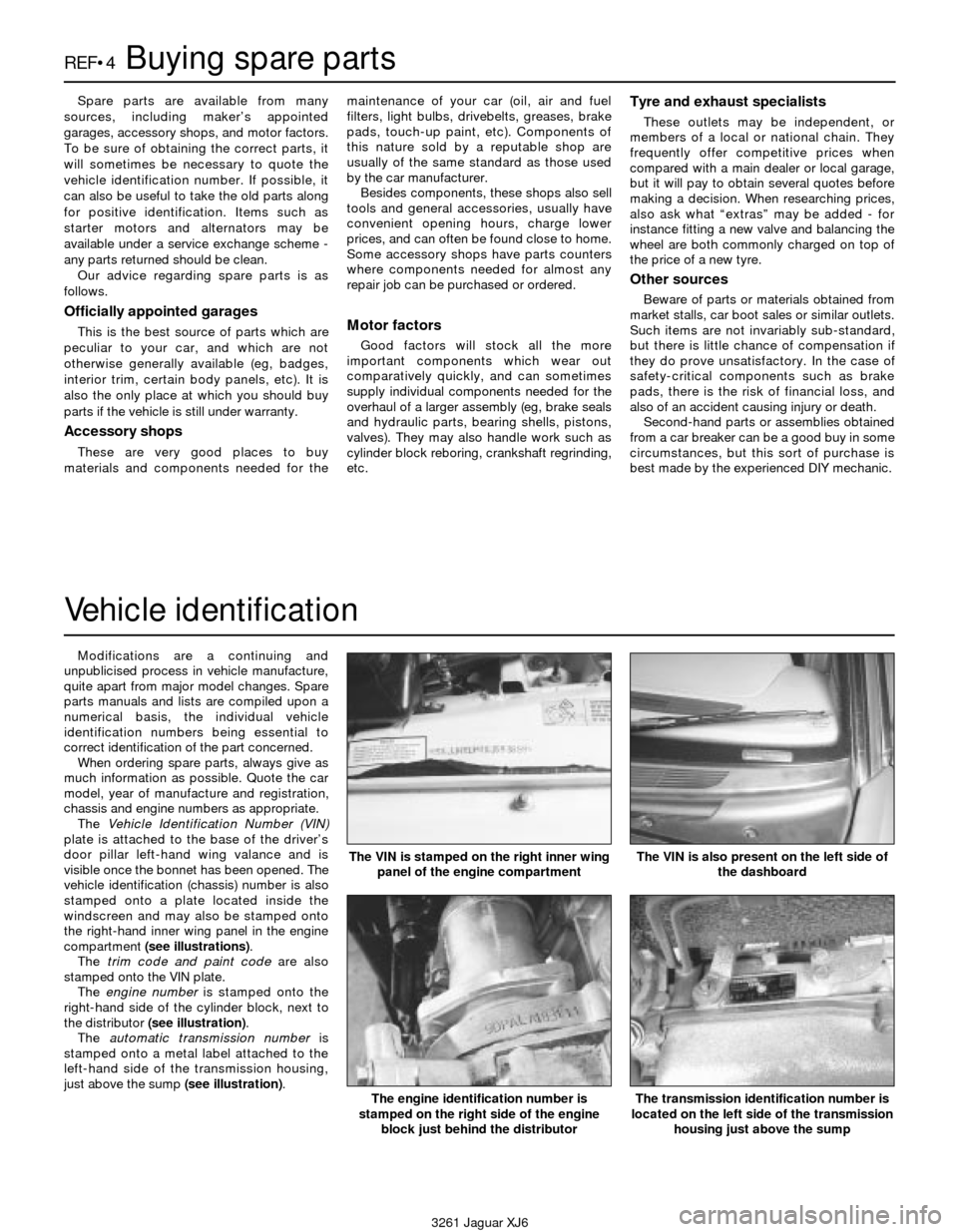
The Vehicle Identification Number (VIN)
plate is attached to the base of the driver’s
door pillar left-hand wing valance and is
visible once the bonnet has been opened. The
vehicle identification (chassis) number is also
stamped onto a plate located inside the
windscreen and may also be stamped onto
the right-hand inner wing panel in the engine
compartment (see illustrations).
The trim code and paint codeare also
stamped onto the VIN plate.
The engine numberis stamped onto the
right-hand side of the cylinder block, next to
the distributor (see illustration).
The automatic transmission numberis
stamped onto a metal label attached to the
left-hand side of the transmission housing,
just above the sump (see illustration).The VIN is stamped on the right inner wing
panel of the engine compartment
The engine identification number is
stamped on the right side of the engine
block just behind the distributorThe transmission identification number is
located on the left side of the transmission
housing just above the sump
The VIN is also present on the left side of
the dashboard
Page 210 of 227

3261 Jaguar XJ6
MOT test checksREF•9
Seat belts and seats
Note: The following checks are applicable to
all seat belts, front and rear.
MExamine the webbing of all the belts
(including rear belts if fitted) for cuts, serious
fraying or deterioration. Fasten and unfasten
each belt to check the buckles. If applicable,
check the retracting mechanism. Check the
security of all seat belt mountings accessible
from inside the vehicle.
MThe front seats themselves must be
securely attached and the backrests must
lock in the upright position.
Doors
MBoth front doors must be able to be opened
and closed from outside and inside, and must
latch securely when closed.
Vehicle identification
MNumber plates must be in good condition,
secure and legible, with letters and numbers
correctly spaced – spacing at (A) should be
twice that at (B).
MThe VIN plate and/or homologation plate
must be legible.
Electrical equipment
MSwitch on the ignition and check the
operation of the horn.
MCheck the windscreen washers and wipers,
examining the wiper blades; renew damaged
or perished blades. Also check the operation
of the stop-lights.
MCheck the operation of the sidelights and
number plate lights. The lenses and reflectors
must be secure, clean and undamaged.
MCheck the operation and alignment of the
headlights. The headlight reflectors must not
be tarnished and the lenses must be
undamaged.
MSwitch on the ignition and check the
operation of the direction indicators (including
the instrument panel tell-tale) and the hazard
warning lights. Operation of the sidelights and
stop-lights must not affect the indicators - if it
does, the cause is usually a bad earth at the
rear light cluster.
MCheck the operation of the rear foglight(s),
including the warning light on the instrument
panel or in the switch.
Footbrake
MExamine the master cylinder, brake pipes
and servo unit for leaks, loose mountings,
corrosion or other damage.
MThe fluid reservoir must be secure and the
fluid level must be between the upper (A) and
lower (B) markings.MInspect both front brake flexible hoses for
cracks or deterioration of the rubber. Turn the
steering from lock to lock, and ensure that the
hoses do not contact the wheel, tyre, or any
part of the steering or suspension mechanism.
With the brake pedal firmly depressed, check
the hoses for bulges or leaks under pressure.
Steering and suspension
MHave your assistant turn the steering wheel
from side to side slightly, up to the point where
the steering gear just begins to transmit this
movement to the roadwheels. Check for
excessive free play between the steering
wheel and the steering gear, indicating wear or
insecurity of the steering column joints, the
column-to-steering gear coupling, or the
steering gear itself.
MHave your assistant turn the steering wheel
more vigorously in each direction, so that the
roadwheels just begin to turn. As this is done,
examine all the steering joints, linkages,
fittings and attachments. Renew any
component that shows signs of wear or
damage. On vehicles with power steering,
check the security and condition of the
steering pump, drivebelt and hoses.
MCheck that the vehicle is standing level,
and at approximately the correct ride height.
Shock absorbers
MDepress each corner of the vehicle in turn,
then release it. The vehicle should rise and
then settle in its normal position. If the vehicle
continues to rise and fall, the shock absorber
is defective. A shock absorber which has
seized will also cause the vehicle to fail.
2Checks carried out
WITH THE VEHICLE ON THE
GROUND