gas type JAGUAR XJ6 1997 2.G User Guide
[x] Cancel search | Manufacturer: JAGUAR, Model Year: 1997, Model line: XJ6, Model: JAGUAR XJ6 1997 2.GPages: 227, PDF Size: 7.2 MB
Page 88 of 227

10With everything disconnected, pull the
heat-air conditioning housing back and out
from under the dash.
Caution: Do not force anything. If the unit
gets stuck, determine where the inter-
ference is before a duct, wire or hose is
broken.
11Pry off the series of black metal clips
connecting the main housing to the evaporator
case, then separate the evaporator case and
pull out the evaporator core. Note:When
refitting the evaporator core into the case, be
sure to refit the foam insulation in the same
way it was installed originally.
12The evaporator core can be cleaned with a
“fin comb” and blown off with compressed air.13The expansion valve is located on the
right side of the bulkhead on the engine side.
To renew it, remove the battery (Chapter 5) for
better access. Disconnect the lines from the
back of the valve as in Step 2. Disconnect the
high and low-pressure hoses from the frontof
the expansion valve (see illustration).
14If the evaporator core is renewed, make
sure the technician adds 1.4 ounces of new
refrigerant oil (of a type compatible with your
type of refrigerant) to the system.
15The remainder of the refitting is the
reverse of the removal process. Be sure to
use new O-rings, and new gaskets on the
expansion valve.
16Have the system evacuated, charged and
leak tested by the workshop that discharged
it.
Cooling, heating and air conditioning systems 3•15
3
17.13 Disconnect the lines at the front of
the expansion valve - always use two
spanners to avoid twisting a line - one
spanner holds the body of the valve
3261 Jaguar XJ6
Page 90 of 227
special electrical device that provides circuit
protection by switching off the ignition and
fuel pump upon impact in the event of vehicle
collision. Later Jaguar models are equipped
with an additional specialised inertia switch.
This later device switches OFF all ignition fed
circuits, locks the fuel filler cap, locks the boot
(only if doors are locked) and unlocks the
doors if they are locked during the accident.
All these functions are directed by the inertia
switch. The inertia switch is located behind
the left kick panel. Refer to Chapter 12 for
more information.
Exhaust system
The exhaust system includes an exhaust
manifold equipped with an exhaust oxygen
sensor, a catalytic converter, an exhaust pipe,
and a silencer.
The catalytic converter is an emission
control device added to the exhaust system to
reduce pollutants. A single-bed converter is
used in combination with a three-way
(reduction) catalyst. See Chapter 6 for more
information regarding the catalytic converter.
2 Fuel pressure relief
1
Warning: Petrol is extremely
flammable, so take extra
precautions when you work on
any part of the fuel system.
Don’t smoke or allow open flames or bare
light bulbs near the work area, and don’t
work in a garage where a natural gas-type
appliance (such as a water heater or a
clothes dryer) with a pilot light is present.
Since petrol is carcinogenic, wear latex
gloves when there’s a possibility of being
exposed to fuel, and, if you spill any fuel on
your skin, rinse it off immediately with soap
and water. Mop up any spills immediately
and do not store fuel-soaked rags wherethey could ignite. The fuel system is under
constant pressure, so, if any fuel lines are
to be disconnected, the fuel pressure in
the system must be relieved first. When
you perform any kind of work on the fuel
system, wear safety glasses and have a
Class B type fire extinguisher on hand.
1Before servicing any fuel system
component, you must relieve the fuel pressure
to minimise the risk of fire or personal injury.
2Remove the fuel filler cap - this will relieve
any pressure built up in the tank.
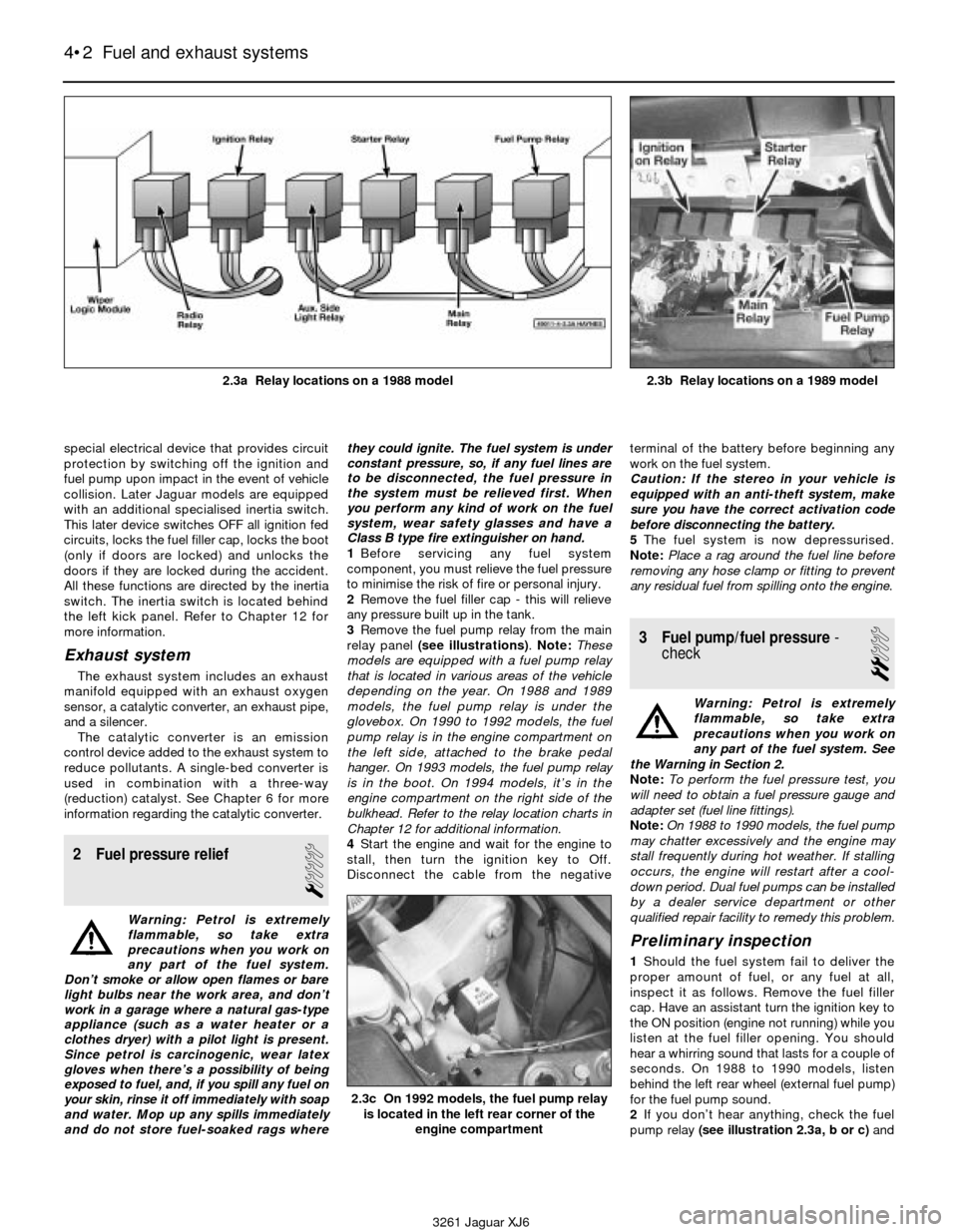
3Remove the fuel pump relay from the main
relay panel (see illustrations). Note:These
models are equipped with a fuel pump relay
that is located in various areas of the vehicle
depending on the year. On 1988 and 1989
models, the fuel pump relay is under the
glovebox. On 1990 to 1992 models, the fuel
pump relay is in the engine compartment on
the left side, attached to the brake pedal
hanger. On 1993 models, the fuel pump relay
is in the boot. On 1994 models, it’s in the
engine compartment on the right side of the
bulkhead. Refer to the relay location charts in
Chapter 12 for additional information.
4Start the engine and wait for the engine to
stall, then turn the ignition key to Off.
Disconnect the cable from the negativeterminal of the battery before beginning any
work on the fuel system.
Caution: If the stereo in your vehicle is
equipped with an anti-theft system, make
sure you have the correct activation code
before disconnecting the battery.
5The fuel system is now depressurised.
Note:Place a rag around the fuel line before
removing any hose clamp or fitting to prevent
any residual fuel from spilling onto the engine.
3 Fuel pump/fuel pressure-
check
2
Warning: Petrol is extremely
flammable, so take extra
precautions when you work on
any part of the fuel system. See
the Warning in Section 2.
Note: To perform the fuel pressure test, you
will need to obtain a fuel pressure gauge and
adapter set (fuel line fittings).
Note: On 1988 to 1990 models, the fuel pump
may chatter excessively and the engine may
stall frequently during hot weather. If stalling
occurs, the engine will restart after a cool-
down period. Dual fuel pumps can be installed
by a dealer service department or other
qualified repair facility to remedy this problem.
Preliminary inspection
1Should the fuel system fail to deliver the
proper amount of fuel, or any fuel at all,
inspect it as follows. Remove the fuel filler
cap. Have an assistant turn the ignition key to
the ON position (engine not running) while you
listen at the fuel filler opening. You should
hear a whirring sound that lasts for a couple of
seconds. On 1988 to 1990 models, listen
behind the left rear wheel (external fuel pump)
for the fuel pump sound.
2If you don’t hear anything, check the fuel
pump relay (see illustration 2.3a, b or c)and
4•2 Fuel and exhaust systems
2.3c On 1992 models, the fuel pump relay
is located in the left rear corner of the
engine compartment
3261 Jaguar XJ6 2.3a Relay locations on a 1988 model
2.3b Relay locations on a 1989 model
Page 111 of 227
3261 Jaguar XJ6
6
Chapter 6
Emissions and engine control systems
EGR gas temperature sensor resistance
Temperature:
212° F . . . . . . . . . . . . . . . . . . . . . . . . . . . . . . . . . . . . . . . . . . . . . . . . . 60 to 100 k-ohms
400° F . . . . . . . . . . . . . . . . . . . . . . . . . . . . . . . . . . . . . . . . . . . . . . . . . 3 to 8 k-ohms
662° F . . . . . . . . . . . . . . . . . . . . . . . . . . . . . . . . . . . . . . . . . . . . . . . . . 250 to 350 ohms
Torque wrench settingNm lbf ft
Crankshaft sensor bolt . . . . . . . . . . . . . . . . . . . . . . . . . . . . . . . . . . . . . . 27 20 Air Injection Reactor (AIR) system . . . . . . . . . . . . . . . . . . . . . . . . . . . 5
Catalytic converter . . . . . . . . . . . . . . . . . . . . . . . . . . . . . . . . . . . . . . . 9
CHECK ENGINE light . . . . . . . . . . . . . . . . . . . . . . . . . . . See Section 3
Crankcase ventilation system . . . . . . . . . . . . . . . . . . . . . . . . . . . . . . 8
Electronic control system and ECU . . . . . . . . . . . . . . . . . . . . . . . . . . 2
Evaporative Emission Control (EVAP) system . . . . . . . . . . . . . . . . . . 6Exhaust Gas Recirculation (EGR) system . . . . . . . . . . . . . . . . . . . . . 6
Fuel tank cap gasket renewal . . . . . . . . . . . . . . . . . . . . . See Chapter 1
General information . . . . . . . . . . . . . . . . . . . . . . . . . . . . . . . . . . . . . . 1
Information sensors . . . . . . . . . . . . . . . . . . . . . . . . . . . . . . . . . . . . . 4
On Board Diagnosis (OBD) system -
description and fault code access . . . . . . . . . . . . . . . . . . . . . . . . . 3
6•1
Specifications Contents
Easy,suitable for
novice with little
experienceFairly easy,suitable
for beginner with
some experienceFairly difficult,
suitable for competent
DIY mechanic
Difficult,suitable for
experienced DIY
mechanicVery difficult,
suitable for expert DIY
or professional
Degrees of difficulty
54321
1 General information
To minimise pollution of the atmosphere
from incompletely burned and evaporating
gases and to maintain good driveability and
fuel economy, a number of emission control
systems are used on these vehicles. They
include the:
Air Injection Reactor (AIR) system
Crankcase Ventilation system
Exhaust Gas Recirculation (EGR) system
Electronic Fuel Injection (EFI) system
Evaporative Emission Control (EVAP)
system
Three-way catalytic converter (TWC)
system
The sections in this chapter include general
descriptions, checking procedures within the
scope of the home mechanic and component
renewal procedures (when possible) for each
of the systems listed above.
Before assuming an emissions control
system is malfunctioning, check the fuel and
ignition systems carefully (Chapters 4 and 5).
The diagnosis of some emission control
devices requires specialised tools, equipment
and training. If checking and servicing becometoo difficult or if a procedure is beyond the
scope of your skills, consult your dealer
service department or other repair workshop.
This doesn’t mean, however, that emission
control systems are particularly difficult to
maintain and repair. You can quickly and
easily perform many checks and do most of
the regular maintenance at home with
common tune-up and hand tools. Note:The
most frequent cause of emission problems is
simply a loose or broken electrical connector
or vacuum hose, so always check the
electrical connectors and vacuum hoses first.Pay close attention to any special
precautions outlined in this chapter. It should
be noted that the illustrations of the various
systems may not exactly match the system
installed on your vehicle because of changes
made by the manufacturer during production
or from year-to-year.
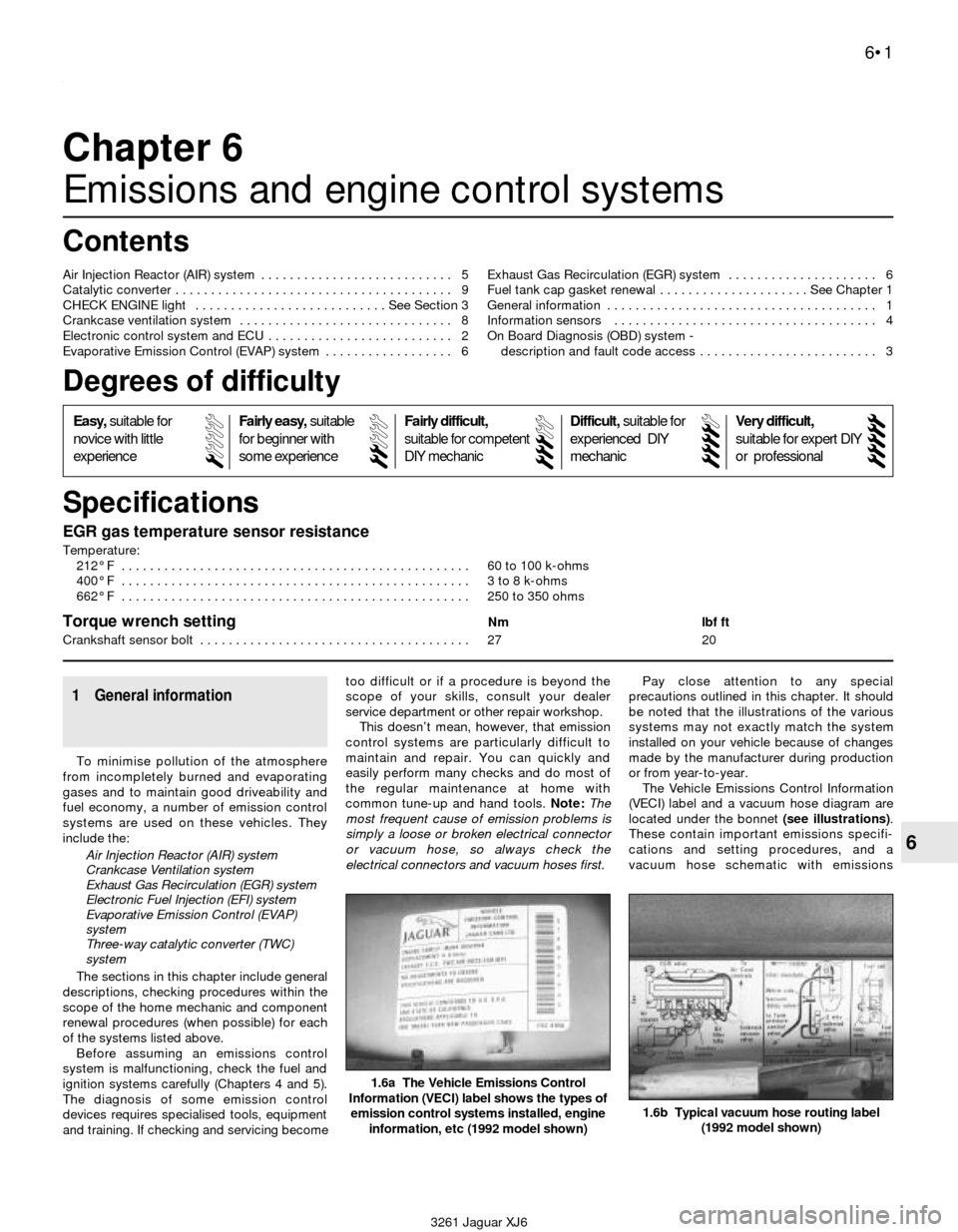
The Vehicle Emissions Control Information
(VECI) label and a vacuum hose diagram are
located under the bonnet (see illustrations).
These contain important emissions specifi-
cations and setting procedures, and a
vacuum hose schematic with emissions
1.6a The Vehicle Emissions Control
Information (VECI) label shows the types of
emission control systems installed, engine
information, etc (1992 model shown)
1.6b Typical vacuum hose routing label
(1992 model shown)
Page 112 of 227
components identified. When servicing the
engine or emissions systems, the VECI label
in your particular vehicle should always be
checked for up-to-date information.
2 Electronic control system
and ECU
General description
Note: These models are susceptible to ECU
damage if water is allowed to build up in the
front cowl drain and overspill into the dash
area near the computer. Inspect and clear the
front cowl drain as a regular maintenance item
to keep the water draining properly. Remove
the duckbill-type rubber hose and inspect it
for clogging, collapsing or deterioration.
1The Lucas LH Engine Management system
controls the fuel injection system by means of
a microcomputer known as the Electronic
Control unit (ECU).
2The ECU receives signals from various
sensors which monitor changing engine
operating conditions such as intake air mass,
intake air temperature, coolant temperature,
engine rpm, acceleration/deceleration,
exhaust oxygen content, etc. These signals
are utilised by the ECU to determine the
correct injection duration.
3The system is analogous to the central
nervous system in the human body: The
sensors (nerve endings) constantly relay
signals to the ECU (brain), which processes
the data and, if necessary, sends out a
command to change the operating
parameters of the engine (body).
4Here’s a specific example of how one
portion of this system operates: An oxygen
sensor, located in the exhaust manifold,
constantly monitors the oxygen content of the
exhaust gas. If the percentage of oxygen in
the exhaust gas is incorrect, an electrical
signal is sent to the ECU. The ECU takes this
information, processes it and then sends a
command to the fuel injection system telling it
to change the air/fuel mixture. This happens in
a fraction of a second and it goes on
continuously when the engine is running. The
end result is an air/fuel mixture ratio which is
constantly maintained at a predetermined
ratio, regardless of driving conditions.
5In the event of a sensor malfunction, a
backup circuit will take over to provide
driveability until the problem is identified and
fixed.
Precautions
6Follow these steps:
a) Always disconnect the power by either
turning off the ignition switch or
disconnecting the battery terminals before
removing electrical connectors.
Warning: Later models are
equipped with airbags. To
prevent accidental deployment ofthe airbag, which could cause personal
injury, DO NOT work in the vicinity of the
steering column or instrument panel. The
manufacturer recommends that, on airbag
equipped models, the following procedure
should be left to a dealer service
department or other repair workshop
because of the special tools and techniques
required to disable the airbag system.
Caution: If the stereo in your vehicle is
equipped with an anti-theft system, make
sure you have the correct activation code
before disconnecting the battery.
b) When refitting a battery, be particularly
careful to avoid reversing the positive and
negative battery cables. Also, make sure
the ignition key is in the Off position when
connecting or disconnecting the battery.
c) Do not subject EFI components,
emissions-related components or the
ECU to severe impact during removal or
refitting.
d) Do not be careless during fault diagnosis.
Even slight terminal contact can invalidate
a testing procedure and damage one of
the numerous transistor circuits.
e) Never attempt to work on the ECU or
open the ECU cover. The ECU is
protected by a government-mandated
extended warranty that will be nullified if
you tamper with or damage the ECU.
f) If you are inspecting electronic control
system components during rainy weather,
make sure that water does not enter any
part. When washing the engine
compartment, do not spray these parts or
their electrical connectors with water.
g) These models are susceptible to ECU
damage if water is allowed to build up in
the front cowl drain and overspill into the
dash area. Inspect and clear the front
cowl drain system as a regular
maintenance item to keep the water
draining properly. Remove the duckbill
type rubber hose and inspect it for
clogging, collapsing or deterioration.
ECU removal and refitting
7Disconnect the negative cable from the
battery (see Chapter 5).
Warning: Later models are
equipped with airbags. To
prevent the accidental deploy-
ment of the airbag, which could
cause personal injury, DO NOT work in the
vicinity of the steering column or
instrument panel. The manufacturer
recommends that, on airbag equipped
models, the following procedure should be
left to a dealer service department or other
repair workshop because of the special
tools and techniques required to disable
the airbag system.
Caution: If the stereo in your vehicle is
equipped with an anti-theft system, make
sure you have the correct activation code
before disconnecting the battery.8Remove the lower instrument panel on the
passenger side under the glove compartment
(see Chapter 11).
9Remove the glove compartment from the
passenger compartment (see Chapter 11).
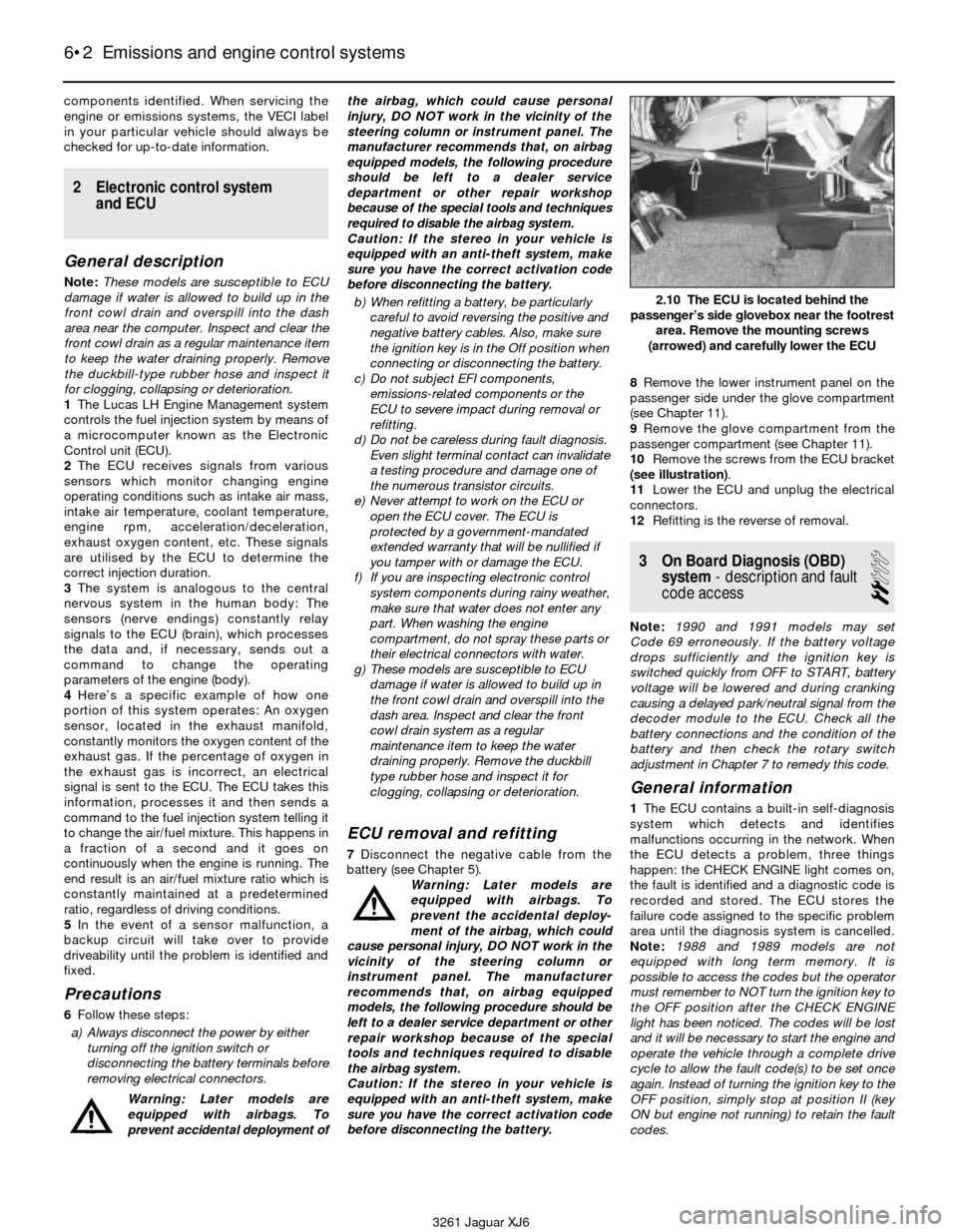
10Remove the screws from the ECU bracket
(see illustration).
11Lower the ECU and unplug the electrical
connectors.
12Refitting is the reverse of removal.
3 On Board Diagnosis (OBD)
system- description and fault
code access
2
Note: 1990 and 1991 models may set
Code 69 erroneously. If the battery voltage
drops sufficiently and the ignition key is
switched quickly from OFF to START, battery
voltage will be lowered and during cranking
causing a delayed park/neutral signal from the
decoder module to the ECU. Check all the
battery connections and the condition of the
battery and then check the rotary switch
adjustment in Chapter 7 to remedy this code.
General information
1The ECU contains a built-in self-diagnosis
system which detects and identifies
malfunctions occurring in the network. When
the ECU detects a problem, three things
happen: the CHECK ENGINE light comes on,
the fault is identified and a diagnostic code is
recorded and stored. The ECU stores the
failure code assigned to the specific problem
area until the diagnosis system is cancelled.
Note: 1988 and 1989 models are not
equipped with long term memory. It is
possible to access the codes but the operator
must remember to NOT turn the ignition key to
the OFF position after the CHECK ENGINE
light has been noticed. The codes will be lost
and it will be necessary to start the engine and
operate the vehicle through a complete drive
cycle to allow the fault code(s) to be set once
again. Instead of turning the ignition key to the
OFF position, simply stop at position II (key
ON but engine not running) to retain the fault
codes.
6•2 Emissions and engine control systems
3261 Jaguar XJ6
2.10 The ECU is located behind the
passenger’s side glovebox near the footrest
area. Remove the mounting screws
(arrowed) and carefully lower the ECU
Page 114 of 227
temperature INCREASES, the resistance
values will DECREASE. A failure in this sensor
circuit should set a Code 3 (1988 and 1989)
or 13 (1990 to 1994). This code indicates a
failure in the coolant temperature sensor
circuit, so in most cases the appropriate
solution to the problem will be either repair of
a connector or wire, or renewal of the sensor.
Check
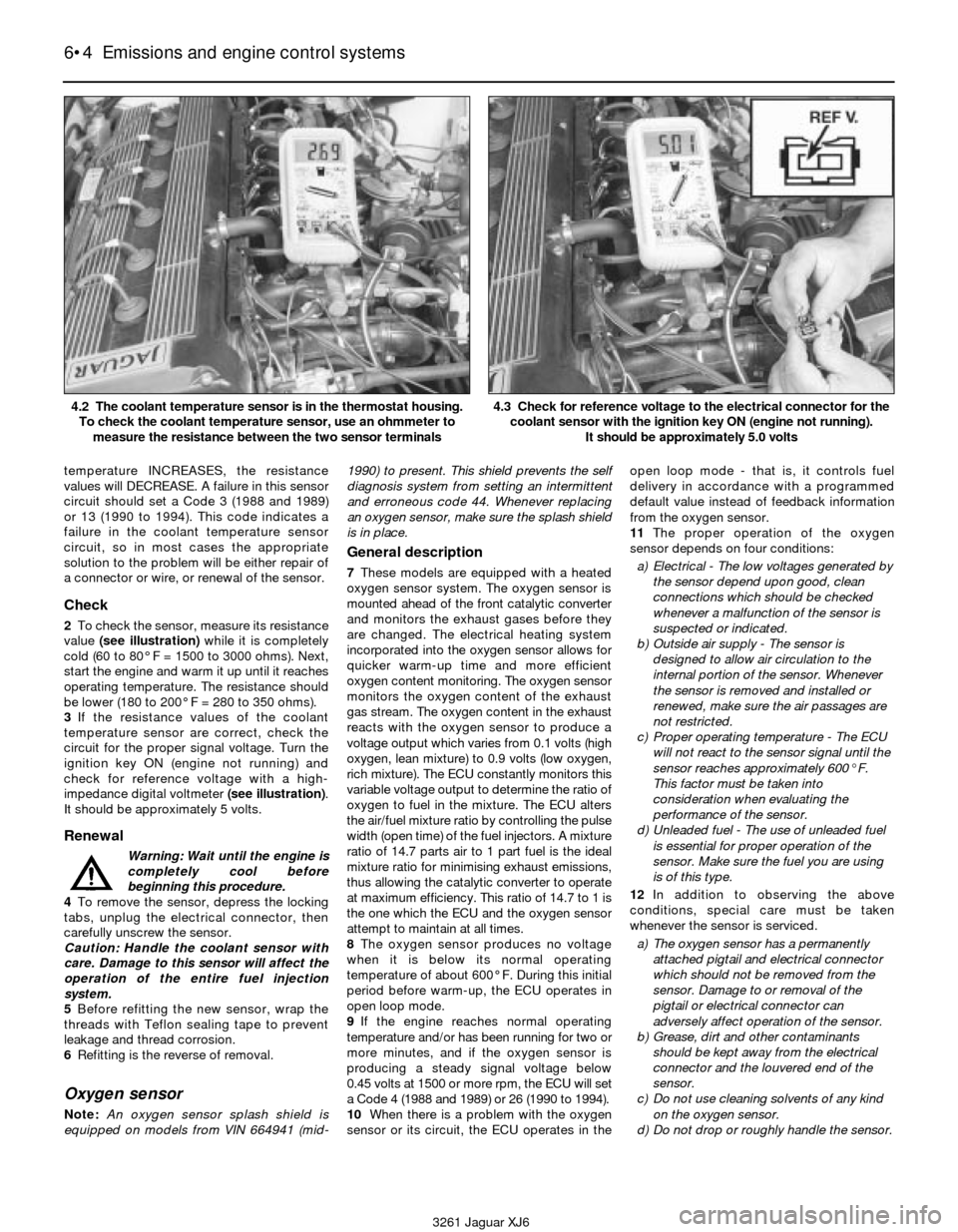
2To check the sensor, measure its resistance
value (see illustration)while it is completely
cold (60 to 80° F = 1500 to 3000 ohms). Next,
start the engine and warm it up until it reaches
operating temperature. The resistance should
be lower (180 to 200° F = 280 to 350 ohms).
3If the resistance values of the coolant
temperature sensor are correct, check the
circuit for the proper signal voltage. Turn the
ignition key ON (engine not running) and
check for reference voltage with a high-
impedance digital voltmeter (see illustration).
It should be approximately 5 volts.
Renewal
Warning: Wait until the engine is
completely cool before
beginning this procedure.
4To remove the sensor, depress the locking
tabs, unplug the electrical connector, then
carefully unscrew the sensor.
Caution: Handle the coolant sensor with
care. Damage to this sensor will affect the
operation of the entire fuel injection
system.
5Before refitting the new sensor, wrap the
threads with Teflon sealing tape to prevent
leakage and thread corrosion.
6Refitting is the reverse of removal.
Oxygen sensor
Note:An oxygen sensor splash shield is
equipped on models from VIN 664941 (mid-1990) to present. This shield prevents the self
diagnosis system from setting an intermittent
and erroneous code 44. Whenever replacing
an oxygen sensor, make sure the splash shield
is in place.
General description
7These models are equipped with a heated
oxygen sensor system. The oxygen sensor is
mounted ahead of the front catalytic converter
and monitors the exhaust gases before they
are changed. The electrical heating system
incorporated into the oxygen sensor allows for
quicker warm-up time and more efficient
oxygen content monitoring. The oxygen sensor
monitors the oxygen content of the exhaust
gas stream. The oxygen content in the exhaust
reacts with the oxygen sensor to produce a
voltage output which varies from 0.1 volts (high
oxygen, lean mixture) to 0.9 volts (low oxygen,
rich mixture). The ECU constantly monitors this
variable voltage output to determine the ratio of
oxygen to fuel in the mixture. The ECU alters
the air/fuel mixture ratio by controlling the pulse
width (open time) of the fuel injectors. A mixture
ratio of 14.7 parts air to 1 part fuel is the ideal
mixture ratio for minimising exhaust emissions,
thus allowing the catalytic converter to operate
at maximum efficiency. This ratio of 14.7 to 1 is
the one which the ECU and the oxygen sensor
attempt to maintain at all times.
8The oxygen sensor produces no voltage
when it is below its normal operating
temperature of about 600° F. During this initial
period before warm-up, the ECU operates in
open loop mode.
9If the engine reaches normal operating
temperature and/or has been running for two or
more minutes, and if the oxygen sensor is
producing a steady signal voltage below
0.45 volts at 1500 or more rpm, the ECU will set
a Code 4 (1988 and 1989) or 26 (1990 to 1994).
10When there is a problem with the oxygen
sensor or its circuit, the ECU operates in theopen loop mode - that is, it controls fuel
delivery in accordance with a programmed
default value instead of feedback information
from the oxygen sensor.
11The proper operation of the oxygen
sensor depends on four conditions:
a) Electrical - The low voltages generated by
the sensor depend upon good, clean
connections which should be checked
whenever a malfunction of the sensor is
suspected or indicated.
b) Outside air supply - The sensor is
designed to allow air circulation to the
internal portion of the sensor. Whenever
the sensor is removed and installed or
renewed, make sure the air passages are
not restricted.
c) Proper operating temperature - The ECU
will not react to the sensor signal until the
sensor reaches approximately 600° F.
This factor must be taken into
consideration when evaluating the
performance of the sensor.
d) Unleaded fuel - The use of unleaded fuel
is essential for proper operation of the
sensor. Make sure the fuel you are using
is of this type.
12In addition to observing the above
conditions, special care must be taken
whenever the sensor is serviced.
a) The oxygen sensor has a permanently
attached pigtail and electrical connector
which should not be removed from the
sensor. Damage to or removal of the
pigtail or electrical connector can
adversely affect operation of the sensor.
b) Grease, dirt and other contaminants
should be kept away from the electrical
connector and the louvered end of the
sensor.
c) Do not use cleaning solvents of any kind
on the oxygen sensor.
d) Do not drop or roughly handle the sensor.
6•4 Emissions and engine control systems
3261 Jaguar XJ6 4.2 The coolant temperature sensor is in the thermostat housing.
To check the coolant temperature sensor, use an ohmmeter to
measure the resistance between the two sensor terminals
4.3 Check for reference voltage to the electrical connector for the
coolant sensor with the ignition key ON (engine not running).
It should be approximately 5.0 volts
Page 150 of 227
again with a dry cloth. Never use alcohol,
petrol, nail polish remover or thinner to clean
leather upholstery.
3After cleaning, regularly treat leather
upholstery with a leather wax. Never use car
wax on leather upholstery.
4In areas where the interior of the vehicle is
subject to bright sunlight, cover leather seats
with a sheet if the vehicle is to be left out for
any length of time.
5 Body repair- minor damage
3
Repair of minor scratches
1If the scratch is superficial and does not
penetrate to the metal of the body, repair is
very simple. Lightly rub the scratched area
with a fine rubbing compound to remove
loose paint and built-up wax. Rinse the area
with clean water.
2Apply touch-up paint to the scratch, using a
small brush. Continue to apply thin layers of
paint until the surface of the paint in the
scratch is level with the surrounding paint.
Allow the new paint at least two weeks to
harden, then blend it into the surrounding
paint by rubbing with a very fine rubbing
compound. Finally, apply a coat of wax to the
scratch area.
3If the scratch has penetrated the paint and
exposed the metal of the body, causing the
metal to rust, a different repair technique is
required. Remove all loose rust from the
bottom of the scratch with a pocket knife,
then apply rust inhibiting paint to prevent the
formation of rust in the future. Using a rubber
or nylon applicator, coat the scratched area
with glaze-type filler. If required, the filler can
be mixed with thinner to provide a very thin
paste, which is ideal for filling narrow
scratches. Before the glaze filler in the scratch
hardens, wrap a piece of smooth cotton cloth
around the tip of a finger. Dip the cloth in
thinner and then quickly wipe it along the
surface of the scratch. This will ensure that
the surface of the filler is slightly hollow. The
scratch can now be painted over as described
earlier in this section.
Repair of dents
4When repairing dents, the first job is to pull
the dent out until the affected area is as close
as possible to its original shape. There is no
point in trying to restore the original shape
completely as the metal in the damaged area
will have stretched on impact and cannot be
restored to its original contours. It is better to
bring the level of the dent up to a point which
is about 1/8-inch below the level of the
surrounding metal. In cases where the dent is
very shallow, it is not worth trying to pull it out
at all.
5If the back side of the dent is accessible, it
can be hammered out gently from behindusing a soft-face hammer. While doing this,
hold a block of wood firmly against the
opposite side of the metal to absorb the
hammer blows and prevent the metal from
being stretched.
6If the dent is in a section of the body which
has double layers, or some other factor makes
it inaccessible from behind, a different
technique is required. Drill several small holes
through the metal inside the damaged area,
particularly in the deeper sections. Screw
long, self-tapping screws into the holes just
enough for them to get a good grip in the
metal. Now the dent can be pulled out by
pulling on the protruding heads of the screws
with locking pliers.
7The next stage of repair is the removal of
paint from the damaged area and from an
inch or so of the surrounding metal. This is
done with a wire brush or sanding disc in a
drill motor, although it can be done just as
effectively by hand with sandpaper. To
complete the preparation for filling, score the
surface of the bare metal with a screwdriver or
the tang of a file, or drill small holes in the
affected area. This will provide a good grip
for the filler material. To complete the repair,
see the subsection on filling and painting later
in this Section.
Repair of rust holes or gashes
8Remove all paint from the affected area and
from an inch or so of the surrounding metal
using a sanding disc or wire brush mounted in
a drill motor. If these are not available, a few
sheets of sandpaper will do the job just as
effectively.
9With the paint removed, you will be able to
determine the severity of the corrosion and
decide whether to replace the whole panel, if
possible, or repair the affected area. New
body panels are not as expensive as most
people think and it is often quicker to refit a
new panel than to repair large areas of rust.
10Remove all trim pieces from the affected
area except those which will act as a guide to
the original shape of the damaged body, such
as headlight shells, etc. Using metal snips or a
hacksaw blade, remove all loose metal and
any other metal that is badly affected by rust.
Hammer the edges of the hole in to create a
slight depression for the filler material.
11Wire brush the affected area to remove
the powdery rust from the surface of the
metal. If the back of the rusted area is
accessible, treat it with rust inhibiting paint.
12Before filling is done, block the hole in
some way. This can be done with sheet metal
riveted or screwed into place, or by stuffing
the hole with wire mesh.
13Once the hole is blocked off, the affected
area can be filled and painted. See the
following subsection on filling and painting.
Filling and painting
14Many types of body fillers are available,
but generally speaking, body repair kits which
contain filler paste and a tube of resinhardener are best for this type of repair work.
A wide, flexible plastic or nylon applicator will
be necessary for imparting a smooth and
contoured finish to the surface of the filler
material. Mix up a small amount of filler on a
clean piece of wood or cardboard (use the
hardener sparingly). Follow the
manufacturer’s instructions on the package,
otherwise the filler will set incorrectly.
15Using the applicator, apply the filler paste
to the prepared area. Draw the applicator
across the surface of the filler to achieve the
desired contour and to level the filler surface.
As soon as a contour that approximates the
original one is achieved, stop working the
paste. If you continue, the paste will begin to
stick to the applicator. Continue to add thin
layers of paste at 20-minute intervals until the
level of the filler is just above the surrounding
metal.
16Once the filler has hardened, the excess
can be removed with a body file. From then
on, progressively finer grades of sandpaper
should be used, starting with a 180-grit paper
and finishing with 600-grit wet-or-dry paper.
Always wrap the sandpaper around a flat
rubber or wooden block, otherwise the
surface of the filler will not be completely flat.
During the sanding of the filler surface, the
wet-or-dry paper should be periodically rinsed
in water. This will ensure that a very smooth
finish is produced in the final stage.
17At this point, the repair area should be
surrounded by a ring of bare metal, which in
turn should be encircled by the finely
feathered edge of good paint. Rinse the repair
area with clean water until all of the dust
produced by the sanding operation is gone.
18Spray the entire area with a light coat of
primer. This will reveal any imperfections in
the surface of the filler. Repair the
imperfections with fresh filler paste or glaze
filler and once more smooth the surface with
sandpaper. Repeat this spray-and-repair
procedure until you are satisfied that the
surface of the filler and the feathered edge of
the paint are perfect. Rinse the area with
clean water and allow it to dry completely.
19The repair area is now ready for painting.
Spray painting must be carried out in a warm,
dry, windless and dust free atmosphere.
These conditions can be created if you have
access to a large indoor work area, but if you
are forced to work in the open, you will have
to pick the day very carefully. If you are
working indoors, dousing the floor in the work
area with water will help settle the dust which
would otherwise be in the air. If the repair area
is confined to one body panel, mask off the
surrounding panels. This will help minimise
the effects of a slight mismatch in paint
colour. Trim pieces such as chrome strips,
door handles, etc., will also need to be
masked off or removed. Use masking tape
and several thickness of newspaper for the
masking operations.
20Before spraying, shake the paint can
thoroughly, then spray a test area until the
11•2 Bodywork and fittings
3261 Jaguar XJ6
Page 173 of 227
8Adjustment should be made with the
vehicle parked 25 feet from the wall, sitting
level, the petrol tank half-full and no unusually
heavy load in the vehicle.
9Starting with the low beam adjustment,
position the high intensity zone so it is two
inches below the horizontal line and two
inches to the right of the headlight vertical
line. Adjustments are made by turning the
knobs located behind the headlight housings
(see illustration 18.2).
10With the high beams on, the high intensity
zone should be vertically centred with the
exact centre just below the horizontal line.
Note:It may not be possible to position the
headlight aim exactly for both high and low
beams. If a compromise must be made, keep
in mind that the low beams are the most used
and have the greatest effect on safety.
11Have the headlights adjusted by a dealer
service department or service station at the
earliest opportunity.
19 Headlight housing
(1992 to 1994 models)-
removal and refitting
1
Warning: These vehicles are
equipped with halogen gas-filled
headlight bulbs which are under
pressure and may shatter if the
surface is damaged or the bulb is dropped.
Wear eye protection and handle the bulbs
carefully, grasping only the base whenever
possible. Do not touch the surface of the
bulb with your fingers because the oil from
your skin could cause it to overheat and
fail prematurely. If you do touch the bulb
surface, clean it with rubbing alcohol.
1Remove the headlight bulb (Section 17).
2Remove the retaining nuts, detach the
housing and withdraw it from the vehicle (see
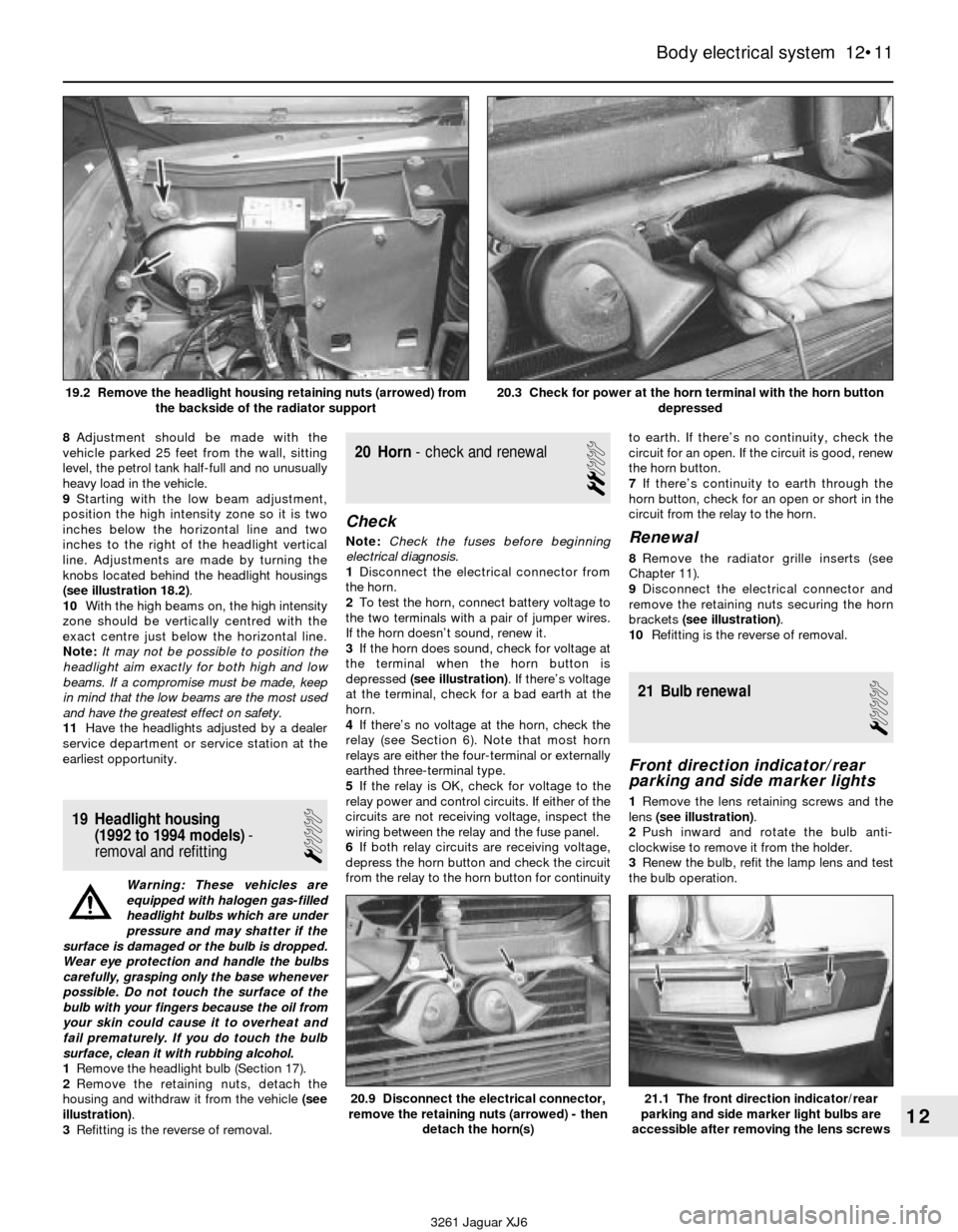
illustration).
3Refitting is the reverse of removal.
20 Horn- check and renewal
2
Check
Note:Check the fuses before beginning
electrical diagnosis.
1Disconnect the electrical connector from
the horn.
2To test the horn, connect battery voltage to
the two terminals with a pair of jumper wires.
If the horn doesn’t sound, renew it.
3If the horn does sound, check for voltage at
the terminal when the horn button is
depressed (see illustration). If there’s voltage
at the terminal, check for a bad earth at the
horn.
4If there’s no voltage at the horn, check the
relay (see Section 6). Note that most horn
relays are either the four-terminal or externally
earthed three-terminal type.
5If the relay is OK, check for voltage to the
relay power and control circuits. If either of the
circuits are not receiving voltage, inspect the
wiring between the relay and the fuse panel.
6If both relay circuits are receiving voltage,
depress the horn button and check the circuit
from the relay to the horn button for continuityto earth. If there’s no continuity, check the
circuit for an open. If the circuit is good, renew
the horn button.
7If there’s continuity to earth through the
horn button, check for an open or short in the
circuit from the relay to the horn.Renewal
8Remove the radiator grille inserts (see
Chapter 11).
9Disconnect the electrical connector and
remove the retaining nuts securing the horn
brackets (see illustration).
10Refitting is the reverse of removal.
21 Bulb renewal
1
Front direction indicator/rear
parking and side marker lights
1Remove the lens retaining screws and the
lens (see illustration).
2Push inward and rotate the bulb anti-
clockwise to remove it from the holder.
3Renew the bulb, refit the lamp lens and test
the bulb operation.
Body electrical system 12•11
12
20.9 Disconnect the electrical connector,
remove the retaining nuts (arrowed) - then
detach the horn(s)21.1 The front direction indicator/rear
parking and side marker light bulbs are
accessible after removing the lens screws
3261 Jaguar XJ6 19.2 Remove the headlight housing retaining nuts (arrowed) from
the backside of the radiator support
20.3 Check for power at the horn terminal with the horn button
depressed
Page 212 of 227
3261 Jaguar XJ6
MOT test checksREF•11
MExamine the handbrake mechanism,
checking for frayed or broken cables,
excessive corrosion, or wear or insecurity of
the linkage. Check that the mechanism works
on each relevant wheel, and releases fully,
without binding.
MIt is not possible to test brake efficiency
without special equipment, but a road test can
be carried out later to check that the vehicle
pulls up in a straight line.
Fuel and exhaust systems
MInspect the fuel tank (including the filler
cap), fuel pipes, hoses and unions. All
components must be secure and free from
leaks.
MExamine the exhaust system over its entire
length, checking for any damaged, broken or
missing mountings, security of the retaining
clamps and rust or corrosion.
Wheels and tyres
MExamine the sidewalls and tread area of
each tyre in turn. Check for cuts, tears, lumps,
bulges, separation of the tread, and exposure
of the ply or cord due to wear or damage.
Check that the tyre bead is correctly seated
on the wheel rim, that the valve is sound andproperly seated, and that the wheel is not
distorted or damaged.
MCheck that the tyres are of the correct size
for the vehicle, that they are of the same size
and type on each axle, and that the pressures
are correct.
MCheck the tyre tread depth. The legal
minimum at the time of writing is 1.6 mm over
at least three-quarters of the tread width.
Abnormal tread wear may indicate incorrect
front wheel alignment.
Body corrosion
MCheck the condition of the entire vehicle
structure for signs of corrosion in load-bearing
areas. (These include chassis box sections,
side sills, cross-members, pillars, and all
suspension, steering, braking system and
seat belt mountings and anchorages.) Any
corrosion which has seriously reduced the
thickness of a load-bearing area is likely to
cause the vehicle to fail. In this case
professional repairs are likely to be needed.
MDamage or corrosion which causes sharp
or otherwise dangerous edges to be exposed
will also cause the vehicle to fail.
Petrol models
MHave the engine at normal operating
temperature, and make sure that it is in good
tune (ignition system in good order, air filter
element clean, etc).
MBefore any measurements are carried out,
raise the engine speed to around 2500 rpm,
and hold it at this speed for 20 seconds. Allowthe engine speed to return to idle, and watch
for smoke emissions from the exhaust
tailpipe. If the idle speed is obviously much
too high, or if dense blue or clearly-visible
black smoke comes from the tailpipe for more
than 5 seconds, the vehicle will fail. As a rule
of thumb, blue smoke signifies oil being burnt
(engine wear) while black smoke signifies
unburnt fuel (dirty air cleaner element, or other
carburettor or fuel system fault).
MAn exhaust gas analyser capable of
measuring carbon monoxide (CO) and
hydrocarbons (HC) is now needed. If such an
instrument cannot be hired or borrowed, a
local garage may agree to perform the check
for a small fee.
CO emissions (mixture)
MAt the time of writing, the maximum CO
level at idle is 3.5% for vehicles first used after
August 1986 and 4.5% for older vehicles.
From January 1996 a much tighter limit
(around 0.5%) applies to catalyst-equipped
vehicles first used from August 1992. If the
CO level cannot be reduced far enough to
pass the test (and the fuel and ignition
systems are otherwise in good condition) then
the carburettor is badly worn, or there is some
problem in the fuel injection system or
catalytic converter (as applicable).
HC emissionsMWith the CO emissions within limits, HC
emissions must be no more than 1200 ppm
(parts per million). If the vehicle fails this test
at idle, it can be re-tested at around 2000 rpm;
if the HC level is then 1200 ppm or less, this
counts as a pass.
MExcessive HC emissions can be caused by
oil being burnt, but they are more likely to be
due to unburnt fuel.
Diesel models
MThe only emission test applicable to Diesel
engines is the measuring of exhaust smoke
density. The test involves accelerating the
engine several times to its maximum
unloaded speed.
Note: It is of the utmost importance that the
engine timing belt is in good condition before
the test is carried out.
M
Excessive smoke can be caused by a dirty
air cleaner element. Otherwise, professional
advice may be needed to find the cause.
4Checks carried out on
YOUR VEHICLE’S EXHAUST
EMISSION SYSTEM
Page 220 of 227
3261 Jaguar XJ6
Glossary of technical termsREF•19
Catalytic converterA silencer-like device in
the exhaust system which converts certain
pollutants in the exhaust gases into less
harmful substances.
CirclipA ring-shaped clip used to prevent
endwise movement of cylindrical parts and
shafts. An internal circlip is installed in a
groove in a housing; an external circlip fits into
a groove on the outside of a cylindrical piece
such as a shaft.
ClearanceThe amount of space between
two parts. For example, between a piston and
a cylinder, between a bearing and a journal,
etc.
Coil springA spiral of elastic steel found in
various sizes throughout a vehicle, for
example as a springing medium in the
suspension and in the valve train.
CompressionReduction in volume, and
increase in pressure and temperature, of a
gas, caused by squeezing it into a smaller
space.
Compression ratioThe relationship between
cylinder volume when the piston is at top
dead centre and cylinder volume when the
piston is at bottom dead centre.
Constant velocity (CV) jointA type of
universal joint that cancels out vibrations
caused by driving power being transmitted
through an angle.
Core plugA disc or cup-shaped metal device
inserted in a hole in a casting through which
core was removed when the casting was
formed. Also known as a freeze plug or
expansion plug.
CrankcaseThe lower part of the engine
block in which the crankshaft rotates.
CrankshaftThe main rotating member, or
shaft, running the length of the crankcase,
with offset “throws” to which the connecting
rods are attached.
Crocodile clipSee Alligator clipDDiagnostic codeCode numbers obtained by
accessing the diagnostic mode of an engine
management computer. This code can be
used to determine the area in the system
where a malfunction may be located.
Disc brakeA brake design incorporating a
rotating disc onto which brake pads are
squeezed. The resulting friction converts the
energy of a moving vehicle into heat.
Double-overhead cam (DOHC)An engine
that uses two overhead camshafts, usually
one for the intake valves and one for the
exhaust valves.
Drivebelt(s)The belt(s) used to drive
accessories such as the alternator, water
pump, power steering pump, air conditioning
compressor, etc. off the crankshaft pulley.
DriveshaftAny shaft used to transmit
motion. Commonly used when referring to the
axleshafts on a front wheel drive vehicle.
Drum brakeA type of brake using a drum-
shaped metal cylinder attached to the inner
surface of the wheel. When the brake pedal is
pressed, curved brake shoes with friction
linings press against the inside of the drum to
slow or stop the vehicle.
EEGR valveA valve used to introduce exhaust
gases into the intake air stream.
Electronic control unit (ECU)A computer
which controls (for instance) ignition and fuel
injection systems, or an anti-lock braking
system. For more information refer to the
Haynes Automotive Electrical and Electronic
Systems Manual.
Electronic Fuel Injection (EFI)A computer
controlled fuel system that distributes fuel
through an injector located in each intake port
of the engine.
Emergency brakeA braking system,
independent of the main hydraulic system,
that can be used to slow or stop the vehicle if
the primary brakes fail, or to hold the vehicle
stationary even though the brake pedal isn’t
depressed. It usually consists of a hand lever
that actuates either front or rear brakes
mechanically through a series of cables and
linkages. Also known as a handbrake or
parking brake.EndfloatThe amount of lengthwise
movement between two parts. As applied to a
crankshaft, the distance that the crankshaft
can move forward and back in the cylinder
block.
Engine management system (EMS)A
computer controlled system which manages
the fuel injection and the ignition systems in
an integrated fashion.
Exhaust manifoldA part with several
passages through which exhaust gases leave
the engine combustion chambers and enter
the exhaust pipe.
F
Fan clutchA viscous (fluid) drive coupling
device which permits variable engine fan
speeds in relation to engine speeds.
Feeler bladeA thin strip or blade of hardened
steel, ground to an exact thickness, used to
check or measure clearances between parts.
Firing orderThe order in which the engine
cylinders fire, or deliver their power strokes,
beginning with the number one cylinder.
Flywheel A heavy spinning wheel in which
energy is absorbed and stored by means of
momentum. On cars, the flywheel is attached
to the crankshaft to smooth out firing
impulses.
Free playThe amount of travel before any
action takes place. The “looseness” in a
linkage, or an assembly of parts, between the
initial application of force and actual
movement. For example, the distance the
brake pedal moves before the pistons in the
master cylinder are actuated.
FuseAn electrical device which protects a
circuit against accidental overload. The typical
fuse contains a soft piece of metal which is
calibrated to melt at a predetermined current
flow (expressed as amps) and break the
circuit.
Fusible linkA circuit protection device
consisting of a conductor surrounded by
heat-resistant insulation. The conductor is
smaller than the wire it protects, so it acts as
the weakest link in the circuit. Unlike a blown
fuse, a failed fusible link must frequently be
cut from the wire for replacement.Catalytic converter
Crankshaft assembly
Accessory drivebelts
Feeler blade
Page 221 of 227
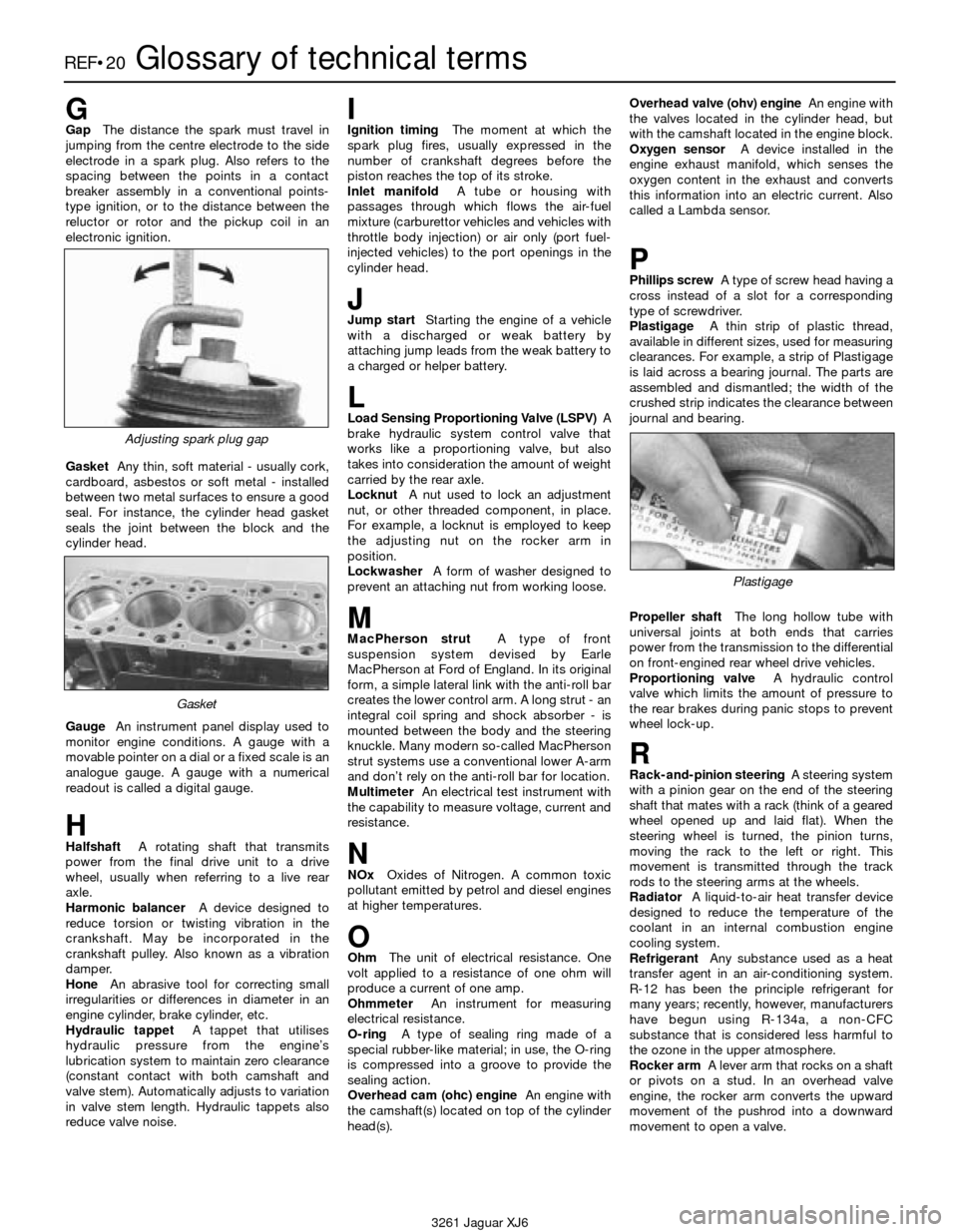
3261 Jaguar XJ6
REF•20Glossary of technical terms
GGapThe distance the spark must travel in
jumping from the centre electrode to the side
electrode in a spark plug. Also refers to the
spacing between the points in a contact
breaker assembly in a conventional points-
type ignition, or to the distance between the
reluctor or rotor and the pickup coil in an
electronic ignition.
GasketAny thin, soft material - usually cork,
cardboard, asbestos or soft metal - installed
between two metal surfaces to ensure a good
seal. For instance, the cylinder head gasket
seals the joint between the block and the
cylinder head.
GaugeAn instrument panel display used to
monitor engine conditions. A gauge with a
movable pointer on a dial or a fixed scale is an
analogue gauge. A gauge with a numerical
readout is called a digital gauge.
HHalfshaftA rotating shaft that transmits
power from the final drive unit to a drive
wheel, usually when referring to a live rear
axle.
Harmonic balancerA device designed to
reduce torsion or twisting vibration in the
crankshaft. May be incorporated in the
crankshaft pulley. Also known as a vibration
damper.
HoneAn abrasive tool for correcting small
irregularities or differences in diameter in an
engine cylinder, brake cylinder, etc.
Hydraulic tappetA tappet that utilises
hydraulic pressure from the engine’s
lubrication system to maintain zero clearance
(constant contact with both camshaft and
valve stem). Automatically adjusts to variation
in valve stem length. Hydraulic tappets also
reduce valve noise.
IIgnition timingThe moment at which the
spark plug fires, usually expressed in the
number of crankshaft degrees before the
piston reaches the top of its stroke.
Inlet manifoldA tube or housing with
passages through which flows the air-fuel
mixture (carburettor vehicles and vehicles with
throttle body injection) or air only (port fuel-
injected vehicles) to the port openings in the
cylinder head.
JJump startStarting the engine of a vehicle
with a discharged or weak battery by
attaching jump leads from the weak battery to
a charged or helper battery.
LLoad Sensing Proportioning Valve (LSPV)A
brake hydraulic system control valve that
works like a proportioning valve, but also
takes into consideration the amount of weight
carried by the rear axle.
LocknutA nut used to lock an adjustment
nut, or other threaded component, in place.
For example, a locknut is employed to keep
the adjusting nut on the rocker arm in
position.
LockwasherA form of washer designed to
prevent an attaching nut from working loose.
MMacPherson strutA type of front
suspension system devised by Earle
MacPherson at Ford of England. In its original
form, a simple lateral link with the anti-roll bar
creates the lower control arm. A long strut - an
integral coil spring and shock absorber - is
mounted between the body and the steering
knuckle. Many modern so-called MacPherson
strut systems use a conventional lower A-arm
and don’t rely on the anti-roll bar for location.
MultimeterAn electrical test instrument with
the capability to measure voltage, current and
resistance.
NNOxOxides of Nitrogen. A common toxic
pollutant emitted by petrol and diesel engines
at higher temperatures.
OOhmThe unit of electrical resistance. One
volt applied to a resistance of one ohm will
produce a current of one amp.
OhmmeterAn instrument for measuring
electrical resistance.
O-ringA type of sealing ring made of a
special rubber-like material; in use, the O-ring
is compressed into a groove to provide the
sealing action.
Overhead cam (ohc) engineAn engine with
the camshaft(s) located on top of the cylinder
head(s).Overhead valve (ohv) engineAn engine with
the valves located in the cylinder head, but
with the camshaft located in the engine block.
Oxygen sensorA device installed in the
engine exhaust manifold, which senses the
oxygen content in the exhaust and converts
this information into an electric current. Also
called a Lambda sensor.
PPhillips screwA type of screw head having a
cross instead of a slot for a corresponding
type of screwdriver.
PlastigageA thin strip of plastic thread,
available in different sizes, used for measuring
clearances. For example, a strip of Plastigage
is laid across a bearing journal. The parts are
assembled and dismantled; the width of the
crushed strip indicates the clearance between
journal and bearing.
Propeller shaftThe long hollow tube with
universal joints at both ends that carries
power from the transmission to the differential
on front-engined rear wheel drive vehicles.
Proportioning valveA hydraulic control
valve which limits the amount of pressure to
the rear brakes during panic stops to prevent
wheel lock-up.
RRack-and-pinion steeringA steering system
with a pinion gear on the end of the steering
shaft that mates with a rack (think of a geared
wheel opened up and laid flat). When the
steering wheel is turned, the pinion turns,
moving the rack to the left or right. This
movement is transmitted through the track
rods to the steering arms at the wheels.
RadiatorA liquid-to-air heat transfer device
designed to reduce the temperature of the
coolant in an internal combustion engine
cooling system.
RefrigerantAny substance used as a heat
transfer agent in an air-conditioning system.
R-12 has been the principle refrigerant for
many years; recently, however, manufacturers
have begun using R-134a, a non-CFC
substance that is considered less harmful to
the ozone in the upper atmosphere.
Rocker armA lever arm that rocks on a shaft
or pivots on a stud. In an overhead valve
engine, the rocker arm converts the upward
movement of the pushrod into a downward
movement to open a valve.
Adjusting spark plug gap
Plastigage
Gasket