belt JAGUAR XJ6 1997 2.G Owner's Manual
[x] Cancel search | Manufacturer: JAGUAR, Model Year: 1997, Model line: XJ6, Model: JAGUAR XJ6 1997 2.GPages: 227, PDF Size: 7.2 MB
Page 100 of 227
headlights or heated rear window and confirm
that the engine rpm decreases at first and
then increases. This check monitors the ISC
motor as it is signalled by the computer to
increase idle speed due to additional
amperage required from the charging system.
As the headlights draw current from the
charging system, the alternator will create
resistance on the belt as it works to produce
the additional energy. If the rpm does not
increase, check the ISC motor.
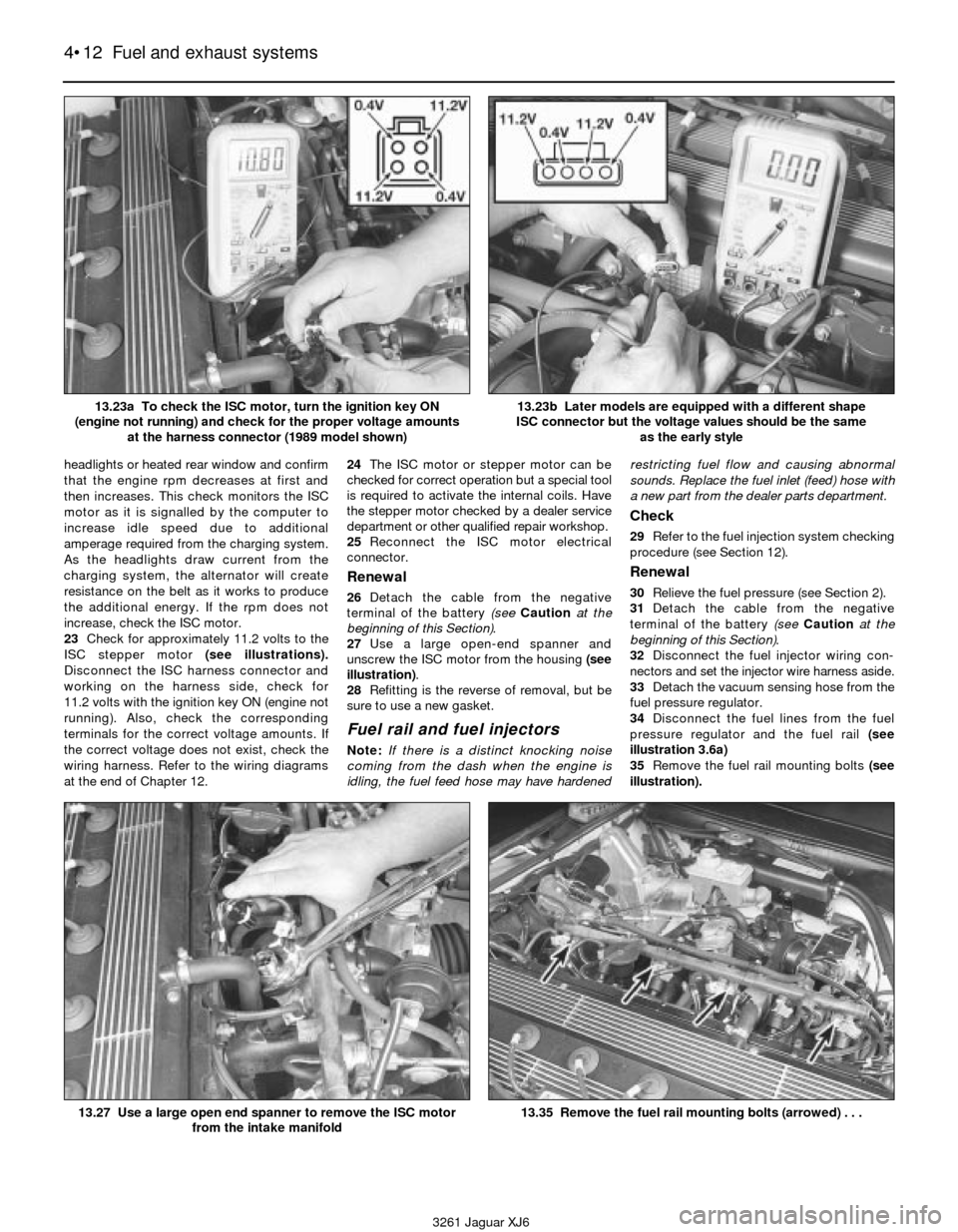
23Check for approximately 11.2 volts to the
ISC stepper motor (see illustrations).
Disconnect the ISC harness connector and
working on the harness side, check for
11.2 volts with the ignition key ON (engine not
running). Also, check the corresponding
terminals for the correct voltage amounts. If
the correct voltage does not exist, check the
wiring harness. Refer to the wiring diagrams
at the end of Chapter 12.24The ISC motor or stepper motor can be
checked for correct operation but a special tool
is required to activate the internal coils. Have
the stepper motor checked by a dealer service
department or other qualified repair workshop.
25Reconnect the ISC motor electrical
connector.
Renewal
26Detach the cable from the negative
terminal of the battery (see Cautionat the
beginning of this Section).
27Use a large open-end spanner and
unscrew the ISC motor from the housing (see
illustration).
28Refitting is the reverse of removal, but be
sure to use a new gasket.
Fuel rail and fuel injectors
Note:If there is a distinct knocking noise
coming from the dash when the engine is
idling, the fuel feed hose may have hardenedrestricting fuel flow and causing abnormal
sounds. Replace the fuel inlet (feed) hose with
a new part from the dealer parts department.
Check
29Refer to the fuel injection system checking
procedure (see Section 12).
Renewal
30Relieve the fuel pressure (see Section 2).
31Detach the cable from the negative
terminal of the battery (see Cautionat the
beginning of this Section).
32Disconnect the fuel injector wiring con-
nectors and set the injector wire harness aside.
33Detach the vacuum sensing hose from the
fuel pressure regulator.
34Disconnect the fuel lines from the fuel
pressure regulator and the fuel rail (see
illustration 3.6a)
35Remove the fuel rail mounting bolts (see
illustration).
4•12 Fuel and exhaust systems
3261 Jaguar XJ6 13.23a To check the ISC motor, turn the ignition key ON
(engine not running) and check for the proper voltage amounts
at the harness connector (1989 model shown)
13.23b Later models are equipped with a different shape
ISC connector but the voltage values should be the same
as the early style
13.27 Use a large open end spanner to remove the ISC motor
from the intake manifold13.35 Remove the fuel rail mounting bolts (arrowed) . . .
Page 103 of 227
3261 Jaguar XJ6
5
Chapter 5
Engine electrical systems
Ignition system
Ignition timing (all models) . . . . . . . . . . . . . . . . . . . . . . . . . . . . . . . . . . . Not adjustable
Ignition coil resistance (at 68°F):
Primary resistance . . . . . . . . . . . . . . . . . . . . . . . . . . . . . . . . . . . . . . . 0.4 to 0.5 ohms
Secondary resistance . . . . . . . . . . . . . . . . . . . . . . . . . . . . . . . . . . . . . 6.0 to 6.5 k-ohms
Charging system
Charging voltage . . . . . . . . . . . . . . . . . . . . . . . . . . . . . . . . . . . . . . . . . . 13.9 to 15.1 volts
Standard amperage:
No load . . . . . . . . . . . . . . . . . . . . . . . . . . . . . . . . . . . . . . . . . . . . . . . . Less than 10 amps
Full load . . . . . . . . . . . . . . . . . . . . . . . . . . . . . . . . . . . . . . . . . . . . . . . 30 amps or more Amplifier - check and renewal . . . . . . . . . . . . . . . . . . . . . . . . . . . . . . 7
Alternator - removal and refitting . . . . . . . . . . . . . . . . . . . . . . . . . . . . 12
Battery cables - check and renewal . . . . . . . . . . . . . . . . . . . . . . . . . 4
Battery check, maintenance and charging . . . . . . . . . . . See Chapter 1
Battery - emergency jump starting . . . . . . . . . . . . . . . . . . . . . . . . . . 2
Battery - removal and refitting . . . . . . . . . . . . . . . . . . . . . . . . . . . . . . 3
Charging system - check . . . . . . . . . . . . . . . . . . . . . . . . . . . . . . . . . . 11
Charging system - general information and precautions . . . . . . . . . 10
CHECK ENGINE light . . . . . . . . . . . . . . . . . . . . . . . . . . . See Chapter 6
Distributor - removal and refitting . . . . . . . . . . . . . . . . . . . . . . . . . . . 9
Drivebelt check, adjustment and renewal . . . . . . . . . . . See Chapter 1General information . . . . . . . . . . . . . . . . . . . . . . . . . . . . . . . . . . . . . . 1
Ignition coil - check and renewal . . . . . . . . . . . . . . . . . . . . . . . . . . . . 8
Ignition system - check . . . . . . . . . . . . . . . . . . . . . . . . . . . . . . . . . . . 6
Ignition system - general information and precautions . . . . . . . . . . . 5
Spark plug renewal . . . . . . . . . . . . . . . . . . . . . . . . . . . . . See Chapter 1
Spark plug lead, distributor cap and rotor check
and renewal . . . . . . . . . . . . . . . . . . . . . . . . . . . . . . . . See Chapter 1
Starter motor - removal and refitting . . . . . . . . . . . . . . . . . . . . . . . . . 15
Starter motor - testing in vehicle . . . . . . . . . . . . . . . . . . . . . . . . . . . . 14
Starter solenoid - removal and refitting . . . . . . . . . . . . . . . . . . . . . . . 16
Starting system - general information and precautions . . . . . . . . . . 13
5•1
Specifications Contents
Easy,suitable for
novice with little
experienceFairly easy,suitable
for beginner with
some experienceFairly difficult,
suitable for competent
DIY mechanic
Difficult,suitable for
experienced DIY
mechanicVery difficult,
suitable for expert DIY
or professional
Degrees of difficulty
54321
1 General information
The engine electrical systems include all
ignition, charging and starting components.
Because of their engine related functions,
these components are discussed separately
from chassis electrical devices such as the
fuses, relays, lights, etc. (which are included in
Chapter 12).
Always observe the following precautions
when working on the electrical systems:
a) Be extremely careful when servicing
engine electrical components. They are
easily damaged if checked, connected or
handled improperly.
b) Never leave the ignition switch on for long
periods of time (10 minutes maximum)
with the engine off.c) Don’t disconnect the battery cables while
the engine is running.
d) Maintain correct polarity when connecting
a battery cable from another vehicle
during jump starting.
e) Always disconnect the negative cable first
and hook it up last or the battery may be
shorted by the tool being used to loosen
the cable clamps.
It’s also a good idea to review the safety-
related information regarding the engine
electrical systems in the Safety first section
near the front of this manual before beginning
any operation included in this Chapter.
2 Battery-
emergency jump starting
1
See “Jump starting”in “Roadside repairs”
at the front of this Manual.
3 Battery- removal and refitting
1
1Disconnect the negative terminal, then the
positive terminal from the battery. On 1989 to
1992 models, the battery is located in the
engine compartment on the passenger side
bulkhead and on 1993 and 1994 models, it is
located in the boot.
Caution: If the stereo in your vehicle is
equipped with an anti-theft system, make
sure you have the correct activation code
before disconnecting the battery.
2Remove the battery hold-down clamp.
3Lift out the battery. Be careful, it’s heavy.
4While the battery is out, inspect the carrier
(tray) for corrosion.
5If you are replacing the battery, make sure
that you get one that’s identical, with the
Page 107 of 227
Refitting
7Insert the distributor into the engine in
exactly the same relationship to the block that
it was in when removed.
8If the distributor does not seat completely,
recheck the alignment marks between the
distributor base and the block to verify that
the distributor is in the same position it was in
before removal. Also check the rotor to see if
it’s aligned with the mark you made on the
edge of the distributor base.
9Refit the distributor hold-down bolt(s).
10The remainder of refitting is the reverse of
removal.
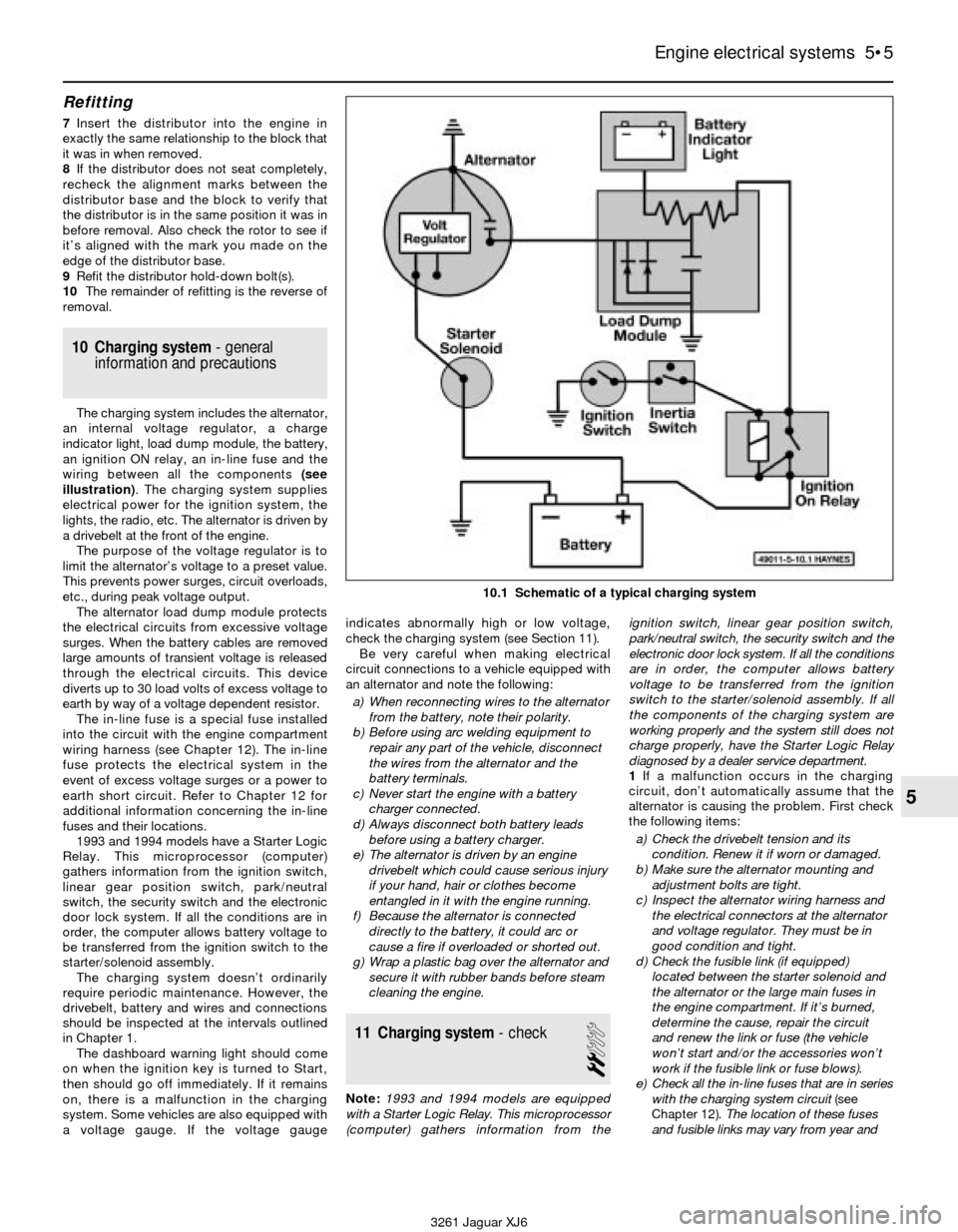
10 Charging system- general
information and precautions
The charging system includes the alternator,
an internal voltage regulator, a charge
indicator light, load dump module, the battery,
an ignition ON relay, an in-line fuse and the
wiring between all the components (see
illustration). The charging system supplies
electrical power for the ignition system, the
lights, the radio, etc. The alternator is driven by
a drivebelt at the front of the engine.
The purpose of the voltage regulator is to
limit the alternator’s voltage to a preset value.
This prevents power surges, circuit overloads,
etc., during peak voltage output.
The alternator load dump module protects
the electrical circuits from excessive voltage
surges. When the battery cables are removed
large amounts of transient voltage is released
through the electrical circuits. This device
diverts up to 30 load volts of excess voltage to
earth by way of a voltage dependent resistor.
The in-line fuse is a special fuse installed
into the circuit with the engine compartment
wiring harness (see Chapter 12). The in-line
fuse protects the electrical system in the
event of excess voltage surges or a power to
earth short circuit. Refer to Chapter 12 for
additional information concerning the in-line
fuses and their locations.
1993 and 1994 models have a Starter Logic
Relay. This microprocessor (computer)
gathers information from the ignition switch,
linear gear position switch, park/neutral
switch, the security switch and the electronic
door lock system. If all the conditions are in
order, the computer allows battery voltage to
be transferred from the ignition switch to the
starter/solenoid assembly.
The charging system doesn’t ordinarily
require periodic maintenance. However, the
drivebelt, battery and wires and connections
should be inspected at the intervals outlined
in Chapter 1.
The dashboard warning light should come
on when the ignition key is turned to Start,
then should go off immediately. If it remains
on, there is a malfunction in the charging
system. Some vehicles are also equipped with
a voltage gauge. If the voltage gaugeindicates abnormally high or low voltage,
check the charging system (see Section 11).
Be very careful when making electrical
circuit connections to a vehicle equipped with
an alternator and note the following:
a) When reconnecting wires to the alternator
from the battery, note their polarity.
b) Before using arc welding equipment to
repair any part of the vehicle, disconnect
the wires from the alternator and the
battery terminals.
c) Never start the engine with a battery
charger connected.
d) Always disconnect both battery leads
before using a battery charger.
e) The alternator is driven by an engine
drivebelt which could cause serious injury
if your hand, hair or clothes become
entangled in it with the engine running.
f) Because the alternator is connected
directly to the battery, it could arc or
cause a fire if overloaded or shorted out.
g) Wrap a plastic bag over the alternator and
secure it with rubber bands before steam
cleaning the engine.
11 Charging system- check
2
Note:1993 and 1994 models are equipped
with a Starter Logic Relay. This microprocessor
(computer) gathers information from theignition switch, linear gear position switch,
park/neutral switch, the security switch and the
electronic door lock system. If all the conditions
are in order, the computer allows battery
voltage to be transferred from the ignition
switch to the starter/solenoid assembly. If all
the components of the charging system are
working properly and the system still does not
charge properly, have the Starter Logic Relay
diagnosed by a dealer service department.
1If a malfunction occurs in the charging
circuit, don’t automatically assume that the
alternator is causing the problem. First check
the following items:
a) Check the drivebelt tension and its
condition. Renew it if worn or damaged.
b) Make sure the alternator mounting and
adjustment bolts are tight.
c) Inspect the alternator wiring harness and
the electrical connectors at the alternator
and voltage regulator. They must be in
good condition and tight.
d) Check the fusible link (if equipped)
located between the starter solenoid and
the alternator or the large main fuses in
the engine compartment. If it’s burned,
determine the cause, repair the circuit
and renew the link or fuse (the vehicle
won’t start and/or the accessories won’t
work if the fusible link or fuse blows).
e) Check all the in-line fuses that are in series
with the charging system circuit (see
Chapter 12).The location of these fuses
and fusible links may vary from year and
Engine electrical systems 5•5
5
10.1 Schematic of a typical charging system
3261 Jaguar XJ6
Page 108 of 227
model but the designations are the same.
Refer to the wiring diagrams at the end of
Chapter 12.
f) Start the engine and check the alternator
for abnormal noises (a shrieking or
squealing sound indicates a bad bushing).
g) Check the specific gravity of the battery
electrolyte. If it’s low, charge the battery
(doesn’t apply to maintenance free
batteries).
h) Make sure that the battery is fully charged
(one bad cell in a battery can cause
overcharging by the alternator).
i) Disconnect the battery cables (negative
first, then positive). Caution:If the stereo
in your vehicle is equipped with an anti-
theft system, make sure you have the
correct activation code before
disconnecting the battery. Inspect the
battery posts and the cable clamps for
corrosion. Clean them thoroughly if
necessary (see Chapter 1). Reconnect the
positive cable, then the negative cable.
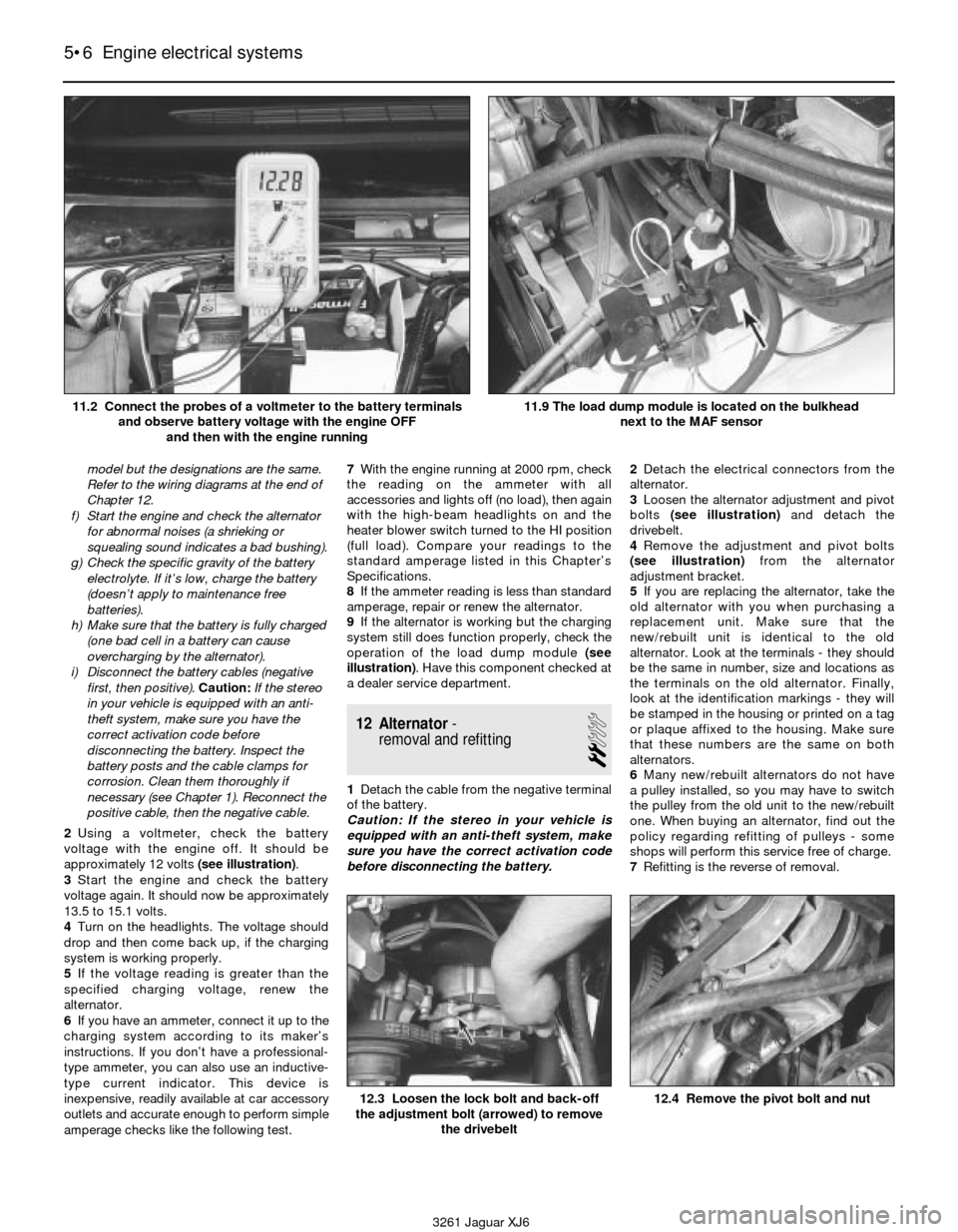
2Using a voltmeter, check the battery
voltage with the engine off. It should be
approximately 12 volts (see illustration).
3Start the engine and check the battery
voltage again. It should now be approximately
13.5 to 15.1 volts.
4Turn on the headlights. The voltage should
drop and then come back up, if the charging
system is working properly.
5If the voltage reading is greater than the
specified charging voltage, renew the
alternator.
6If you have an ammeter, connect it up to the
charging system according to its maker’s
instructions. If you don’t have a professional-
type ammeter, you can also use an inductive-
type current indicator. This device is
inexpensive, readily available at car accessory
outlets and accurate enough to perform simple
amperage checks like the following test.7With the engine running at 2000 rpm, check
the reading on the ammeter with all
accessories and lights off (no load), then again
with the high-beam headlights on and the
heater blower switch turned to the HI position
(full load). Compare your readings to the
standard amperage listed in this Chapter’s
Specifications.
8If the ammeter reading is less than standard
amperage, repair or renew the alternator.
9If the alternator is working but the charging
system still does function properly, check the
operation of the load dump module (see
illustration). Have this component checked at
a dealer service department.
12 Alternator-
removal and refitting
2
1Detach the cable from the negative terminal
of the battery.
Caution: If the stereo in your vehicle is
equipped with an anti-theft system, make
sure you have the correct activation code
before disconnecting the battery.2Detach the electrical connectors from the
alternator.
3Loosen the alternator adjustment and pivot
bolts (see illustration) and detach the
drivebelt.
4Remove the adjustment and pivot bolts
(see illustration)from the alternator
adjustment bracket.
5If you are replacing the alternator, take the
old alternator with you when purchasing a
replacement unit. Make sure that the
new/rebuilt unit is identical to the old
alternator. Look at the terminals - they should
be the same in number, size and locations as
the terminals on the old alternator. Finally,
look at the identification markings - they will
be stamped in the housing or printed on a tag
or plaque affixed to the housing. Make sure
that these numbers are the same on both
alternators.
6Many new/rebuilt alternators do not have
a pulley installed, so you may have to switch
the pulley from the old unit to the new/rebuilt
one. When buying an alternator, find out the
policy regarding refitting of pulleys - some
shops will perform this service free of charge.
7Refitting is the reverse of removal.
5•6 Engine electrical systems
12.3 Loosen the lock bolt and back-off
the adjustment bolt (arrowed) to remove
the drivebelt12.4 Remove the pivot bolt and nut
3261 Jaguar XJ6 11.2 Connect the probes of a voltmeter to the battery terminals
and observe battery voltage with the engine OFF
and then with the engine running
11.9 The load dump module is located on the bulkhead
next to the MAF sensor
Page 109 of 227
8After the alternator is installed, adjust the
drivebelt tension (see Chapter 1).
9Check the charging voltage to verify proper
operation of the alternator (see Section 11).
13 Starting system- general
information and precautions
The sole function of the starting system is
to crank the engine over quickly enough to
allow it to start.
The starting system consists of the battery,
the starter motor, the starter solenoid, the
starter relay and the electrical circuit
connecting the components. The solenoid is
mounted directly on the starter motor.
The solenoid/starter motor assembly is
installed on the upper part of the engine, next
to the transmission bellhousing.
When the ignition key is turned to the
START position, the starter solenoid is
actuated through the starter control circuit.
The starter solenoid then connects the battery
to the starter. The battery supplies the
electrical energy to the starter motor, which
does the actual work of cranking the engine.
The starter on a vehicle equipped with an
automatic transmission can be operated only
when the transmission selector lever is in Park
or Neutral.
These vehicles are equipped with either a
Bosch or Lucas starter assembly. The Lucas
unit is distinguished by the separate earth
strap from the solenoid to the starter body.
Bosch starter assemblies are equipped with a
solid metal earthing bar.
The starting system circuit is equipped with
a relay. The relay allows the ignition switch to
power the starter solenoid.
Always observe the following precautions
when working on the starting system:
a) Excessive cranking of the starter motor
can overheat it and cause serious
damage. Never operate the starter motor
for more than 15 seconds at a time
without pausing to allow it to cool for at
least two minutes.
b) The starter is connected directly to the
battery and could arc or cause a fire if
mishandled, overloaded or short circuited.
c) Always detach the cable from the
negative terminal of the battery before
working on the starting system.
Caution:If the stereo in your vehicle is
equipped with an anti-theft system, make
sure you have the correct activation code
before disconnecting the battery.
14 Starter motor-
testing in vehicle
2
1Make sure that the battery is charged and
that all cables, both at the battery and starter
solenoid terminals, are clean and secure.2If the starter motor does not turn at all when
the switch is operated, make sure that the
shift lever is in Neutral or Park (automatic
transmission) or that the clutch pedal is
depressed (manual transmission).
3If the starter motor spins but the engine is
not cranking, the overrunning clutch in the
starter motor is slipping and the starter motor
must be renewed.
4If, when the switch is actuated, the starter
motor does not operate at all but the solenoid
clicks, then the problem lies with either the
battery, the main solenoid contacts or the
starter motor itself (or the engine is seized).
5If the solenoid plunger cannot be heard
when the switch is actuated, the battery is
bad, the in-line fuse is burned (the circuit is
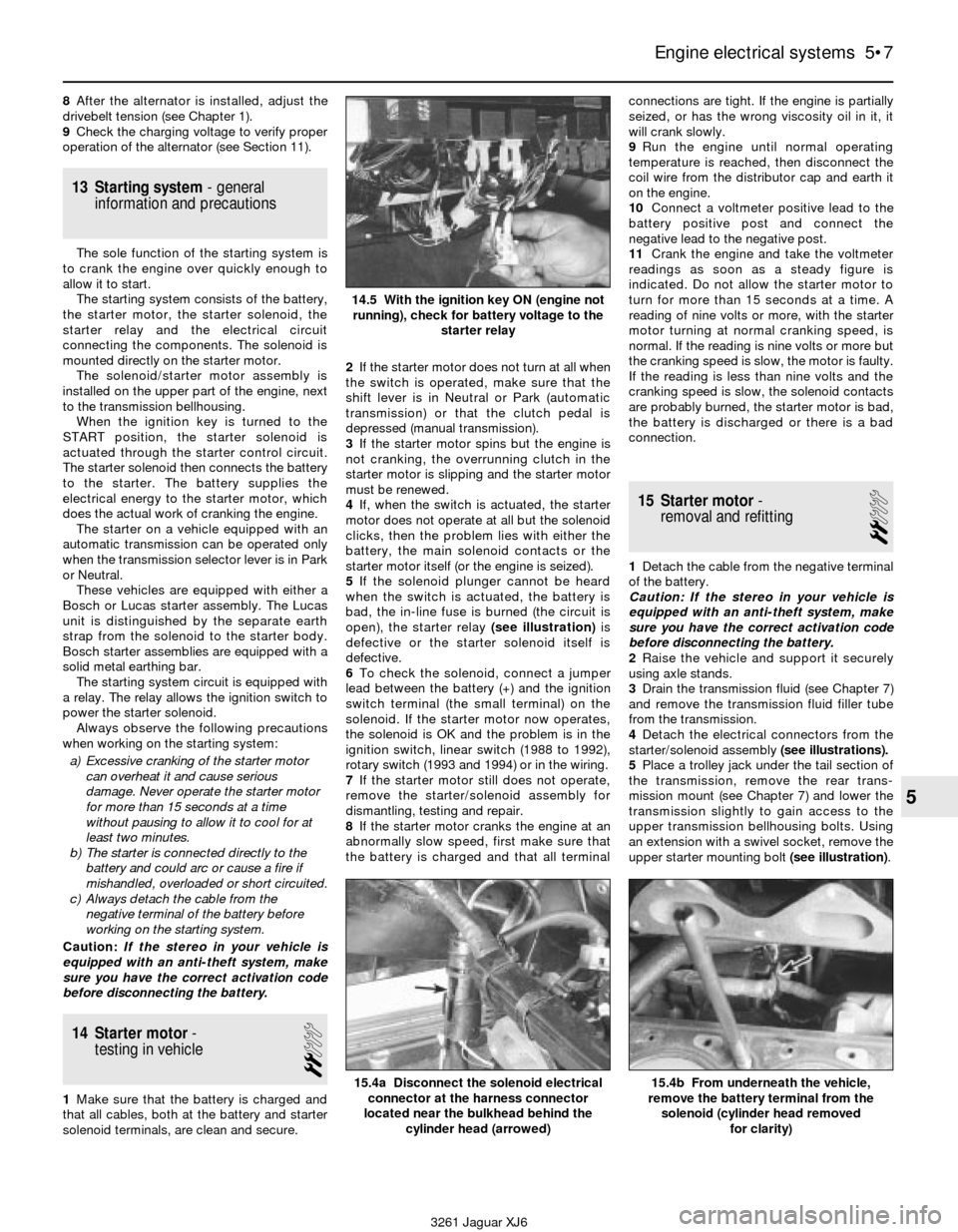
open), the starter relay (see illustration)is
defective or the starter solenoid itself is
defective.
6To check the solenoid, connect a jumper
lead between the battery (+) and the ignition
switch terminal (the small terminal) on the
solenoid. If the starter motor now operates,
the solenoid is OK and the problem is in the
ignition switch, linear switch (1988 to 1992),
rotary switch (1993 and 1994) or in the wiring.
7If the starter motor still does not operate,
remove the starter/solenoid assembly for
dismantling, testing and repair.
8If the starter motor cranks the engine at an
abnormally slow speed, first make sure that
the battery is charged and that all terminalconnections are tight. If the engine is partially
seized, or has the wrong viscosity oil in it, it
will crank slowly.
9Run the engine until normal operating
temperature is reached, then disconnect the
coil wire from the distributor cap and earth it
on the engine.
10Connect a voltmeter positive lead to the
battery positive post and connect the
negative lead to the negative post.
11Crank the engine and take the voltmeter
readings as soon as a steady figure is
indicated. Do not allow the starter motor to
turn for more than 15 seconds at a time. A
reading of nine volts or more, with the starter
motor turning at normal cranking speed, is
normal. If the reading is nine volts or more but
the cranking speed is slow, the motor is faulty.
If the reading is less than nine volts and the
cranking speed is slow, the solenoid contacts
are probably burned, the starter motor is bad,
the battery is discharged or there is a bad
connection.
15 Starter motor-
removal and refitting
2
1Detach the cable from the negative terminal
of the battery.
Caution: If the stereo in your vehicle is
equipped with an anti-theft system, make
sure you have the correct activation code
before disconnecting the battery.
2Raise the vehicle and support it securely
using axle stands.
3Drain the transmission fluid (see Chapter 7)
and remove the transmission fluid filler tube
from the transmission.
4Detach the electrical connectors from the
starter/solenoid assembly (see illustrations).
5Place a trolley jack under the tail section of
the transmission, remove the rear trans-
mission mount (see Chapter 7) and lower the
transmission slightly to gain access to the
upper transmission bellhousing bolts. Using
an extension with a swivel socket, remove the
upper starter mounting bolt (see illustration).
Engine electrical systems 5•7
5
14.5 With the ignition key ON (engine not
running), check for battery voltage to the
starter relay
15.4a Disconnect the solenoid electrical
connector at the harness connector
located near the bulkhead behind the
cylinder head (arrowed)15.4b From underneath the vehicle,
remove the battery terminal from the
solenoid (cylinder head removed
for clarity)
3261 Jaguar XJ6
Page 118 of 227

5 Air Injector Reactor
(AIR) system
General information
1The air injection reactor system reduces
carbon monoxide and hydrocarbon content
in the exhaust gases by injecting fresh air into
the hot exhaust gases leaving the exhaust
ports. When fresh air is mixed with hot
exhaust gases, oxidation is increased,
reducing the concentration of hydrocarbons
and carbon monoxide and converting them
into harmless carbon dioxide and water.
2The air injection system is composed of an
air pump, diverter valve (bypass), check valve,
air injection manifold, vacuum delay valve,
vacuum control solenoid, air pump magnetic
clutch, air pump clutch relay and hoses (see
illustration). The air pump is driven by a belt
from the crankshaft and supplies compressed
air to the exhaust manifold(s). The check valve
prevents the reverse flow of exhaust gases into
the system. The vacuum-operated (early
models) or electrically-operated (later models)air cut-off valve prevents air from being drawn
into the exhaust when the air pump is switched
off. System vacuum to the air cut-off valve is
controlled by the solenoid vacuum valve in
parallel circuit with the air pump. A delay valve
prevents vacuum loss to the solenoid valve
during wide open throttle operation.
3Injected air is controlled by the computer,
the air pump clutch and the air pump clutch
relay. The AIR system is used during warm-up
(58 to 83° F) to control emissions while the
engine is running rich. The oxygen sensor
feedback system cannot function while the AIR
system is operating. The computer controls
both systems during warm-up and operating
temperatures. If problems occur with the
AIR system relay or circuit, the on-board
diagnosis system will set a code 66.
Check
4Check the condition of the air pump
drivebelt, the injection hoses and the injection
manifold. Make sure that all components are
intact and there are no leaks.
5Check the operation of the air pump clutch
relay (see illustration)and the air pump
clutch. First remove the relay and check forbattery voltage to the relay. Also, check the
relay itself. Refer to the relay checking
procedure in Chapter 12. Extract codes from
the self-diagnosis system (see Section 3) and
check for a code 66, AIR relay malfunction.
6Make sure the electrical connector is
securely fastened to the diverter valve (see
illustration). If everything appears OK but a
fault code still sets, have the system
diagnosed by a dealer service department or
other qualified repair workshop.
Air pump renewal
7Disconnect the cable from the negative
terminal of the battery.
Caution: If the stereo in your vehicle is
equipped with an anti-theft system, make
sure you have the correct activation code
before disconnecting the battery.
8Disconnect the electrical connector from
the air pump clutch.
9Loosen the clips from the air inlet and outlet
hose and separate them from the air injection
pump.
10Loosen the adjuster and pivot bolts (see
illustration)and nuts but do not remove them
from the air injection pump brackets.
6•8 Emissions and engine control systems
3261 Jaguar XJ6 5.2 Schematic of the Air Injection Reactor (AIR) system
5.6 Location of the AIR diverter valve on a 1992 model - check the
hoses for cracking and the electrical connector for security5.10 Loosen the pivot bolt and then the adjustment nut to remove
the drivebelt from the air pump. The adjustment nut has a lock bolt
that must be loosened before the pump will move down the adjuster
5.5 Location of the AIR pump relay on a 1992 model
Page 119 of 227

11Swing the pump toward the engine and
remove the drivebelt from the pump.
12Remove the link arm through-bolt.
13Remove the pivot bolt and front spacer,
rear cone and air injection pump from the
engine compartment.
14Remove the nut securing the front pulley
on the air injection pump.
15Remove the clutch snap-ring and the
clutch.
16Refitting is the reverse of removal.
6 Exhaust Gas Recirculation
(EGR) system
Note 1: Some 1990 models have the EGR
vacuum hose routed incorrectly through the
bulkhead securing straps, thereby restricting
the vacuum signal to the EGR valve. Remove
the EGR vacuum hose from the bulkhead
harness and refit a new hose. Secure it to the
engine compartment using tie-wraps and do
not allow any restrictions in the hose.Note 2: Some models have copper sealing
washers that soften and leak around the EGR
valve causing engine performance and
starting problems. Refit steel washers and
pipe adapters into the EGR system. Contact a
Jaguar dealer for the VIN numbers and years
of the models that are affected by this defect.
1To reduce oxides of nitrogen emissions,
some of the exhaust gases are recirculated
through the EGR valve to the intake manifold
to lower combustion temperatures.
2The EGR system consists of the EGR valve,
an EGR solenoid, an EGR gas temperature
sensor and the transfer pipe (see illustration).
Check
EGR valve
3Start the engine and allow it to idle.
4Detach the vacuum hose from the EGR
valve and attach a hand vacuum pump in its
place (see illustration).
5Apply vacuum to the EGR valve. Vacuum
should remain steady and the engine should
run poorly. Note:This action will raise the
pintle and allow exhaust gases to recirculateinto the intake system and cause rough
running condition at idle.Double-check the
movement of the pintle by checking the
diaphragm using the tip of your finger (see
illustration). If the EGR diaphragm moves
smoothly and holds steady when vacuum is
applied, the EGR valve is working properly.
Warning: Don’t burn yourself. If
the EGR valve is hot, wear a
glove or wait until it cools.
a) If the vacuum doesn’t remain steady and
the engine doesn’t run poorly, renew the
EGR valve and recheck it.
b) If the vacuum remains steady but the
engine doesn’t run poorly, remove the
EGR valve and check the valve and the
intake manifold for blockage. Clean or
renew parts as necessary and recheck.EGR system
6Disconnect the hose from the EGR valve,
refit a vacuum gauge and check for vacuum
to the EGR valve. There should be vacuum
present with the engine warmed to operating
temperature (above 140° F) and between
1000 and 4000 rpm (see illustration).
Emissions and engine control systems 6•9
6
3261 Jaguar XJ6 6.2 Schematic of the EGR system
6.4 Apply vacuum to the EGR valve and confirm that the valve
opens and allows exhaust gases to circulate. Once it is activated,
the EGR valve should hold steady (no loss in vacuum)
6.5 Use a fingertip to move the diaphragm inside the EGR valve6.6 Check for vacuum to the EGR valve from the throttle body
Page 147 of 227
and installed on a new or rebuilt pump. (This
procedure requires special tools, and the
height of the driven coupling on the shaft
must be set with a depth gauge.)
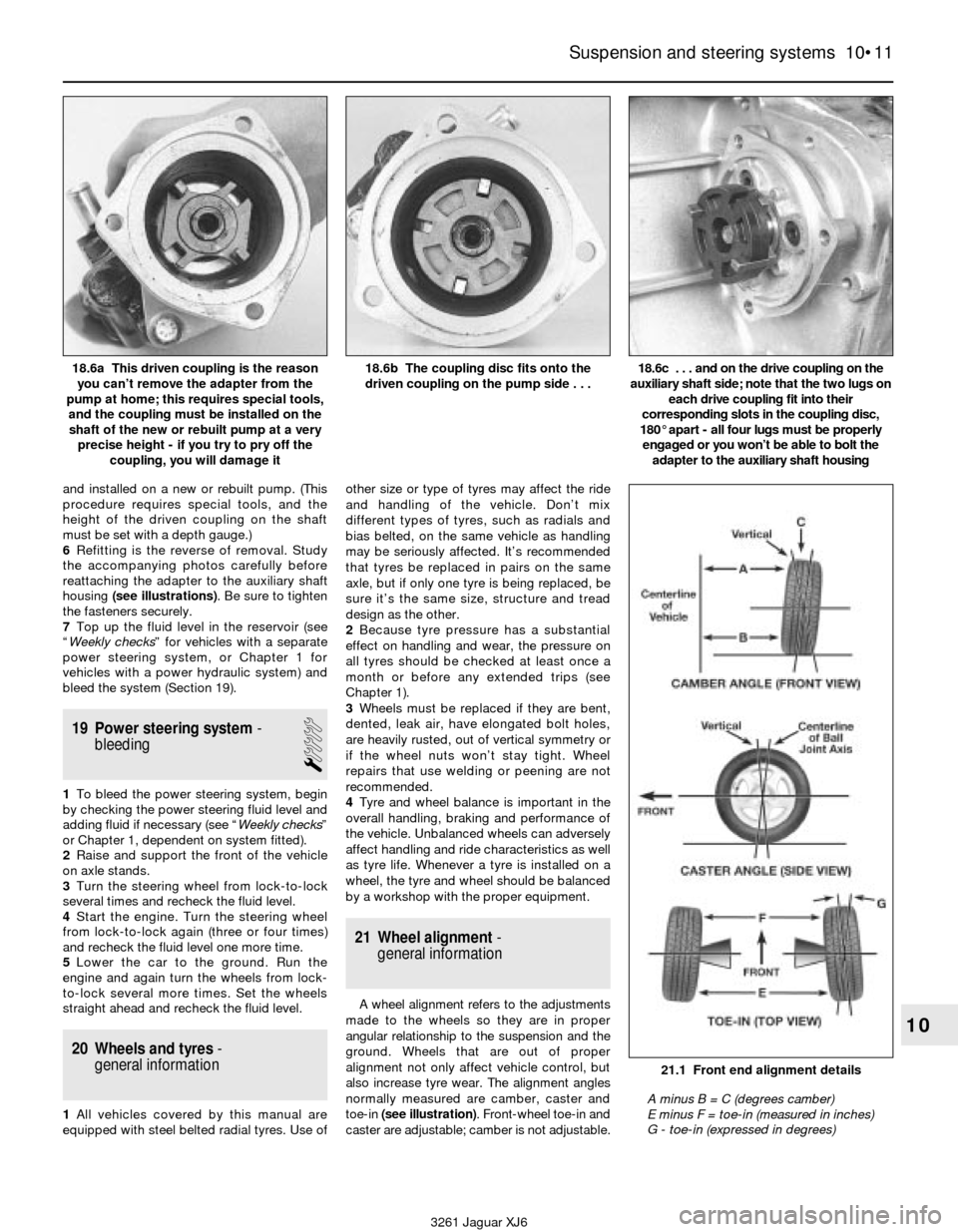
6Refitting is the reverse of removal. Study
the accompanying photos carefully before
reattaching the adapter to the auxiliary shaft
housing (see illustrations). Be sure to tighten
the fasteners securely.
7Top up the fluid level in the reservoir (see
“Weekly checks” for vehicles with a separate
power steering system, or Chapter 1 for
vehicles with a power hydraulic system) and
bleed the system (Section 19).
19 Power steering system-
bleeding
1
1To bleed the power steering system, begin
by checking the power steering fluid level and
adding fluid if necessary (see “Weekly checks”
or Chapter 1, dependent on system fitted).
2Raise and support the front of the vehicle
on axle stands.
3Turn the steering wheel from lock-to-lock
several times and recheck the fluid level.
4Start the engine. Turn the steering wheel
from lock-to-lock again (three or four times)
and recheck the fluid level one more time.
5Lower the car to the ground. Run the
engine and again turn the wheels from lock-
to-lock several more times. Set the wheels
straight ahead and recheck the fluid level.
20 Wheels and tyres-
general information
1All vehicles covered by this manual are
equipped with steel belted radial tyres. Use ofother size or type of tyres may affect the ride
and handling of the vehicle. Don’t mix
different types of tyres, such as radials and
bias belted, on the same vehicle as handling
may be seriously affected. It’s recommended
that tyres be replaced in pairs on the same
axle, but if only one tyre is being replaced, be
sure it’s the same size, structure and tread
design as the other.
2Because tyre pressure has a substantial
effect on handling and wear, the pressure on
all tyres should be checked at least once a
month or before any extended trips (see
Chapter 1).
3Wheels must be replaced if they are bent,
dented, leak air, have elongated bolt holes,
are heavily rusted, out of vertical symmetry or
if the wheel nuts won’t stay tight. Wheel
repairs that use welding or peening are not
recommended.
4Tyre and wheel balance is important in the
overall handling, braking and performance of
the vehicle. Unbalanced wheels can adversely
affect handling and ride characteristics as well
as tyre life. Whenever a tyre is installed on a
wheel, the tyre and wheel should be balanced
by a workshop with the proper equipment.
21 Wheel alignment-
general information
A wheel alignment refers to the adjustments
made to the wheels so they are in proper
angular relationship to the suspension and the
ground. Wheels that are out of proper
alignment not only affect vehicle control, but
also increase tyre wear. The alignment angles
normally measured are camber, caster and
toe-in (see illustration). Front-wheel toe-in and
caster are adjustable; camber is not adjustable.
Suspension and steering systems 10•11
10
3261 Jaguar XJ6 18.6a This driven coupling is the reason
you can’t remove the adapter from the
pump at home; this requires special tools,
and the coupling must be installed on the
shaft of the new or rebuilt pump at a very
precise height - if you try to pry off the
coupling, you will damage it
18.6b The coupling disc fits onto the
driven coupling on the pump side . . .18.6c . . . and on the drive coupling on the
auxiliary shaft side; note that the two lugs on
each drive coupling fit into their
corresponding slots in the coupling disc,
180° apart - all four lugs must be properly
engaged or you won’t be able to bolt the
adapter to the auxiliary shaft housing
21.1 Front end alignment details
A minus B = C (degrees camber)
E minus F = toe-in (measured in inches)
G - toe-in (expressed in degrees)
Page 205 of 227
3261 Jaguar XJ6
REF•4Buying spare parts
Spare parts are available from many
sources, including maker’s appointed
garages, accessory shops, and motor factors.
To be sure of obtaining the correct parts, it
will sometimes be necessary to quote the
vehicle identification number. If possible, it
can also be useful to take the old parts along
for positive identification. Items such as
starter motors and alternators may be
available under a service exchange scheme -
any parts returned should be clean.
Our advice regarding spare parts is as
follows.
Officially appointed garages
This is the best source of parts which are
peculiar to your car, and which are not
otherwise generally available (eg, badges,
interior trim, certain body panels, etc). It is
also the only place at which you should buy
parts if the vehicle is still under warranty.
Accessory shops
These are very good places to buy
materials and components needed for themaintenance of your car (oil, air and fuel
filters, light bulbs, drivebelts, greases, brake
pads, touch-up paint, etc). Components of
this nature sold by a reputable shop are
usually of the same standard as those used
by the car manufacturer.
Besides components, these shops also sell
tools and general accessories, usually have
convenient opening hours, charge lower
prices, and can often be found close to home.
Some accessory shops have parts counters
where components needed for almost any
repair job can be purchased or ordered.
Motor factors
Good factors will stock all the more
important components which wear out
comparatively quickly, and can sometimes
supply individual components needed for the
overhaul of a larger assembly (eg, brake seals
and hydraulic parts, bearing shells, pistons,
valves). They may also handle work such as
cylinder block reboring, crankshaft regrinding,
etc.
Tyre and exhaust specialists
These outlets may be independent, or
members of a local or national chain. They
frequently offer competitive prices when
compared with a main dealer or local garage,
but it will pay to obtain several quotes before
making a decision. When researching prices,
also ask what “extras” may be added - for
instance fitting a new valve and balancing the
wheel are both commonly charged on top of
the price of a new tyre.
Other sources
Beware of parts or materials obtained from
market stalls, car boot sales or similar outlets.
Such items are not invariably sub-standard,
but there is little chance of compensation if
they do prove unsatisfactory. In the case of
safety-critical components such as brake
pads, there is the risk of financial loss, and
also of an accident causing injury or death.
Second-hand parts or assemblies obtained
from a car breaker can be a good buy in some
circumstances, but this sort of purchase is
best made by the experienced DIY mechanic.
Vehicle identification
Modifications are a continuing and
unpublicised process in vehicle manufacture,
quite apart from major model changes. Spare
parts manuals and lists are compiled upon a
numerical basis, the individual vehicle
identification numbers being essential to
correct identification of the part concerned.
When ordering spare parts, always give as
much information as possible. Quote the car
model, year of manufacture and registration,
chassis and engine numbers as appropriate.
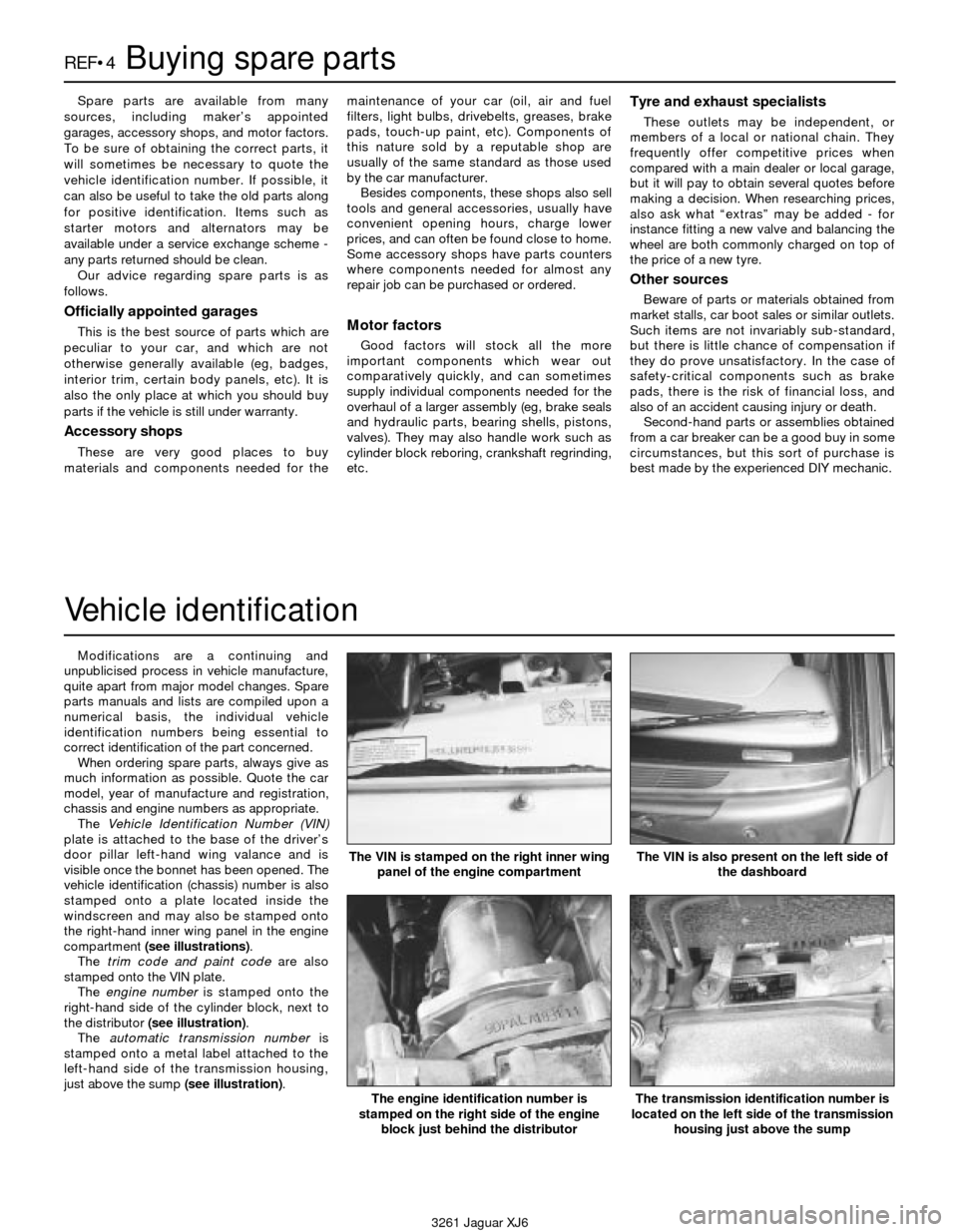
The Vehicle Identification Number (VIN)
plate is attached to the base of the driver’s
door pillar left-hand wing valance and is
visible once the bonnet has been opened. The
vehicle identification (chassis) number is also
stamped onto a plate located inside the
windscreen and may also be stamped onto
the right-hand inner wing panel in the engine
compartment (see illustrations).
The trim code and paint codeare also
stamped onto the VIN plate.
The engine numberis stamped onto the
right-hand side of the cylinder block, next to
the distributor (see illustration).
The automatic transmission numberis
stamped onto a metal label attached to the
left-hand side of the transmission housing,
just above the sump (see illustration).The VIN is stamped on the right inner wing
panel of the engine compartment
The engine identification number is
stamped on the right side of the engine
block just behind the distributorThe transmission identification number is
located on the left side of the transmission
housing just above the sump
The VIN is also present on the left side of
the dashboard
Page 210 of 227

3261 Jaguar XJ6
MOT test checksREF•9
Seat belts and seats
Note: The following checks are applicable to
all seat belts, front and rear.
MExamine the webbing of all the belts
(including rear belts if fitted) for cuts, serious
fraying or deterioration. Fasten and unfasten
each belt to check the buckles. If applicable,
check the retracting mechanism. Check the
security of all seat belt mountings accessible
from inside the vehicle.
MThe front seats themselves must be
securely attached and the backrests must
lock in the upright position.
Doors
MBoth front doors must be able to be opened
and closed from outside and inside, and must
latch securely when closed.
Vehicle identification
MNumber plates must be in good condition,
secure and legible, with letters and numbers
correctly spaced – spacing at (A) should be
twice that at (B).
MThe VIN plate and/or homologation plate
must be legible.
Electrical equipment
MSwitch on the ignition and check the
operation of the horn.
MCheck the windscreen washers and wipers,
examining the wiper blades; renew damaged
or perished blades. Also check the operation
of the stop-lights.
MCheck the operation of the sidelights and
number plate lights. The lenses and reflectors
must be secure, clean and undamaged.
MCheck the operation and alignment of the
headlights. The headlight reflectors must not
be tarnished and the lenses must be
undamaged.
MSwitch on the ignition and check the
operation of the direction indicators (including
the instrument panel tell-tale) and the hazard
warning lights. Operation of the sidelights and
stop-lights must not affect the indicators - if it
does, the cause is usually a bad earth at the
rear light cluster.
MCheck the operation of the rear foglight(s),
including the warning light on the instrument
panel or in the switch.
Footbrake
MExamine the master cylinder, brake pipes
and servo unit for leaks, loose mountings,
corrosion or other damage.
MThe fluid reservoir must be secure and the
fluid level must be between the upper (A) and
lower (B) markings.MInspect both front brake flexible hoses for
cracks or deterioration of the rubber. Turn the
steering from lock to lock, and ensure that the
hoses do not contact the wheel, tyre, or any
part of the steering or suspension mechanism.
With the brake pedal firmly depressed, check
the hoses for bulges or leaks under pressure.
Steering and suspension
MHave your assistant turn the steering wheel
from side to side slightly, up to the point where
the steering gear just begins to transmit this
movement to the roadwheels. Check for
excessive free play between the steering
wheel and the steering gear, indicating wear or
insecurity of the steering column joints, the
column-to-steering gear coupling, or the
steering gear itself.
MHave your assistant turn the steering wheel
more vigorously in each direction, so that the
roadwheels just begin to turn. As this is done,
examine all the steering joints, linkages,
fittings and attachments. Renew any
component that shows signs of wear or
damage. On vehicles with power steering,
check the security and condition of the
steering pump, drivebelt and hoses.
MCheck that the vehicle is standing level,
and at approximately the correct ride height.
Shock absorbers
MDepress each corner of the vehicle in turn,
then release it. The vehicle should rise and
then settle in its normal position. If the vehicle
continues to rise and fall, the shock absorber
is defective. A shock absorber which has
seized will also cause the vehicle to fail.
2Checks carried out
WITH THE VEHICLE ON THE
GROUND