drain bolt JAGUAR XJ6 1997 2.G Owner's Manual
[x] Cancel search | Manufacturer: JAGUAR, Model Year: 1997, Model line: XJ6, Model: JAGUAR XJ6 1997 2.GPages: 227, PDF Size: 7.2 MB
Page 142 of 227
and support it securely on axle stands.
Remove the wheel.
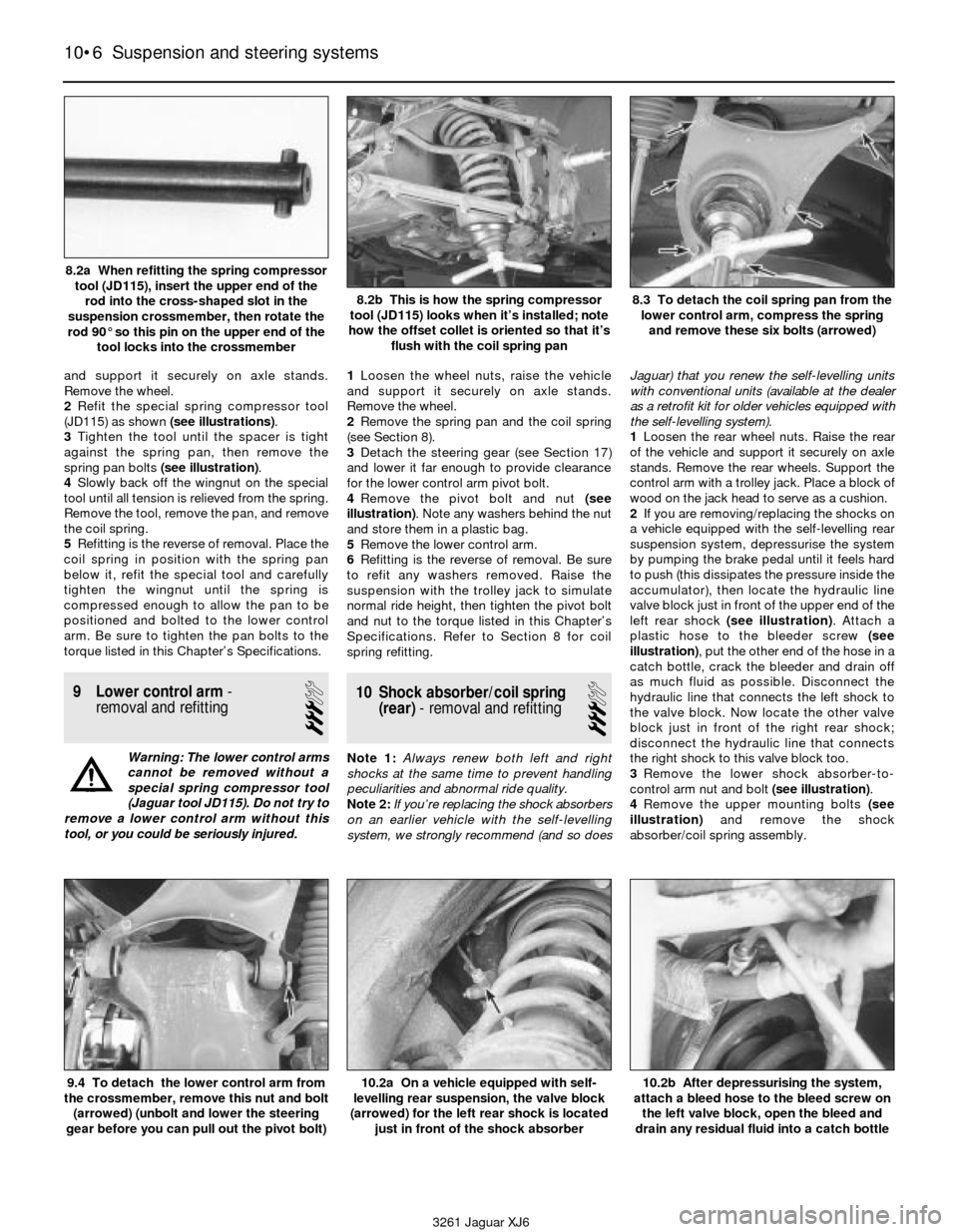
2Refit the special spring compressor tool
(JD115) as shown (see illustrations).
3Tighten the tool until the spacer is tight
against the spring pan, then remove the
spring pan bolts (see illustration).
4Slowly back off the wingnut on the special
tool until all tension is relieved from the spring.
Remove the tool, remove the pan, and remove
the coil spring.
5Refitting is the reverse of removal. Place the
coil spring in position with the spring pan
below it, refit the special tool and carefully
tighten the wingnut until the spring is
compressed enough to allow the pan to be
positioned and bolted to the lower control
arm. Be sure to tighten the pan bolts to the
torque listed in this Chapter’s Specifications.
9 Lower control arm-
removal and refitting
3
Warning: The lower control arms
cannot be removed without a
special spring compressor tool
(Jaguar tool JD115). Do not try to
remove a lower control arm without this
tool, or you could be seriously injured.1Loosen the wheel nuts, raise the vehicle
and support it securely on axle stands.
Remove the wheel.
2Remove the spring pan and the coil spring
(see Section 8).
3Detach the steering gear (see Section 17)
and lower it far enough to provide clearance
for the lower control arm pivot bolt.
4Remove the pivot bolt and nut (see
illustration). Note any washers behind the nut
and store them in a plastic bag.
5Remove the lower control arm.
6Refitting is the reverse of removal. Be sure
to refit any washers removed. Raise the
suspension with the trolley jack to simulate
normal ride height, then tighten the pivot bolt
and nut to the torque listed in this Chapter’s
Specifications. Refer to Section 8 for coil
spring refitting.
10 Shock absorber/coil spring
(rear)- removal and refitting
3
Note 1: Always renew both left and right
shocks at the same time to prevent handling
peculiarities and abnormal ride quality.
Note 2:If you’re replacing the shock absorbers
on an earlier vehicle with the self-levelling
system, we strongly recommend (and so doesJaguar) that you renew the self-levelling units
with conventional units (available at the dealer
as a retrofit kit for older vehicles equipped with
the self-levelling system).
1Loosen the rear wheel nuts. Raise the rear
of the vehicle and support it securely on axle
stands. Remove the rear wheels. Support the
control arm with a trolley jack. Place a block of
wood on the jack head to serve as a cushion.
2If you are removing/replacing the shocks on
a vehicle equipped with the self-levelling rear
suspension system, depressurise the system
by pumping the brake pedal until it feels hard
to push (this dissipates the pressure inside the
accumulator), then locate the hydraulic line
valve block just in front of the upper end of the
left rear shock (see illustration). Attach a
plastic hose to the bleeder screw (see
illustration), put the other end of the hose in a
catch bottle, crack the bleeder and drain off
as much fluid as possible. Disconnect the
hydraulic line that connects the left shock to
the valve block. Now locate the other valve
block just in front of the right rear shock;
disconnect the hydraulic line that connects
the right shock to this valve block too.
3Remove the lower shock absorber-to-
control arm nut and bolt (see illustration).
4Remove the upper mounting bolts (see
illustration)and remove the shock
absorber/coil spring assembly.
10•6 Suspension and steering systems
9.4 To detach the lower control arm from
the crossmember, remove this nut and bolt
(arrowed) (unbolt and lower the steering
gear before you can pull out the pivot bolt)10.2a On a vehicle equipped with self-
levelling rear suspension, the valve block
(arrowed) for the left rear shock is located
just in front of the shock absorber10.2b After depressurising the system,
attach a bleed hose to the bleed screw on
the left valve block, open the bleed and
drain any residual fluid into a catch bottle
3261 Jaguar XJ6 8.2a When refitting the spring compressor
tool (JD115), insert the upper end of the
rod into the cross-shaped slot in the
suspension crossmember, then rotate the
rod 90° so this pin on the upper end of the
tool locks into the crossmember
8.2b This is how the spring compressor
tool (JD115) looks when it’s installed; note
how the offset collet is oriented so that it’s
flush with the coil spring pan8.3 To detach the coil spring pan from the
lower control arm, compress the spring
and remove these six bolts (arrowed)
Page 146 of 227

17 Steering gear-
removal and refitting
3
Warning: On models with an
airbag, do not apply excessive
force or severe shock to the
steering column shaft, or
accidental deployment of the airbag could
occur.
1Using a large syringe or hand pump, empty
the power steering fluid reservoir.
2Loosen the wheel nuts, raise the vehicle
and support it securely on axle stands.
Remove the wheels.
3Mark the relationship of the steering shaft
U-joint to the steering gear pinion shaft (see
illustration)to ensure proper alignment when
they’re reassembled. Remove the nut and bolt
that clamp the U-joint to the pinion shaft.
4Disconnect the power steering pressure
and return lines from the steering gear. Place
a container under the lines to catch spilledfluid. Plug the lines to prevent excessive fluid
loss and contamination. Discard the sealing
washers (new ones should be used when
reassembling).
5Disconnect the tie-rod ends from the
steering knuckle arms (see Section 17).
6Remove the nuts and bolts from the steering
gear mounting brackets (see illustration).
7Remove the steering gear assembly,
detaching the U-joint as you lower it. Don’t
damage the steering gear dust boots.
8Refitting is the reverse of removal. Ensure the
marks you made on the U-joint and the pinion
shaft are aligned before you tighten the U-joint
clamp bolt and nut. Tighten the mounting bolts,
the tie-rod end nuts and the U-joint shaft
clamping bolts to the specified torque.
9After lowering the vehicle, fill the reservoir
with the recommended fluid (see Chapter 1).
10Bleed the power steering system (see
Section 19).
11Have the front wheels aligned by a dealer
service department or alignment workshop
after reassembly.
18 Power steering pump-
removal and refitting
3
1Raise the vehicle and support it securely on
axle stands. Remove the engine under-cover.
2Loosen the hose clamp and disconnect the
fluid return hose from the top of the pump
(see illustration)and drain the power steering
fluid from the reservoir into a clean container.
Unscrew the pressure line fitting from the
back of the pump. Plug the return hose and
the pressure line to prevent fluid from leaking
and to protect the power steering system
from contamination.
3Remove the bolts (see illustration)that
attach the power steering pump adapter to
the auxiliary shaft housing.
4Remove the power steering pump and
adapter.
5Take the power steering pump and adapter
to a Jaguar dealer service department and
have the adapter removed from the old pump
10•10 Suspension and steering systems
18.2 Disconnect the steering fluid return hose from the upper
pipe (arrowed) and disconnect the pressure line
from the back of the pump18.3 To detach the pump adapter from the auxiliary shaft
housing, remove these bolts
3261 Jaguar XJ6 17.3 Mark the relationship of the steering shaft U-joint to the
steering gear pinion shaft, then unscrew the pressure and return
line fittings (arrowed) - plug the lines to prevent contamination
from entering the system
17.6 To detach the steering gear from the vehicle, remove these
nuts and bolts (arrowed) from the mounting brackets (right
bracket shown, left bracket similar)
Page 206 of 227

3261 Jaguar XJ6
General repair proceduresREF•5
Whenever servicing, repair or overhaul work
is carried out on the car or its components, it
is necessary to observe the following
procedures and instructions. This will assist in
carrying out the operation efficiently and to a
professional standard of workmanship.
Joint mating faces and gaskets
When separating components at their
mating faces, never insert screwdrivers or
similar implements into the joint between the
faces in order to prise them apart. This can
cause severe damage which results in oil
leaks, coolant leaks, etc upon reassembly.
Separation is usually achieved by tapping
along the joint with a soft-faced hammer in
order to break the seal. However, note that
this method may not be suitable where
dowels are used for component location.
Where a gasket is used between the mating
faces of two components, ensure that it is
renewed on reassembly, and fit it dry unless
otherwise stated in the repair procedure. Make
sure that the mating faces are clean and dry,
with all traces of old gasket removed. When
cleaning a joint face, use a tool which is not
likely to score or damage the face, and remove
any burrs or nicks with an oilstone or fine file.
Make sure that tapped holes are cleaned
with a pipe cleaner, and keep them free of
jointing compound, if this is being used,
unless specifically instructed otherwise.
Ensure that all orifices, channels or pipes
are clear, and blow through them, preferably
using compressed air.
Oil seals
Oil seals can be removed by levering them
out with a wide flat-bladed screwdriver or
similar tool. Alternatively, a number of self-
tapping screws may be screwed into the seal,
and these used as a purchase for pliers or
similar in order to pull the seal free.
Whenever an oil seal is removed from its
working location, either individually or as part
of an assembly, it should be renewed.
The very fine sealing lip of the seal is easily
damaged, and will not seal if the surface it
contacts is not completely clean and free from
scratches, nicks or grooves. If the original
sealing surface of the component cannot be
restored, and the manufacturer has not made
provision for slight relocation of the seal
relative to the sealing surface, the component
should be renewed.
Protect the lips of the seal from any surface
which may damage them in the course of
fitting. Use tape or a conical sleeve where
possible. Lubricate the seal lips with oil before
fitting and, on dual-lipped seals, fill the space
between the lips with grease.
Unless otherwise stated, oil seals must be
fitted with their sealing lips toward the
lubricant to be sealed.
Use a tubular drift or block of wood of the
appropriate size to install the seal and, if the
seal housing is shouldered, drive the seal
down to the shoulder. If the seal housing isunshouldered, the seal should be fitted with
its face flush with the housing top face (unless
otherwise instructed).
Screw threads and fastenings
Seized nuts, bolts and screws are quite a
common occurrence where corrosion has set
in, and the use of penetrating oil or releasing
fluid will often overcome this problem if the
offending item is soaked for a while before
attempting to release it. The use of an impact
driver may also provide a means of releasing
such stubborn fastening devices, when used
in conjunction with the appropriate
screwdriver bit or socket. If none of these
methods works, it may be necessary to resort
to the careful application of heat, or the use of
a hacksaw or nut splitter device.
Studs are usually removed by locking two
nuts together on the threaded part, and then
using a spanner on the lower nut to unscrew
the stud. Studs or bolts which have broken off
below the surface of the component in which
they are mounted can sometimes be removed
using a stud extractor. Always ensure that a
blind tapped hole is completely free from oil,
grease, water or other fluid before installing
the bolt or stud. Failure to do this could cause
the housing to crack due to the hydraulic
action of the bolt or stud as it is screwed in.
When tightening a castellated nut to accept
a split pin, tighten the nut to the specified
torque, where applicable, and then tighten
further to the next split pin hole. Never
slacken the nut to align the split pin hole,
unless stated in the repair procedure.
When checking or retightening a nut or bolt
to a specified torque setting, slacken the nut
or bolt by a quarter of a turn, and then
retighten to the specified setting. However,
this should not be attempted where angular
tightening has been used.
For some screw fastenings, notably
cylinder head bolts or nuts, torque wrench
settings are no longer specified for the latter
stages of tightening, “angle-tightening” being
called up instead. Typically, a fairly low torque
wrench setting will be applied to the
bolts/nuts in the correct sequence, followed
by one or more stages of tightening through
specified angles.
Locknuts, locktabs and washers
Any fastening which will rotate against a
component or housing during tightening
should always have a washer between it and
the relevant component or housing.
Spring or split washers should always be
renewed when they are used to lock a critical
component such as a big-end bearing
retaining bolt or nut. Locktabs which are
folded over to retain a nut or bolt should
always be renewed.
Self-locking nuts can be re-used in non-
critical areas, providing resistance can be felt
when the locking portion passes over the bolt
or stud thread. However, it should be noted
that self-locking stiffnuts tend to lose theireffectiveness after long periods of use, and
should be renewed as a matter of course.
Split pins must always be replaced with
new ones of the correct size for the hole.
When thread-locking compound is found
on the threads of a fastener which is to be re-
used, it should be cleaned off with a wire
brush and solvent, and fresh compound
applied on reassembly.
Special tools
Some repair procedures in this manual
entail the use of special tools such as a press,
two or three-legged pullers, spring
compressors, etc. Wherever possible, suitable
readily-available alternatives to the
manufacturer’s special tools are described,
and are shown in use. In some instances,
where no alternative is possible, it has been
necessary to resort to the use of a
manufacturer’s tool, and this has been done
for reasons of safety as well as the efficient
completion of the repair operation. Unless you
are highly-skilled and have a thorough
understanding of the procedures described,
never attempt to bypass the use of any
special tool when the procedure described
specifies its use. Not only is there a very great
risk of personal injury, but expensive damage
could be caused to the components involved.
Environmental considerations
When disposing of used engine oil, brake
fluid, antifreeze, etc, give due consideration to
any detrimental environmental effects. Do not,
for instance, pour any of the above liquids
down drains into the general sewage system,
or onto the ground to soak away. Many local
council refuse tips provide a facility for waste
oil disposal, as do some garages. If none of
these facilities are available, consult your local
Environmental Health Department, or the
National Rivers Authority, for further advice.
With the universal tightening-up of
legislation regarding the emission of
environmentally-harmful substances from
motor vehicles, most current vehicles have
tamperproof devices fitted to the main
adjustment points of the fuel system. These
devices are primarily designed to prevent
unqualified persons from adjusting the fuel/air
mixture, with the chance of a consequent
increase in toxic emissions. If such devices
are encountered during servicing or overhaul,
they should, wherever possible, be renewed
or refitted in accordance with the vehicle
manufacturer’s requirements or current
legislation.
Note: It is
antisocial and
illegal to dump oil
down the drain.
To find the
location of your
local oil recycling
bank, call this
number free.
Page 214 of 227
3261 Jaguar XJ6
Fault findingREF•13
1 Engine
Engine will not rotate when attempting to start
m mBattery terminal connections loose or corroded (Chapter 1).
m mBattery discharged or faulty (Chapter 1).
m mDamaged left rear window harness shorting against glass rail
inside door, causing battery to drain (Chapter 12).
m mAutomatic transmission not completely engaged in Park
(Chapter 7).
m mBroken, loose or disconnected wiring in the starting circuit
(Chapters 5 and 12).
m mStarter motor pinion jammed in flywheel ring gear (Chapter 5).
m mStarter solenoid faulty (Chapter 5).
m mStarter motor faulty (Chapter 5).
m mIgnition switch faulty (Chapter 12).
m mStarter pinion or flywheel teeth worn or broken (Chapter 5).
m mInternal engine problem (Chapter 2B).
m mInertia switch activated (Chapter 12).
m mStarter relay defective (Chapter 5).
Engine rotates but will not start
m
mFuel tank empty.
m mBattery discharged (engine rotates slowly) (Chapter 5).
m mBattery terminal connections loose or corroded (Chapter 1).
m mLeaking fuel injector(s), faulty fuel pump, pressure regulator, etc.
(Chapter 4).
m mFuel not reaching fuel injection system (Chapter 4).
m mIgnition components damp or damaged (Chapter 5).
m mFuel injector stuck open (Chapter 4).
m mWorn, faulty or incorrectly gapped spark plugs (Chapter 1).
m mBroken, loose or disconnected wiring in the starting circuit
(Chapter 5).
m mLoose distributor is changing ignition timing (Chapter 1).
m mBroken, loose or disconnected wires at the ignition coil or faulty
coil (Chapter 5).
m m1988 and 1989 models may have electrical connector damage
between the fuel pump relay and the fuel pump (Chapter 12).
m mCoolant temperature sensor shorting on bonnet liner (Chapter 11).
m mDefective Mass Airflow (MAF) sensor (Chapter 6).
Engine hard to start when cold
m
mBattery discharged or low (Chapter 1).
m mFuel system malfunctioning (Chapter 4).
m mInjector(s) leaking (Chapter 4).
m mDistributor rotor carbon tracked (Chapter 5).
m mWater enters the air cleaner housing near the left front wheel arch
(Chapter 4).
Engine hard to start when hot
m mAir filter clogged (Chapter 1).
m mFuel not reaching the fuel injection system (Chapter 4).
m mCorroded battery connections, especially ground (Chapter 1).
m mFuel vaporises at fuel pump inlet. Refit dual fuel pumps
(Chapter 4).
m mFuel vapours from charcoal canister enter intake during idle and
cause idling, stalling and starting problems (Chapter 6).
Starter motor noisy or excessively rough in
engagement
m mPinion or flywheel gear teeth worn or broken (Chapter 5).
m mStarter motor mounting bolts loose or missing (Chapter 5).
Engine starts but stops immediately
m
mLoose or faulty electrical connections at distributor, coil or
alternator (Chapter 5).
m mInsufficient fuel reaching the fuel injector(s) (Chapters 1 and 4).
m mDamaged fuel injection system speed sensors (Chapter 5).
m mFaulty fuel injection relays (Chapter 5).
m mLeaking threaded adapter on the EGR valve - where fitted
(Chapter 6)
Oil puddle under engine
m mSump gasket and/or sump drain bolt seal leaking (Chapter 2).
m mOil pressure sending unit leaking (Chapter 2).
m mValve cover gaskets leaking (Chapter 2).
m mEngine oil seals leaking (Chapter 2).
m mCylinder head rear plate gasket leaking (Chapter 2).
m mAlternator mounting bolt threads leaking oil (Chapter 5).
m mOil cooler or oil cooler lines leaking (Chapter 3).
Engine misses while idling or idles erratically
m
mVacuum leakage (Chapter 2).
m mAir filter clogged (Chapter 1).
m mFuel pump not delivering sufficient fuel to the fuel injection system
(Chapter 4).
m mLeaking head gasket (Chapter 2).
m mTiming belt/chain and/or sprockets worn (Chapter 2).
m mCamshaft lobes worn (Chapter 2).
m mEGR valve stuck open - where fitted (Chapter 6).
Engine misses at idle speed
m
mSpark plugs worn or not gapped properly (Chapter 1).
m mFaulty spark plug leads (Chapter 1).
m mVacuum leaks (Chapter 1).
m mIncorrect ignition timing (Chapter 5).
m mUneven or low compression (Chapter 2).
m mRestricted EGR vacuum hose - where fitted (Chapter 6).
Engine misses throughout driving speed range
m
mFuel filter clogged and/or impurities in the fuel system (Chapter 1).
m mLow fuel output at the injectors (Chapter 4).
m mFaulty or incorrectly gapped spark plugs (Chapter 1).
m mIncorrect ignition timing (Chapter 5).
m mCracked distributor cap, disconnected distributor wires or
damaged distributor components (Chapter 1).
m mLeaking spark plug leads (Chapter 1).
m mFaulty emission system components (Chapter 6).
m mLow or uneven cylinder compression pressures (Chapter 2).
m mWeak or faulty ignition system (Chapter 5).
m mVacuum leak in fuel injection system, intake manifold or vacuum
hoses (Chapter 4).
m mCrankshaft sensor teeth damaged or missing (see Chapter 12).
m mDistributor installed incorrectly (see Chapter 5)
Engine stumbles on acceleration
m
mSpark plugs fouled (Chapter 1).
m mFuel injection system malfunctioning (Chapter 4).
m mFuel filter clogged (Chapters 1 and 4).
m mIncorrect ignition timing (Chapter 5).
m mIntake manifold air leak (Chapter 4).
m mCollapsed or damaged fuel tank caused by blocked EVAP system
- where fitted (see Chapter 6).