key JEEP CHEROKEE 1994 Service Owners Manual
[x] Cancel search | Manufacturer: JEEP, Model Year: 1994, Model line: CHEROKEE, Model: JEEP CHEROKEE 1994Pages: 1784, PDF Size: 77.09 MB
Page 1510 of 1784
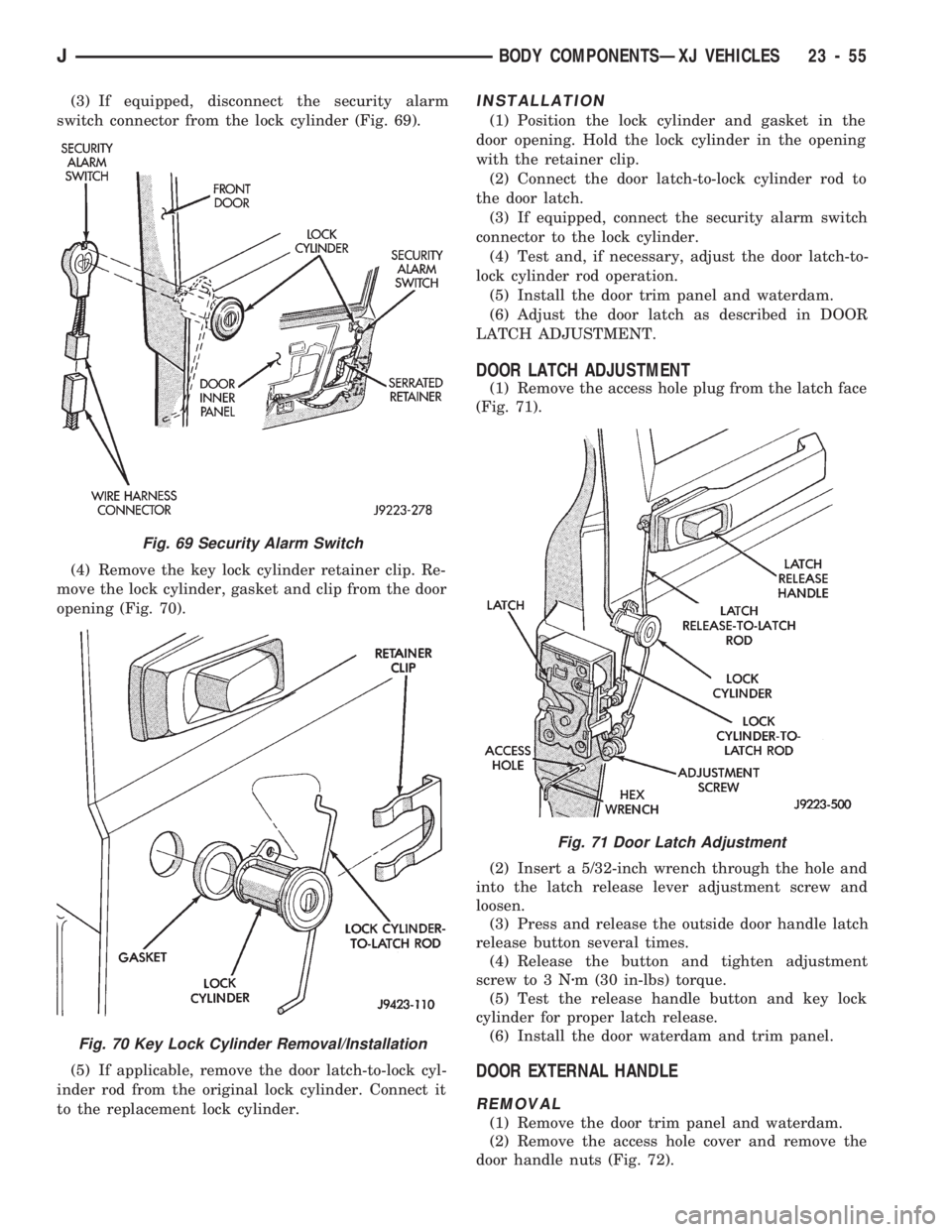
(3) If equipped, disconnect the security alarm
switch connector from the lock cylinder (Fig. 69).
(4) Remove the key lock cylinder retainer clip. Re-
move the lock cylinder, gasket and clip from the door
opening (Fig. 70).
(5) If applicable, remove the door latch-to-lock cyl-
inder rod from the original lock cylinder. Connect it
to the replacement lock cylinder.INSTALLATION
(1) Position the lock cylinder and gasket in the
door opening. Hold the lock cylinder in the opening
with the retainer clip.
(2) Connect the door latch-to-lock cylinder rod to
the door latch.
(3) If equipped, connect the security alarm switch
connector to the lock cylinder.
(4) Test and, if necessary, adjust the door latch-to-
lock cylinder rod operation.
(5) Install the door trim panel and waterdam.
(6) Adjust the door latch as described in DOOR
LATCH ADJUSTMENT.
DOOR LATCH ADJUSTMENT
(1) Remove the access hole plug from the latch face
(Fig. 71).
(2) Insert a 5/32-inch wrench through the hole and
into the latch release lever adjustment screw and
loosen.
(3) Press and release the outside door handle latch
release button several times.
(4) Release the button and tighten adjustment
screw to 3 Nzm (30 in-lbs) torque.
(5) Test the release handle button and key lock
cylinder for proper latch release.
(6) Install the door waterdam and trim panel.
DOOR EXTERNAL HANDLE
REMOVAL
(1) Remove the door trim panel and waterdam.
(2) Remove the access hole cover and remove the
door handle nuts (Fig. 72).
Fig. 71 Door Latch Adjustment
Fig. 69 Security Alarm Switch
Fig. 70 Key Lock Cylinder Removal/Installation
JBODY COMPONENTSÐXJ VEHICLES 23 - 55
Page 1511 of 1784
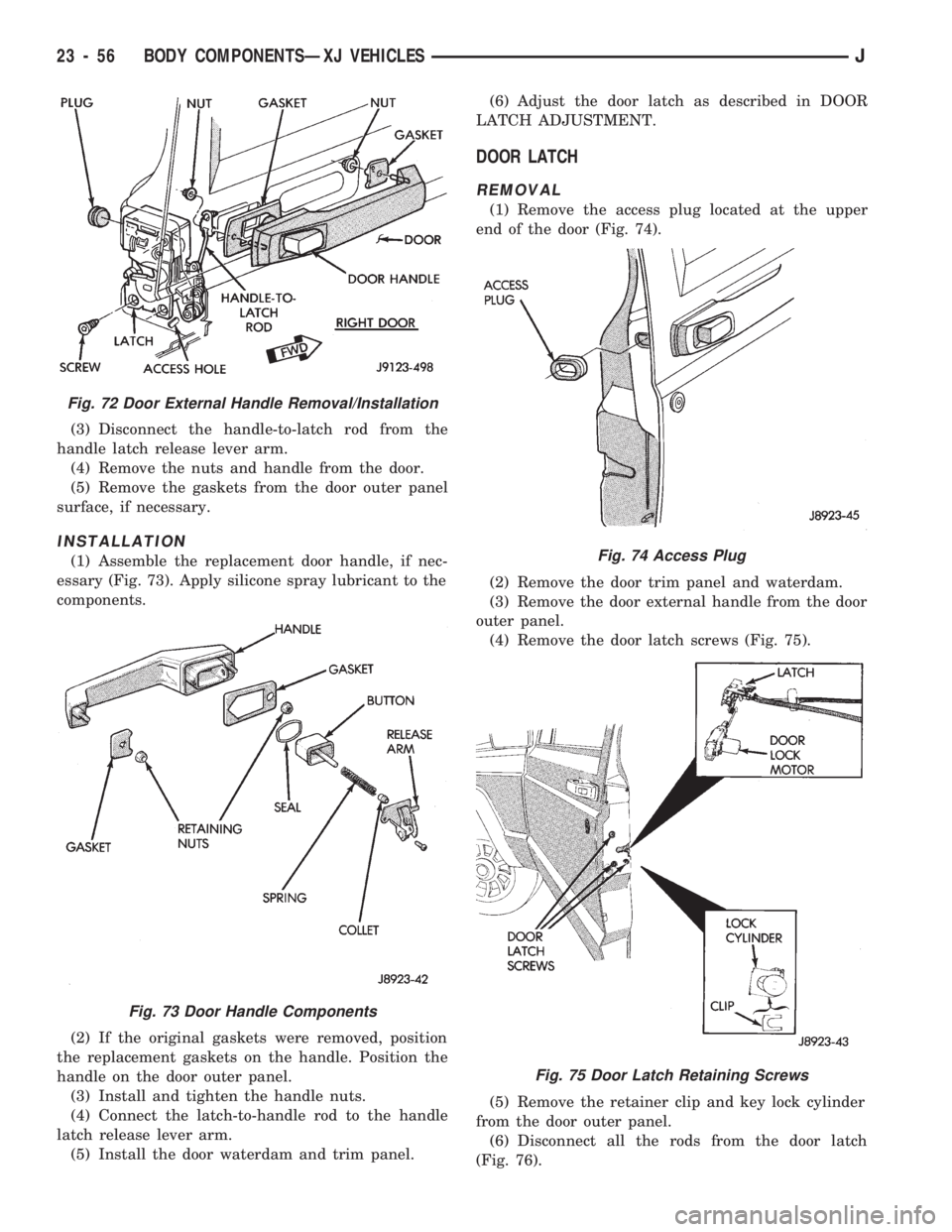
(3) Disconnect the handle-to-latch rod from the
handle latch release lever arm.
(4) Remove the nuts and handle from the door.
(5) Remove the gaskets from the door outer panel
surface, if necessary.
INSTALLATION
(1) Assemble the replacement door handle, if nec-
essary (Fig. 73). Apply silicone spray lubricant to the
components.
(2) If the original gaskets were removed, position
the replacement gaskets on the handle. Position the
handle on the door outer panel.
(3) Install and tighten the handle nuts.
(4) Connect the latch-to-handle rod to the handle
latch release lever arm.
(5) Install the door waterdam and trim panel.(6) Adjust the door latch as described in DOOR
LATCH ADJUSTMENT.
DOOR LATCH
REMOVAL
(1) Remove the access plug located at the upper
end of the door (Fig. 74).
(2) Remove the door trim panel and waterdam.
(3) Remove the door external handle from the door
outer panel.
(4) Remove the door latch screws (Fig. 75).
(5) Remove the retainer clip and key lock cylinder
from the door outer panel.
(6) Disconnect all the rods from the door latch
(Fig. 76).
Fig. 72 Door External Handle Removal/Installation
Fig. 73 Door Handle Components
Fig. 74 Access Plug
Fig. 75 Door Latch Retaining Screws
23 - 56 BODY COMPONENTSÐXJ VEHICLESJ
Page 1512 of 1784
(7) Remove the door latch from the door face.
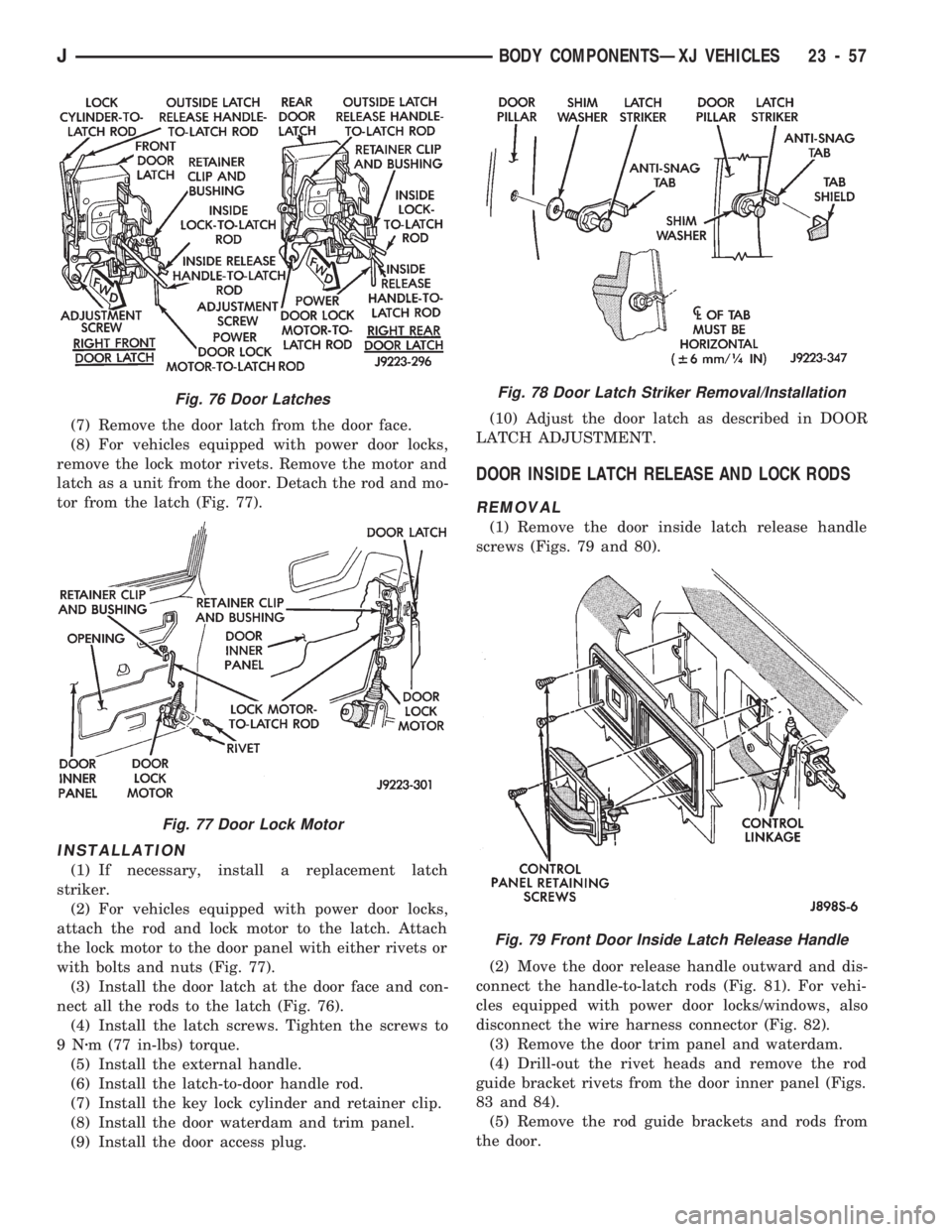
(8) For vehicles equipped with power door locks,
remove the lock motor rivets. Remove the motor and
latch as a unit from the door. Detach the rod and mo-
tor from the latch (Fig. 77).
INSTALLATION
(1) If necessary, install a replacement latch
striker.
(2) For vehicles equipped with power door locks,
attach the rod and lock motor to the latch. Attach
the lock motor to the door panel with either rivets or
with bolts and nuts (Fig. 77).
(3) Install the door latch at the door face and con-
nect all the rods to the latch (Fig. 76).
(4) Install the latch screws. Tighten the screws to
9Nzm (77 in-lbs) torque.
(5) Install the external handle.
(6) Install the latch-to-door handle rod.
(7) Install the key lock cylinder and retainer clip.
(8) Install the door waterdam and trim panel.
(9) Install the door access plug.(10) Adjust the door latch as described in DOOR
LATCH ADJUSTMENT.
DOOR INSIDE LATCH RELEASE AND LOCK RODS
REMOVAL
(1) Remove the door inside latch release handle
screws (Figs. 79 and 80).
(2) Move the door release handle outward and dis-
connect the handle-to-latch rods (Fig. 81). For vehi-
cles equipped with power door locks/windows, also
disconnect the wire harness connector (Fig. 82).
(3) Remove the door trim panel and waterdam.
(4) Drill-out the rivet heads and remove the rod
guide bracket rivets from the door inner panel (Figs.
83 and 84).
(5) Remove the rod guide brackets and rods from
the door.
Fig. 76 Door Latches
Fig. 77 Door Lock Motor
Fig. 78 Door Latch Striker Removal/Installation
Fig. 79 Front Door Inside Latch Release Handle
JBODY COMPONENTSÐXJ VEHICLES 23 - 57
Page 1523 of 1784
(2) Install and tighten hinge-to-roof panel nuts to 9
Nzm (7 ft-lbs) torque.
(3) Install the liftgate-to-hinge screws. Tighten
screws to 9 Nzm (7 ft-lbs) torque.
(4) Install the liftgate (headliner) upper trim moul-
ding (Fig. 111).
LIFTGATE LATCH/KEY LOCK CYLINDER/STRIKER
REMOVAL
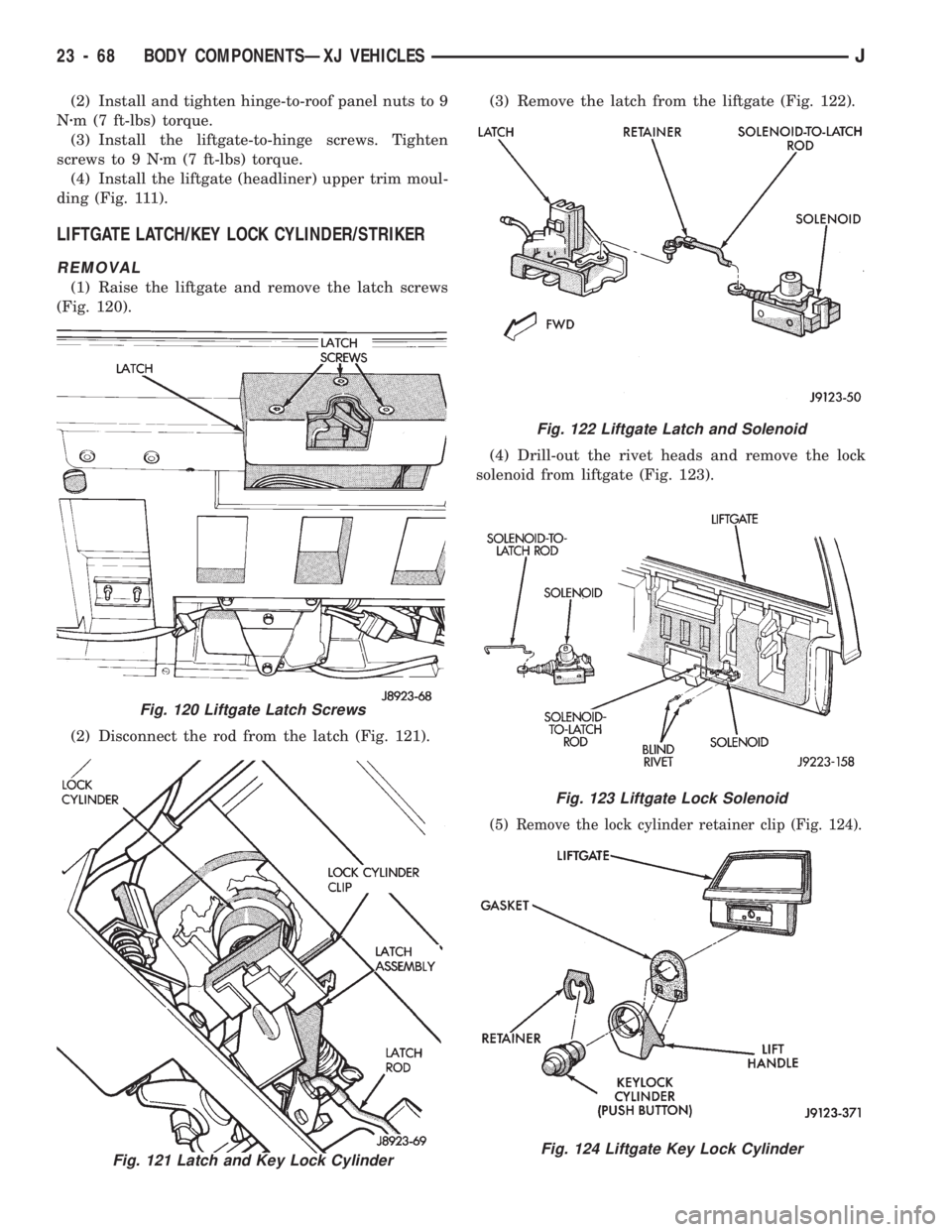
(1) Raise the liftgate and remove the latch screws
(Fig. 120).
(2) Disconnect the rod from the latch (Fig. 121).(3) Remove the latch from the liftgate (Fig. 122).
(4) Drill-out the rivet heads and remove the lock
solenoid from liftgate (Fig. 123).
(5) Remove the lock cylinder retainer clip (Fig. 124).
Fig. 121 Latch and Key Lock Cylinder
Fig. 122 Liftgate Latch and Solenoid
Fig. 123 Liftgate Lock Solenoid
Fig. 124 Liftgate Key Lock Cylinder
Fig. 120 Liftgate Latch Screws
23 - 68 BODY COMPONENTSÐXJ VEHICLESJ
Page 1524 of 1784
(6) Remove the key lock cylinder.
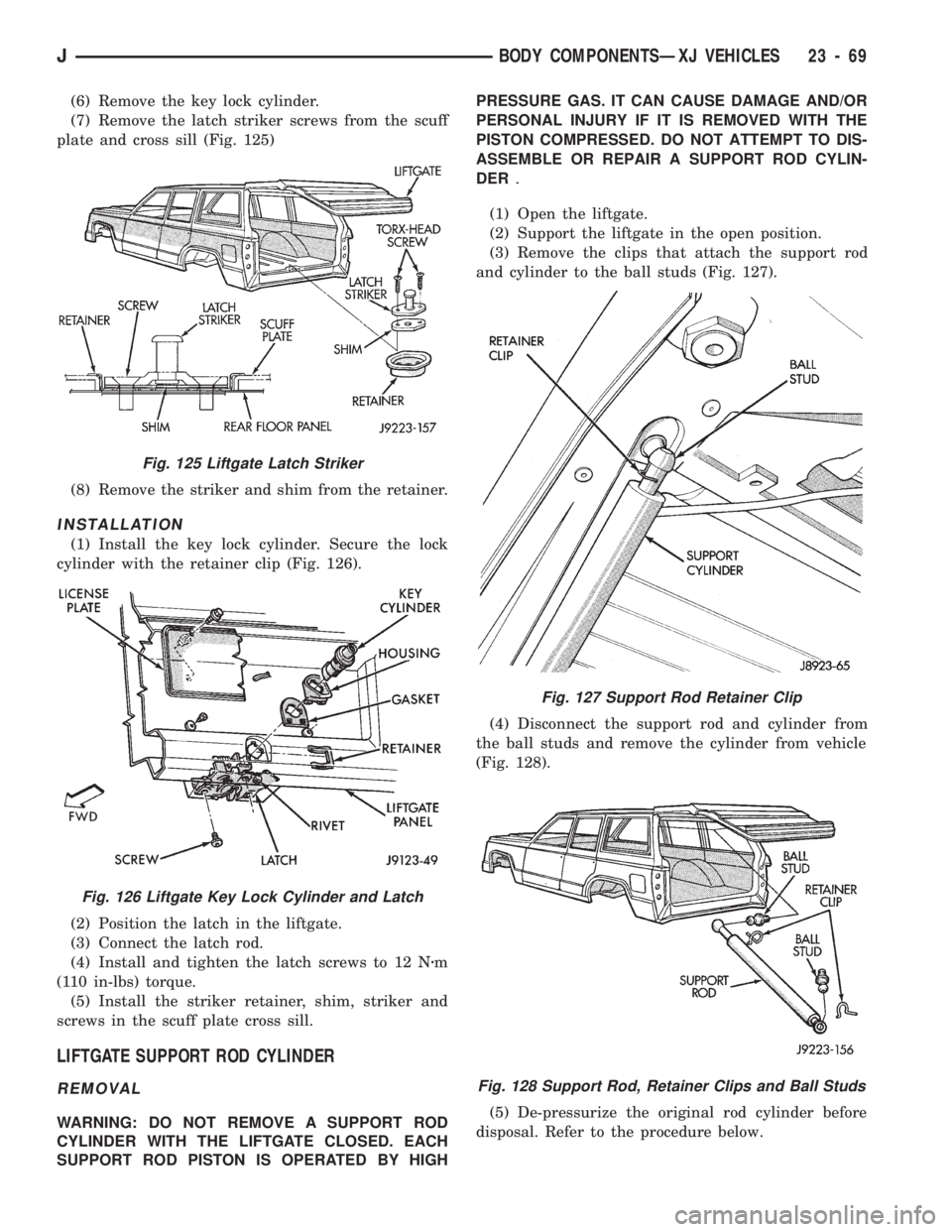
(7) Remove the latch striker screws from the scuff
plate and cross sill (Fig. 125)
(8) Remove the striker and shim from the retainer.
INSTALLATION
(1) Install the key lock cylinder. Secure the lock
cylinder with the retainer clip (Fig. 126).
(2) Position the latch in the liftgate.
(3) Connect the latch rod.
(4) Install and tighten the latch screws to 12 Nzm
(110 in-lbs) torque.
(5) Install the striker retainer, shim, striker and
screws in the scuff plate cross sill.
LIFTGATE SUPPORT ROD CYLINDER
REMOVAL
WARNING: DO NOT REMOVE A SUPPORT ROD
CYLINDER WITH THE LIFTGATE CLOSED. EACH
SUPPORT ROD PISTON IS OPERATED BY HIGHPRESSURE GAS. IT CAN CAUSE DAMAGE AND/OR
PERSONAL INJURY IF IT IS REMOVED WITH THE
PISTON COMPRESSED. DO NOT ATTEMPT TO DIS-
ASSEMBLE OR REPAIR A SUPPORT ROD CYLIN-
DER.
(1) Open the liftgate.
(2) Support the liftgate in the open position.
(3) Remove the clips that attach the support rod
and cylinder to the ball studs (Fig. 127).
(4) Disconnect the support rod and cylinder from
the ball studs and remove the cylinder from vehicle
(Fig. 128).
(5) De-pressurize the original rod cylinder before
disposal. Refer to the procedure below.
Fig. 127 Support Rod Retainer Clip
Fig. 128 Support Rod, Retainer Clips and Ball Studs
Fig. 125 Liftgate Latch Striker
Fig. 126 Liftgate Key Lock Cylinder and Latch
JBODY COMPONENTSÐXJ VEHICLES 23 - 69
Page 1576 of 1784
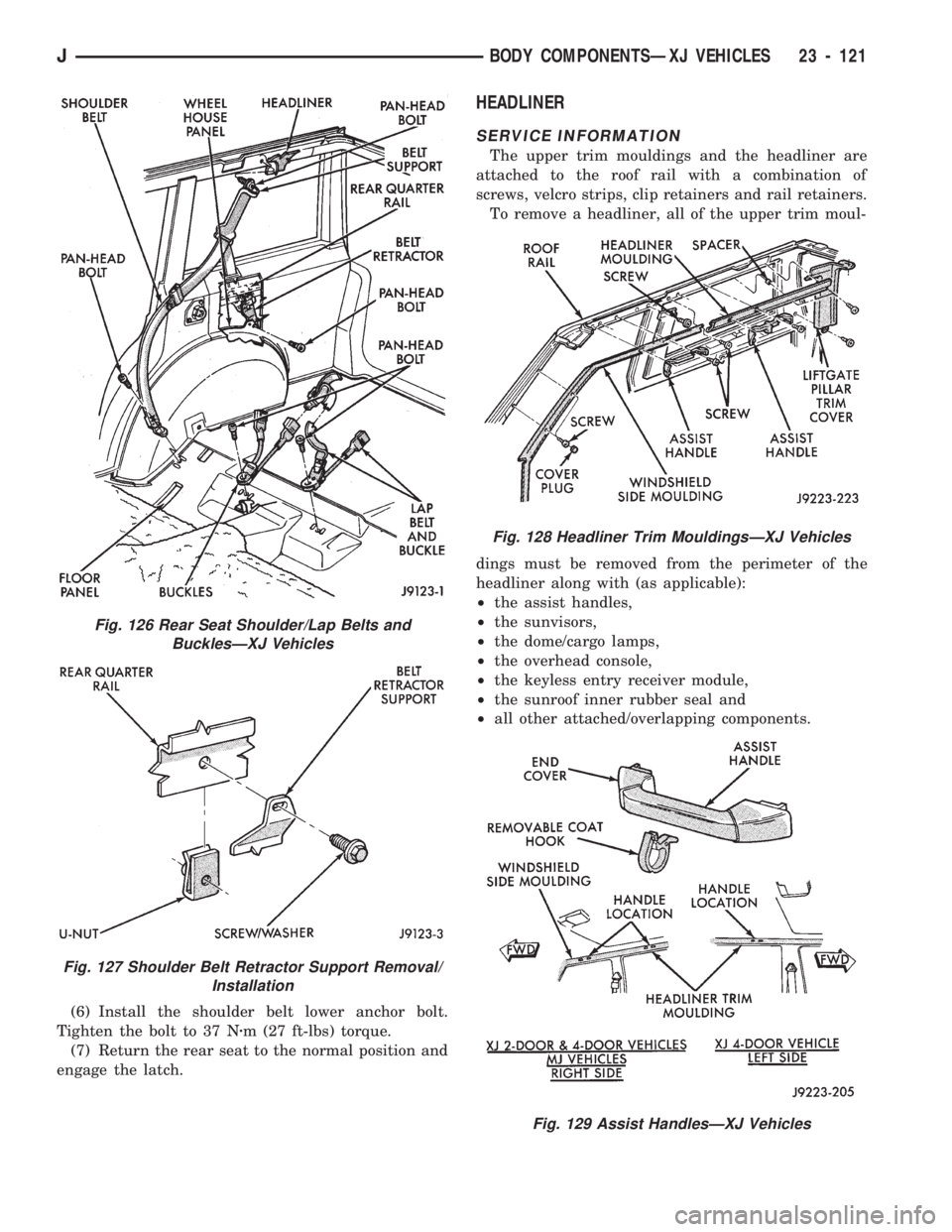
(6) Install the shoulder belt lower anchor bolt.
Tighten the bolt to 37 Nzm (27 ft-lbs) torque.
(7) Return the rear seat to the normal position and
engage the latch.
HEADLINER
SERVICE INFORMATION
The upper trim mouldings and the headliner are
attached to the roof rail with a combination of
screws, velcro strips, clip retainers and rail retainers.
To remove a headliner, all of the upper trim moul-
dings must be removed from the perimeter of the
headliner along with (as applicable):
²the assist handles,
²the sunvisors,
²the dome/cargo lamps,
²the overhead console,
²the keyless entry receiver module,
²the sunroof inner rubber seal and
²all other attached/overlapping components.
Fig. 128 Headliner Trim MouldingsÐXJ Vehicles
Fig. 129 Assist HandlesÐXJ Vehicles
Fig. 126 Rear Seat Shoulder/Lap Belts and
BucklesÐXJ Vehicles
Fig. 127 Shoulder Belt Retractor Support Removal/
Installation
JBODY COMPONENTSÐXJ VEHICLES 23 - 121
Page 1577 of 1784
DOME/CARGO LAMPÐXJ VEHICLES
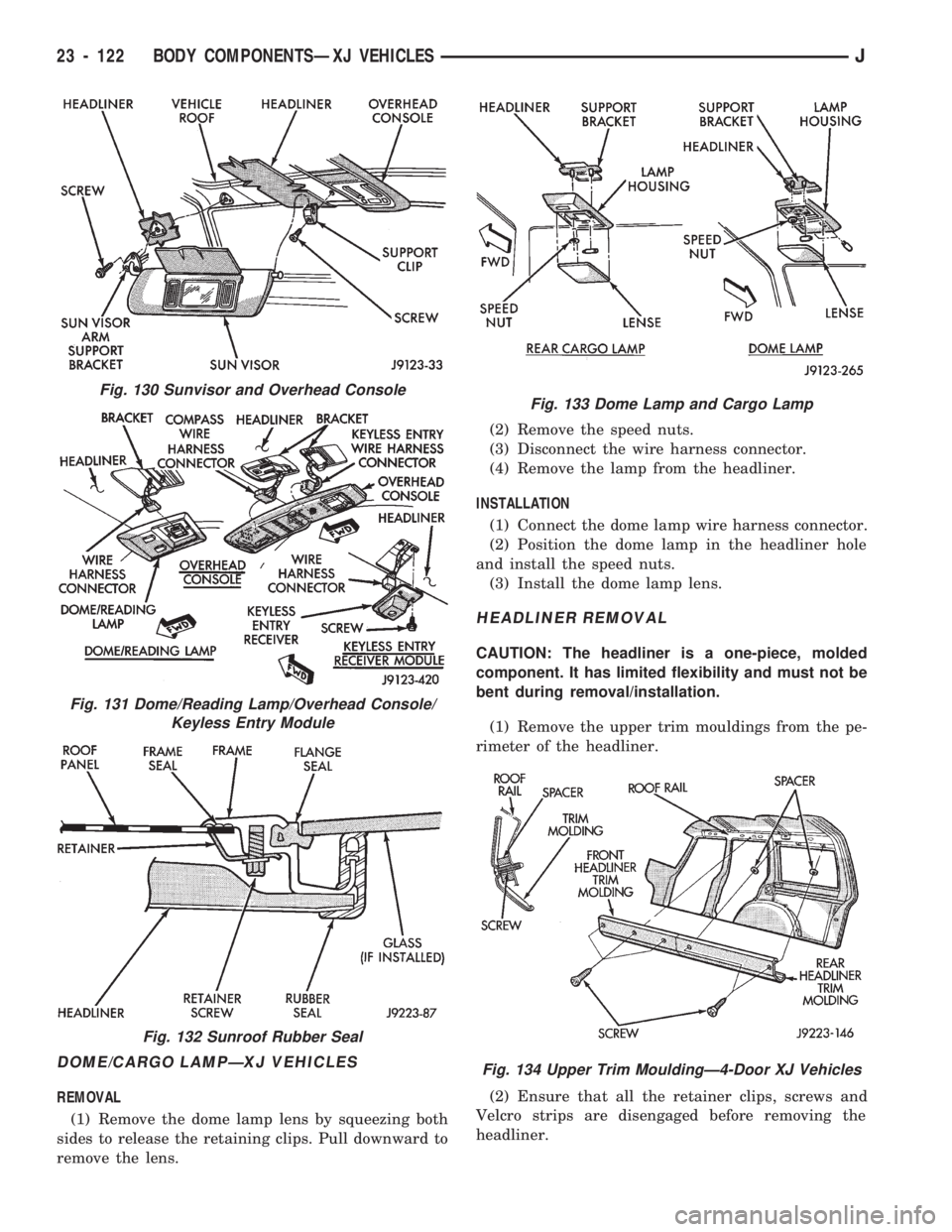
REMOVAL
(1) Remove the dome lamp lens by squeezing both
sides to release the retaining clips. Pull downward to
remove the lens.(2) Remove the speed nuts.
(3) Disconnect the wire harness connector.
(4) Remove the lamp from the headliner.
INSTALLATION
(1) Connect the dome lamp wire harness connector.
(2) Position the dome lamp in the headliner hole
and install the speed nuts.
(3) Install the dome lamp lens.
HEADLINER REMOVAL
CAUTION: The headliner is a one-piece, molded
component. It has limited flexibility and must not be
bent during removal/installation.
(1) Remove the upper trim mouldings from the pe-
rimeter of the headliner.
(2) Ensure that all the retainer clips, screws and
Velcro strips are disengaged before removing the
headliner.
Fig. 130 Sunvisor and Overhead Console
Fig. 131 Dome/Reading Lamp/Overhead Console/
Keyless Entry Module
Fig. 132 Sunroof Rubber Seal
Fig. 133 Dome Lamp and Cargo Lamp
Fig. 134 Upper Trim MouldingÐ4-Door XJ Vehicles
23 - 122 BODY COMPONENTSÐXJ VEHICLESJ
Page 1578 of 1784
HEADLINER INSTALLATION
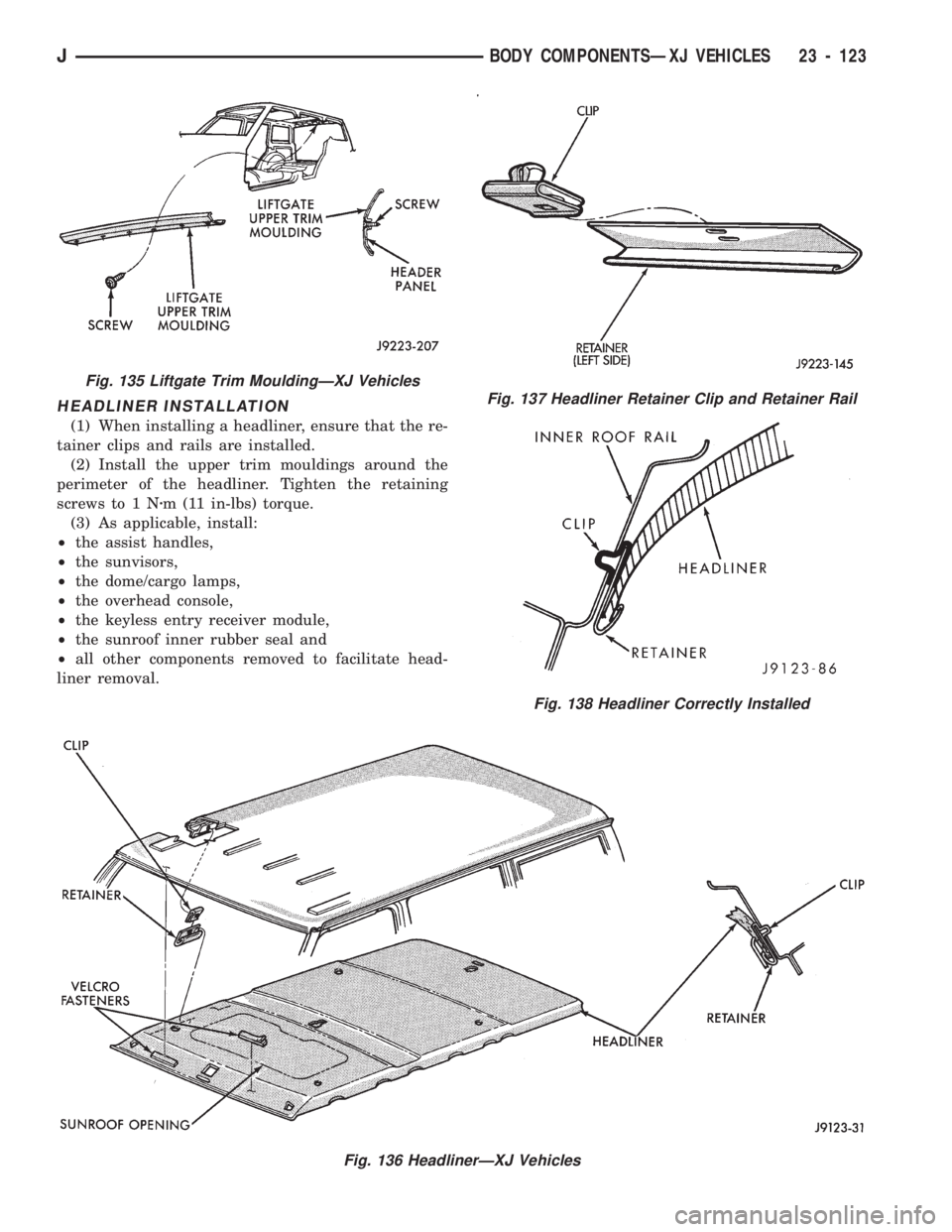
(1) When installing a headliner, ensure that the re-
tainer clips and rails are installed.
(2) Install the upper trim mouldings around the
perimeter of the headliner. Tighten the retaining
screws to 1 Nzm (11 in-lbs) torque.
(3) As applicable, install:
²the assist handles,
²the sunvisors,
²the dome/cargo lamps,
²the overhead console,
²the keyless entry receiver module,
²the sunroof inner rubber seal and
²all other components removed to facilitate head-
liner removal.
Fig. 136 HeadlinerÐXJ Vehicles
Fig. 137 Headliner Retainer Clip and Retainer Rail
Fig. 138 Headliner Correctly Installed
Fig. 135 Liftgate Trim MouldingÐXJ Vehicles
JBODY COMPONENTSÐXJ VEHICLES 23 - 123
Page 1587 of 1784
BODY COMPONENTSÐYJ VEHICLES
CONTENTS
page page
ADD-A-TRUNK........................ 198
DOORS.............................. 172
EXTERIOR COMPONENTS............... 134FIXED WINDOW GLASS................ 181
GENERAL SERVICE INFORMATION........ 132
INTERIOR COMPONENTS............... 188
GENERAL SERVICE INFORMATION
LABELS/DECALS/PLATES
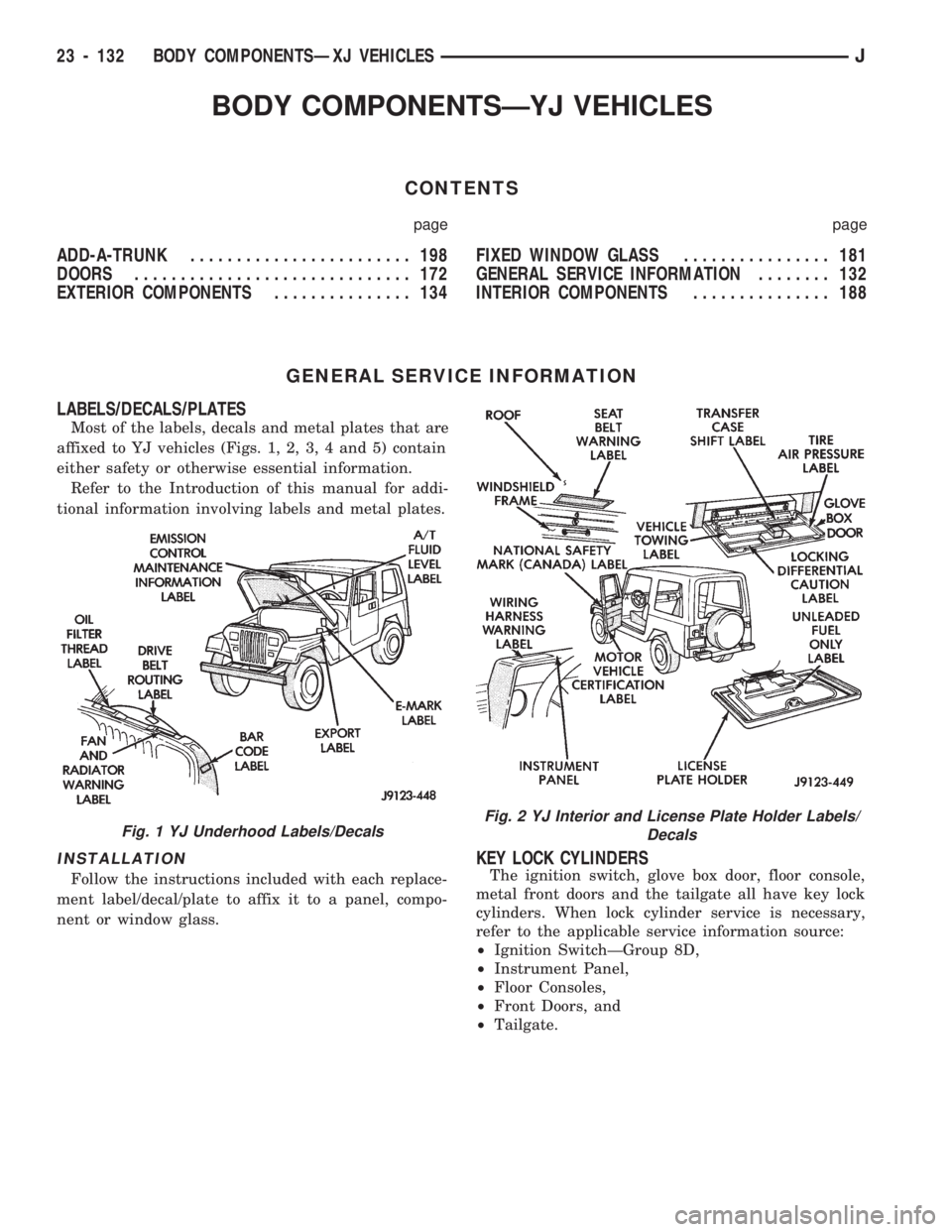
Most of the labels, decals and metal plates that are
affixed to YJ vehicles (Figs. 1, 2, 3, 4 and 5) contain
either safety or otherwise essential information.
Refer to the Introduction of this manual for addi-
tional information involving labels and metal plates.
INSTALLATION
Follow the instructions included with each replace-
ment label/decal/plate to affix it to a panel, compo-
nent or window glass.
KEY LOCK CYLINDERS
The ignition switch, glove box door, floor console,
metal front doors and the tailgate all have key lock
cylinders. When lock cylinder service is necessary,
refer to the applicable service information source:
²Ignition SwitchÐGroup 8D,
²Instrument Panel,
²Floor Consoles,
²Front Doors, and
²Tailgate.
Fig. 1 YJ Underhood Labels/DecalsFig. 2 YJ Interior and License Plate Holder Labels/
Decals
23 - 132 BODY COMPONENTSÐXJ VEHICLESJ
Page 1609 of 1784
The following equipment and material are neces-
sary for body stripe/decal removal and installation:
²a commercial tape stripe/decal removal solution;
²a commercial adhesive removal solution;
²liquid dish detergent (for the wetting solution);
²a mixture of wetting solution;
²a commercial wax and silicone removal solution;
²isopropyl (rubbing) alcohol;
²a small squeegee (plastic or hard rubber);
²a water bucket and sponge;
²clean wiping rags or paper towels;
²a heat gun (or infra-red heat bulb);
²a wax pencil;
²a sharp knife, single edge razor blade or X-acto
knife;
²a pair of scissors; and
²a needle or pin.
A wetting solution assures a better bond between
the painted surface of the body and the tape stripe/
decal. Prepare a supply of wetting solution by mixing
two or three teaspoons of dish detergent with 1 gal-
lon of water.Do not use soap.
Too much detergent will reduce the effective-
ness of the mixture.
REMOVAL
The key to successful tape stripe/decal re-
moval is to apply heat to area and slowly peel
stripe/decal from panel.
(1) Clean the repaired surface, adjacent panels and
door openings as necessary.
(2) Start at one end of the tape stripe/decal and
apply heat with a heat gun. Slowly peel the stripe/
decal from the panel by pulling it back.Do not pull
the tape stripe/decal outward from the panel.
WARNING: USE THE TAPE STRIPE/DECAL RE-
MOVAL SOLUTION IN A WELL-VENTILATED AREA
ONLY.
(3) A commercial tape stripe/decal removal solution
can be used for stripe/decal removal at areas where a
heat gun is ineffective:
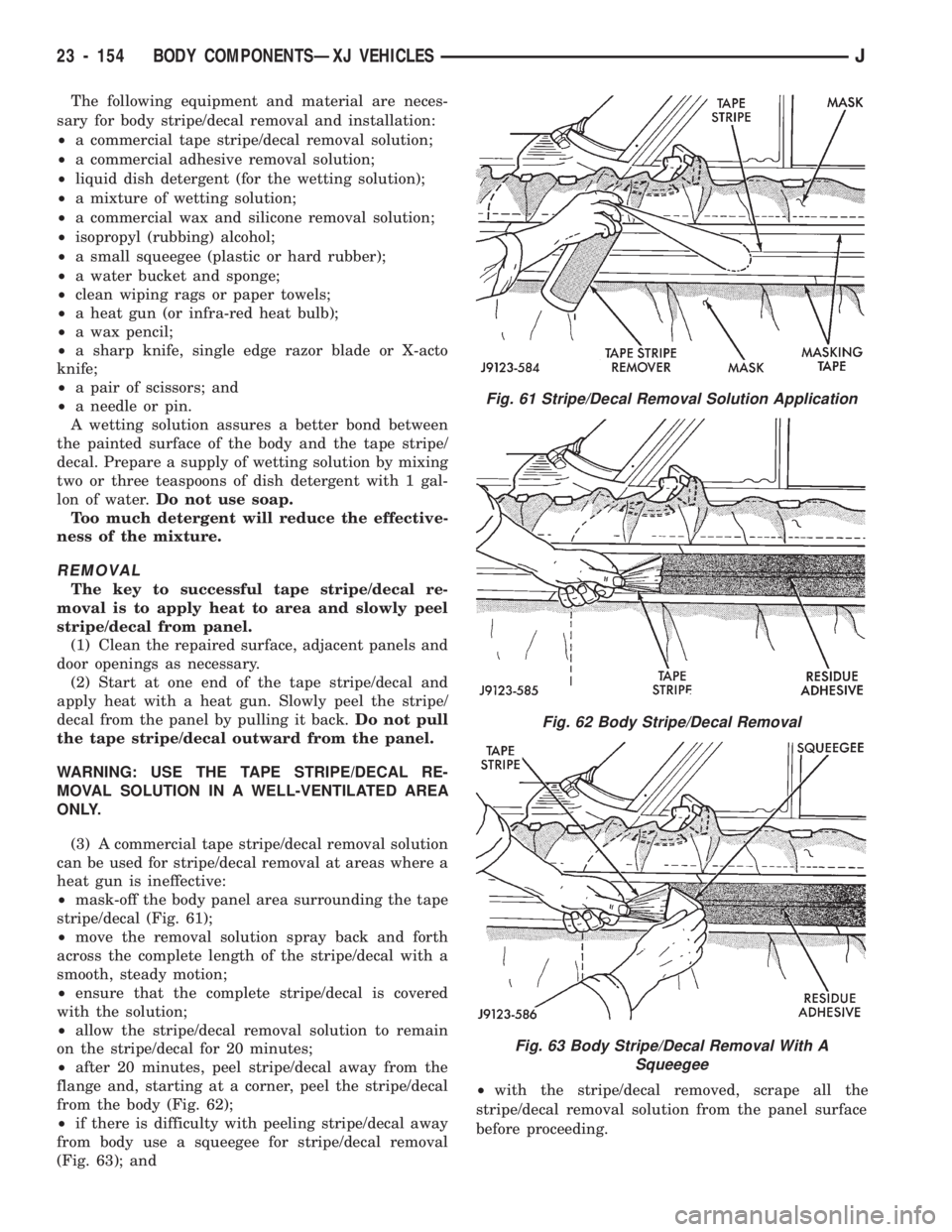
²mask-off the body panel area surrounding the tape
stripe/decal (Fig. 61);
²move the removal solution spray back and forth
across the complete length of the stripe/decal with a
smooth, steady motion;
²ensure that the complete stripe/decal is covered
with the solution;
²allow the stripe/decal removal solution to remain
on the stripe/decal for 20 minutes;
²after 20 minutes, peel stripe/decal away from the
flange and, starting at a corner, peel the stripe/decal
from the body (Fig. 62);
²if there is difficulty with peeling stripe/decal away
from body use a squeegee for stripe/decal removal
(Fig. 63); and²with the stripe/decal removed, scrape all the
stripe/decal removal solution from the panel surface
before proceeding.
Fig. 61 Stripe/Decal Removal Solution Application
Fig. 62 Body Stripe/Decal Removal
Fig. 63 Body Stripe/Decal Removal With A
Squeegee
23 - 154 BODY COMPONENTSÐXJ VEHICLESJ