warning JEEP CHEROKEE 1994 Service Repair Manual
[x] Cancel search | Manufacturer: JEEP, Model Year: 1994, Model line: CHEROKEE, Model: JEEP CHEROKEE 1994Pages: 1784, PDF Size: 77.09 MB
Page 1703 of 1784
HEATER CORE AND HOUSING
REMOVAL
WARNING: HOT ENGINE COOLANT CAN CAUSE
SEVERE BURNS. DO NOT OPEN THE RADIATOR
DRAIN COCK WHEN THE COOLING SYSTEM IS
HOT AND PRESSURIZED. ALLOW THE COOLANT
TO DECREASE TO ROOM TEMPERATURE BEFORE
STARTING REPAIR OPERATIONS.
(1) Drain approximately 1.9 liters (2 qts) of coolant
from the radiator. Drain the coolant into a clean con-
tainer.
(2) Disconnect the heater hoses.
(3) Disconnect the vent door cables.
(4) Disconnect the blower motor wire.
(5) Disconnect the defroster duct.
(6) Remove the nuts that attach the heater hous-
ing studs to the engine compartment side of the dash
panel.
(7) Remove the heater housing assembly by tilting
it downward, to disengage it from the defroster duct.
Pull it rearward and out from under the instrument
panel.
(8) Remove the heater hosing cover from the hous-
ing.
(9) Remove the heater core from the housing.
INSTALLATION
(1) Install the heater core in the housing and in-
stall the cover on the housing.
(2) Position the heater housing on the dash panel.
Be sure the housing studs all extend through the
dash panel.
(3) Install the seals on the heater core outlet and
inlet tubes and over the blower motor housing.
(4) Install the attaching nuts on the housing studs.
CAUTION: DO NOT over tighten the attaching nuts.
The housing could become distorted causing air
leaks and improper heater door operation. Tighten
the nuts alternately and evenly until 2 stud threads
are visible beyond each nut.
(5) Connect the defroster duct to the housing.
(6) Connect the blower motor wire.
(7) Connect the vent door control cables.
(8) Connect the heater hoses.
(9) Fill and bleed the cooling system.
(10) Check system operation.
BLOWER MOTOR (HEATING)
REMOVAL
(1) Remove the heater housing.
(2) Remove the blower motor-to-heater housing at-
taching screws/nuts.
(3) Remove the blower motor from the housing.
INSTALLATION
(1) Position the blower motor into the housing.
(2) Install and tighten the blower motor-to-heater
housing attaching screws/nuts.
(3) Install the heater housing.
(4) Check blower motor and heater operation.
DEFROSTER NOZZLE AND DUCT
REMOVAL
WARNING: HOT ENGINE COOLANT CAN CAUSE
SEVERE BURNS. DO NOT OPEN THE RADIATOR
DRAIN COCK WHEN THE COOLING SYSTEM IS
HOT AND PRESSURIZED. ALLOW THE COOLANT
TO DECREASE TO ROOM TEMPERATURE BEFORE
STARTING REPAIR OPERATIONS.
(1) Drain approximately 1.9 liters (2 qts) of coolant
from the radiator. Drain the coolant into a clean con-
tainer.
(2) Disconnect the heater hoses.
(3) Remove the nuts attaching the heater housing
studs to the engine compartment side of the dash
panel.
(4) Disconnect the speedometer cable.
(5) Remove the glove box.
(6) Tilt the heater housing back and pull it rear-
ward and out from under the instrument panel.
(7) Disconnect the vent control cables.
(8) Remove the fresh air intake grille from the
cowl.
(9) Remove the fresh air intake duct.
(10) Lower the windshield.
(11) Remove the defroster nozzle attaching screws
and remove the nozzle and duct.
INSTALLATION
(1) Install the defroster nozzle and duct.
(2) Raise and secure the windshield.
(3) Install the fresh air intake duct.
(4) Install the fresh air intake grille on the cowl.
(5) Install the vent cables.
(6) Position the heater housing on the dash panel.
Be sure all the housing studs extend through the
dash panel.
(7) Install the seals on the blower motor and the
heater core inlet and outlet tubes.
(8) Install the attaching nuts on the housing studs.
CAUTION: DO NOT over tighten the attaching nuts.
The housing could become distorted causing air
leaks and improper heater door operation. Tighten
the nuts alternately and evenly until 2 stud threads
are visible beyond each nut.
(9) Install the glove box.
(10) Connect the speedometer cable.
(11) Connect the heater hoses.
24 - 40 HEATING AND AIR CONDITIONINGJ
Page 1704 of 1784
(12) Fill and bleed the cooling system.
FRESH AIR DOOR VACUUM MOTOR
REMOVAL
(1) Remove the glove box and assist handle.
(2) Disconnect the vacuum hose from the motor.
(3) Remove the motor lever retaining clip.
(4) Remove the motor attaching nuts and remove
the motor from the fresh air duct.
INSTALLATION
(1) Position the motor on the fresh air duct and in-
stall the motor attaching nuts.
(2) Align the motor lever with the air door lever
and install the lever retaining clip.
(3) Connect the vacuum hose to the motor.
(4) Install the glove box and assist handle.
FRESH AIR INTAKE DUCT
REMOVAL
WARNING: HOT ENGINE COOLANT CAN CAUSE
SEVERE BURNS. DO NOT OPEN THE RADIATOR
DRAIN COCK WHEN THE COOLING SYSTEM IS
HOT AND PRESSURIZED. ALLOW THE COOLANT
TO DECREASE TO ROOM TEMPERATURE BEFORE
STARTING REPAIR OPERATIONS.
(1) Drain approximately 1.9 liters (2 qts) of coolant
from the radiator. Drain the coolant into a clean con-
tainer.
(2) Disconnect the heater hoses.
(3) Remove the nuts attaching the heater housing
studs to the dash panel from inside the engine com-
partment.
(4) Disconnect the speedometer cable.
(5) Remove the glove box and assist handle.
(6) Tilt the heater housing back and pull it rear-
ward and out from under the instrument panel.
(7) Disconnect the vent cables.
(8) Remove the fresh air intake grille from the
cowl.
(9) Remove the fresh air intake duct.
INSTALLATION
(1) Install the fresh air intake duct.
(2) Install the defroster nozzle and duct.
(3) Raise and secure the windshield.
(4) Install the fresh air grille on the cowl.
(5) Install the vent cables.
(6) Position the heater housing on the dash panel.
Be sure all the housing studs extend through the
dash panel.
(7) Install the seals on the blower motor and
heater core inlet and outlet tubes.
(8) Install the attaching nuts on the heater hous-
ing studs.CAUTION: DO NOT over tighten the attaching nuts.
The housing could become distorted causing air
leaks and improper heater door operation. Tighten
the nuts alternately and evenly until 2 stud threads
are visible beyond each nut.
(9) Install the glove box and assist handle.
(10) Connect the speedometer cable.
(11) Connect the heater hoses.
(12) Fill and bleed the cooling system.
DESCRIPTION (AIR CONDITIONING)
The evaporator, blower fan and motor, thermostat,
expansion valve, capillary tube, air outlets and sys-
tem controls are located in the evaporator housing.
The evaporator housing is mounted under the instru-
ment panel. The compressor, condenser, receiver-
dryer and refrigerant lines are located in the engine
compartment.
A rotary-type compressor with magnetic clutch op-
erated drive pulley is used for all vehicles equipped
with air conditioning.
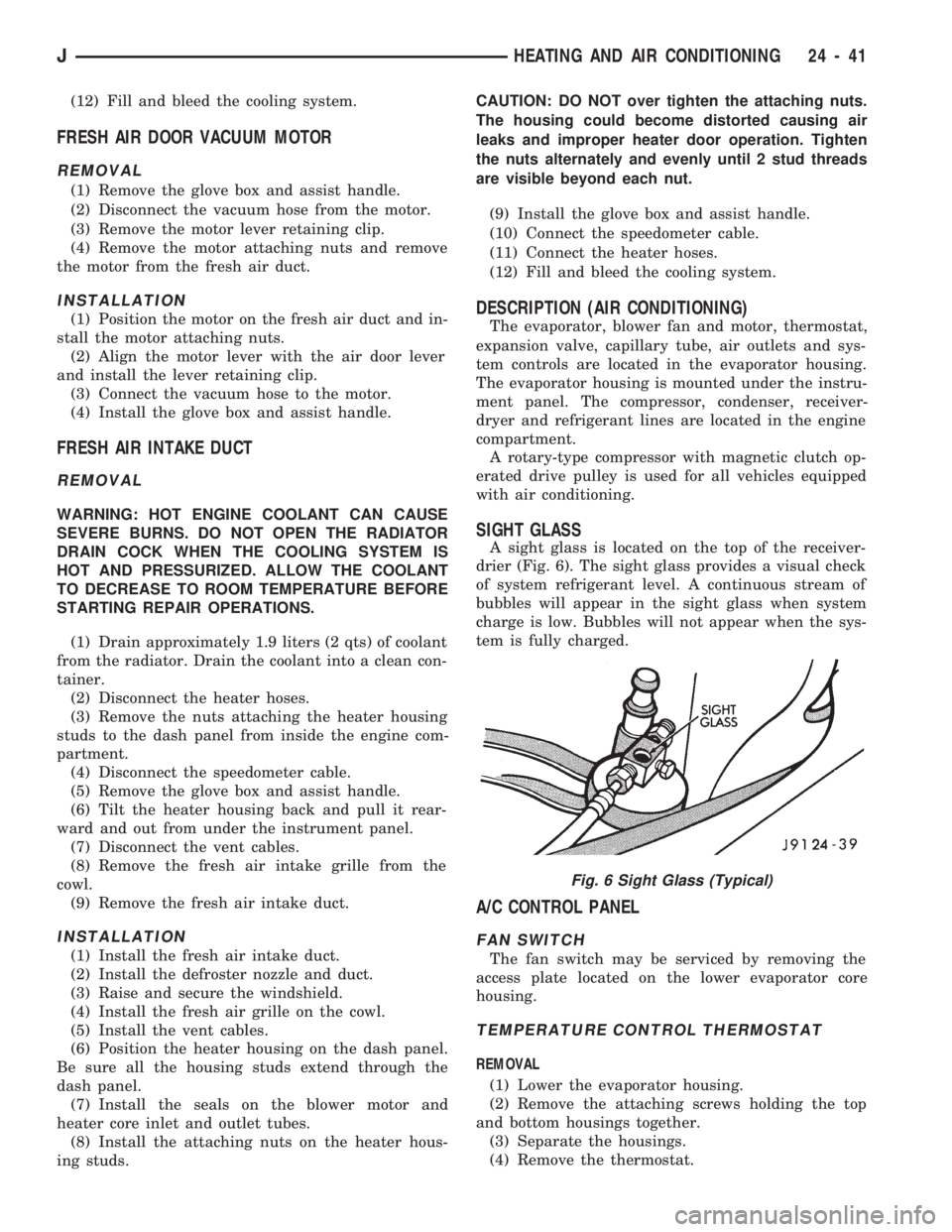
SIGHT GLASS
A sight glass is located on the top of the receiver-
drier (Fig. 6). The sight glass provides a visual check
of system refrigerant level. A continuous stream of
bubbles will appear in the sight glass when system
charge is low. Bubbles will not appear when the sys-
tem is fully charged.
A/C CONTROL PANEL
FAN SWITCH
The fan switch may be serviced by removing the
access plate located on the lower evaporator core
housing.
TEMPERATURE CONTROL THERMOSTAT
REMOVAL
(1) Lower the evaporator housing.
(2) Remove the attaching screws holding the top
and bottom housings together.
(3) Separate the housings.
(4) Remove the thermostat.
Fig. 6 Sight Glass (Typical)
JHEATING AND AIR CONDITIONING 24 - 41
Page 1705 of 1784
INSTALLATION
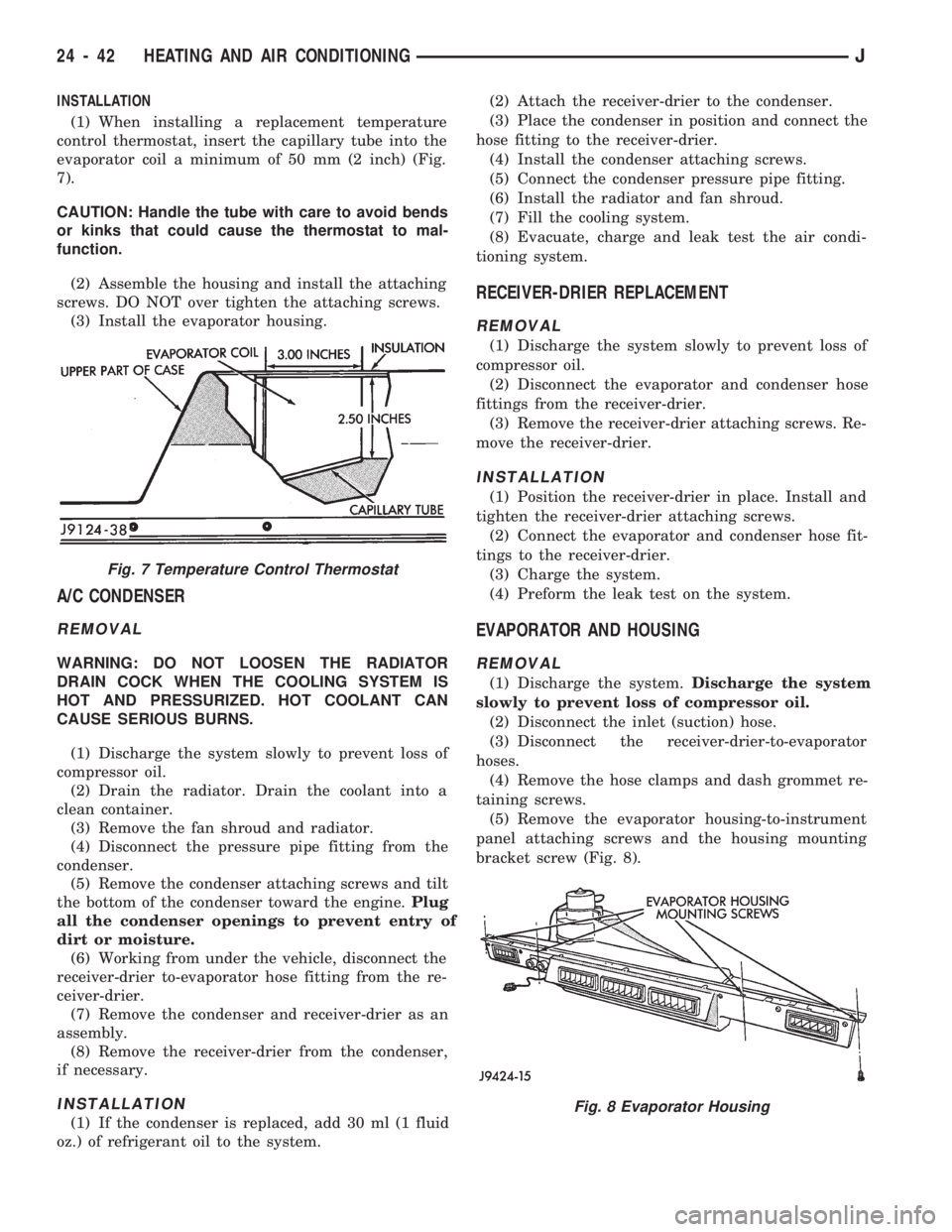
(1) When installing a replacement temperature
control thermostat, insert the capillary tube into the
evaporator coil a minimum of 50 mm (2 inch) (Fig.
7).
CAUTION: Handle the tube with care to avoid bends
or kinks that could cause the thermostat to mal-
function.
(2) Assemble the housing and install the attaching
screws. DO NOT over tighten the attaching screws.
(3) Install the evaporator housing.
A/C CONDENSER
REMOVAL
WARNING: DO NOT LOOSEN THE RADIATOR
DRAIN COCK WHEN THE COOLING SYSTEM IS
HOT AND PRESSURIZED. HOT COOLANT CAN
CAUSE SERIOUS BURNS.
(1) Discharge the system slowly to prevent loss of
compressor oil.
(2) Drain the radiator. Drain the coolant into a
clean container.
(3) Remove the fan shroud and radiator.
(4) Disconnect the pressure pipe fitting from the
condenser.
(5) Remove the condenser attaching screws and tilt
the bottom of the condenser toward the engine.Plug
all the condenser openings to prevent entry of
dirt or moisture.
(6) Working from under the vehicle, disconnect the
receiver-drier to-evaporator hose fitting from the re-
ceiver-drier.
(7) Remove the condenser and receiver-drier as an
assembly.
(8) Remove the receiver-drier from the condenser,
if necessary.
INSTALLATION
(1) If the condenser is replaced, add 30 ml (1 fluid
oz.) of refrigerant oil to the system.(2) Attach the receiver-drier to the condenser.
(3) Place the condenser in position and connect the
hose fitting to the receiver-drier.
(4) Install the condenser attaching screws.
(5) Connect the condenser pressure pipe fitting.
(6) Install the radiator and fan shroud.
(7) Fill the cooling system.
(8) Evacuate, charge and leak test the air condi-
tioning system.
RECEIVER-DRIER REPLACEMENT
REMOVAL
(1) Discharge the system slowly to prevent loss of
compressor oil.
(2) Disconnect the evaporator and condenser hose
fittings from the receiver-drier.
(3) Remove the receiver-drier attaching screws. Re-
move the receiver-drier.
INSTALLATION
(1) Position the receiver-drier in place. Install and
tighten the receiver-drier attaching screws.
(2) Connect the evaporator and condenser hose fit-
tings to the receiver-drier.
(3) Charge the system.
(4) Preform the leak test on the system.
EVAPORATOR AND HOUSING
REMOVAL
(1) Discharge the system.Discharge the system
slowly to prevent loss of compressor oil.
(2) Disconnect the inlet (suction) hose.
(3) Disconnect the receiver-drier-to-evaporator
hoses.
(4) Remove the hose clamps and dash grommet re-
taining screws.
(5) Remove the evaporator housing-to-instrument
panel attaching screws and the housing mounting
bracket screw (Fig. 8).
Fig. 7 Temperature Control Thermostat
Fig. 8 Evaporator Housing
24 - 42 HEATING AND AIR CONDITIONINGJ
Page 1710 of 1784
AIR CONDITIONING
CONTENTS
page page
AIR CONDITIONING EQUIPMENT........... 4
AIR CONDITIONING PERFORMANCE TESTS . . 5
GENERAL INFORMATION.................. 1
REFRIGERANT LEAK TESTING, DISCHARGING,
EVACUATING AND CHARGING............ 8REFRIGERANT OIL....................... 9
SERVICE PRECAUTIONS.................. 3
WARNINGS AND CAUTIONS FOR R134A
SYSTEM.............................. 3
GENERAL INFORMATION
A/C COMPONENTS
COMPRESSORÐThe SD-709 Compressor is used
on all models. The compressor compresses the low-
pressure refrigerant vapor from the evaporator into a
high pressure, high temperature vapor. The compres-
sor is serviced as an assembly only.
CLUTCH PULLEY AND COILÐThey are
mounted on the compressor and providing a way to
drive the compressor. The compressor clutch and coil
are the only serviced parts on the SD-709 compres-
sor. When the compressor is not in operation, the
pulley free wheels on the clutch hub bearing. When
the coil is energized the clutch plate is magnetically
engaged with the pulley and turns the compressor
shaft.
CONDENSERÐThe condenser is located in front
of the engine radiator. Its function is to cool the hot
high pressure refrigerant gas. This causes it to con-
dense into high pressure liquid refrigerant.
FILTER-DRIERÐThe drier is used to remove con-
taminates and traces of moisture from the refriger-
ant system.
SIGHT-GLASSÐThe sight glass is located on top
of the filter drier. It is used as a diagnostic tool to ob-
serve refrigerant flow.
LOW-PRESSURE HIGH-PRESSURE CUT-OFF
SWITCHÐThe switch is located on the filter drier
and is wired in series with compressor clutch. When
the pressure drops down to 193 kPa (28 psi) the
switch interrupts the power to the compressor clutch.
When the pressure increases above 3100 to 3375 kPa
(450 to 490 psi) the switch interrupts the power to
the compressor clutch.
HIGH PRESSURE RELIEF VALVEÐThe valve
is located on the filter drier. The valve is used to pre-
vent excessive pressure up build of 3445 to 4135
kPag (500 to 600 psi) and above. This will prevent
damage to the compressor and other system compo-
nents.EXPANSION VALVEÐThe expansion valve is lo-
cated in the engine compartment on XJ vehicles. On
YJ vehicles it is located behind the A/C housing. Its
function is to meter refrigerant into the evaporator in
accordance with cooling requirements.
EVAPORATOR COILÐThe coil is located in the
A/C housing. Its function is to remove heat and de-
humidify the air before it enters the vehicle.
FIN SENSING CYCLING CLUTCH SWITCHÐ
The switch is attached to the evaporator coil. This
switch prevents condensate water on the evaporator
coil from freezing. It does this by cycling the com-
pressor clutch on and off. This switch is used onXJ
only
THERMOSTATÐThe thermostat is located in the
evaporator housing. Its function is to cycle the com-
pressor clutch to control temperature. The thermo-
stat is used on theYJonly.
REFRIGERANT LINESÐThe lines are used to
carry the refrigerant between the various system
components.
SERVICE PORTSÐThe high pressure service
port is located on the discharge line near the com-
pressor. The low pressure service port is located on
the suction line near the compressor. The compressor
no longer uses service valves.
After servicing the refrigerant system, always in-
stall service port caps.
REFRIGERANT
The vehicles use a new type of refrigerant called
R-134a. It is a non-toxic, non-flammable, clear color-
less liquified gas.
R-134a refrigerant is not compatible with R-12 re-
frigerant in an air conditioning system. A small
amount of R-12 in a R-134a system will cause com-
pressor failure, refrigerant oil sludge or poor A/C per-
formance.
JAIR CONDITIONING1
Page 1712 of 1784
WARNINGS AND CAUTIONS FOR R134A SYSTEM
WARNING: AVOID BREATHING A/C REFRIGERANT
AND LUBRICANT VAPOR OR MIST. EXPOSURE MAY
IRRITATE EYES, NOSE AND/OR THROAT. WEAR
EYE PROTECTION WHEN SERVICING THE AIR
CONDITIONING REFRIGERANT SYSTEM. SERIOUS
EYE INJURY CAN RESULT FROM EYE CONTACT
WITH REFRIGERANT. IF EYE CONTACT IS MADE,
SEEK MEDICAL ATTENTION IMMEDIATELY.
WARNING: DO NOT EXPOSE REFRIGERANT TO
OPEN FLAME. POISONOUS GAS IS CREATED
WHEN REFRIGERANT IS BURNED. AN ELEC-
TRONIC LEAK DETECTOR IS RECOMMENDED.
WARNING: IF ACCIDENTAL SYSTEM DISCHARGE
OCCURS, VENTILATE THE WORK AREA BEFORE
RESUMING SERVICE. LARGE AMOUNTS OF RE-
FRIGERANT RELEASED IN A CLOSED WORK AREA
WILL DISPLACE THE OXYGEN AND CAUSE SUFFO-
CATION.
WARNING: THE EVAPORATION RATE OF R-134A
REFRIGERANT AT AVERAGE TEMPERATURE AND
ALTITUDE IS EXTREMELY HIGH. AS A RESULT,
ANYTHING THAT COMES IN CONTACT WITH THE
REFRIGERANT WILL FREEZE. ALWAYS PROTECT
SKIN OR DELICATE OBJECTS FROM DIRECT CON-
TACT WITH REFRIGERANT.WARNING: R-134A SERVICE EQUIPMENT OR VEHI-
CLE A/C SYSTEM SHOULD NOT BE PRESSURE
TESTED OR LEAK TESTED WITH COMPRESSED
AIR. SOME MIXTURES OF AIR AND R-134A HAVE
BEEN SHOWN TO BE COMBUSTIBLE AT ELEVATED
PRESSURES. THESE MIXTURES ARE POTENTIALLY
DANGEROUS AND MAY RESULT IN FIRE OR EX-
PLOSION CAUSING INJURY OR PROPERTY DAM-
AGE.
CAUTION: Liquid refrigerant is corrosive to metal
surfaces. Follow the operating instructions supplied
with equipment being used.
CAUTION: Never add R-12 to a system designed to
use R-134a. Damage to the system will result.
CAUTION: R-12 compressor oil can not be mixed
with the R-134a compressor oil. They ARE NOT
compatible.
CAUTION: DO NOT use R-12 equipment or parts on
the R-134a system. Damage to the system will re-
sult.
SERVICE PRECAUTIONS
Never open or loosen a connection before discharg-
ing the system refrigerant.
The A/C system must always be evacuated before
charging.
DO NOT open a refrigerant system or uncap a re-
placement component unless it is as close as possible
to room temperature. This will prevent condensation
from forming inside of a component which is cooler
than the surrounding air.
Before disconnecting a component from the system,
clean the outside of the fittings thoroughly.
Immediately after disconnecting a component from
the system, seal the open fittings with a cap or plug.
Before connecting an open fitting always insall a
new seal/gasket. Coat the fitting and seal with clean
refrigerant oil before connecting.
DO NOT remove the sealing caps from a replace-
ment component until ready to install.When installing a refrigerant line avoid sharp
bends. Position the line away from the exhaust or
any sharp edges which may chafe the line.
Tighten fittings only to the specified torque. The
aluminum fittings used in the A/C system will not
tolerate over tightening.
When disconnecting a fitting use a wrench on both
halves of the fitting. This will prevent twisting of the
refrigerant lines or tubes.
Refrigerant oil will absorb moisture from the atmo-
sphere if left uncapped. DO NOT open an oil con-
tainer until ready to use and install the cap
immediately after using. Store the oil only in a clean
moisture-free container.
Keep service tools and the work area clean. Con-
tamination of A/C system through careless work hab-
its must be avoided.
JAIR CONDITIONING3
Page 1713 of 1784
AIR CONDITIONING EQUIPMENT
WARNING: EYE PROTECTION MUST BE USED
WHEN SERVICING AN AIR CONDITIONING REFRIG-
ERANT SYSTEM. TURN OFF (ROTATE CLOCKWISE)
ALL VALVES ON THE EQUIPMENT BEING USED
BEFORE PROCEEDING WITH THIS OPERATION.
PERSONNEL INJURY CAN RESULT.
When servicing an air conditioning system, a
R-134a Charging Station and a Recovery/Recycling
Station is required. These devices must meet SAE
standard J2210. Refer to the operating instructions
provided with the equipment for proper operation.
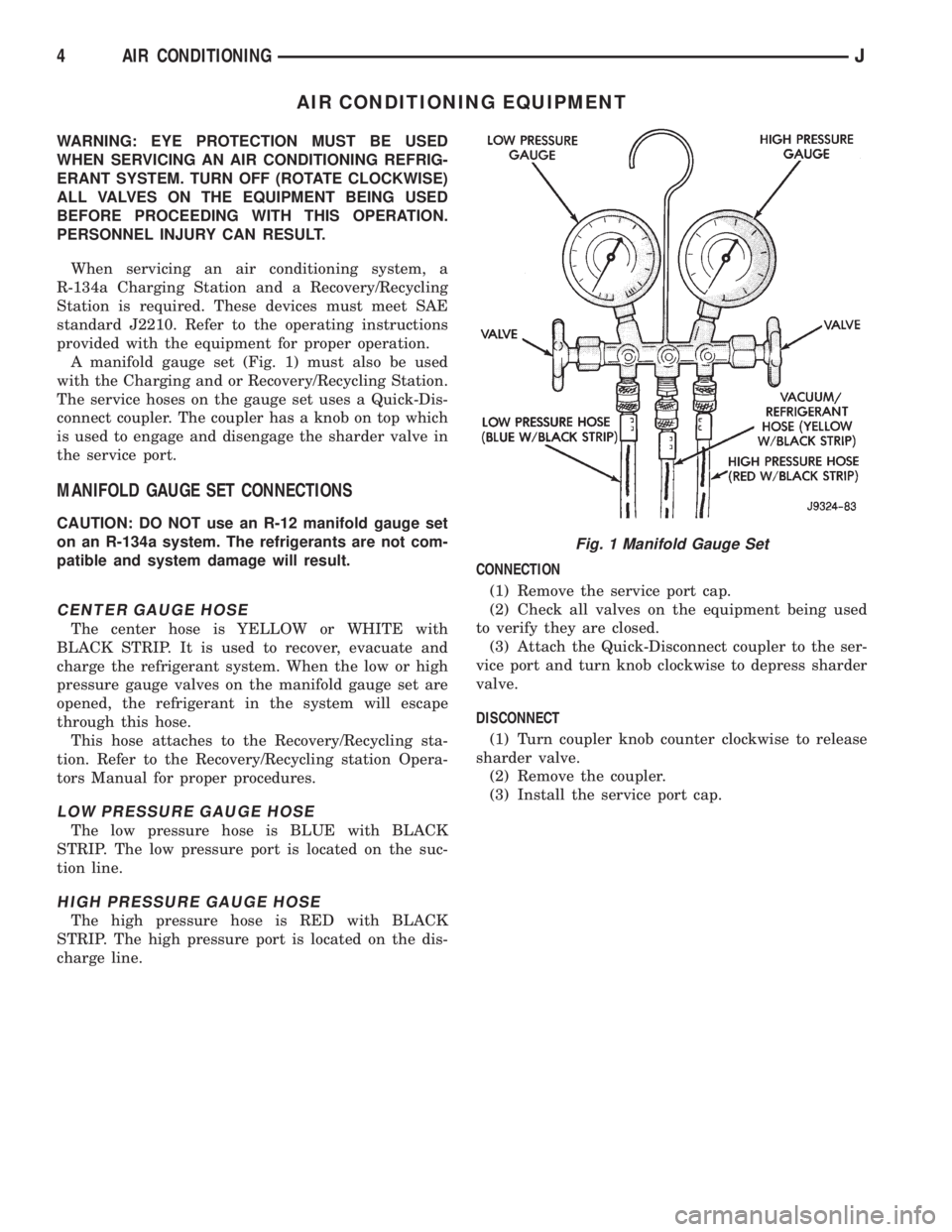
A manifold gauge set (Fig. 1) must also be used
with the Charging and or Recovery/Recycling Station.
The service hoses on the gauge set uses a Quick-Dis-
connect coupler. The coupler has a knob on top which
is used to engage and disengage the sharder valve in
the service port.
MANIFOLD GAUGE SET CONNECTIONS
CAUTION: DO NOT use an R-12 manifold gauge set
on an R-134a system. The refrigerants are not com-
patible and system damage will result.
CENTER GAUGE HOSE
The center hose is YELLOW or WHITE with
BLACK STRIP. It is used to recover, evacuate and
charge the refrigerant system. When the low or high
pressure gauge valves on the manifold gauge set are
opened, the refrigerant in the system will escape
through this hose.
This hose attaches to the Recovery/Recycling sta-
tion. Refer to the Recovery/Recycling station Opera-
tors Manual for proper procedures.
LOW PRESSURE GAUGE HOSE
The low pressure hose is BLUE with BLACK
STRIP. The low pressure port is located on the suc-
tion line.
HIGH PRESSURE GAUGE HOSE
The high pressure hose is RED with BLACK
STRIP. The high pressure port is located on the dis-
charge line.CONNECTION
(1) Remove the service port cap.
(2) Check all valves on the equipment being used
to verify they are closed.
(3) Attach the Quick-Disconnect coupler to the ser-
vice port and turn knob clockwise to depress sharder
valve.
DISCONNECT
(1) Turn coupler knob counter clockwise to release
sharder valve.
(2) Remove the coupler.
(3) Install the service port cap.
Fig. 1 Manifold Gauge Set
4 AIR CONDITIONINGJ
Page 1717 of 1784
REFRIGERANT LEAK TESTING, DISCHARGING, EVACUATING AND CHARGING
LEAK TESTING REFRIGERANT
WARNING: REVIEW WARNINGS AND CAUTIONS IN
GENERAL INFORMATION SECTION OF THIS
GROUP BEFORE LEAK TESTING.
If A/C system is not cooling properly, determine if
system is fully charged. Refer to Refrigerant System
Diagnosis Chart. If the system is empty evacuate the
A/C system and charge system with 0.283 kPa (0.6
lbs. or 10 oz.) R-134a refrigerant. Refer to Charging
Refrigerant System for instructions. To detect a leak
in the system, perform the following procedures.
(1) Position the vehicle in a wind free work area.
This will aid in detecting small leaks.
(2) Bring A/C system up to operating temperature
and pressure. This is done by allowing the engine to
run with the A/C on for 5 to 7 minutes.
(3) Open hood 5 minutes prior to leak test. This
will dissipate any accumulated refrigerant in the en-
gine compartment.
(4) With the engine not running, use an R-134a
Electronic Leak Detector and search for leaks. Move
probe slowly along the bottom side of lines and fit-
tings, because R-134a is heavier than air. Fittings,
lines, or components that appear to be oily usually
indicates a refrigerant leak.
(5) To inspect the evaporator core for leaks. Set the
blower at low speed and the selector in PANEL and
RECIRC mode check for leaks at CENTER panel ou-
lets.
DISCHARGING REFRIGERANT SYSTEM
WARNING: REVIEW WARNINGS AND CAUTIONS IN
GENERAL INFORMATION SECTION OF THIS
GROUP BEFORE DISCHARGING SYSTEM.
R-134a refrigrant is a hydrofluorocarbon (HFC)
that does not contain chlorine. R-134a refrigerant Re-
covery/Recycling Station that meets SAE standard
J2210 must be used to discharge the refrigerant sys-
tem. Refer to the operating instructions provided
with the equipment for proper operation.
EVACUATING REFRIGERANT SYSTEM
WARNING: REVIEW WARNINGS AND CAUTIONS IN
GENERAL INFORMATION SECTION OF THIS
GROUP BEFORE EVACUATING SYSTEM.If the A/C system has been open to the atmosphere,
it must be evacuated before the system can be
charged. Moisture and air mixed with refrigerant will
raise the compressor head pressure above acceptable
operating levels. This will reduce the performance of
the air conditioner and damage the compressor. Mois-
ture will boil at near room temperature when ex-
posed to vacuum. To evacuate the refrigerant system
use following procedure:
(1) Connect a suitable charging station and mani-
fold gauge set to the vehicle.
(2) Open the low and high side valves and start
vacuum pump. When suction gauge reads 88 kPag
(26 in. Hg) vacuum or greater, close all valves and
turn off vacuum pump. If system fails to reach spec-
ified vacuum, the system has a leak that must be
corrected. If system maintains the specified vacuum
for 30 minutes, start the vacuum pump. Then open
the suction and discharge valves and evacuate an ad-
ditional 10 minutes.
(3) Close all valves. Turn off and disconnect the
vacuum pump.
The system is now ready to be charged with refrig-
erant.
CHARGING REFRIGERANT SYSTEM
WARNING: REVIEW WARNINGS AND CAUTIONS IN
GENERAL INFORMATION SECTION OF THIS
GROUP BEFORE CHARGING SYSTEM.
After the system has been tested for leaks and
evacuated, a refrigerant charge can be injected into
the system. Refer to refrigerant capacities for proper
amount of refrigerant charge.
The most accurate method of charging is to com-
pletely evacuate the system. Then charge the system
using a Recovery/Recycling Station approved for
R-134a refrigerant. Refer to the operating instruc-
tions provided with the equipment for proper opera-
tion.
CAUTION: Do not over charge refrigerant system.
This will cause excessive compressor head pres-
sure and can cause noise and system failure.
REFRIGERANT CHARGE CAPACITY
The R-134a system charge capacity is 0.9 kPag (32
oz.) for XJ and YJ vehicles.
8 AIR CONDITIONINGJ
Page 1742 of 1784
SPECIFICATIONS
SPECIFICATION NOTATIONS
All torque specifications listed in this service man-
ual are in both metric system and SAE/English sys-
tem.
WARNING: THE USE OF INCORRECT ATTACHING
HARDWARE CAN RESULT IN COMPONENT DAM-
AGE AND/OR PERSONAL INJURY.
During all procedures, it is important to retain the
original attaching hardware. If the hardware is not
reusable, replace new hardware with equivalent
specifications.
METRIC SYSTEM NOTATION
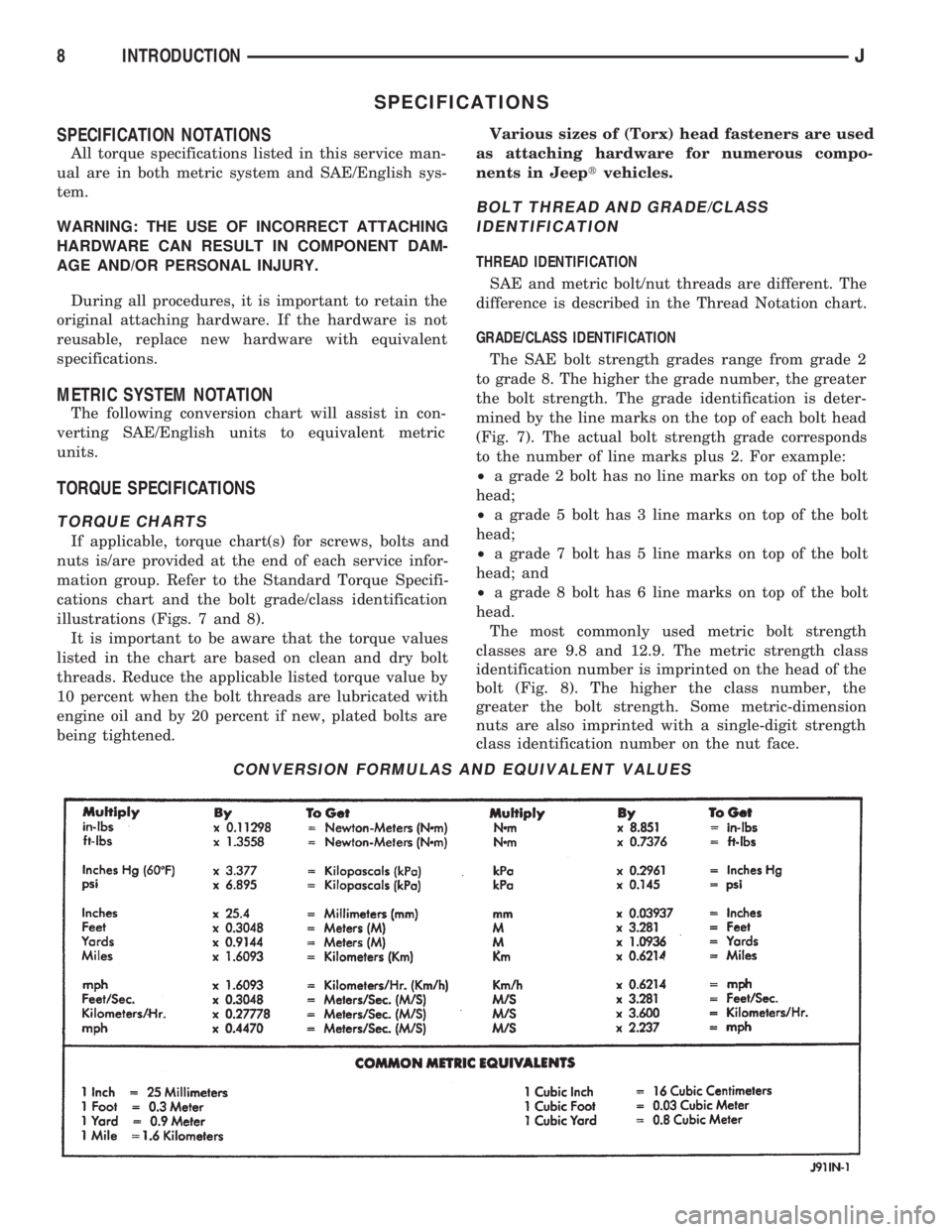
The following conversion chart will assist in con-
verting SAE/English units to equivalent metric
units.
TORQUE SPECIFICATIONS
TORQUE CHARTS
If applicable, torque chart(s) for screws, bolts and
nuts is/are provided at the end of each service infor-
mation group. Refer to the Standard Torque Specifi-
cations chart and the bolt grade/class identification
illustrations (Figs. 7 and 8).
It is important to be aware that the torque values
listed in the chart are based on clean and dry bolt
threads. Reduce the applicable listed torque value by
10 percent when the bolt threads are lubricated with
engine oil and by 20 percent if new, plated bolts are
being tightened.Various sizes of (Torx) head fasteners are used
as attaching hardware for numerous compo-
nents in Jeeptvehicles.
BOLT THREAD AND GRADE/CLASS
IDENTIFICATION
THREAD IDENTIFICATION
SAE and metric bolt/nut threads are different. The
difference is described in the Thread Notation chart.
GRADE/CLASS IDENTIFICATION
The SAE bolt strength grades range from grade 2
to grade 8. The higher the grade number, the greater
the bolt strength. The grade identification is deter-
mined by the line marks on the top of each bolt head
(Fig. 7). The actual bolt strength grade corresponds
to the number of line marks plus 2. For example:
²a grade 2 bolt has no line marks on top of the bolt
head;
²a grade 5 bolt has 3 line marks on top of the bolt
head;
²a grade 7 bolt has 5 line marks on top of the bolt
head; and
²a grade 8 bolt has 6 line marks on top of the bolt
head.
The most commonly used metric bolt strength
classes are 9.8 and 12.9. The metric strength class
identification number is imprinted on the head of the
bolt (Fig. 8). The higher the class number, the
greater the bolt strength. Some metric-dimension
nuts are also imprinted with a single-digit strength
class identification number on the nut face.
CONVERSION FORMULAS AND EQUIVALENT VALUES
8 INTRODUCTIONJ
Page 1745 of 1784
30RH/32RH AUTOMATIC TRANSMISSION . . . 21-66
30RH/32RH GENERAL SPECIFICATIONS . . . 21-322
30RH/32RH IN-VEHICLE SERVICE.........21-96
30RH/32RH PRESSURE TEST
SPECIFICATIONS....................21-323
30RH/32RH SNAP RING/THRUST
WASHER/THRUST PLATE
SPECIFICATIONS....................21-322
30RH/32RH TORQUE SPECIFICATIONS....21-323
30RH/32RH TRANSMISSION DIAGNOSIS . . . 21-69,
21-77,21-78,21-79,21-80,21-81,21-82,21-83,21-84,
21-85
30RH/32RH TRANSMISSION OVERHAUL . . . 21-112
30RH/32RH TRANSMISSION REMOVAL
AND INSTALLATION..................21-108
3-2 DOWNSHIFT, HYDRAULIC FLOW
DURING FULL THROTTLE..............21-92
3-2 DOWNSHIFT, HYDRAULIC FLOW
DURING PART THROTTLE..............21-91
4WD INDICATOR......................8E-22
4WD INDICATOR INOPERATIVE............8E-4
4WD INDICATOR LAMP..................8E-2
60-WAY CONNECTOR, POWERTRAIN
CONTROL MODULE (PCM).............14-38
ABBREVIATIONS, SYMBOLS, FUSES........8W-6
ABS BRAKE DIAGNOSIS...................5-3
ABS BRAKES, BRAKE BLEEDINGÐWITH.....5-14
ABS COMPONENT SERVICE...............5-47
ABS FAULT DIAGNOSIS................5-4,5-6
ABS OPERATION IN ANTILOCK BRAKING
MODE..............................5-43
ABS OPERATION IN NORMAL BRAKING
MODE..............................5-43
ABS SYSTEM OPERATION................5-39
ABS SYSTEM WIRING AND ELECTRICAL
CIRCUITS............................5-4
ABS WARNING LIGHT DISPLAY.............5-3
ABSOLUTE PRESSURE (MAP) SENSOR,
MANIFOLD; FUEL SYSTEM.............14-57
ABSOLUTE PRESSURE (MAP) SENSOR,
MANIFOLD; IGNITION SYSTEMS....8D-5,8D-27
ABSOLUTE PRESSURE (MAP) SENSORÐ
PCM INPUT, MANIFOLD...............14-21
ABSOLUTE PRESSURE (MAP) SENSOR
TEST, MANIFOLD; FUEL SYSTEM........14-44
ABSOLUTE PRESSURE (MAP) SENSOR
TEST, MANIFOLD; IGNITION
SYSTEMS..........................8D-14
ABSORBER, SHOCK; FRONT
SUSPENSION AND AXLE............2-12,2-14
ABSORBER, SHOCK; REAR SUSPENSION
AND AXLES........................3-3,3-5
A/C BLOWER MOTOR...................24-43
A/C CONDENSER......................24-42
A/C CONTROL PANEL...................24-41
A/C CONTROL PANEL REPLACEMENT,
HEATER ............................24-26
A/C OPERATION........................24-1
A/C PERFORMANCE TEST................24-8
A/C RECIRCULATING AIR DOOR
VACUUM MOTOR REPLACEMENT........24-31
ACCELERATION SENSOR INSTALLATION.....5-52
ACCELERATION SENSOR REMOVAL........5-52
ACCELERATION SWITCH.................5-41
ACCELERATION SWITCH OPERATION.......5-45
ACCELERATOR PEDAL..................14-16
ACCELERATOR PEDAL AND THROTTLE
CABLE........................14-16,14-54
ACCENT PAINT.......................23-202
ACCESSORY DRIVE BELT.................0-20
ACCESSORY DRIVE BELTS, ENGINE........7-31
ACCUMULATOR PISTONS AND SPRINGS . . 21-179
ACTUATOR MOTOR STALL TEST...........8P-6
ADAPTER HOUSING AND PARK LOCK
COMPONENT OVERHAUL.............21-120
ADAPTER HOUSING SEAL REPLACEMENT . . 21-182
ADD-A-TRUNK.......................23-199
ADJUSTER PLUG ASSEMBLY
REPLACEMENT......................19-27
ADJUSTMENT, BRAKELIGHT SWITCH.......5-66
ADJUSTMENT, DIFFERENTIAL SHIM
PACK MEASUREMENT..................2-42
ADJUSTMENT, DOOR LATCH
.............23-55
ADJUSTMENT, DRUM BRAKE
..............5-35
ADJUSTMENT, FOG LAMP BEAM
..........8L-12
ADJUSTMENT, FRONT BAND
.............21-99ADJUSTMENT, HEADLAMP BEAM..........8L-3
ADJUSTMENT, HOOD....................23-9
ADJUSTMENT, LIFTGATE................23-70
ADJUSTMENTÐMAJOR, DOOR
ALIGNMENT.........................23-47
ADJUSTMENTÐMINOR, DOOR
ALIGNMENT.........................23-46
ADJUSTMENT, PARK INTERLOCK CABLE . . . 21-186
ADJUSTMENT, PARKING BRAKE...........5-63
ADJUSTMENT, PRELIMINARY
INSPECTION.......................21-167
ADJUSTMENT PROCEDURES,
TRANSMISSION ASSEMBLY...........21-146
ADJUSTMENT, REAR BAND..............21-99
ADJUSTMENT, SHIFT CABLE............21-186
ADJUSTMENT, SHIFT LINKAGE....21-275,21-296
ADJUSTMENT, TAILGATE...............23-160
ADJUSTMENT, TRANSMISSION
ASSEMBLY..............21-15,21-51,21-255
ADJUSTMENT, TRANSMISSION
THROTTLE CABLE..............21-98,21-185
ADJUSTMENT, TRANSMISSION
THROTTLE VALVE CABLE..............21-70
ADJUSTMENT, VALVE BODY ASSEMBLY . . . 21-144
ADJUSTMENT, WHEEL SENSOR AIR GAP....5-49
ADJUSTMENT (XJ), PARK INTERLOCK
CABLE.............................21-97
ADJUSTMENT (XJ), SHIFT CABLE.........21-97
ADJUSTMENT (YJ), GEARSHIFT LINKAGE . . . 21-96
ADJUSTMENTS, ALIGNMENT
MEASUREMENTS......................2-6
ADJUSTMENTS IN VEHICLE, GEAR........19-37
ADJUSTMENTS ON BENCH, GEAR.........19-42
ADJUSTMENTS, SPECIFICATIONS AND
BAND..............................21-66
ADJUSTMENTS, STEERING GEAR.........19-22
AIR CLEANER..........................25-7
AIR CLEANER FILTER ELEMENT, ENGINE....0-16
AIR CLEANER HOUSING; EMISSION
CONTROL SYSTEMS...................25-8
AIR CLEANER HOUSING; FUEL SYSTEM....14-54
AIR CONDITIONER COMPRESSOR/HOSES/
FITTINGS............................0-21
AIR CONDITIONING CLUTCH RELAY.......14-54
AIR CONDITIONING CLUTCH RELAYÐ
PCM OUTPUT.......................14-24
AIR CONDITIONING CONTROLSÐPCM
INPUT.............................14-19
AIR CONDITIONING, DESCRIPTION........24-41
AIR CONDITIONING SCHEMATIC..........24-25
AIR CONDITIONING SYSTEM DIAGNOSIS . . . 24-12
AIR CONDITIONING SYSTEMÐXJ
VEHICLES..........................24-14
AIR CONDITIONING SYSTEMÐYJ
VEHICLES..........................24-15
AIR CONTROL (IAC) MOTOR, IDLE........14-56
AIR CONTROL (IAC) MOTORÐPCM
OUTPUT, IDLE.......................14-25
AIR CONTROL MOTOR TEST, IDLE........14-46
AIR DEFLECTOR, COWL WEATHERSTRIP
SEAL/CROSSMEMBER.................23-10
AIR DOOR VACUUM MOTOR, FRESH.......24-41
AIR DOOR VACUUM MOTOR
REPLACEMENT, A/C RECIRCULATING.....24-31
AIR EXHAUST GRILLEÐXJ VEHICLES......23-30
AIR FILTER; EMISSION CONTROL
SYSTEMS...........................25-9
AIR FILTER; FUEL SYSTEM..............14-54
AIR GAP ADJUSTMENT, WHEEL SENSOR....5-49
AIR GAP, REAR SPEED SENSOR............5-3
AIR INTAKE DUCT, FRESH...............24-41
AIR PRESSURE TEST...................21-73
AIR, PURGING COMPRESSOR OF.........24-17
AIR TEMPERATURE SENSOR, INTAKE......14-54
AIR TEMPERATURE SENSOR, INTAKE
MANIFOLD.....................8D-5,8D-27
AIR TEMPERATURE SENSORÐPCM
INPUT, INTAKE.......................14-20
AIR TEMPERATURE, SENSOR RESISTANCE
(OHMS)ÐCOOLANT TEMPERATURE
SENSOR/MANIF; FUEL SYSTEM
.........14-43
AIR TEMPERATURE SENSOR TEST,
INTAKE
............................14-43
AIR TEMPERATURE SENSOR TEST,
INTAKE MANIFOLD
...................8D-14
AIR VENTILATION, FRESH
...............24-39AIRFLOW DIAGRAM....................24-23
ALIGNMENT ADJUSTMENTÐMAJOR,
DOOR.............................23-47
ALIGNMENT ADJUSTMENTÐMINOR,
DOOR.............................23-46
ALIGNMENT, FRAME...................13-10
ALIGNMENT, FRONT WHEEL...............2-5
ALIGNMENT, HOOD...................23-138
ALIGNMENT MEASUREMENTS AND
ADJUSTMENTS........................2-6
ALIGNMENTÐMINOR, XJ DOOR..........23-46
ALIGNMENT, REAR AXLE..................3-8
ALIGNMENT SPECIFICATIONSÐXJ
VEHICLES............................2-9
ALIGNMENT SPECIFICATIONSÐYJ VEHICLES . . 2-9
ANALYSIS, BACKLASH AND CONTACT
PATTERN; FRONT SUSPENSION AND AXLE . 2-44
ANALYSIS, BACKLASH AND CONTACT
PATTERN; REAR SUSPENSION AND AXLES . 3-25
ANCHOR AND BUMPER, LIFTGATE
LICENSE PLATE SCREW...............23-72
ANGLE MEASUREMENT, UNIVERSAL
JOINT..............................16-4
ANTENNA, RADIO.......................8F-8
ANTENNA TESTS.......................8F-9
ANTILOCK BRAKE SYSTEM (ABS)...........5-1
ANTI-LOCK BRAKE SYSTEM (ABS)
INDICATOR LAMP.....................8E-2
ANTILOCK BRAKE SYSTEM OPERATION.....5-43
ANTILOCK BRAKING MODE, ABS
OPERATION..........................5-43
ANTI-LOCK INDICATOR..................8E-4
ANTILOCK MODE, VEHICLE RESPONSE.......5-3
APPLICATION CHARTS, GEARTRAIN
OPERATION........................21-159
APPLICATION, PAINT..................23-201
APPLICATION, TRANSMISSION...........21-66
APPLIQUE, RADIATOR GRILLE
...........23-134
APPLIQUEÐXJ VEHICLES, QUARTER
WINDOW
...........................23-29
APRONS, FENDER SPLASH
.............23-147
ARM AND PIVOT ASSEMBLY
REPLACEMENT, FRONT WIPER
...........8K-9
ARM, LOWER SUSPENSION
...............2-11
ARM, PITMAN
...................19-15,19-18
ARM REPLACEMENT, FRONT WIPER
........8K-8
ARM REPLACEMENT, REAR WIPER
........8K-12
ARM, UPPER SUSPENSION
...............2-11
ARMS, ROCKER
....................9-19,9-59
ASH RECEIVER TRAY LAMP, I/P
..........23-92
ASSEMBLY AND ADJUSTMENT
PROCEDURES, TRANSMISSION
........21-146
ASSEMBLY AND ADJUSTMENT,
TRANSMISSION
..........21-15,21-51,21-255
ASSEMBLY AND ADJUSTMENT, VALVE
BODY
.............................21-144
ASSEMBLY, CALIPER
....................5-29
ASSEMBLY, DIFFERENTIAL; FRONT
SUSPENSION AND AXLE
................2-36
ASSEMBLY, DIFFERENTIAL; REAR
SUSPENSION AND AXLES
...............3-19
ASSEMBLY, FINAL; FRONT SUSPENSION
AND AXLE
...........................2-44
ASSEMBLY, FINAL; REAR SUSPENSION
AND AXLES
..........................3-26
ASSEMBLY, FUEL RAIL
..................14-56
ASSEMBLY, GEAR
......................19-41
ASSEMBLY, PRESSURE GAUGE AND
MANIFOLD
...........................24-2
ASSEMBLY REPLACEMENT, ADJUSTER
PLUG
..............................19-27
ASSEMBLY REPLACEMENT, CONNECTOR
AND TERMINAL
......................8W-5
ASSEMBLY REPLACEMENT, FRONT WIPER
ARM AND PIVOT
......................8K-9
ASSEMBLY REPLACEMENT, SOLENOID
AND LATCH
..........................8P-6
ASSEMBLY REPLACEMENTÐXJ VEHICLES,
DRIVE AXLE; FRONT SUSPENSION AND
AXLE
...............................2-21
ASSEMBLY REPLACEMENTÐXJ VEHICLES,
DRIVE AXLE; REAR SUSPENSION AND
AXLES
..........................3-11,3-30
JINDEX1
Description Group-Page Description Group-Page Description Group-Page
Page 1747 of 1784
BODY SOLENOIDS, TRANSMISSION
VALVE ............................21-175
BODY STRIPES/DECALS...........23-25,23-153
BODY, THROTTLE.................14-29,14-59
BODY UNDERCOAT....................23-203
BOOSTER CHECK VALVE TEST, POWER......5-11
BOOSTER INSTALLATION, POWER
BRAKE..........................5-23,5-51
BOOSTER OPERATION, POWER BRAKE......5-22
BOOSTER, POWER BRAKE............5-22,5-40
BOOSTER REMOVAL, POWER BRAKE . . . 5-22,5-51
BOOSTER TEST, MASTER CYLINDER/
POWER.............................5-11
BOOSTER VACUUM TEST, POWER..........5-12
BORES, HONING CYLINDER................9-2
BOX, GLOVE.........................23-194
BRACKET, FUEL FILTER.................23-86
BRACKET, FUEL FILTER SHIELD...........13-17
BRACKET, I/P TWEETER SPEAKER/
COURTESY LAMP SUPPORT............23-95
BRACKET, MUFFLER/TAILPIPE HANGER.....13-16
BRACKET, REARVIEW MIRROR
RETAINING........................23-183
BRACKET REPLACEMENT, INTERIOR
REARVIEW MIRROR SUPPORT..........23-75
BRACKETS, CATALYTIC CONVERTER/
MUFFLER/TAILPIPE SUPPORT...........23-85
BRACKETSÐXJ VEHICLES, SPARE TIRE/
WHEEL HOLDDOWN AND FLOOR.......23-128
BRAKE ADJUSTMENT, DRUM..............5-35
BRAKE ADJUSTMENT PARKING............5-63
BRAKE BLEEDINGÐBRAKE FLUID AND
LEVELÐBRAKELINES AND HOSES........5-13
BRAKE BLEEDINGÐWITH ABS BRAKES.....5-14
BRAKE BLEEDINGÐWITH STANDARD
BRAKES.............................5-13
BRAKE BOOSTER INSTALLATION,
POWER.........................5-23,5-51
BRAKE BOOSTER OPERATION, POWER......5-22
BRAKE BOOSTER, POWER............5-22,5-40
BRAKE BOOSTER REMOVAL, POWER . . . 5-22,5-51
BRAKE CABLE TENSIONER REPLACEMENT
(XJ), PARKING........................5-61
BRAKE CHECK, PRELIMINARY..............5-7
BRAKE COMPONENTS, WHEEL.............5-1
BRAKE DIAGNOSIS, ABS..................5-3
BRAKE DIAGNOSIS, SERVICE..............5-7
BRAKE DRUM REFINISHING..............5-37
BRAKE FLUID CONTAMINATION............5-13
BRAKE FLUID, IMPORTANCE OF CLEAN.....5-48
BRAKE FLUID LEVEL....................5-13
BRAKE FLUID, RECOMMENDED........5-13,5-48
BRAKE FLUID TUBE RETAINER CLIP,
FUEL AND; BODY COMPONENTSÐXJ
VEHICLES..........................23-86
BRAKE FLUID TUBE RETAINER CLIP,
FUEL AND; FRAME AND BUMPERS......13-16
BRAKE FLUID/LUBRICANTS/CLEANING
SOLVENTS............................5-1
BRAKE FRONT CABLE REPLACEMENT
(YJ), PARKING........................5-62
BRAKE INDICATOR INOPERATIVE..........8E-4
BRAKE INDICATOR LAMP; INSTRUMENT
PANEL AND GAUGESÐXJ...............8E-2
BRAKE INDICATOR LAMP; INSTRUMENT
PANEL AND GAUGESÐYJ
..............8E-16
BRAKE LEVER INSTALLATION (XJ WITH
FULLCONSOLE), PARKING
..............5-60
BRAKE LEVER INSTALLATION (XJ WITH
MINICONSOLE), PARKING
...............5-58
BRAKE LEVER INSTALLATION (XJ
WITHOUT CONSOLE), PARKING
..........5-60
BRAKE LEVER REMOVAL (XJ WITH FULL
CONSOLE), PARKING
..................5-59
BRAKE LEVER REMOVAL (XJ WITH MINI
CONSOLE), PARKING
..................5-58
BRAKE LEVER REMOVAL (XJ WITHOUT
CONSOLE), PARKING
..................5-60
BRAKE OPERATION, PARKING
.............5-56
BRAKE OVERHAUL, SECOND
............21-232
BRAKE PACK REQUIREMENTS, AW-4
CLUTCH
...........................21-328
BRAKE PEDAL AND BRAKELIGHT
SWITCH
.............................5-65
BRAKE PEDAL INSTALLATION
.............5-66BRAKE PEDAL INSTALLATION (YJ),
PARKING............................5-61
BRAKE PEDAL REMOVAL.................5-65
BRAKE PEDAL REMOVAL (YJ), PARKING....5-61
BRAKE PEDAL SERVICE..................5-65
BRAKE PISTON AND TRANSMISSION
CASE OVERHAUL, FIRST-REVERSE......21-237
BRAKE PROBLEMS, DIAGNOSING
PARKING............................5-10
BRAKE PROBLEMS, DIAGNOSING
SERVICE.............................5-8
BRAKE REAR CABLE REPLACEMENT
(XJ), PARKING........................5-62
BRAKE REAR CABLE REPLACEMENT (YJ),
PARKING............................5-63
BRAKE ROTOR REFINISHING, DISC.........5-32
BRAKE ROTOR RUNOUT, DISC............5-31
BRAKE ROTOR THICKNESS, DISC..........5-31
BRAKE ROTOR THICKNESS VARIATION,
DISC...............................5-31
BRAKE SAFETY PRECAUTIONS.............5-2
BRAKE SERVO, SECOND COAST.........21-181
BRAKE SWITCH.......................14-54
BRAKE SWITCHÐPCM INPUT............14-20
BRAKE SYSTEM (ABS), ANTILOCK..........5-1
BRAKE SYSTEM (ABS) INDICATOR
LAMP, ANTI-LOCK.....................8E-2
BRAKE SYSTEM OPERATION, ANTILOCK.....5-43
BRAKE SYSTEM, POWER.................0-32
BRAKE TORQUE SPECIFICATIONS..........5-67
BRAKE WARNING LIGHT DISPLAY...........5-4
BRAKE WARNING LIGHTS.................5-1
BRAKELIGHT SWITCH ADJUSTMENT........5-66
BRAKELIGHT SWITCH, BRAKE PEDAL.......5-65
BRAKELIGHT SWITCH INSTALLATION.......5-66
BRAKELIGHT SWITCH REMOVAL...........5-66
BRAKELINE CHARTS....................5-15
BRAKELINES AND HOSES................5-15
BRAKELINING MATERIAL..................5-1
BRAKES, BRAKE BLEEDINGÐWITH ABS.....5-14
BRAKES, BRAKE BLEEDINGÐWITH
STANDARD..........................5-13
BRAKES, DISC.........................5-24
BRAKES, DRUM........................5-34
BRAKES, PARKING......................5-56
BRAKES, POWER........................5-1
BRAKESHOE INSTALLATION, DISC..........5-26
BRAKESHOE INSTALLATION, DRUM........5-34
BRAKESHOE REMOVAL, DISC.............5-25
BRAKESHOE REMOVAL, DRUM............5-34
BRAKING MODE, ABS OPERATION IN
ANTILOCK...........................5-43
BRAKING MODE, ABS OPERATION
IN NORMAL..........................5-43
BREAK-IN, ENGINE......................0-13
BRUSH GUARD........................23-3
BUCKET SEAT COMPONENTS, POWER....23-106
BUCKET SEAT CUSHION AND COVER......23-98
BUCKET SEAT PLATFORM AND TRACKS . . . 23-105
BUCKET SEATBACK COVER AND FRAME . . . 23-100
BUCKET SEATBACK RECONDITIONING.....23-102
BUCKET SEATS, FRONT.................23-97
BUFFING AND POLISHING..............23-203
BULB REPLACEMENT, BACK-UP/REAR
TURN SIGNAL/TAIL LAMP...............8L-9
BULB REPLACEMENT, FRONT PARK/
TURN SIGNAL LAMP
...................8L-8
BULB REPLACEMENT, HEADLAMP
..........8L-3
BULB REPLACEMENT, INSTRUMENT
CLUSTER
...........................8E-19
BULB REPLACEMENT, SIDE MARKER
LAMP
...............................8L-7
BULB REPLACEMENT, UNDERHOOD
LAMP
..............................8L-18
BULB REPLACEMENTÐYJ VEHICLES,
HARDTOP DOME/CARGO LAMP
.........8L-20
BULB/ELEMENT REPLACEMENT, FOG
LAMP
..............................8L-13
BUMPER, FRONT
..................13-3,13-14
BUMPER, LIFTGATE LICENSE PLATE
SCREW ANCHOR
.....................23-72
BUMPER, REAR
...................13-6,13-18
BUMPER, REAR JOUNCE
................13-18
BUMPERÐXJ VEHICLES, REAR
SEATBACK LATCH STRIKER
...........23-111BUMPERS AND FRAME ATTACHED
COMPONENTS, YJ....................13-14
BUMPERS, FUEL FILLER DOOR...........23-31
BUMPERS, XJ.........................13-3
BUSHING AND PISTON CLEARANCE, AW-
4 ................................21-326
BUSHING REPLACEMENT, AXLE.......2-11,2-32
BUSHING REPLACEMENT, LEAF SPRING
EYE; FRONT SUSPENSION AND AXLE.....2-15
BUSHING REPLACEMENT, LEAF SPRING
EYE; REAR SUSPENSION AND AXLES . . . 3-4,3-6
BUZZER SYSTEM, CHIME/WARNING........8A-1
CABLE, ACCELERATOR PEDAL AND
THROTTLE.....................14-16,14-54
CABLE ADJUSTMENT, PARK INTERLOCK . . . 21-186
CABLE ADJUSTMENT, SHIFT............21-186
CABLE ADJUSTMENT, TRANSMISSION
THROTTLE....................21-98,21-185
CABLE ADJUSTMENT, TRANSMISSION
THROTTLE VALVE....................21-70
CABLE ADJUSTMENT (XJ), PARK
INTERLOCK.........................21-97
CABLE ADJUSTMENT (XJ), SHIFT.........21-97
CABLE REPLACEMENT, HEATER
CONTROL..........................24-30
CABLE REPLACEMENT, LATCH
RELEASE...........................23-10
CABLE REPLACEMENT, SERVO............8H-9
CABLE REPLACEMENT, TRANSMISSION
THROTTLE.........................21-184
CABLE REPLACEMENT (XJ),
PARKING BRAKE REAR.................5-62
CABLE REPLACEMENT (YJ), PARKING
BRAKE FRONT........................5-62
CABLE REPLACEMENT (YJ), PARKING
BRAKE REAR.........................5-63
CABLE RESISTANCE, SPARK PLUG........8D-18
CABLE TENSIONER REPLACEMENT (XJ),
PARKING BRAKE......................5-61
CABLE, THROTTLE.....................14-16
CABLEÐCONSOLE SHIFT AUTOMATIC,
PARK-LOCK.........................19-45
CABLES, DISTRIBUTOR CAP AND ROTOR,
IGNITION............................0-18
CABLES, SPARK PLUG SECONDARY . . 8D-17,8D-29
CABLES, VENT DOOR CONTROL..........24-39
CALIBRATION VALUES, GAUGE...........8E-22
CALIPER ASSEMBLY....................5-29
CALIPER CLEANING AND INSPECTION......5-28
CALIPER DISASSEMBLY..................5-27
CALIPER INSTALLATION..................5-30
CALIPER OPERATION AND WEAR
COMPENSATION......................5-24
CALIPER REMOVAL.....................5-27
CAMSHAFT........................9-29,9-69
CAMSHAFT PIN REPLACEMENT........9-31,9-71
CAMSHAFT POSITION SENSOR; FUEL
SYSTEM............................14-54
CAMSHAFT POSITION SENSOR;
IGNITION SYSTEMS..............8D-1,8D-20
CAMSHAFT POSITION SENSORÐPCM
INPUT.............................14-20
CAMSHAFT POSITION SENSOR TEST;
FUEL SYSTEM.......................14-43
CAMSHAFT POSITION SENSOR TEST;
IGNITION SYSTEMS...................8D-8
CANADA ONLY, DAYTIME RUNNING
LIGHTS............................8L-16
CANISTER, EVAP...................25-4,25-9
CAP AND ROTOR, IGNITION CABLES,
DISTRIBUTOR........................0-18
CAP, DISTRIBUTOR.....................8D-9
CAP, FUEL TANK FILLER TUBE; EMISSION
CONTROL SYSTEMS...............25-4,25-9
CAP, FUEL TANK FILLER TUBE; FUEL
SYSTEM............................14-12
CAP, RADIATOR PRESSURE...............7-20
CAPACITIES, COOLING SYSTEM...........7-38
CAPACITIES, FLUID......................0-4
CAPACITIES, FUEL TANK...........14-12,14-62
CAPACITY TEST, FUEL PUMP..............14-7
CAR REPLACEMENT, PITMAN SHAFT
SEALSÐIN
.........................19-21
CARDAN (CV), DOUBLE
.................16-10
CARDAN, SINGLE
.......................16-9
CARDAN U-JOINT, AXLE SHAFT
............2-25
JINDEX3
Description Group-Page Description Group-Page Description Group-Page