ABS JEEP CHEROKEE 1994 Service Service Manual
[x] Cancel search | Manufacturer: JEEP, Model Year: 1994, Model line: CHEROKEE, Model: JEEP CHEROKEE 1994Pages: 1784, PDF Size: 77.09 MB
Page 161 of 1784
CAUTION: Do not allow the master cylinder to run
out of fluid when bleeding the brakes. An empty
cylinder will allow additional air to be drawn into
the system. Check the cylinder fluid level frequently
and add fluid as needed.
(10) Bleed each wheel brake unit as follows:
(a) Open caliper or wheel cylinder bleed fitting
1/2 to 3/4 turn.
(b) Have helper press and hold brake pedal to
floor.Do not pump brake pedal while bleeding.
Air in system will be compressed into small
bubbles that are distributed throughout hy-
draulic system. This will make a second and
third bleeding operation necessary.
(c) Tighten bleed fitting and have helper release
brake pedal. Continue bleeding operation until
fluid entering bleed container is clear and free of
bubbles.
(d) Repeat bleeding operation at remaining
wheel brake units.
(e) Discard fluid bled into glass container. It
should not be reused.
(11) Check and adjust master cylinder fluid level.
(12) Verify proper brake operation before moving
vehicle.
PRESSURE BLEEDING
The front brake metering valve is located in the
forward end of the combination valve. The valve
stem is accessible from the same end of the valve.
The stem must be either pressed inward, or held out-
ward slightly in order to bleed the front brakes.
(1) Fill bleeder tank if necessary.
(2) Purge air from bleeder tank and lines before
proceeding.(3) Wipe master cylinder cover clean.
(4) Remove master cylinder cover and install pres-
sure hose adapter in place of cover. A suitable
adapter will usually be available from tank manufac-
turer.
(5) Connect bleeder tank pressure hose to adapter.
(6) Bleed master cylinder first. Then bleed rear
brakes as described in manual bleeding procedure.
(7) Bleed front brakes as described in manual
bleeding procedure. Have helper hold metering valve
open by pressing valve stem inward slightly. Amount
of valve stem movement needed to hold valve open is
quite modest. Do not use excessive force.
(8) Remove pressure bleeding equipment and top
off master cylinder reservoir.
BRAKE BLEEDINGÐXJ/YJ WITH ABS BRAKES
A different bleeding method is required for the
ABS system. It is basically a three step process
consisting of: A conventional manual brake
bleed. A second bleed using the DRB II, fol-
lowed by a repeat of the conventional manual
bleed procedure. Recommended ABS bleeding
procedure is as follows:
(1) Clean master cylinder reservoir caps and reser-
voir exterior. Dirt, foreign material on the caps and
reservoir must not be allowed to enter reservoir.
(2) Fill reservoir with Mopar brake fluid, or equiv-
alent quality fluid meeting SAE 1703 and DOT 3
standards.
(3) Recommended bleeding sequence is:
²master cylinder
²HCU valve body (at fluid lines)
²right rear wheel
²left rear wheel
²right front wheel
²left front wheel.
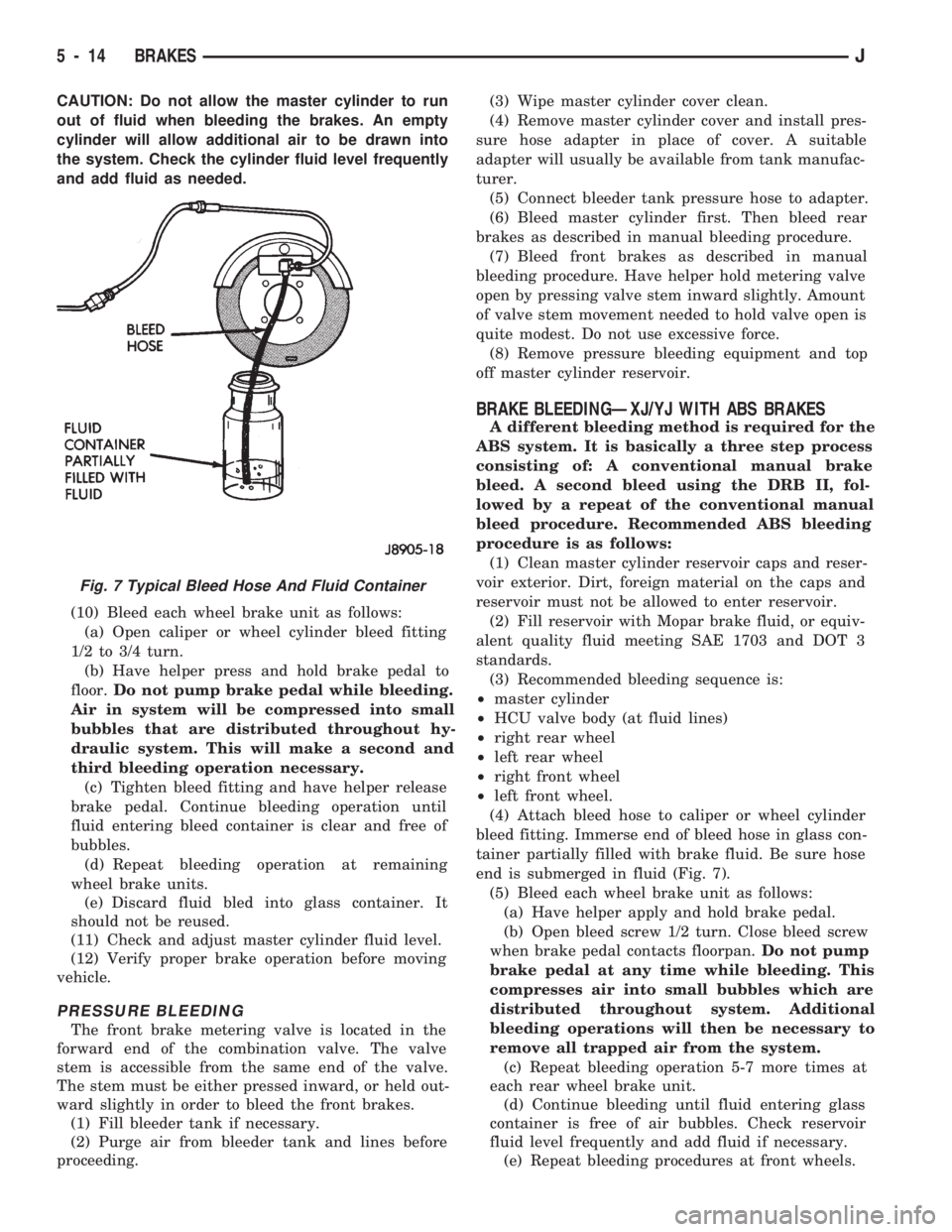
(4) Attach bleed hose to caliper or wheel cylinder
bleed fitting. Immerse end of bleed hose in glass con-
tainer partially filled with brake fluid. Be sure hose
end is submerged in fluid (Fig. 7).
(5) Bleed each wheel brake unit as follows:
(a) Have helper apply and hold brake pedal.
(b) Open bleed screw 1/2 turn. Close bleed screw
when brake pedal contacts floorpan.Do not pump
brake pedal at any time while bleeding. This
compresses air into small bubbles which are
distributed throughout system. Additional
bleeding operations will then be necessary to
remove all trapped air from the system.
(c) Repeat bleeding operation 5-7 more times at
each rear wheel brake unit.
(d) Continue bleeding until fluid entering glass
container is free of air bubbles. Check reservoir
fluid level frequently and add fluid if necessary.
(e) Repeat bleeding procedures at front wheels.
Fig. 7 Typical Bleed Hose And Fluid Container
5 - 14 BRAKESJ
Page 162 of 1784
CAUTION: Do not allow the master cylinder reser-
voir to run dry while bleeding the brakes. Running
dry will allow air to re-enter the system making a
second bleeding operation necessary.
(6) Perform ``Bleed Brake'' procedure with DRB II
scan tool. Procedure is described in DRB II software
information and diagnostic manual.
(a) Connect DRB II scan tool to diagnostic con-
nector.
(b) Run Bleed Brake procedure as described in
tester manual.
(7) Repeat conventional bleeding procedure out-
lined in steps (1) through (8).
(8) Top off master cylinder fluid level if necessary.
(9) Verify proper brake operation.
BRAKELINES AND HOSES
Metal brakelines and rubber brake hoses should be
inspected periodically and replaced if damaged.
Rubber brake hoses should be replaced if cut,
cracked, swollen, or leaking. Rubber hoses must be
replaced. They are not repairable parts.
When installing new, or original brakelines andhoses, lubricate the fitting threads with brake fluid
before connection.
The steel brakelines should be checked every time
the vehicle is in for normal maintainence. This is im-
portant on high mileage vehicles. It is even more im-
portant when a vehicle is operated in areas where
salt is used regularly on the road surface during win-
ter.
Heavily rusted/corroded brake rotors, drums, sup-
port plates, and brakelines should be cleaned and
carefully inspected. Heavy rust buildup can hide se-
vere damge to a component. Severely rusted parts
should be replaced if you are unsure about their con-
dition.
COMBINATION VALVE
The combination valve is not a serviceable part.
The valve must be replaced if a malfunction occurs.
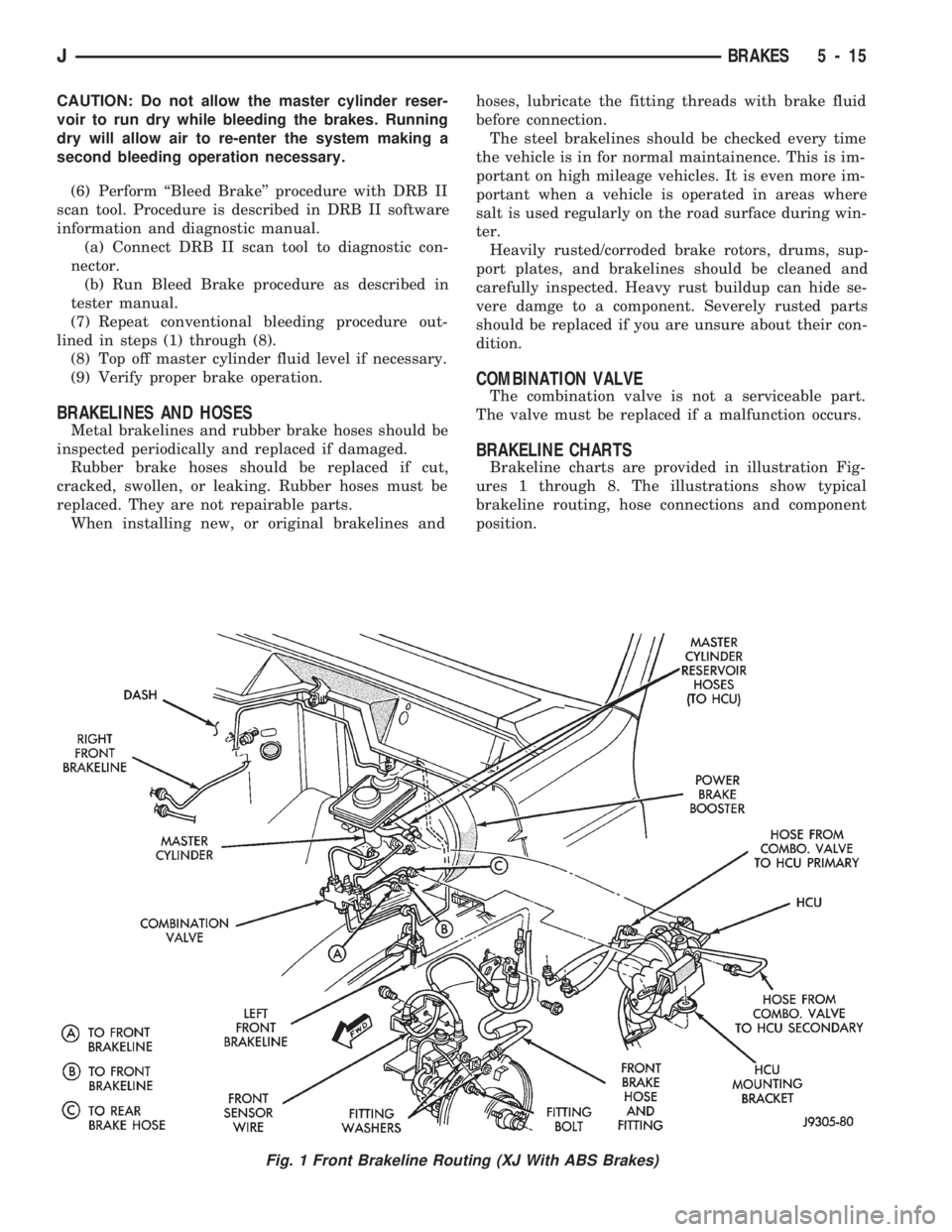
BRAKELINE CHARTS
Brakeline charts are provided in illustration Fig-
ures 1 through 8. The illustrations show typical
brakeline routing, hose connections and component
position.
Fig. 1 Front Brakeline Routing (XJ With ABS Brakes)
JBRAKES 5 - 15
Page 163 of 1784
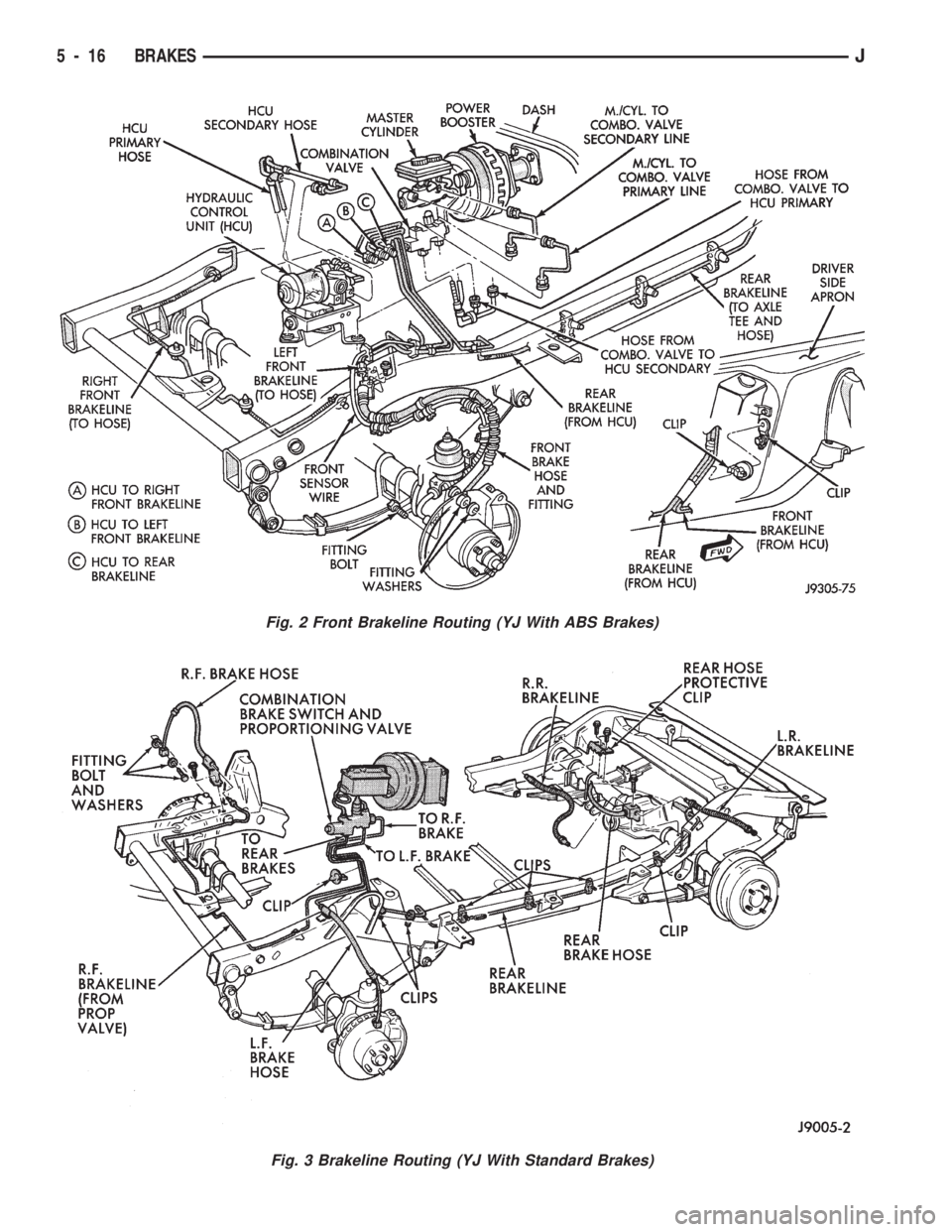
Fig. 2 Front Brakeline Routing (YJ With ABS Brakes)
Fig. 3 Brakeline Routing (YJ With Standard Brakes)
5 - 16 BRAKESJ
Page 164 of 1784
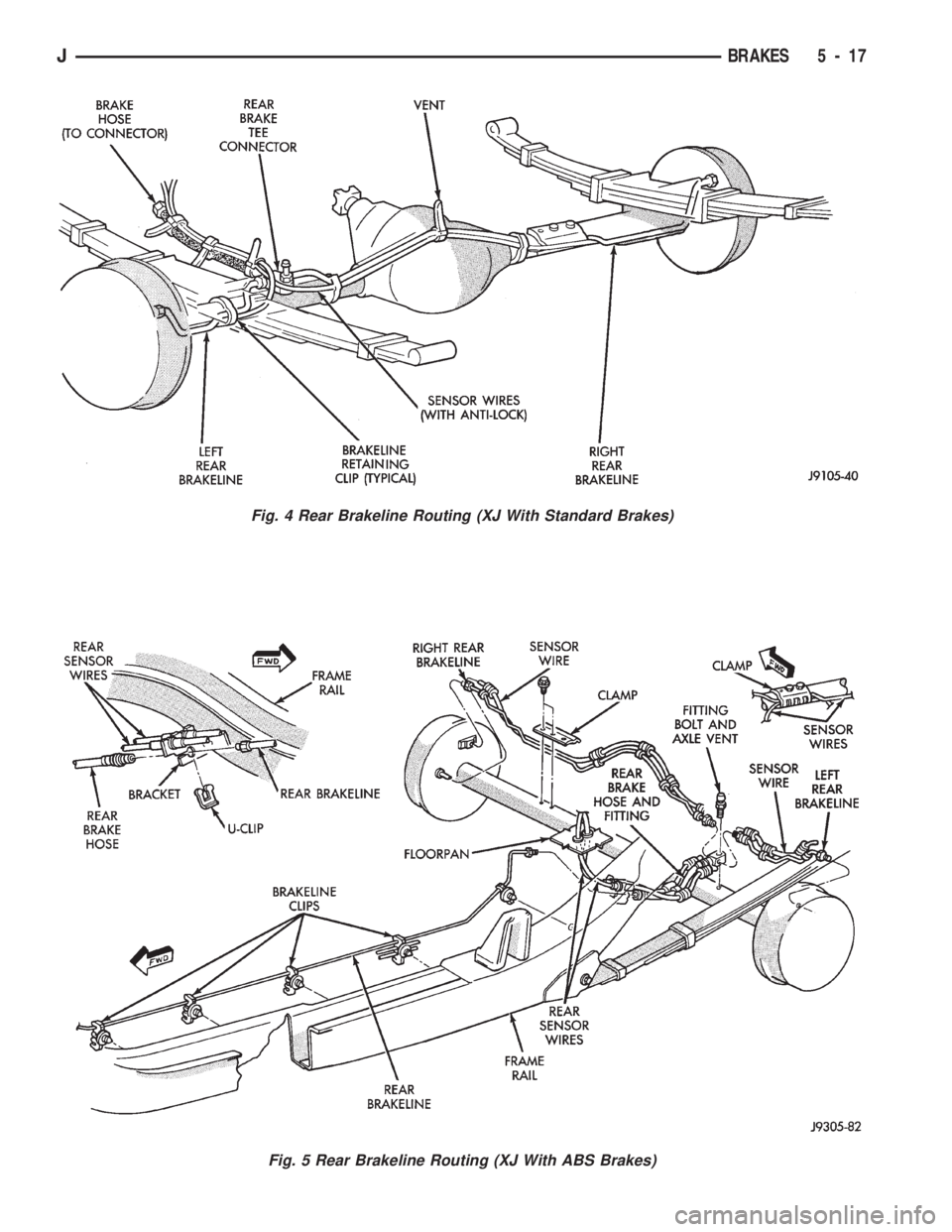
Fig. 4 Rear Brakeline Routing (XJ With Standard Brakes)
Fig. 5 Rear Brakeline Routing (XJ With ABS Brakes)
JBRAKES 5 - 17
Page 165 of 1784
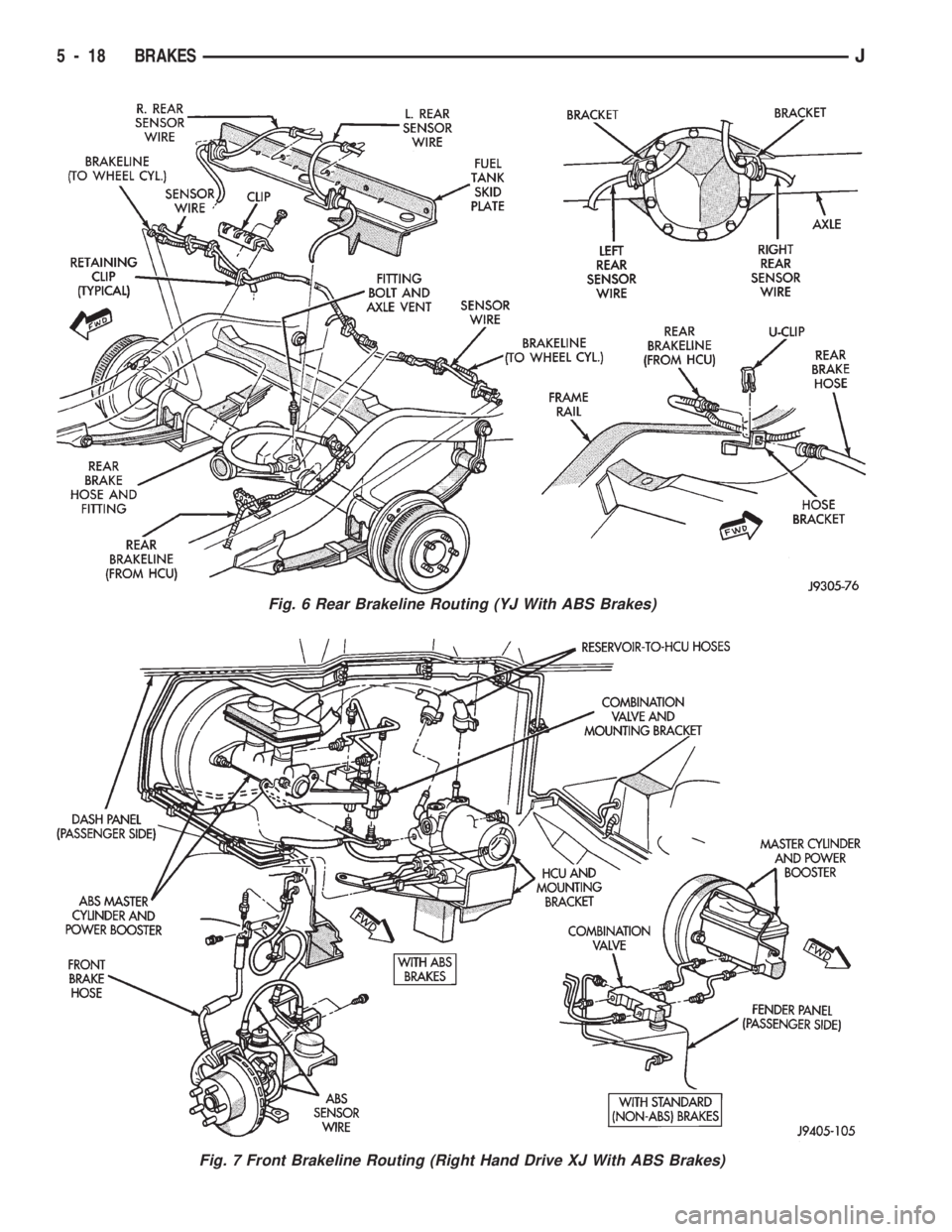
Fig. 6 Rear Brakeline Routing (YJ With ABS Brakes)
Fig. 7 Front Brakeline Routing (Right Hand Drive XJ With ABS Brakes)
5 - 18 BRAKESJ
Page 166 of 1784
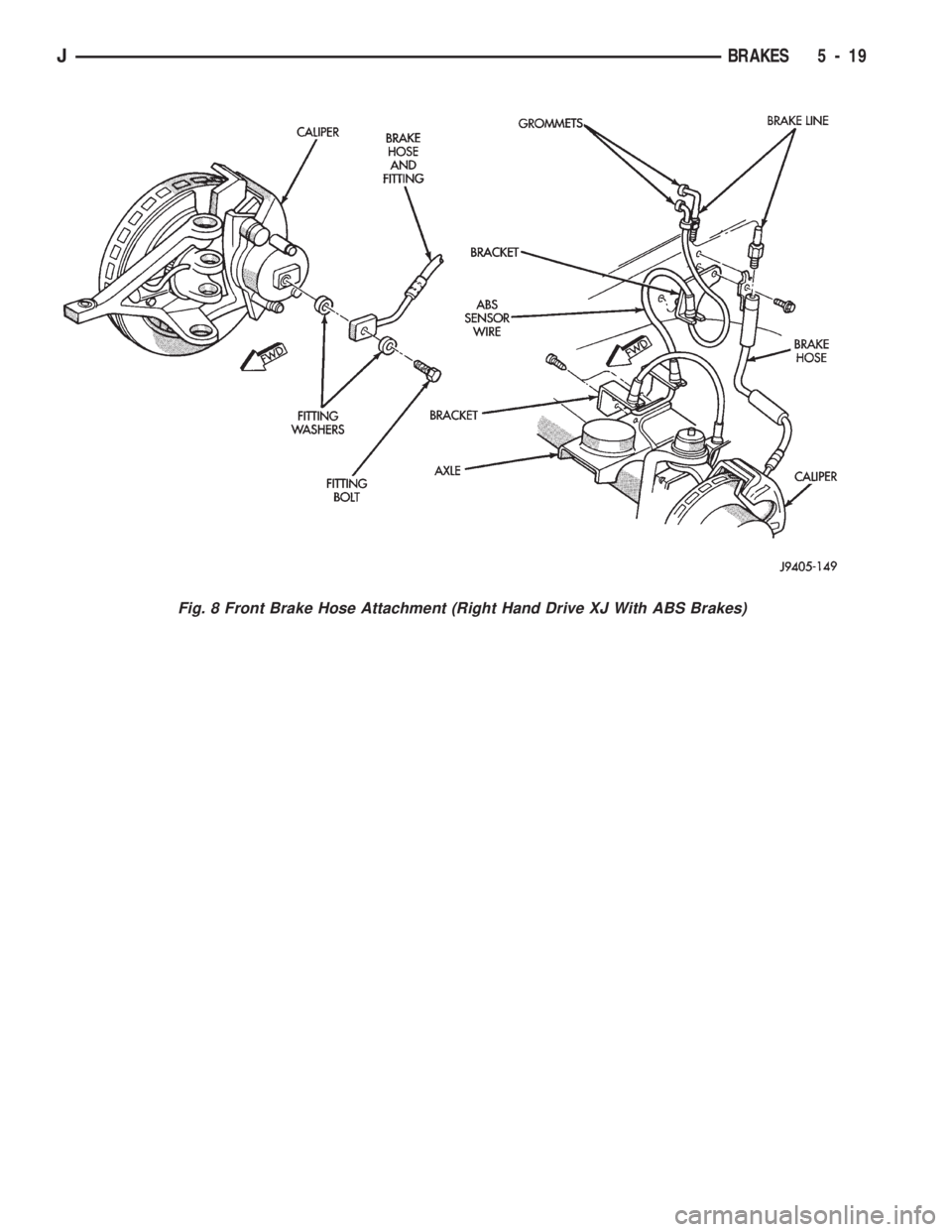
Fig. 8 Front Brake Hose Attachment (Right Hand Drive XJ With ABS Brakes)
JBRAKES 5 - 19
Page 167 of 1784
STANDARD MASTER CYLINDER
INDEX
page page
General Service Information................ 20
Master Cylinder Installation................. 20Master Cylinder Overhaul.................. 20
Master Cylinder Removal.................. 20
GENERAL SERVICE INFORMATION
The service information in this section covers the
standard (non-ABS) master cylinder only. The center
feed master cylinder used with the ABS system is
covered in the antilock brake component service sec-
tion.
MASTER CYLINDER REMOVAL
(1) Disconnect brake lines at master cylinder.
(2) Remove cylinder mounting nuts and remove
master cylinder.
(3) Remove cylinder cover and drain fluid.
MASTER CYLINDER INSTALLATION
(1) Bleed master cylinder on bench before installa-
tion. Refer to overhaul assembly procedure in this
section for bleeding method.
(2) Install cylinder on brake booster studs and in-
stall cylinder attaching nuts. Tighten nuts to 21 NIm
(15 ft. lbs.).
(3) Connect brakelines to cylinder.
(4) Fill and bleed brake system.
MASTER CYLINDER OVERHAUL
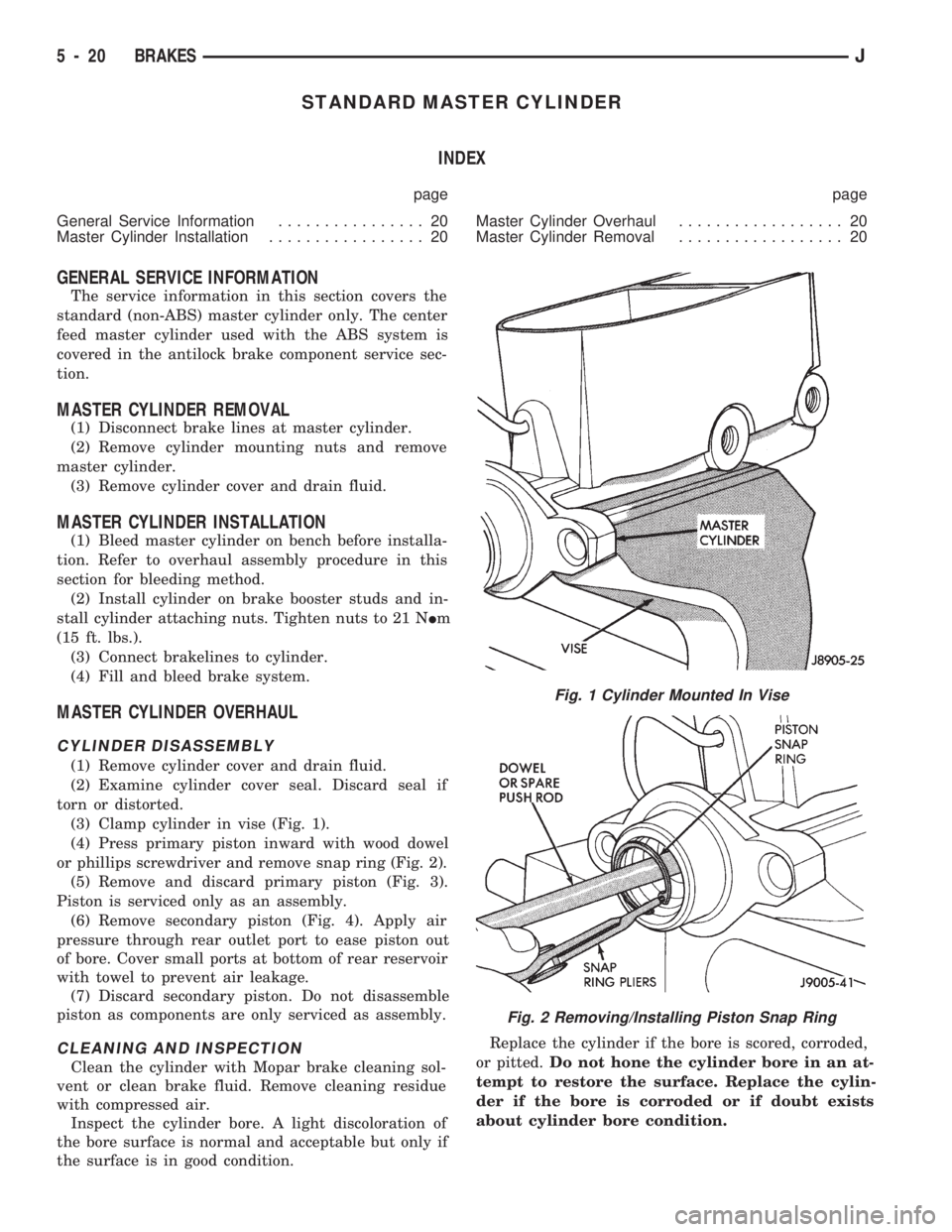
CYLINDER DISASSEMBLY
(1) Remove cylinder cover and drain fluid.
(2) Examine cylinder cover seal. Discard seal if
torn or distorted.
(3) Clamp cylinder in vise (Fig. 1).
(4) Press primary piston inward with wood dowel
or phillips screwdriver and remove snap ring (Fig. 2).
(5) Remove and discard primary piston (Fig. 3).
Piston is serviced only as an assembly.
(6) Remove secondary piston (Fig. 4). Apply air
pressure through rear outlet port to ease piston out
of bore. Cover small ports at bottom of rear reservoir
with towel to prevent air leakage.
(7) Discard secondary piston. Do not disassemble
piston as components are only serviced as assembly.
CLEANING AND INSPECTION
Clean the cylinder with Mopar brake cleaning sol-
vent or clean brake fluid. Remove cleaning residue
with compressed air.
Inspect the cylinder bore. A light discoloration of
the bore surface is normal and acceptable but only if
the surface is in good condition.Replace the cylinder if the bore is scored, corroded,
or pitted.Do not hone the cylinder bore in an at-
tempt to restore the surface. Replace the cylin-
der if the bore is corroded or if doubt exists
about cylinder bore condition.
Fig. 1 Cylinder Mounted In Vise
Fig. 2 Removing/Installing Piston Snap Ring
5 - 20 BRAKESJ
Page 186 of 1784
ABS SYSTEM OPERATION
INDEX
page page
Acceleration Switch....................... 41
Combination Valve....................... 42
Electronic Control Unit (ECU)............... 41
General Information....................... 39
Hydraulic Control Unit (HCU)................ 39
Ignition Switch........................... 42Master Cylinder.......................... 40
Pedal Travel Sensor...................... 41
Power Brake Booster..................... 40
System Relays.......................... 42
System Warning Lights.................... 42
Wheel Speed Sensors..................... 41
GENERAL INFORMATION
The Jeep antilock brake system (ABS) is an elec-
tronically operated, all-wheel brake control system.
Major components include the master cylinder, vac-
uum power brake booster, ECU, hydraulic control
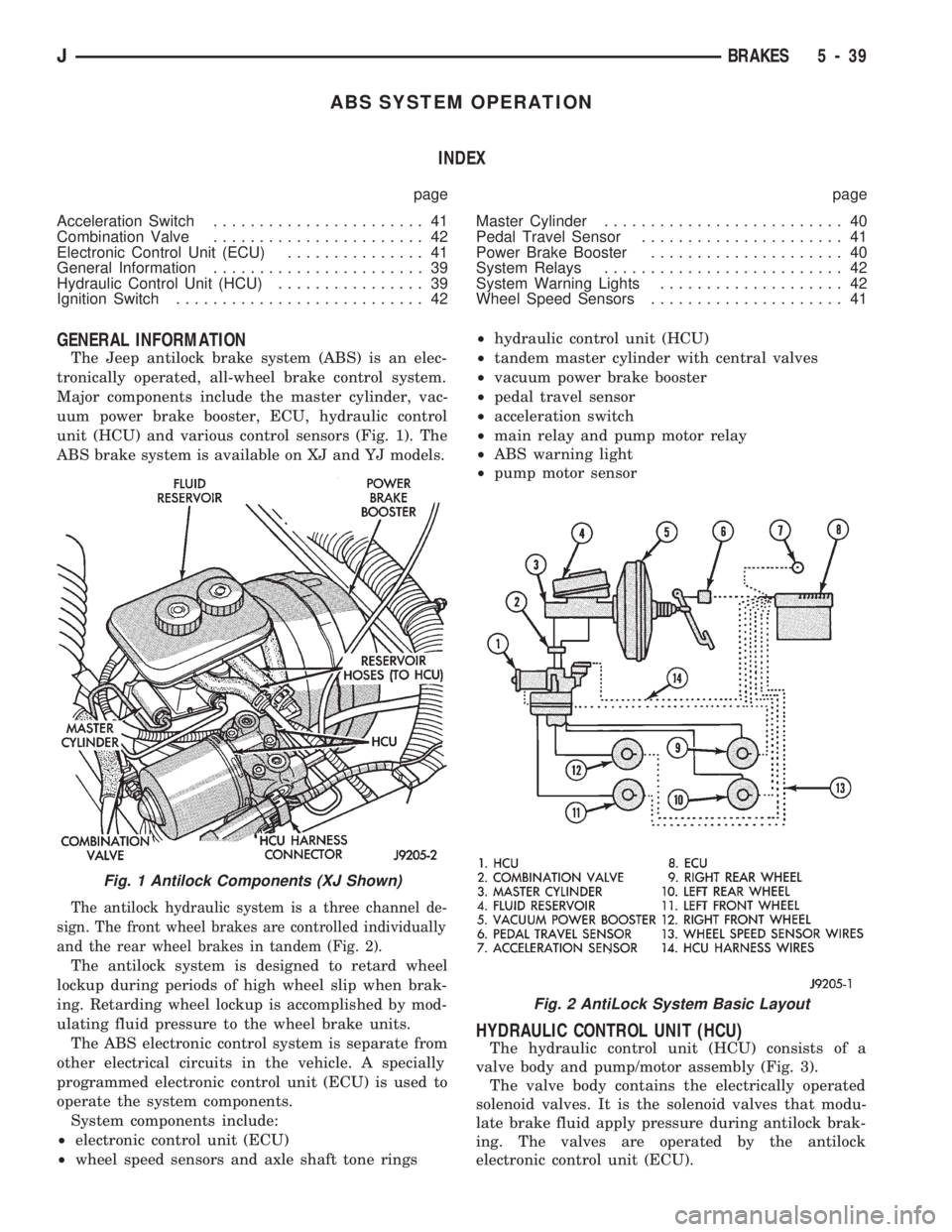
unit (HCU) and various control sensors (Fig. 1). The
ABS brake system is available on XJ and YJ models.
The antilock hydraulic system is a three channel de-
sign. The front wheel brakes are controlled individually
and the rear wheel brakes in tandem (Fig. 2).
The antilock system is designed to retard wheel
lockup during periods of high wheel slip when brak-
ing. Retarding wheel lockup is accomplished by mod-
ulating fluid pressure to the wheel brake units.
The ABS electronic control system is separate from
other electrical circuits in the vehicle. A specially
programmed electronic control unit (ECU) is used to
operate the system components.
System components include:
²electronic control unit (ECU)
²wheel speed sensors and axle shaft tone rings²hydraulic control unit (HCU)
²tandem master cylinder with central valves
²vacuum power brake booster
²pedal travel sensor
²acceleration switch
²main relay and pump motor relay
²ABS warning light
²pump motor sensor
HYDRAULIC CONTROL UNIT (HCU)
The hydraulic control unit (HCU) consists of a
valve body and pump/motor assembly (Fig. 3).
The valve body contains the electrically operated
solenoid valves. It is the solenoid valves that modu-
late brake fluid apply pressure during antilock brak-
ing. The valves are operated by the antilock
electronic control unit (ECU).
Fig. 1 Antilock Components (XJ Shown)
Fig. 2 AntiLock System Basic Layout
JBRAKES 5 - 39
Page 187 of 1784
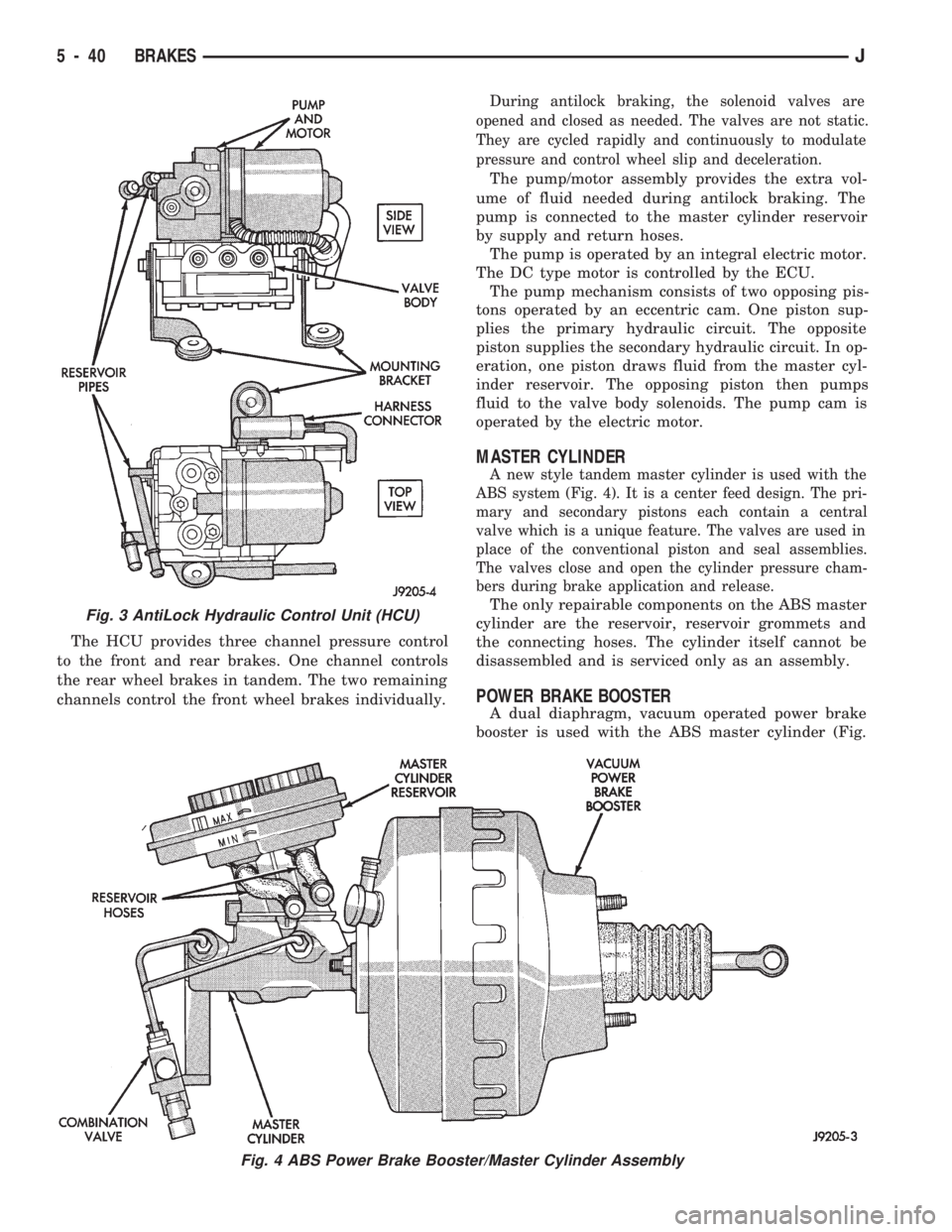
The HCU provides three channel pressure control
to the front and rear brakes. One channel controls
the rear wheel brakes in tandem. The two remaining
channels control the front wheel brakes individually.
During antilock braking, the solenoid valves are
opened and closed as needed. The valves are not static.
They are cycled rapidly and continuously to modulate
pressure and control wheel slip and deceleration.
The pump/motor assembly provides the extra vol-
ume of fluid needed during antilock braking. The
pump is connected to the master cylinder reservoir
by supply and return hoses.
The pump is operated by an integral electric motor.
The DC type motor is controlled by the ECU.
The pump mechanism consists of two opposing pis-
tons operated by an eccentric cam. One piston sup-
plies the primary hydraulic circuit. The opposite
piston supplies the secondary hydraulic circuit. In op-
eration, one piston draws fluid from the master cyl-
inder reservoir. The opposing piston then pumps
fluid to the valve body solenoids. The pump cam is
operated by the electric motor.
MASTER CYLINDER
A new style tandem master cylinder is used with the
ABS system (Fig. 4). It is a center feed design. The pri-
mary and secondary pistons each contain a central
valve which is a unique feature. The valves are used in
place of the conventional piston and seal assemblies.
The valves close and open the cylinder pressure cham-
bers during brake application and release.
The only repairable components on the ABS master
cylinder are the reservoir, reservoir grommets and
the connecting hoses. The cylinder itself cannot be
disassembled and is serviced only as an assembly.
POWER BRAKE BOOSTER
A dual diaphragm, vacuum operated power brake
booster is used with the ABS master cylinder (Fig.
Fig. 3 AntiLock Hydraulic Control Unit (HCU)
Fig. 4 ABS Power Brake Booster/Master Cylinder Assembly
5 - 40 BRAKESJ
Page 188 of 1784
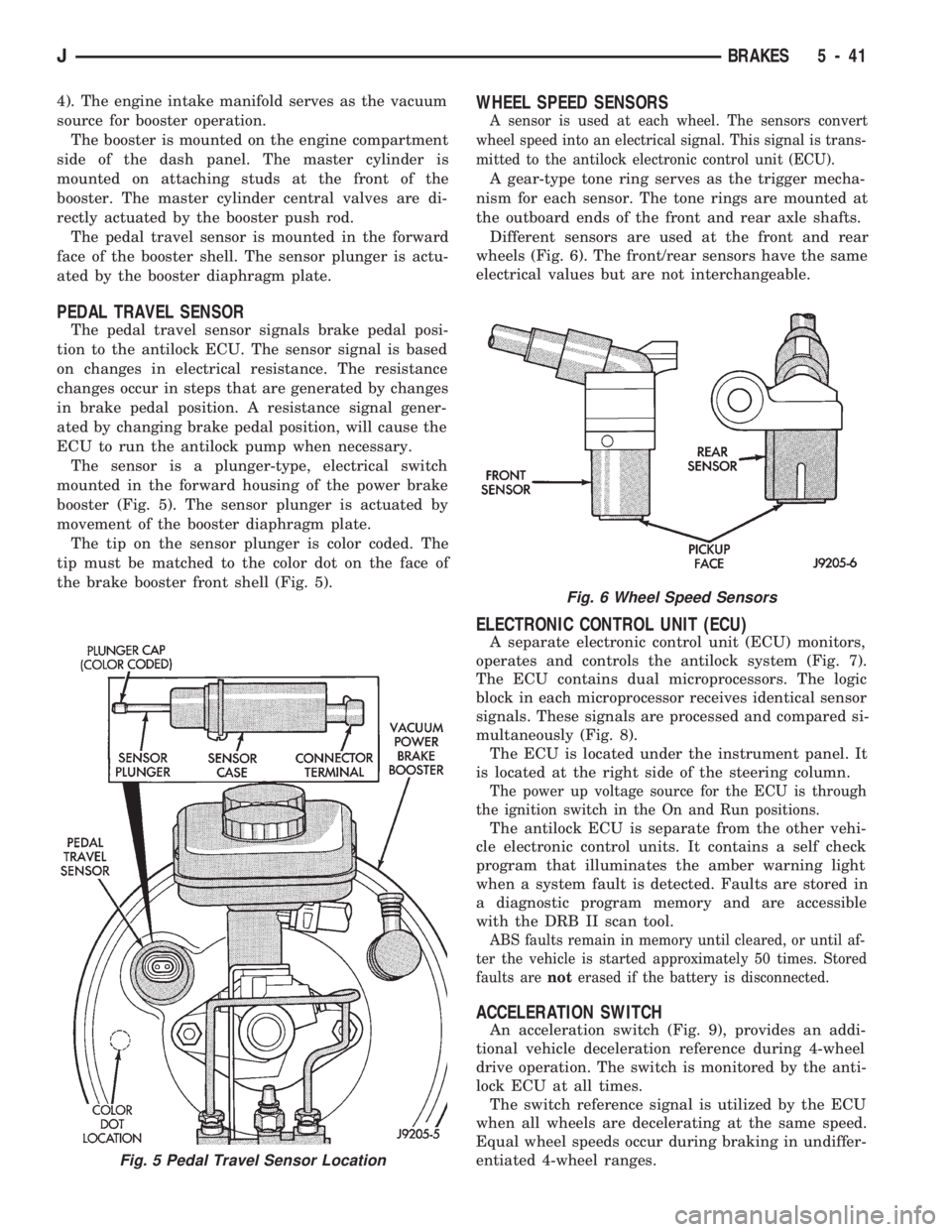
4). The engine intake manifold serves as the vacuum
source for booster operation.
The booster is mounted on the engine compartment
side of the dash panel. The master cylinder is
mounted on attaching studs at the front of the
booster. The master cylinder central valves are di-
rectly actuated by the booster push rod.
The pedal travel sensor is mounted in the forward
face of the booster shell. The sensor plunger is actu-
ated by the booster diaphragm plate.
PEDAL TRAVEL SENSOR
The pedal travel sensor signals brake pedal posi-
tion to the antilock ECU. The sensor signal is based
on changes in electrical resistance. The resistance
changes occur in steps that are generated by changes
in brake pedal position. A resistance signal gener-
ated by changing brake pedal position, will cause the
ECU to run the antilock pump when necessary.
The sensor is a plunger-type, electrical switch
mounted in the forward housing of the power brake
booster (Fig. 5). The sensor plunger is actuated by
movement of the booster diaphragm plate.
The tip on the sensor plunger is color coded. The
tip must be matched to the color dot on the face of
the brake booster front shell (Fig. 5).
WHEEL SPEED SENSORS
A sensor is used at each wheel. The sensors convert
wheel speed into an electrical signal. This signal is trans-
mitted to the antilock electronic control unit (ECU).
A gear-type tone ring serves as the trigger mecha-
nism for each sensor. The tone rings are mounted at
the outboard ends of the front and rear axle shafts.
Different sensors are used at the front and rear
wheels (Fig. 6). The front/rear sensors have the same
electrical values but are not interchangeable.
ELECTRONIC CONTROL UNIT (ECU)
A separate electronic control unit (ECU) monitors,
operates and controls the antilock system (Fig. 7).
The ECU contains dual microprocessors. The logic
block in each microprocessor receives identical sensor
signals. These signals are processed and compared si-
multaneously (Fig. 8).
The ECU is located under the instrument panel. It
is located at the right side of the steering column.
The power up voltage source for the ECU is through
the ignition switch in the On and Run positions.
The antilock ECU is separate from the other vehi-
cle electronic control units. It contains a self check
program that illuminates the amber warning light
when a system fault is detected. Faults are stored in
a diagnostic program memory and are accessible
with the DRB II scan tool.
ABS faults remain in memory until cleared, or until af-
ter the vehicle is started approximately 50 times. Stored
faults arenoterased if the battery is disconnected.
ACCELERATION SWITCH
An acceleration switch (Fig. 9), provides an addi-
tional vehicle deceleration reference during 4-wheel
drive operation. The switch is monitored by the anti-
lock ECU at all times.
The switch reference signal is utilized by the ECU
when all wheels are decelerating at the same speed.
Equal wheel speeds occur during braking in undiffer-
entiated 4-wheel ranges.
Fig. 5 Pedal Travel Sensor Location
Fig. 6 Wheel Speed Sensors
JBRAKES 5 - 41