light JEEP CHEROKEE 1995 Service Repair Manual
[x] Cancel search | Manufacturer: JEEP, Model Year: 1995, Model line: CHEROKEE, Model: JEEP CHEROKEE 1995Pages: 2198, PDF Size: 82.83 MB
Page 1534 of 2198
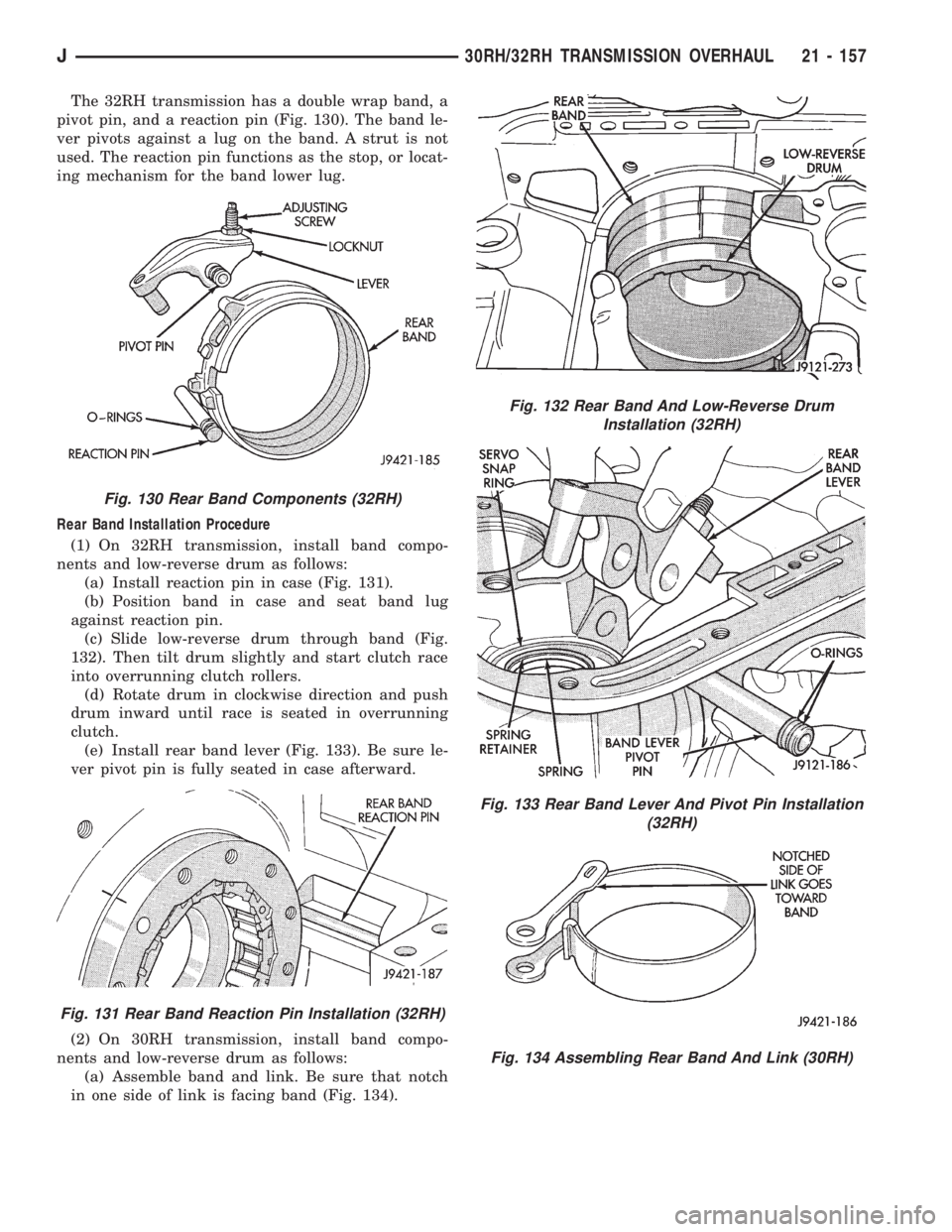
The 32RH transmission has a double wrap band, a
pivot pin, and a reaction pin (Fig. 130). The band le-
ver pivots against a lug on the band. A strut is not
used. The reaction pin functions as the stop, or locat-
ing mechanism for the band lower lug.
Rear Band Installation Procedure
(1) On 32RH transmission, install band compo-
nents and low-reverse drum as follows:
(a) Install reaction pin in case (Fig. 131).
(b) Position band in case and seat band lug
against reaction pin.
(c) Slide low-reverse drum through band (Fig.
132). Then tilt drum slightly and start clutch race
into overrunning clutch rollers.
(d) Rotate drum in clockwise direction and push
drum inward until race is seated in overrunning
clutch.
(e) Install rear band lever (Fig. 133). Be sure le-
ver pivot pin is fully seated in case afterward.
(2) On 30RH transmission, install band compo-
nents and low-reverse drum as follows:
(a) Assemble band and link. Be sure that notch
in one side of link is facing band (Fig. 134).
Fig. 130 Rear Band Components (32RH)
Fig. 131 Rear Band Reaction Pin Installation (32RH)
Fig. 132 Rear Band And Low-Reverse Drum
Installation (32RH)
Fig. 133 Rear Band Lever And Pivot Pin Installation
(32RH)
Fig. 134 Assembling Rear Band And Link (30RH)
J30RH/32RH TRANSMISSION OVERHAUL 21 - 157
Page 1535 of 2198
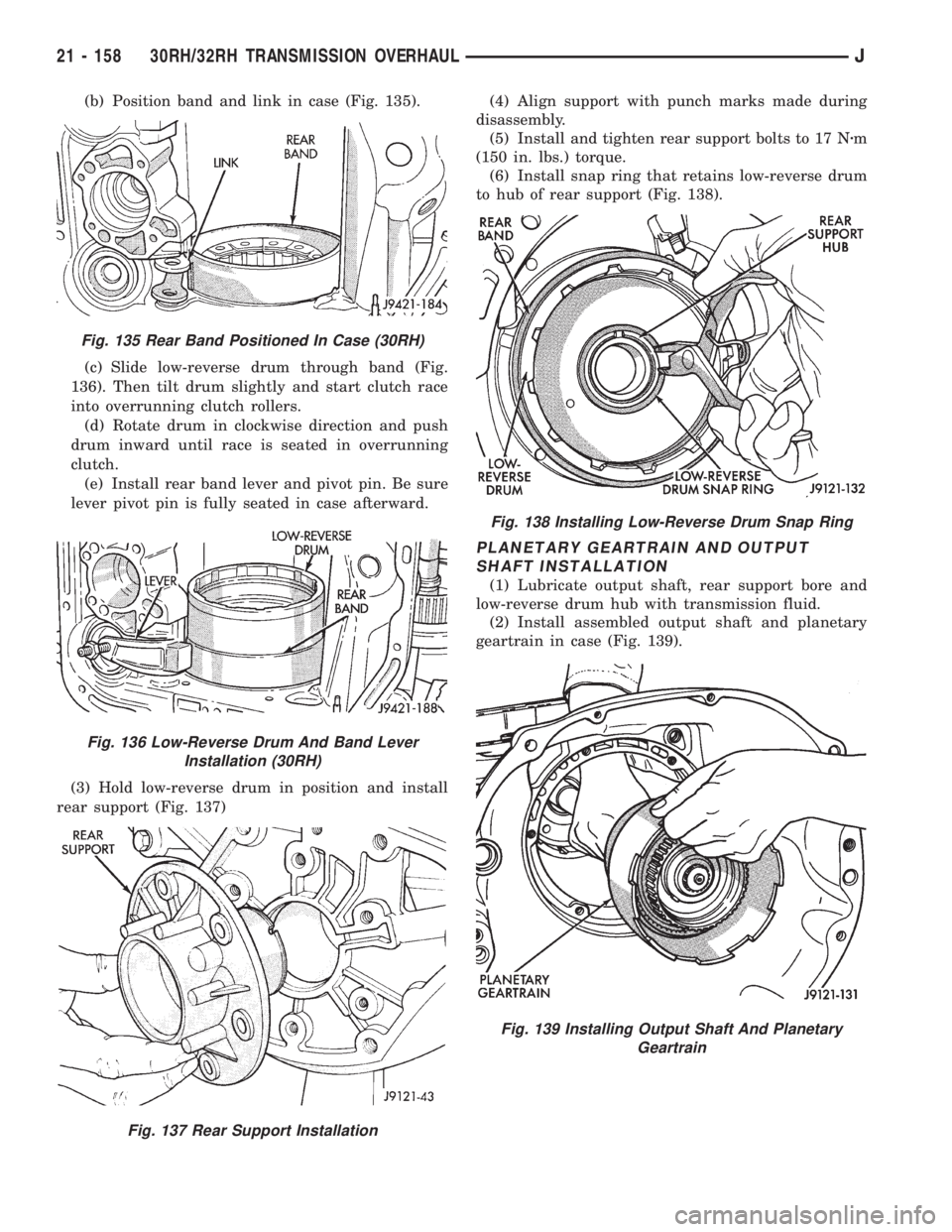
(b) Position band and link in case (Fig. 135).
(c) Slide low-reverse drum through band (Fig.
136). Then tilt drum slightly and start clutch race
into overrunning clutch rollers.
(d) Rotate drum in clockwise direction and push
drum inward until race is seated in overrunning
clutch.
(e) Install rear band lever and pivot pin. Be sure
lever pivot pin is fully seated in case afterward.
(3) Hold low-reverse drum in position and install
rear support (Fig. 137)(4) Align support with punch marks made during
disassembly.
(5) Install and tighten rear support bolts to 17 Nzm
(150 in. lbs.) torque.
(6) Install snap ring that retains low-reverse drum
to hub of rear support (Fig. 138).
PLANETARY GEARTRAIN AND OUTPUT
SHAFT INSTALLATION
(1) Lubricate output shaft, rear support bore and
low-reverse drum hub with transmission fluid.
(2) Install assembled output shaft and planetary
geartrain in case (Fig. 139).
Fig. 135 Rear Band Positioned In Case (30RH)
Fig. 136 Low-Reverse Drum And Band Lever
Installation (30RH)
Fig. 137 Rear Support Installation
Fig. 138 Installing Low-Reverse Drum Snap Ring
Fig. 139 Installing Output Shaft And Planetary
Geartrain
21 - 158 30RH/32RH TRANSMISSION OVERHAULJ
Page 1547 of 2198
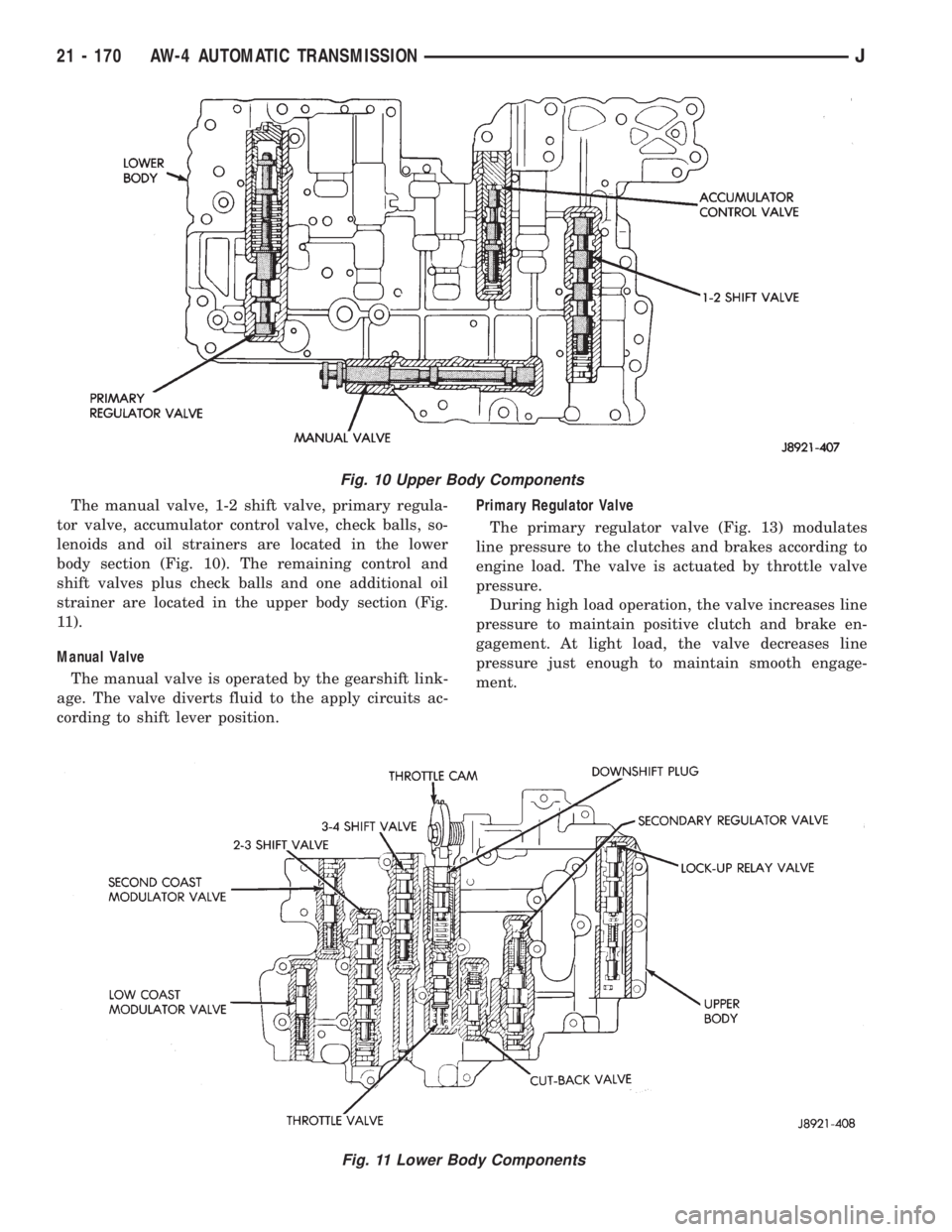
The manual valve, 1-2 shift valve, primary regula-
tor valve, accumulator control valve, check balls, so-
lenoids and oil strainers are located in the lower
body section (Fig. 10). The remaining control and
shift valves plus check balls and one additional oil
strainer are located in the upper body section (Fig.
11).
Manual Valve
The manual valve is operated by the gearshift link-
age. The valve diverts fluid to the apply circuits ac-
cording to shift lever position.Primary Regulator Valve
The primary regulator valve (Fig. 13) modulates
line pressure to the clutches and brakes according to
engine load. The valve is actuated by throttle valve
pressure.
During high load operation, the valve increases line
pressure to maintain positive clutch and brake en-
gagement. At light load, the valve decreases line
pressure just enough to maintain smooth engage-
ment.
Fig. 10 Upper Body Components
Fig. 11 Lower Body Components
21 - 170 AW-4 AUTOMATIC TRANSMISSIONJ
Page 1679 of 2198
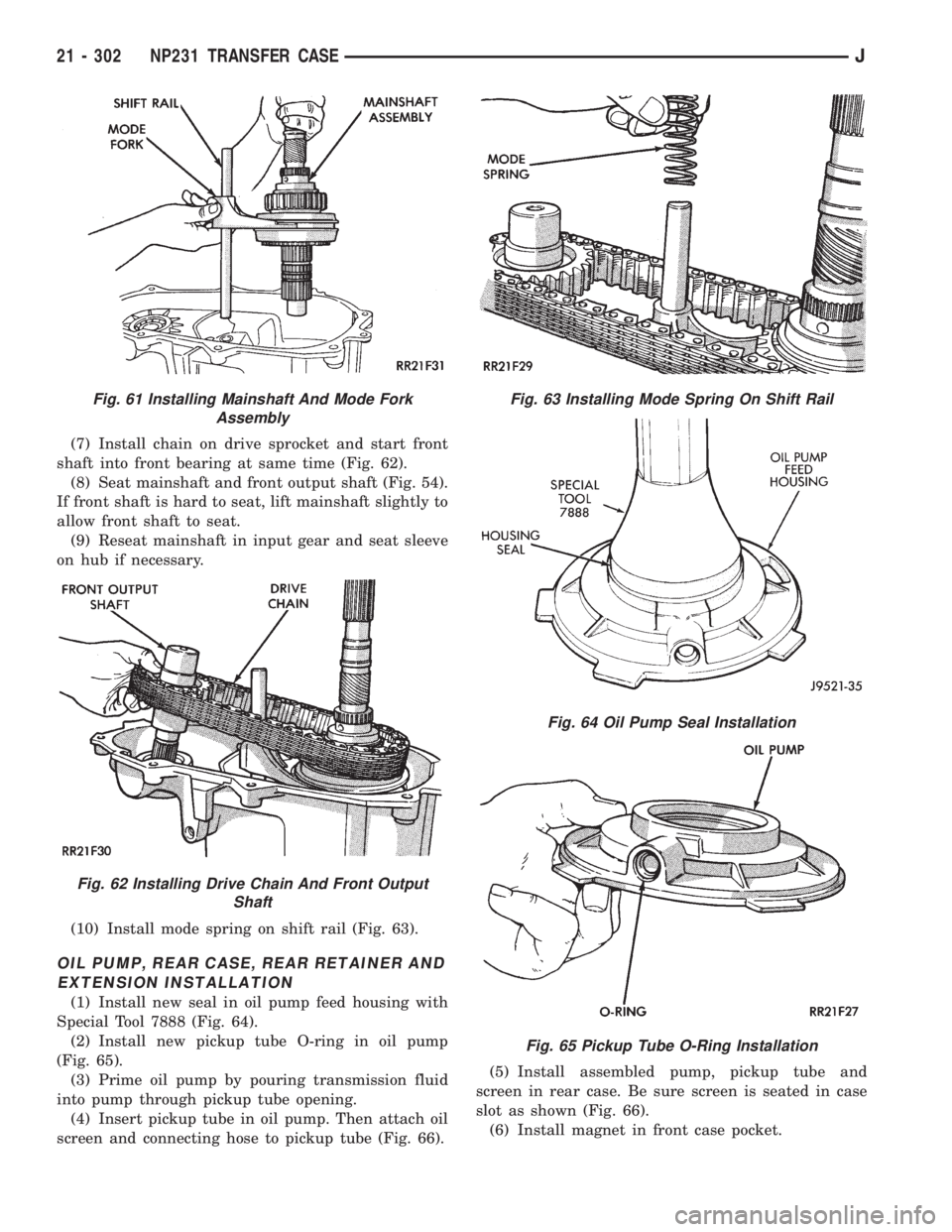
(7) Install chain on drive sprocket and start front
shaft into front bearing at same time (Fig. 62).
(8) Seat mainshaft and front output shaft (Fig. 54).
If front shaft is hard to seat, lift mainshaft slightly to
allow front shaft to seat.
(9) Reseat mainshaft in input gear and seat sleeve
on hub if necessary.
(10) Install mode spring on shift rail (Fig. 63).
OIL PUMP, REAR CASE, REAR RETAINER AND
EXTENSION INSTALLATION
(1) Install new seal in oil pump feed housing with
Special Tool 7888 (Fig. 64).
(2) Install new pickup tube O-ring in oil pump
(Fig. 65).
(3) Prime oil pump by pouring transmission fluid
into pump through pickup tube opening.
(4) Insert pickup tube in oil pump. Then attach oil
screen and connecting hose to pickup tube (Fig. 66).(5) Install assembled pump, pickup tube and
screen in rear case. Be sure screen is seated in case
slot as shown (Fig. 66).
(6) Install magnet in front case pocket.
Fig. 61 Installing Mainshaft And Mode Fork
Assembly
Fig. 62 Installing Drive Chain And Front Output
Shaft
Fig. 63 Installing Mode Spring On Shift Rail
Fig. 64 Oil Pump Seal Installation
Fig. 65 Pickup Tube O-Ring Installation
21 - 302 NP231 TRANSFER CASEJ
Page 1680 of 2198
(7) Clean sealing surfaces of rear case front case,
retainer and extension. Use 3M all puspose cleaner
or equivalent product.
(8) Apply 3 mm (1/8 in.) wide bead of Mopar gas-
ket maker, silicone adhesive sealer, or Loctite 518 to
sealing surface of front case.
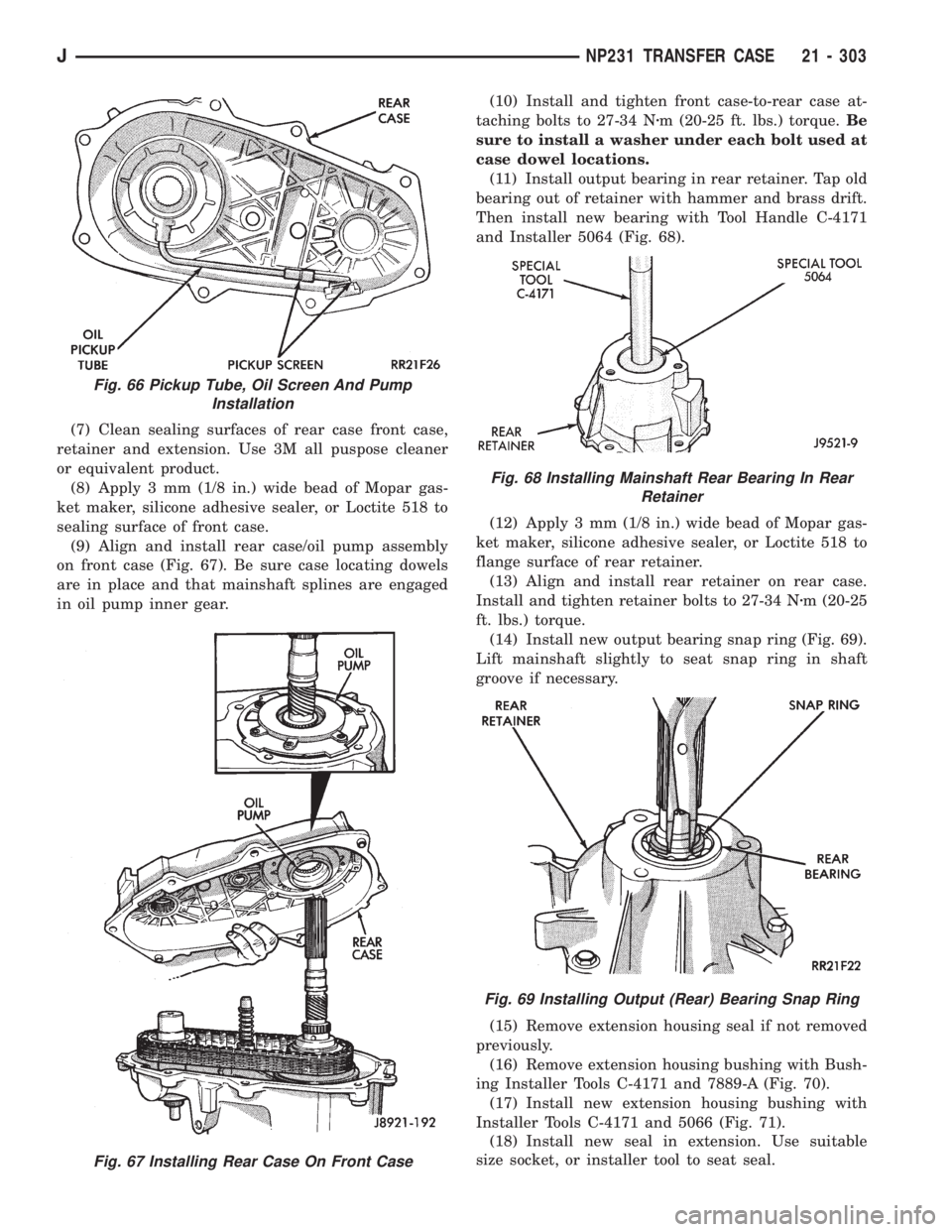
(9) Align and install rear case/oil pump assembly
on front case (Fig. 67). Be sure case locating dowels
are in place and that mainshaft splines are engaged
in oil pump inner gear.(10) Install and tighten front case-to-rear case at-
taching bolts to 27-34 Nzm (20-25 ft. lbs.) torque.Be
sure to install a washer under each bolt used at
case dowel locations.
(11) Install output bearing in rear retainer. Tap old
bearing out of retainer with hammer and brass drift.
Then install new bearing with Tool Handle C-4171
and Installer 5064 (Fig. 68).
(12) Apply 3 mm (1/8 in.) wide bead of Mopar gas-
ket maker, silicone adhesive sealer, or Loctite 518 to
flange surface of rear retainer.
(13) Align and install rear retainer on rear case.
Install and tighten retainer bolts to 27-34 Nzm (20-25
ft. lbs.) torque.
(14) Install new output bearing snap ring (Fig. 69).
Lift mainshaft slightly to seat snap ring in shaft
groove if necessary.
(15) Remove extension housing seal if not removed
previously.
(16) Remove extension housing bushing with Bush-
ing Installer Tools C-4171 and 7889-A (Fig. 70).
(17) Install new extension housing bushing with
Installer Tools C-4171 and 5066 (Fig. 71).
(18) Install new seal in extension. Use suitable
size socket, or installer tool to seat seal.
Fig. 67 Installing Rear Case On Front Case
Fig. 66 Pickup Tube, Oil Screen And Pump
Installation
Fig. 68 Installing Mainshaft Rear Bearing In Rear
Retainer
Fig. 69 Installing Output (Rear) Bearing Snap Ring
JNP231 TRANSFER CASE 21 - 303
Page 1703 of 2198
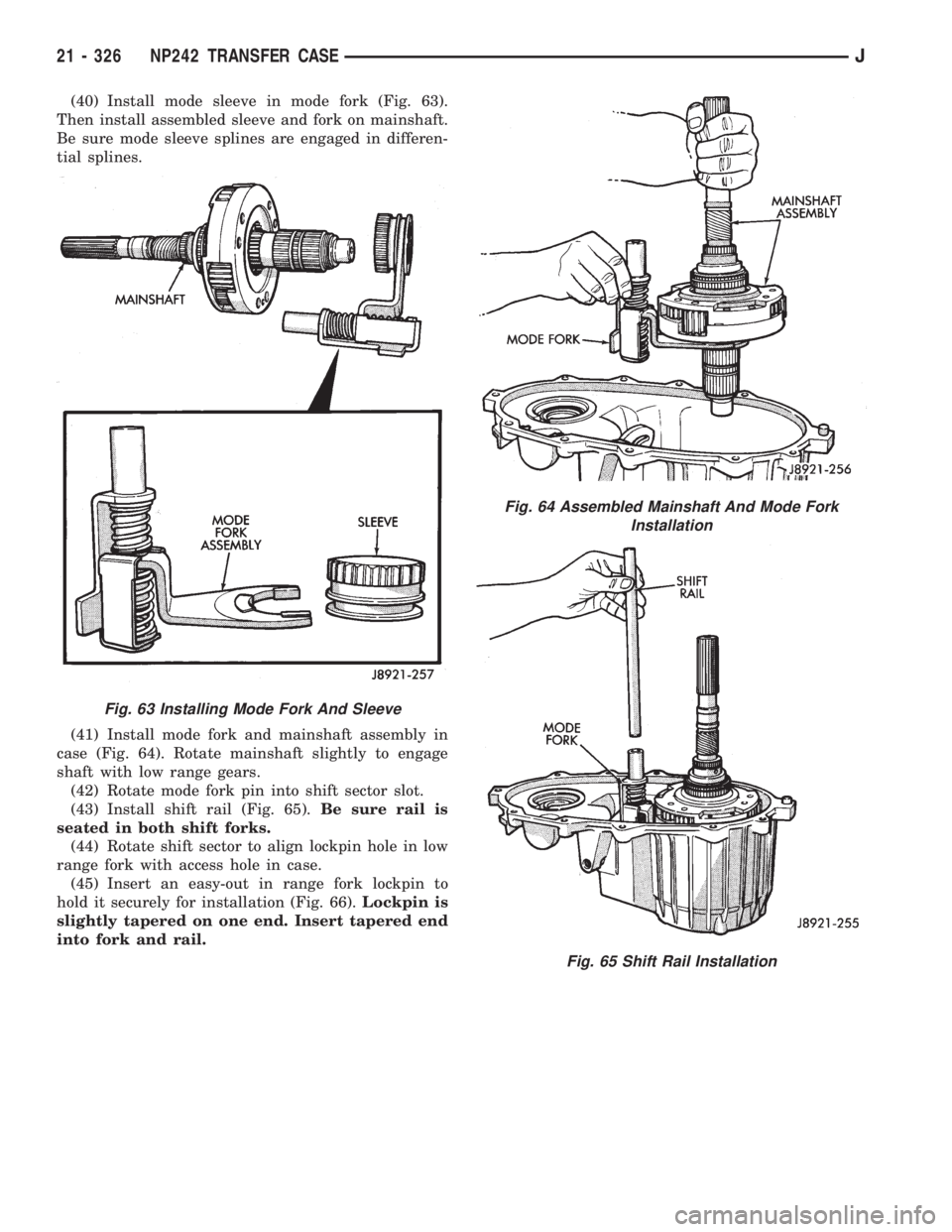
(40) Install mode sleeve in mode fork (Fig. 63).
Then install assembled sleeve and fork on mainshaft.
Be sure mode sleeve splines are engaged in differen-
tial splines.
(41) Install mode fork and mainshaft assembly in
case (Fig. 64). Rotate mainshaft slightly to engage
shaft with low range gears.
(42) Rotate mode fork pin into shift sector slot.
(43) Install shift rail (Fig. 65).Be sure rail is
seated in both shift forks.
(44) Rotate shift sector to align lockpin hole in low
range fork with access hole in case.
(45) Insert an easy-out in range fork lockpin to
hold it securely for installation (Fig. 66).Lockpin is
slightly tapered on one end. Insert tapered end
into fork and rail.
Fig. 63 Installing Mode Fork And Sleeve
Fig. 64 Assembled Mainshaft And Mode Fork
Installation
Fig. 65 Shift Rail Installation
21 - 326 NP242 TRANSFER CASEJ
Page 1706 of 2198
(62) Install and tighten front case-to-rear case
bolts to 41 Nzm (30 ft. lbs.) torque.Be sure to in-
stall a washer under each bolt used at case
dowel locations.
(63) Tap rear retainer bearing out of retainer with
hammer and brass drift.
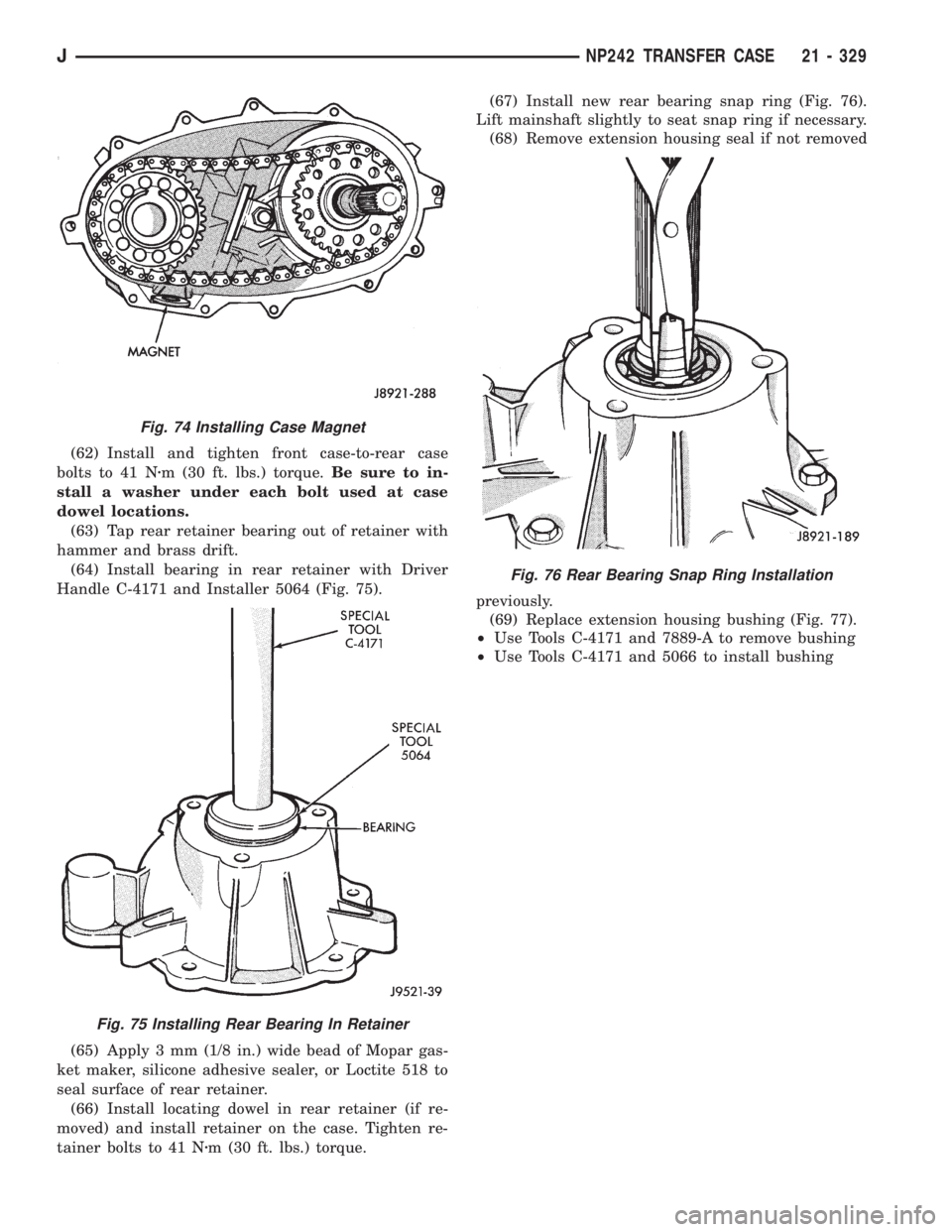
(64) Install bearing in rear retainer with Driver
Handle C-4171 and Installer 5064 (Fig. 75).
(65) Apply 3 mm (1/8 in.) wide bead of Mopar gas-
ket maker, silicone adhesive sealer, or Loctite 518 to
seal surface of rear retainer.
(66) Install locating dowel in rear retainer (if re-
moved) and install retainer on the case. Tighten re-
tainer bolts to 41 Nzm (30 ft. lbs.) torque.(67) Install new rear bearing snap ring (Fig. 76).
Lift mainshaft slightly to seat snap ring if necessary.
(68) Remove extension housing seal if not removed
previously.
(69) Replace extension housing bushing (Fig. 77).
²Use Tools C-4171 and 7889-A to remove bushing
²Use Tools C-4171 and 5066 to install bushing
Fig. 74 Installing Case Magnet
Fig. 75 Installing Rear Bearing In Retainer
Fig. 76 Rear Bearing Snap Ring Installation
JNP242 TRANSFER CASE 21 - 329
Page 1722 of 2198
WHEELS AND TIRES
CONTENTS
page page
SPECIFICATIONS........................ 12
TIRES.................................. 1VEHICLE VIBRATION..................... 10
WHEELS................................ 6
TIRES
INDEX
page page
Cleaning of Tires.......................... 2
General Information........................ 1
Pressure Gauges.......................... 2
Repairing Leaks........................... 3
Replacement Tires......................... 2Rotation................................. 3
Tire Inflation Pressures...................... 2
Tire Noise or Vibration...................... 4
Tire Wear Patterns......................... 4
Tread Wear Indicators....................... 3
GENERAL INFORMATION
Tires are designed for each specific vehicle. They
provide the best overall performance for normal oper-
ation. The ride and handling characteristics match
the vehicle's requirements. With proper care they
will give excellent reliability, traction, skid resis-
tance, and tread life. These tires have specific load
carrying capacities. When correctly inflated, they will
operate properly.
Tires used in cool climates, and with light loads
will have a longer life than tires used in hot climates
with heavy loads. Abrasive road surfaces will acceler-
ate tire wear.
Driving habits have more effect on tire life than
any other factor. Careful drivers will obtain much
greater mileage than careless drivers.
Driving habits that shorten the life of any tire;
²Rapid acceleration and deceleration
²Severe application of brakes
²High-speed driving
²Taking turns at excessive speeds
²Striking curbs and other obstacles
It is very important to follow the tire rotation in-
terval
IDENTIFICATION
Tire type, size, aspect ratio and speed rating are
encoded in the letters and numbers imprinted on the
side wall of the tire. Refer to the chart to decipher
the tire identification code (Fig. 1).Performance tires will have a speed rating letter
after the aspect ratio number. The speed rating is not
always printed on the tire sidewall. The letterSin-
dicates that the tire is speed rated up to 112 mph.
²Qup to 100 mph
²Tup to 118 mph
²Uup to 124 mph
²Hup to 130 mph
²Vup to 149 mph
²Zmore than 149 mph (consult the tire manufac-
turer for the specific speed rating)
An All Season type tire will have eitherM+S,M
&SorMÐS(indicating mud and snow traction) im-
printed on the side wall.
RADIAL-PLY TIRES
Radial-ply tires improve handling, tread life, ride
quality and decrease rolling resistance.
Radial-ply tires must always be used in sets of
four. Under no circumstances should they be used on
the front only. They may be mixed with temporary
spare tires when necessary, but reduced speeds are
recommended.
Radial-ply tires have the same load-carrying capac-
ity as other types of tires of the same size. They use
the same recommended inflation pressures.
SPARE TIRE (TEMPORARY)
The compact spare tire is designed for emergency
use only. The original tire should be repaired and re-
installed at the first opportunity. Refer to Owner's
Manual for complete details.
JWHEELS AND TIRES 22 - 1
Page 1750 of 2198
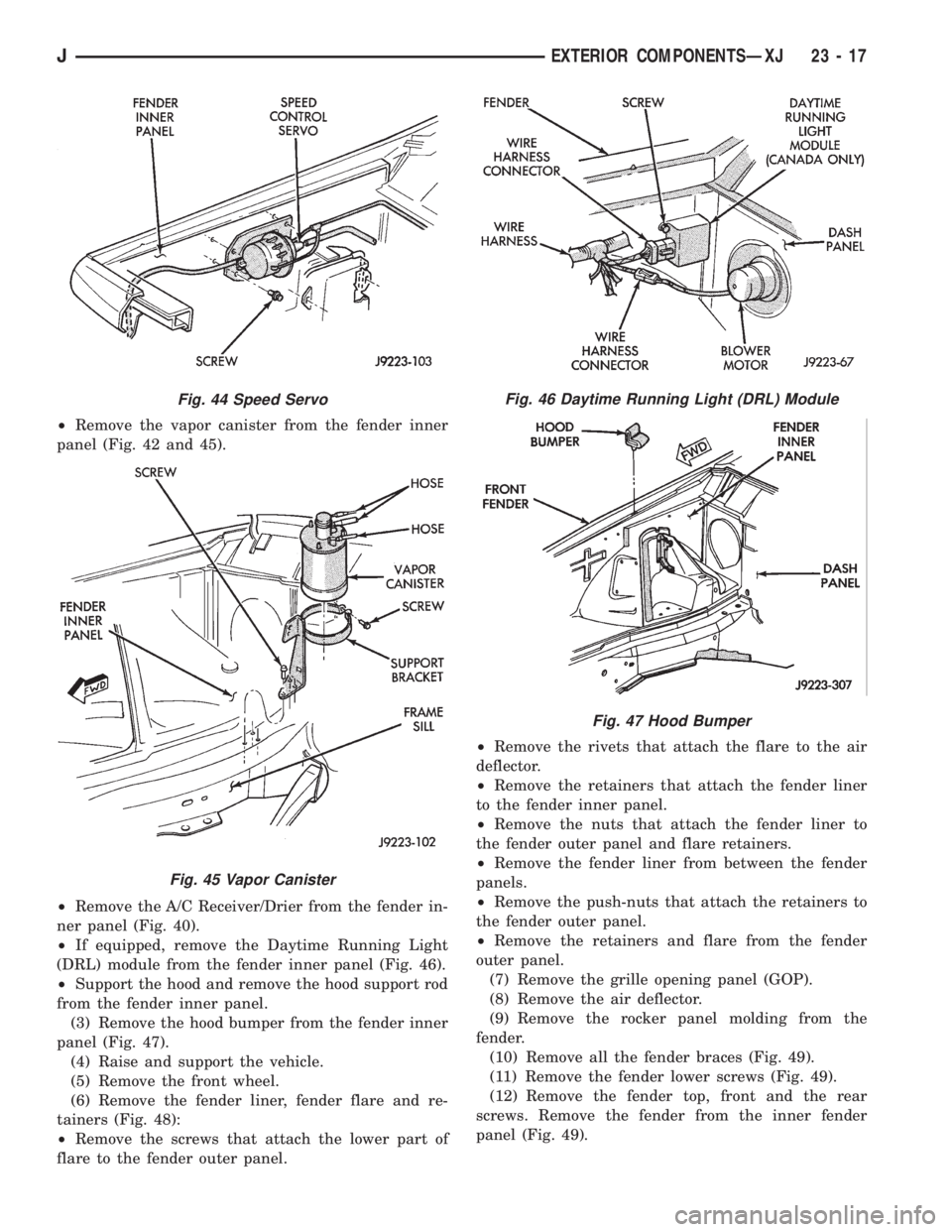
²Remove the vapor canister from the fender inner
panel (Fig. 42 and 45).
²Remove the A/C Receiver/Drier from the fender in-
ner panel (Fig. 40).
²If equipped, remove the Daytime Running Light
(DRL) module from the fender inner panel (Fig. 46).
²Support the hood and remove the hood support rod
from the fender inner panel.
(3) Remove the hood bumper from the fender inner
panel (Fig. 47).
(4) Raise and support the vehicle.
(5) Remove the front wheel.
(6) Remove the fender liner, fender flare and re-
tainers (Fig. 48):
²Remove the screws that attach the lower part of
flare to the fender outer panel.²Remove the rivets that attach the flare to the air
deflector.
²Remove the retainers that attach the fender liner
to the fender inner panel.
²Remove the nuts that attach the fender liner to
the fender outer panel and flare retainers.
²Remove the fender liner from between the fender
panels.
²Remove the push-nuts that attach the retainers to
the fender outer panel.
²Remove the retainers and flare from the fender
outer panel.
(7) Remove the grille opening panel (GOP).
(8) Remove the air deflector.
(9) Remove the rocker panel molding from the
fender.
(10) Remove all the fender braces (Fig. 49).
(11) Remove the fender lower screws (Fig. 49).
(12) Remove the fender top, front and the rear
screws. Remove the fender from the inner fender
panel (Fig. 49).
Fig. 44 Speed Servo
Fig. 45 Vapor Canister
Fig. 46 Daytime Running Light (DRL) Module
Fig. 47 Hood Bumper
JEXTERIOR COMPONENTSÐXJ 23 - 17
Page 1752 of 2198
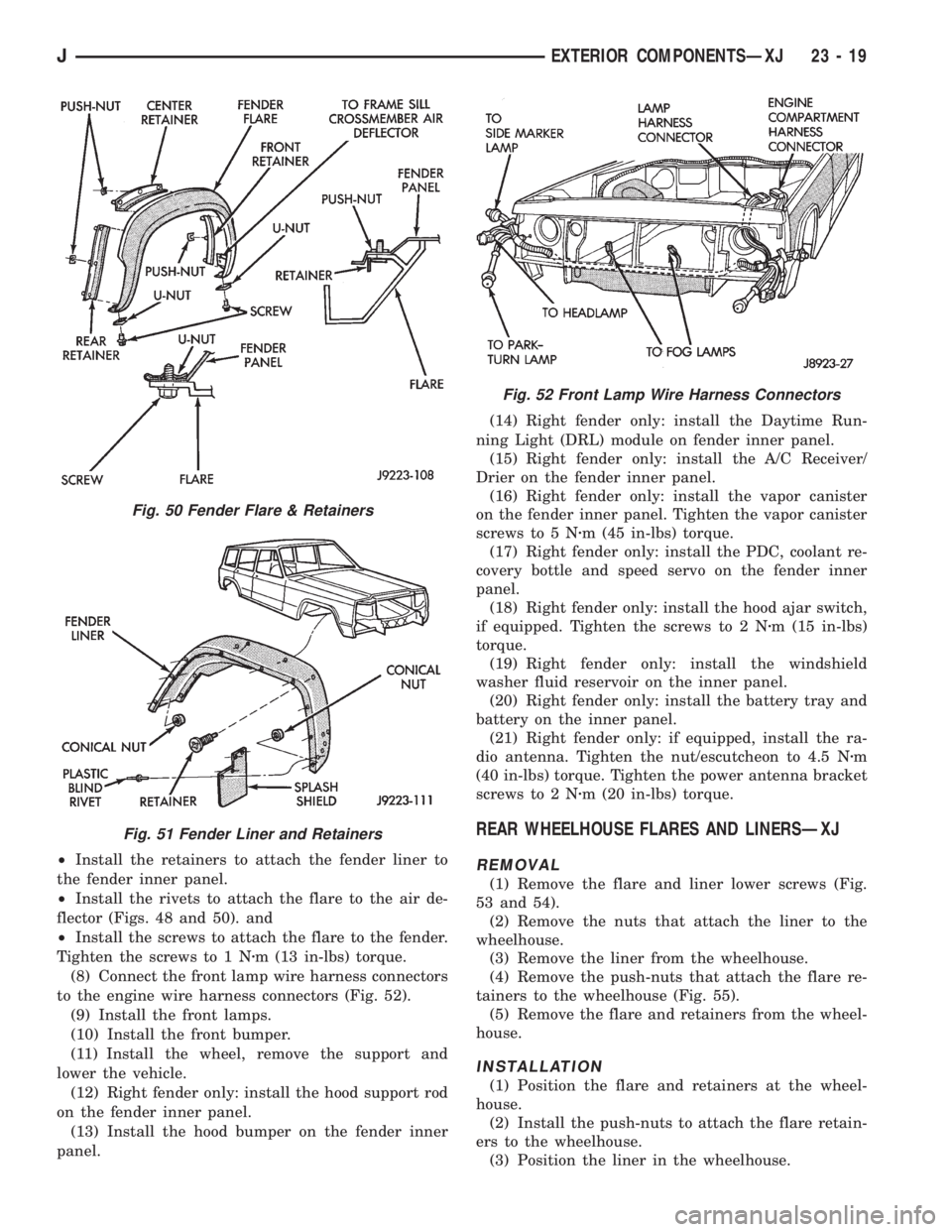
²Install the retainers to attach the fender liner to
the fender inner panel.
²Install the rivets to attach the flare to the air de-
flector (Figs. 48 and 50). and
²Install the screws to attach the flare to the fender.
Tighten the screws to 1 Nzm (13 in-lbs) torque.
(8) Connect the front lamp wire harness connectors
to the engine wire harness connectors (Fig. 52).
(9) Install the front lamps.
(10) Install the front bumper.
(11) Install the wheel, remove the support and
lower the vehicle.
(12) Right fender only: install the hood support rod
on the fender inner panel.
(13) Install the hood bumper on the fender inner
panel.(14) Right fender only: install the Daytime Run-
ning Light (DRL) module on fender inner panel.
(15) Right fender only: install the A/C Receiver/
Drier on the fender inner panel.
(16) Right fender only: install the vapor canister
on the fender inner panel. Tighten the vapor canister
screws to 5 Nzm (45 in-lbs) torque.
(17) Right fender only: install the PDC, coolant re-
covery bottle and speed servo on the fender inner
panel.
(18) Right fender only: install the hood ajar switch,
if equipped. Tighten the screws to 2 Nzm (15 in-lbs)
torque.
(19) Right fender only: install the windshield
washer fluid reservoir on the inner panel.
(20) Right fender only: install the battery tray and
battery on the inner panel.
(21) Right fender only: if equipped, install the ra-
dio antenna. Tighten the nut/escutcheon to 4.5 Nzm
(40 in-lbs) torque. Tighten the power antenna bracket
screws to 2 Nzm (20 in-lbs) torque.
REAR WHEELHOUSE FLARES AND LINERSÐXJ
REMOVAL
(1) Remove the flare and liner lower screws (Fig.
53 and 54).
(2) Remove the nuts that attach the liner to the
wheelhouse.
(3) Remove the liner from the wheelhouse.
(4) Remove the push-nuts that attach the flare re-
tainers to the wheelhouse (Fig. 55).
(5) Remove the flare and retainers from the wheel-
house.
INSTALLATION
(1) Position the flare and retainers at the wheel-
house.
(2) Install the push-nuts to attach the flare retain-
ers to the wheelhouse.
(3) Position the liner in the wheelhouse.
Fig. 50 Fender Flare & Retainers
Fig. 51 Fender Liner and Retainers
Fig. 52 Front Lamp Wire Harness Connectors
JEXTERIOR COMPONENTSÐXJ 23 - 19