engine JEEP CHEROKEE 1995 Service Repair Manual
[x] Cancel search | Manufacturer: JEEP, Model Year: 1995, Model line: CHEROKEE, Model: JEEP CHEROKEE 1995Pages: 2198, PDF Size: 82.83 MB
Page 1934 of 2198
EMISSION CONTROL SYSTEMS
CONTENTS
page page
COMPONENT REMOVAL/INSTALLATION....... 7
EMISSION CONTROLS.................... 4GENERAL INFORMATION.................. 1
GENERAL INFORMATION
INDEX
page page
Catalytic Convertor......................... 1
DRB Scan Tool............................ 2
Exhaust Gas Recirculation (EGR) System........ 1Service Reminder Indicator (SRI) Lamp.......... 1
Vacuum Hose Routing Schematics............. 2
Vehicle Emission Control Information (VECI) Label . 1
Throughout this group, references are made to par-
ticular vehicle models by alphabetical designation
(XJ or YJ) or by the particular vehicle nameplate. A
chart showing a breakdown of alphabetical designa-
tions is included in the Introduction section at the
beginning of this manual.
Information on the air cleaner housing and the air
cleaner element can be found in Group 14, Fuel Sys-
tems.
CATALYTIC CONVERTOR
Refer to Group 11, Exhaust System and Intake
Manifold for information.
EXHAUST GAS RECIRCULATION (EGR) SYSTEM
An EGR system is not used with the 2.5L 4 cylin-
der or the 4.0L 6 cylinder engine on any XJ or YJ
model.
SERVICE REMINDER INDICATOR (SRI) LAMP
The instrument panel mounted SRI lamp was for-
merly referred to as the emission maintenance re-
minder (EMR) lamp. It isnot usedon any XJ or YJ
model for the 1995 model year.
VEHICLE EMISSION CONTROL INFORMATION
(VECI) LABEL
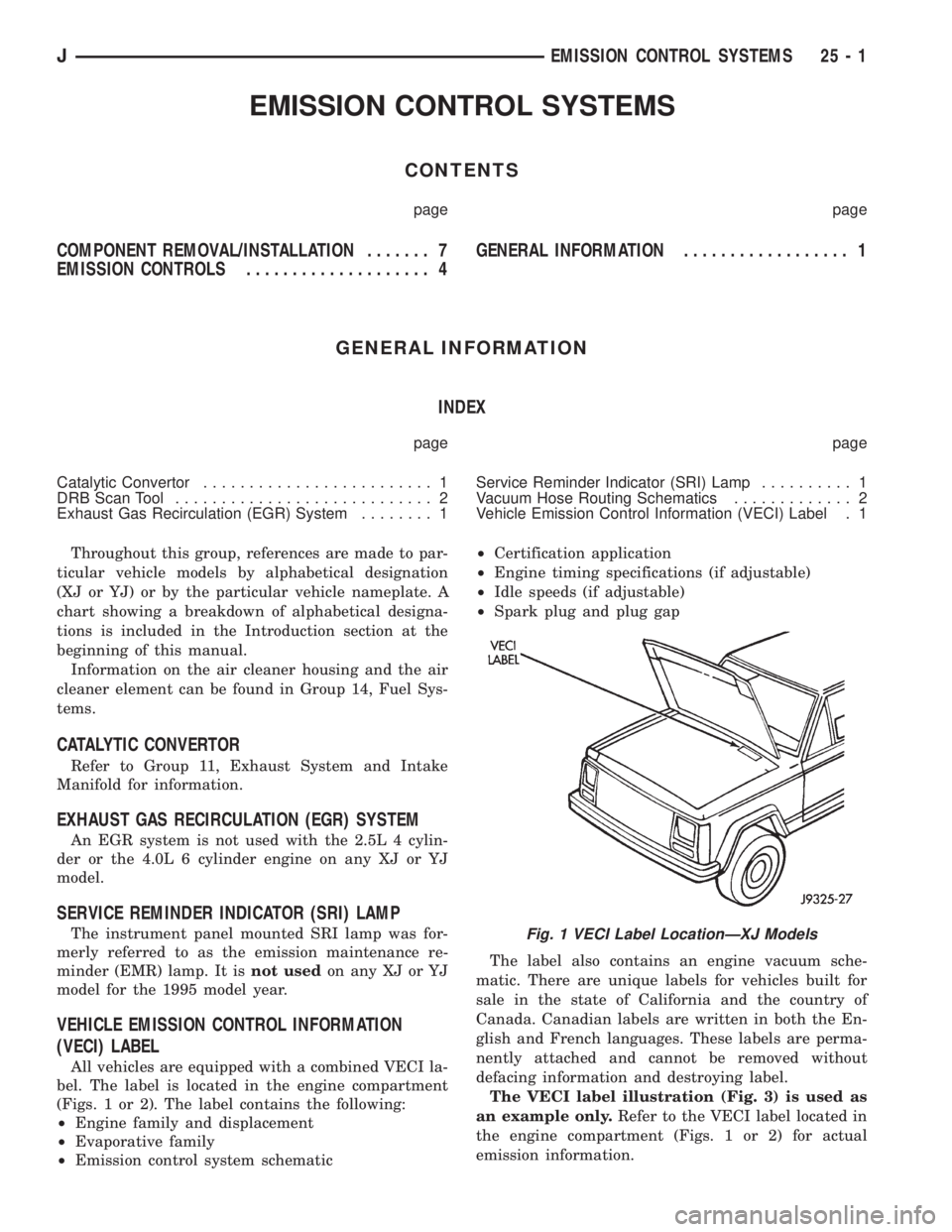
All vehicles are equipped with a combined VECI la-
bel. The label is located in the engine compartment
(Figs. 1 or 2). The label contains the following:
²Engine family and displacement
²Evaporative family
²Emission control system schematic²Certification application
²Engine timing specifications (if adjustable)
²Idle speeds (if adjustable)
²Spark plug and plug gap
The label also contains an engine vacuum sche-
matic. There are unique labels for vehicles built for
sale in the state of California and the country of
Canada. Canadian labels are written in both the En-
glish and French languages. These labels are perma-
nently attached and cannot be removed without
defacing information and destroying label.
The VECI label illustration (Fig. 3) is used as
an example only.Refer to the VECI label located in
the engine compartment (Figs. 1 or 2) for actual
emission information.
Fig. 1 VECI Label LocationÐXJ Models
JEMISSION CONTROL SYSTEMS 25 - 1
Page 1936 of 2198
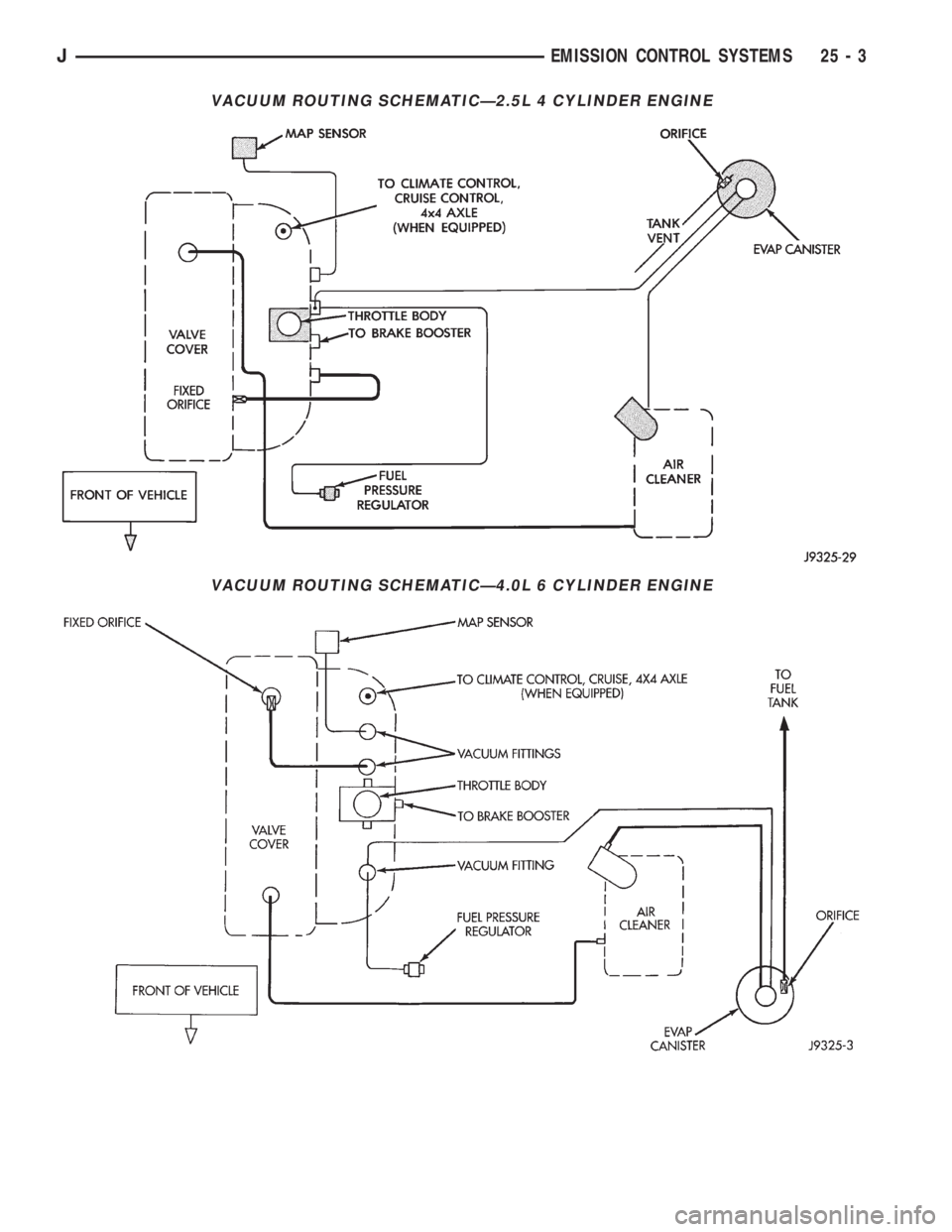
VACUUM ROUTING SCHEMATICÐ2.5L 4 CYLINDER ENGINE
VACUUM ROUTING SCHEMATICÐ4.0L 6 CYLINDER ENGINE
JEMISSION CONTROL SYSTEMS 25 - 3
Page 1937 of 2198
EMISSION CONTROLS
INDEX
page page
Crankcase Ventilation System................. 5
EVAP (Evaporation) Control System............ 4
EVAP Canister............................ 4Fuel Tank Filler Tube Cap.................... 4
Oxygen (O2S) Sensor....................... 6
Pressure Relief/Rollover Valve................. 6
EVAP (EVAPORATION) CONTROL SYSTEM
GENERAL INFORMATION
The function of the EVAP control system is to pre-
vent the emissions of gasoline vapors from the fuel
tank into the atmosphere. When fuel evaporates in
the fuel tank, the vapors pass through vent hoses or
tubes to a carbon filled EVAP canister. They are tem-
porarily held in the canister until they can be drawn
into the intake manifold when the engine is running.
The EVAP canister is a feature on all models for
the storage of fuel vapors from the fuel tank.
The hoses used in this system are specially
manufactured. If replacement becomes neces-
sary, it is important to use only fuel resistant
hose.
EVAP CANISTER
A sealed, maintenance free, EVAP canister is used
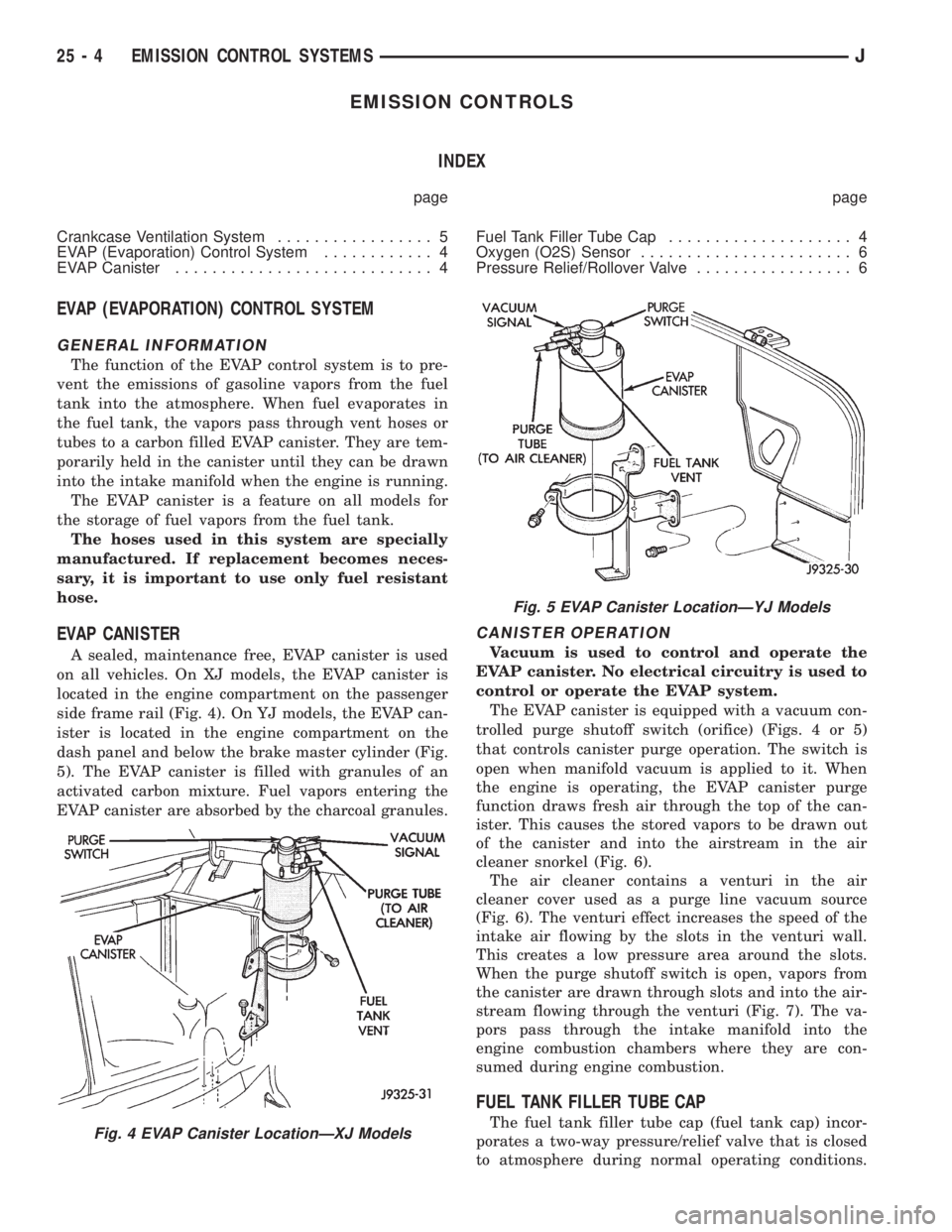
on all vehicles. On XJ models, the EVAP canister is
located in the engine compartment on the passenger
side frame rail (Fig. 4). On YJ models, the EVAP can-
ister is located in the engine compartment on the
dash panel and below the brake master cylinder (Fig.
5). The EVAP canister is filled with granules of an
activated carbon mixture. Fuel vapors entering the
EVAP canister are absorbed by the charcoal granules.
CANISTER OPERATION
Vacuum is used to control and operate the
EVAP canister. No electrical circuitry is used to
control or operate the EVAP system.
The EVAP canister is equipped with a vacuum con-
trolled purge shutoff switch (orifice) (Figs. 4 or 5)
that controls canister purge operation. The switch is
open when manifold vacuum is applied to it. When
the engine is operating, the EVAP canister purge
function draws fresh air through the top of the can-
ister. This causes the stored vapors to be drawn out
of the canister and into the airstream in the air
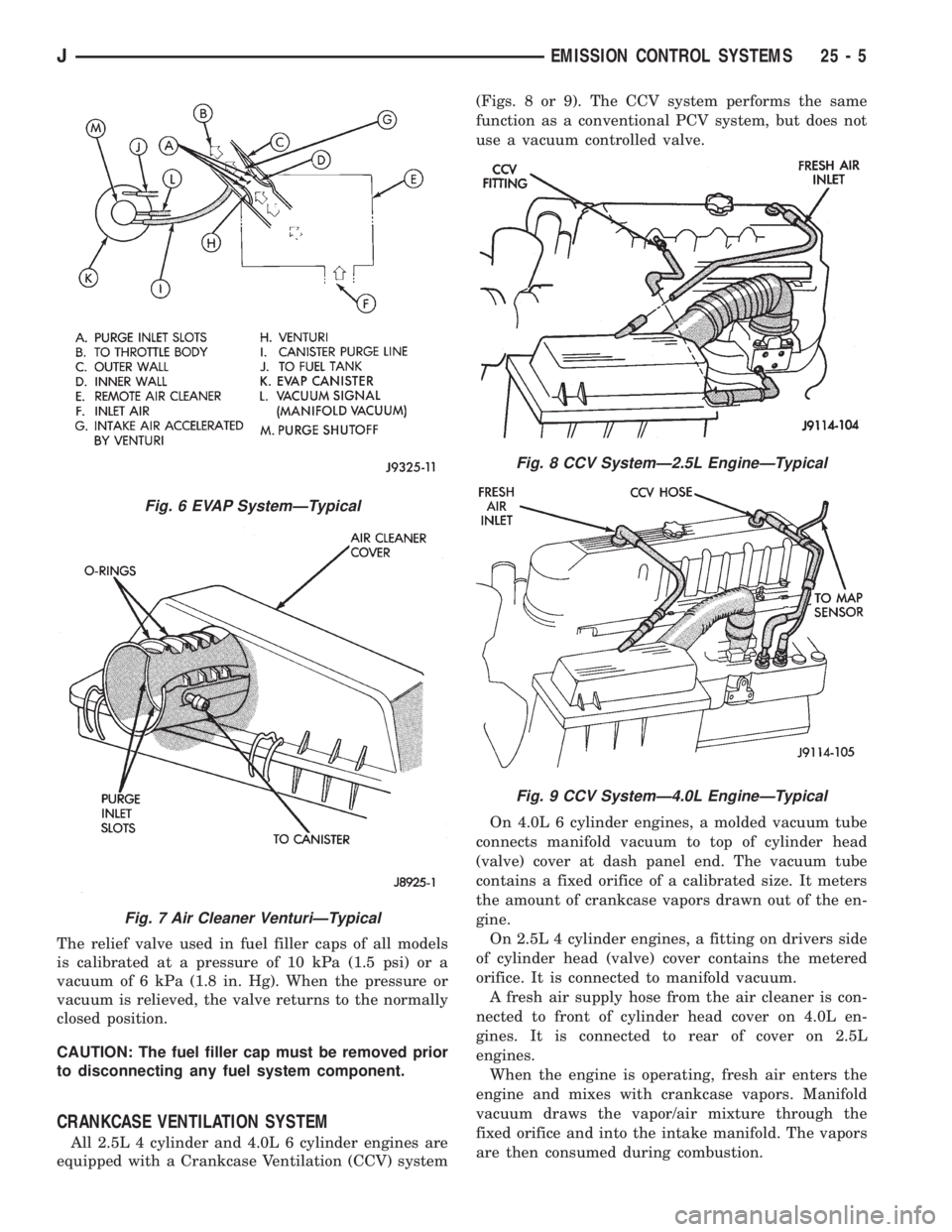
cleaner snorkel (Fig. 6).
The air cleaner contains a venturi in the air
cleaner cover used as a purge line vacuum source
(Fig. 6). The venturi effect increases the speed of the
intake air flowing by the slots in the venturi wall.
This creates a low pressure area around the slots.
When the purge shutoff switch is open, vapors from
the canister are drawn through slots and into the air-
stream flowing through the venturi (Fig. 7). The va-
pors pass through the intake manifold into the
engine combustion chambers where they are con-
sumed during engine combustion.
FUEL TANK FILLER TUBE CAP
The fuel tank filler tube cap (fuel tank cap) incor-
porates a two-way pressure/relief valve that is closed
to atmosphere during normal operating conditions.Fig. 4 EVAP Canister LocationÐXJ Models
Fig. 5 EVAP Canister LocationÐYJ Models
25 - 4 EMISSION CONTROL SYSTEMSJ
Page 1938 of 2198
The relief valve used in fuel filler caps of all models
is calibrated at a pressure of 10 kPa (1.5 psi) or a
vacuum of 6 kPa (1.8 in. Hg). When the pressure or
vacuum is relieved, the valve returns to the normally
closed position.
CAUTION: The fuel filler cap must be removed prior
to disconnecting any fuel system component.
CRANKCASE VENTILATION SYSTEM
All 2.5L 4 cylinder and 4.0L 6 cylinder engines are
equipped with a Crankcase Ventilation (CCV) system(Figs. 8 or 9). The CCV system performs the same
function as a conventional PCV system, but does not
use a vacuum controlled valve.
On 4.0L 6 cylinder engines, a molded vacuum tube
connects manifold vacuum to top of cylinder head
(valve) cover at dash panel end. The vacuum tube
contains a fixed orifice of a calibrated size. It meters
the amount of crankcase vapors drawn out of the en-
gine.
On 2.5L 4 cylinder engines, a fitting on drivers side
of cylinder head (valve) cover contains the metered
orifice. It is connected to manifold vacuum.
A fresh air supply hose from the air cleaner is con-
nected to front of cylinder head cover on 4.0L en-
gines. It is connected to rear of cover on 2.5L
engines.
When the engine is operating, fresh air enters the
engine and mixes with crankcase vapors. Manifold
vacuum draws the vapor/air mixture through the
fixed orifice and into the intake manifold. The vapors
are then consumed during combustion.
Fig. 6 EVAP SystemÐTypical
Fig. 7 Air Cleaner VenturiÐTypical
Fig. 8 CCV SystemÐ2.5L EngineÐTypical
Fig. 9 CCV SystemÐ4.0L EngineÐTypical
JEMISSION CONTROL SYSTEMS 25 - 5
Page 1940 of 2198
COMPONENT REMOVAL/INSTALLATION
INDEX
page page
Air Cleaner Element........................ 7
Coolant Temperature Sensor.................. 7
EVAP Canister............................ 7
Fuel Tank Filler Tube Cap.................... 7Oxygen (O2S) Sensor....................... 7
Powertrain Control Module (PCM).............. 7
Pressure Relief/Rollover Valve................. 7
AIR CLEANER ELEMENT
For removal and installation procedures of both the
air cleaner housing and the air cleaner element, refer
to the Group 14, Fuel System.
COOLANT TEMPERATURE SENSOR
For description, operation, diagnosis and removal/
installation procedures of the engine coolant temper-
ature sensor, refer to Group 14, Fuel Systems.
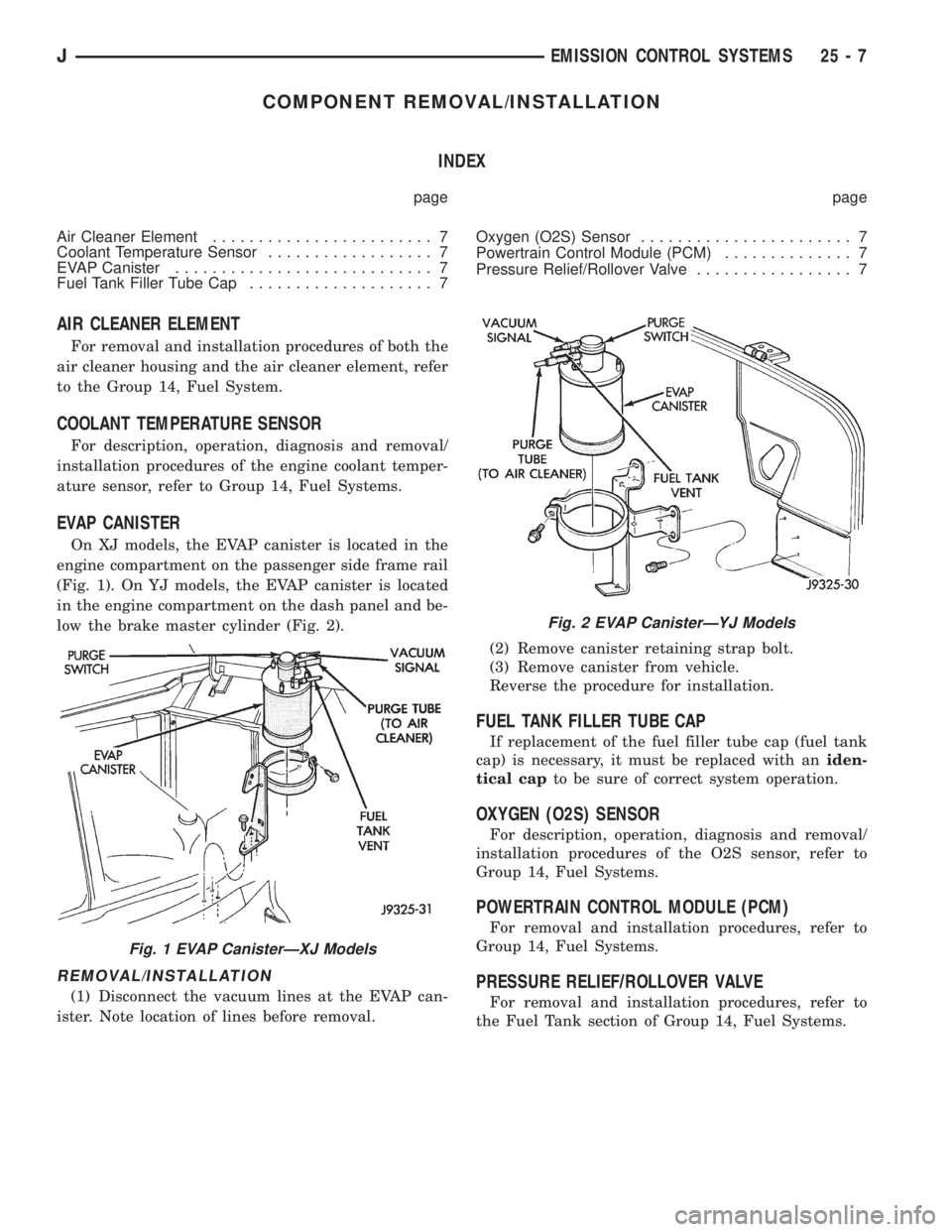
EVAP CANISTER
On XJ models, the EVAP canister is located in the
engine compartment on the passenger side frame rail
(Fig. 1). On YJ models, the EVAP canister is located
in the engine compartment on the dash panel and be-
low the brake master cylinder (Fig. 2).
REMOVAL/INSTALLATION
(1) Disconnect the vacuum lines at the EVAP can-
ister. Note location of lines before removal.(2) Remove canister retaining strap bolt.
(3) Remove canister from vehicle.
Reverse the procedure for installation.
FUEL TANK FILLER TUBE CAP
If replacement of the fuel filler tube cap (fuel tank
cap) is necessary, it must be replaced with aniden-
tical capto be sure of correct system operation.
OXYGEN (O2S) SENSOR
For description, operation, diagnosis and removal/
installation procedures of the O2S sensor, refer to
Group 14, Fuel Systems.
POWERTRAIN CONTROL MODULE (PCM)
For removal and installation procedures, refer to
Group 14, Fuel Systems.
PRESSURE RELIEF/ROLLOVER VALVE
For removal and installation procedures, refer to
the Fuel Tank section of Group 14, Fuel Systems.
Fig. 1 EVAP CanisterÐXJ Models
Fig. 2 EVAP CanisterÐYJ Models
JEMISSION CONTROL SYSTEMS 25 - 7
Page 1943 of 2198

FOREWORD
The information contained in this service manual has been prepared for the professional automotive tech-
nician involved in daily repair operations. This manual does not cover theory of operation, which is addressed
in service training material. Information describing the operation and use of standard and optional equipment
is included in the Owner 's Manual provided with the vehicle.
Information in this manual is divided into groups. These groups contain general information, diagnosis,
testing, adjustments, removal, installation, disassembly, and assembly procedures for the components. To as-
sist in locating a group title page, use the Group Tab Locator on the following page. The solid bar after the
group title is aligned to a solid tab on the first page of each group. The first page of the group has a contents
section that lists major topics within the group. If you are not sure which Group contains the information you
need, look up the Component/System in the alphabetical index located in the rear of this manual.
A Service Manual Comment form is included at the rear of this manual. Use the form to provide Chrysler
Corporation with your comments and suggestions.
Tightening torques are provided as a specific value throughout this manual. This value represents the
midpoint of the acceptable engineering torque range for a given fastener application. These torque values are
intended for use in service assembly and installation procedures using the correct OEM fasteners. When re-
placing fasteners, always use the same type (part number) fastener as removed.
Chrysler Corporation reserves the right to change testing procedures, specifications, diagnosis, repair
methods, or vehicle wiring at any time without prior notice or incurring obligation.
NOTE: The acronyms, terminology and nomenclature used to identify emissions related components in
this manual may have changed from prior publications. These new terms are in compliance with S.A.E.
recommended practice J1930.
NEXT PAGE©
Page 1944 of 2198
GROUP TAB LOCATOR
Introduction
0Lubrication and Maintenance
2Front Suspension and Axle
3Rear Suspension and Axles
5Brakes
6Clutch
7Cooling System
8Electrical
9Engines
11Exhaust System and Intake Manifold
13Frame and Bumpers
14Fuel System
16Propeller Shafts
19Steering
21Transmission and Transfer Cases
22Wheels and Tires
23Body Components
24Heating and Air Conditioning
25Emission Control Systems
Index
Service Manual Comment Forms (Rear of Manual)
Page 1946 of 2198
INTRODUCTION
CONTENTS
page page
DESIGNATIONS, LABELS/PLATES, CODES AND
DIMENSIONS.......................... 1MEASUREMENT AND TORQUE
SPECIFICATIONS...................... 11
DESIGNATIONS, LABELS/PLATES, CODES AND DIMENSIONS
INDEX
page page
Engine and Transmission/Transfer Case
Identification............................ 5
International Vehicle Control and Display Symbols . . 5
Major Component Identification................ 5
Trailer Towing Specifications.................. 5
Vehicle Code Plate......................... 4Vehicle Designations........................ 1
Vehicle Dimension Data..................... 5
Vehicle Identification Number (VIN) Plate......... 4
Vehicle Load Data......................... 5
Vehicle Safety Certification Label............... 4
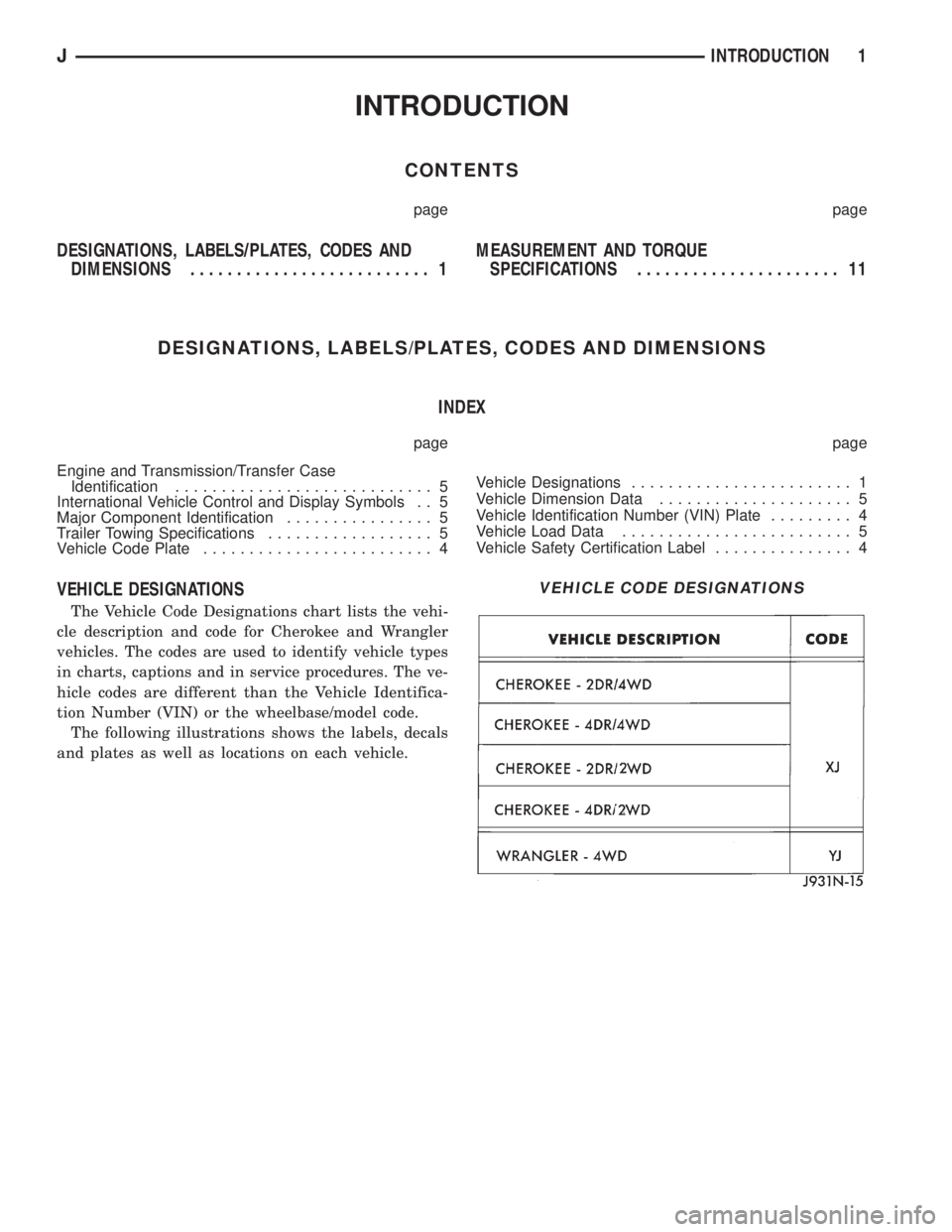
VEHICLE DESIGNATIONS
The Vehicle Code Designations chart lists the vehi-
cle description and code for Cherokee and Wrangler
vehicles. The codes are used to identify vehicle types
in charts, captions and in service procedures. The ve-
hicle codes are different than the Vehicle Identifica-
tion Number (VIN) or the wheelbase/model code.
The following illustrations shows the labels, decals
and plates as well as locations on each vehicle.
VEHICLE CODE DESIGNATIONS
JINTRODUCTION 1
Page 1949 of 2198
VEHICLE SAFETY CERTIFICATION LABEL
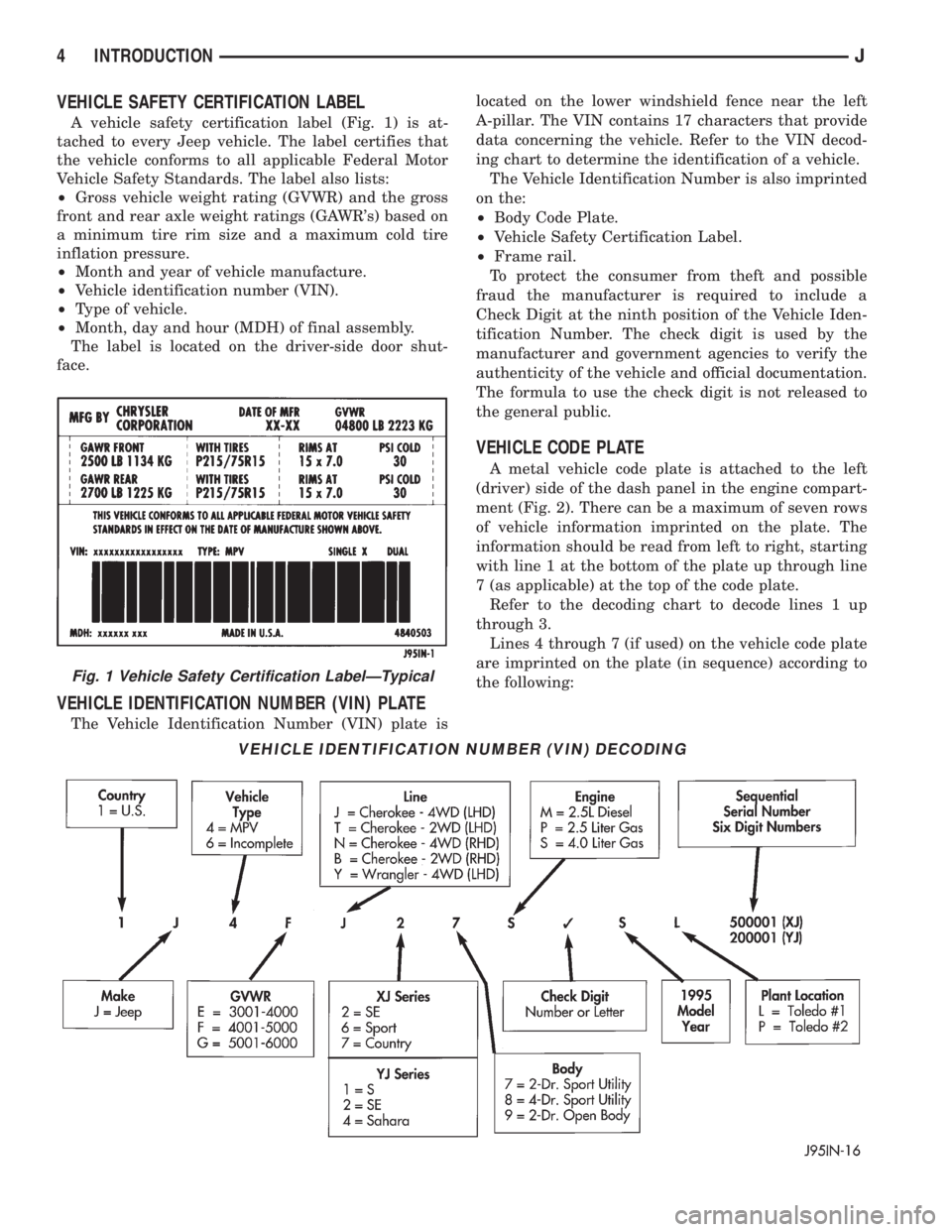
A vehicle safety certification label (Fig. 1) is at-
tached to every Jeep vehicle. The label certifies that
the vehicle conforms to all applicable Federal Motor
Vehicle Safety Standards. The label also lists:
²Gross vehicle weight rating (GVWR) and the gross
front and rear axle weight ratings (GAWR's) based on
a minimum tire rim size and a maximum cold tire
inflation pressure.
²Month and year of vehicle manufacture.
²Vehicle identification number (VIN).
²Type of vehicle.
²Month, day and hour (MDH) of final assembly.
The label is located on the driver-side door shut-
face.
VEHICLE IDENTIFICATION NUMBER (VIN) PLATE
The Vehicle Identification Number (VIN) plate islocated on the lower windshield fence near the left
A-pillar. The VIN contains 17 characters that provide
data concerning the vehicle. Refer to the VIN decod-
ing chart to determine the identification of a vehicle.
The Vehicle Identification Number is also imprinted
on the:
²Body Code Plate.
²Vehicle Safety Certification Label.
²Frame rail.
To protect the consumer from theft and possible
fraud the manufacturer is required to include a
Check Digit at the ninth position of the Vehicle Iden-
tification Number. The check digit is used by the
manufacturer and government agencies to verify the
authenticity of the vehicle and official documentation.
The formula to use the check digit is not released to
the general public.
VEHICLE CODE PLATE
A metal vehicle code plate is attached to the left
(driver) side of the dash panel in the engine compart-
ment (Fig. 2). There can be a maximum of seven rows
of vehicle information imprinted on the plate. The
information should be read from left to right, starting
with line 1 at the bottom of the plate up through line
7 (as applicable) at the top of the code plate.
Refer to the decoding chart to decode lines 1 up
through 3.
Lines 4 through 7 (if used) on the vehicle code plate
are imprinted on the plate (in sequence) according to
the following:
VEHICLE IDENTIFICATION NUMBER (VIN) DECODING
Fig. 1 Vehicle Safety Certification LabelÐTypical
4 INTRODUCTIONJ
Page 1950 of 2198
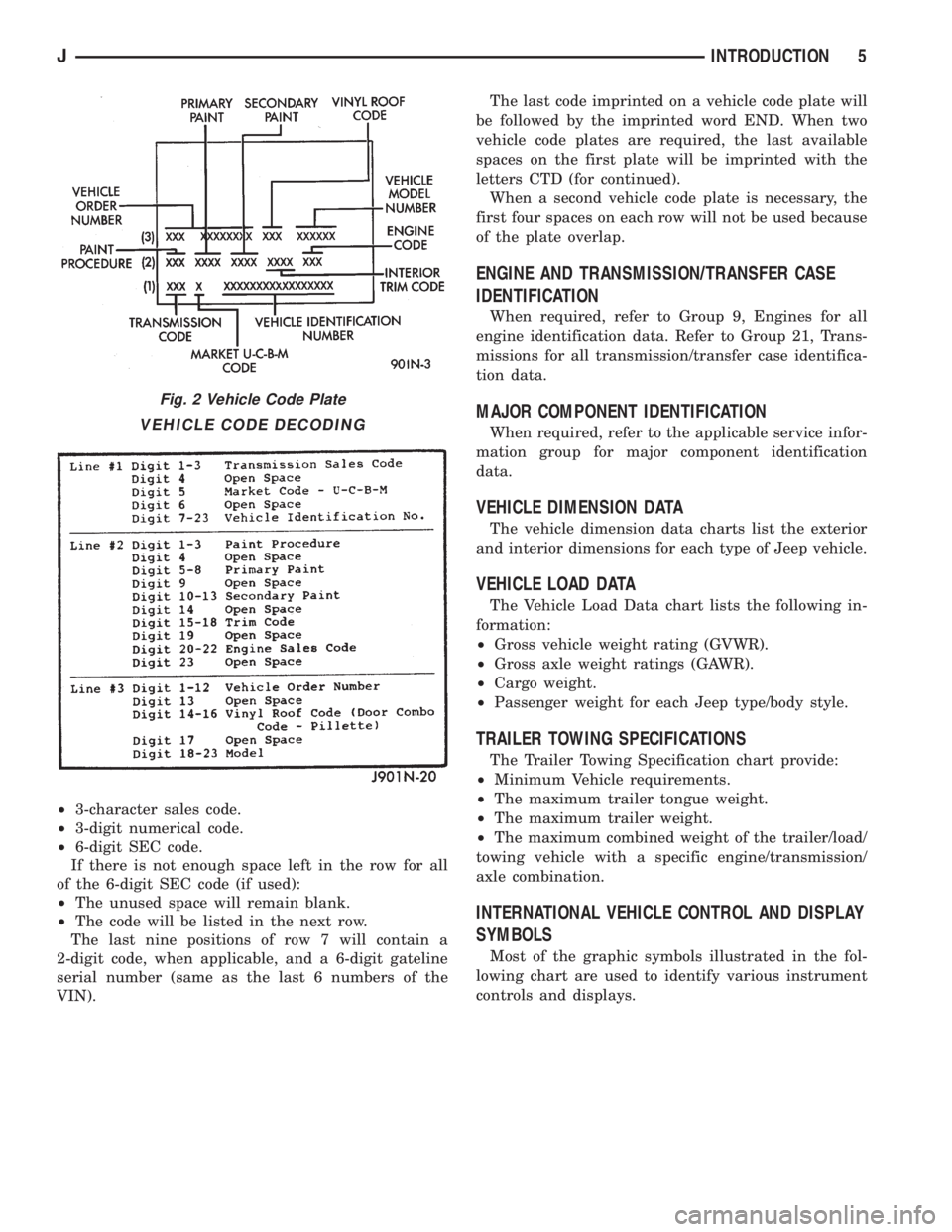
²3-character sales code.
²3-digit numerical code.
²6-digit SEC code.
If there is not enough space left in the row for all
of the 6-digit SEC code (if used):
²The unused space will remain blank.
²The code will be listed in the next row.
The last nine positions of row 7 will contain a
2-digit code, when applicable, and a 6-digit gateline
serial number (same as the last 6 numbers of the
VIN).The last code imprinted on a vehicle code plate will
be followed by the imprinted word END. When two
vehicle code plates are required, the last available
spaces on the first plate will be imprinted with the
letters CTD (for continued).
When a second vehicle code plate is necessary, the
first four spaces on each row will not be used because
of the plate overlap.
ENGINE AND TRANSMISSION/TRANSFER CASE
IDENTIFICATION
When required, refer to Group 9, Engines for all
engine identification data. Refer to Group 21, Trans-
missions for all transmission/transfer case identifica-
tion data.
MAJOR COMPONENT IDENTIFICATION
When required, refer to the applicable service infor-
mation group for major component identification
data.
VEHICLE DIMENSION DATA
The vehicle dimension data charts list the exterior
and interior dimensions for each type of Jeep vehicle.
VEHICLE LOAD DATA
The Vehicle Load Data chart lists the following in-
formation:
²Gross vehicle weight rating (GVWR).
²Gross axle weight ratings (GAWR).
²Cargo weight.
²Passenger weight for each Jeep type/body style.
TRAILER TOWING SPECIFICATIONS
The Trailer Towing Specification chart provide:
²Minimum Vehicle requirements.
²The maximum trailer tongue weight.
²The maximum trailer weight.
²The maximum combined weight of the trailer/load/
towing vehicle with a specific engine/transmission/
axle combination.
INTERNATIONAL VEHICLE CONTROL AND DISPLAY
SYMBOLS
Most of the graphic symbols illustrated in the fol-
lowing chart are used to identify various instrument
controls and displays.
Fig. 2 Vehicle Code Plate
VEHICLE CODE DECODING
JINTRODUCTION 5