Compressor JEEP CHEROKEE 1995 Service Workshop Manual
[x] Cancel search | Manufacturer: JEEP, Model Year: 1995, Model line: CHEROKEE, Model: JEEP CHEROKEE 1995Pages: 2198, PDF Size: 82.83 MB
Page 1512 of 2198
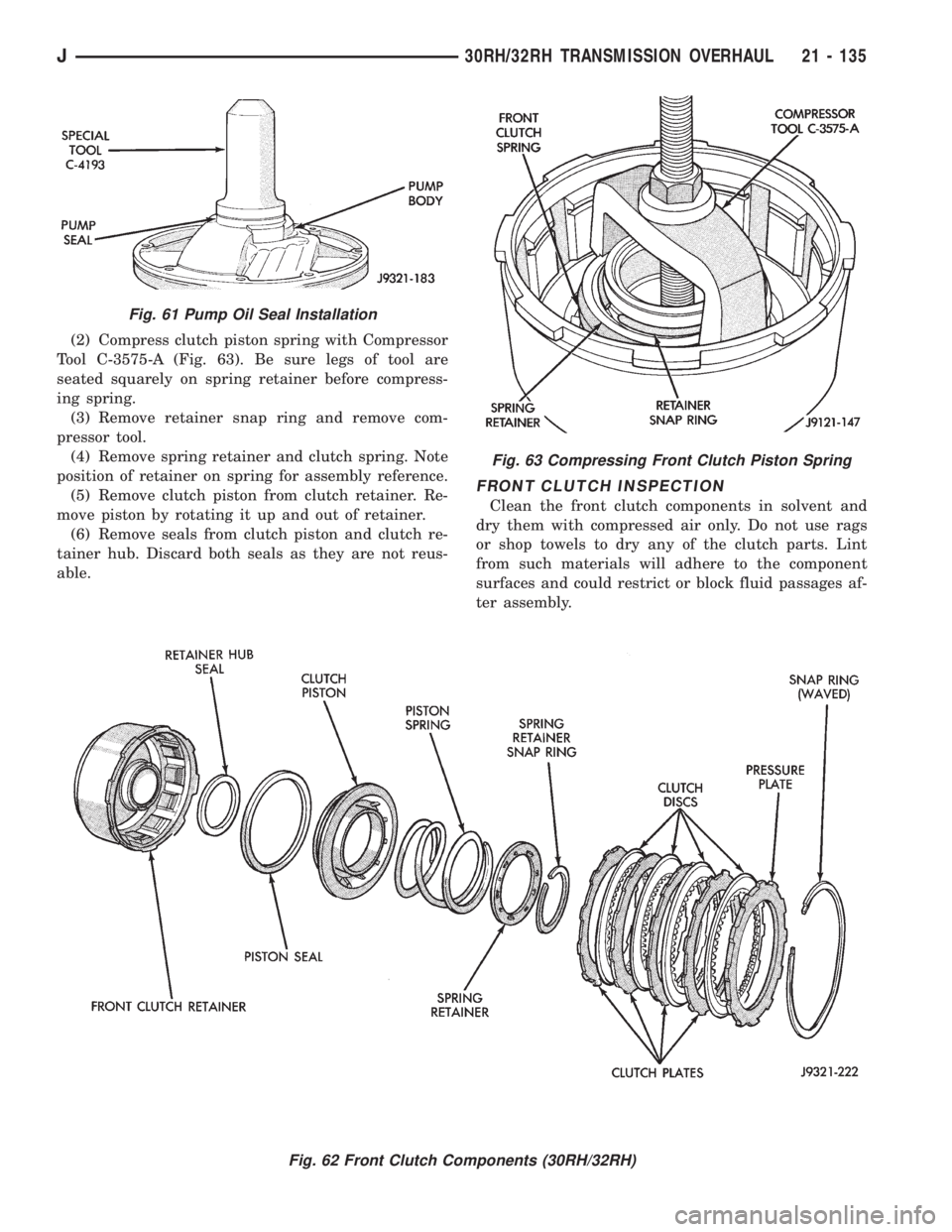
(2) Compress clutch piston spring with Compressor
Tool C-3575-A (Fig. 63). Be sure legs of tool are
seated squarely on spring retainer before compress-
ing spring.
(3) Remove retainer snap ring and remove com-
pressor tool.
(4) Remove spring retainer and clutch spring. Note
position of retainer on spring for assembly reference.
(5) Remove clutch piston from clutch retainer. Re-
move piston by rotating it up and out of retainer.
(6) Remove seals from clutch piston and clutch re-
tainer hub. Discard both seals as they are not reus-
able.
FRONT CLUTCH INSPECTION
Clean the front clutch components in solvent and
dry them with compressed air only. Do not use rags
or shop towels to dry any of the clutch parts. Lint
from such materials will adhere to the component
surfaces and could restrict or block fluid passages af-
ter assembly.
Fig. 63 Compressing Front Clutch Piston Spring
Fig. 62 Front Clutch Components (30RH/32RH)
Fig. 61 Pump Oil Seal Installation
J30RH/32RH TRANSMISSION OVERHAUL 21 - 135
Page 1532 of 2198
justment must be performed properly and in the cor-
rect sequence. The correct sequence is line pressure
adjustment first and throttle pressure adjustment
last.
Line Pressure Adjustment
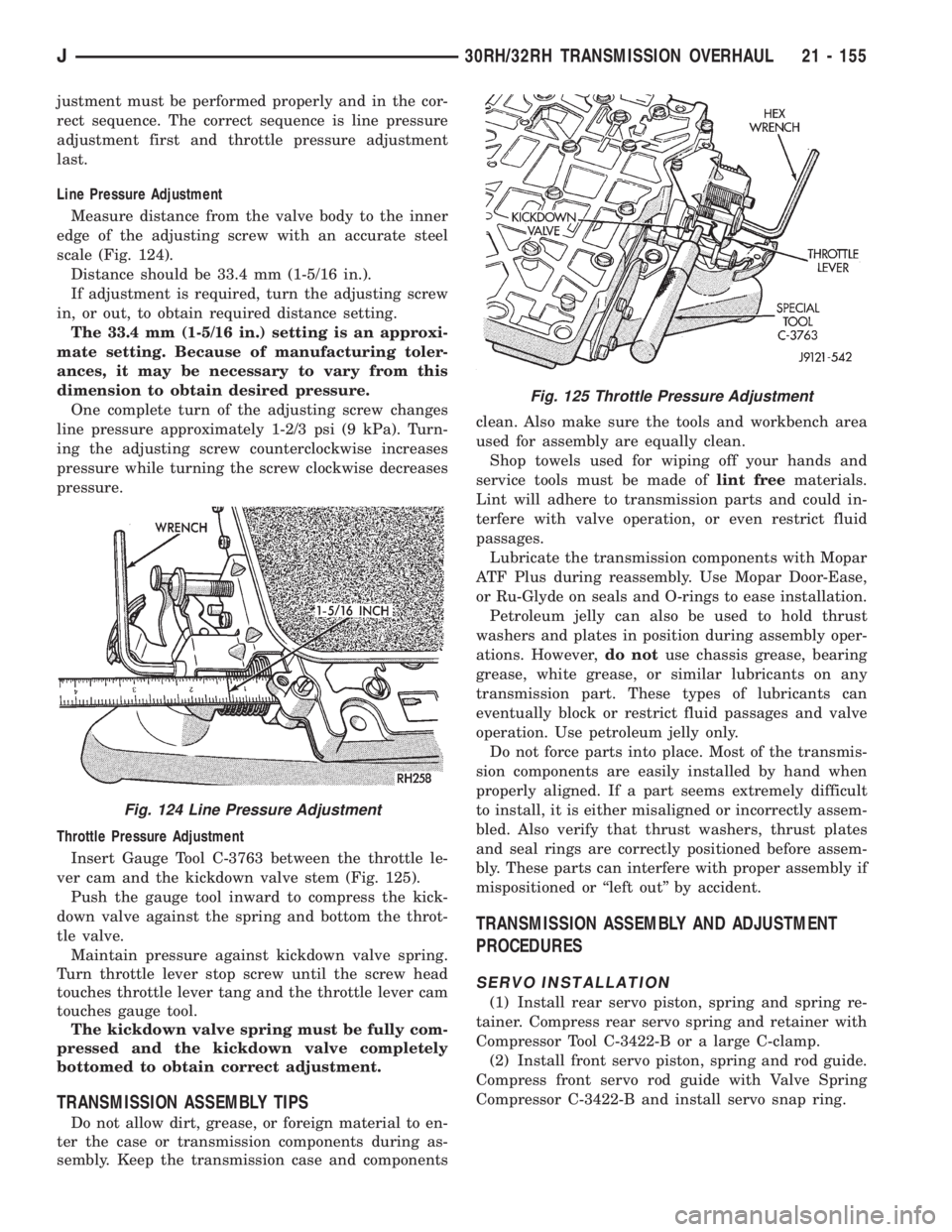
Measure distance from the valve body to the inner
edge of the adjusting screw with an accurate steel
scale (Fig. 124).
Distance should be 33.4 mm (1-5/16 in.).
If adjustment is required, turn the adjusting screw
in, or out, to obtain required distance setting.
The 33.4 mm (1-5/16 in.) setting is an approxi-
mate setting. Because of manufacturing toler-
ances, it may be necessary to vary from this
dimension to obtain desired pressure.
One complete turn of the adjusting screw changes
line pressure approximately 1-2/3 psi (9 kPa). Turn-
ing the adjusting screw counterclockwise increases
pressure while turning the screw clockwise decreases
pressure.
Throttle Pressure Adjustment
Insert Gauge Tool C-3763 between the throttle le-
ver cam and the kickdown valve stem (Fig. 125).
Push the gauge tool inward to compress the kick-
down valve against the spring and bottom the throt-
tle valve.
Maintain pressure against kickdown valve spring.
Turn throttle lever stop screw until the screw head
touches throttle lever tang and the throttle lever cam
touches gauge tool.
The kickdown valve spring must be fully com-
pressed and the kickdown valve completely
bottomed to obtain correct adjustment.
TRANSMISSION ASSEMBLY TIPS
Do not allow dirt, grease, or foreign material to en-
ter the case or transmission components during as-
sembly. Keep the transmission case and componentsclean. Also make sure the tools and workbench area
used for assembly are equally clean.
Shop towels used for wiping off your hands and
service tools must be made oflint freematerials.
Lint will adhere to transmission parts and could in-
terfere with valve operation, or even restrict fluid
passages.
Lubricate the transmission components with Mopar
ATF Plus during reassembly. Use Mopar Door-Ease,
or Ru-Glyde on seals and O-rings to ease installation.
Petroleum jelly can also be used to hold thrust
washers and plates in position during assembly oper-
ations. However,do notuse chassis grease, bearing
grease, white grease, or similar lubricants on any
transmission part. These types of lubricants can
eventually block or restrict fluid passages and valve
operation. Use petroleum jelly only.
Do not force parts into place. Most of the transmis-
sion components are easily installed by hand when
properly aligned. If a part seems extremely difficult
to install, it is either misaligned or incorrectly assem-
bled. Also verify that thrust washers, thrust plates
and seal rings are correctly positioned before assem-
bly. These parts can interfere with proper assembly if
mispositioned or ``left out'' by accident.
TRANSMISSION ASSEMBLY AND ADJUSTMENT
PROCEDURES
SERVO INSTALLATION
(1) Install rear servo piston, spring and spring re-
tainer. Compress rear servo spring and retainer with
Compressor Tool C-3422-B or a large C-clamp.
(2) Install front servo piston, spring and rod guide.
Compress front servo rod guide with Valve Spring
Compressor C-3422-B and install servo snap ring.
Fig. 124 Line Pressure Adjustment
Fig. 125 Throttle Pressure Adjustment
J30RH/32RH TRANSMISSION OVERHAUL 21 - 155
Page 1597 of 2198
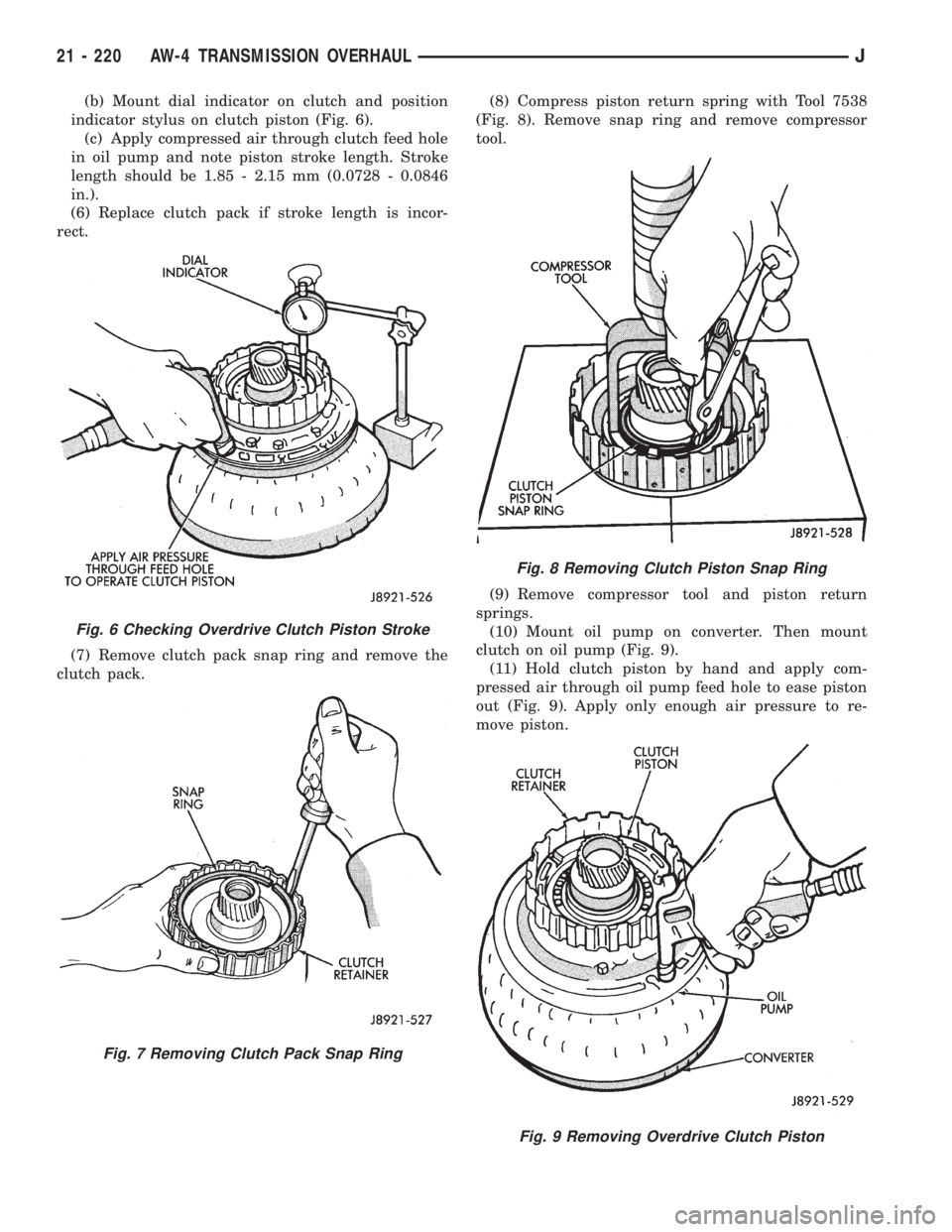
(b) Mount dial indicator on clutch and position
indicator stylus on clutch piston (Fig. 6).
(c) Apply compressed air through clutch feed hole
in oil pump and note piston stroke length. Stroke
length should be 1.85 - 2.15 mm (0.0728 - 0.0846
in.).
(6) Replace clutch pack if stroke length is incor-
rect.
(7) Remove clutch pack snap ring and remove the
clutch pack.(8) Compress piston return spring with Tool 7538
(Fig. 8). Remove snap ring and remove compressor
tool.
(9) Remove compressor tool and piston return
springs.
(10) Mount oil pump on converter. Then mount
clutch on oil pump (Fig. 9).
(11) Hold clutch piston by hand and apply com-
pressed air through oil pump feed hole to ease piston
out (Fig. 9). Apply only enough air pressure to re-
move piston.
Fig. 6 Checking Overdrive Clutch Piston Stroke
Fig. 7 Removing Clutch Pack Snap Ring
Fig. 8 Removing Clutch Piston Snap Ring
Fig. 9 Removing Overdrive Clutch Piston
21 - 220 AW-4 TRANSMISSION OVERHAULJ
Page 1606 of 2198
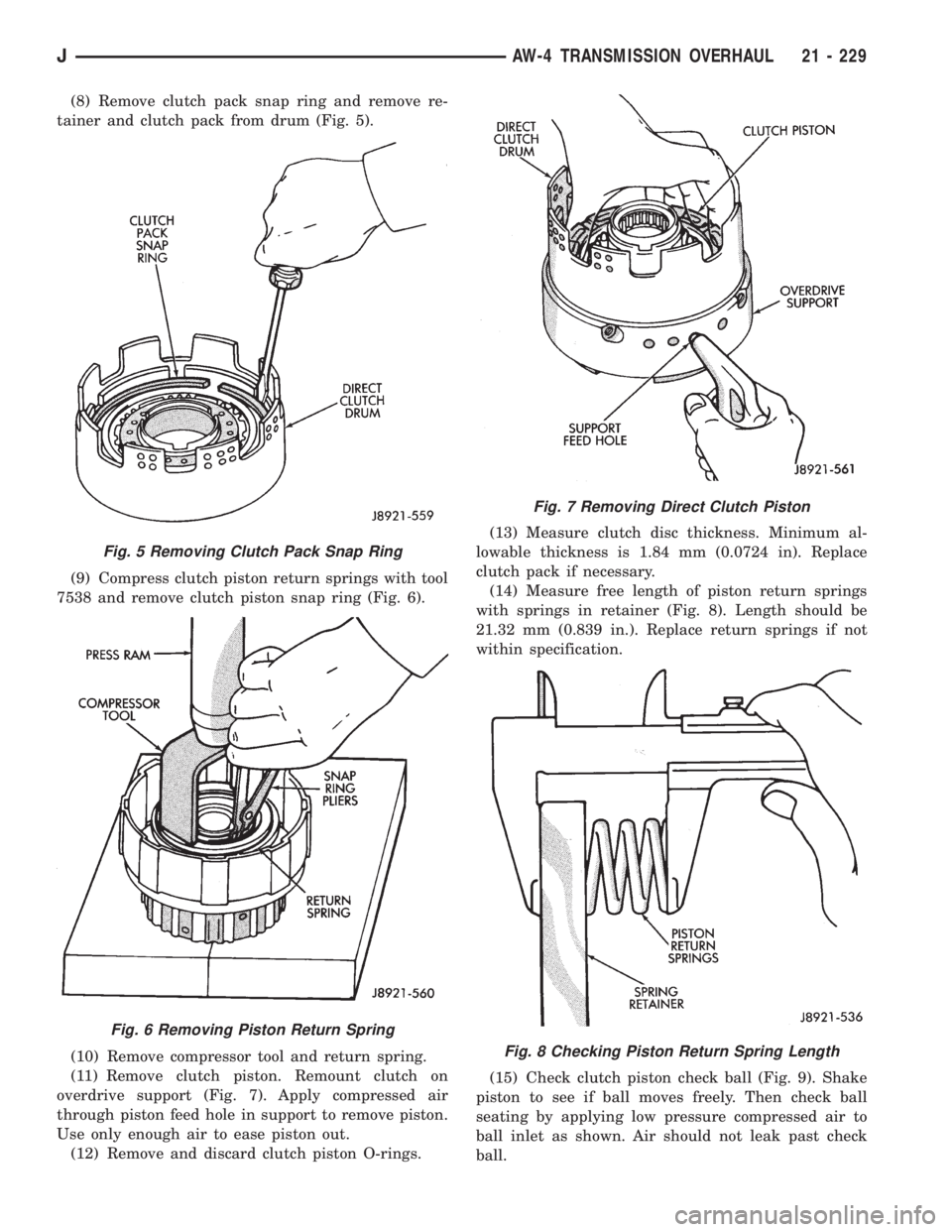
(8) Remove clutch pack snap ring and remove re-
tainer and clutch pack from drum (Fig. 5).
(9) Compress clutch piston return springs with tool
7538 and remove clutch piston snap ring (Fig. 6).
(10) Remove compressor tool and return spring.
(11) Remove clutch piston. Remount clutch on
overdrive support (Fig. 7). Apply compressed air
through piston feed hole in support to remove piston.
Use only enough air to ease piston out.
(12) Remove and discard clutch piston O-rings.(13) Measure clutch disc thickness. Minimum al-
lowable thickness is 1.84 mm (0.0724 in). Replace
clutch pack if necessary.
(14) Measure free length of piston return springs
with springs in retainer (Fig. 8). Length should be
21.32 mm (0.839 in.). Replace return springs if not
within specification.
(15) Check clutch piston check ball (Fig. 9). Shake
piston to see if ball moves freely. Then check ball
seating by applying low pressure compressed air to
ball inlet as shown. Air should not leak past check
ball.
Fig. 5 Removing Clutch Pack Snap Ring
Fig. 6 Removing Piston Return Spring
Fig. 7 Removing Direct Clutch Piston
Fig. 8 Checking Piston Return Spring Length
JAW-4 TRANSMISSION OVERHAUL 21 - 229
Page 1611 of 2198
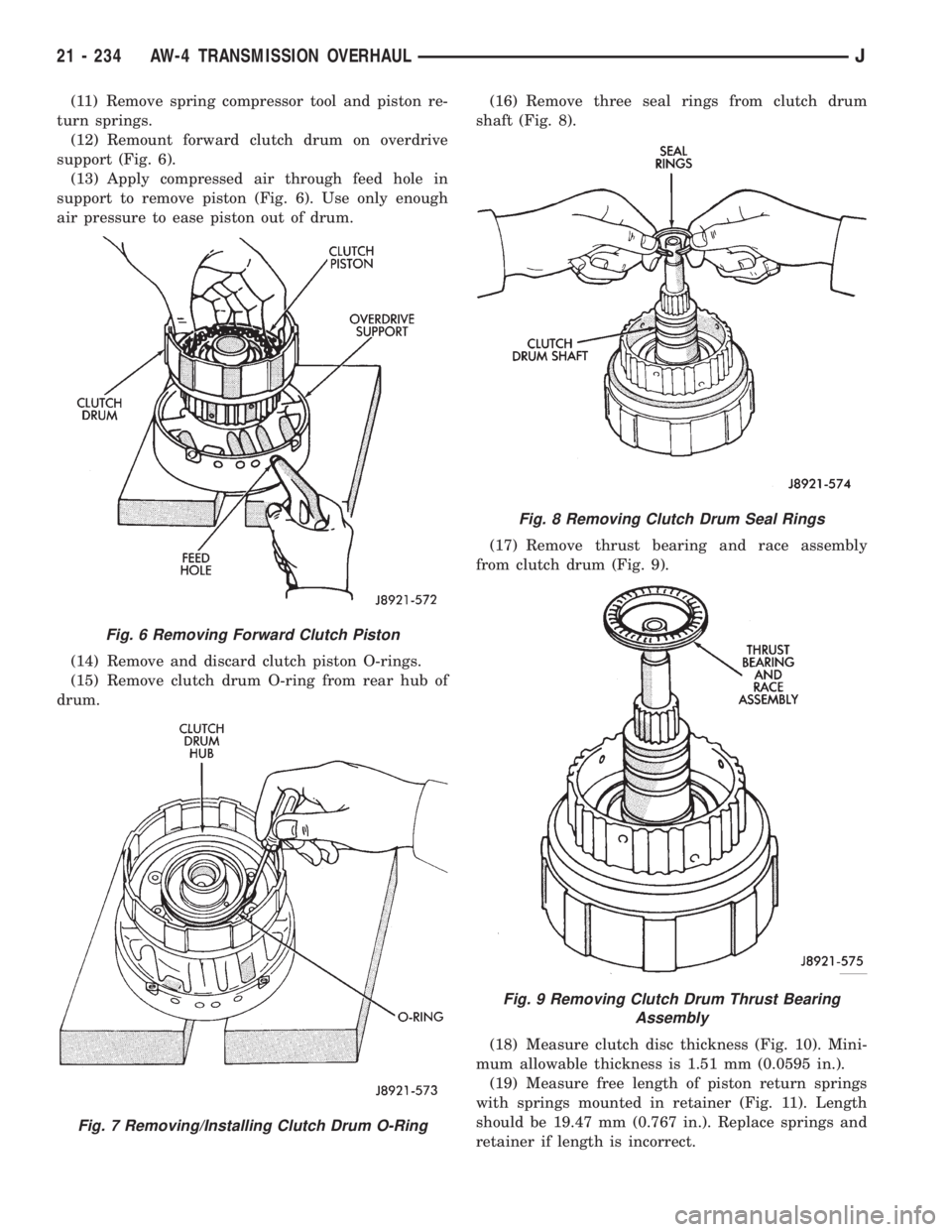
(11) Remove spring compressor tool and piston re-
turn springs.
(12) Remount forward clutch drum on overdrive
support (Fig. 6).
(13) Apply compressed air through feed hole in
support to remove piston (Fig. 6). Use only enough
air pressure to ease piston out of drum.
(14) Remove and discard clutch piston O-rings.
(15) Remove clutch drum O-ring from rear hub of
drum.(16) Remove three seal rings from clutch drum
shaft (Fig. 8).
(17) Remove thrust bearing and race assembly
from clutch drum (Fig. 9).
(18) Measure clutch disc thickness (Fig. 10). Mini-
mum allowable thickness is 1.51 mm (0.0595 in.).
(19) Measure free length of piston return springs
with springs mounted in retainer (Fig. 11). Length
should be 19.47 mm (0.767 in.). Replace springs and
retainer if length is incorrect.
Fig. 6 Removing Forward Clutch Piston
Fig. 7 Removing/Installing Clutch Drum O-Ring
Fig. 8 Removing Clutch Drum Seal Rings
Fig. 9 Removing Clutch Drum Thrust Bearing
Assembly
21 - 234 AW-4 TRANSMISSION OVERHAULJ
Page 1619 of 2198
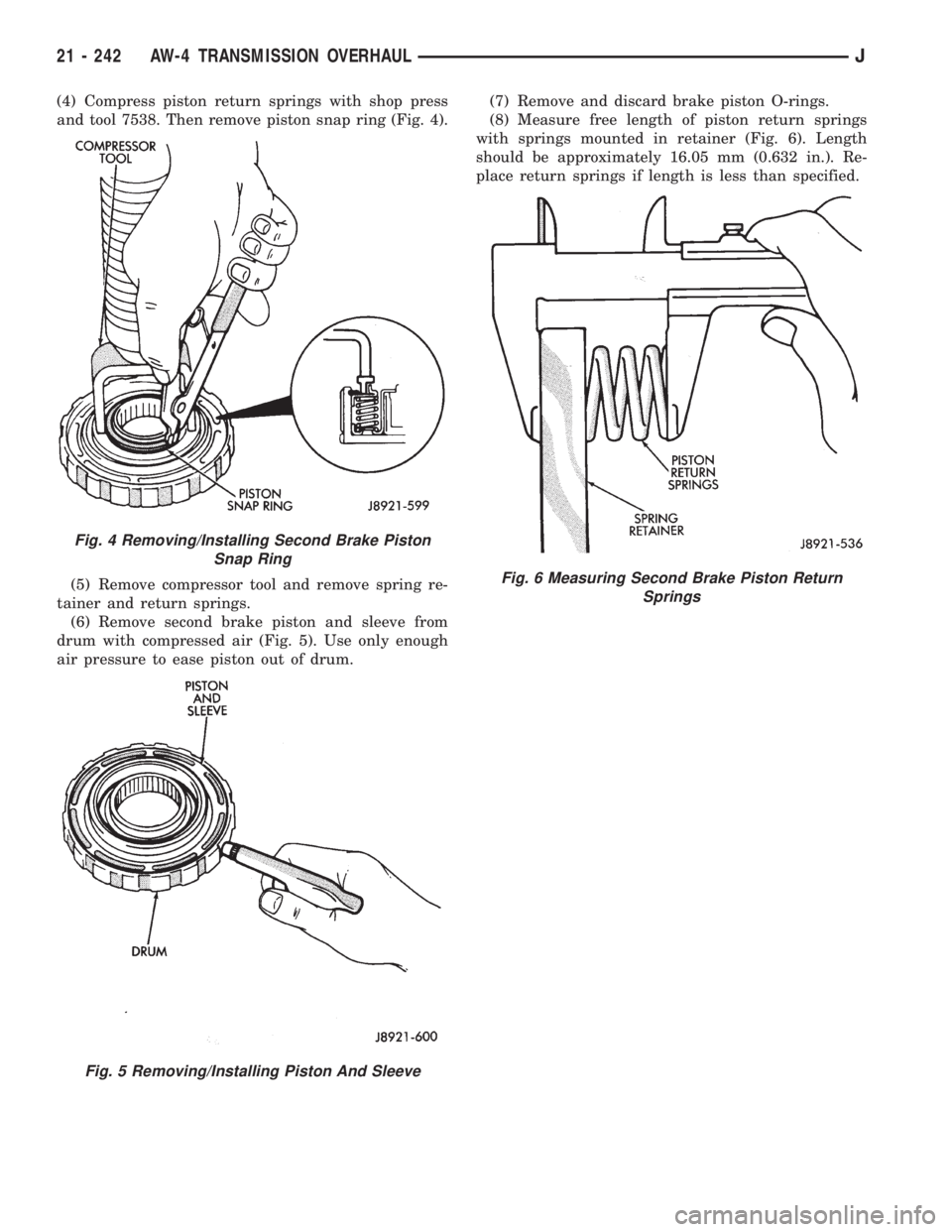
(4) Compress piston return springs with shop press
and tool 7538. Then remove piston snap ring (Fig. 4).
(5) Remove compressor tool and remove spring re-
tainer and return springs.
(6) Remove second brake piston and sleeve from
drum with compressed air (Fig. 5). Use only enough
air pressure to ease piston out of drum.(7) Remove and discard brake piston O-rings.
(8) Measure free length of piston return springs
with springs mounted in retainer (Fig. 6). Length
should be approximately 16.05 mm (0.632 in.). Re-
place return springs if length is less than specified.
Fig. 4 Removing/Installing Second Brake Piston
Snap Ring
Fig. 5 Removing/Installing Piston And Sleeve
Fig. 6 Measuring Second Brake Piston Return
Springs
21 - 242 AW-4 TRANSMISSION OVERHAULJ
Page 1620 of 2198
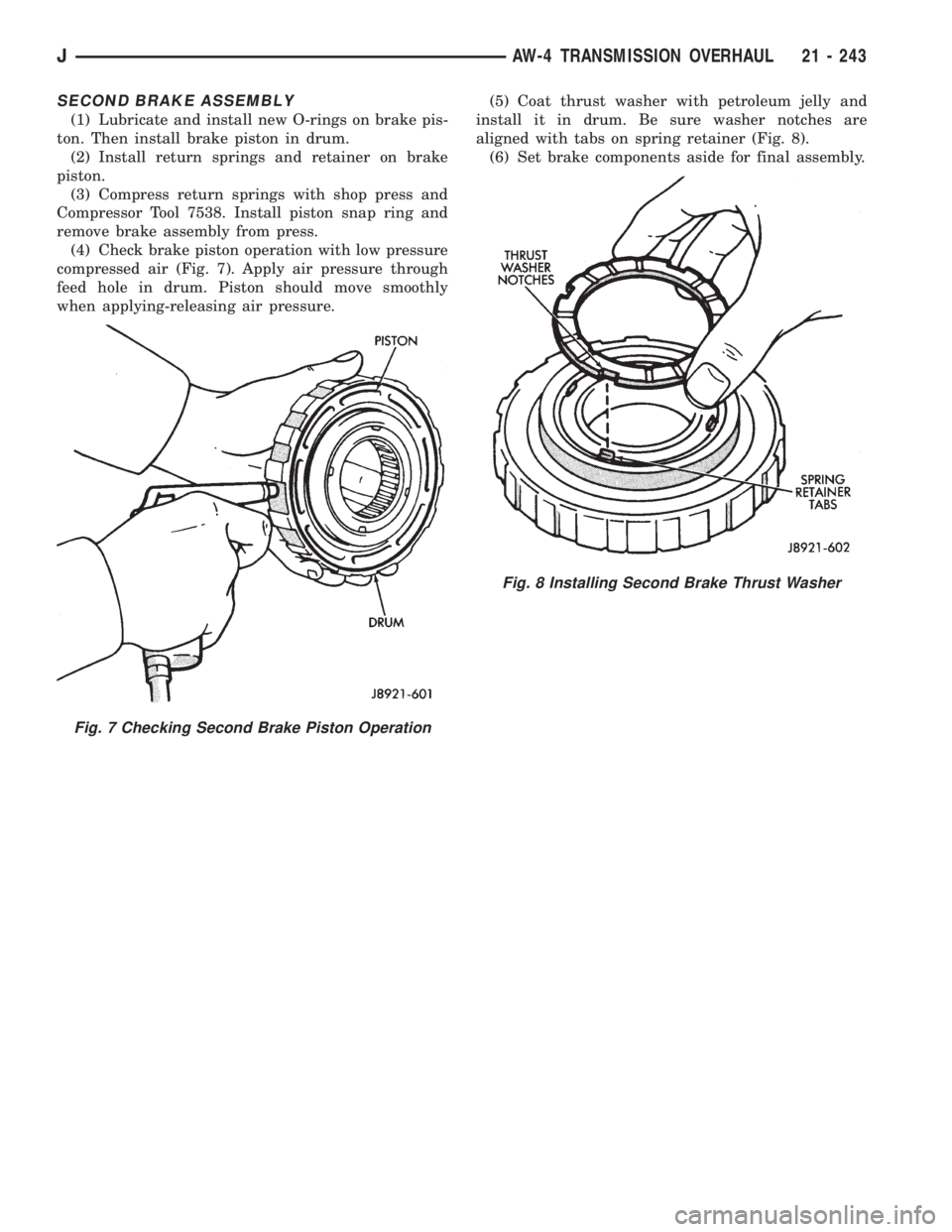
SECOND BRAKE ASSEMBLY
(1) Lubricate and install new O-rings on brake pis-
ton. Then install brake piston in drum.
(2) Install return springs and retainer on brake
piston.
(3) Compress return springs with shop press and
Compressor Tool 7538. Install piston snap ring and
remove brake assembly from press.
(4) Check brake piston operation with low pressure
compressed air (Fig. 7). Apply air pressure through
feed hole in drum. Piston should move smoothly
when applying-releasing air pressure.(5) Coat thrust washer with petroleum jelly and
install it in drum. Be sure washer notches are
aligned with tabs on spring retainer (Fig. 8).
(6) Set brake components aside for final assembly.
Fig. 7 Checking Second Brake Piston Operation
Fig. 8 Installing Second Brake Thrust Washer
JAW-4 TRANSMISSION OVERHAUL 21 - 243
Page 1732 of 2198
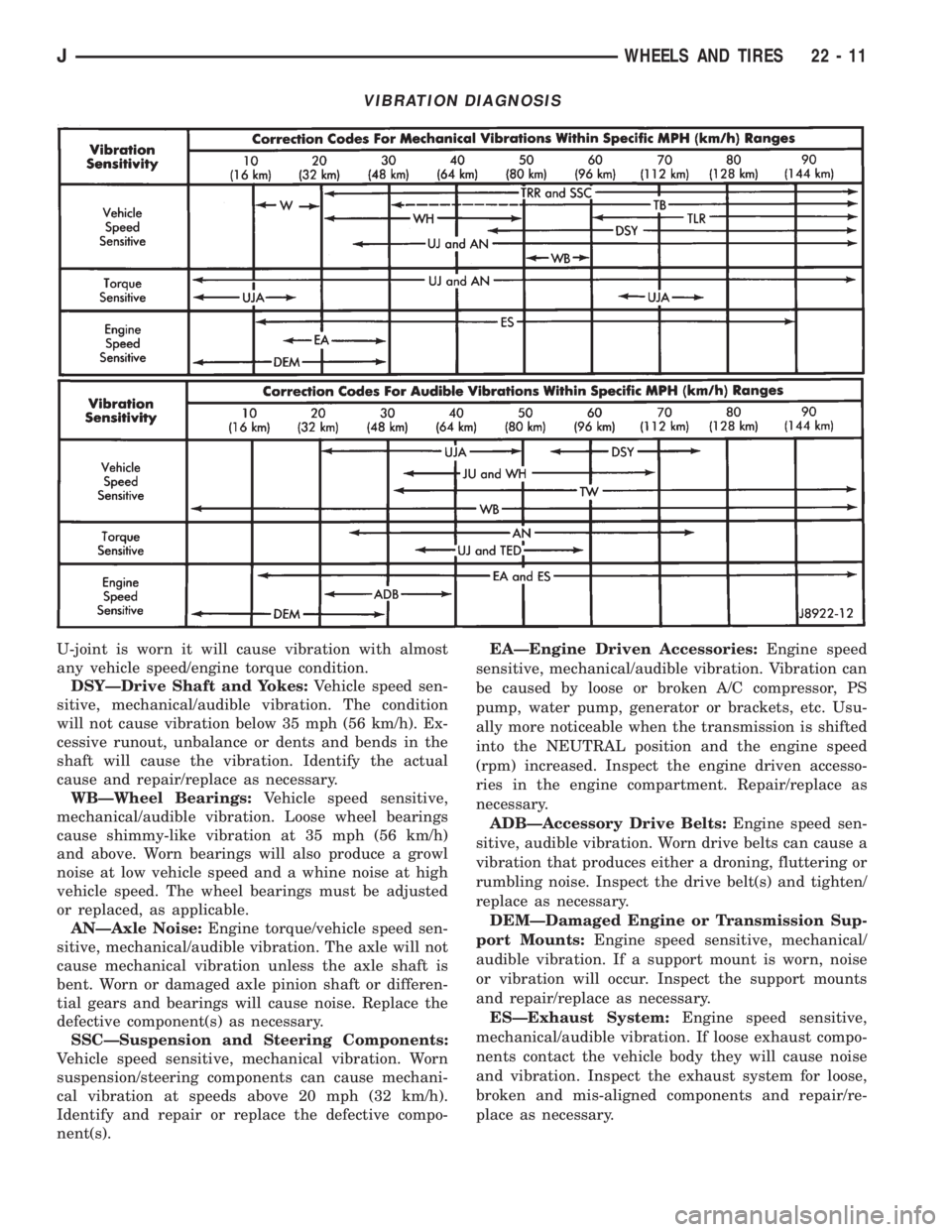
U-joint is worn it will cause vibration with almost
any vehicle speed/engine torque condition.
DSYÐDrive Shaft and Yokes:Vehicle speed sen-
sitive, mechanical/audible vibration. The condition
will not cause vibration below 35 mph (56 km/h). Ex-
cessive runout, unbalance or dents and bends in the
shaft will cause the vibration. Identify the actual
cause and repair/replace as necessary.
WBÐWheel Bearings:Vehicle speed sensitive,
mechanical/audible vibration. Loose wheel bearings
cause shimmy-like vibration at 35 mph (56 km/h)
and above. Worn bearings will also produce a growl
noise at low vehicle speed and a whine noise at high
vehicle speed. The wheel bearings must be adjusted
or replaced, as applicable.
ANÐAxle Noise:Engine torque/vehicle speed sen-
sitive, mechanical/audible vibration. The axle will not
cause mechanical vibration unless the axle shaft is
bent. Worn or damaged axle pinion shaft or differen-
tial gears and bearings will cause noise. Replace the
defective component(s) as necessary.
SSCÐSuspension and Steering Components:
Vehicle speed sensitive, mechanical vibration. Worn
suspension/steering components can cause mechani-
cal vibration at speeds above 20 mph (32 km/h).
Identify and repair or replace the defective compo-
nent(s).EAÐEngine Driven Accessories:Engine speed
sensitive, mechanical/audible vibration. Vibration can
be caused by loose or broken A/C compressor, PS
pump, water pump, generator or brackets, etc. Usu-
ally more noticeable when the transmission is shifted
into the NEUTRAL position and the engine speed
(rpm) increased. Inspect the engine driven accesso-
ries in the engine compartment. Repair/replace as
necessary.
ADBÐAccessory Drive Belts:Engine speed sen-
sitive, audible vibration. Worn drive belts can cause a
vibration that produces either a droning, fluttering or
rumbling noise. Inspect the drive belt(s) and tighten/
replace as necessary.
DEMÐDamaged Engine or Transmission Sup-
port Mounts:Engine speed sensitive, mechanical/
audible vibration. If a support mount is worn, noise
or vibration will occur. Inspect the support mounts
and repair/replace as necessary.
ESÐExhaust System:Engine speed sensitive,
mechanical/audible vibration. If loose exhaust compo-
nents contact the vehicle body they will cause noise
and vibration. Inspect the exhaust system for loose,
broken and mis-aligned components and repair/re-
place as necessary.
VIBRATION DIAGNOSIS
JWHEELS AND TIRES 22 - 11
Page 1839 of 2198
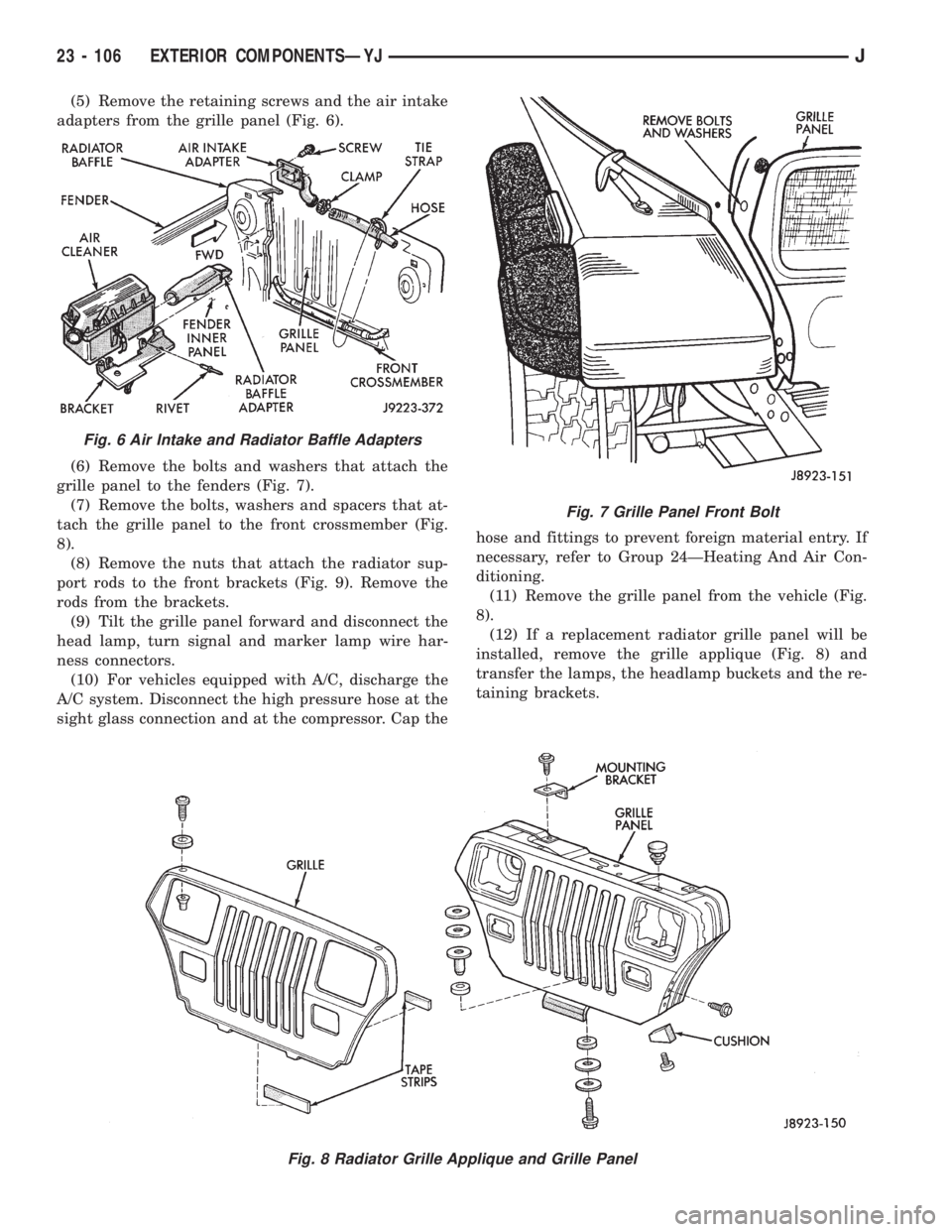
(5) Remove the retaining screws and the air intake
adapters from the grille panel (Fig. 6).
(6) Remove the bolts and washers that attach the
grille panel to the fenders (Fig. 7).
(7) Remove the bolts, washers and spacers that at-
tach the grille panel to the front crossmember (Fig.
8).
(8) Remove the nuts that attach the radiator sup-
port rods to the front brackets (Fig. 9). Remove the
rods from the brackets.
(9) Tilt the grille panel forward and disconnect the
head lamp, turn signal and marker lamp wire har-
ness connectors.
(10) For vehicles equipped with A/C, discharge the
A/C system. Disconnect the high pressure hose at the
sight glass connection and at the compressor. Cap thehose and fittings to prevent foreign material entry. If
necessary, refer to Group 24ÐHeating And Air Con-
ditioning.
(11) Remove the grille panel from the vehicle (Fig.
8).
(12) If a replacement radiator grille panel will be
installed, remove the grille applique (Fig. 8) and
transfer the lamps, the headlamp buckets and the re-
taining brackets.
Fig. 7 Grille Panel Front Bolt
Fig. 8 Radiator Grille Applique and Grille Panel
Fig. 6 Air Intake and Radiator Baffle Adapters
23 - 106 EXTERIOR COMPONENTSÐYJJ
Page 1896 of 2198
HEATING AND AIR CONDITIONING
CONTENTS
page page
COMPONENT SERVICEÐXJ VEHICLES...... 23
COMPONENT SERVICEÐYJ VEHICLES...... 32
COMPRESSOR SERVICE.................. 19
GENERAL INFORMATION.................. 1
HEATING AND AIR CONDITIONING TEST
PROCEDURES......................... 15REFRIGERANT SERVICE AND PERFORMANCE
TEST................................ 11
TORQUE SPECIFICATIONS................ 37
WARNINGS, CAUTIONS AND SERVICE
PRECAUTIONS......................... 9
GENERAL INFORMATION
INDEX
page page
A/C Components.......................... 4
Heater and A/C Operation.................... 1
Manifold Gauge Set........................ 7Refrigerant............................... 7
Refrigerant Equipment...................... 7
HEATER AND A/C OPERATION
HEATERÐXJ
A blend-air heating system is used in XJ vehicles.
The temperature of heated air is controlled by regu-
lating the quantity of air flow through the heater
core. This is accomplished by blending outside air
with heated air from the heater core to obtain the de-
sired discharge temperature. A temperature control
lever on the heater control determines air flow
through the heater core. The lever uses a cable to op-erate the blend-air door. This door controls air flow
through the core. Vacuum motors are used to actuate
and position the remaining door in the system.
On left hand drive (LHD) XJ vehicles a water valve
controls coolant flow to the heater core. The valve is
vacuum operated. When vacuum is applied, the valve
opens and coolant is directed through the heater core
and back to the engine. When the water valve is
closed (no vacuum applied) coolant flow bypasses the
heater core back to the engine.
JHEATING AND AIR CONDITIONING 24 - 1