Torque s JEEP CHEROKEE 2015 KL / 5.G User Guide
[x] Cancel search | Manufacturer: JEEP, Model Year: 2015, Model line: CHEROKEE, Model: JEEP CHEROKEE 2015 KL / 5.GPages: 772, PDF Size: 18.21 MB
Page 347 of 772
the vehicle in a high torque converter slip condition,
such as 4-wheel drive operation (e.g., snow plowing,
off- road operation). If this light comes on, stop the
vehicle and run the engine at idle or faster, with the
transmission in NEUTRAL until the light goes off.
CAUTION!
Continuous driving with the Transmission Tempera-
ture Warning Light illuminated will eventually cause
severe transmission damage or transmission failure.
WARNING!
If you continue operating the vehicle when the
Transmission Temperature Warning Light is illumi-
nated you could cause the fluid to boil over, come in
contact with hot engine or exhaust components and
cause a fire.
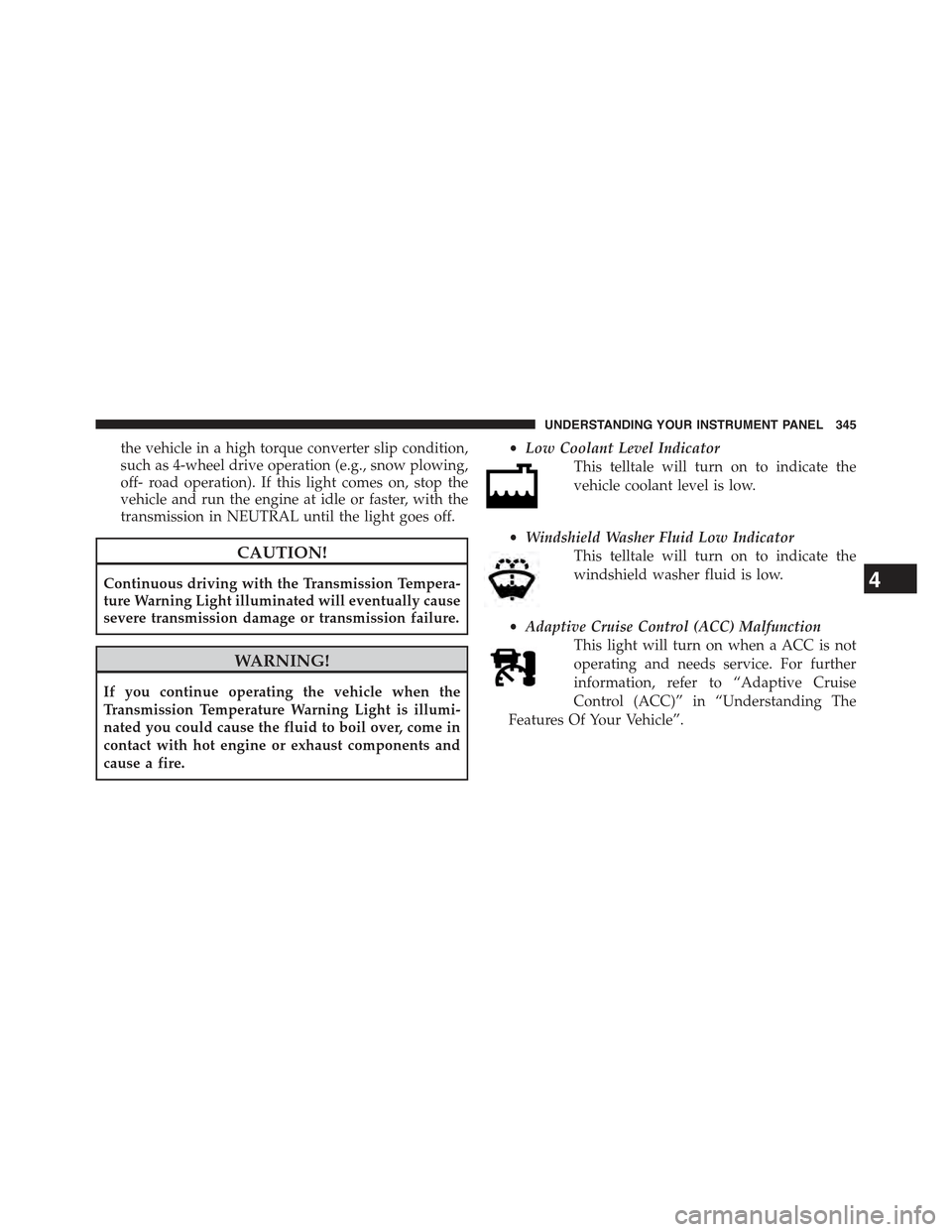
•Low Coolant Level Indicator
This telltale will turn on to indicate the
vehicle coolant level is low.
•Windshield Washer Fluid Low Indicator
This telltale will turn on to indicate the
windshield washer fluid is low.
•Adaptive Cruise Control (ACC) Malfunction
This light will turn on when a ACC is not
operating and needs service. For further
information, refer to “Adaptive Cruise
Control (ACC)” in “Understanding The
Features Of Your Vehicle”.
4
UNDERSTANDING YOUR INSTRUMENT PANEL 345
Page 352 of 772
and rear wheels to rotate at the same speed. Low range
provides a greater gear reduction ratio to provide in-
creased torque at the wheels.
For further information on four-wheel drive operation
and proper use, refer to “Four-Wheel Drive Operation —
If Equipped” in “Starting And Operating”.
15. SERV 4WD Indicator Light — If Equipped
This light alerts the driver that the 4WD is in need of
service. If this light is illuminated, see your authorized
dealer as soon as possible.
16. Temperature Gauge
The temperature gauge shows engine coolant tempera-
ture. Any reading within the normal range indicates that
the engine cooling system is operating satisfactorily.
The gauge pointer will likely indicate a higher tempera-
ture when driving in hot weather, up mountain grades,
or when towing a trailer. It should not be allowed to
exceed the upper limits of the normal operating range.
CAUTION!
Driving with a hot engine cooling system could
damage your vehicle. If the temperature gauge reads
“H” pull over and stop the vehicle. Idle the vehicle
with the air conditioner turned off until the pointer
drops back into the normal range. If the pointer
remains on the “H” and you hear continuous chimes,
turn the engine off immediately and call an autho-
rized dealer for service.
WARNING!
A hot engine cooling system is dangerous. You or
others could be badly burned by steam or boiling
coolant. You may want to call an authorized dealer
for service if your vehicle overheats. If you decide to
look under the hood yourself, see “Maintaining Your
(Continued)
350 UNDERSTANDING YOUR INSTRUMENT PANEL
Page 364 of 772
•Trip B
•Audio Information
•None
Restore To Defaults (Restores All Settings To Default
Settings)
•OK
•Cancel
DRIVER INFORMATION DISPLAY (DID)
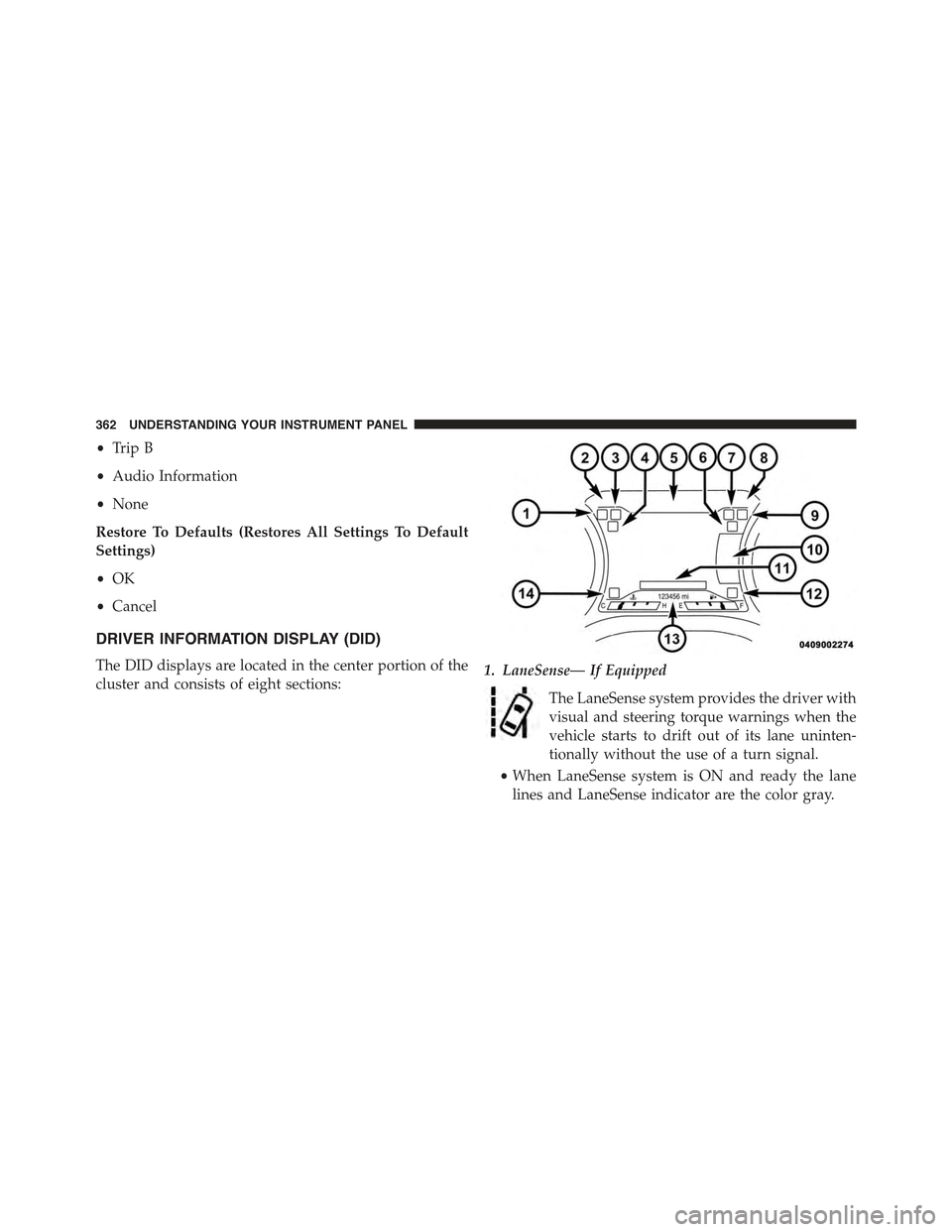
The DID displays are located in the center portion of the
cluster and consists of eight sections:1. LaneSense— If Equipped
The LaneSense system provides the driver with
visual and steering torque warnings when the
vehicle starts to drift out of its lane uninten-
tionally without the use of a turn signal.
•When LaneSense system is ON and ready the lane
lines and LaneSense indicator are the color gray.
362 UNDERSTANDING YOUR INSTRUMENT PANEL
Page 370 of 772
12. Amber Reconfigurable Telltale Display
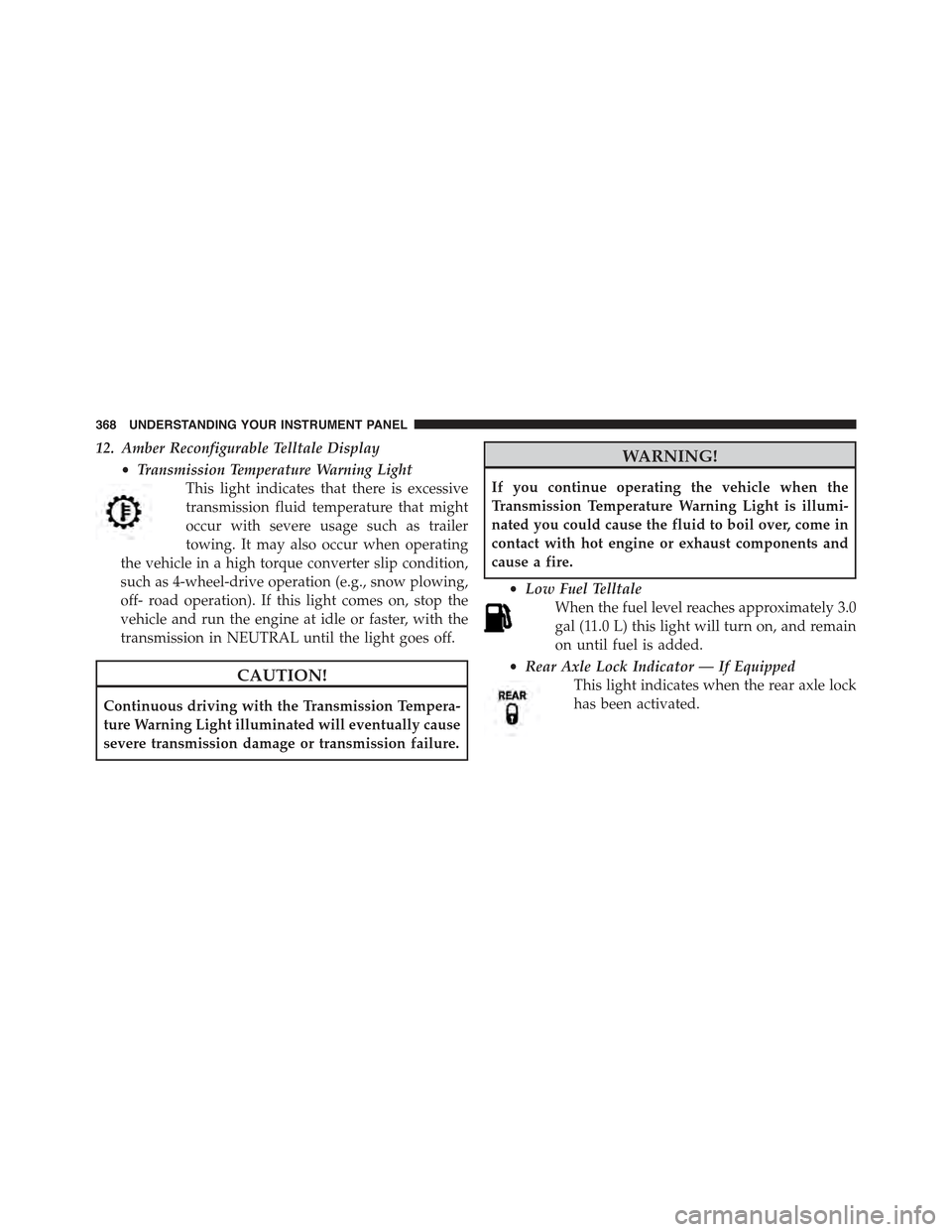
•Transmission Temperature Warning Light
This light indicates that there is excessive
transmission fluid temperature that might
occur with severe usage such as trailer
towing. It may also occur when operating
the vehicle in a high torque converter slip condition,
such as 4-wheel-drive operation (e.g., snow plowing,
off- road operation). If this light comes on, stop the
vehicle and run the engine at idle or faster, with the
transmission in NEUTRAL until the light goes off.
CAUTION!
Continuous driving with the Transmission Tempera-
ture Warning Light illuminated will eventually cause
severe transmission damage or transmission failure.
WARNING!
If you continue operating the vehicle when the
Transmission Temperature Warning Light is illumi-
nated you could cause the fluid to boil over, come in
contact with hot engine or exhaust components and
cause a fire.
•Low Fuel Telltale
When the fuel level reaches approximately 3.0
gal (11.0 L) this light will turn on, and remain
on until fuel is added.
•Rear Axle Lock Indicator — If Equipped
This light indicates when the rear axle lock
has been activated.
368 UNDERSTANDING YOUR INSTRUMENT PANEL
Page 371 of 772
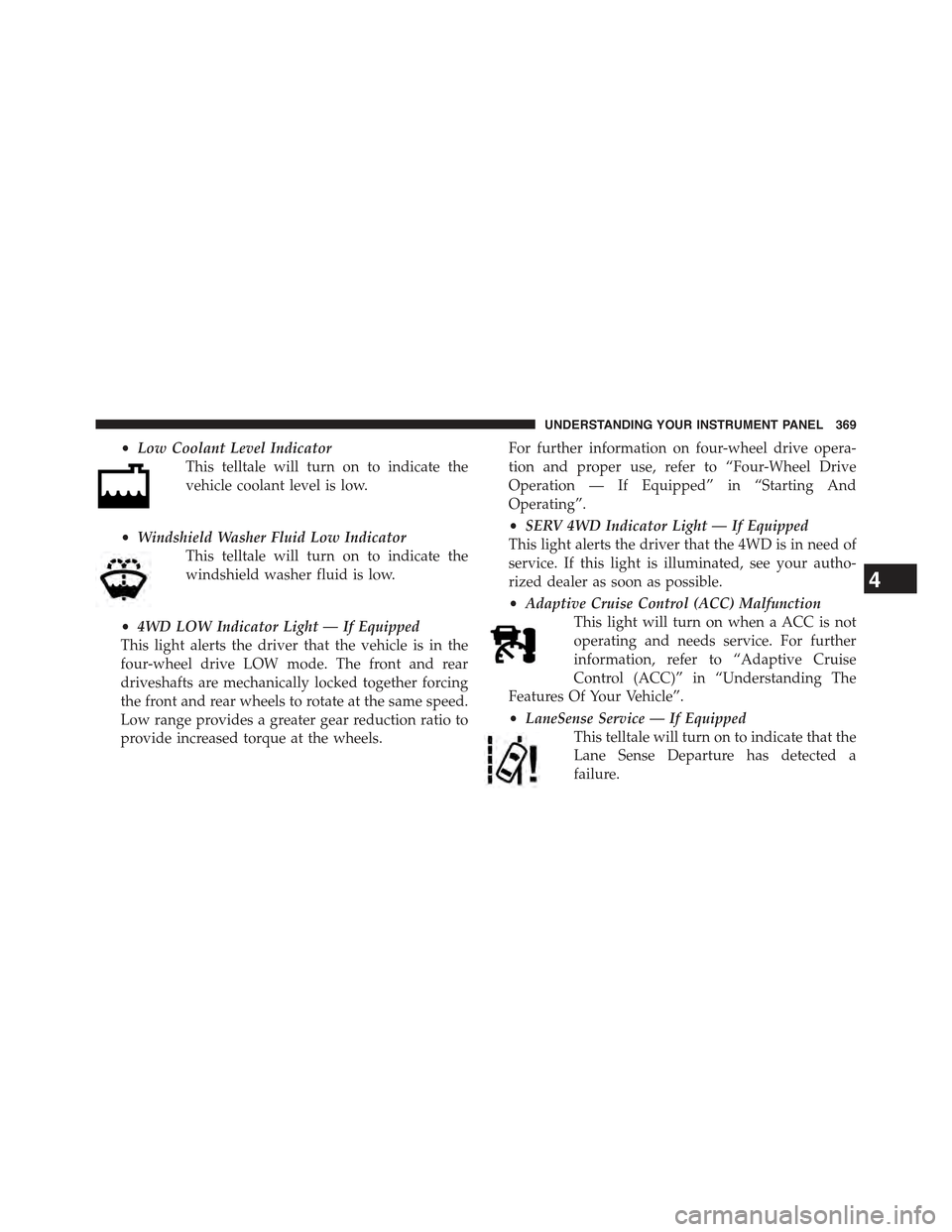
•Low Coolant Level Indicator
This telltale will turn on to indicate the
vehicle coolant level is low.
•Windshield Washer Fluid Low Indicator
This telltale will turn on to indicate the
windshield washer fluid is low.
•4WD LOW Indicator Light — If Equipped
This light alerts the driver that the vehicle is in the
four-wheel drive LOW mode. The front and rear
driveshafts are mechanically locked together forcing
the front and rear wheels to rotate at the same speed.
Low range provides a greater gear reduction ratio to
provide increased torque at the wheels.
For further information on four-wheel drive opera-
tion and proper use, refer to “Four-Wheel Drive
Operation — If Equipped” in “Starting And
Operating”.
•SERV 4WD Indicator Light — If Equipped
This light alerts the driver that the 4WD is in need of
service. If this light is illuminated, see your autho-
rized dealer as soon as possible.
•Adaptive Cruise Control (ACC) Malfunction
This light will turn on when a ACC is not
operating and needs service. For further
information, refer to “Adaptive Cruise
Control (ACC)” in “Understanding The
Features Of Your Vehicle”.
•LaneSense Service — If Equipped
This telltale will turn on to indicate that the
Lane Sense Departure has detected a
failure.
4
UNDERSTANDING YOUR INSTRUMENT PANEL 369
Page 493 of 772
If the transmission temperature exceeds normal operat-
ing limits, the transmission controller may modify the
transmission shift schedule, reduce engine torque,
and/or expand the range of torque converter clutch
engagement. This is done to prevent transmission dam-
age due to overheating.
If the transmission becomes extremely hot, the “Trans-
mission Temperature Warning Light” may illuminate and
the transmission may operate differently until the trans-
mission cools down.
During cold temperatures, transmission operation may
be modified depending on engine and transmission
temperature as well as vehicle speed. This feature im-
proves warm up time of the engine and transmission to
achieve maximum efficiency. Engagement of the torque
converter clutch, and shifts into 8th or 9th gear, are
inhibited until the transmission fluid is warm (refer to the
“Note” under “Torque Converter Clutch” in this section).
Normal operation will resume once the transmission
temperature has risen to a suitable level.
SPORT — IF EQUIPPED
This mode alters the transmission’s automatic shift
schedule for sportier driving. Upshift speeds are in-
creased to make full use of available engine power.
SPORT mode is activated using the rotary switch on the
center console. Refer to#Selec-Terrain#in this section for
further information.
Transmission Limp Home Mode
Transmission function is monitored electronically for
abnormal conditions. If a condition is detected that could
result in transmission damage, Transmission Limp Home
Mode is activated. In this mode, the transmission remains
in fourth gear regardless of which forward gear is
selected. PARK, REVERSE, and NEUTRAL will continue
5
STARTING AND OPERATING 491
Page 495 of 772
Moving the shift lever to the ERS position (beside
DRIVE) will activate ERS mode, display the current gear
in the instrument cluster, and maintain that gear as the
top available gear. Once in ERS mode, moving the shift
lever forward (-) or rearward (+) will change the top
available gear.
To exit ERS mode, simply return the shift lever to the
DRIVE position.
WARNING!
Do not downshift for additional engine braking on a
slippery surface. The drive wheels could lose their
grip and the vehicle could skid, causing a collision or
personal injury.
NOTE:To select the proper gear position for maximum
deceleration (engine braking), move the shift lever into
the ERS position, then simply press and hold it forward
(-). The transmission will shift to the range from which
the vehicle can best be slowed down.
Torque Converter Clutch
A feature designed to improve fuel economy has been
included in the automatic transmission on your vehicle.
A clutch within the torque converter engages automati-
cally at calibrated speeds. This may result in a slightly
different feeling or response during normal operation in
the upper gears. When the vehicle speed drops or during
some accelerations, the clutch automatically disengages.
5
STARTING AND OPERATING 493
Page 496 of 772
![JEEP CHEROKEE 2015 KL / 5.G User Guide NOTE:The torque converter clutch will not engage until
the transmission fluid is warm (usually after 1 to 3 miles
[2 to 5 km] of driving). Because the engine speed is higher
when the torque converter](/img/16/7057/w960_7057-495.png "JEEP CHEROKEE 2015 KL / 5.G User Guide NOTE:The torque converter clutch will not engage until
the transmission fluid is warm (usually after 1 to 3 miles
[2 to 5 km] of driving). Because the engine speed is higher
when the torque converter")
NOTE:The torque converter clutch will not engage until
the transmission fluid is warm (usually after 1 to 3 miles
[2 to 5 km] of driving). Because the engine speed is higher
when the torque converter clutch is not engaged, it may
seem as if the transmission is not shifting properly when
cold, this is normal. The torque converter clutch will
function normally once the transmission is sufficiently
warm.
FOUR-WHEEL DRIVE OPERATION
1-Speed Four-Wheel Drive (4X4) — If Equipped
This feature provides on-demand four-wheel drive (4X4).
The system is automatic with no driver inputs or addi-
tional driving skills required. Under normal driving
conditions, the front wheels provide most of the traction.
If the front wheels begin to lose traction, power is shifted
automatically to the rear wheels. The greater the front
wheel traction loss, the greater the power transfer to the
rear wheels.
1-Speed 4X4 Switch
494 STARTING AND OPERATING
Page 497 of 772
Additionally, on dry pavement under heavy throttle
input (where one may have no wheel spin), torque will be
sent to the rear in a pre-emptive effort to improve vehicle
launch and performance characteristics.
CAUTION!
All wheels must have the same size and type tires.
Unequal tire sizes must not be used. Unequal tire
size may cause failure of the power transfer unit.
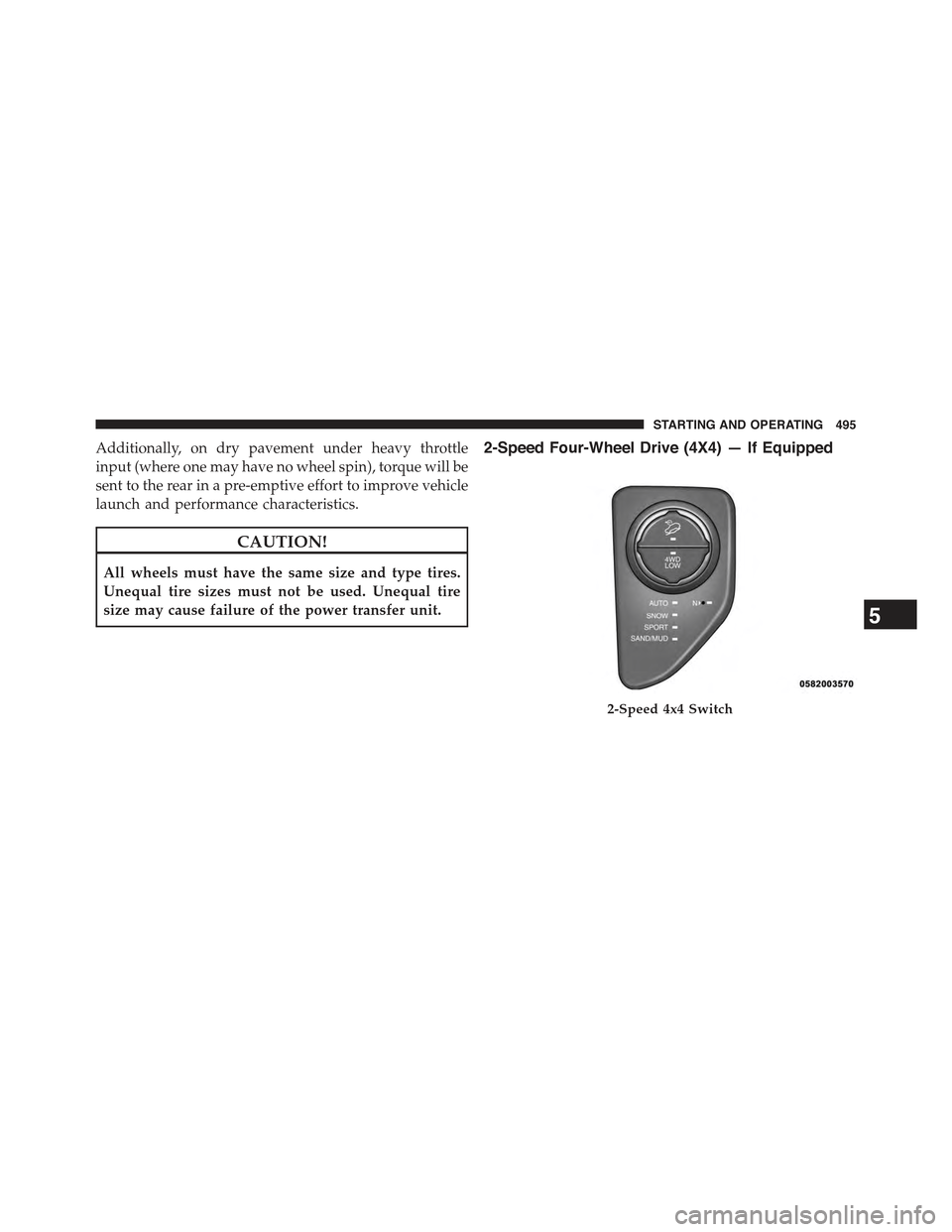
2-Speed Four-Wheel Drive (4X4) — If Equipped
2-Speed 4x4 Switch
5
STARTING AND OPERATING 495
Page 498 of 772
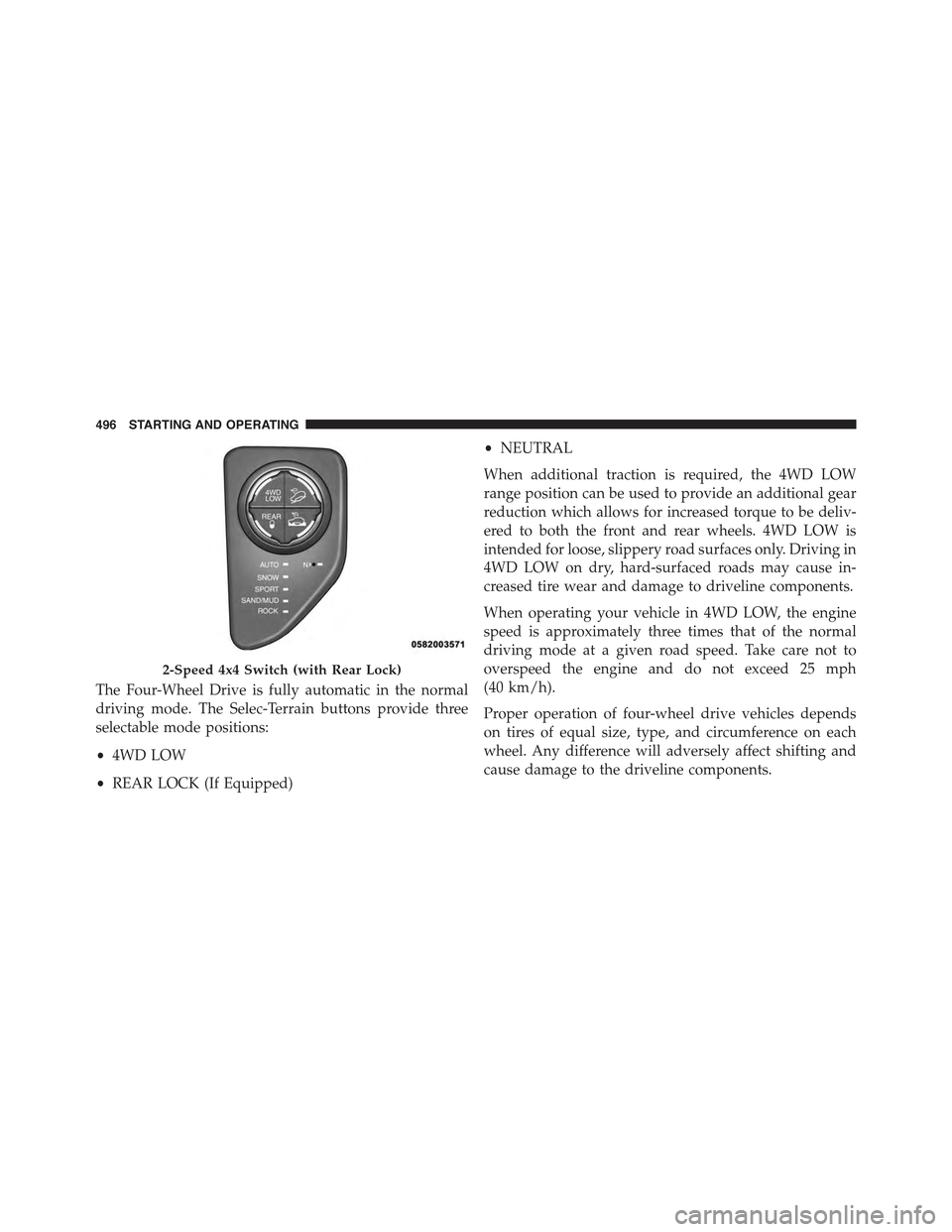
The Four-Wheel Drive is fully automatic in the normal
driving mode. The Selec-Terrain buttons provide three
selectable mode positions:
•4WD LOW
•REAR LOCK (If Equipped)
•NEUTRAL
When additional traction is required, the 4WD LOW
range position can be used to provide an additional gear
reduction which allows for increased torque to be deliv-
ered to both the front and rear wheels. 4WD LOW is
intended for loose, slippery road surfaces only. Driving in
4WD LOW on dry, hard-surfaced roads may cause in-
creased tire wear and damage to driveline components.
When operating your vehicle in 4WD LOW, the engine
speed is approximately three times that of the normal
driving mode at a given road speed. Take care not to
overspeed the engine and do not exceed 25 mph
(40 km/h).
Proper operation of four-wheel drive vehicles depends
on tires of equal size, type, and circumference on each
wheel. Any difference will adversely affect shifting and
cause damage to the driveline components.
2-Speed 4x4 Switch (with Rear Lock)
496 STARTING AND OPERATING