spare tire JEEP CHEROKEE 2015 KL / 5.G User Guide
[x] Cancel search | Manufacturer: JEEP, Model Year: 2015, Model line: CHEROKEE, Model: JEEP CHEROKEE 2015 KL / 5.GPages: 772, PDF Size: 18.21 MB
Page 568 of 772
CAUTION!
To avoid damage to your vehicle or tires, observe the
following precautions:
•Because of restricted traction device clearance be-
tween tires and other suspension components, it is
important that only traction devices in good condi-
tion are used. Broken devices can cause serious
damage. Stop the vehicle immediately if noise
occurs that could indicate device breakage. Remove
the damaged parts of the device before further use.
•Install device as tightly as possible and then re-
tighten after driving about½mile (0.8 km).
•Do not exceed 30 mph (48 km/h).
•Drive cautiously and avoid severe turns and large
bumps, especially with a loaded vehicle.
•Do not drive for a prolonged period on dry pave-
ment.
(Continued)
CAUTION!(Continued)
•Observe the traction device manufacturer ’s instruc-
tions on the method of installation, operating
speed, and conditions for use. Always use the
suggested operating speed of the device manufac-
turer ’s if it is less than 30 mph (48 km/h).
•Do not use traction devices on a compact spare tire.
TIRE ROTATION RECOMMENDATIONS
The tires on the front and rear of your vehicle operate at
different loads and perform different steering, handling,
and braking functions. For these reasons, they wear at
unequal rates.
These effects can be reduced by timely rotation of tires.
The benefits of rotation are especially worthwhile with
aggressive tread designs such as those on On/Off Road
566 STARTING AND OPERATING
Page 575 of 772
NOTE:When filling warm tires, the tire pressure may
need to be increased up to an additional 4 psi (30 kPa)
above the recommended cold placard pressure in order
to turn the Tire Pressure Monitoring Telltale Light off.
The vehicle may need to be driven for up to 20 minutes
above 15 mph (24 km/h) in order for the TPMS to receive
this information.
Service TPMS Warning
When a system fault is detected, the “Tire Pressure
Monitoring Telltale Light” will flash on and off for 75
seconds and then remain on solid. The system fault will
also sound a chime. If the ignition is cycled, this sequence
will repeat, providing the system fault still exists. The
“Tire Pressure Monitoring Telltale Light” will turn off
when the fault condition no longer exists. A system fault
can occur due to any of the following:
1. Jamming due to electronic devices or driving next to
facilities emitting the same radio frequencies as the
TPMS sensors.
2. Installing some form of aftermarket window tinting
that affects radio wave signals.
3. Lots of snow or ice around the wheels or wheel
housings.
4. Using tire chains on the vehicle.
5. Using wheels/tires not equipped with TPMS sensors.
Vehicles With Compact Spare or non-Matching Full
Size Spare
1. The compact spare tire or non-matching full size spare
tire does not have a tire pressure monitoring sensor.
Therefore, the TPMS will not monitor the pressure in
the spare tire.
5
STARTING AND OPERATING 573
Page 576 of 772
2. If you install the compact or non-matching full size
spare tire in place of a road tire that has a pressure
below the low-pressure warning limit, a chime will
sound and the “TPMS Telltale Light” and “LOW TIRE
PRESSURE” and#Inflate to XX#messages will turn on
upon the next ignition cycle.
3. After driving the vehicle for up to 20 minutes above
15 mph (24 km/h), the “TPMS Telltale Light” will
flash on and off for 75 seconds and then remain on
solid.
4. For each subsequent ignition cycle, a chime will sound
and the “TPMS Telltale Light” will flash on and off for
75 seconds and then remain on solid.
5. Once you repair or replace the original road tire and
reinstall it on the vehicle in place of the compact spare
or non-matching full size spare, the TPMS will update
automatically and the “TPMS Telltale Light” will turn
off, as long as no tire pressure is below the low-
pressure warning limit in any of the four active road
tires. The vehicle may need to be driven for up to 20
minutes above 15 mph (24 km/h) in order for the
TPMS to receive this information.
Premium System — If Equipped
The Tire Pressure Monitor System (TPMS) uses wireless
technology with wheel rim mounted electronic sensors to
monitor tire pressure levels. Sensors, mounted to each
wheel as part of the valve stem, transmit tire pressure
readings to the receiver module.
NOTE:It is particularly important for you to check the
tire pressure in all of the tires on your vehicle monthly
and to maintain the proper pressure.
The TPMS consists of the following components:
•Receiver Module
•Four Tire Pressure Monitoring Sensors
574 STARTING AND OPERATING
Page 579 of 772
SYSTEM” message will no longer display, and a pressure
value will display in place of the dashes. A system fault
can occur due to any of the following:
1. Jamming due to electronic devices or driving next to
facilities emitting the same radio frequencies as the
TPMS sensors.
2. Installing some form of aftermarket window tinting
that affects radio wave signals.
3. Lots of snow or ice around the wheels or wheel
housings.
4. Using tire chains on the vehicle.
5. Using wheels/tires not equipped with TPMS sensors.
Vehicles With Matching Full-Size Spare
1. The matching full size spare wheel and tire assembly
has a tire pressure monitoring sensor that can be
monitored by the TPMS.
2. If you install the full size spare in place of a road tire
that has a pressure below the low-pressure warning
limit, a chime will sound and the “TPMS Telltale
Light” will turn on upon the next ignition key cycle. In
addition, the EVIC/DID will display a Tire Low
message, an#Inflate to XX#message and a graphic
showing the low tire pressure value in a different
color.
3. After driving the vehicle for up to 20 minutes above
15.5 mph (25 km/h) the “TPMS Telltale Light” will
turn OFF, as long as no tire pressure is below the
low-pressure warning limit in any of the four active
road tires.
4. The EVIC/DID will display a graphic showing the tire
pressure value in the same color as the other pressure
values in place of the different color low tire pressure
5
STARTING AND OPERATING 577
Page 580 of 772

value. The EVIC/DID will also display a “SPARE
LOW PRESSURE” message to remind you to service
the flat tire.
Vehicles With Compact Spare or Non-Matching Full
Size Spare
1. The compact spare tire or non-matching full size does
not have a tire pressure monitoring sensor. Therefore,
the TPMS will not monitor the pressure in the compact
spare tire.
2. If you install the compact or non-matching full size
spare tire in place of a road tire that has a pressure
below the low-pressure warning limit, upon the next
ignition key cycle, the “TPMS Telltale Light” will
remain on and a chime will sound. In addition, the
graphic in the EVIC/DID will still display a different
color pressure value and an#Inflate to XX#message.
3. After driving the vehicle for up to 20 minutes above
15.5 mph (25 km/h), the “TPMS Telltale Light” will
flash on and off for 75 seconds and then remain on
solid. In addition, the EVIC/DID will display a “SER-
VICE TPM SYSTEM” message for five seconds and
then display dashes (- -) in place of the pressure value.
4. For each subsequent ignition key cycle, a chime will
sound, the “TPMS Telltale Light” will flash on and off
for 75 seconds and then remain on solid, and the
EVIC/DID will display a “SERVICE TPM SYSTEM”
message for five seconds and then display dashes (- -)
in place of the pressure value.
5. Once you repair or replace the original road tire and
reinstall it on the vehicle in place of the compact spare
or non-matching full size, the TPMS will update
automatically. In addition, the “TPMS Telltale Light”
will turn off and the graphic in the EVIC will display
a new pressure value instead of dashes (- -), as long as
578 STARTING AND OPERATING
Page 603 of 772
WARNING!(Continued)
•Vehicles with trailers should not be parked on a
grade. When parking, apply the parking brake on
the tow vehicle. Put the tow vehicle transmission in
PARK. Always, block or%chock%the trailer wheels.
•GCWR must not be exceeded.
•Total weight must be distributed between the tow
vehicle and the trailer such that the following four
ratings are not exceeded:
1. GVWR
2. GTW
3. GAWR
4. Tongue weight rating for the trailer hitch uti-
lized.
CAUTION!
•Do not tow a trailer at all during the first 500 miles
(805 km) the new vehicle is driven. The engine, axle
or other parts could be damaged.
•Then, during the first 500 miles (805 km) that a
trailer is towed, do not drive over 50 mph (80 km/h)
and do not make starts at full throttle. This helps
the engine and other parts of the vehicle wear in at
the heavier loads.
Towing Requirements — Tires
•Do not attempt to tow a trailer while using a compact
spare tire.
•Proper tire inflation pressures are essential to the safe
and satisfactory operation of your vehicle. Refer to
“Tires – General Information” in “Starting And Oper-
ating” for proper tire inflation procedures.
5
STARTING AND OPERATING 601
Page 615 of 772
WHAT TO DO IN EMERGENCIES
CONTENTS
!HAZARD WARNING FLASHERS...........615
!IF YOUR ENGINE OVERHEATS............615
!WHEEL AND TIRE TORQUE
SPECIFICATIONS......................616
▫Torque Specifications..................616
!TIRE SERVICE KIT — IF EQUIPPED.........618
▫Tire Service Kit Storage.................618
▫Tire Service Kit Components And Operation . .619
▫Tire Service Kit Usage Precautions..........620
▫Sealing A Tire With Tire Service Kit.........622
!JACKING AND TIRE CHANGING..........628
▫Jack Location/Spare Tire Stowage.........629
▫Preparations For Jacking................631
▫Jacking Instructions...................632
▫Road Tire Installation...................639
!JUMP-STARTING PROCEDURES...........640
▫Preparations For Jump-Start..............641
▫Jump-Starting Procedure................642
!FREEING A STUCK VEHICLE.............644
!RECOVERY STRAP — IF EQUIPPED.........646
6
Page 631 of 772
WARNING!(Continued)
•The jack is designed to be used as a tool for
changing tires only. The jack should not be used to
lift the vehicle for service purposes. The vehicle
should be jacked on a firm level surface only.
Avoid ice or slippery areas.
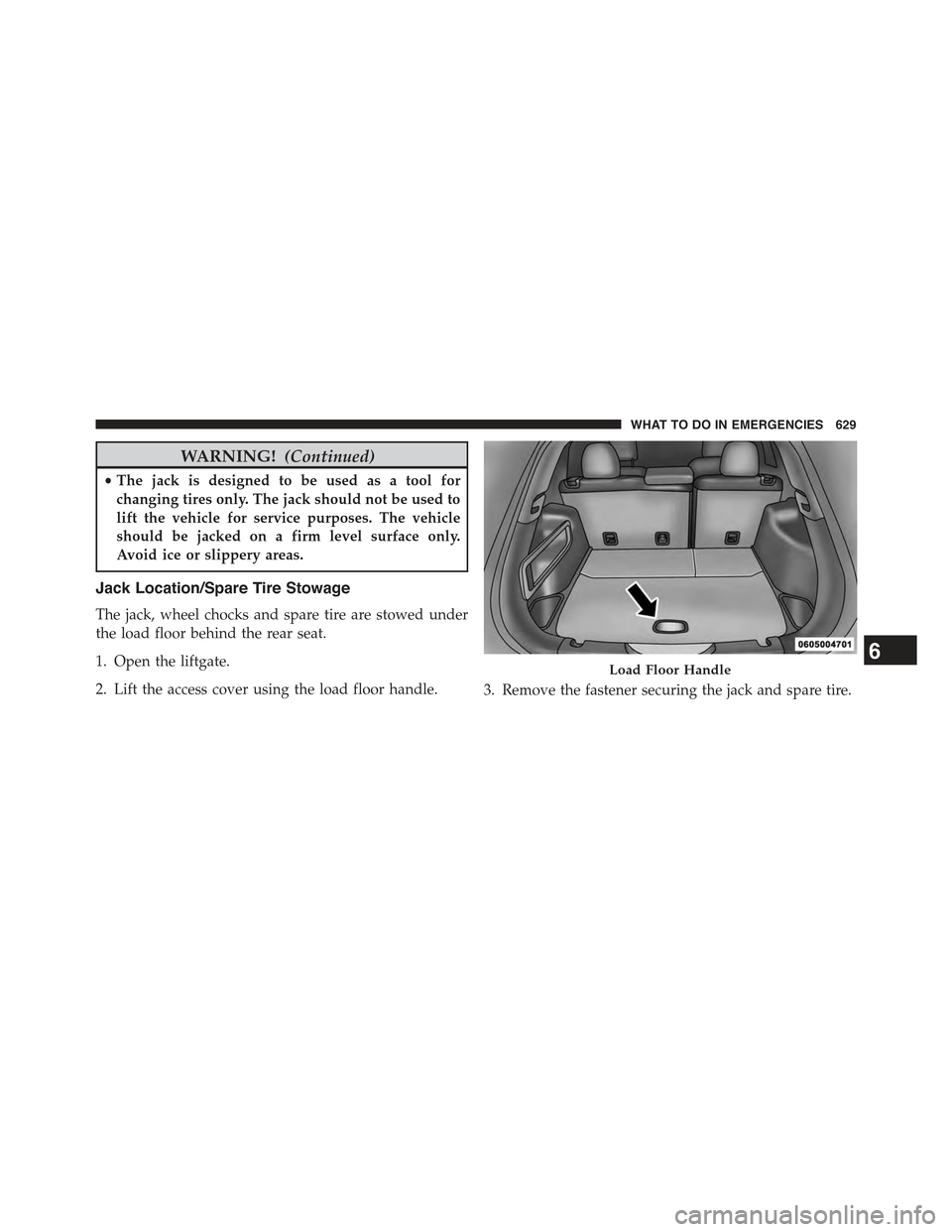
Jack Location/Spare Tire Stowage
The jack, wheel chocks and spare tire are stowed under
the load floor behind the rear seat.
1. Open the liftgate.
2. Lift the access cover using the load floor handle.3. Remove the fastener securing the jack and spare tire.
Load Floor Handle6
WHAT TO DO IN EMERGENCIES 629
Page 632 of 772
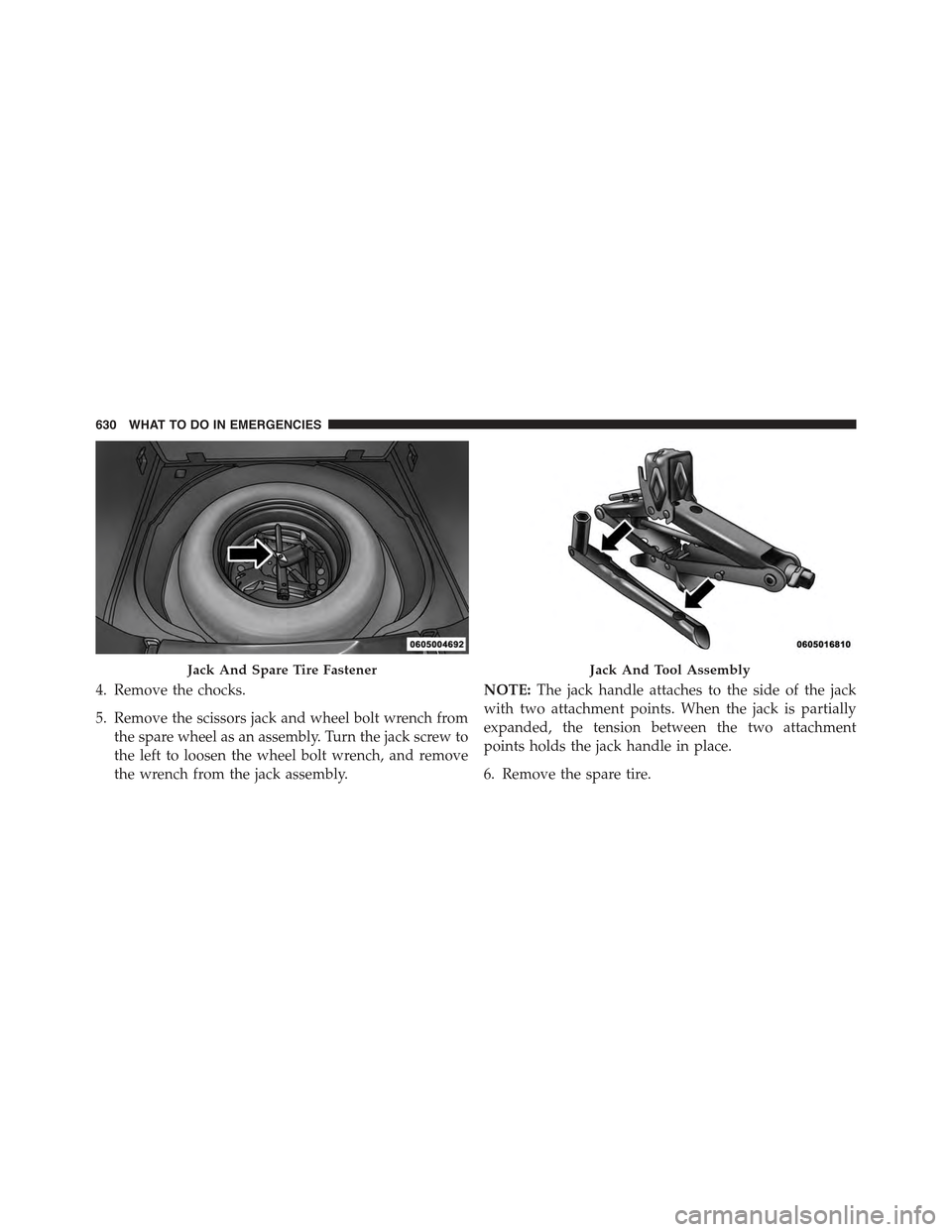
4. Remove the chocks.
5. Remove the scissors jack and wheel bolt wrench from
the spare wheel as an assembly. Turn the jack screw to
the left to loosen the wheel bolt wrench, and remove
the wrench from the jack assembly.
NOTE:The jack handle attaches to the side of the jack
with two attachment points. When the jack is partially
expanded, the tension between the two attachment
points holds the jack handle in place.
6. Remove the spare tire.
Jack And Spare Tire FastenerJack And Tool Assembly
630 WHAT TO DO IN EMERGENCIES
Page 633 of 772
WARNING!
A loose tire or jack thrown forward in a collision or
hard stop could endanger the occupants of the ve-
hicle. Always stow the jack parts and the spare tire in
the places provided. Have the deflated (flat) tire
repaired or replaced immediately.
Preparations For Jacking
1. Park the vehicle on a firm level surface as far from the
edge of the roadway as possible. Avoid icy or slippery
areas.
WARNING!
Do not attempt to change a tire on the side of the
vehicle close to moving traffic, pull far enough off
the road to avoid being hit when operating the jack
or changing the wheel.
2. Turn on the Hazard Warning flasher.
3. Set the parking brake.
4. Place the shift lever into PARK (automatic transmis-
sion) or REVERSE (manual transmission).
5. Turn the ignition off to the LOCK position.
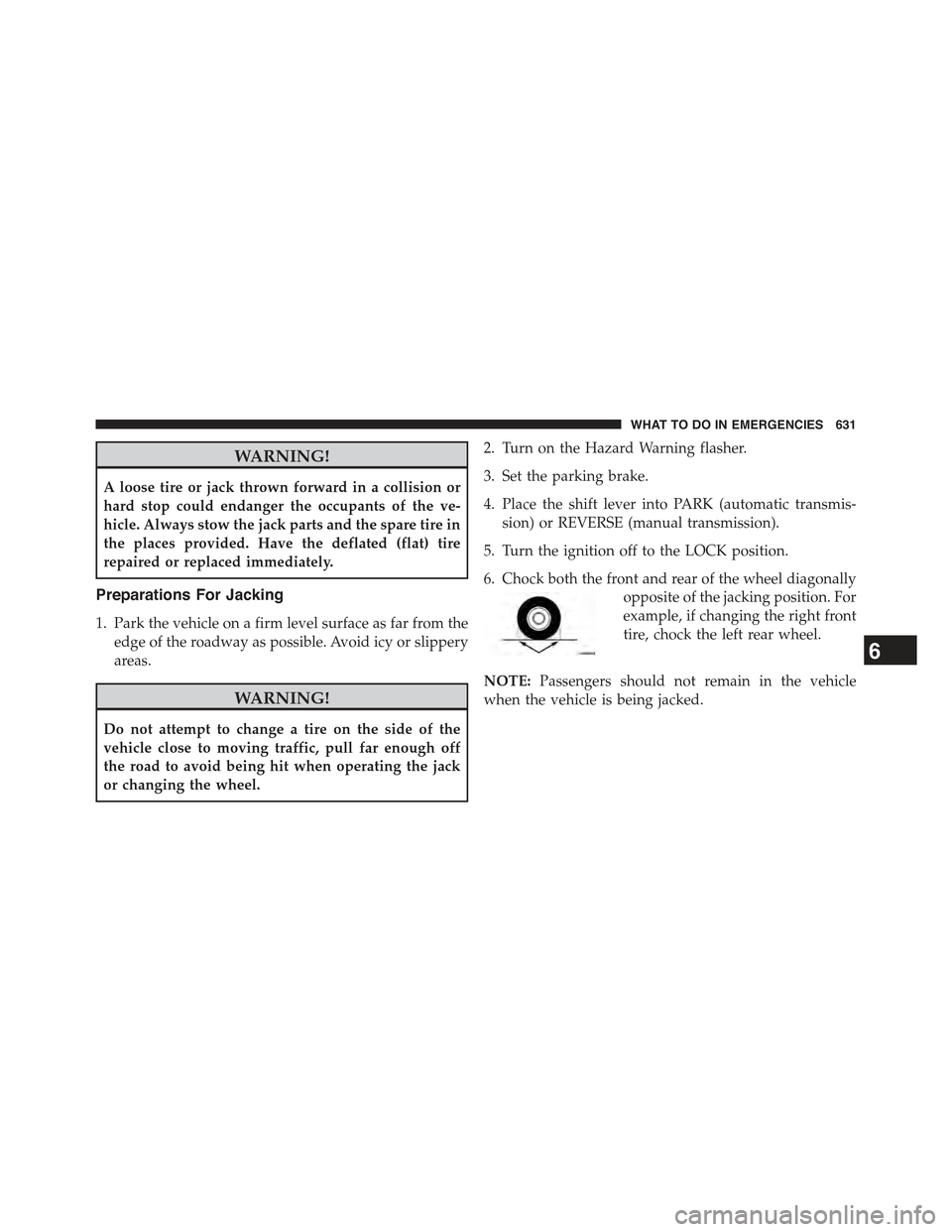
6. Chock both the front and rear of the wheel diagonally
opposite of the jacking position. For
example, if changing the right front
tire, chock the left rear wheel.
NOTE:Passengers should not remain in the vehicle
when the vehicle is being jacked.
6
WHAT TO DO IN EMERGENCIES 631