Transmission JEEP CHEROKEE 2015 KL / 5.G Workshop Manual
[x] Cancel search | Manufacturer: JEEP, Model Year: 2015, Model line: CHEROKEE, Model: JEEP CHEROKEE 2015 KL / 5.GPages: 772, PDF Size: 18.21 MB
Page 491 of 772
CAUTION!
•Before moving the shift lever out of PARK, you
must turn the ignition switch from the LOCK/OFF
position to the ON/RUN position, and also press
the brake pedal. Otherwise, damage to the shift
lever could result.
•DO NOT race the engine when shifting from
PARK or NEUTRAL into another gear range, as this
can damage the drivetrain.
The following indicators should be used to ensure that
you have engaged the transmission into the PARK posi-
tion:
•When shifting into PARK, press the lock button on the
shift lever and firmly move the lever all the way
forward until it stops and is fully seated.
•Look at the transmission gear position display and
verify that it indicates the PARK position (P).
•With brake pedal released, verify that the shift lever
will not move out of PARK.
REVERSE (R)
This range is for moving the vehicle backward. Shift into
REVERSE only after the vehicle has come to a complete
stop.
NEUTRAL (N)
Use this range when the vehicle is standing for prolonged
periods with the engine running. The engine may be
started in this range. Apply the parking brake and shift
the transmission into PARK if you must leave the vehicle.
5
STARTING AND OPERATING 489
Page 492 of 772
WARNING!
Do not coast in NEUTRAL and never turn off the
ignition to coast down a hill. These are unsafe
practices that limit your response to changing traffic
or road conditions. You might lose control of the
vehicle and have a collision.
CAUTION!
Towing the vehicle, coasting, or driving for any other
reason with the transmission in NEUTRAL can cause
severe transmission damage. Refer to “Recreational
Towing” in “Starting And Operating” and “Towing A
Disabled Vehicle” in “What To Do In Emergencies”
for further information.
DRIVE (D)
This range should be used for most city and highway
driving. It provides the smoothest upshifts and down-
shifts, and the best fuel economy. The transmission
automatically upshifts through all forward gears. The
DRIVE position provides optimum driving characteris-
tics under all normal operating conditions.
When frequent transmission shifting occurs (such as
when operating the vehicle under heavy loading condi-
tions, in hilly terrain, traveling into strong head winds, or
while towing heavy trailers), use the Electronic Range
Select (ERS) shift control (refer to#Electronic Range Select
(ERS) Operation#in this section for further information)
to select a lower gear range. Under these conditions,
using a lower gear range will improve performance and
extend transmission life by reducing excessive shifting
and heat buildup.
490 STARTING AND OPERATING
Page 493 of 772
If the transmission temperature exceeds normal operat-
ing limits, the transmission controller may modify the
transmission shift schedule, reduce engine torque,
and/or expand the range of torque converter clutch
engagement. This is done to prevent transmission dam-
age due to overheating.
If the transmission becomes extremely hot, the “Trans-
mission Temperature Warning Light” may illuminate and
the transmission may operate differently until the trans-
mission cools down.
During cold temperatures, transmission operation may
be modified depending on engine and transmission
temperature as well as vehicle speed. This feature im-
proves warm up time of the engine and transmission to
achieve maximum efficiency. Engagement of the torque
converter clutch, and shifts into 8th or 9th gear, are
inhibited until the transmission fluid is warm (refer to the
“Note” under “Torque Converter Clutch” in this section).
Normal operation will resume once the transmission
temperature has risen to a suitable level.
SPORT — IF EQUIPPED
This mode alters the transmission’s automatic shift
schedule for sportier driving. Upshift speeds are in-
creased to make full use of available engine power.
SPORT mode is activated using the rotary switch on the
center console. Refer to#Selec-Terrain#in this section for
further information.
Transmission Limp Home Mode
Transmission function is monitored electronically for
abnormal conditions. If a condition is detected that could
result in transmission damage, Transmission Limp Home
Mode is activated. In this mode, the transmission remains
in fourth gear regardless of which forward gear is
selected. PARK, REVERSE, and NEUTRAL will continue
5
STARTING AND OPERATING 491
Page 494 of 772
to operate. The Malfunction Indicator Light (MIL) may be
illuminated. Limp Home Mode allows the vehicle to be
driven to an authorized dealer for service without dam-
aging the transmission.
In the event of a momentary problem, the transmission
can be reset to regain all forward gears by performing the
following steps:
1. Stop the vehicle.
2. Shift the transmission into PARK.
3. Turn the ignition switch to the OFF position.
4. Wait approximately 10 seconds.
5. Restart the engine.
6. Shift into the desired gear range. If the problem is no
longer detected, the transmission will return to normal
operation.
NOTE:Even if the transmission can be reset, we recom-
mend that you visit your authorized dealer at your
earliest possible convenience. Your authorized dealer has
diagnostic equipment to determine if the problem could
recur. If the transmission cannot be reset, authorized
dealer service is required.
Electronic Range Select (ERS) Operation
The Electronic Range Select (ERS) shift control allows the
driver to limit the highest available gear. For example, if
you shift the transmission into 5 (fifth gear), the trans-
mission will not shift above fifth gear, but will shift
through the lower gears normally.
You can switch between DRIVE and ERS mode at any
vehicle speed. When the shift lever is in the DRIVE
position, the transmission will operate automatically,
shifting between all available gears.
492 STARTING AND OPERATING
Page 495 of 772
Moving the shift lever to the ERS position (beside
DRIVE) will activate ERS mode, display the current gear
in the instrument cluster, and maintain that gear as the
top available gear. Once in ERS mode, moving the shift
lever forward (-) or rearward (+) will change the top
available gear.
To exit ERS mode, simply return the shift lever to the
DRIVE position.
WARNING!
Do not downshift for additional engine braking on a
slippery surface. The drive wheels could lose their
grip and the vehicle could skid, causing a collision or
personal injury.
NOTE:To select the proper gear position for maximum
deceleration (engine braking), move the shift lever into
the ERS position, then simply press and hold it forward
(-). The transmission will shift to the range from which
the vehicle can best be slowed down.
Torque Converter Clutch
A feature designed to improve fuel economy has been
included in the automatic transmission on your vehicle.
A clutch within the torque converter engages automati-
cally at calibrated speeds. This may result in a slightly
different feeling or response during normal operation in
the upper gears. When the vehicle speed drops or during
some accelerations, the clutch automatically disengages.
5
STARTING AND OPERATING 493
Page 496 of 772
![JEEP CHEROKEE 2015 KL / 5.G Workshop Manual NOTE:The torque converter clutch will not engage until
the transmission fluid is warm (usually after 1 to 3 miles
[2 to 5 km] of driving). Because the engine speed is higher
when the torque converter](/img/16/7057/w960_7057-495.png "JEEP CHEROKEE 2015 KL / 5.G Workshop Manual NOTE:The torque converter clutch will not engage until
the transmission fluid is warm (usually after 1 to 3 miles
[2 to 5 km] of driving). Because the engine speed is higher
when the torque converter")
NOTE:The torque converter clutch will not engage until
the transmission fluid is warm (usually after 1 to 3 miles
[2 to 5 km] of driving). Because the engine speed is higher
when the torque converter clutch is not engaged, it may
seem as if the transmission is not shifting properly when
cold, this is normal. The torque converter clutch will
function normally once the transmission is sufficiently
warm.
FOUR-WHEEL DRIVE OPERATION
1-Speed Four-Wheel Drive (4X4) — If Equipped
This feature provides on-demand four-wheel drive (4X4).
The system is automatic with no driver inputs or addi-
tional driving skills required. Under normal driving
conditions, the front wheels provide most of the traction.
If the front wheels begin to lose traction, power is shifted
automatically to the rear wheels. The greater the front
wheel traction loss, the greater the power transfer to the
rear wheels.
1-Speed 4X4 Switch
494 STARTING AND OPERATING
Page 499 of 772
Because four-wheel drive provides improved traction,
there is a tendency to exceed safe turning and stopping
speeds. Do not go faster than road conditions permit.
Shift Positions
For additional information on the appropriate use of each
4WD system mode position, see the information below:
NEUTRAL
This range disengages the driveline from the powertrain.
It is to be used for flat towing behind another vehicle.
Refer to “Recreational Towing” in “Starting and Operat-
ing” for further information.
WARNING!
You or others could be injured or killed if you leave
the vehicle unattended with the power transfer unit
(Continued)
WARNING!(Continued)
in the NEUTRAL (N) position without first fully
engaging the parking brake. The NEUTRAL (N)
position disengages both the front and rear drive
shafts from the powertrain and will allow the vehicle
to roll, even if the transmission is in PARK. The
parking brake should always be applied when the
driver is not in the vehicle.
4WD LOW
This range is for low speed four-wheel drive. It provides
an additional gear reduction which allows for increased
torque to be delivered to both the front and rear wheels
while providing maximum pulling power for loose,
slippery road surfaces only. Do not exceed 25 mph
(40 km/h).
5
STARTING AND OPERATING 497
Page 500 of 772
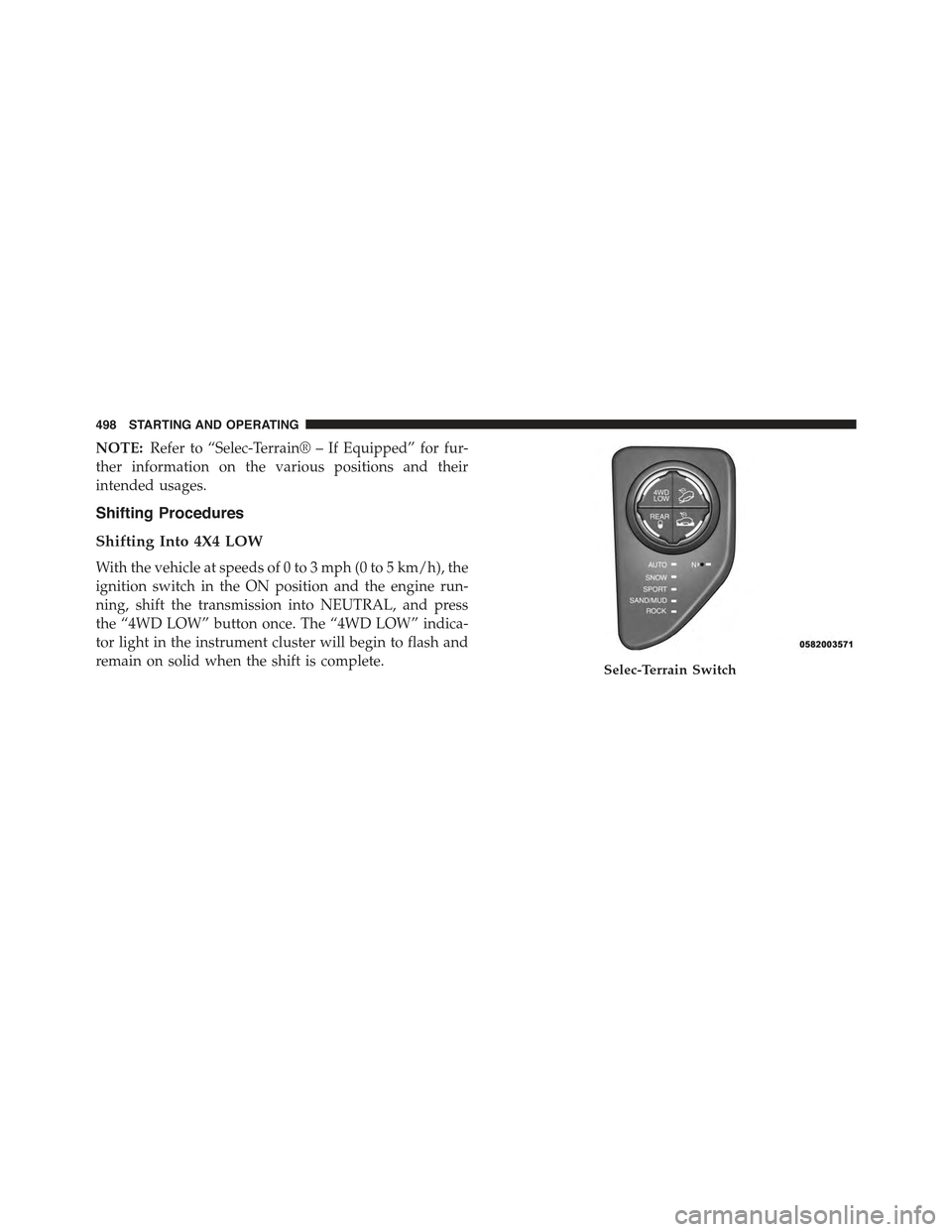
NOTE:Refer to “Selec-Terrain® – If Equipped” for fur-
ther information on the various positions and their
intended usages.
Shifting Procedures
Shifting Into 4X4 LOW
With the vehicle at speeds of 0 to 3 mph (0 to 5 km/h), the
ignition switch in the ON position and the engine run-
ning, shift the transmission into NEUTRAL, and press
the “4WD LOW” button once. The “4WD LOW” indica-
tor light in the instrument cluster will begin to flash and
remain on solid when the shift is complete.Selec-Terrain Switch
498 STARTING AND OPERATING
Page 501 of 772
NOTE:If shift conditions/interlocks are not met a mes-
sage will flash from the Electronic Vehicle Information
Center (EVIC)/Driver Information Display (DID) with
instructions on how to complete the requested shift.
Refer to “Electronic Vehicle Information Center (EVIC)/
Driver Information Display (DID) in “Understanding
Your Instrument Panel” for further information.
Shifting Out Of 4X4 LOW
With the vehicle at speeds of 0 to 3 mph (0 to 5 km/h), the
ignition switch in the ON position and the engine run-
ning, shift the transmission into NEUTRAL, and press
the “4WD LOW” button once. The “4WD LOW” indica-
tor light in the instrument cluster will flash and go out
when the shift is complete.
NOTE:
•If shift conditions/interlocks are not met, a message
will flash from the Electronic Vehicle Information
Center (EVIC)/Driver Information Display (DID) with
instructions on how to complete the requested shift.
Refer to “Electronic Vehicle Information Center
(EVIC)/Driver Information Display (DID) in “Under-
standing Your Instrument Panel” for further informa-
tion.
•Shifting into or out of 4WD LOW is possible with the
vehicle completely stopped; however, difficulty may
occur due to the mating clutch teeth not being prop-
erly aligned. Several attempts may be required for
clutch teeth alignment and shift completion to occur.
The preferred method is with the vehicle rolling 0 to
3 mph (0 to 5 km/h). If the vehicle is moving faster
than 3 mph (5 km/h), the 4WD system will not allow
the shift.
5
STARTING AND OPERATING 499
Page 502 of 772
NEUTRAL Shift Procedure
WARNING!
You or others could be injured or killed if you leave
the vehicle unattended with the power transfer unit
in the NEUTRAL (N) position without first fully
engaging the parking brake. The NEUTRAL (N)
position disengages both the front and rear drive
shafts from the powertrain and will allow the vehicle
to roll, even if the transmission is in PARK. The
parking brake should always be applied when the
driver is not in the vehicle.
1. Bring the vehicle to a complete stop and shift the
transmission to PARK.
2. Turn the engine OFF.
3. Turn the ignition switch to the ON/RUN position, but
do not start the engine.
4. Press and hold the brake pedal.
5. Shift the transmission into NEUTRAL.
6. Using a ballpoint pen or similar object, press and hold
the recessed power transfer unit NEUTRAL (N) button
(located by the selector switch) for four seconds. The
light behind the NEUTRAL (N) symbol will blink,
indicating shift in progress. The light will stop blink-
ing (stay on solid) when the shift to NEUTRAL (N) is
complete.
500 STARTING AND OPERATING