steering JEEP CHEROKEE 2015 KL / 5.G Repair Manual
[x] Cancel search | Manufacturer: JEEP, Model Year: 2015, Model line: CHEROKEE, Model: JEEP CHEROKEE 2015 KL / 5.GPages: 772, PDF Size: 18.21 MB
Page 470 of 772
▫Fuel Economy (ECO) Mode..............484
▫Nine-Speed Automatic Transmission........484
▫Gear Ranges.........................486
!FOUR-WHEEL DRIVE OPERATION.........494
▫1-Speed Four-Wheel Drive (4X4) — If
Equipped...........................494
▫2-Speed Four-Wheel Drive (4X4) — If
Equipped...........................495
▫Shift Positions........................497
▫Shifting Procedures....................498
▫Rear Electronic Locker (E-Locker) System — If
Equipped...........................501
!SELEC-TERRAIN™.....................503
▫Description..........................503
!ON-ROAD DRIVING TIPS................505
!OFF-ROAD DRIVING TIPS................505
▫When To Use 4WD LOW Range...........505
▫Driving Through Water.................506
▫Driving In Snow, Mud And Sand..........507
▫Hill Climbing........................507
▫Traction Downhill.....................508
▫After Driving Off-Road.................508
!POWER STEERING.....................509
!ELECTRIC PARKING BRAKE (EPB).........511
▫Auto Park Brake......................515
▫Safehold...........................516
▫Brake Service Mode....................516
468 STARTING AND OPERATING
Page 479 of 772
•Battery charge is low.
•The vehicle is on a steep grade.
•Cabin heating or cooling is in process and an accept-
able cabin temperature has not been achieved.
•HVAC is set to full defrost mode at a high blower
speed.
•HVAC set to MAX A/C.
•Engine has not reached normal operating temperature.
•The transmission is not in a forward gear.
•Hood is open.
•Vehicle is in 4LO transfer case mode.
•Brake pedal is not pressed with sufficient pressure.
Other Factors Which Can Inhibit Autostop Include:
•Fuel level.
•Accelerator pedal input.
•Engine temp too high.
•5 MPH threshold not achieved from previous AU-
TOSTOP.
•Steering angle beyond threshold.
•ACC is on and speed is set.
It may be possible for the vehicle to be driven several
times without the STOP/START system going into a
STOP/START READY state under more extreme condi-
tions of the items listed above.
To Start The Engine While In Autostop Mode
While in a forward gear, the engine will start when the
brake pedal is released or the throttle pedal is depressed.
The transmission will automatically re-engage upon en-
gine restart.
5
STARTING AND OPERATING 477
Page 504 of 772
Activating The Rear E-Locker
To activate the Rear E-Locker System, the following
conditions must be met:
1. The 4WD system must be in 4WD LOW.
2. The ignition switch in the ON position and the engine
running.
3. Vehicle speed must be below 15 MPH (24 km/h).
4. To engage Rear E-Locker, press the REAR LOCK
button once.
Deactivating The Rear E-Locker System
To deactivate the Rear E-Locker System, the following
conditions must be met:
1. Rear E-Locker must be engaged, and the REAR LOCK
indicator light on.
2. The ignition switch in the ON position and the engine
running.
3. To disengage Rear E-Locker, press the REAR LOCK
button once.
NOTE:
•It may also be necessary to drive slowly steering back
and forth to complete engagement and disengagement
of the E-Locker.
•When engaging Rear E-Locker, the indicator lights in
the instrument cluster and on the REAR LOCK button
will begin to flash. When the shift is complete the
REAR LOCK indicator lights will remain on.
•When disengaging Rear E-Locker, the indicator lights
in the instrument cluster and on the REAR LOCK
button will begin to flash. When the shift is complete
the REAR LOCK indicator lights will remain off.
502 STARTING AND OPERATING
Page 505 of 772
•Shifting into or out of Rear E-Locker is possible with
the vehicle completely stopped; however, difficulty
may occur due to the mating clutch teeth not being
properly aligned. Several attempts may be required for
clutch teeth alignment and shift completion to occur.
The preferred method is for the vehicle to be rolling,
below 15 MPH (24 km/h), while including right and
left steering maneuvers to allow for the clutch teeth to
align.
•The Rear E-Locker System must be disengaged prior to
taking the vehicle out of 4WD LOW range. If 4WD
LOW shift conditions/interlocks are not met, a mes-
sage will flash from the Electronic Vehicle Information
Center (EVIC)/Driver Information Display (DID) with
instructions on how to complete the requested shift.
SELEC-TERRAIN™
Description
Selec-Terrain™ combines the capabilities of the vehicle
control systems, along with driver input, to provide the
best performance for all terrains.
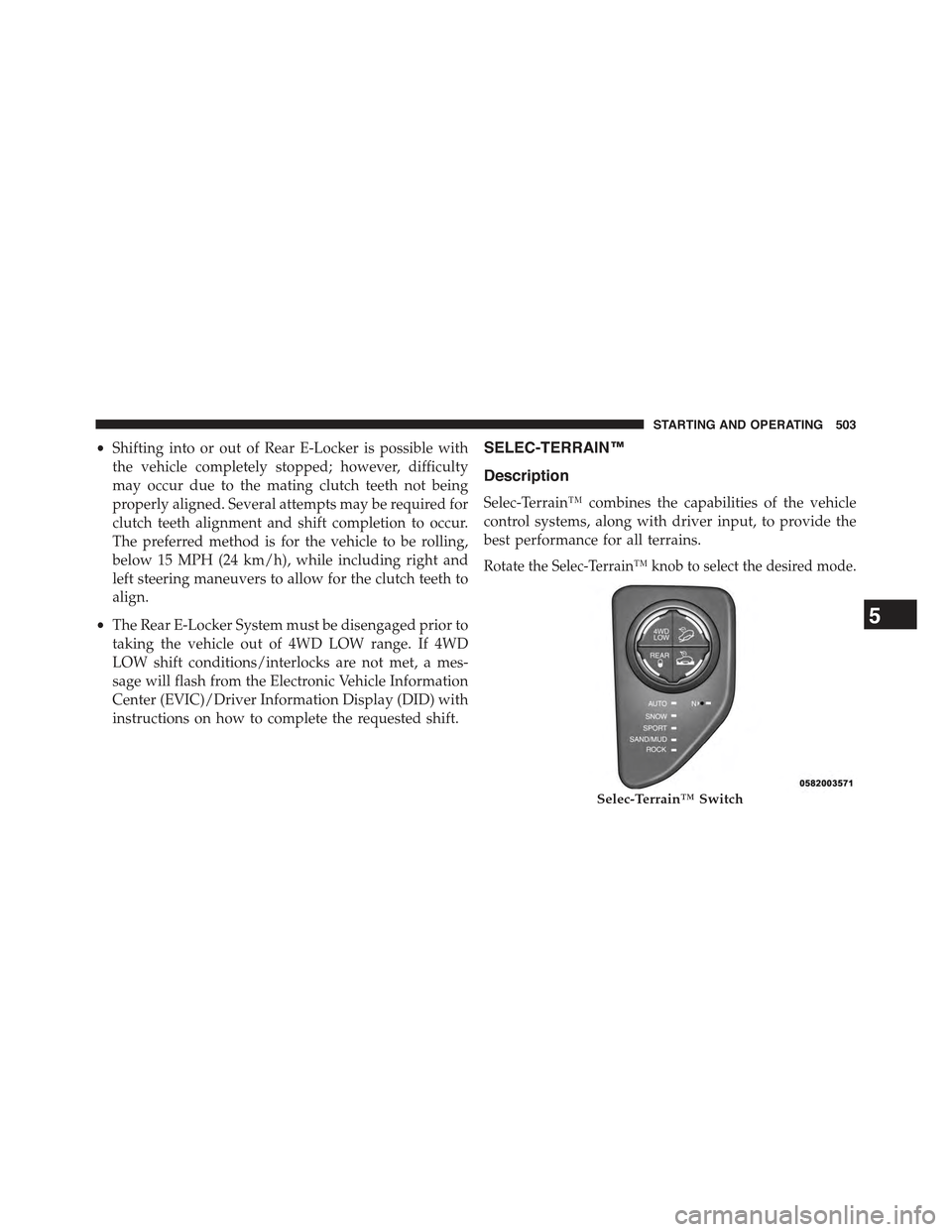
Rotate the Selec-Terrain™ knob to select the desired mode.
Selec-Terrain™ Switch
5
STARTING AND OPERATING 503
Page 506 of 772
Selec-Terrain™ offers the following modes:
•Auto— Fully automatic full time four-wheel drive
operation can be used on and off road. Balances
traction with seamless steering feel to provide im-
proved handling and acceleration over two-wheel
drive vehicles.
•Snow— Tuning set for additional stability in inclem-
ent weather. Use on and off road on loose traction
surfaces such as snow. When in SNOW mode (depend-
ing on certain operating conditions), the transmission
may use second gear (rather than first gear) during
launches, to minimize wheel slippage.
•Sport— This mode alters the transmission’s automatic
shift schedule for sportier driving. Upshift speeds are
increased to make full use of available engine power.
NOTE:SPORT mode is not available when 4WD LOW is
selected.
•Sand/Mud— Off road calibration for use on low
traction surfaces such as mud, sand, or wet grass.
Driveline is maximized for traction. Some binding may
be felt on less forgiving surfaces. The electronic brake
controls are set to limit traction control management of
throttle and wheel spin.
•Rock— Off-road calibration only available in 4WD
LOW range. Traction based tuning with improved
steer-ability for use on high traction off-road surfaces.
Use for low speed obstacles such as large rocks, deep
ruts, etc.
NOTE:
•Rock mode is only available on the vehicles equipped
with the Off-Road package.
•Activate the Hill Descent Control or Selec Speed Control
for steep downhill control. See “Electronic Brake Control
System” in this section for further information.
504 STARTING AND OPERATING
Page 511 of 772
•Completely inspect the underbody of your vehicle.
Check tires, body structure, steering, suspension, and
exhaust system for damage.
•Inspect the radiator for mud and debris and clean as
required.
•Check threaded fasteners for looseness, particularly on
the chassis, drivetrain components, steering, and sus-
pension. Retighten them, if required, and torque to the
values specified in the Service Manual.
•Check for accumulations of plants or brush. These
things could be a fire hazard. They might hide damage
to fuel lines, brake hoses, axle pinion seals, and
propeller shafts.
•After extended operation in mud, sand, water, or
similar dirty conditions, have the radiator, fan, brake
rotors, wheels, brake linings, and axle yokes inspected
and cleaned as soon as possible.
WARNING!
Abrasive material in any part of the brakes may cause
excessive wear or unpredictable braking. You might
not have full braking power when you need it to
prevent a collision. If you have been operating your
vehicle in dirty conditions, get your brakes checked
and cleaned as necessary.
•If you experience unusual vibration after driving in
mud, slush or similar conditions, check the wheels for
impacted material. Impacted material can cause a
wheel imbalance and freeing the wheels of it will
correct the situation.
POWER STEERING
The electric power steering system will give you good
vehicle response and increased ease of maneuverability
in tight spaces. The system will vary its assist to provide
5
STARTING AND OPERATING 509
Page 512 of 772
light efforts while parking and good feel while driving. If
the electric steering system experiences a fault that
reduces assist or prevents the vehicle from providing
assist, you will still have the ability to steer the vehicle
manually.
WARNING!
Continued operation with reduced assist could pose
a safety risk to yourself and others. Service should be
obtained as soon as possible.
If the “SERVICE POWER STEERING#OR
#POWER STEERING ASSIST OFF - SERVICE
SYSTEM” message and a steering wheel icon
are displayed on the EVIC/DID screen, it indi-
cates that the vehicle needs to be taken to the dealer for
service. It is likely the vehicle has lost power steering
assistance. Refer to “Electronic Vehicle Information
(EVIC) or#Driver Information Display (DID)” in “Under-
standing Your Instrument Panel” for further information.
If the “POWER STEERING SYSTEM HOT - PERFOR-
MANCE MAY BE LIMITED” message and an icon are
displayed on the EVIC/DID screen, it indicates that
extreme steering maneuvers may have occurred, which
caused an over temperature condition in the power
steering system. You will lose power steering assistance
momentarily until the over temperature condition no
longer exists. Once driving conditions are safe, then pull
over and let vehicle idle for a few moments until the light
turns off. Refer to “Electronic Vehicle Information
(EVIC)/Driver Information Display (DID)” in “Under-
standing Your Instrument Panel” for further information.
510 STARTING AND OPERATING
Page 513 of 772
NOTE:
•Even if the power steering assistance is no longer
operational, it is still possible to steer the vehicle.
Under these conditions there will be a substantial
increase in steering effort, especially at low speeds and
during parking maneuvers.
•If the condition persists, see your authorized dealer for
service.
ELECTRIC PARKING BRAKE (EPB)
Your vehicle is equipped with an Electric Parking Brake
System (EPB) that offers simple operation, and some
additional features that make the parking brake more
convenient and useful.
The parking brake is primarily intended to prevent the
vehicle from rolling while parked. Before leaving the
vehicle, make sure that the parking brake is applied.
Also, be certain to leave the transmission in PARK.
You can engage the parking brake in two ways;
•Manually, by applying the park brake switch.
•Automatically, by enabling the Auto Park Brake fea-
ture in the customer programmable features section of
the Uconnect® settings.
The parking brake switch is located in the center console.
5
STARTING AND OPERATING 511
Page 522 of 772
The ABS pump motor runs during the self-test at 12 mph
(20 km/h) and during an ABS stop. The pump motor
makes a low humming noise during operation, which is
normal.
WARNING!
•Pumping of the Anti-Lock Brakes will diminish
their effectiveness and may lead to a collision.
Pumping makes the stopping distance longer. Just
press firmly on your brake pedal when you need to
slow down or stop.
•The ABS cannot prevent the natural laws of phys-
ics from acting on the vehicle, nor can it increase
braking or steering efficiency beyond that afforded
by the condition of the vehicle brakes and tires or
the traction afforded.
(Continued)
WARNING!(Continued)
•The ABS cannot prevent collisions, including those
resulting from excessive speed in turns, following
another vehicle too closely, or hydroplaning.
•The capabilities of an ABS equipped vehicle must
never be exploited in a reckless or dangerous
manner, which could jeopardize the user’s safety or
the safety of others.
CAUTION!
The ABS is subject to possible detrimental effects of
electronic interference caused by improperly in-
stalled aftermarket radios or telephones.
NOTE:During severe braking conditions, a pulsing sen-
sation may occur and a clicking noise will be heard. This
is normal, indicating that the ABS is functioning.
520 STARTING AND OPERATING
Page 525 of 772
Electronic Roll Mitigation (ERM)
This system anticipates the potential for wheel lift by
monitoring the driver ’s steering wheel input and the
speed of the vehicle. When ERM determines that the rate
of change of the steering wheel angle and vehicle’s speed
are sufficient to potentially cause wheel lift, it then
applies the appropriate brake and may also reduce
engine power to lessen the chance that wheel lift will
occur. ERM will only intervene during very severe or
evasive driving maneuvers. ERM can only reduce the
chance of wheel lift occurring during severe or evasive
driving maneuvers. It cannot prevent wheel lift due to
other factors, such as road conditions, leaving the road-
way, or striking objects or other vehicles.
NOTE:ERM is disabled anytime the ESC is in “Full Off”
mode. Refer to Electronic Stability Control (ESC) for a
complete explanation of the available ESC modes.
WARNING!
Many factors, such as vehicle loading, road condi-
tions, and driving conditions, influence the chance
that wheel lift or rollover may occur. Electronic Roll
Mitigation (ERM) cannot prevent all wheel lift or
rollovers, especially those that involve leaving the
roadway or striking objects or other vehicles. The
capabilities of an ERM-equipped vehicle must never
be exploited in a reckless or dangerous manner,
which could jeopardize the user’s safety or the safety
of others.
Hill Start Assist (HSA)
The HSA system is designed to help the driver accelerate
the vehicle from a complete stop while on an incline. If
the driver releases the brake while stopped on an incline,
HSA will continue to hold the brake pressure for a short
period. If the driver does not apply the throttle before this
5
STARTING AND OPERATING 523