Four- Wheel Drive Operation JEEP CHEROKEE 2015 KL / 5.G Owners Manual
[x] Cancel search | Manufacturer: JEEP, Model Year: 2015, Model line: CHEROKEE, Model: JEEP CHEROKEE 2015 KL / 5.GPages: 772, PDF Size: 18.21 MB
Page 220 of 772
To Turn Off
The system will turn off and erase the set speed in
memory if:
•The Normal (Fixed Speed) Electronic Speed Control
ON/OFF button is pressed.
•The ignition is turned off.
•You engage Four-Wheel Drive Low.
•The Adaptive Cruise Control (ACC) On/Off button is
pressed.
FORWARD COLLISION WARNING (FCW) WITH
MITIGATION — IF EQUIPPED
Forward Collision Warning (FCW) With Mitigation
Operation
The Forward Collision Warning (FCW) system with
mitigation provides the driver with audible warnings,
visual warnings (within the EVIC/DID), and may apply
a brake jerk to warn the driver when it detects a potential
frontal collision. The warnings and limited braking are
intended to provide the driver with enough time to react,
avoid or mitigate the potential collision.
NOTE:FCW monitors the information from the forward
looking sensors as well as the Electronic Brake Controller
(EBC), to calculate the probability of a forward collision.
When the system determines that a forward collision is
probable, the driver will be provided with audible and
visual warnings and may provide a brake jerk warning.
If the driver does not take action based upon these
progressive warnings, then the system will provide a
limited level of active braking to help slow the vehicle
and mitigate the potential forward collision. If the driver
reacts to the warnings by braking and the system deter-
mines that the driver intends to avoid the collision by
218 UNDERSTANDING THE FEATURES OF YOUR VEHICLE
Page 352 of 772
and rear wheels to rotate at the same speed. Low range
provides a greater gear reduction ratio to provide in-
creased torque at the wheels.
For further information on four-wheel drive operation
and proper use, refer to “Four-Wheel Drive Operation —
If Equipped” in “Starting And Operating”.
15. SERV 4WD Indicator Light — If Equipped
This light alerts the driver that the 4WD is in need of
service. If this light is illuminated, see your authorized
dealer as soon as possible.
16. Temperature Gauge
The temperature gauge shows engine coolant tempera-
ture. Any reading within the normal range indicates that
the engine cooling system is operating satisfactorily.
The gauge pointer will likely indicate a higher tempera-
ture when driving in hot weather, up mountain grades,
or when towing a trailer. It should not be allowed to
exceed the upper limits of the normal operating range.
CAUTION!
Driving with a hot engine cooling system could
damage your vehicle. If the temperature gauge reads
“H” pull over and stop the vehicle. Idle the vehicle
with the air conditioner turned off until the pointer
drops back into the normal range. If the pointer
remains on the “H” and you hear continuous chimes,
turn the engine off immediately and call an autho-
rized dealer for service.
WARNING!
A hot engine cooling system is dangerous. You or
others could be badly burned by steam or boiling
coolant. You may want to call an authorized dealer
for service if your vehicle overheats. If you decide to
look under the hood yourself, see “Maintaining Your
(Continued)
350 UNDERSTANDING YOUR INSTRUMENT PANEL
Page 371 of 772
•Low Coolant Level Indicator
This telltale will turn on to indicate the
vehicle coolant level is low.
•Windshield Washer Fluid Low Indicator
This telltale will turn on to indicate the
windshield washer fluid is low.
•4WD LOW Indicator Light — If Equipped
This light alerts the driver that the vehicle is in the
four-wheel drive LOW mode. The front and rear
driveshafts are mechanically locked together forcing
the front and rear wheels to rotate at the same speed.
Low range provides a greater gear reduction ratio to
provide increased torque at the wheels.
For further information on four-wheel drive opera-
tion and proper use, refer to “Four-Wheel Drive
Operation — If Equipped” in “Starting And
Operating”.
•SERV 4WD Indicator Light — If Equipped
This light alerts the driver that the 4WD is in need of
service. If this light is illuminated, see your autho-
rized dealer as soon as possible.
•Adaptive Cruise Control (ACC) Malfunction
This light will turn on when a ACC is not
operating and needs service. For further
information, refer to “Adaptive Cruise
Control (ACC)” in “Understanding The
Features Of Your Vehicle”.
•LaneSense Service — If Equipped
This telltale will turn on to indicate that the
Lane Sense Departure has detected a
failure.
4
UNDERSTANDING YOUR INSTRUMENT PANEL 369
Page 470 of 772
▫Fuel Economy (ECO) Mode..............484
▫Nine-Speed Automatic Transmission........484
▫Gear Ranges.........................486
!FOUR-WHEEL DRIVE OPERATION.........494
▫1-Speed Four-Wheel Drive (4X4) — If
Equipped...........................494
▫2-Speed Four-Wheel Drive (4X4) — If
Equipped...........................495
▫Shift Positions........................497
▫Shifting Procedures....................498
▫Rear Electronic Locker (E-Locker) System — If
Equipped...........................501
!SELEC-TERRAIN™.....................503
▫Description..........................503
!ON-ROAD DRIVING TIPS................505
!OFF-ROAD DRIVING TIPS................505
▫When To Use 4WD LOW Range...........505
▫Driving Through Water.................506
▫Driving In Snow, Mud And Sand..........507
▫Hill Climbing........................507
▫Traction Downhill.....................508
▫After Driving Off-Road.................508
!POWER STEERING.....................509
!ELECTRIC PARKING BRAKE (EPB).........511
▫Auto Park Brake......................515
▫Safehold...........................516
▫Brake Service Mode....................516
468 STARTING AND OPERATING
Page 496 of 772
![JEEP CHEROKEE 2015 KL / 5.G Owners Manual NOTE:The torque converter clutch will not engage until
the transmission fluid is warm (usually after 1 to 3 miles
[2 to 5 km] of driving). Because the engine speed is higher
when the torque converter](/img/16/7057/w960_7057-495.png "JEEP CHEROKEE 2015 KL / 5.G Owners Manual NOTE:The torque converter clutch will not engage until
the transmission fluid is warm (usually after 1 to 3 miles
[2 to 5 km] of driving). Because the engine speed is higher
when the torque converter")
NOTE:The torque converter clutch will not engage until
the transmission fluid is warm (usually after 1 to 3 miles
[2 to 5 km] of driving). Because the engine speed is higher
when the torque converter clutch is not engaged, it may
seem as if the transmission is not shifting properly when
cold, this is normal. The torque converter clutch will
function normally once the transmission is sufficiently
warm.
FOUR-WHEEL DRIVE OPERATION
1-Speed Four-Wheel Drive (4X4) — If Equipped
This feature provides on-demand four-wheel drive (4X4).
The system is automatic with no driver inputs or addi-
tional driving skills required. Under normal driving
conditions, the front wheels provide most of the traction.
If the front wheels begin to lose traction, power is shifted
automatically to the rear wheels. The greater the front
wheel traction loss, the greater the power transfer to the
rear wheels.
1-Speed 4X4 Switch
494 STARTING AND OPERATING
Page 498 of 772
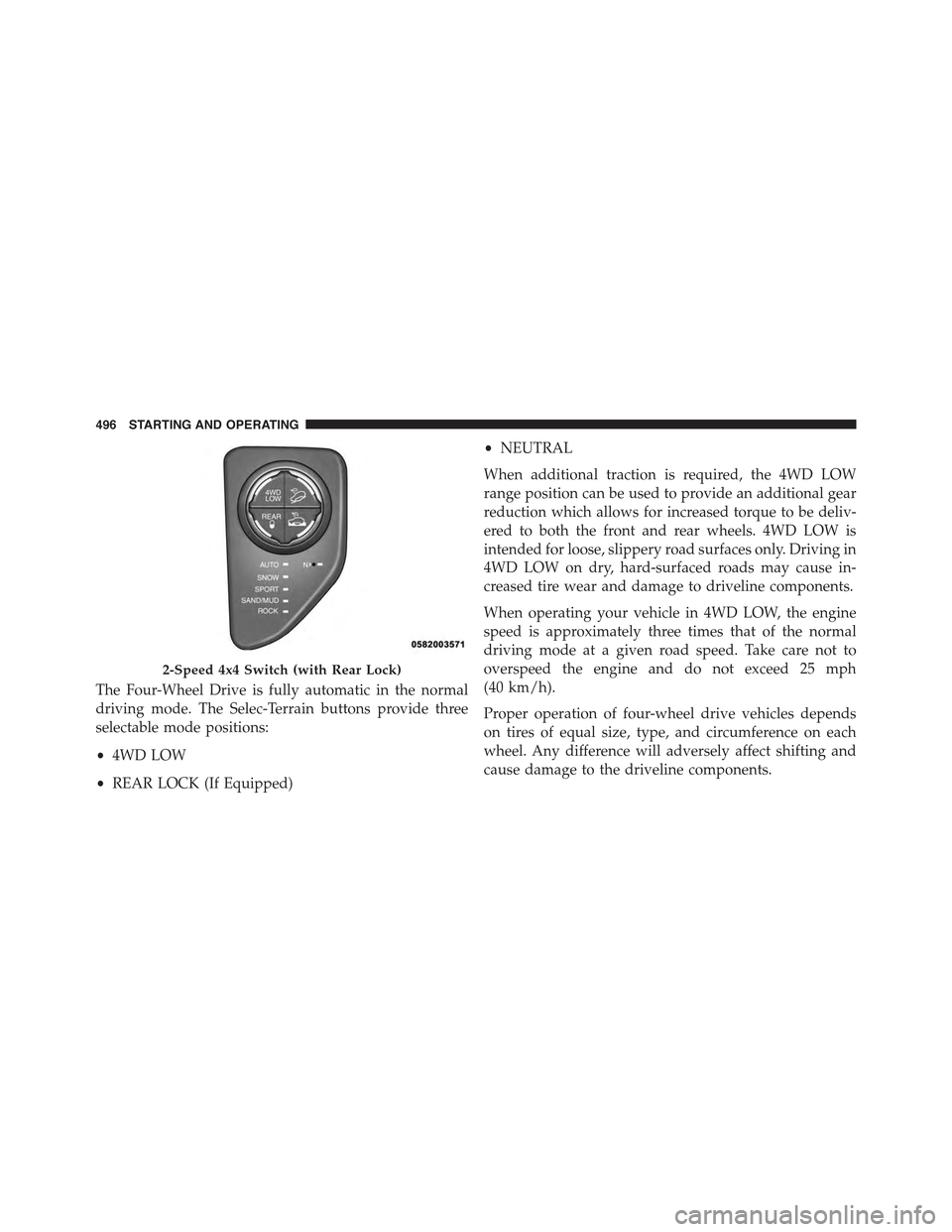
The Four-Wheel Drive is fully automatic in the normal
driving mode. The Selec-Terrain buttons provide three
selectable mode positions:
•4WD LOW
•REAR LOCK (If Equipped)
•NEUTRAL
When additional traction is required, the 4WD LOW
range position can be used to provide an additional gear
reduction which allows for increased torque to be deliv-
ered to both the front and rear wheels. 4WD LOW is
intended for loose, slippery road surfaces only. Driving in
4WD LOW on dry, hard-surfaced roads may cause in-
creased tire wear and damage to driveline components.
When operating your vehicle in 4WD LOW, the engine
speed is approximately three times that of the normal
driving mode at a given road speed. Take care not to
overspeed the engine and do not exceed 25 mph
(40 km/h).
Proper operation of four-wheel drive vehicles depends
on tires of equal size, type, and circumference on each
wheel. Any difference will adversely affect shifting and
cause damage to the driveline components.
2-Speed 4x4 Switch (with Rear Lock)
496 STARTING AND OPERATING
Page 506 of 772
Selec-Terrain™ offers the following modes:
•Auto— Fully automatic full time four-wheel drive
operation can be used on and off road. Balances
traction with seamless steering feel to provide im-
proved handling and acceleration over two-wheel
drive vehicles.
•Snow— Tuning set for additional stability in inclem-
ent weather. Use on and off road on loose traction
surfaces such as snow. When in SNOW mode (depend-
ing on certain operating conditions), the transmission
may use second gear (rather than first gear) during
launches, to minimize wheel slippage.
•Sport— This mode alters the transmission’s automatic
shift schedule for sportier driving. Upshift speeds are
increased to make full use of available engine power.
NOTE:SPORT mode is not available when 4WD LOW is
selected.
•Sand/Mud— Off road calibration for use on low
traction surfaces such as mud, sand, or wet grass.
Driveline is maximized for traction. Some binding may
be felt on less forgiving surfaces. The electronic brake
controls are set to limit traction control management of
throttle and wheel spin.
•Rock— Off-road calibration only available in 4WD
LOW range. Traction based tuning with improved
steer-ability for use on high traction off-road surfaces.
Use for low speed obstacles such as large rocks, deep
ruts, etc.
NOTE:
•Rock mode is only available on the vehicles equipped
with the Off-Road package.
•Activate the Hill Descent Control or Selec Speed Control
for steep downhill control. See “Electronic Brake Control
System” in this section for further information.
504 STARTING AND OPERATING
Page 507 of 772
Electronic Vehicle Information Center
(EVIC)/Driver Information Display (DID) Display
Messages
When the appropriate conditions exist, a message will
appear in the EVIC/DID display. Refer to “Electronic
Vehicle Information Center (EVIC)/Driver Information
Display (DID)” in “Understanding Your Instrument
Panel” for further information.
ON-ROAD DRIVING TIPS
Utility vehicles have higher ground clearance and a
narrower track to make them capable of performing in a
wide variety of off-road applications. Specific design
characteristics give them a higher center of gravity than
ordinary cars.
An advantage of the higher ground clearance is a better
view of the road, allowing you to anticipate problems.
They are not designed for cornering at the same speeds as
conventional two-wheel drive vehicles any more than
low-slung sports cars are designed to perform satisfacto-
rily in off-road conditions. If at all possible, avoid sharp
turns or abrupt maneuvers. As with other vehicles of this
type, failure to operate this vehicle correctly may result in
loss of control or vehicle rollover.
OFF-ROAD DRIVING TIPS
When To Use 4WD LOW Range
When off-road driving, shift to 4WD LOW for additional
traction and control on slippery or difficult terrain,
ascending or descending steep hills, and to increase
low-speed pulling power (refer to “All Wheel Drive and
Four-Wheel Drive Operation” in this section for further
details). This range should be limited to extreme situa-
tions such as deep snow, mud, or sand where additional
low speed pulling power is needed. Vehicle speeds in
excess of 25 mph (40 km/h) should be avoided when in
4WD LOW range.
5
STARTING AND OPERATING 505
Page 509 of 772
Maintenance
After driving through deep water, inspect your vehicle
fluids and lubricants (engine, transmission, Power Trans-
fer Unit and Rear Drive Module) to assure they have not
been contaminated. Contaminated fluids and lubricants
(milky, foamy in appearance) should be flushed/changed
as soon as possible to prevent component damage.
Driving In Snow, Mud And Sand
In heavy snow, when pulling a load, or for additional
control at slower speeds, shift the transmission to a low
gear and shift the 4WD system to the appropriate terrain
mode, using 4WD LOW if necessary. Refer to “Four-
Wheel Drive Operation” in “Starting and Operating” for
further information. Do not shift to a lower gear than
necessary to maintain headway. Over-revving the engine
can spin the wheels and traction will be lost.
Avoid abrupt downshifts on icy or slippery roads be-
cause engine braking may cause skidding and loss of
control.
Hill Climbing
NOTE:Before attempting to climb a hill, determine the
conditions at the crest and/or on the other side.
Before climbing a steep hill,shift the transmission to a
lower gear and shift the 4WD System to 4WD LOW. Use
first gear and 4WD LOW for very steep hills.
If you stall or begin to lose headwaywhile climbing a
steep hill, allow your vehicle to come to a stop and
immediately apply the brakes. Restart the engine and
shift to REVERSE. Back slowly down the hill allowing the
compression braking of the engine to help regulate your
speed. If the brakes are required to control vehicle speed,
apply them lightly and avoid locking or skidding the
tires.
5
STARTING AND OPERATING 507
Page 537 of 772

ESC Operating Modes
Depending upon model and mode of operation, the ESC
system has up to three operating modes: “ESC On”
“Partial Off,” and “Full Off.”
ESC On — Two-Wheel Drive Vehicles And Four-Wheel
Drive Vehicles In 2WD And 4WD High Range
This is the normal operating mode for ESC when oper-
ating a two-wheel drive vehicle. It is also the normal
mode for operating a four-wheel drive vehicle in 2WD or
4WD HIGH range. The ESC system will be in “ESC On”
mode whenever the vehicle is started or the power
transfer unit (if equipped) is shifted out of 4WD LOW
range. This mode should be used for most driving
situations. ESC should only be turned to “Partial Off” or
“Full Off” for specific reasons as noted. Refer to “Partial
Off” and to “Full Off” for additional information.
Partial Off — Two-Wheel Drive Vehicles And Four-
Wheel Drive Vehicles In 2WD And 4WD High Range
The “Partial Off” mode is intended for driving in deep
snow, sand, or gravel. This mode raises the threshold for
TCS and ESC activation, which allows for more wheel
spin than what ESC normally allows.
The “ESC Off” button is located in the lower switch bank
above the climate control. To enter the “Partial Off”
mode, momentarily press the “ESC Off” button and the
#ESC Off#indicator light will illuminate. To turn the ESC
on again, momentarily press the#ESC OFF#button and
the#ESC Off#indicator light will turn off. This will restore
the normal “ESC On” mode of operation.
5
STARTING AND OPERATING 535