hood open JEEP CHEROKEE 2021 Owner handbook (in English)
[x] Cancel search | Manufacturer: JEEP, Model Year: 2021, Model line: CHEROKEE, Model: JEEP CHEROKEE 2021Pages: 332, PDF Size: 8.87 MB
Page 9 of 332
7
WINDSHIELD WIPERS AND WASHERS ..... 34
Windshield Wiper Operation............. 34
Rain Sensing Wipers —
If Equipped ................................... 35 Rear Window Wiper/Washer ............. 36
CLIMATE CONTROLS............................... 36
Automatic Climate Control
Overview ........................................ 37 Climate Control Functions ............... 45
Automatic Temperature
Control (ATC) ................................ 45 Operating Tips ............................... 46
WINDOWS ............................................ 47
Power Window Controls ................... 47
Auto-Up Feature With Anti-Pinch
Protection ..................................... 48 Window Lockout Switch .................. 48
POWER SUNROOF WITH POWER SHADE —
IF EQUIPPED ......................................... 49
Opening Sunroof ............................ 49
Venting Sunroof.............................. 50
Closing Sunroof .............................. 50
Wind Buffeting .............................. 50
Opening Power Shade ..................... 50
Closing Power Shade....................... 51
Pinch Protect Feature ..................... 51
Sunroof Maintenance ...................... 51
Ignition Off Operation ..................... 51
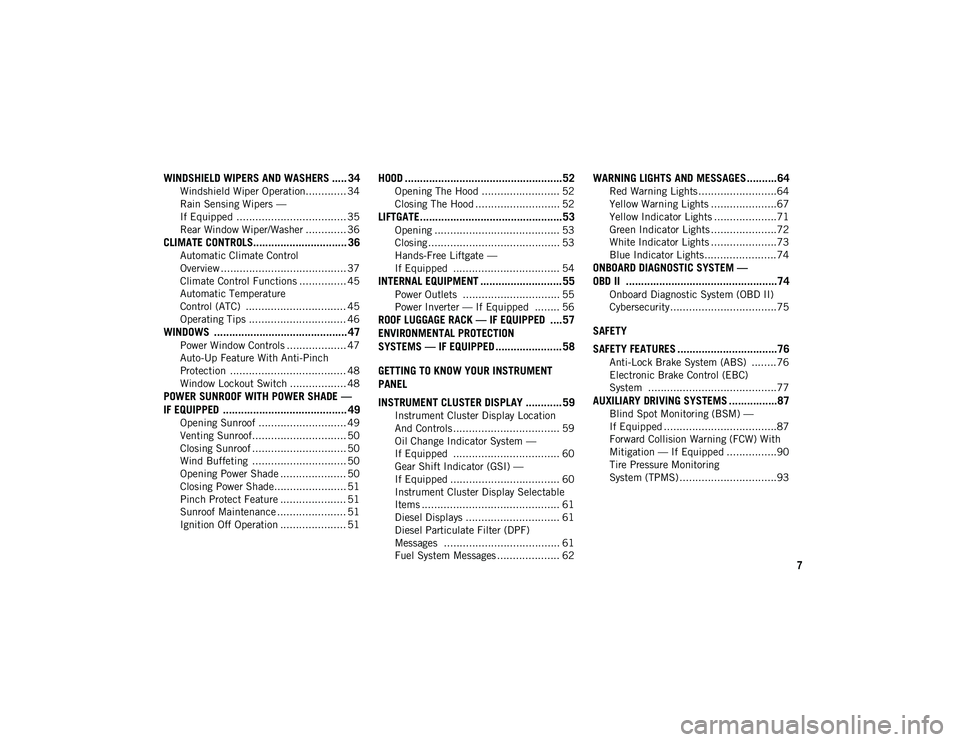
HOOD ....................................................52
Opening The Hood ......................... 52
Closing The Hood ........................... 52
LIFTGATE...............................................53
Opening ........................................ 53
Closing .......................................... 53
Hands-Free Liftgate —
If Equipped .................................. 54
INTERNAL EQUIPMENT ........................... 55
Power Outlets ............................... 55
Power Inverter — If Equipped ........ 56
ROOF LUGGAGE RACK — IF EQUIPPED ....57
ENVIRONMENTAL PROTECTION
SYSTEMS — IF EQUIPPED ...................... 58
GETTING TO KNOW YOUR INSTRUMENT
PANEL
INSTRUMENT CLUSTER DISPLAY ............ 59
Instrument Cluster Display Location
And Controls .................................. 59 Oil Change Indicator System —
If Equipped .................................. 60 Gear Shift Indicator (GSI) —
If Equipped ................................... 60 Instrument Cluster Display Selectable
Items ............................................ 61 Diesel Displays .............................. 61
Diesel Particulate Filter (DPF)
Messages ..................................... 61 Fuel System Messages .................... 62
WARNING LIGHTS AND MESSAGES ..........64
Red Warning Lights .........................64
Yellow Warning Lights .....................67
Yellow Indicator Lights ....................71
Green Indicator Lights .....................72
White Indicator Lights .....................73
Blue Indicator Lights .......................74
ONBOARD DIAGNOSTIC SYSTEM —
OBD II ..................................................74
Onboard Diagnostic System (OBD II)
Cybersecurity..................................75
SAFETY
SAFETY FEATURES .................................76
Anti-Lock Brake System (ABS) ........76
Electronic Brake Control (EBC)
System .........................................77
AUXILIARY DRIVING SYSTEMS ................87
Blind Spot Monitoring (BSM) —
If Equipped ....................................87 Forward Collision Warning (FCW) With
Mitigation — If Equipped ................90 Tire Pressure Monitoring
System (TPMS)...............................93
2020_JEEP_CHEROKEE_UG_RHD_UK.book Page 7
Page 20 of 332
GETTING TO KNOW YOUR VEHICLE
18
For security, power window and power
sunroof operation (if equipped) are
disabled when the vehicle is in the
Remote Start mode.
The engine can be started two consecutive
times with the key fob. However, the igni-
tion must be cycled by pushing the
START/STOP ignition button twice (or the
ignition switch must be placed in the ON/
RUN position) before you can repeat the
start sequence for a third cycle.
VEHICLE SECURITY ALARM —
IF EQUIPPED
The vehicle security alarm monitors the
vehicle doors, hood, liftgate, and the Keyless
Enter-N-Go — Ignition for unauthorized
operation. While the vehicle security alarm is
armed, interior switches for door locks and
liftgate release are disabled. If something
triggers the alarm, the vehicle security alarm
will provide the following audible and visible
signals:
The horn will pulse.
The turn signals will flash.
The vehicle security light in the instru -
ment cluster will flash.
To Arm The System
Follow these steps to arm the Vehicle Secu -
rity Alarm:
1. Make sure the vehicle’s ignition is placed in the OFF position.
For vehicles equipped with Keyless
Entry, make sure the vehicle’s keyless
ignition system is OFF.
2. Perform one of the following methods to lock the vehicle:
Push the lock button on the interiorpower door lock switch with the driver and/or passenger door open.
Push the lock button on the exterior
Passive Entry Door Handle with a valid
key fob available in the same exterior
zone. Refer to "Doors" in this chapter for further information.
Push the lock button on the key fob.
3.
If any doors are open, close them.
To Disarm The System
The Vehicle Security Alarm can be disarmed
using any of the following methods:
Push the unlock button on the key fob.
Grasp the passive entry door handle to
unlock the door; refer to "Doors" in this
chapter for further information.
Place the ignition in the OFF position to
disarm the system.
NOTE:
The driver's door key cylinder and the lift -
gate button on the key fob cannot arm or
disarm the Vehicle Security Alarm.
The Vehicle Security Alarm remains armed
during power liftgate entry. Pushing the
liftgate button will not disarm the Vehicle
Security Alarm. If someone enters the
vehicle through the liftgate and opens any
door, the alarm will sound.
When the Vehicle Security Alarm is armed,
the interior power door lock switches will
not unlock the doors.
2020_JEEP_CHEROKEE_UG_RHD_UK.book Page 18
Page 54 of 332
GETTING TO KNOW YOUR VEHICLE
52
HOOD
Opening The Hood
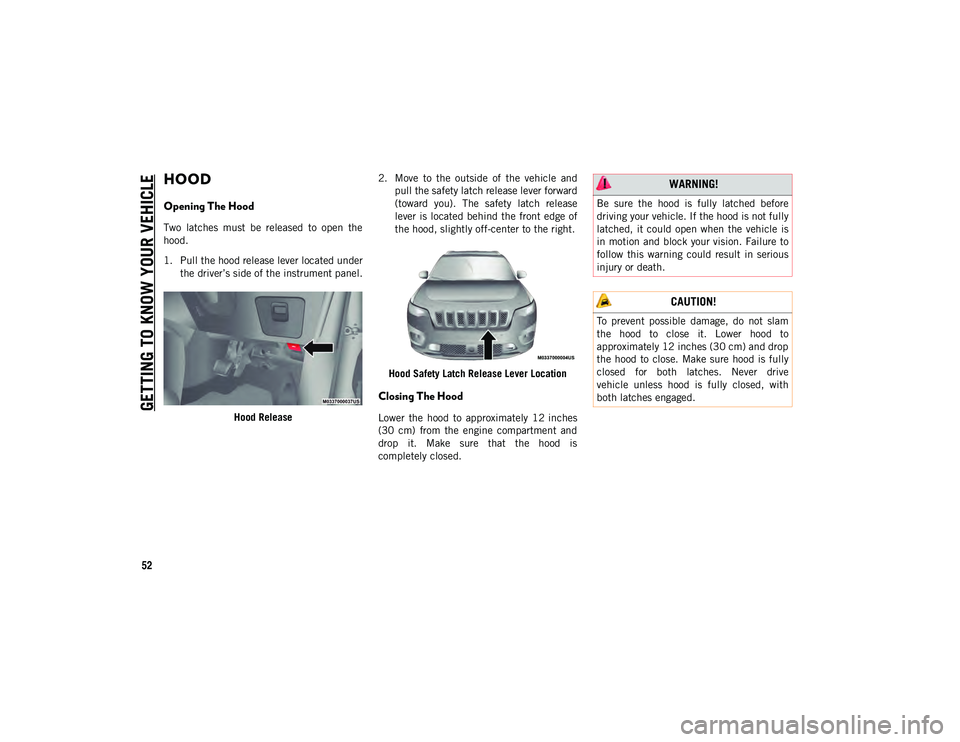
Two latches must be released to open the
hood.
1. Pull the hood release lever located underthe driver’s side of the instrument panel.
Hood Release 2. Move to the outside of the vehicle and
pull the safety latch release lever forward
(toward you). The safety latch release
lever is located behind the front edge of
the hood, slightly off-center to the right.
Hood Safety Latch Release Lever Location
Closing The Hood
Lower the hood to approximately 12 inches
(30 cm) from the engine compartment and
drop it. Make sure that the hood is
completely closed.
WARNING!
Be sure the hood is fully latched before
driving your vehicle. If the hood is not fully
latched, it could open when the vehicle is
in motion and block your vision. Failure to
follow this warning could result in serious
injury or death.
CAUTION!
To prevent possible damage, do not slam
the hood to close it. Lower hood to
approximately 12 inches (30 cm) and drop
the hood to close. Make sure hood is fully
closed for both latches. Never drive
vehicle unless hood is fully closed, with
both latches engaged.
2020_JEEP_CHEROKEE_UG_RHD_UK.book Page 52
Page 68 of 332
GETTING TO KNOW YOUR INSTRUMENT PANEL
66
If the light continues to flash when the
vehicle is running, immediate service is
required. You may experience reduced
performance, an elevated/rough idle, or
engine stall and your vehicle may require
towing. The light will come on when the igni-
tion is placed in the ON/RUN or ACC/ON/
RUN position and remain on briefly as a bulb
check. If the light does not come on during
starting, have the system checked by an
authorized dealer.
— Engine Coolant Temperature Warning
Light
This light warns of an overheated engine
condition. If the engine coolant temperature
is too high, this indicator will illuminate and
a single chime will sound.
If the light turns on while driving, safely pull
over and stop the vehicle. If the A/C system
is on, turn it off. Also, shift the transmission
into NEUTRAL and idle the vehicle. If the
temperature reading does not return to
normal, turn the engine off immediately and
call for service. Refer to “If Your Engine
Overheats” in “In Case Of Emergency” for
further information.
— Hood Open Warning Light
This warning light will illuminate when the
hood is left open and not fully closed.
NOTE:
If the vehicle is moving, there will also be a
single chime.
— Liftgate Open Warning Light
This warning light will illuminate when the
liftgate is open.
NOTE:
If the vehicle is moving, there will also be a
single chime.
— Oil Pressure Warning Light
This warning light will illuminate to indicate
low engine oil pressure. A chime will sound
when this light turns on and a message “Oil
Pressure Low” will display in the message
screen. If the light turns on while driving,
pull the vehicle to the side of the road at a
safe location, stop the vehicle, shut off the
engine as soon as possible, check the oil
level and correct the oil level if it is low.
Contact an authorized dealer. Do not operate the vehicle until the cause is
corrected. This light may or may not indicate
how much oil is in the engine. The engine oil
level must be checked according to section
“Scheduling Service” Checking Oil Level. If
the oil level is low and corrected, the engine
can be restarted. Otherwise the vehicle
should be serviced by an authorized dealer.
NOTE:
The light may flash, a message in the center
of the dash may be displayed momentarily
“low oil pressure” and a chime may occur
during sharp cornering maneuvers. If this
happen it may indicate a low oil level. The oil
level should be checked and serviced by a
dealer if this occurs.
— Oil Temperature Warning Light
This warning light will illuminate to indicate
the engine oil temperature is high. If the light
turns on while driving, stop the vehicle and
shut off the engine as soon as possible. Wait for
oil temperature to return to normal levels.
CAUTION!
If the vehicle is driven with low oil levels
severe engine damage can occur. Have the
vehicle checked immediately.
2020_JEEP_CHEROKEE_UG_RHD_UK.book Page 66
Page 157 of 332
155
Engine has not reached normal operating
temperature
The transmission is not in a forward or
reverse gear
Hood is open
Vehicle is in 4WD LOW transfer case mode
(if equipped with 4WD)
Brake pedal is not pressed with sufficient
pressure with vehicle in DRIVE position
Other Factors Which Can Inhibit Autostop
Include:
Accelerator pedal input
Engine temp too high
5 mph threshold not achieved from
previous AUTOSTOP
Steering angle beyond threshold
ACC is on and speed is set
It may be possible for the vehicle to be driven
several times without the Stop/Start system
going into a STOP/START READY state
under more extreme conditions of the items
listed above.
To Start The Engine While In Autostop
Mode
While in a forward gear, the engine will start
when the brake pedal is released or the
throttle pedal is depressed. The transmission
will automatically re-engage upon engine
restart.
Conditions That Will Cause The Engine To Start
Automatically While In Autostop Mode:
The transmission gear selector is moved
out of DRIVE except in the PARK position.
To maintain cabin temperature comfort
HVAC is set to full defrost mode
HVAC system temperature or fan speed is
manually adjusted
Battery voltage drops too low
Low brake vacuum (e.g. after several brake
pedal applications)
Stop/Start OFF switch is pushed
A Stop/Start system error occurs
4WD system is put into 4WD LOW mode
(if equipped with 4WD) Conditions That Force An Application Of The
Electric Park Brake While In Autostop Mode:
The driver’s door is open and brake pedal
released
The driver’s door is open and the driver’s
seat belt is unbuckled
The engine hood has been opened
A Stop/Start system error occurs
If the Electric Park Brake is applied with the
engine off, the engine may require a manual
restart and the electric park brake may
require a manual release (depress brake
pedal and push Electric Park Brake switch).
Refer to “Instrument Cluster Display” in
“Getting To Know Your Instrument Panel” in
your Owner’s Manual.
2020_JEEP_CHEROKEE_UG_RHD_UK.book Page 155
Page 159 of 332
157
Possible Reasons The Engine Does Not
Autostop
Prior to engine shut down, the system will
check many safety and comfort conditions to
see if they are fulfilled. Detailed information
about the operation of the Stop/Start system
may be viewed in the instrument cluster
Stop/Start Screen. In the following situations
the engine will not stop:
Driver’s seat belt is not buckled.
Driver’s door is not closed.
Battery temperature is too warm or cold.
The vehicle is on a steep grade.
Cabin heating or cooling is in process and
an acceptable cabin temperature has not
been achieved.
HVAC is set to full defrost mode at a high
blower speed.
Engine has not reached normal operating
temperature.
Battery charge is low.
The transmission is not in DRIVE (auto-
matic transmission) or NEUTRAL (manual
transmission).
Hood is open.
Vehicle is in 4WD LOW transfer case
mode.
Exhaust system regeneration in process.
Other Factors Which Can Inhibit Autostop
Include:
Fuel level.
Accelerator pedal input (automatic trans-
mission only).
Engine temperature too high.
It may be possible for the vehicle to be driven
several times without the Stop/Start system
going into a STOP/START READY state
under more extreme conditions of the items
listed above.
To Start The Engine While In Autostop
Mode
Automatic Transmission:
While in DRIVE, the engine will start when the
brake pedal is released or the throttle pedal is
depressed. The transmission will automatically
re-engage upon engine restart. During this tran -
sition, the brakes will hold the vehicle to avoid
undesired vehicle movement.
Manual Transmission:
When the gear selector is in NEUTRAL, the
engine will start when the clutch pedal is
pressed. The vehicle will go into STOP/START
SYSTEM NOT READY mode until the vehicle
speed is greater than 4 mph (7 km/h).
Conditions That Will Cause The Engine To Start
Automatically While In Autostop Mode:
The transmission gear selector is moved
from DRIVE to REVERSE or NEUTRAL.
To maintain cabin temperature comfort.
HVAC is set to full defrost mode.
Battery voltage drops too low.
Low brake vacuum (e.g. after several brake
pedal applications).
Stop/Start OFF switch is pushed.
4WD system is put into 4WD LOW mode.
The emissions system requires it.
A Stop/Start system error occurs.
HVAC system temperature or fan speed is
manually adjusted.
2020_JEEP_CHEROKEE_UG_RHD_UK.book Page 157
Page 160 of 332
STARTING AND OPERATING
158
Conditions That Force An Application Of The
Electric Park Brake While In Autostop Mode:
The driver door is open and brake pedal
released.
The driver door is open and the driver seat
belt is unbuckled.
The engine hood has been opened.
A Stop/Start system error occurs.
If the Electric Park Brake is applied with the
engine off, the engine may require a manual
restart and the electric park brake may
require a manual release (depress brake
pedal and push Electric Park Brake switch).
Refer to “Instrument Cluster Display” in
“Getting To Know Your Instrument Panel” in
your Owner’s Manual for further information.
To Manually Turn Off The Stop/Start
System
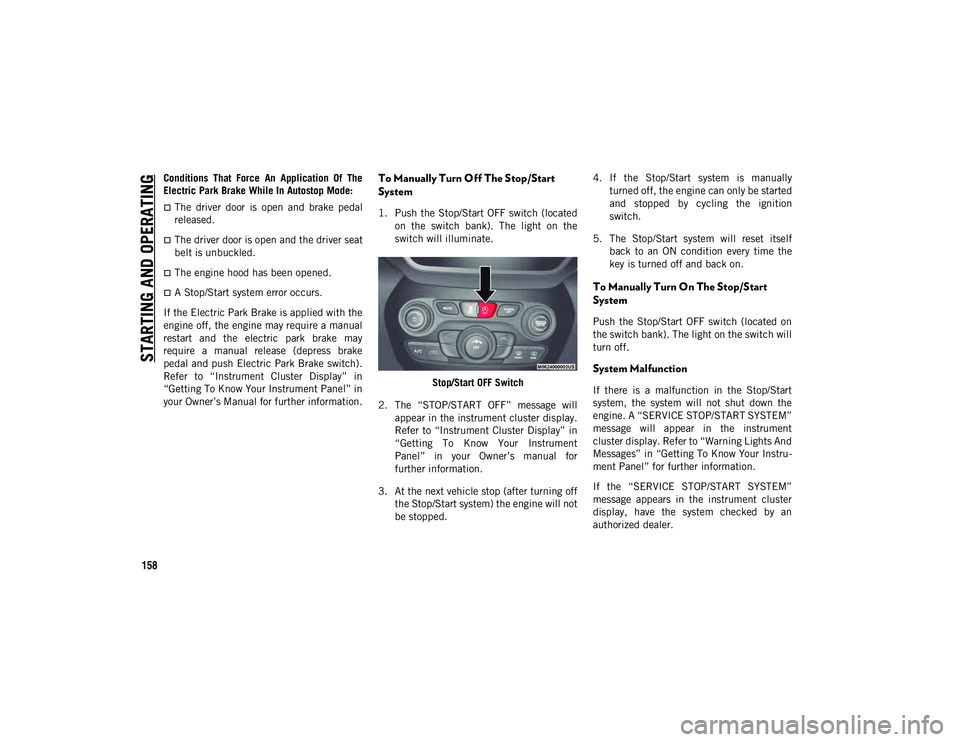
1. Push the Stop/Start OFF switch (located on the switch bank). The light on the
switch will illuminate.
Stop/Start OFF Switch
2. The “STOP/START OFF” message will appear in the instrument cluster display.
Refer to “Instrument Cluster Display” in
“Getting To Know Your Instrument
Panel” in your Owner’s manual for
further information.
3. At the next vehicle stop (after turning off the Stop/Start system) the engine will not
be stopped. 4. If the Stop/Start system is manually
turned off, the engine can only be started
and stopped by cycling the ignition
switch.
5. The Stop/Start system will reset itself back to an ON condition every time the
key is turned off and back on.
To Manually Turn On The Stop/Start
System
Push the Stop/Start OFF switch (located on
the switch bank). The light on the switch will
turn off.
System Malfunction
If there is a malfunction in the Stop/Start
system, the system will not shut down the
engine. A “SERVICE STOP/START SYSTEM”
message will appear in the instrument
cluster display. Refer to “Warning Lights And
Messages” in “Getting To Know Your Instru -
ment Panel” for further information.
If the “SERVICE STOP/START SYSTEM”
message appears in the instrument cluster
display, have the system checked by an
authorized dealer.
2020_JEEP_CHEROKEE_UG_RHD_UK.book Page 158
Page 212 of 332
IN CASE OF EMERGENCY
210
(Continued)
Preparations For Jump Start
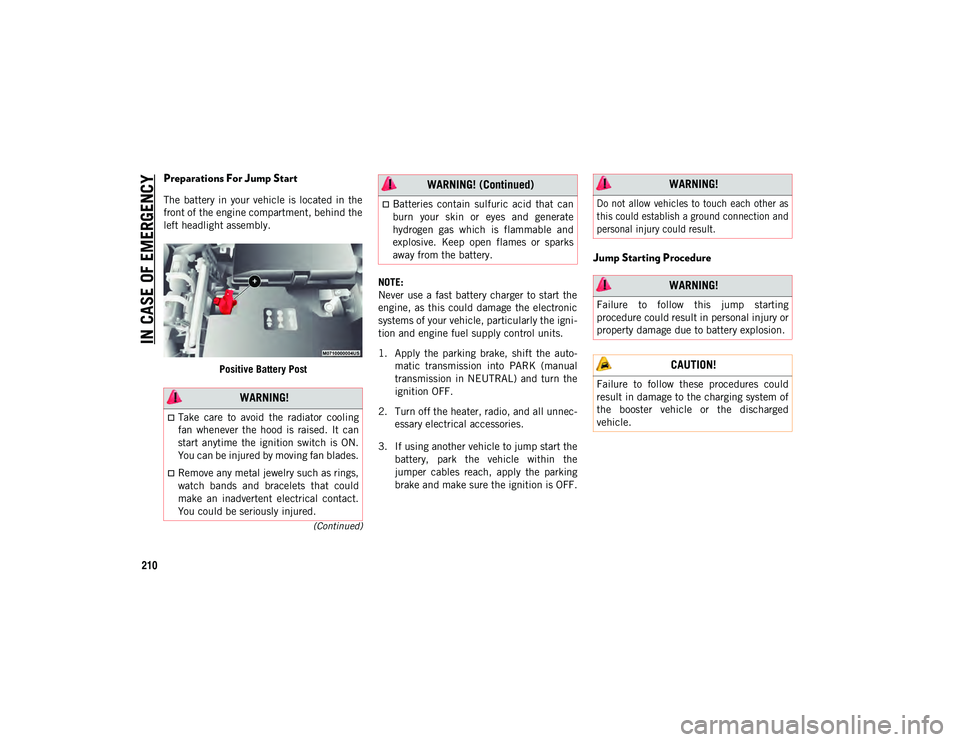
The battery in your vehicle is located in the
front of the engine compartment, behind the
left headlight assembly.Positive Battery Post NOTE:
Never use a fast battery charger to start the
engine, as this could damage the electronic
systems of your vehicle, particularly the igni
-
tion and engine fuel supply control units.
1. Apply the parking brake, shift the auto -
matic transmission into PARK (manual
transmission in NEUTRAL) and turn the
ignition OFF.
2. Turn off the heater, radio, and all unnec -
essary electrical accessories.
3. If using another vehicle to jump start the battery, park the vehicle within the
jumper cables reach, apply the parking
brake and make sure the ignition is OFF.
Jump Starting Procedure
WARNING!
Take care to avoid the radiator cooling
fan whenever the hood is raised. It can
start anytime the ignition switch is ON.
You can be injured by moving fan blades.
Remove any metal jewelry such as rings,
watch bands and bracelets that could
make an inadvertent electrical contact.
You could be seriously injured.
Batteries contain sulfuric acid that can
burn your skin or eyes and generate
hydrogen gas which is flammable and
explosive. Keep open flames or sparks
away from the battery.
WARNING! (Continued) WARNING!
Do not allow vehicles to touch each other as
this could establish a ground connection and
personal injury could result.
WARNING!
Failure to follow this jump starting
procedure could result in personal injury or
property damage due to battery explosion.
CAUTION!
Failure to follow these procedures could
result in damage to the charging system of
the booster vehicle or the discharged
vehicle.
2020_JEEP_CHEROKEE_UG_RHD_UK.book Page 210
Page 215 of 332
213
You can also turn the temperature control
to maximum heat, the mode control to
floor and the blower control to high. This
allows the heater core to act as a supple-
ment to the radiator and aids in removing
heat from the engine cooling system.GEAR SELECTOR OVERRIDE
If a malfunction occurs and the gear selector
cannot be moved out of the PARK position,
you can use the following procedure to
temporarily move the gear selector:
1. Turn the engine OFF.
2. Apply the parking brake.
3. Using a screwdriver or similar tool, care-
fully separate the shifter bezel and boot
assembly from the center console, and
raise it up to access the gear selector
mechanism.
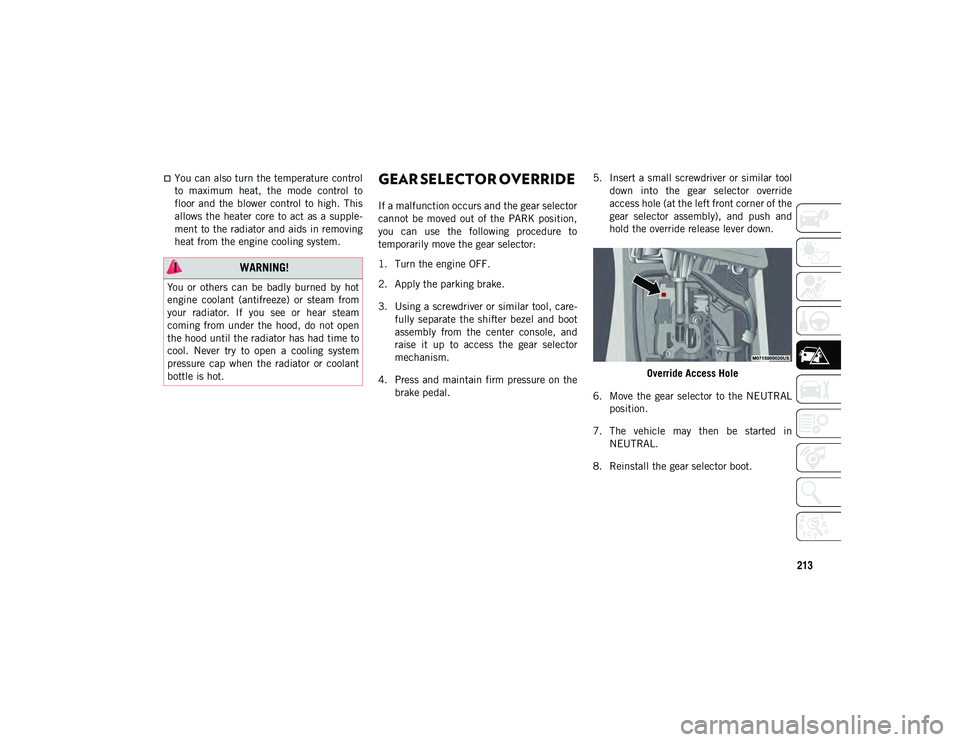
4. Press and maintain firm pressure on the brake pedal. 5. Insert a small screwdriver or similar tool
down into the gear selector override
access hole (at the left front corner of the
gear selector assembly), and push and
hold the override release lever down.
Override Access Hole
6. Move the gear selector to the NEUTRAL position.
7. The vehicle may then be started in NEUTRAL.
8. Reinstall the gear selector boot.
WARNING!
You or others can be badly burned by hot
engine coolant (antifreeze) or steam from
your radiator. If you see or hear steam
coming from under the hood, do not open
the hood until the radiator has had time to
cool. Never try to open a cooling system
pressure cap when the radiator or coolant
bottle is hot.
2020_JEEP_CHEROKEE_UG_RHD_UK.book Page 213
Page 236 of 332
SERVICING AND MAINTENAN
CE
234
Cooling System
Engine Coolant Checks
Check the engine coolant (antifreeze) protec-
tion every 12 months (before the onset of
freezing weather, where applicable). If the
engine coolant (antifreeze) is dirty, the
system should be drained, flushed, and refilled with fresh OAT coolant (conforming
to MS.90032) by an authorized dealer.
Check the front of the A/C condenser for any
accumulation of bugs, leaves, etc. If dirty,
clean by gently spraying water from a garden
hose vertically down the face of the
condenser.
Check the engine cooling system hoses for
brittle rubber, cracking, tears, cuts, and
tightness of the connection at the coolant
recovery bottle and radiator. Inspect the
entire system for leaks. DO NOT REMOVE
THE COOLANT PRESSURE CAP WHEN THE
COOLING SYSTEM IS HOT.
Adding Washer Fluid
The windshield and rear window washers
share the same fluid reservoir. The fluid
reservoir is located in the front of the engine
compartment. Be sure to check the fluid
level in the reservoir at regular intervals. Fill
the reservoir with windshield washer solvent
(not radiator antifreeze) and operate the
system for a few seconds to flush out the
residual water.
When refilling the washer fluid reservoir,
take some washer fluid and apply it to a cloth
or towel and wipe clean the wiper blades,
this will help blade performance.To prevent freeze-up of your windshield
washer system in cold weather, select a solu
-
tion or mixture that meets or exceeds the
temperature range of your climate. This
rating information can be found on most
washer fluid containers.
Brake System
In order to ensure brake system perfor -
mance, all brake system components should
be inspected periodically. Refer to the
“Maintenance Plan” in this section for the
proper maintenance intervals.
WARNING!
You or others can be badly burned by hot
engine coolant (antifreeze) or steam
from your radiator. If you see or hear
steam coming from under the hood, do
not open the hood until the radiator has
had time to cool. Never open a cooling
system pressure cap when the radiator or
coolant bottle is hot.
Keep hands, tools, clothing, and jewelry
away from the radiator cooling fan when
the hood is raised. The fan starts auto-
matically and may start at any time,
whether the engine is running or not.
When working near the radiator cooling
fan, turn the ignition to the OFF mode.
The fan is temperature controlled and
can start at any time the ignition is in the
ON mode.
WARNING!
Commercially available windshield washer
solvents are flammable. They could ignite
and burn you. Care must be exercised
when filling or working around the washer
solution.
CAUTION!
Do not travel with the windshield washer
fluid reservoir empty: the windshield
washer is essential for improving visibility.
2020_JEEP_CHEROKEE_UG_RHD_UK.book Page 234