seats JEEP CHEROKEE 2021 Owner handbook (in English)
[x] Cancel search | Manufacturer: JEEP, Model Year: 2021, Model line: CHEROKEE, Model: JEEP CHEROKEE 2021Pages: 332, PDF Size: 8.87 MB
Page 8 of 332
6
WELCOME FROM FCA
HOW TO FIND YOUR OWNER’S MANUAL
ONLINE ................................................... 1
HOW TO USE THIS MANUAL
HOW TO USE THIS MANUAL ..................... 2
Essential Information ........................ 2
Symbols .......................................... 2
ROLLOVER WARNING ................................ 2
IMPORTANT NOTICE ................................. 3
WARNINGS AND CAUTIONS ...................... 4
VEHICLE MODIFICATIONS/ALTERATIONS .... 4
GETTING TO KNOW YOUR VEHICLE
KEYS .................................................... 13
Key Fob ......................................... 13
IGNITION SWITCH .................................. 15
Ignition Node Module (IGNM) —
If Equipped.................................... 15 Keyless Enter-N-Go (Ignition) —
If Equipped.................................... 15
REMOTE STARTING SYSTEM —
IF EQUIPPED .......................................... 17
How To Use Remote Start ............... 17
To Enter Remote Start Mode............ 17
VEHICLE SECURITY ALARM —
IF EQUIPPED ..........................................18
To Arm The System ....................... 18
To Disarm The System ................... 18
DOORS ................................................. 19
Keyless Enter-N-Go —
Passive Entry ................................ 19 Child-Protection Door Lock System —
Rear Doors .................................... 22
SEATS ..................................................22
Driver Memory Seat —
If Equipped ................................... 23 Heated Seats ................................. 24
Front Ventilated Seats —
If Equipped .................................. 25
HEAD RESTRAINTS ................................ 26
Reactive Head Restraints —
Front Seats .................................... 26 Rear Head Restraints...................... 27
STEERING WHEEL .................................. 28
Tilt/Telescoping Steering Column ..... 28
Heated Steering Wheel —
If Equipped .................................. 28
MIRRORS .............................................29
Power Folding Mirrors —
If Equipped ................................... 29
EXTERIOR LIGHTS ..................................30
Multifunction Lever ........................30
Headlight Switch ............................30
Daytime Running Lights (DRLs) —
If Equipped ....................................30 High/Low Beam Switch....................31
Automatic High Beam Headlamp
Control — If Equipped ...................31 Flash-To-Pass .................................31
Automatic Headlights —
If Equipped ...................................31 Parking Lights ................................31
Headlights On With Wipers (Available
With Automatic Headlights Only) ......31 Adaptive Bi-Xenon High Intensity
Discharge Headlights —
If Equipped ....................................32 Headlight Time Delay ......................32
Lights-On Reminder .......................32
Front And Rear Fog Lights —
If Equipped ....................................32 Turn Signals ...................................33
Automatic Headlight Leveling —
HID Headlights Only .......................33 Battery Saver ..................................33
2020_JEEP_CHEROKEE_UG_RHD_UK.book Page 6
Page 12 of 332
10
IF YOUR ENGINE OVERHEATS ............... 212
GEAR SELECTOR OVERRIDE .................. 213FREEING A STUCK VEHICLE .................. 214TOWING A DISABLED VEHICLE ............. 215
Without The Key Fob .................... 216
Front-Wheel Drive (FWD) Models .... 216
4x4 Models .................................. 216
Recovery Strap — If Equipped ....... 217
ENHANCED ACCIDENT RESPONSE
SYSTEM (EARS) .................................. 217
EVENT DATA RECORDER (EDR) .............. 217
SERVICING AND MAINTENANCE
SCHEDULED SERVICING ....................... 218
Scheduled Servicing —
Gasoline Engine .......................... 218 Scheduled Servicing —
Diesel Engine ............................... 224
ENGINE COMPARTMENT ....................... 229
2.0L Engine ................................ 229
2.4L Engine ................................ 230
3.2L Engine ................................ 231
2.2L Diesel Engine ...................... 232
Checking Oil Level ........................ 233
Cooling System ............................ 234
Adding Washer Fluid .................... 234
Brake System .............................. 234 Manual Transmission —
If Equipped ................................. 236 Automatic Transmission —
If Equipped ................................. 236 Maintenance-Free Battery ............ 236
Pressure Washing ......................... 237
DEALER SERVICE ................................237
Windshield Wiper Blades ............. 237
RAISING THE VEHICLE ..........................241
TIRES .................................................241
Tires — General Information ........ 241
Tire Types ................................... 246
Spare Tires — If Equipped ........... 246
Wheel And Wheel Trim Care ......... 248
Tire Chains And Traction
Devices ...................................... 249 Tire Rotation Recommendations .... 250
STORING THE VEHICLE .........................251BODYWORK .........................................252
Preserving The Bodywork .............. 252
INTERIORS .........................................253
Seats And Fabric Parts ................. 253
Plastic And Coated Parts............... 254
Leather Parts ............................... 254
Glass Surfaces ............................ 254
TECHNICAL SPECIFICATIONS
VEHICLE IDENTIFICATION NUMBER........255BRAKE SYSTEM ...................................255
WHEEL AND TIRE TORQUE
SPECIFICATIONS ..................................256
Torque Specifications ....................256
WHEELS ..............................................256
WEIGHTS.............................................256
FUEL REQUIREMENTS —
GASOLINE ENGINES ..............................257
2.0L Engine .................................257
2.4L And 3.2L Engines .................257
Materials Added To Fuel ................257
Fuel Icon Identification Compliant
To EN16942 ................................257
FUEL REQUIREMENTS —
DIESEL ENGINE ....................................259
Fuel Icon Identification Compliant
To EN16942 ................................259
FLUID CAPACITIES ..............................261
FLUIDS AND LUBRICANTS .....................262
Engine .........................................262
Chassis ........................................265
FUEL CONSUMPTION AND
CO
2 EMISSIONS ..................................266
MOPAR ACCESSORIES .........................266
Authentic Accessories By Mopar .....266
2020_JEEP_CHEROKEE_UG_RHD_UK.book Page 10
Page 24 of 332
GETTING TO KNOW YOUR VEHICLE
22
Child-Protection Door Lock System —
Rear Doors
To provide a safer environment for small chil-
dren riding in the rear seats, the rear doors
are equipped with a Child-Protection Door
Lock system.
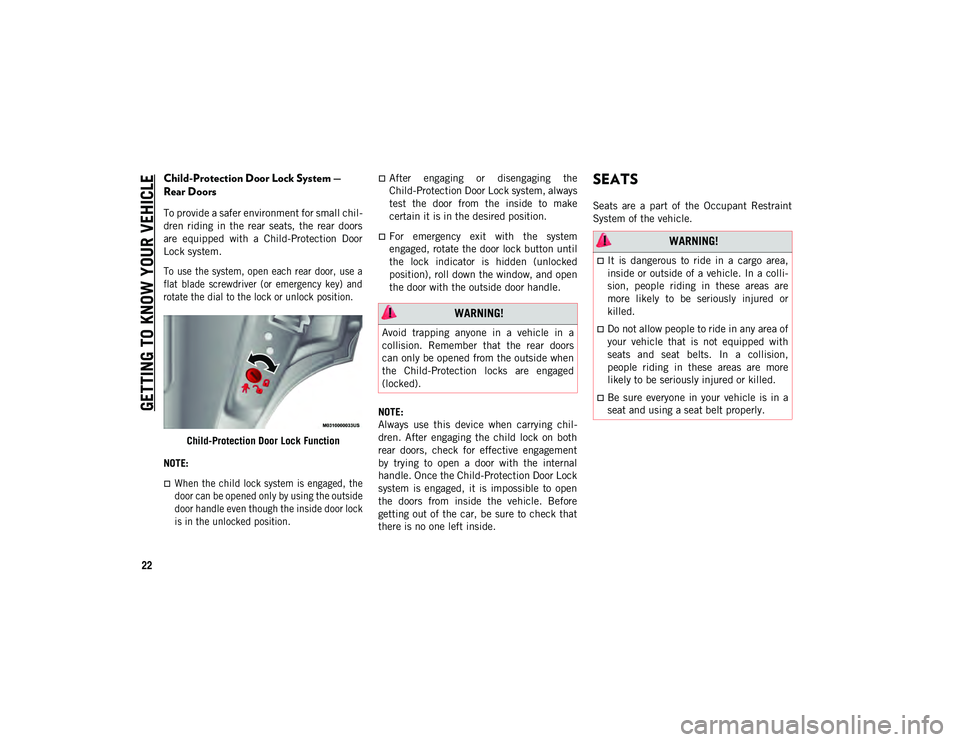
To use the system, open each rear door, use a
flat blade screwdriver (or emergency key) and
rotate the dial to the lock or unlock position.
Child-Protection Door Lock Function
NOTE:
When the child lock system is engaged, the
door can be opened only by using the outside
door handle even though the inside door lock
is in the unlocked position.
After engaging or disengaging the
Child-Protection Door Lock system, always
test the door from the inside to make
certain it is in the desired position.
For emergency exit with the system
engaged, rotate the door lock button until
the lock indicator is hidden (unlocked
position), roll down the window, and open
the door with the outside door handle.
NOTE:
Always use this device when carrying chil -
dren. After engaging the child lock on both
rear doors, check for effective engagement
by trying to open a door with the internal
handle. Once the Child-Protection Door Lock
system is engaged, it is impossible to open
the doors from inside the vehicle. Before
getting out of the car, be sure to check that
there is no one left inside.
SEATS
Seats are a part of the Occupant Restraint
System of the vehicle.
WARNING!
Avoid trapping anyone in a vehicle in a
collision. Remember that the rear doors
can only be opened from the outside when
the Child-Protection locks are engaged
(locked).
WARNING!
It is dangerous to ride in a cargo area,
inside or outside of a vehicle. In a colli -
sion, people riding in these areas are
more likely to be seriously injured or
killed.
Do not allow people to ride in any area of
your vehicle that is not equipped with
seats and seat belts. In a collision,
people riding in these areas are more
likely to be seriously injured or killed.
Be sure everyone in your vehicle is in a
seat and using a seat belt properly.
2020_JEEP_CHEROKEE_UG_RHD_UK.book Page 22
Page 25 of 332
23
Driver Memory Seat — If Equipped
The memory seat feature allows you to save
two different driver seating positions, driver's
outside mirror, and radio station preset
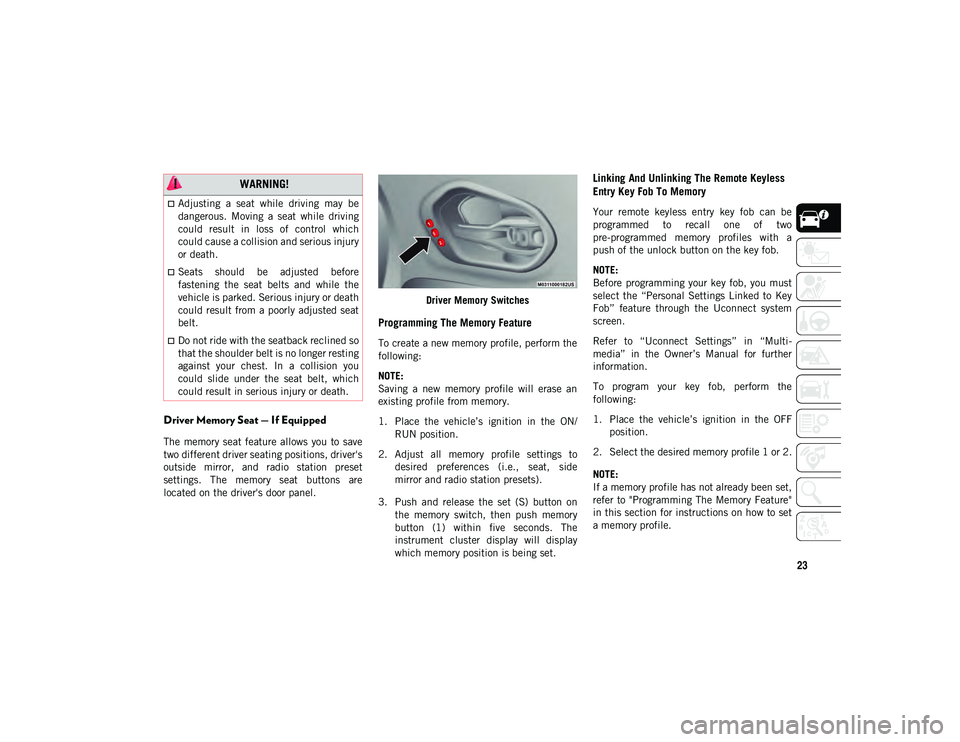
settings. The memory seat buttons are
located on the driver's door panel.Driver Memory Switches
Programming The Memory Feature
To create a new memory profile, perform the
following:
NOTE:
Saving a new memory profile will erase an
existing profile from memory.
1. Place the vehicle’s ignition in the ON/
RUN position.
2. Adjust all memory profile settings to desired preferences (i.e., seat, side
mirror and radio station presets).
3. Push and release the set (S) button on the memory switch, then push memory
button (1) within five seconds. The
instrument cluster display will display
which memory position is being set.
Linking And Unlinking The Remote Keyless
Entry Key Fob To Memory
Your remote keyless entry key fob can be
programmed to recall one of two
pre-programmed memory profiles with a
push of the unlock button on the key fob.
NOTE:
Before programming your key fob, you must
select the “Personal Settings Linked to Key
Fob” feature through the Uconnect system
screen.
Refer to “Uconnect Settings” in “Multi -
media” in the Owner’s Manual for further
information.
To program your key fob, perform the
following:
1. Place the vehicle’s ignition in the OFF position.
2. Select the desired memory profile 1 or 2.
NOTE:
If a memory profile has not already been set,
refer to "Programming The Memory Feature"
in this section for instructions on how to set
a memory profile.
WARNING!
Adjusting a seat while driving may be
dangerous. Moving a seat while driving
could result in loss of control which
could cause a collision and serious injury
or death.
Seats should be adjusted before
fastening the seat belts and while the
vehicle is parked. Serious injury or death
could result from a poorly adjusted seat
belt.
Do not ride with the seatback reclined so
that the shoulder belt is no longer resting
against your chest. In a collision you
could slide under the seat belt, which
could result in serious injury or death.
2020_JEEP_CHEROKEE_UG_RHD_UK.book Page 23
Page 26 of 332
GETTING TO KNOW YOUR VEHICLE
24
3. Push and release the set (S) button onthe memory switch, then within five
seconds push and release the button
labeled (1) or (2) accordingly. “Memory
Profile Set” (1 or 2) will display in the
instrument cluster display.
4. Push and release the lock button on the key fob within 10 seconds.
NOTE:
Your key fob can be unlinked to your memory
settings by pushing the set (S) button,
followed by pushing the unlock button on the
key fob within 10 seconds.
Memory Position Recall
To recall the memory settings for driver one,
push memory button (1) or the unlock button
on the key fob linked to memory position 1.
To recall the memory settings for driver two,
push memory button (2) or the unlock button
on the key fob linked to memory position 2.
A recall can be cancelled by pushing any of the
memory buttons (S, 1, or 2) during a recall.
When a recall is cancelled, the driver seat will
stop moving. A delay of one second will occur
before another recall can be selected.
Easy Entry/Exit Seat — If Equipped
This feature provides automatic driver seat
positioning to enhance driver mobility when
entering and exiting the vehicle.
The distance the driver seat moves depends
on where you have the driver seat positioned
when you place the vehicle’s ignition in the
OFF position.
Each stored memory setting will have an
associated Easy Entry and Easy Exit position.
NOTE:
The Easy Entry/Exit feature is not enabled
when the vehicle is delivered from the
factory. The Easy Entry/Exit feature is
enabled (or later disabled) through the
programmable features in the Uconnect
system.
Refer to “Uconnect Settings” in “Multi -
media” in the Owner’s Manual for further
information.
Heated Seats
On some models, the front and rear seats
may be equipped with heaters located in the
seat cushions and seat backs.
WARNING!
Persons who are unable to feel pain to
the skin because of advanced age,
chronic illness, diabetes, spinal cord
injury, medication, alcohol use, exhaus-
tion or other physical condition must
exercise care when using the seat heater.
It may cause burns even at low tempera-
tures, especially if used for long periods
of time.
Do not place anything on the seat or
seatback that insulates against heat,
such as a blanket or cushion. This may
cause the seat heater to overheat. Sitting
in a seat that has been overheated could
cause serious burns due to the increased
surface temperature of the seat.
2020_JEEP_CHEROKEE_UG_RHD_UK.book Page 24
Page 27 of 332
25
Front Heated Seats — If Equipped
If your vehicle is equipped with front heated
seats, the control buttons are located within
the Uconnect system. You can gain access to
the control buttons through the climate
screen or the controls screen.
Press the heated seat button once to
turn the HI setting on.
Press the heated seat button a second
time to turn the LO setting on.
Press the heated seat button a third
time to turn the heating elements off.
The level of heat selected will stay on until
changed by the operator.
NOTE:
The engine must be running for the heated
seats to operate.
Vehicles Equipped With Remote Start
On models that are equipped with remote start,
the driver’s heated seat can be programmed to
come on during a remote start.
This feature can be programmed through the
Uconnect system. Refer to “Uconnect Settings”
in “Multimedia” in the Owner's Manual.
Rear Heated Seats — If Equipped
On some models, the two outboard rear seats
are equipped with heated seats. The heated
seat switches for these seats are located on
the rear of the center console.
There are two heated seat switches that allow
the rear passengers to operate the seats
independently. Amber indicator lights in
each switch indicate the level of heat in use. Two indicator lights will illuminate for HI,
one for LO and none for off.
Push the heated seat button once to
turn the HI setting on.
Push the heated seat button a second
time to turn the LO setting on.
Push the heated seat button a third
time to turn the heating elements off.
NOTE:
Once a heat setting is selected, heat will
be felt within two to five minutes.
The engine must be running for the heated
seats to operate.
When the HI-level setting is selected, the
heater will provide a boosted heat level
during the first four minutes of operation.
Then, the heat output will drop to the normal
HI-level. The level of heat selected will stay
on until changed by the operator.
Front Ventilated Seats — If Equipped
If your vehicle is equipped with ventilated
seats, the seat cushion and seat back will
have fans that draw the air from the
passenger compartment and move air
through fine perforations in the seat cover to
WARNING!
Persons who are unable to feel pain to
the skin because of advanced age,
chronic illness, diabetes, spinal cord
injury, medication, alcohol use, exhaus-
tion or other physical condition must
exercise care when using the seat heater.
It may cause burns even at low tempera-
tures, especially if used for long periods
of time.
Do not place anything on the seat or
seatback that insulates against heat,
such as a blanket or cushion. This may
cause the seat heater to overheat. Sitting
in a seat that has been overheated could
cause serious burns due to the increased
surface temperature of the seat.
2020_JEEP_CHEROKEE_UG_RHD_UK.book Page 25
Page 28 of 332
GETTING TO KNOW YOUR VEHICLE
26
help keep the driver and front passenger
cooler in higher ambient temperatures. The
fans operate at two speeds, HI and LO.
The front ventilated seats control buttons are
located within the Uconnect system. You can
gain access to the control buttons through
the climate screen or the controls screen.
Press the ventilated seat button once to
choose HI.
Press the ventilated seat button a
second time to choose LO.
Press the ventilated seat button a third
time to turn the ventilated seat off.
NOTE:
The engine must be running for the venti -
lated seats to operate.
Vehicles Equipped With Remote Start
On models that are equipped with remote
start, the driver’s ventilated seat can be
programmed to come on during a remote
start.
This feature can be programmed through the
Uconnect system. Refer to “Uconnect
Settings” in “Multimedia” in the Owner's
Manual.
HEAD RESTRAINTS
Head restraints are designed to reduce the
risk of injury by restricting head movement in
the event of a rear impact. Head restraints
should be adjusted so that the top of the
head restraint is located above the top of
your ear.
NOTE:
Do not reverse the head restraints (making
the rear of the head restraint face forward) in
an attempt to gain additional clearance to
the back of your head.
Reactive Head Restraints — Front Seats
The front driver and passenger seats are
equipped with Reactive Head Restraints
(RHR). In the event of a rear impact, the
RHRs will automatically extend forward
minimizing the gap between the back of the
occupant’s head and the RHR.
The RHRs will automatically return to their
normal position following a rear impact. If
the RHRs do not return to their normal posi -
tion, see your authorized dealer immediately.
To raise the head restraint, pull upward on
the head restraint. To lower the head
restraint, push the adjustment button,
located at the base of the head restraint, and
push downward on the head restraint.
NOTE:
To remove the head restraint, raise it as far
as it can go. Then, push the release button
and the adjustment button at the base of
each post while pulling the head restraint up.
Seatback angle may need to be adjusted to
fully remove the head restraint. To reinstall
the head restraint, put the head restraint
posts into the holes and push downward.
Then adjust the head restraint to the appro -
priate height.
WARNING!
All occupants, including the driver,
should not operate a vehicle or sit in a
vehicle’s seat until the head restraints
are placed in their proper positions in
order to minimize the risk of neck injury
in the event of a crash.
Head restraints should never be adjusted
while the vehicle is in motion. Driving a
vehicle with the head restraints improp -
erly adjusted or removed could cause
serious injury or death in the event of a
collision.
2020_JEEP_CHEROKEE_UG_RHD_UK.book Page 26
Page 100 of 332
SAFETY
98
OCCUPANT RESTRAINT
SYSTEMS
Some of the most important safety features
in your vehicle are the restraint systems:
Occupant Restraint Systems Features
Seat Belt Systems
Supplemental Restraint Systems (SRS)
Air Bags
Child Restraints
Some of the safety features described in this
section may be standard equipment on some
models, or may be optional equipment on
others. If you are not sure, ask an authorized
dealer.
Important Safety Precautions
Please pay close attention to the information
in this section. It tells you how to use your
restraint system properly, to keep you and
your passengers as safe as possible. Here are some simple steps you can take to
minimize the risk of harm from a deploying
air bag:
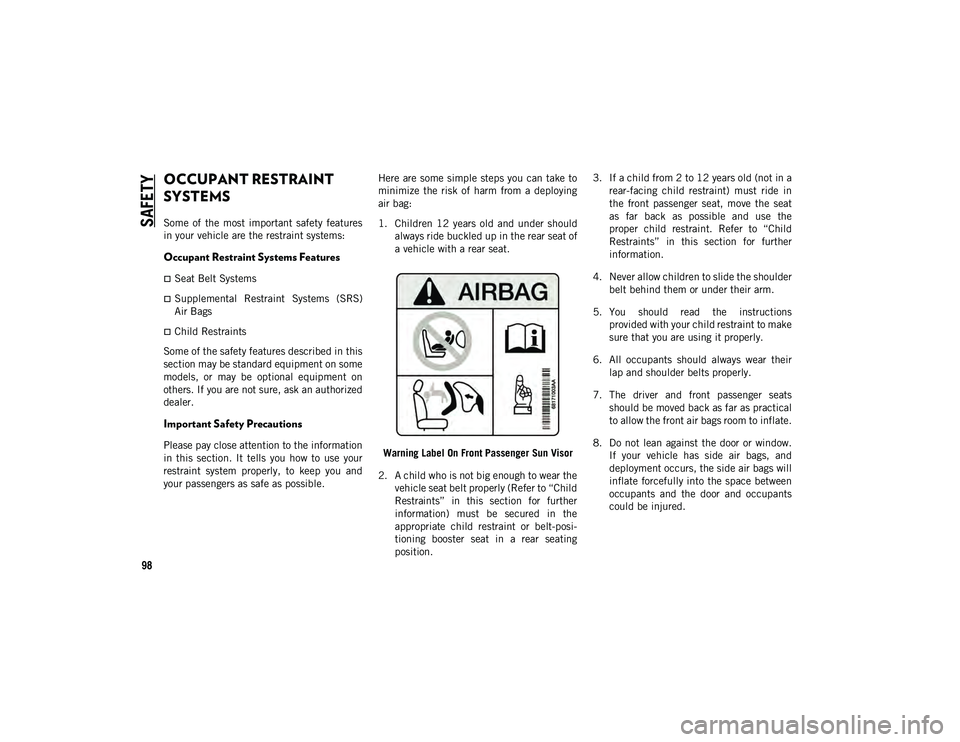
1. Children 12 years old and under should
always ride buckled up in the rear seat of
a vehicle with a rear seat.
Warning Label On Front Passenger Sun Visor
2. A child who is not big enough to wear the vehicle seat belt properly (Refer to “Child
Restraints” in this section for further
information) must be secured in the
appropriate child restraint or belt-posi -
tioning booster seat in a rear seating
position. 3. If a child from 2 to 12 years old (not in a
rear-facing child restraint) must ride in
the front passenger seat, move the seat
as far back as possible and use the
proper child restraint. Refer to “Child
Restraints” in this section for further
information.
4. Never allow children to slide the shoulder belt behind them or under their arm.
5. You should read the instructions provided with your child restraint to make
sure that you are using it properly.
6. All occupants should always wear their lap and shoulder belts properly.
7. The driver and front passenger seats should be moved back as far as practical
to allow the front air bags room to inflate.
8. Do not lean against the door or window. If your vehicle has side air bags, and
deployment occurs, the side air bags will
inflate forcefully into the space between
occupants and the door and occupants
could be injured.
2020_JEEP_CHEROKEE_UG_RHD_UK.book Page 98
Page 103 of 332
101
(Continued)
(Continued)
(Continued)
It is dangerous to ride in a cargo area,
inside or outside of a vehicle. In a colli -
sion, people riding in these areas are
more likely to be seriously injured or
killed.
Do not allow people to ride in any area of
your vehicle that is not equipped with
seats and seat belts.
Be sure everyone in your vehicle is in a
seat and using a seat belt properly.
Occupants, including the driver, should
always wear their seat belts whether or
not an air bag is also provided at their
seating position to minimize the risk of
severe injury or death in the event of a
crash.
Wearing your seat belt incorrectly could
make your injuries in a collision much
worse. You might suffer internal injuries,
or you could even slide out of the seat
belt. Follow these instructions to wear
your seat belt safely and to keep your
passengers safe, too.
WARNING! (Continued)
Two people should never be belted into a
single seat belt. People belted together
can crash into one another in a collision,
hurting one another badly. Never use a
lap/shoulder belt or a lap belt for more
than one person, no matter what their
size.
WARNING!
A lap belt worn too high can increase the
risk of injury in a collision. The seat belt
forces won’t be at the strong hip and
pelvic bones, but across your abdomen.
Always wear the lap part of your seat belt
as low as possible and keep it snug.
A twisted seat belt may not protect you
properly. In a collision, it could even cut
into you. Be sure the seat belt is flat
against your body, without twists. If you
can’t straighten a seat belt in your
vehicle, take it to an authorized dealer
immediately and have it fixed.
WARNING! (Continued)
A seat belt that is buckled into the wrong
buckle will not protect you properly. The
lap portion could ride too high on your
body, possibly causing internal injuries.
Always buckle your seat belt into the
buckle nearest you.
A seat belt that is too loose will not
protect you properly. In a sudden stop,
you could move too far forward,
increasing the possibility of injury. Wear
your seat belt snugly.
A seat belt that is worn under your arm is
dangerous. Your body could strike the
inside surfaces of the vehicle in a colli -
sion, increasing head and neck injury. A
seat belt worn under the arm can cause
internal injuries. Ribs aren’t as strong as
shoulder bones. Wear the seat belt over
your shoulder so that your strongest
bones will take the force in a collision.
A shoulder belt placed behind you will
not protect you from injury during a colli -
sion. You are more likely to hit your head
in a collision if you do not wear your
shoulder belt. The lap and shoulder belt
are meant to be used together.
WARNING! (Continued)
2020_JEEP_CHEROKEE_UG_RHD_UK.book Page 101
Page 105 of 332
103
6. To release the seat belt, push the redbutton on the buckle. The seat belt will
automatically retract to its stowed posi -
tion. If necessary, slide the latch plate
down the webbing to allow the seat belt
to retract fully.
Lap/Shoulder Belt Untwisting Procedure
Use the following procedure to untwist a
twisted lap/shoulder belt.
1. Position the latch plate as close as possible to the anchor point.
2. At about 6 to 12 inches (15 to 30 cm) above the latch plate, grasp and twist the
seat belt webbing 180 degrees to create
a fold that begins immediately above the
latch plate.
3. Slide the latch plate upward over the folded webbing. The folded webbing
must enter the slot at the top of the latch
plate.
4. Continue to slide the latch plate up until it clears the folded webbing and the seat
belt is no longer twisted.
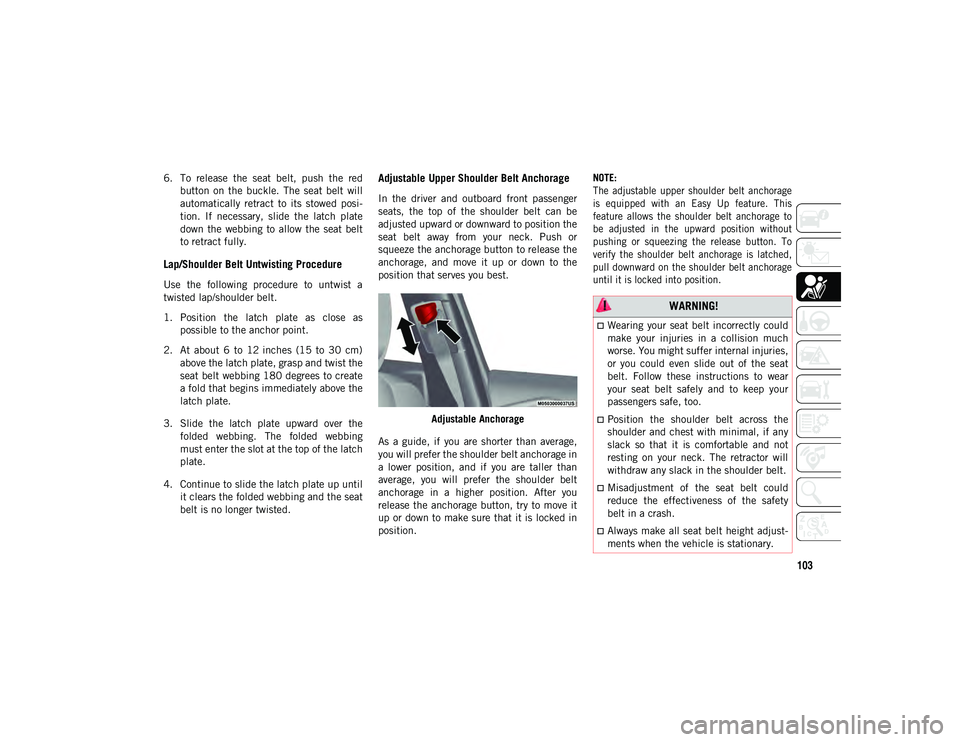
Adjustable Upper Shoulder Belt Anchorage
In the driver and outboard front passenger
seats, the top of the shoulder belt can be
adjusted upward or downward to position the
seat belt away from your neck. Push or
squeeze the anchorage button to release the
anchorage, and move it up or down to the
position that serves you best.
Adjustable Anchorage
As a guide, if you are shorter than average,
you will prefer the shoulder belt anchorage in
a lower position, and if you are taller than
average, you will prefer the shoulder belt
anchorage in a higher position. After you
release the anchorage button, try to move it
up or down to make sure that it is locked in
position.
NOTE:
The adjustable upper shoulder belt anchorage
is equipped with an Easy Up feature. This
feature allows the shoulder belt anchorage to
be adjusted in the upward position without
pushing or squeezing the release button. To
verify the shoulder belt anchorage is latched,
pull downward on the shoulder belt anchorage
until it is locked into position.
WARNING!
Wearing your seat belt incorrectly could
make your injuries in a collision much
worse. You might suffer internal injuries,
or you could even slide out of the seat
belt. Follow these instructions to wear
your seat belt safely and to keep your
passengers safe, too.
Position the shoulder belt across the
shoulder and chest with minimal, if any
slack so that it is comfortable and not
resting on your neck. The retractor will
withdraw any slack in the shoulder belt.
Misadjustment of the seat belt could
reduce the effectiveness of the safety
belt in a crash.
Always make all seat belt height adjust
-
ments when the vehicle is stationary.
2020_JEEP_CHEROKEE_UG_RHD_UK.book Page 103