seats JEEP CHEROKEE 2021 Owner handbook (in English)
[x] Cancel search | Manufacturer: JEEP, Model Year: 2021, Model line: CHEROKEE, Model: JEEP CHEROKEE 2021Pages: 332, PDF Size: 8.87 MB
Page 106 of 332
SAFETY
104
Second Row Center Seat Belt Operating
Instructions — Fixed Rear Seat — If
Equipped
The second row center seat belt may feature
a seat belt with a mini-latch plate and
buckle, which allows the seat belt to detach
from the lower anchor when the seat is
folded. The mini-latch plate and regular
latch plate can then be stored out of the way
in the left side trim panel for added conve-
nience to open up utilization of the storage
areas behind the front seats when the seat is
not occupied.
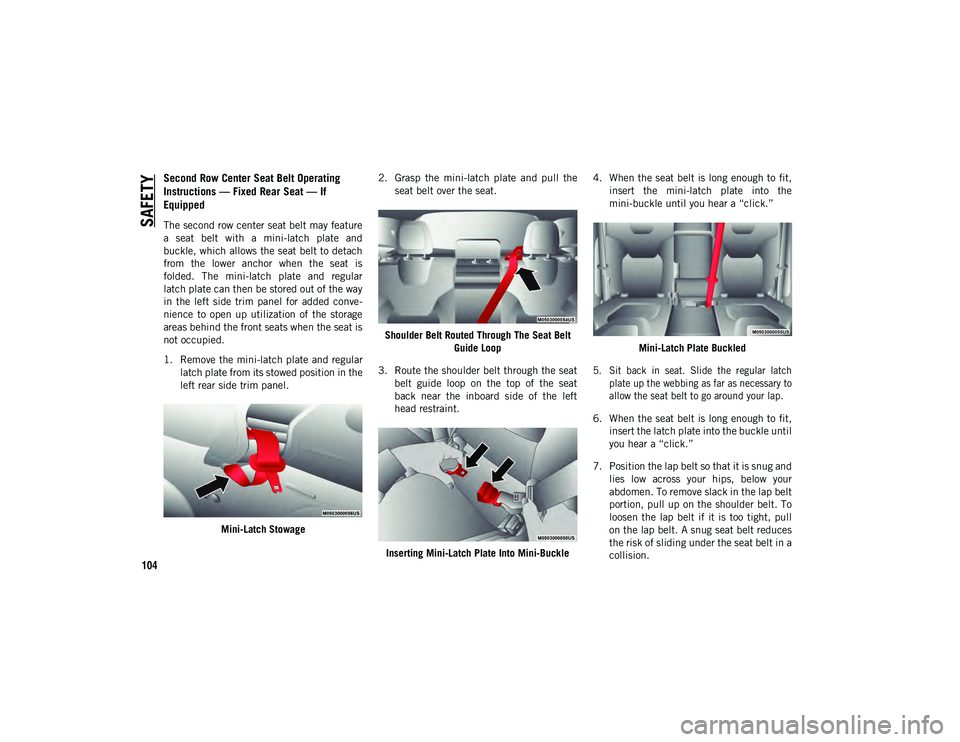
1. Remove the mini-latch plate and regular latch plate from its stowed position in the
left rear side trim panel.
Mini-Latch Stowage 2. Grasp the mini-latch plate and pull the
seat belt over the seat.
Shoulder Belt Routed Through The Seat Belt Guide Loop
3. Route the shoulder belt through the seat belt guide loop on the top of the seat
back near the inboard side of the left
head restraint.
Inserting Mini-Latch Plate Into Mini-Buckle 4. When the seat belt is long enough to fit,
insert the mini-latch plate into the
mini-buckle until you hear a “click.”
Mini-Latch Plate Buckled
5. Sit back in seat. Slide the regular latch plate up the webbing as far as necessary to
allow the seat belt to go around your lap.
6. When the seat belt is long enough to fit, insert the latch plate into the buckle until
you hear a “click.”
7. Position the lap belt so that it is snug and lies low across your hips, below your
abdomen. To remove slack in the lap belt
portion, pull up on the shoulder belt. To
loosen the lap belt if it is too tight, pull
on the lap belt. A snug seat belt reduces
the risk of sliding under the seat belt in a
collision.
2020_JEEP_CHEROKEE_UG_RHD_UK.book Page 104
Page 109 of 332
107
(Continued)
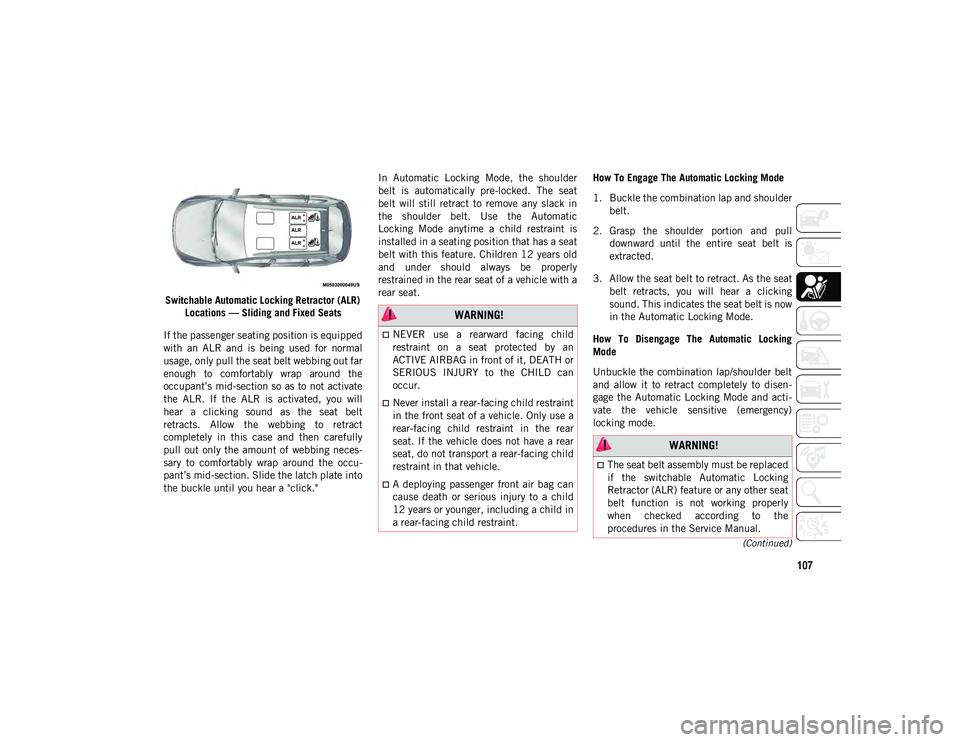
Switchable Automatic Locking Retractor (ALR) Locations — Sliding and Fixed Seats
If the passenger seating position is equipped
with an ALR and is being used for normal
usage, only pull the seat belt webbing out far
enough to comfortably wrap around the
occupant’s mid-section so as to not activate
the ALR. If the ALR is activated, you will
hear a clicking sound as the seat belt
retracts. Allow the webbing to retract
completely in this case and then carefully
pull out only the amount of webbing neces -
sary to comfortably wrap around the occu -
pant’s mid-section. Slide the latch plate into
the buckle until you hear a "click." In Automatic Locking Mode, the shoulder
belt is automatically pre-locked. The seat
belt will still retract to remove any slack in
the shoulder belt. Use the Automatic
Locking Mode anytime a child restraint is
installed in a seating position that has a seat
belt with this feature. Children 12 years old
and under should always be properly
restrained in the rear seat of a vehicle with a
rear seat.
How To Engage The Automatic Locking Mode
1. Buckle the combination lap and shoulder
belt.
2. Grasp the shoulder portion and pull downward until the entire seat belt is
extracted.
3. Allow the seat belt to retract. As the seat belt retracts, you will hear a clicking
sound. This indicates the seat belt is now
in the Automatic Locking Mode.
How To Disengage The Automatic Locking
Mode
Unbuckle the combination lap/shoulder belt
and allow it to retract completely to disen -
gage the Automatic Locking Mode and acti -
vate the vehicle sensitive (emergency)
locking mode.
WARNING!
NEVER use a rearward facing child
restraint on a seat protected by an
ACTIVE AIRBAG in front of it, DEATH or
SERIOUS INJURY to the CHILD can
occur.
Never install a rear-facing child restraint
in the front seat of a vehicle. Only use a
rear-facing child restraint in the rear
seat. If the vehicle does not have a rear
seat, do not transport a rear-facing child
restraint in that vehicle.
A deploying passenger front air bag can
cause death or serious injury to a child
12 years or younger, including a child in
a rear-facing child restraint.
WARNING!
The seat belt assembly must be replaced
if the switchable Automatic Locking
Retractor (ALR) feature or any other seat
belt function is not working properly
when checked according to the
procedures in the Service Manual.
2020_JEEP_CHEROKEE_UG_RHD_UK.book Page 107
Page 110 of 332
SAFETY
108
Supplemental Restraint Systems (SRS)
Some of the safety features described in this
section may be standard equipment on some
models, or may be optional equipment on
others. If you are not sure, ask an authorized
dealer.
The air bag system must be ready to protect
you in a collision. The Occupant Restraint
Controller (ORC) monitors the internal
circuits and interconnecting wiring associ-
ated with the electrical Air Bag System
Components. Your vehicle may be equipped
with the following Air Bag System Compo -
nents:
Air Bag System Components
Occupant Restraint Controller (ORC)
Air Bag Warning Light
Steering Wheel and Column
Instrument Panel
Knee Impact Bolsters
Driver and Front Passenger Air Bags
Seat Belt Buckle Switch
Supplemental Side Air Bags
Supplemental Knee Air Bags
Front and Side Impact Sensors
Seat Belt Pretensioners
Seat Track Position Sensors
Air Bag Warning Light
The Occupant Restraint Controller
(ORC) monitors the readiness of the
electronic parts of the air bag
system whenever the ignition
switch is in the START or ON/RUN position.
If the ignition switch is in the OFF position or
in the ACC position, the air bag system is not
on and the air bags will not inflate. The ORC contains a backup power supply
system that may deploy the air bag system
even if the battery loses power or it becomes
disconnected prior to deployment.
The ORC turns on the Air Bag Warning Light
in the instrument panel for approximately
four to eight seconds for a self-check when
the ignition switch is first in the ON/RUN
position. After the self-check, the Air Bag
Warning Light will turn off. If the ORC
detects a malfunction in any part of the
system, it turns on the Air Bag Warning
Light, either momentarily or continuously. A
single chime will sound to alert you if the
light comes on again after initial startup.
The ORC also includes diagnostics that will
illuminate the instrument panel Air Bag
Warning Light if a malfunction is detected
that could affect the air bag system. The
diagnostics also record the nature of the
malfunction. While the air bag system is
designed to be maintenance free, if any of
the following occurs, have an authorized
dealer service the air bag system
immediately.
Failure to replace the seat belt assembly
could increase the risk of injury in
collisions.
Do not use the Automatic Locking Mode
to restrain occupants who are wearing
the seat belt or children who are using
booster seats. The locked mode is only
used to install rear-facing or
forward-facing child restraints that have
a harness for restraining the child.
WARNING! (Continued)
2020_JEEP_CHEROKEE_UG_RHD_UK.book Page 108
Page 113 of 332
111
Front Air Bag Operation
Front Air Bags are designed to provide addi-
tional protection by supplementing the seat
belts. Front air bags are not expected to
reduce the risk of injury in rear, side, or roll -
over collisions. The front air bags will not
deploy in all frontal collisions, including
some that may produce substantial vehicle
damage — for example, some pole colli -
sions, truck underrides, and angle offset
collisions.
On the other hand, depending on the type
and location of impact, front air bags may
deploy in crashes with little vehicle front-end
damage but that produce a severe initial
deceleration.
Because air bag sensors measure vehicle
deceleration over time, vehicle speed and
damage by themselves are not good indica -
tors of whether or not an air bag should have
deployed.
Seat belts are necessary for your protection
in all collisions, and also are needed to help
keep you in position, away from an inflating
air bag. When the ORC detects a collision requiring
the front air bags, it signals the inflator units.
A large quantity of non-toxic gas is generated
to inflate the front air bags.
The steering wheel hub trim cover and the
upper passenger side of the instrument
panel separate and fold out of the way as the
air bags inflate to their full size. The front air
bags fully inflate in less time than it takes to
blink your eyes. The front air bags then
quickly deflate while helping to restrain the
driver and front passenger.
Knee Impact Bolsters
The Knee Impact Bolsters help protect the
knees of the driver and front passenger, and
position the front occupants for improved
interaction with the front air bags.
Supplemental Driver Knee Air Bag
This vehicle is equipped with a Supple
-
mental Driver Knee Air Bag mounted in the
instrument panel below the steering column.
The Supplemental Driver Knee Air Bag
provides enhanced protection during a
frontal impact by working together with the
seat belts, pretensioners, and front air bags.
Supplemental Side Air Bags
Supplemental Seat-Mounted Side Air Bags
(SABs) – If Equipped
Your vehicle may be equipped with Supple -
mental Seat-Mounted Side Air Bags (SABs).
If your vehicle is equipped with Supple -
mental Seat-Mounted Side Air Bags (SABs),
please refer to the information below.
Supplemental Seat-Mounted Side Air Bags
(SABs) are located in the outboard side of
the front seats. The SABs are marked with
“SRS AIRBAG” or “AIRBAG” on a label or on
the seat trim on the outboard side of the
seats.
WARNING!
Do not drill, cut, or tamper with the knee
impact bolsters in any way.
Do not mount any accessories to the
knee impact bolsters such as alarm
lights, stereos, citizen band radios, etc.
2020_JEEP_CHEROKEE_UG_RHD_UK.book Page 111
Page 115 of 332
113
The SABICs (if equipped with SABICs) may
help reduce the risk of partial or complete
ejection of vehicle occupants through side
windows in certain side impact events.Side Impacts
The Side Air Bags are designed to activate in
certain side impacts. The Occupant
Restraint Controller (ORC) determines
whether the deployment of the Side Air Bags
in a particular impact event is appropriate,
based on the severity and type of collision.
The side impact sensors aid the ORC in
determining the appropriate response to
impact events. The system is calibrated to
deploy the Side Air Bags on the impact side
of the vehicle during impacts that require
Side Air Bag occupant protection. In side
impacts, the Side Air Bags deploy inde
-
pendently; a left side impact deploys the left
Side Air Bags only and a right-side impact
deploys the right Side Air Bags only. Vehicle
damage by itself is not a good indicator of
whether or not Side Air Bags should have
deployed.
The Side Air Bags will not deploy in all side
collisions, including some collisions at
certain angles, or some side collisions that
do not impact the area of the passenger
compartment. The Side Air Bags may deploy
during angled or offset frontal collisions
where the front air bags deploy. Side Air Bags are a supplement to the seat
belt restraint system. Side Air Bags deploy in
less time than it takes to blink your eyes.
WARNING!
Do not mount equipment, or stack
luggage or other cargo up high enough to
block the deployment of the SABICs.
The trim covering above the side
windows where the SABIC and its
deployment path are located should
remain free from any obstructions.
In order for the SABICs to work as
intended, do not install any accessory
items in your vehicle which could alter
the roof. Do not add an aftermarket
sunroof to your vehicle. Do not add roof
racks that require permanent attach
-
ments (bolts or screws) for installation
on the vehicle roof. Do not drill into the
roof of the vehicle for any reason.
WARNING!
Occupants, including children, who are
up against or very close to Side Air Bags
can be seriously injured or killed. Occu -
pants, including children, should never
lean on or sleep against the door, side
windows, or area where the side air bags
inflate, even if they are in an infant or
child restraint.
Seat belts (and child restraints where
appropriate) are necessary for your
protection in all collisions. They also
help keep you in position, away from an
inflating Side Air Bag. To get the best
protection from the Side Air Bags, occu -
pants must wear their seat belts properly
and sit upright with their backs against
the seats. Children must be properly
restrained in a child restraint or booster
seat that is appropriate for the size of the
child.
2020_JEEP_CHEROKEE_UG_RHD_UK.book Page 113
Page 120 of 332
SAFETY
118
Child Restraints — Carrying Children
Safely
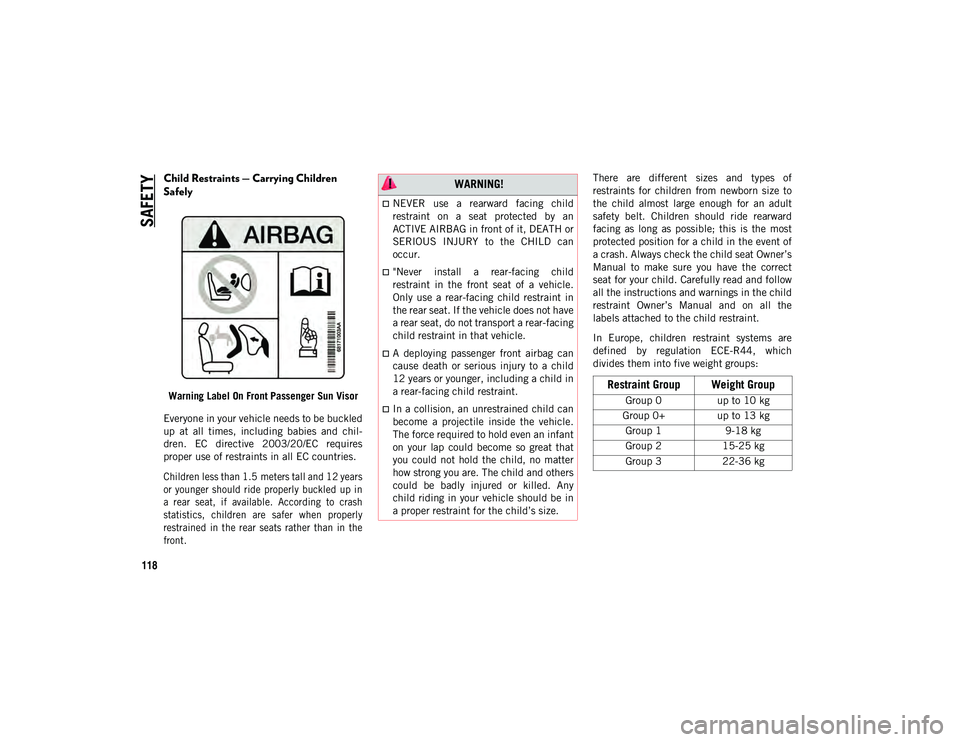
Warning Label On Front Passenger Sun Visor
Everyone in your vehicle needs to be buckled
up at all times, including babies and chil -
dren. EC directive 2003/20/EC requires
proper use of restraints in all EC countries.
Children less than 1.5 meters tall and 12 years
or younger should ride properly buckled up in
a rear seat, if available. According to crash
statistics, children are safer when properly
restrained in the rear seats rather than in the
front.
There are different sizes and types of
restraints for children from newborn size to
the child almost large enough for an adult
safety belt. Children should ride rearward
facing as long as possible; this is the most
protected position for a child in the event of
a crash. Always check the child seat Owner’s
Manual to make sure you have the correct
seat for your child. Carefully read and follow
all the instructions and warnings in the child
restraint Owner’s Manual and on all the
labels attached to the child restraint.
In Europe, children restraint systems are
defined by regulation ECE-R44, which
divides them into five weight groups:
WARNING!
NEVER use a rearward facing child
restraint on a seat protected by an
ACTIVE AIRBAG in front of it, DEATH or
SERIOUS INJURY to the CHILD can
occur.
"Never install a rear-facing child
restraint in the front seat of a vehicle.
Only use a rear-facing child restraint in
the rear seat. If the vehicle does not have
a rear seat, do not transport a rear-facing
child restraint in that vehicle.
A deploying passenger front airbag can
cause death or serious injury to a child
12 years or younger, including a child in
a rear-facing child restraint.
In a collision, an unrestrained child can
become a projectile inside the vehicle.
The force required to hold even an infant
on your lap could become so great that
you could not hold the child, no matter
how strong you are. The child and others
could be badly injured or killed. Any
child riding in your vehicle should be in
a proper restraint for the child’s size.
Restraint Group Weight Group
Group 0
up to 10 kg
Group 0+ up to 13 kg
Group 1 9-18 kg
Group 2 15-25 kg
Group 3 22-36 kg
2020_JEEP_CHEROKEE_UG_RHD_UK.book Page 118
Page 124 of 332
SAFETY
122
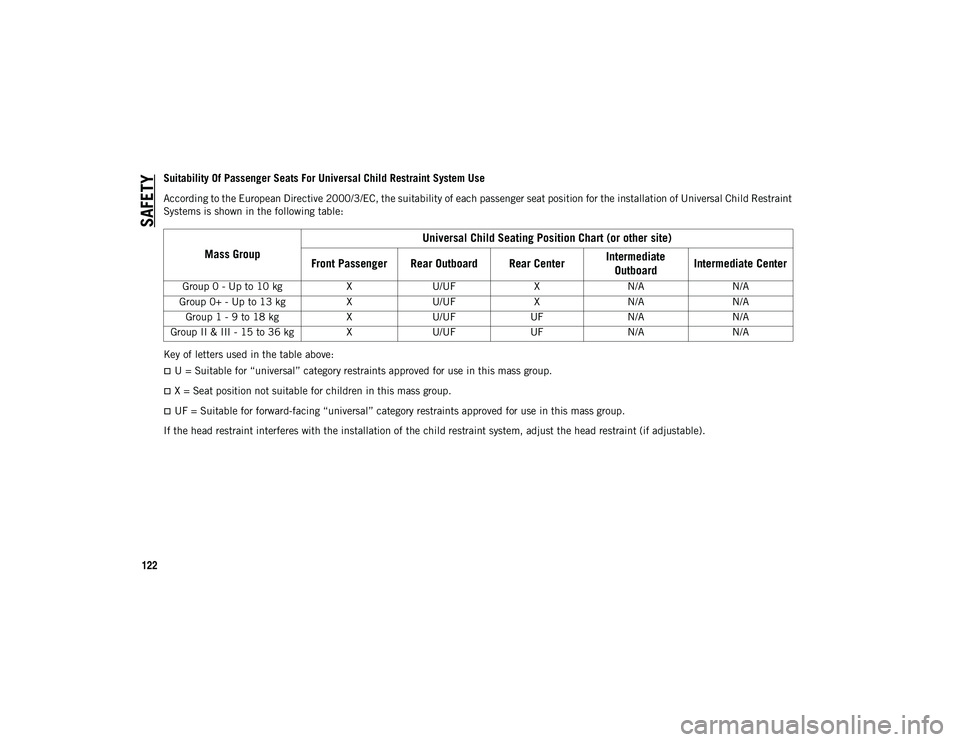
Suitability Of Passenger Seats For Universal Child Restraint System Use
According to the European Directive 2000/3/EC, the suitability of each passenger seat position for the installation of Universal Child Restraint
Systems is shown in the following table:
Key of letters used in the table above:
U = Suitable for “universal” category restraints approved for use in this mass group.
X = Seat position not suitable for children in this mass group.
UF = Suitable for forward-facing “universal” category restraints approved for use in this mass group.
If the head restraint interferes with the installation of the child restraint system, adjust the head restraint (if adjustable).
Mass Group Universal Child Seating Position Chart (or other site)
Front Passenger Rear Outboard Rear Center Intermediate
Outboard Intermediate Center
Group 0 - Up to 10 kg
XU/UF XN/A N/A
Group 0+ - Up to 13 kg XU/UF XN/A N/A
Group 1 - 9 to 18 kg XU/UF UFN/A N/A
Group II & III - 15 to 36 kg XU/UF UFN/A N/A
2020_JEEP_CHEROKEE_UG_RHD_UK.book Page 122
Page 126 of 332
SAFETY
124
Seat Belts For Older Children
Children over 1.50 m in height can wear seat
belts instead of using child restraints.
Use this simple 5-step test to decide
whether the seat belt properly fits the child
or if they should still use a Group 2 or Group
3 child restraint to improve the fit of the seat
belt:
1. Can the child sit all the way back againstthe back of the vehicle seat?
2. Do the child’s knees bend comfortably over the front of the vehicle seat – while
the child is still sitting all the way back?
3. Does the shoulder belt cross the child’s shoulder between the neck and arm?
4. Is the lap part of the belt as low as possible, touching the child’s thighs and
not the stomach?
5. Can the child stay seated like this for the whole trip? If the answer to any of these questions was
“no,” then the child still needs to use a
Group 2 or 3 child restraint in this vehicle. If
the child is using the lap/shoulder belt,
check belt fit periodically and make sure the
seat belt buckle is latched. A child’s
squirming or slouching can move the belt out
of position. If the shoulder belt contacts the
face or neck, move the child closer to the
center of the vehicle, or use a booster seat to
position the seat belt on the child correctly.
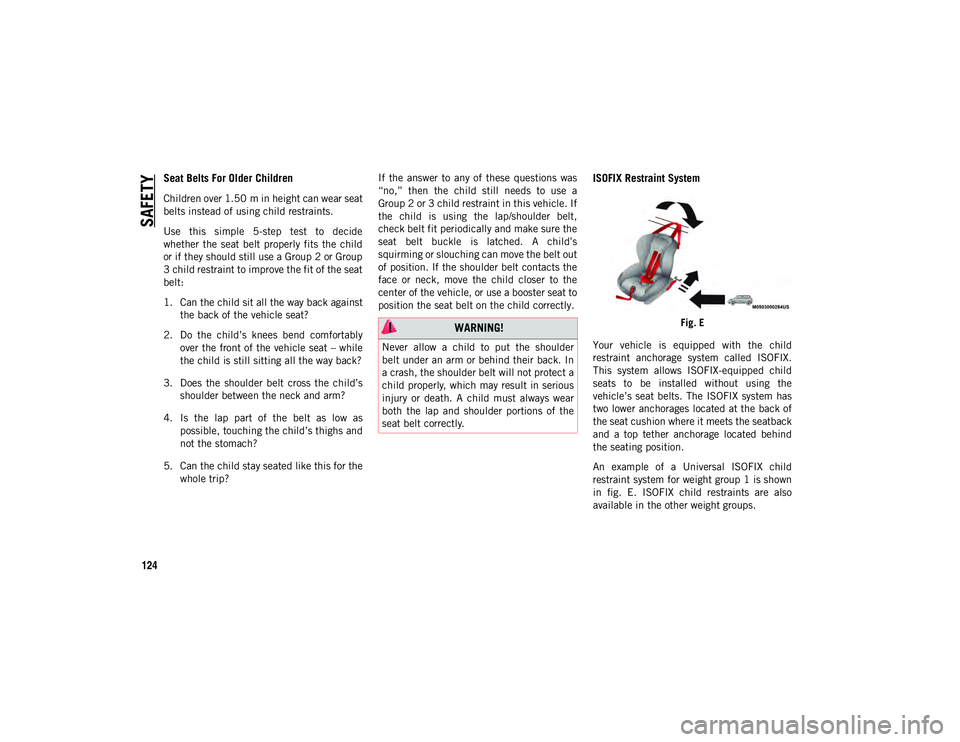
ISOFIX Restraint System
Fig. E
Your vehicle is equipped with the child
restraint anchorage system called ISOFIX.
This system allows ISOFIX-equipped child
seats to be installed without using the
vehicle’s seat belts. The ISOFIX system has
two lower anchorages located at the back of
the seat cushion where it meets the seatback
and a top tether anchorage located behind
the seating position.
An example of a Universal ISOFIX child
restraint system for weight group 1 is shown
in fig. E. ISOFIX child restraints are also
available in the other weight groups. WARNING!
Never allow a child to put the shoulder
belt under an arm or behind their back. In
a crash, the shoulder belt will not protect a
child properly, which may result in serious
injury or death. A child must always wear
both the lap and shoulder portions of the
seat belt correctly.
2020_JEEP_CHEROKEE_UG_RHD_UK.book Page 124
Page 128 of 332
SAFETY
126
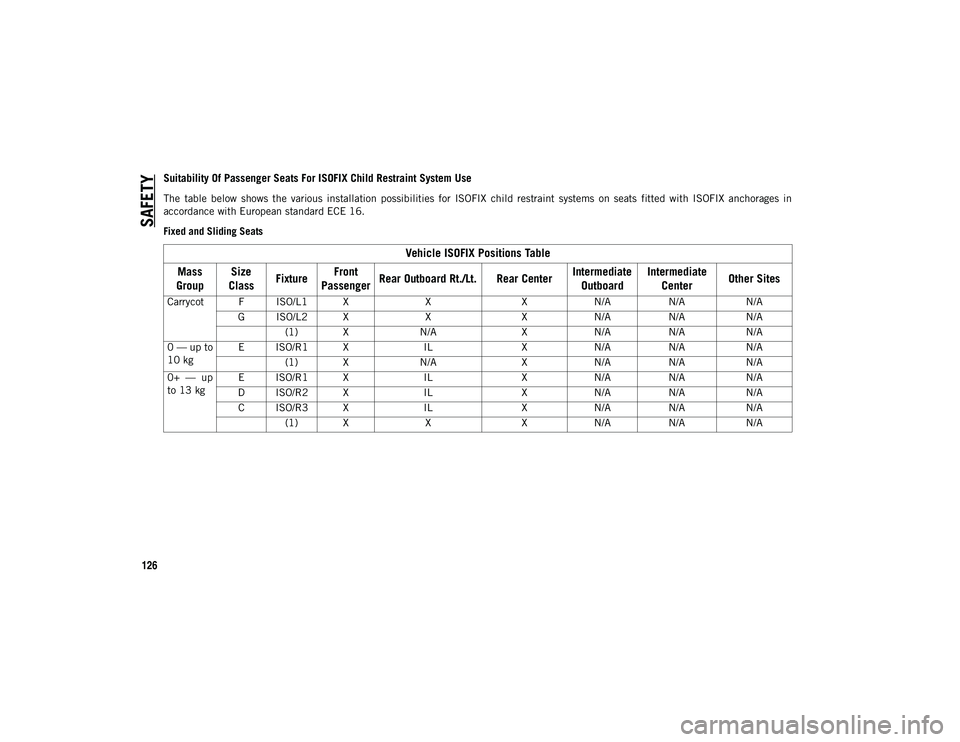
Suitability Of Passenger Seats For ISOFIX Child Restraint System Use
The table below shows the various installation possibilities for ISOFIX child restraint systems on seats fitted with ISOFIX anchorages in
accordance with European standard ECE 16.
Fixed and Sliding Seats
Vehicle ISOFIX Positions Table
Mass
Group Size
Class Fixture Front
Passenger Rear Outboard Rt./Lt. Rear Center Intermediate
Outboard Intermediate
Center Other Sites
Carrycot F ISO/L1 X
XXN/A N/A N/A
G ISO/L2 X XXN/A N/A N/A
(1) X N/AXN/A N/A N/A
0 — up to
10 kg E ISO/R1 X
ILXN/A N/A N/A
(1) X N/AXN/A N/A N/A
0+ — up
to 13 kg E ISO/R1 X
ILXN/A N/A N/A
D ISO/R2 X ILXN/A N/A N/A
C ISO/R3 X ILXN/A N/A N/A
(1) X XXN/A N/A N/A
2020_JEEP_CHEROKEE_UG_RHD_UK.book Page 126
Page 130 of 332
SAFETY
128
(Continued)
To Install An ISOFIX Child Restraint
If the selected seating position has a Switch-
able Automatic Locking Retractor (ALR) seat
belt, stow the seat belt, following the instruc -
tions below. See the section “Installing Child
Restraints Using the Vehicle Seat Belt” to
check what type of seat belt each seating
position has.
1. Loosen the adjusters on the lower connectors and on the tether strap of the
child seat so that you can more easily
attach the connectors to the vehicle
anchorages.
2. Place the child seat between the lower anchorages for that seating position. For
some second row seats, you may need to
recline the seat and / or raise the head
restraint to get a better fit. If the rear seat
can be moved forward and rearward in
the vehicle, you may wish to move it to its
rear-most position to make room for the
child seat. You may also move the front
seat forward to allow more room for the
child seat.
3. Attach the connectors of the child restraint to the lower anchorages in the
selected seating position. 4. If the child restraint has a tether strap,
connect it to the top tether anchorage.
See the section “Installing Child
Restraints Using the Top Tether
Anchorage” for directions to attach a
tether anchor.
5. Tighten all of the straps as you push the child restraint rearward and downward
into the seat. Remove slack in the straps
according to the child restraint manufac -
turer’s instructions.
6. Test that the child restraint is installed tightly by pulling back and forth on the
child seat at the belt path. It should not
move more than 25 mm in any direction.
Installing Child Restraints Using The Top
Tether Anchorage
1. Look behind the seating position whereyou plan to install the child restraint to
find the tether anchorage. You may need
to move the seat forward to provide better
access to the tether anchorage. If there is
no top tether anchorage for that seating
position, move the child restraint to
another position in the vehicle if one is
available. WARNING!
Improper installation of a child restraint
to the ISOFIX anchorages can lead to
failure of the restraint. The child could
be badly injured or killed. Follow the
child restraint manufacturer’s directions
exactly when installing an infant or child
restraint.
Child restraint anchorages are designed
to withstand only those loads imposed by
correctly-fitted child restraints. Under
no circumstances are they to be used for
adult seat belts, harnesses, or for
attaching other items or equipment to
the vehicle.
Install the child restraint system when
the vehicle is stationary. The ISOFIX
child restraint system is correctly fixed to
the brackets when you hear the click.
WARNING! (Continued)
2020_JEEP_CHEROKEE_UG_RHD_UK.book Page 128