heating JEEP CHEROKEE 2023 User Guide
[x] Cancel search | Manufacturer: JEEP, Model Year: 2023, Model line: CHEROKEE, Model: JEEP CHEROKEE 2023Pages: 276, PDF Size: 12.55 MB
Page 205 of 276
IN CASE OF EMERGENCY203
IF YOUR ENGINE OVERHEATS
If the vehicle is overheating, it will need to be serviced by
an authorized dealer.
Potential signs of vehicle overheating:
Temperature gauge is at HOT (H)
Strong smell of coolant
White smoke coming from engine or exhaust
Coolant bottle coolant has bubbles present
In the event it is observed that the temperature gauge is
moving towards or close to the HOT (H) position, you can
reduce the potential for overheating by taking the
appropriate action.
On the highways — slow down.
In city traffic — while stopped, place the transmission in
NEUTRAL (N), but do not increase the engine idle speed
while preventing vehicle motion with the brakes.
If your Air Conditioner (A/C) is on, turn it off. The A/C
system adds heat to the engine cooling system and
turning the A/C off can help remove this heat.
You can also turn the temperature control to maximum
heat, the mode control to floor and the blower control
to high. This allows the heater core to act as a supple -
ment to the radiator and aids in removing heat from the
engine cooling system.
GEAR SELECTOR OVERRIDE
If a malfunction occurs and the gear selector cannot be
moved out of the PARK (P) position, you can use the
following procedure to temporarily move the gear selector:
1. Turn the engine OFF.
2. Apply the parking brake.
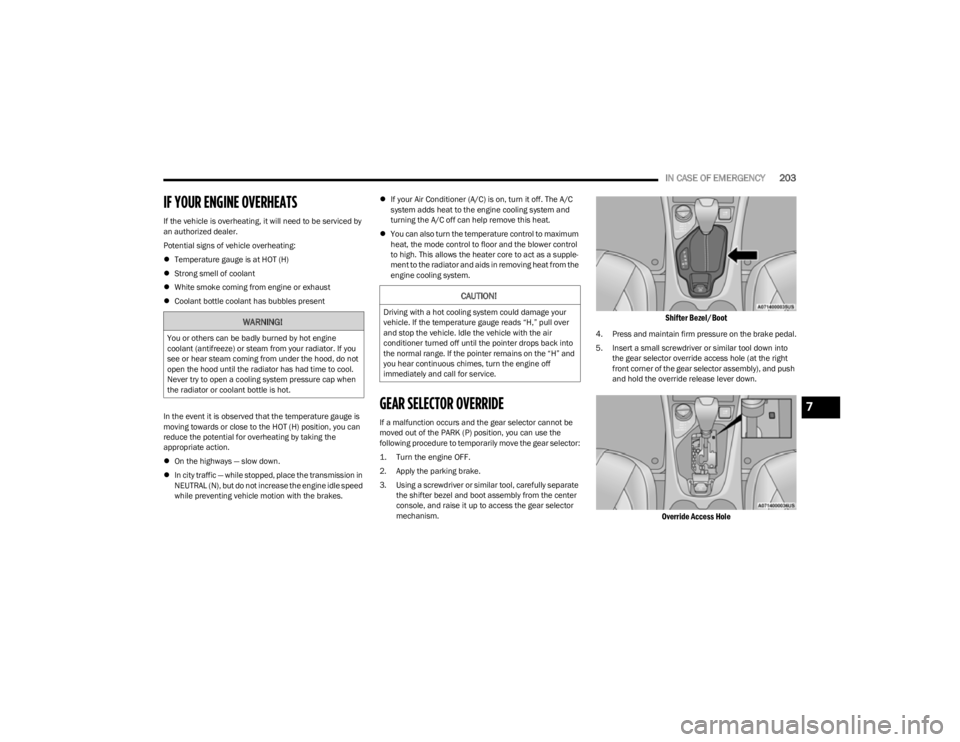
3. Using a screwdriver or similar tool, carefully separate the shifter bezel and boot assembly from the center
console, and raise it up to access the gear selector
mechanism.
Shifter Bezel/Boot
4. Press and maintain firm pressure on the brake pedal.
5. Insert a small screwdriver or similar tool down into the gear selector override access hole (at the right
front corner of the gear selector assembly), and push
and hold the override release lever down.
Override Access Hole
WARNING!
You or others can be badly burned by hot engine
coolant (antifreeze) or steam from your radiator. If you
see or hear steam coming from under the hood, do not
open the hood until the radiator has had time to cool.
Never try to open a cooling system pressure cap when
the radiator or coolant bottle is hot.
CAUTION!
Driving with a hot cooling system could damage your
vehicle. If the temperature gauge reads “H,” pull over
and stop the vehicle. Idle the vehicle with the air
conditioner turned off until the pointer drops back into
the normal range. If the pointer remains on the “H” and
you hear continuous chimes, turn the engine off
immediately and call for service.
7
23_KL_OM_EN_USC_t.book Page 203
Page 206 of 276

204IN CASE OF EMERGENCY
6. Move the gear selector to the NEUTRAL (N) position.
7. The vehicle may then be started in NEUTRAL (N).
8. Reinstall the gear selector boot.
FREEING A STUCK VEHICLE
If your vehicle becomes stuck in mud, sand or snow, it can
often be moved using a rocking motion. Turn the steering
wheel right and left to clear the area around the front
wheels. Push and hold the lock button on the gear
selector. Then shift back and forth between DRIVE (D) and
REVERSE (R), while gently pressing the accelerator.
NOTE:Shifts between DRIVE (D) and REVERSE (R) can only be
achieved at wheel speeds of 5 mph (8 km/h) or less.
Whenever the transmission remains in NEUTRAL (N) for
more than two seconds, you must press the brake pedal
to engage DRIVE (D) or REVERSE (R). Use the least amount of accelerator pedal pressure that
will maintain the rocking motion without spinning the
wheels or racing the engine.NOTE:Push the ESC OFF button (if necessary), to place the Elec
-
tronic Stability Control (ESC) system in “Partial Off” mode,
before rocking the vehicle
Úpage 145. Once the vehicle
has been freed, push the ESC OFF button again to restore
“ESC On” mode.
WARNING!
Fast spinning tires can be dangerous. Forces generated
by excessive wheel speeds may cause damage, or even
failure, of the axle and tires. A tire could explode and
injure someone. Do not spin your vehicle's wheels
faster than 30 mph (48 km/h) or for longer than 30
seconds continuously without stopping when you are
stuck and do not let anyone near a spinning wheel, no
matter what the speed.
CAUTION!
Racing the engine or spinning the wheels may lead to
transmission overheating and failure. Allow the
engine to idle with the transmission in NEUTRAL for
at least one minute after every five rocking-motion
cycles. This will minimize overheating and reduce the
risk of clutch or transmission failure during
prolonged efforts to free a stuck vehicle.
When “rocking” a stuck vehicle by shifting between
DRIVE and REVERSE, do not spin the wheels faster
than 15 mph (24 km/h), or drivetrain damage may
result.
Revving the engine or spinning the wheels too fast
may lead to transmission overheating and failure. It
can also damage the tires. Do not spin the wheels
above 30 mph (48 km/h) while in gear (no transmis -
sion shifting occurring).
23_KL_OM_EN_USC_t.book Page 204
Page 224 of 276

222SERVICING AND MAINTENANCE
(Continued)
(Continued)
3. Insert the wiper blade pivot pin into the opening on
the end of the wiper arm. Grab the bottom end of the
wiper arm with one hand, and apply pressure on the
wiper blade flush with the wiper arm until it snaps into
place.
4. Lower the wiper blade onto the glass and snap the wiper arm pivot cap back into place.
EXHAUST SYSTEM
The best protection against carbon monoxide entry into
the vehicle body is a properly maintained engine exhaust
system.
If you notice a change in the sound of the exhaust system;
or if the exhaust fumes can be detected inside the vehicle;
or when the underside or rear of the vehicle is damaged;
have an authorized technician inspect the complete
exhaust system and adjacent body areas for broken,
damaged, deteriorated, or mispositioned parts. Open
seams or loose connections could permit exhaust fumes
to seep into the passenger compartment. In addition, have
the exhaust system inspected each time the vehicle is
raised for lubrication or oil change. Replace as required.
Under normal operating conditions, the catalytic converter
will not require maintenance. However, it is important to
keep the engine properly tuned to ensure proper catalyst
operation and prevent possible catalyst damage.
NOTE:Intentional tampering with emissions control systems can
result in civil penalties being assessed against you.
In unusual situations involving grossly malfunctioning
engine operation, a scorching odor may suggest severe
and abnormal catalyst overheating. If this occurs, stop the
vehicle, turn off the engine and allow it to cool. Service,
including a tune-up to manufacturer's specifications,
should be obtained immediately.
To minimize the possibility of catalytic converter damage:
Do not interrupt the ignition when the transmission is
in gear and the vehicle is in motion.
Do not try to start the vehicle by pushing or towing the
vehicle.
Do not idle the engine with any ignition components
disconnected or removed, such as when diagnostic
testing, or for prolonged periods during very rough idle
or malfunctioning operating conditions.
COOLING SYSTEM
WARNING!
Exhaust gases can injure or kill. They contain carbon
monoxide (CO), which is colorless and odorless.
Breathing it can make you unconscious and can
eventually poison you. To avoid breathing CO see
Úpage 186.
A hot exhaust system can start a fire if you park over
materials that can burn. Such materials might be
grass or leaves coming into contact with your
exhaust system. Do not park or operate your vehicle
in areas where your exhaust system can contact
anything that can burn.
CAUTION!
The catalytic converter requires the use of unleaded
fuel only. Leaded gasoline will destroy the effective -
ness of the catalyst as an emissions control device
and may seriously reduce engine performance and
cause serious damage to the engine.
Damage to the catalytic converter can result if your
vehicle is not kept in proper operating condition. In
the event of engine malfunction, particularly
involving engine misfire or other apparent loss of
performance, have your vehicle serviced promptly.
Continued operation of your vehicle with a severe
malfunction could cause the converter to overheat,
resulting in possible damage to the converter and
vehicle.
WARNING!
WARNING!
You or others can be badly burned by hot engine
coolant (antifreeze) or steam from your radiator. If
you see or hear steam coming from under the hood,
do not open the hood until the radiator has had time
to cool. Never open a cooling system pressure cap
when the radiator or coolant bottle is hot.
23_KL_OM_EN_USC_t.book Page 222
Page 243 of 276

SERVICING AND MAINTENANCE241
(Continued)
TIRES — GENERAL INFORMATION
Tire Pressure
Proper tire inflation pressure is essential to the safe and
satisfactory operation of your vehicle. Four primary areas
are affected by improper tire pressure:
Safety
Fuel Economy
Tread Wear
Ride Comfort and Vehicle Stability
Safety Both underinflation and overinflation affect the stability of
the vehicle and can produce a feeling of sluggish response
or over responsiveness in the steering.
NOTE:
Unequal tire pressures from side to side may cause
erratic and unpredictable steering response.
Unequal tire pressure from side to side may cause the
vehicle to drift left or right.
Fuel Economy
Underinflated tires will increase tire rolling resistance
resulting in higher fuel consumption.
Tread Wear
Improper cold tire inflation pressures can cause abnormal
wear patterns and reduced tread life, resulting in the need
for earlier tire replacement.
Ride Comfort And Vehicle Stability
Proper tire inflation contributes to a comfortable ride.
Overinflation produces a jarring and uncomfortable ride.
Tire Inflation Pressures
The proper cold tire inflation pressure is listed on the
driver's side B-pillar or rear edge of the driver's side door. At least once a month:
Check and adjust tire pressure with a good quality
pocket-type pressure gauge. Do not make a visual judg -
ment when determining proper inflation. Tires may look
properly inflated even when they are underinflated.
Inspect tires for signs of tire wear or visible damage.
Inflation pressures specified on the placard are always
“cold tire inflation pressure”. Cold tire inflation pressure is
defined as the tire pressure after the vehicle has not been
driven for at least three hours, or driven less than 1 mile
(1.6 km) after sitting for a minimum of three hours. The
cold tire inflation pressure must not exceed the maximum
inflation pressure molded into the tire sidewall.
Check tire pressures more often if subject to a wide range
of outdoor temperatures, as tire pressures vary with
temperature changes.
Tire pressures change by approximately 1 psi (7 kPa) per
12°F (7°C) of air temperature change. Keep this in mind
when checking tire pressure inside a garage, especially in
the Winter.
WARNING!
Improperly inflated tires are dangerous and can
cause collisions.
Underinflation increases tire flexing and can result in
overheating and tire failure.
Overinflation reduces a tire's ability to cushion shock.
Objects on the road and chuckholes can cause
damage that result in tire failure.
Overinflated or underinflated tires can affect vehicle
handling and can fail suddenly, resulting in loss of
vehicle control.
Unequal tire pressures can cause steering problems.
You could lose control of your vehicle.
Unequal tire pressures from one side of the vehicle
to the other can cause the vehicle to drift to the right
or left.
Always drive with each tire inflated to the recom -
mended cold tire inflation pressure.
WARNING!
CAUTION!
After inspecting or adjusting the tire pressure, always
reinstall the valve stem cap. This will prevent moisture
and dirt from entering the valve stem, which could
damage the valve stem.
8
23_KL_OM_EN_USC_t.book Page 241
Page 267 of 276

265
Oil Selection ............................................................ 215
Oil Synthetic ............................................................ 215
Overheating ............................................................. 203
Engine Fluids And Lubricants...................................... 256
Enhanced Accident Response Feature ............. 175
, 207
Ethanol.......................................................................... 254
Exhaust Gas Cautions.................................................. 188
Exhaust System ............................................................ 222
Exterior Lights........................................................ 39
, 188
FFilters Air Cleaner ............................................................... 216Air Conditioning................................................ 48
, 218
Engine Oil ................................................................ 216 Engine Oil Disposal ................................................. 215
Flashers Hazard Warning ...................................................... 189
Turn Signals ..................................................... 74
, 188
Flash-To-Pass ..................................................................40
Flat Tire Changing ............................................... 235
, 244
Flat Tire Stowage ................................................ 235, 244
Flooded Engine Starting .................................................78
Fluid Capacities ............................................................ 256
Fluid Leaks ................................................................... 188
Fluid Level Checks Brake ....................................................................... 225Engine Oil ................................................................ 214
Fob, Key ...........................................................................13
Fog Lights ........................................................................41 Fold-Flat Seats ................................................................28Folding Rear Seats..........................................................29Forward Collision Warning ........................................... 154
Four Wheel Drive............................................................. 85 Freeing A Stuck Vehicle................................................ 204
Fuel
Additives...................................................................255Clean Air ...................................................................254Ethanol .....................................................................254
Light............................................................................ 71
Materials Added ...................................................... 255
Methanol .................................................................. 254
Tank Capacity .......................................................... 256
Fueling ...........................................................................113
Fuses .............................................................................226
GGarage Door Opener (HomeLink®) ............................... 35 Gasoline, Clean Air ....................................................... 254
Gasoline, Reformulated ............................................... 254
Gear Ranges ................................................................... 82Gear Selector Override ................................................. 203
Glass Cleaning .............................................................. 252
Gross Axle Weight Rating ............................................. 115
Gross Combination Weight Rating............................... 115
Gross Trailer Weight ..................................................... 115
Gross Vehicle Weight Rating ........................................ 114
GVWR.............................................................................113
HHazard Warning Flashers ............................................. 189
Head Restraint Removal ................................................ 32
Head Restraints .............................................................. 32
Head Rests...................................................................... 32
Headlights ....................................................................... 39 Automatic ................................................................... 40
Automatic High Beam ............................................... 40 Cleaning ................................................................... 250
High Beam .......................................................... 39
, 40
High Beam/Low Beam Select Switch ...................... 40
On With Wipers.......................................................... 41
Passing ............................................................... 39
, 40
Switch ........................................................................ 39
Time Delay ................................................................. 41
Heated Mirrors ............................................................... 35 Heated Seats .................................................................. 31
Heated Steering Wheel .................................................. 24
Hill Descent Control ..................................................... 146
Hill Descent Control Indicator...................................... 146
Hill Start Assist ............................................................. 148
Hitches Trailer Towing .......................................................... 116
HomeLink® (Garage Door Opener)............................... 35
Hood Prop ....................................................................... 56
Hood Release ................................................................. 56
IIgnition ............................................................................ 16 Switch ........................................................................ 16
Ignition Pak Interlock ..................................................... 81
Illuminated Entry ............................................................ 43
Indicator light Blue ............................................................................ 75
Green ......................................................................... 73
White .......................................................................... 74
Yellow......................................................................... 73
Inside Rearview Mirror .......................................... 34
, 189
Instrument Cluster Descriptions
S
.......................................... 61, 63, 74
Display ....................................................................... 63
Display Controls ........................................................ 6311
23_KL_OM_EN_USC_t.book Page 265
Page 269 of 276

267
Modifications/AlterationsVehicle .......................................................................... 8
Monitor, Tire Pressure System .................................... 155
Mopar Parts .................................................................. 260
MP3 Control ....................................................................50
Multi-Function Control Lever ..........................................39
NNew Vehicle Break-In Period ..........................................78
OOccupant Restraints .................................................... 159
Off Road Pages ............................................................ 141 Accessory Gauges................................................... 142
Drivetrain................................................................. 141
Pitch And Roll .......................................................... 142
Status Bar ............................................................... 141
Off-Road Pages Selec-Terrain ........................................................... 142
Oil Filter, Change .......................................................... 216
Oil Filter, Selection ....................................................... 216
Oil Life Reset — If Equipped
S
..................................... 64
Oil Pressure Light ............................................................69
Oil Reset ..........................................................................64
Oil, Engine..................................................................... 215 Capacity ................................................................... 256
Checking .................................................................. 214
Dipstick.................................................................... 214
Disposal................................................................... 215
Filter......................................................................... 216
Filter Disposal ......................................................... 215Identification Logo .................................................. 215Materials Added To................................................. 215Pressure Warning Light ............................................. 69 Recommendation ....................................................215
Synthetic .................................................................. 215
Onboard Diagnostic System........................................... 75
Operating Precautions.................................................... 75 Operator Manual Owner's Manual ....................................................... 261
Outside Rearview Mirrors............................................... 34
Overheating, Engine ..................................................... 203
PPaddle Shifters ............................................................... 84
Paint Care...................................................................... 250
Parking Brake ................................................................. 78
ParkSense Front And Rear........................................................... 99
ParkSense Active Park Assist ...................................... 106
ParkSense System, Rear................................................ 99
Passive Entry................................................................... 22 Pets ................................................................................ 186
Pinch Protection.............................................................. 56
Placard, Tire And Loading Information ........................ 238
Power Brakes ...................................................................... 253
Door Locks ................................................................. 21
Inverter ....................................................................... 52
Mirrors ........................................................................ 35
Outlet (Auxiliary Electrical Outlet) ............................. 51
Windows..................................................................... 53
Power Seats Down .......................................................................... 30
Forward ...................................................................... 30
Rearward.................................................................... 30
Up ............................................................................... 30
Pregnant Women And Seat Belts ................................ 165 Preparation For Jacking ............................................... 191
Pressure Washing ........................................................ 215
Pretensioners
Seat Belts ................................................................ 165
RRadial Ply Tires ............................................................. 242
Radiator Cap (Coolant Pressure Cap) ......................... 224
RadioOff-Road Pages ....................................................... 141
Radio Operation ........................................................... 140
Radio Remote Controls ................................................ 140
Rain Sensitive Wiper System......................................... 44 Rear Camera................................................................. 112
Rear Cross Path............................................................ 153
Rear ParkSense System ................................................ 99Rear Seats, Folding ........................................................ 29Rear Wiper/Washer ....................................................... 45Recreational Towing ..................................................... 120 Shifting Into Power Transfer Unit Neutral (N)........ 122
Shifting Into Transfer Case Neutral (N) ................. 122
Shifting Out Of Power Transfer Unit Neutral (N) ... 123
Shifting Out Of Transfer Case Neutral (N) ............. 123
Reformulated Gasoline ................................................ 254
Refrigerant .................................................................... 218
Release, Hood ................................................................ 56
Reminder, Lights On....................................................... 41 Reminder, Seat Belt ..................................................... 159
Remote Control Starting System ......................................................... 18
Remote Keyless Entry .................................................... 14 Arm The Alarm ........................................................... 20
Disarm The Alarm ..................................................... 20
Programming Additional Key Fobs ........................... 15
11
23_KL_OM_EN_USC_t.book Page 267