brake JEEP CHEROKEE 2023 Manual PDF
[x] Cancel search | Manufacturer: JEEP, Model Year: 2023, Model line: CHEROKEE, Model: JEEP CHEROKEE 2023Pages: 276, PDF Size: 12.55 MB
Page 207 of 276
IN CASE OF EMERGENCY205
TOWING A DISABLED VEHICLE
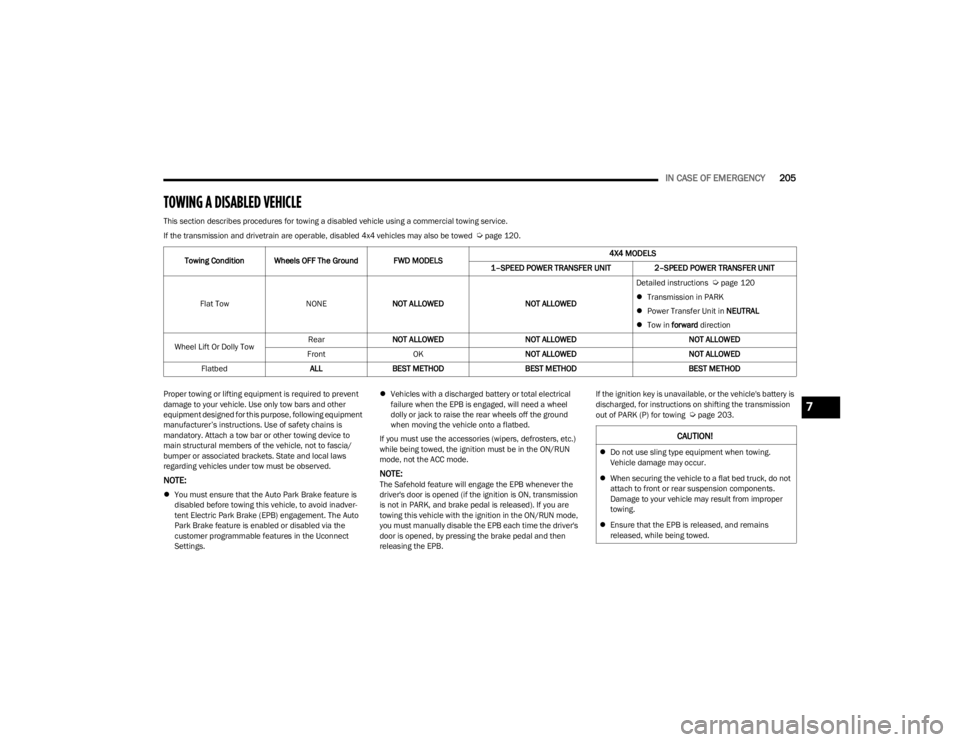
This section describes procedures for towing a disabled vehicle using a commercial towing service.
If the transmission and drivetrain are operable, disabled 4x4 vehicles may also be towed
Úpage 120.
Proper towing or lifting equipment is required to prevent
damage to your vehicle. Use only tow bars and other
equipment designed for this purpose, following equipment
manufacturer’s instructions. Use of safety chains is
mandatory. Attach a tow bar or other towing device to
main structural members of the vehicle, not to fascia/
bumper or associated brackets. State and local laws
regarding vehicles under tow must be observed.
NOTE:
You must ensure that the Auto Park Brake feature is
disabled before towing this vehicle, to avoid inadver -
tent Electric Park Brake (EPB) engagement. The Auto
Park Brake feature is enabled or disabled via the
customer programmable features in the Uconnect
Settings.
Vehicles with a discharged battery or total electrical
failure when the EPB is engaged, will need a wheel
dolly or jack to raise the rear wheels off the ground
when moving the vehicle onto a flatbed.
If you must use the accessories (wipers, defrosters, etc.)
while being towed, the ignition must be in the ON/RUN
mode, not the ACC mode.
NOTE:The Safehold feature will engage the EPB whenever the
driver's door is opened (if the ignition is ON, transmission
is not in PARK, and brake pedal is released). If you are
towing this vehicle with the ignition in the ON/RUN mode,
you must manually disable the EPB each time the driver's
door is opened, by pressing the brake pedal and then
releasing the EPB. If the ignition key is unavailable, or the vehicle's battery is
discharged, for instructions on shifting the transmission
out of PARK (P) for towing
Úpage 203.
Towing Condition Wheels OFF The Ground FWD MODELS
4X4 MODELS
1–SPEED POWER TRANSFER UNIT 2–SPEED POWER TRANSFER UNIT
Flat Tow NONENOT ALLOWED NOT ALLOWEDDetailed instructions
Úpage 120
Transmission in PARK
Power Transfer Unit in NEUTRAL
Tow in forward direction
Wheel Lift Or Dolly Tow Rear
NOT ALLOWED NOT ALLOWED NOT ALLOWED
Front OK NOT ALLOWED NOT ALLOWED
Flatbed ALLBEST METHOD BEST METHOD BEST METHOD
CAUTION!
Do not use sling type equipment when towing.
Vehicle damage may occur.
When securing the vehicle to a flat bed truck, do not
attach to front or rear suspension components.
Damage to your vehicle may result from improper
towing.
Ensure that the EPB is released, and remains
released, while being towed.
7
23_KL_OM_EN_USC_t.book Page 205
Page 208 of 276
206IN CASE OF EMERGENCY
(Continued)
FRONT-WHEEL DRIVE (FWD) MODELS
The FCA US LLC recommends towing your vehicle with all
four wheels OFF of the ground using a flatbed.
If flatbed equipment is not available, this vehicle must be
towed with the front wheels OFF of the ground (using a
towing dolly, or wheel lift equipment with the front wheels
raised).
Ensure that the Electric Park Brake (EPB) is released, and
remains released, while being towed. The EPB does not
need to be released, if all four wheels are OFF the ground.
4X4 MODELS WITH 1–SPEED POWER
T
RANSFER UNIT
The FCA US LLC requires towing with all four wheels OFF
the ground.
Acceptable methods are to tow the vehicle on a flatbed, or
with one end of vehicle raised and the opposite end on a
towing dolly.
4X4 MODELS WITH 2–SPEED POWER
T
RANSFER UNIT
The FCA US LLC recommends towing with all four wheels
OFF the ground.
Acceptable methods are to tow the vehicle on a flatbed or
with one end of the vehicle raised and the opposite end on
a towing dolly.
If flatbed equipment is not available and the Power
Transfer Unit is operable, vehicles with a 2–speed Power
Transfer Unit may be towed (in the forward direction, with
ALL wheels on the ground), under the following conditions:
The Power Transfer Unit must be in NEUTRAL (N).
The transmission must be in PARK (P) .
Ensure that the EPB is released, and remains released,
while being towed
Úpage 120.
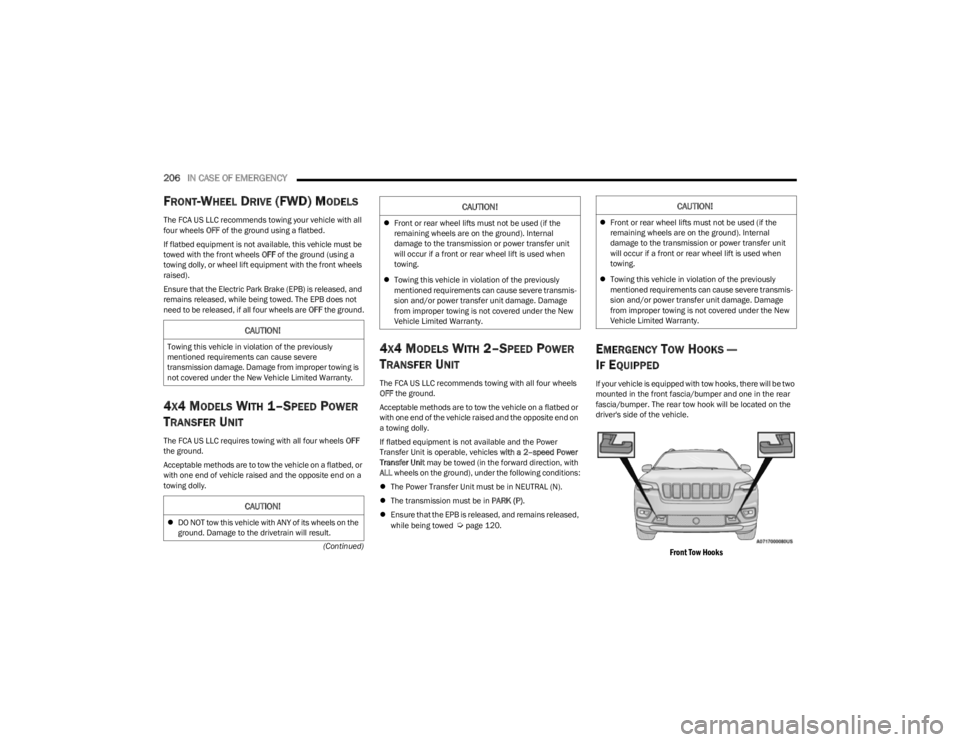
EMERGENCY TOW HOOKS —
I
F EQUIPPED
If your vehicle is equipped with tow hooks, there will be two
mounted in the front fascia/bumper and one in the rear
fascia/bumper. The rear tow hook will be located on the
driver's side of the vehicle.
Front Tow Hooks
CAUTION!
Towing this vehicle in violation of the previously
mentioned requirements can cause severe
transmission damage. Damage from improper towing is
not covered under the New Vehicle Limited Warranty.
CAUTION!
DO NOT tow this vehicle with ANY of its wheels on the
ground. Damage to the drivetrain will result.
Front or rear wheel lifts must not be used (if the
remaining wheels are on the ground). Internal
damage to the transmission or power transfer unit
will occur if a front or rear wheel lift is used when
towing.
Towing this vehicle in violation of the previously
mentioned requirements can cause severe transmis -
sion and/or power transfer unit damage. Damage
from improper towing is not covered under the New
Vehicle Limited Warranty.
CAUTION!CAUTION!
Front or rear wheel lifts must not be used (if the
remaining wheels are on the ground). Internal
damage to the transmission or power transfer unit
will occur if a front or rear wheel lift is used when
towing.
Towing this vehicle in violation of the previously
mentioned requirements can cause severe transmis -
sion and/or power transfer unit damage. Damage
from improper towing is not covered under the New
Vehicle Limited Warranty.
23_KL_OM_EN_USC_t.book Page 206
Page 210 of 276
208
SERVICING AND MAINTENANCE
SCHEDULED SERVICING
Your vehicle is equipped with an automatic oil change
indicator system. The oil change indicator system will
remind you that it is time to take your vehicle in for
scheduled maintenance.
Based on engine operation conditions, the oil change
indicator message will illuminate. This means that service
is required for your vehicle. Operating conditions such as
frequent short-trips, trailer tow, or extremely hot or cold
ambient temperatures will influence when the “Oil Change
Required” message is displayed. Have your vehicle
serviced as soon as possible, within the next 500 miles
(805 km).An authorized dealer will reset the oil change indicator
message after completing the scheduled oil change. If a
scheduled oil change is performed by someone other than
an authorized dealer, the message can be reset by
referring to the steps described under Instrument Cluster
Display
Úpage 64.
NOTE:Under no circumstances should oil change intervals
exceed 10,000 miles (16,000 km), 12 months or
350 hours of engine run time, whichever comes first. The
350 hours of engine run or idle time is generally only a
concern for fleet customers.
At Every Fuel Stop:
Check engine oil level.
Check windshield washer fluid level.
Check tire pressure and look for unusual wear or
damage. Rotate tires at the first sign of irregular wear,
even if it occurs before the oil indicator system turns
on.
Check the fluid levels of the coolant reservoir and
brake master cylinder; fill as needed.
Check function of all interior and exterior lights.
23_KL_OM_EN_USC_t.book Page 208
Page 211 of 276
SERVICING AND MAINTENANCE209
MAINTENANCE PLAN
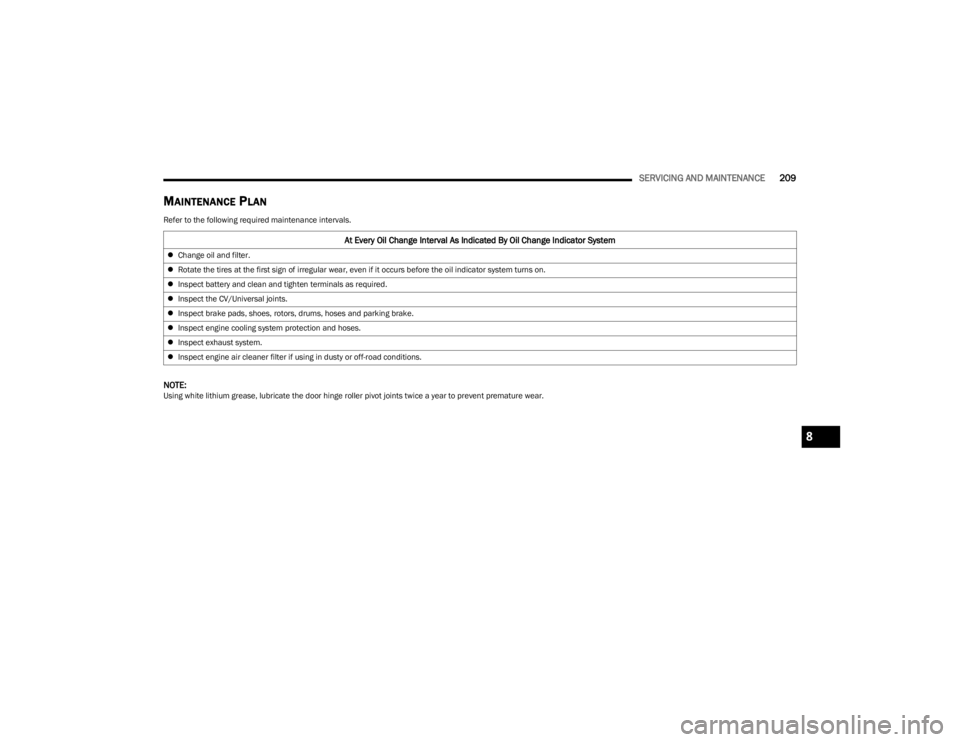
Refer to the following required maintenance intervals.
NOTE:Using white lithium grease, lubricate the door hinge roller pivot joints twice a year to prevent premature wear.
At Every Oil Change Interval As Indicated By Oil Change Indicator System
Change oil and filter.
Rotate the tires at the first sign of irregular wear, even if it occurs before the oil indicator system turns on.
Inspect battery and clean and tighten terminals as required.
Inspect the CV/Universal joints.
Inspect brake pads, shoes, rotors, drums, hoses and parking brake.
Inspect engine cooling system protection and hoses.
Inspect exhaust system.
Inspect engine air cleaner filter if using in dusty or off-road conditions.
8
23_KL_OM_EN_USC_t.book Page 209
Page 212 of 276
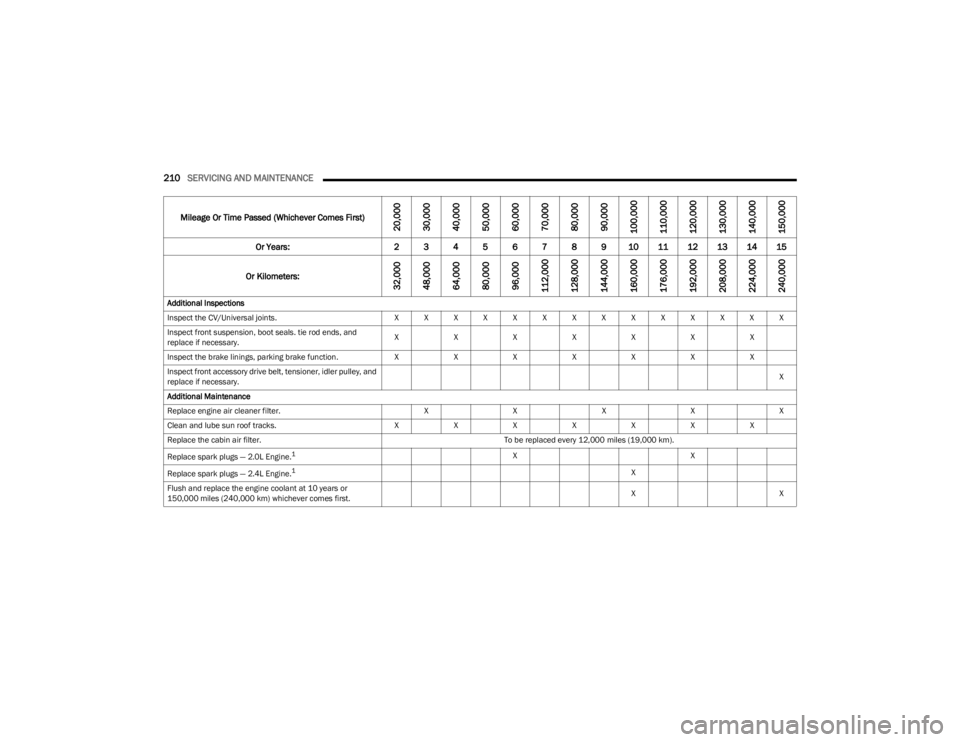
210SERVICING AND MAINTENANCE
Mileage Or Time Passed (Whichever Comes First)20,000
30,000
40,000
50,000
60,000
70,000
80,000
90,000
100,000
110,000
120,000
130,000
140,000
150,000
Or Years: 2 3 4 5 6 7 8 9 10 11 12 13 14 15
Or Kilometers:
32,000
48,000
64,000
80,000
96,000
112,000
128,000
144,000
160,000
176,000
192,000
208,000
224,000
240,000
Additional Inspections
Inspect the CV/Universal joints. X X X X X X X X X X X X X X
Inspect front suspension, boot seals. tie rod ends, and
replace if necessary. X
XXXXXX
Inspect the brake linings, parking brake function. XXXXXXX
Inspect front accessory drive belt, tensioner, idler pulley, and
replace if necessary. X
Additional Maintenance
Replace engine air cleaner filter. XXXXX
Clean and lube sun roof tracks. XXXXXXX
Replace the cabin air filter. To be replaced every 12,000 miles (19,000 km).
Replace spark plugs — 2.0L Engine.
1X X
Replace spark plugs — 2.4L Engine.
1X
Flush and replace the engine coolant at 10 years or
150,000 miles (240,000 km) whichever comes first. X
X
23_KL_OM_EN_USC_t.book Page 210
Page 214 of 276

212SERVICING AND MAINTENANCE
ENGINE COMPARTMENT
2.0L ENGINE
1 — Engine Air Cleaner Filter 5 — Engine Oil Dipstick
2 — Oil Fill Cap 6 — Engine Coolant Reservoir
3 — Brake Fluid Reservoir Cap 7 — Battery
4 — Power Distribution Center (Fuses) 8 — Washer Fluid Reservoir Cap
23_KL_OM_EN_USC_t.book Page 212
Page 215 of 276
SERVICING AND MAINTENANCE213
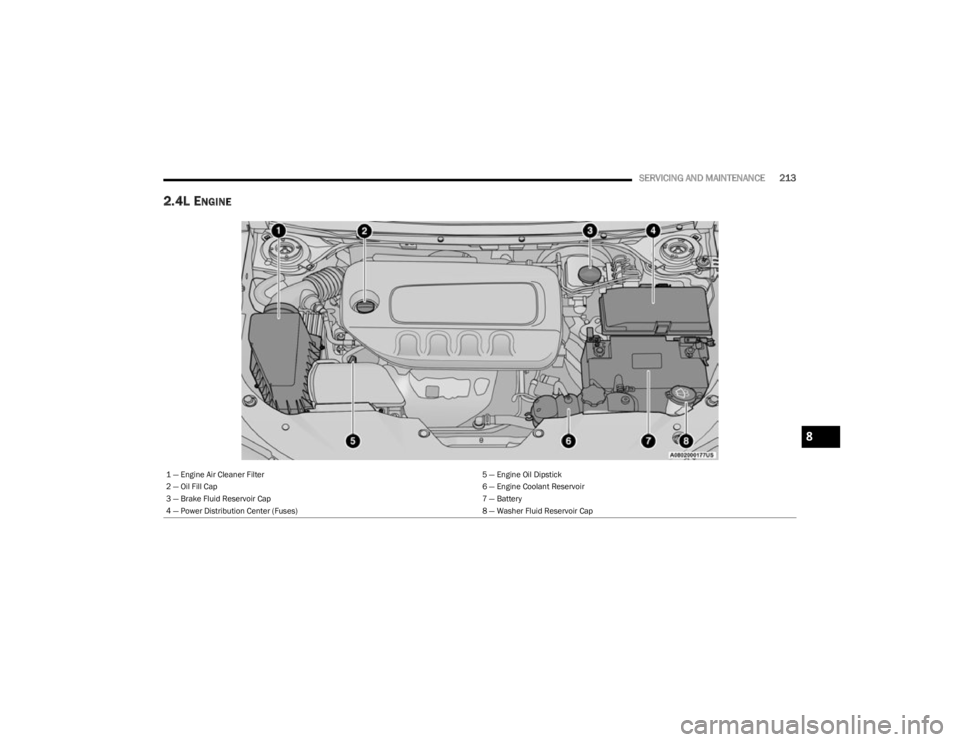
2.4L ENGINE
1 — Engine Air Cleaner Filter 5 — Engine Oil Dipstick
2 — Oil Fill Cap 6 — Engine Coolant Reservoir
3 — Brake Fluid Reservoir Cap 7 — Battery
4 — Power Distribution Center (Fuses) 8 — Washer Fluid Reservoir Cap
8
23_KL_OM_EN_USC_t.book Page 213
Page 227 of 276
SERVICING AND MAINTENANCE225
Make sure that the coolant expansion bottle overflow
hoses are not kinked or obstructed.
Keep the front of the radiator clean. If your vehicle is
equipped with air conditioning, keep the front of the
condenser clean.
Do not change the thermostat for Summer or Winter
operation. If replacement is ever necessary, install
ONLY the correct type thermostat. Other designs may
result in unsatisfactory engine cooling performance,
poor gas mileage, and increased emissions.
BRAKE SYSTEM
In order to ensure brake system performance, all brake
system components should be inspected periodically.
Refer to the Maintenance Plan for the proper
maintenance intervals
Úpage 209.
Fluid Level Check — Brake Master Cylinder
The fluid level of the brake master cylinder should be
checked whenever the vehicle is serviced, or immediately
if the Brake System Warning Light is on. If necessary, add
fluid to bring level within the designated marks on the side
of the reservoir of the brake master cylinder. Be sure to
clean the top of the master cylinder area before removing cap. With disc brakes, fluid level can be expected to fall as
the brake pads wear. Brake fluid level should be checked
when pads are replaced. If the brake fluid is abnormally
low, check the system for leaks. For further information
Úpage 256.
AUTOMATIC TRANSMISSION
Special Additives
It is strongly recommended against using any special
additives in the transmission. Automatic Transmission
Fluid (ATF) is an engineered product and its performance
may be impaired by supplemental additives. Therefore, do
not add any fluid additives to the transmission. Avoid
using transmission sealers as they may adversely affect
seals.
Fluid Level Check
The fluid level is preset at the factory and does not require
adjustment under normal operating conditions. Routine
fluid level checks are not required; therefore the
transmission has no dipstick. An authorized dealer can
check your transmission fluid level using special service
tools. If you notice fluid leakage or transmission
malfunction, visit an authorized dealer immediately to
have the transmission fluid level checked. Operating the
vehicle with an improper fluid level can cause severe
transmission damage.
WARNING!
Riding the brakes can lead to brake failure and possibly
a collision. Driving with your foot resting or riding on the
brake pedal can result in abnormally high brake
temperatures, excessive lining wear, and possible brake
damage. You would not have your full braking capacity
in an emergency.
WARNING!
Use only manufacturer's recommended brake fluid.
For further information Úpage 256. Using the wrong
type of brake fluid can severely damage your brake
system and/or impair its performance. The proper
type of brake fluid for your vehicle is also identified
on the original factory installed hydraulic master
cylinder reservoir.
To avoid contamination from foreign matter or mois -
ture, use only new brake fluid or fluid that has been
in a tightly closed container. Keep the master
cylinder reservoir cap secured at all times. Brake
fluid in a open container absorbs moisture from the
air resulting in a lower boiling point. This may cause
it to boil unexpectedly during hard or prolonged
braking, resulting in sudden brake failure. This could
result in a collision.
Overfilling the brake fluid reservoir can result in
spilling brake fluid on hot engine parts, causing the
brake fluid to catch fire. Brake fluid can also damage
painted and vinyl surfaces, care should be taken to
avoid its contact with these surfaces.
Do not allow petroleum-based fluid to contaminate
the brake fluid. Brake seal components could be
damaged, causing partial or complete brake failure.
This could result in a collision.
CAUTION!
Do not use chemical flushes in your transmission as the
chemicals can damage your transmission components.
Such damage is not covered by the New Vehicle Limited
Warranty.
8
23_KL_OM_EN_USC_t.book Page 225
Page 230 of 276
228SERVICING AND MAINTENANCE
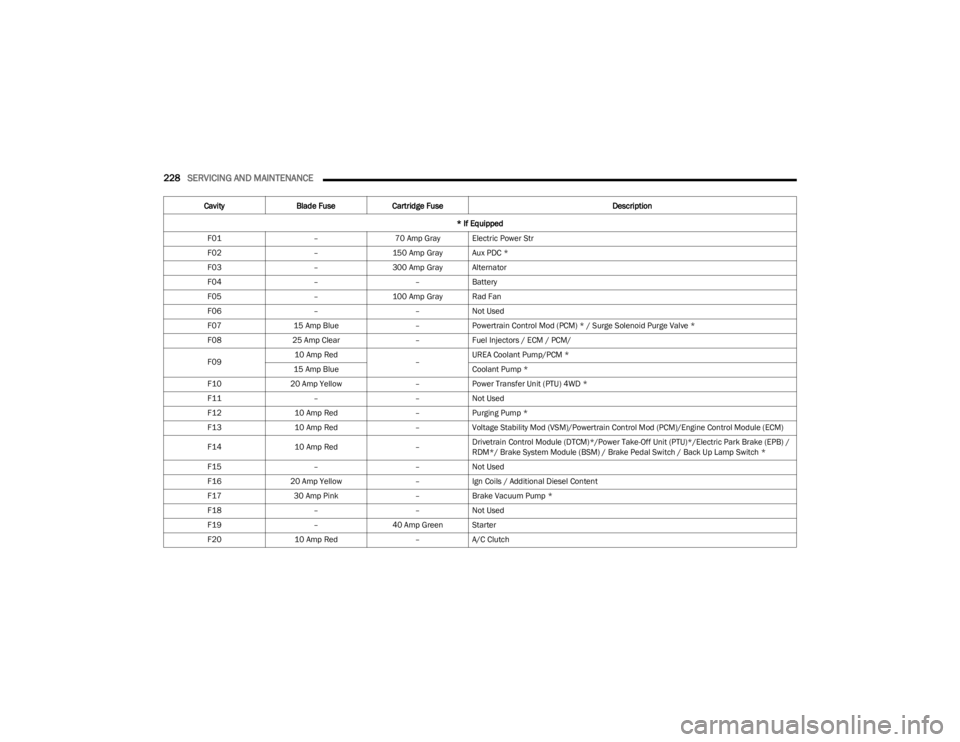
CavityBlade Fuse Cartridge Fuse Description
* If Equipped
F01 –70 Amp Gray Electric Power Str
F02 –150 Amp Gray Aux PDC *
F03 –300 Amp Gray Alternator
F04 ––Battery
F05 –100 Amp Gray Rad Fan
F06 ––Not Used
F07 15 Amp Blue –Powertrain Control Mod (PCM) * / Surge Solenoid Purge Valve *
F08 25 Amp Clear –Fuel Injectors / ECM / PCM/
F09 10 Amp Red
–UREA Coolant Pump/PCM *
15 Amp Blue Coolant Pump *
F10 20 Amp Yellow –Power Transfer Unit (PTU) 4WD *
F11 ––Not Used
F12 10 Amp Red –Purging Pump *
F13 10 Amp Red –Voltage Stability Mod (VSM)/Powertrain Control Mod (PCM)/Engine Control Module (ECM)
F14 10 Amp Red –Drivetrain Control Module (DTCM)*/Power Take-Off Unit (PTU)*/Electric Park Brake (EPB) /
RDM*/ Brake System Module (BSM) / Brake Pedal Switch / Back Up Lamp Switch *
F15 ––Not Used
F16 20 Amp Yellow –Ign Coils / Additional Diesel Content
F17 30 Amp Pink –Brake Vacuum Pump *
F18 ––Not Used
F19 –40 Amp Green Starter
F20 10 Amp Red –A/C Clutch
23_KL_OM_EN_USC_t.book Page 228
Page 232 of 276
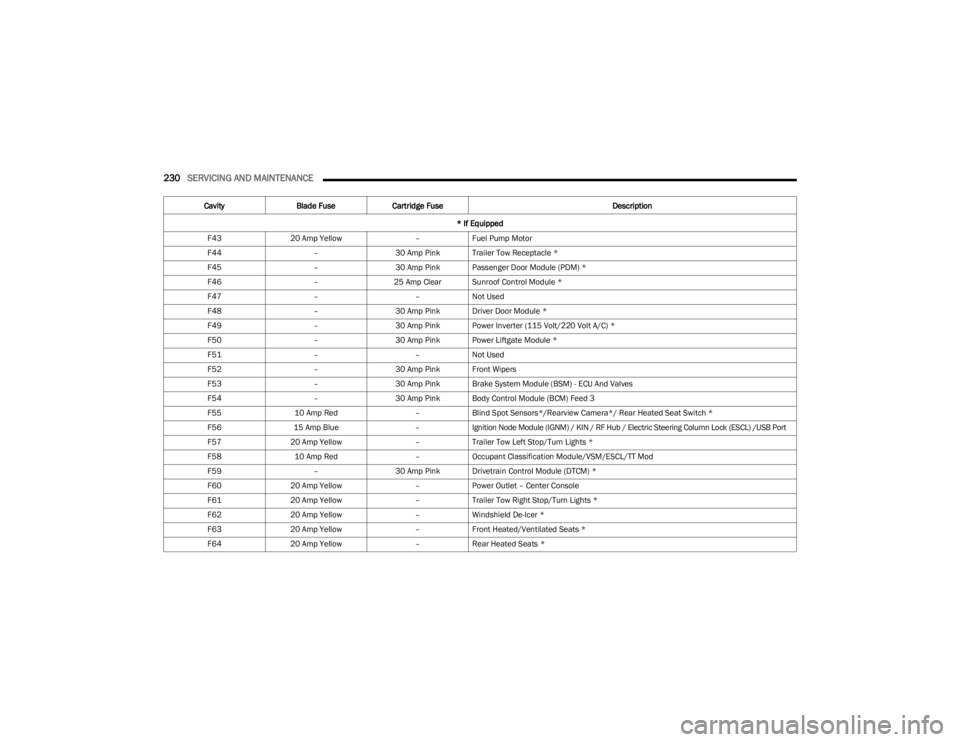
230SERVICING AND MAINTENANCE
F4320 Amp Yellow –Fuel Pump Motor
F44 –30 Amp Pink Trailer Tow Receptacle *
F45 –30 Amp Pink Passenger Door Module (PDM) *
F46 –25 Amp Clear Sunroof Control Module *
F47 ––Not Used
F48 –30 Amp Pink Driver Door Module *
F49 –30 Amp Pink Power Inverter (115 Volt/220 Volt A/C) *
F50 –30 Amp Pink Power Liftgate Module *
F51 ––Not Used
F52 –30 Amp Pink Front Wipers
F53 –30 Amp Pink Brake System Module (BSM) - ECU And Valves
F54 –30 Amp Pink Body Control Module (BCM) Feed 3
F55 10 Amp Red –Blind Spot Sensors*/Rearview Camera*/ Rear Heated Seat Switch *
F56 15 Amp Blue –Ignition Node Module (IGNM) / KIN / RF Hub / Electric Steering Column Lock (ESCL) /USB Port
F57 20 Amp Yellow –Trailer Tow Left Stop/Turn Lights *
F58 10 Amp Red –Occupant Classification Module/VSM/ESCL/TT Mod
F59 –30 Amp Pink Drivetrain Control Module (DTCM) *
F60 20 Amp Yellow –Power Outlet – Center Console
F61 20 Amp Yellow –Trailer Tow Right Stop/Turn Lights *
F62 20 Amp Yellow –Windshield De-Icer *
F63 20 Amp Yellow –Front Heated/Ventilated Seats *
F64 20 Amp Yellow –Rear Heated Seats *
Cavity
Blade Fuse Cartridge Fuse Description
* If Equipped
23_KL_OM_EN_USC_t.book Page 230