brakes JEEP CJ 1953 User Guide
[x] Cancel search | Manufacturer: JEEP, Model Year: 1953, Model line: CJ, Model: JEEP CJ 1953Pages: 376, PDF Size: 19.96 MB
Page 279 of 376
'Jeep*
UNIVERSAL
SERIES
SERVICE
MANUAL
m f. Disconnect propeller shaft from the differential
companion flange.
g.
Disconnect both front springs from front spring hangers.
h.
Remove spring clip and spring clip plates secur
ing axle to front springs.
i.
Remove front
wheels
from axle assembly.
j.
Lower
jack
slightly and
pull
axle forward from
under
vehicle.
M-5.
FRONT AXLE SHAFT REMOVAL
Refer
to Fig. M-2.
The
following procedure applies to either right or
left
front axle shaft.
Note:
Axle shafts can be removed without remov
ing the axle housing from the vehicle. Use the fol
lowing procedure.
First
raise and support front end
of vehicle, and remove front wheels.
a.
Remove drive
flange
snap
ring.
b-
Remove the hub cap with a puller as shown in
Fig.
M-3.
c.
Remove the axle shaft driving
flange
bolts.
d.
Apply the
foot
brakes and remove the axle shaft
flange
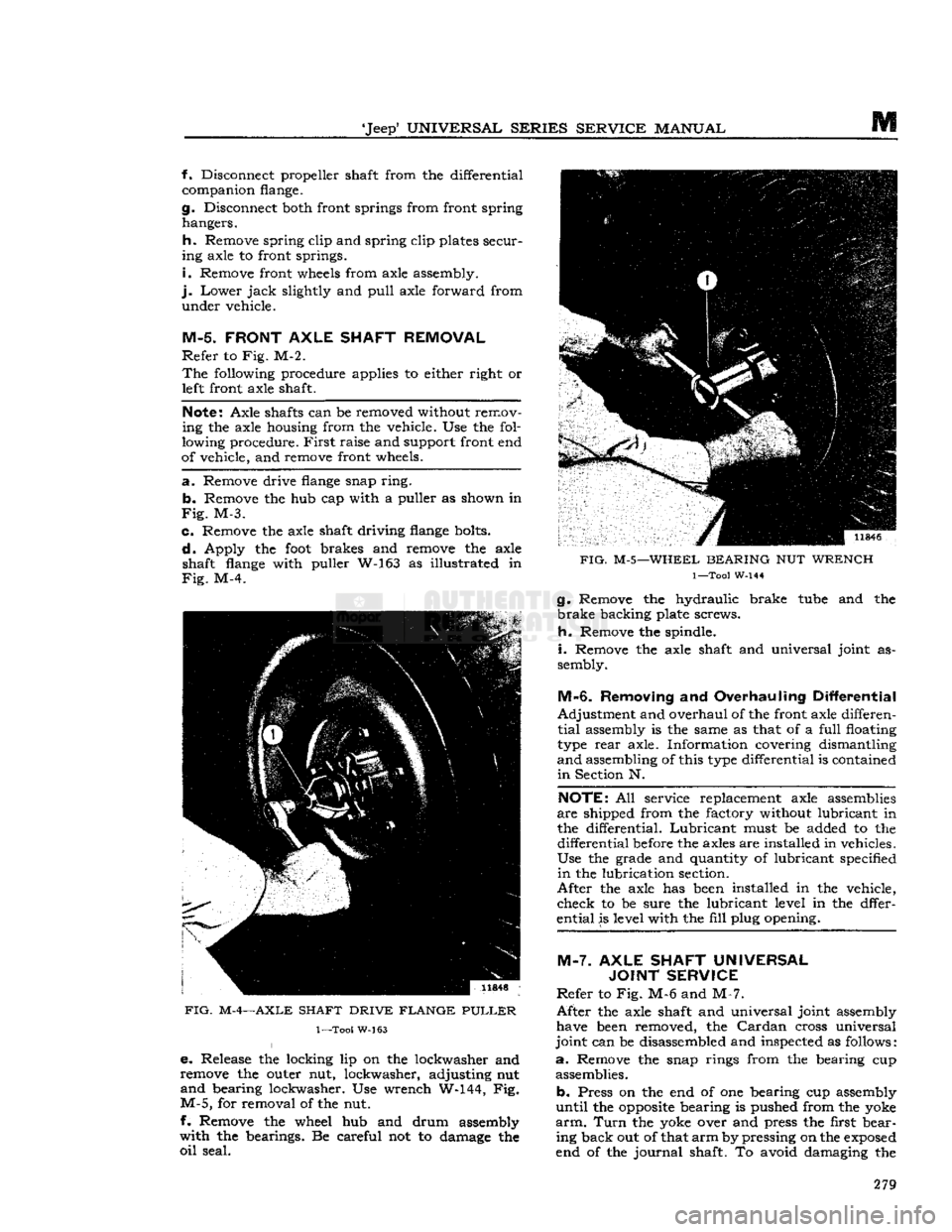
with puller W-163 as illustrated in
Fig.
M-4.
FIG.
M-4—AXLE
SHAFT
DRIVE
FLANGE
PULLER
1—Too!
W-163
e.
Release the locking lip on the lockwasher and
remove the outer nut, lockwasher, adjusting nut
and
bearing lockwasher. Use wrench W-144, Fig.
M-5,
for removal of the nut.
f- Remove the wheel hub and drum assembly
with
the bearings. Be careful not to damage the
oil
seal.
FIG.
M-5—WHEEL
BEARING
NUT
WRENCH
1—Tool
W-144
g.
Remove the hydraulic brake
tube
and the
brake
backing plate screws.
h.
Remove the spindle.
i.
Remove the axle shaft and universal joint as
sembly.
M-6.
Removing
and
Overhauling Differential
Adjustment
and overhaul of the front axle differen
tial
assembly is the same as that of a
full
floating
type
rear
axle. Information covering dismantling
and
assembling of this
type
differential is contained
in
Section N.
NOTE:
All service replacement axle assemblies
are
shipped from the factory without lubricant in
the differential.
Lubricant
must be added to the
differential
before
the axles are installed in vehicles.
Use
the grade and quantity of lubricant specified
in
the lubrication section.
After
the axle has
been
installed in the vehicle,
check
to be sure the lubricant level in the dffer-
ential
is level with the
fill
plug opening.
M-7.
AXLE SHAFT UNIVERSAL JOINT SERVICE
Refer
to Fig. M-6 and M-7.
After
the axle shaft and universal joint assembly have
been
removed, the
Cardan
cross universal
joint
can be disassembled and inspected as follows:
a.
Remove the snap rings from the bearing cup assemblies.
b.
Press on the end of one bearing cup assembly
until
the
opposite
bearing is pushed from the yoke
arm.
Turn
the yoke over and press the first bear ing back out of that
arm
by pressing on the
exposed
end of the
journal
shaft. To avoid damaging the 279
Page 282 of 376
FRONT
AXLE
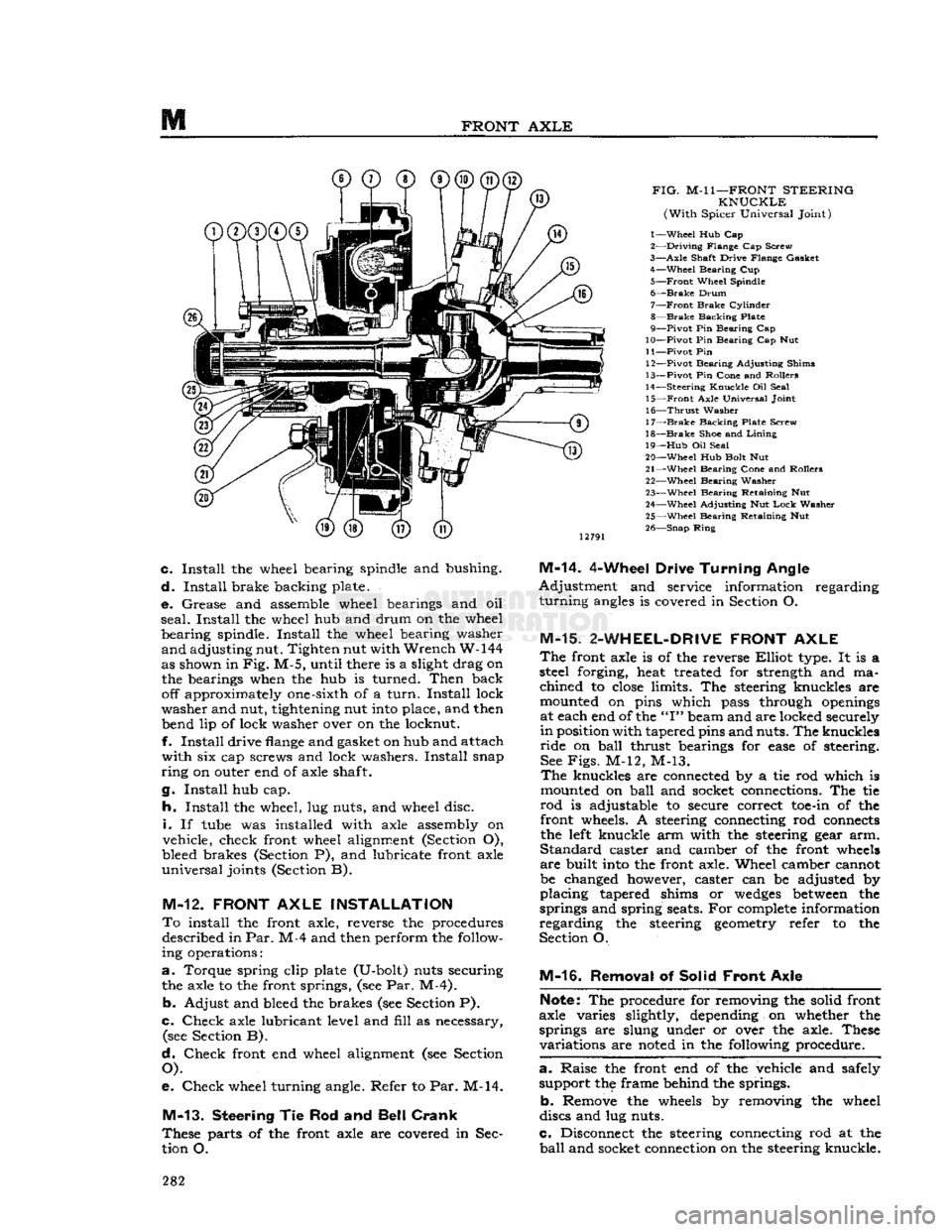
FIG.
M-l
1—FRONT
STEERING
KNUCKLE
(With
Spicer Universal Joint)
1—
Wheel
Hub Cap
2—
Driving
Flange Cap Screw
3—
Axle
Shaft Drive Flange Gasket 4—
Wheel
Bearing Cup
5—
Front
Wheel Spindle
6—
Brake
Drum
7—
Front
Brake
Cylinder
8—
Brake
Backing Plate
9—
Pivot
Pin Bearing Cap
10—
Pivot
Pin Bearing Cap Nut
11—
Pivot
Pin 12—
Pivot
Bearing Adjusting Shims
13—
Pivot
Pin Cone and Rollers
14—
Steering
Knuckle
Oil Seal 15—
Front
Axle Universal Joint
16—
Thrust
Washer
17—
Brake
Backing Plate Screw
18—
Brake
Shoe and
Lining
19—
Hub
Oil Seal
20—
Wheel
Hub Bolt Nut
21—
Wheel
Bearing Cone and Rollers 22—
Wheel
Bearing Washer
23—
Wheel
Bearing Retaining Nut
24—
Wheel
Adjusting Nut
Lock
Washer
25—
Wheel
Bearing Retaining Nut
26—
Snap
Ring
c.
Install
the wheel bearing spindle and bushing.
d.
Install
brake backing plate.
e.
Grease and assemble wheel bearings and oil
seal.
Install
the wheel hub and drum on the wheel
bearing
spindle.
Install
the wheel bearing washer
and
adjusting nut. Tighten nut with
Wrench
W-144
as shown in
Fig.
M-5, until there is a slight drag on the bearings when the hub is turned.
Then
back off approximately one-sixth of a
turn.
Install
lock
washer
and nut, tightening nut
into
place, and then bend lip of lock washer over on the locknut.
f.
Install
drive
flange
and gasket on hub and attach
with
six cap screws and lock washers.
Install
snap
ring
on outer end of axle shaft.
g.
Install
hub cap.
h.
Install
the wheel, lug nuts, and wheel disc.
i.
If
tube
was installed with axle assembly on
vehicle, check front wheel alignment (Section O),
bleed brakes (Section P), and lubricate front axle
universal
joints (Section B).
M-12.
FRONT
AXLE
INSTALLATION
To
install the front axle, reverse the procedures described in
Par.
M-4 and then perform the follow
ing operations:
a.
Torque spring clip plate (U-bolt) nuts securing the axle to the front springs, (see Par. M-4).
b.
Adjust and bleed the brakes (see Section P).
c.
Check
axle lubricant level and
fill
as necessary, (see Section B).
d.
Check
front end wheel alignment (see Section
O).
e.
Check
wheel turning angle. Refer to Par. M-14.
M-13.
Steering
Tie Rod and
Bell Crank
These
parts of the front axle are covered in Sec
tion O.
M-14.
4-Wheel Drive
Turning
Angle
Adjustment
and service information regarding
turning
angles
is covered in Section O.
M-15.
2-WHEEL-DRIVE
FRONT
AXLE
The
front axle is of the reverse
Elliot
type. It is a
steel forging, heat treated for strength and ma
chined
to
close
limits. The steering knuckles are
mounted on pins which pass through
openings
at each end of the
"I"
beam and are locked securely
in
position with tapered pins and nuts. The knuckles
ride
on
ball
thrust bearings for
ease
of steering. See
Figs.
M-12, M-13.
The
knuckles are connected by a tie rod which is
mounted on
ball
and socket connections. The tie
rod
is adjustable to secure correct
toe-in
of the front wheels. A steering connecting rod
connects
the
left
knuckle arm with the steering gear arm.
Standard
caster and camber of the front
wheels
are
built
into
the front axle. Wheel camber cannot
be changed however, caster can be adjusted by
placing
tapered shims or
wedges
between
the
springs and spring seats. For
complete
information
regarding
the steering
geometry
refer to the
Section O.
M-16.
Removal of Solid
Front
Axle
Note:
The procedure for removing the solid front
axle varies slightly, depending on whether the
springs are slung under or over the axle. These
variations
are
noted
in the following procedure.
a. -
Raise the front end of the vehicle and safely support the frame behind the springs.
b.
Remove the
wheels
by removing the wheel
discs and lug nuts.
c.
Disconnect the steering connecting rod at the
ball
and socket connection on the steering knuckle. 282
Page 284 of 376
M
FRONT
AXLE
from
the spring shackles by removing the lower
spring
shackle bolts.
Lower
the front springs to the floor and slide the axle assembly from underneath the vehicle.
M-17. STEERING KNUCKLE SERVICE
The
following procedures are given for steering
knuckle
service when the axle is installed on the vehicle.
With
the axle removed, eliminate the ap
propriate
steps.
M-18.
Steering
Knuckle
Pin Replacement
Refer
to
Figs.
M-12, M-13.
The
only parts of the front axle, subjected to weir
which
may require replacement are the steering
knuckle
pins and bushings. To accomplish this re placement follow the procedure outlined below.
a.
Jack
up the front of the vehicle to free the
wheels.
Install
axle stands under the front axle for safety.
b.
Remove the hub cap and dust cap.
c.
Remove the wheel retaining cotter pin, nut,
and
washer.
d.
Remove the wheel with hub, bearings, and oil
retainer.
e. Disconnect the hydraulic brake tube.
f. Remove the brake backing plate. g. Remove the tapered steering knuckle pin lock.
h.
Remove the upper steering knuckle expansion
plug on early models, or the lock spring on late models.
i.
Drive the Steering
Kunckle
Pin and lower ex
pansion plug out through the bottom. When the
spindle is disassembled, do not
lose
the spacing
shim
between
the upper face of the axle and the spindle.
j.
Remove the thrust bearing and bushings,
k.
Assemble in reverse order. Be sure the oil
holes
in
the bushings are aligned with the lubrication fittings.
Ream
the bushings for running clearance
with
the steering knuckle pin.
Check
the thrust
bearing
to be sure it is not worn or damaged. When
installing
the steering knuckle pin, align the notch
for the tapered retaining pin with the pin hole.
When
assembling the knuckle, guard against lost motion
between
the axle and inner face of the
knuckle.
Adjustment is made by selective fitting
of the spacing shim
between
the upper face of the
axle and the inner face of the knuckle. Shims are
available
in the following thicknesses:
.011" [0,279 mm.] .035* [0,889 mm.] .033* [0,838 mm.]
Do not overlook bleeding the brakes after the axle
end has been reassembled. 284
Page 310 of 376
m
REAR AXLE
c. Attach the brake line
hose
at tee fitting on top
of housing.
d.
Attach parking brake cables at rear of brake
backing plate. DJ
models
only.
e. Connect the shock absorbers at the axle mount
ing pads.
f. Connect the propeller shaft at the rear universal
joint.
g. Adjust and bleed brakes. (See Section P).
h.
Install
wheels
and lower vehicle to floor.
i.
Check parking brake as described in Section P.
j.
Fill
the axle housing with the proper lubricant.
For
correct lubricant refer to the
Lubrication
Chart.
N-34.
TROUBLE
SHOOTING
The
following problems can be present with either the conventional differential,
Powr-Lok
or
Trac-
Lok
differential.
N-35. Backlash
Excessive
backlash in the vehicle drive line may be the results of
excessive
backlash in the trans
mission, propeller shaft spline, universal joint, ring gear and pinion, the axle shaft spline, or the dif
ferential.
Excessive
backlash in the differential may be meas
ured
as follows:
a.
Jack
up one rear wheel.
b. Put the transmission in gear.
c. Measure the travel of the jacked-up wheel on
a
10"
[25,40
cm.] radius from the wheel center.
This
total
movement
should not
exceed
IVi" [3,17 cm.] in a new unit. In order to restrict the
backlash
to the axles only, make sure that the
yoke of the propeller shaft
does
not
move
during
the check.
d.
If all causes of backlash mentioned
above
have
been
eliminated with the exception of the differen
tial
and that still
exceeds
the maximum allowable
movement, overhaul the differential.
N-36.
Rear
Wheel
Noise
Looseness of the rear axle shaft nut on semifloat- ing tapered rear axles may produce a clicking or
creaking
noise.
This
noise
can usually be
stopped
by torquing the wheel hub nut 150 to 175 lb-ft. [20,7 a 24,2 kg-m.]. If the condition has continued
for
some
time, slight wear may have resulted allow
ing the
noise
to persist. In this case, coat the hub,
key, and keyway on tapered axle shafts with white
lead and torque the nut as specified. If the
noise
persists after this treatment, replace the worn parts.
N-37.
SERVICE DIAGNOSIS
SYMPTOMS
Axle
Noisy on Pull and
Coast
Excessive
Back
Lash
Bevel
Gear
and Pinion. . . . . Adjust
End
Play Pinion Shaft Adjust
Worn
Pinion Shaft Bearing Adjust
Pinion
Set too Deep in Bevel
Gear
too Tight..... Adjust
Wrong
Lubricant
Being Used
(Powr-Lok
or
Trac-Lok
Differential) . Replace
Axle
Noisy on
Pull
Pinion
and Bevel
Gear
Improperly Adjusted Adjust
Pinion
Bearings Rough....................... Adjust
Pinion
Bearings Loose Adjust
Axle
Noisy on Coast
Excessive
Back
Lash
in Bevel
Gear
and Pinion. . . Adjust
End
Play in Pinion Shaft. . Adjust
Improper
Tooth Contact.
....................
Adjust
Rough Bearings Replace
Back
Lash
Worn
Differential Pinion
Gear
Washers Adjust
Excessive
Back
Lash
in Bevel
Gear
and Pinion. . . Adjust
Worn
Universal Joints Replace
PROBABLE REMEDY
310
Page 315 of 376
'Jeep'
UNIVERSAL
SERIES SERVICE
MANUAL
O Note:
If the steering-gear-to-frame
bolts
are not
properly
torqued, they
will
eventually
loosen
dur
ing operation of the vehicle. Loose
bolts
will
result
in
elongated
bolt
holes
making maintenance of bolt torque difficult, and may allow position of the
steering columns to be misaligned. Therefore,
proper
torquing is extremely important.
Do not tighten the steering gear to dampen out
steering trouble. Adjust the steering gear only to
remove lost motion or play within the unit.
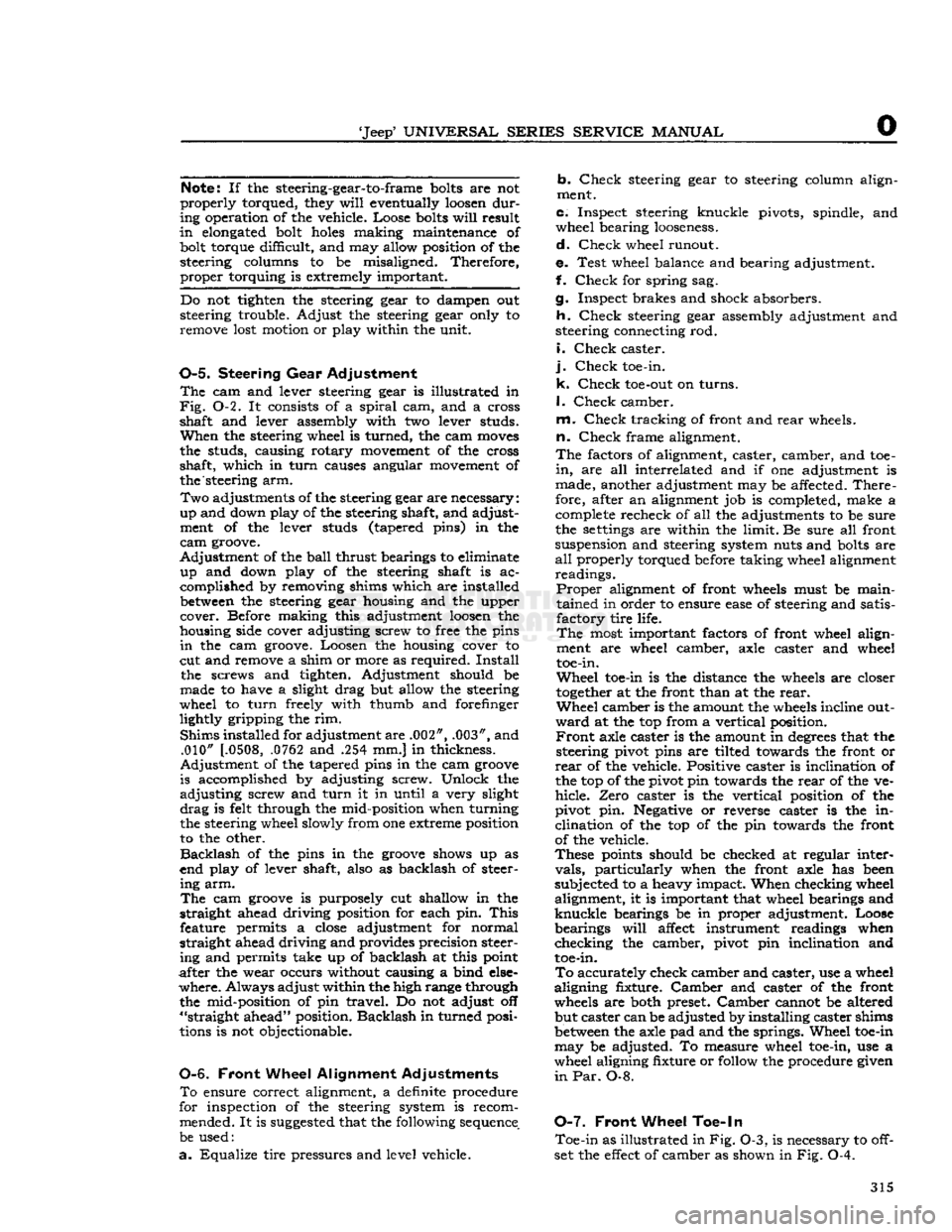
0-5. Steering
Gear
Adjustment
The
cam and lever steering gear is illustrated in
Fig.
0-2. It consists of a
spiral
cam, and a cross shaft and lever assembly with two lever studs.
When
the steering wheel is turned, the cam
moves
the studs, causing rotary movement of the cross
shaft, which in
turn
causes angular movement of
the*steering arm.
Two
adjustments of the steering gear are necessary:
up and down play of the steering shaft, and adjustment of the lever studs (tapered pins) in the
cam
groove.
Adjustment
of the
ball
thrust bearings to eliminate up and down play of the steering shaft is ac
complished by removing shims which are installed
between
the steering gear housing and the upper
cover. Before making this adjustment
loosen
the
housing side cover adjusting screw to free the pins
in
the cam groove. Loosen the housing cover to
cut and remove a shim or more as required.
Install
the screws and tighten. Adjustment should be
made to have a slight drag but allow the steering
wheel to
turn
freely with thumb and forefinger
lightly gripping the rim.
Shims
installed for adjustment are .002*, .003", and .010"
[.0508,
.0762
and .254 mm.] in thickness.
Adjustment
of the tapered pins in the cam
groove
is accomplished by adjusting screw. Unlock the
adjusting
screw and
turn
it in until a very slight
drag
is felt through the mid-position when turning
the steering wheel slowly from one extreme position
to the other.
Backlash
of the pins in the
groove
shows up as
end play of lever shaft, also as backlash of steer ing arm.
The
cam
groove
is purposely cut shallow in the
straight
ahead driving position for each pin.
This
feature permits a
close
adjustment for normal
straight
ahead driving and provides precision steer ing and permits take up of backlash at this point
after the wear occurs without causing a bind else
where.
Always
adjust within the high range through
the mid-position of pin travel. Do not adjust off
"straight
ahead" position.
Backlash
in turned posi
tions is not objectionable.
0-6.
Front
Wheel Alignment Adjustments
To
ensure correct alignment, a definite procedure
for inspection of the steering system is recom mended. It is
suggested
that the following sequence
be used:
a.
Equalize
tire pressures and level vehicle.
b.
Check
steering gear to steering column align
ment.
c.
Inspect steering knuckle pivots, spindle, and
wheel bearing
looseness.
d.
Check
wheel runout.
e.
Test wheel balance and bearing adjustment.
f.
Check
for spring sag.
g.
Inspect brakes and shock absorbers.
h.
Check
steering gear assembly adjustment and
steering connecting rod.
i.
Check
caster,
j.
Check
toe-in.
k.
Check
toe-out
on turns.
I.
Check
camber.
m.
Check
tracking of front and
rear
wheels,
n.
Check
frame alignment.
The
factors of alignment, caster, camber, and toe-
in,
are all interrelated and if one adjustment is
made, another adjustment may be affected.
There
fore, after an alignment job is completed, make a
complete recheck of all the adjustments to be sure
the
settings
are within the limit. Be sure all front
suspension and steering system nuts and
bolts
are
all
properly torqued before taking wheel alignment readings.
Proper
alignment of front wheels must be main
tained in order to ensure
ease
of steering and satisfactory tire life.
The
most important factors of front wheel alignment are wheel camber, axle caster and wheel
toe-in.
Wheel
toe-in is the distance the wheels are closer
together
at the front than at the
rear.
Wheel
camber is the amount the wheels incline out
ward
at the top from a vertical position.
Front
axle caster is the amount in
degrees
that the
steering pivot pins are tilted towards the front or
rear
of the vehicle. Positive caster is inclination of
the top of the pivot pin towards the
rear
of the ve
hicle.
Zero caster is the vertical position of the
pivot pin. Negative or reverse caster is the in
clination
of the top of the pin towards the front
of the vehicle.
These
points should be checked at regular inter
vals,
particularly when the front axle has been
subjected to a heavy impact. When checking wheel alignment, it is important that wheel bearings and
knuckle
bearings be in proper adjustment. Loose bearings
will
affect instrument readings when
checking
the camber, pivot pin inclination and
toe-in.
To
accurately check camber and caster, use a wheel
aligning fixture.
Camber
and caster of the front
wheels are both preset.
Camber
cannot be altered
but caster can be adjusted by installing caster shims
between
the axle pad and the springs. Wheel toe-in
may
be adjusted. To measure wheel toe-in, use a
wheel aligning fixture or follow the procedure given
in Par.
0-8.
0-7.
Front Wheel Toe-in
Toe-in
as illustrated in
Fig.
0-3, is necessary to
off
set the
effect
of camber as shown in Fig. Q-4. 315
Page 317 of 376
'Jeep'
UNIVERSAL SERIES SERVICE
MANUAL
The
purpose of caster Fig. O-S, is to provide steer
ing stability which
will
keep the front wheels in the
straight
ahead position and also assist in straighten
ing up the wheels when coming out of a
turn.
Caster
of the front wheels is preset. If the angle of
caster,
when accurately measured, is found to be
incorrect,
correct it to the specification given at
the end of this section by either installing new
parts
or installing caster shims
between
the axle
pad
and the springs.
If
the camber and toe-in are correct and it is known
the the axle is not twisted, a satisfactory check
may
be made by testing the vehicle on the road.
Before road testing, make sure all tires are properly
inflated,
being particularly careful that both front
tires are inflated to exactly the same pressure.
If
vehicle turns easily to either side but is
hard
to
straighten out, insufficient caster for easy handling of vehicle is indicated. If correction is necessary, it
can
usually be accomplished by installing shims
between
the springs and axle pads to secure the
desired
result.
0-11-
Front
Wheel
Turning
Angle
When
the front wheels are turned, the inside wheel
on the
turn
travels in a smaller circle than the outside wheel, therefore, it is necessary for the wheels
to toe out to prevent the tire on the inside wheel
frOm
being scuffed sideways.
This
angle for toe out
on turns is designed to permit both front wheels to
turn
on a common center by having the ends of the
steering
knuckle
arms closer
together
than the king
pins.
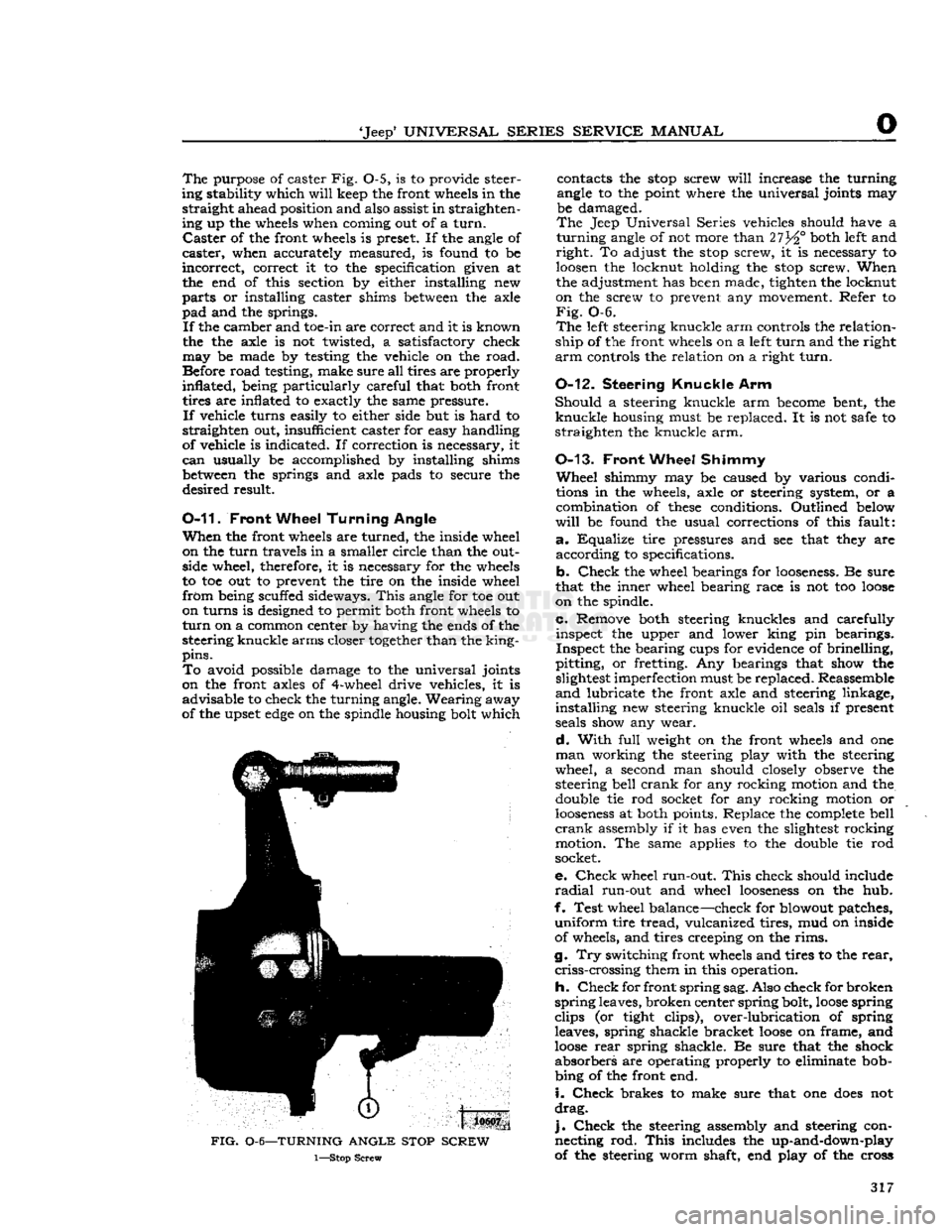
To
avoid possible damage to the universal joints
on the front axles of 4-wheel drive vehicles, it is advisable to check the turning angle.
Wearing
away
of the upset
edge
on the spindle housing bolt which
10607
FIG.
0-6—TURNING
ANGLE
STOP
SCREW
1—Stop
Screw
contacts the
stop
screw
will
increase the turning
angle to the point where the universal joints may
be damaged.
The
Jeep Universal Series vehicles should have a
turning
angle of not more than 27^° both left and
right.
To adjust the
stop
screw, it is necessary to
loosen
the locknut holding the
stop
screw. When
the adjustment has been made, tighten the locknut
on the screw to prevent any movement. Refer to
Fig.
O 6.
The
left steering knuckle arm controls the relation
ship of the front wheels on a left
turn
and the right
arm
controls the relation on a right
turn.
0-12. Steering
Knuckle
Arm
Should
a steering knuckle arm
become
bent, the
knuckle
housing must be replaced. It is not safe to
straighten the knuckle arm.
0-13.
Front
Wheel
Shimmy
Wheel
shimmy may be caused by various condi
tions in the wheels, axle or steering system, or a
combination of
these
conditions. Outlined below
will
be found the usual corrections of this fault:
a.
Equalize
tire pressures and see that they are
according
to specifications.
b.
Check
the wheel bearings for
looseness.
Be sure
that the inner wheel bearing race is not too
loose
on the spindle.
c.
Remove both steering knuckles and carefully inspect the upper and lower king pin bearings.
Inspect
the bearing cups for evidence of brinelling,
pitting, or fretting. Any bearings that show the slightest imperfection must be
replaced.
Reassemble
and
lubricate the front axle and steering linkage,
installing
new steering knuckle oil seals if present
seals show any wear.
d.
With
full
weight on the front wheels and one
man
working the steering play with the steering
wheel, a second man should closely observe the steering bell
crank
for any rocking motion and the
double tie rod socket for any rocking motion or
looseness
at both points. Replace the complete bell
crank
assembly if it has even the slightest rocking motion. The same applies to the double tie rod
socket.
e.
Check
wheel run-out.
This
check should include
radial
run-out and wheel
looseness
on the hub.
f- Test wheel balance—check for blowout patches,
uniform
tire tread, vulcanized tires, mud on inside
of wheels, and tires creeping on the
rims.
g.
Try
switching front wheels and tires to the
rear,
criss-crossing
them in this operation.
h.
Check
for front
spring
sag. Also check for broken
spring
leaves, broken center
spring
bolt,
loose
spring
clips
(or tight clips), over-lubrication of spring leaves, spring shackle bracket
loose
on frame, and
loose
rear
spring shackle. Be sure that the shock
absorbers
are operating properly to eliminate bobbing of the front end.
i.
Check
brakes to make sure that one
does
not
drag.
j.
Check
the steering assembly and steering con necting rod.
This
includes the up-and-down-play
of the steering worm shaft, end play of the cross 317
Page 323 of 376
'Jeep'
UNIVERSAL
SERIES SERVICE
MANUAL
P
BRAKES
SUBJECT
PAR
GENERAL.
. P-l
Brake
Maintenance P-5
Master
Cylinder.
P-2
Parking
Brake
P-3
Transmission
Brake
P-4
BRAKE SERVICE
.P-6 Bleeding Brakes P-7
Brake
Adjustments P-14
Brake
Hoses P-8
Brake
Shoe
Initial
Adjustment P-l9
Brake
Shoe Installation P-l8
Brake
Pedal Adjustment P-9
Hand
Brake.
P-10 Inspection P-17
SUBJECT
PAR
Brake
Shoe Removal P-l6
Master
Cylinder Reconditioned. . P-20
Parking
Brake
Adjustment
.P-l 1
Relining
Transmission
Brake
P-13
Relining
Wheel
Brake
P-l5
Transmission
Brake
Adjustment .P-12
Wheel
Brake
Units P-14
Wheel
Cylinder Reconditioning P-21
TROUBLESHOOTING
P-2 2 Squeaky Brakes P-23
Rattles in Brakes P-24
SERVICE
DIAGNOSIS.
P-25
SPECIFICATIONS
P-2 6
P-1. GENERAL
A
double-safety
hydraulic brake system in con
junction with self-adjusting wheel brake units are
standard
equipment on all current production
'Jeep* vehicles. The
double-safety
brake system
Is
equipped with dual
stop
light switches that op
erate independently of each other, thus eliminating
possible
stop
light failure. Service information for
self adjusting brakes starts with Par. P-14.
All
four-wheel-drive vehicles are equipped with a transmission brake that operates in the drive line
and
is mounted to the rear of the transfer case. Two-wheel-drive vehicles
(DJ-5,
DJ-6)
are equipped
with a hand-operated parking brake that operates at the rear wheels.
P-2.
Master Cylinder —
Double Safety-Brake System
The
master cylinder (cast integrally with the res
ervoir)
is the compensating type. Refer to Fig.
P-2 and P-13.
Action by the brake pedal
moves
the master cylinder piston which exerts pressure on the fluid in
the cylinder and lines. 12914
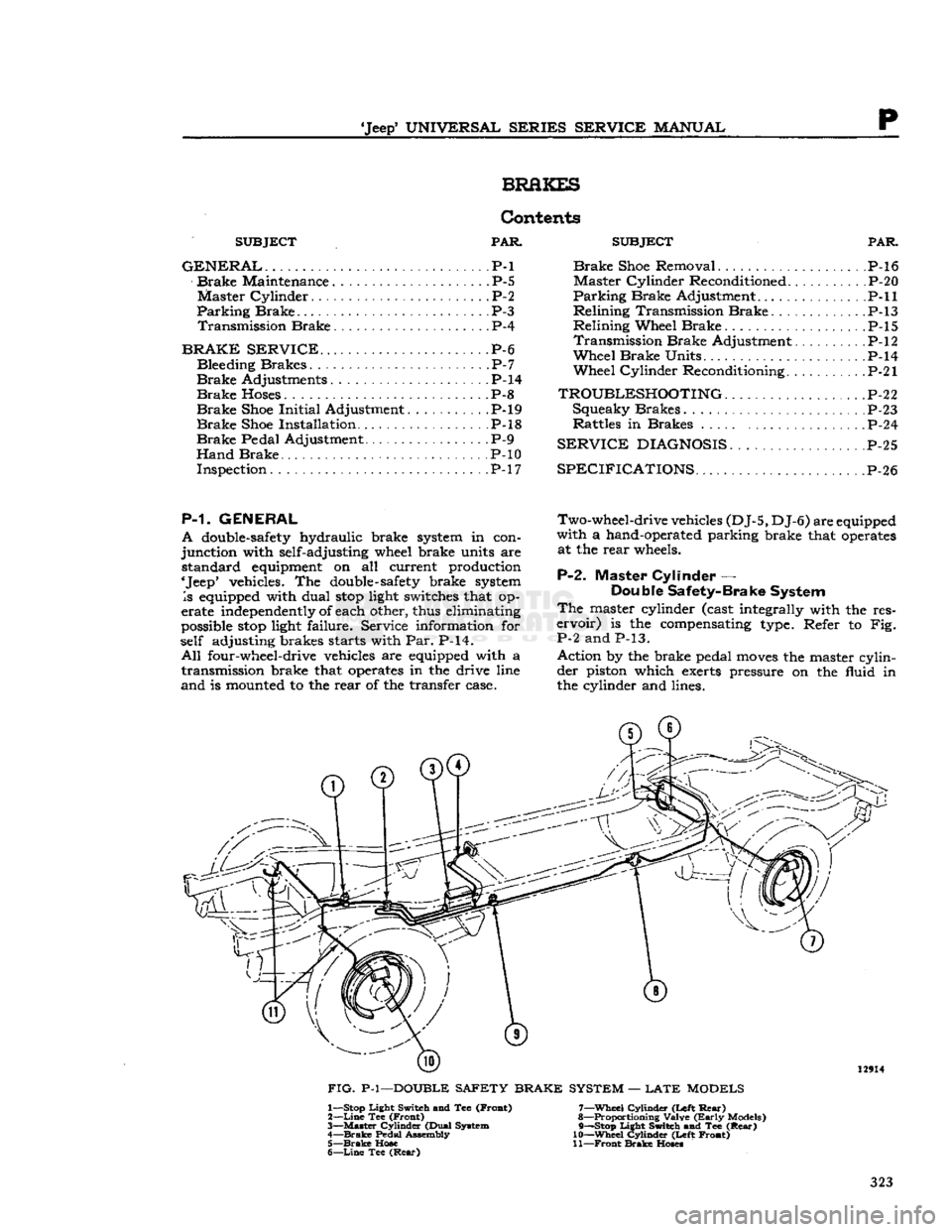
FIG.
P-l—DOUBLE SAFETY BRAKE SYSTEM —
LATE
MODELS 1— Stop Light Switch and Tee (Froat)
2—
Line
Tee (Front)
3—
Master
Cylinder (Dual System
4—
Brake
Pedal Assembly 5—
Brake
Hose
6—
Line
Tee
(Rear)
7—
Wheel
Cylinder (Left
Rear)
8— Proportioning Valve
(Early
Models)
9— —Stop Light Switch and Tee
(Rear)
10—
Wheel
Cylinder (Left Front)
11—
Front
Brake
Hoses
323
Page 324 of 376
p
BRAKES
13264
FIG- P-2—DOUBLE
SAFETY BRAKE
MASTER
CYLINDER
With
the Double-Safety brake system type master
cylinder,
failure
in one part of the brake system
does
not result in
failure
of the entire hydraulic
brake system. Failure in the
front
brake system
will
leave the rear brake system
still
operative or
failure
in
the rear system
will
leave the
front
brake system
operative.
A
double hydraulic
cylinder
with
two outlets, two
residual
check valves, two
fluid
reservoirs, and
two
hydraulic pistons (a
primary
and secondary)
are operated in tandem by a single hydraulic push
rod.
The
primary
outlet is connected to the
front
brakes
with
the secondary outlet connected to the rear brakes.
With
the master
cylinder
fluid
reservoirs
filled
and the
front
and rear brake system
bled,
there is a
solid
column
of
fluid
on the
forward
side of both the
primary
and the secondary pistons.
Upon
application
of the brakes, through movement
of
the brake pedal,
fluid
is displaced by the pistons
into
the wheel cylinders to activate both
front
and
rear brakes.
Upon
release
of the brakes,
fluid
re
turns
from
the rear wheel cylinders through the secondary residual check valve to the secondary
portion
of the master
cylinder
bore.
Fluid
also
returns
from
the
front
wheel cylinders through the
primary
residual check valve to the
primary
portion
of the master
cylinder
bore.
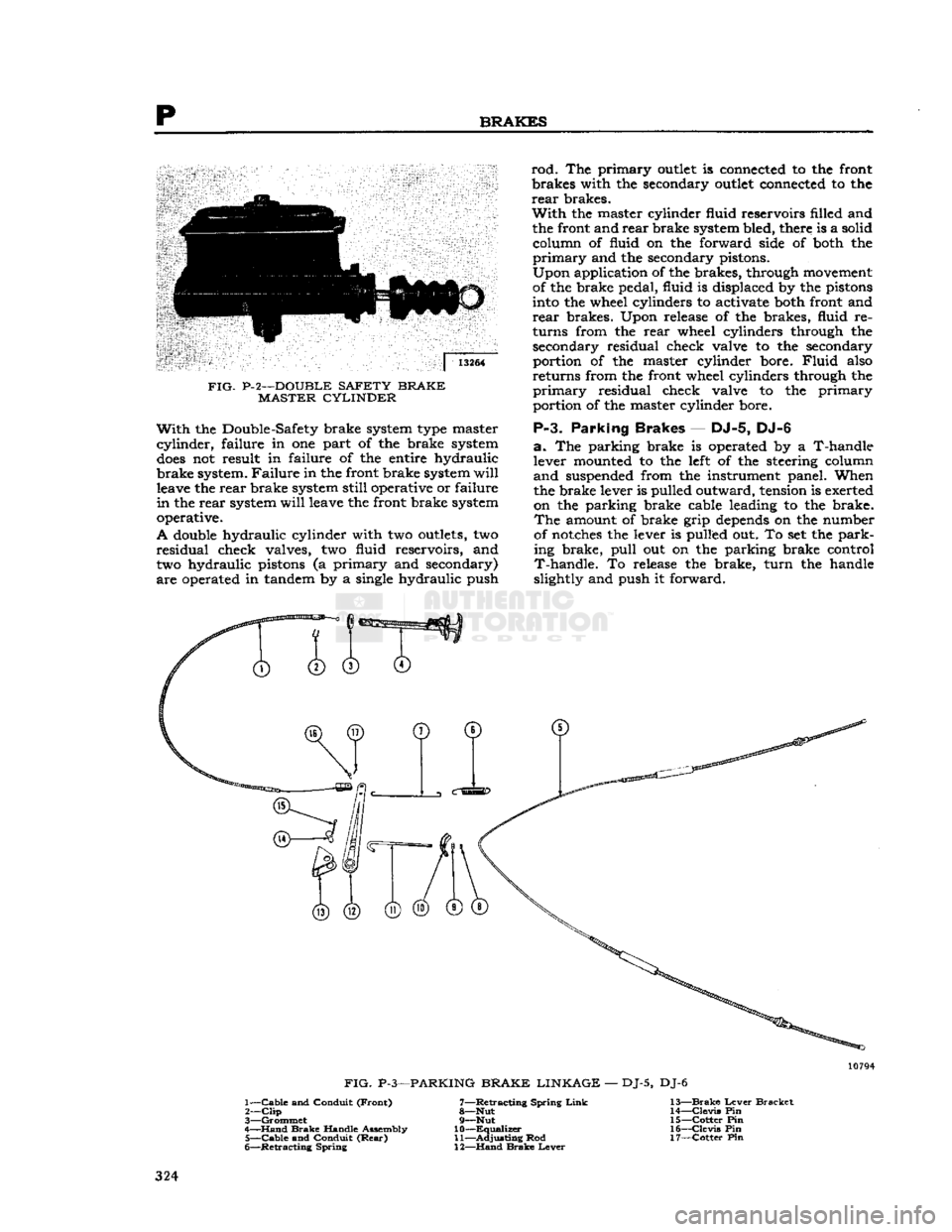
P-3.
Parking
Brakes
— DJ-5, DJ-6
a.
The parking brake is operated by a T-handle
lever
mounted to the
left
of the steering
column
and
suspended
from
the instrument panel. When
the brake lever is
pulled
outward, tension is exerted
on
the parking brake cable leading to the brake.
The
amount of brake
grip
depends
on the number
of
notches the lever is
pulled
out. To set the park
ing
brake,
pull
out on the parking brake
control
T-handle.
To
release
the brake,
turn
the handle
slightly
and push it
forward.
0
FIG.
P-3—PARKING
BRAKE LINKAGE
—
DJ-5,
DJ-6
1—
Cable
and
Conduit
(Front)
7—Retracting
Spring
Link
13—Brake
Lever
Bracket
2—
Clip
8—Nut
14—Clevis
Pin
3—
Grommet
9—Nut
15—Cotter
Pin
4—
Hand
Brake
Handle
Assembly
10—Equalizer
16—Clevis
Pin
5—
Cable
and
Conduit
(Rear)
11—Adjusting
Rod
17—Cotter
Pin
6—
Retracting
Spring
12—Hand
Brake
Lever
324
Page 325 of 376
'Jeep'
UNIVERSAL
SERIES SERVICE
MANUAL
P The
standard parking brakes (Fig. P-3) consist of
cable-controlled linkage for applying the rear wheel
brake
shoes
mechanically. A single cable from the
parking
brake control lever is connected, by means of an equalizer, to cables leading to individual rear
brakes.
A lever attached to the secondary
shoe,
with a link acting against the
primary
shoe,
expands the
shoes
into
contact with the drums.
P-4.
Transmission Brake
The
transmission brake is mechanically operated
by a hand lever through a cable and conduit and is mounted at the rear output bearing housing on the
transfer case. The transmission brake and its
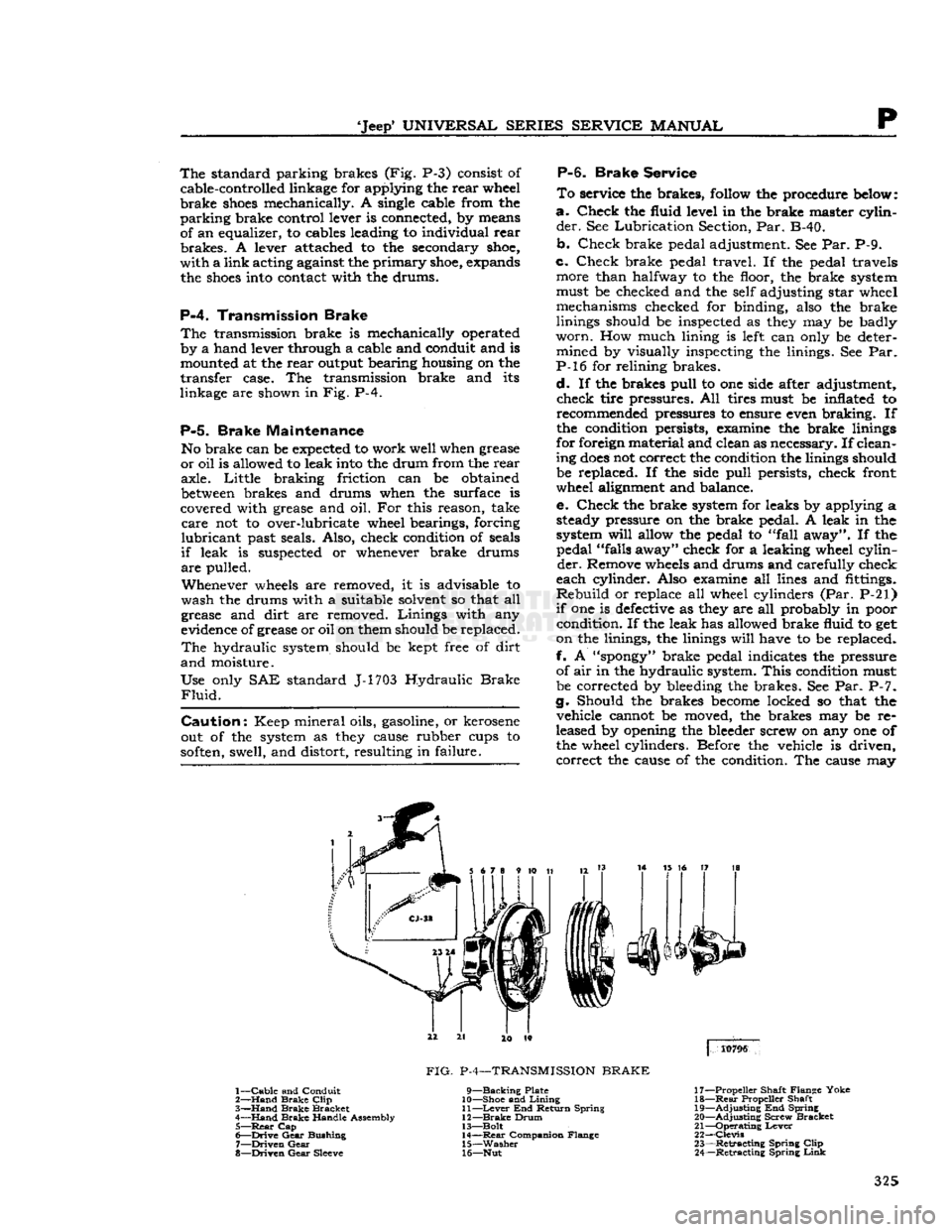
linkage are shown in Fig. P-4.
P-5.
Brake Maintenance
No brake can be
expected
to work well when grease
or oil is allowed to leak
into
the drum from the rear axle. Little braking friction can be obtained
between
brakes and drums when the surface is
covered with grease and oil. For this reason, take
care
not to over-lubricate wheel bearings, forcing
lubricant
past seals. Also, check condition of seals
if
leak is suspected or whenever brake drums
are
pulled.
Whenever
wheels
are removed, it is advisable to
wash the drums with a suitable solvent so that all
grease and dirt are removed. Linings with any
evidence of grease or oil on them should be replaced.
The
hydraulic system should be kept free of dirt
and
moisture.
Use only SAE standard J-1703 Hydraulic
Brake
Fluid.
Caution:
Keep mineral oils, gasoline, or kerosene
out of the system as
they
cause rubber cups to
soften,
swell, and distort, resulting in failure.
P-6.
Brake
Service
To
service the brakes,
follow
the procedure
below:
a.
Check the fluid level in the brake master cylin
der.
See Lubrication Section, Par. B-40.
b. Check brake pedal adjustment. See Par. P-9.
c. Check brake pedal travel. If the pedal travels more than halfway to the floor, the brake system
must be checked and the self adjusting star wheel mechanisms checked for binding, also the brake
linings should be inspected as
they
may be badly
worn.
How much lining is
left
can only be deter mined by visually inspecting the linings. See Par.
P-l6 for relining brakes.
d.
If the brakes pull to one side after adjustment, check tire pressures. All tires must be inflated to recommended pressures to ensure even braking. If
the condition persists, examine the brake linings
for foreign material and clean as necessary. If clean
ing
does
not correct the condition the linings should be replaced. If the side pull persists, check front
wheel alignment and balance.
e. Check the brake system for leaks by applying a steady pressure on the brake pedal. A leak in the
system
will
allow the pedal to "fall away". If the pedal "falls away" check for a leaking wheel cylin
der.
Remove
wheels
and drums and carefully check
each cylinder. Also examine all lines and fittings.
Rebuild
or replace all wheel cylinders (Par. P-21)
if
one is
defective
as
they
are all probably in poor condition. If the leak has allowed brake fluid to get
on the linings, the linings
will
have to be replaced.
f. A
"spongy"
brake pedal indicates the pressure of air in the hydraulic system.
This
condition must
be corrected by bleeding the brakes. See Par. P-7.
g. Should the brakes
become
locked so that the vehicle cannot be moved, the brakes may be re
leased by opening the bleeder screw on any one of the wheel cylinders. Before the vehicle is driven, correct the cause of the condition. The cause may
3
14 15 16 17 18
4
10796
1—
Cable
and Conduit
2—
Hand
Brake
Clip
3—
Hand
Brake
Bracket
4—
Hand
Brake
Handle Assembly 5—
Rear
Cap
6—
Drive
Gear
Bushing
7—
Driven
Gear
8—
Driven
Gear
Sleeve
FIG.
P-4—TRANSMISSION
BRAKE
9—Backing
Plate
10— Shoe and
Lining
11—
Lever
End Return Spring
12—
Brake
Drum
13— Bolt 14—
Rear
Companion Flange
15—
Washer
16— Nut 17— Propeller Shaft Flange Yoke
18—
Rear
Propeller Shaft
19—
Adjusting
End Spring
20—
Adjusting
Screw Bracket
21—
Operating
Lever
22—
Clevis
23—
Retracting
Spring
Clip
24—
Retracting
Spring
Link
325
Page 326 of 376
p
BRAKES
be either a defective master cylinder or the use of
low grade brake fluid which has expanded because
of heat. Use standard duty brake fluid conforming to
SAE-J1703
specification.
P-7.
Bleeding
Brakes
The
hydraulic
brake system must be bled whenever
a
fluid line has been disconnected or air
gets
into the system. A leak in the system may sometimes
be indicated by the presence of a spongy brake
pedal.
Air trapped in the system is compressible
and
does
not permit the pressure, applied to the
brake
pedal, to be transmitted solidly through to
the brakes. The system must be absolutely free
from
air at all times. When bleeding brakes, bleed
at that wheel with the
longest
line from the master
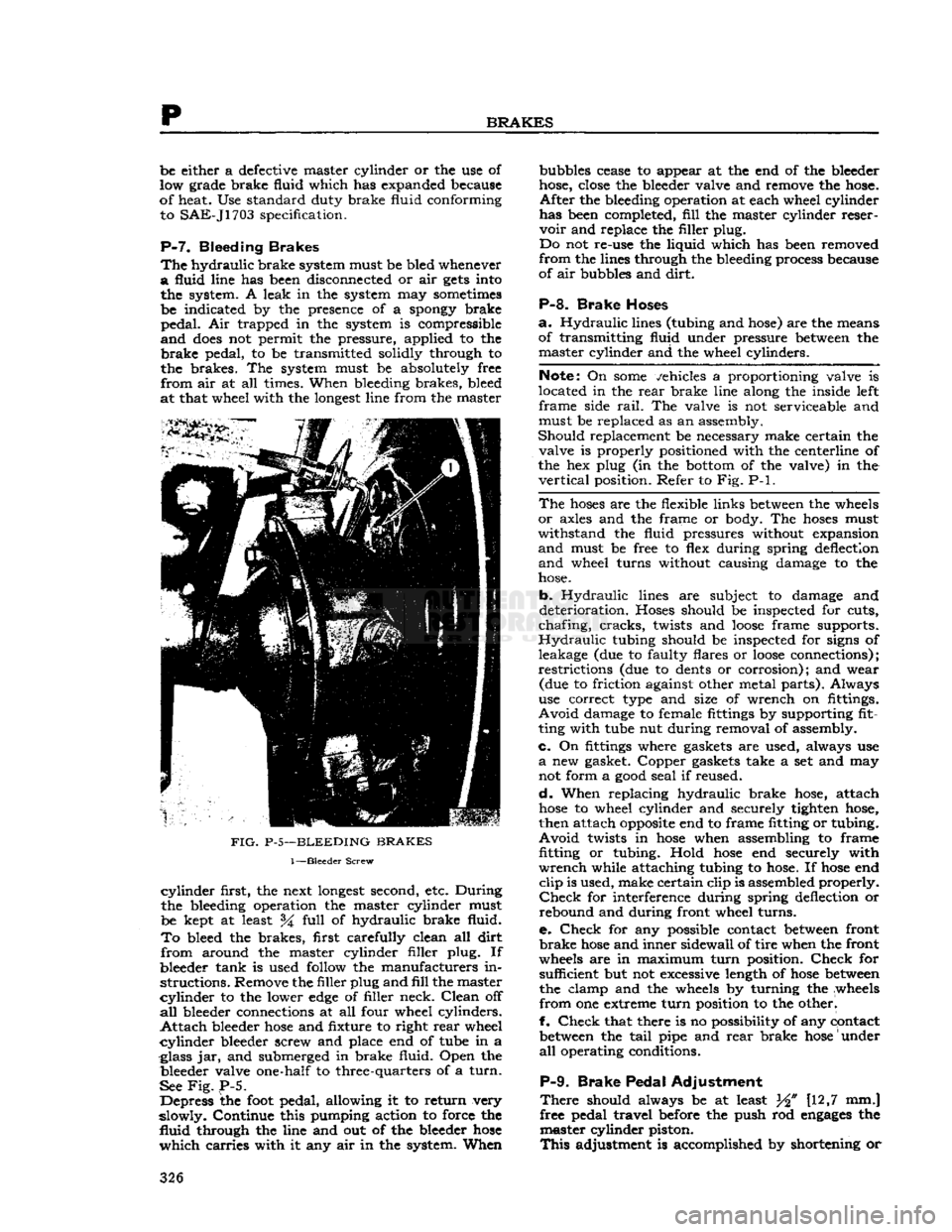
FIG.
P-5—BLEEDING
BRAKES
1—Bleeder
Screw
cylinder
first, the next
longest
second, etc. During
the bleeding operation the master cylinder must
be kept at least %
full
of hydraulic brake fluid.
To
bleed the brakes, first carefully clean all
dirt
from
around the master cylinder filler plug. If
bleeder tank is used follow the manufacturers in
structions.
Remove the filler plug and
fill
the master
cylinder
to the lower
edge
of filler neck.
Clean
off
all
bleeder connections at all four wheel cylinders.
Attach
bleeder
hose
and fixture to right
rear
wheel
cylinder
bleeder screw and place end of tube in a
glass jar, and submerged in brake fluid. Open the bleeder valve one-half to three-quarters of a
turn.
See
Fig.
P-5.
Depress the
foot
pedal, allowing it to return very
slowly. Continue this pumping action to force the
fluid
through the line and out of the bleeder
hose
which
carries with it any air in the system. When bubbles cease to appear at the end of the bleeder
hose, close the bleeder valve and remove the hose.
After
the bleeding operation at each wheel cylinder
has been completed,
fill
the master cylinder reser
voir
and replace the filler plug.
Do not re-use the liquid which has been removed
from
the lines through the bleeding process because
of air bubbles and
dirt.
P-8.
Brake Hoses
a.
Hydraulic
lines (tubing and hose) are the means
of transmitting fluid under pressure between the master cylinder and the wheel cylinders.
Note:
On
some
vehicles a proportioning valve is
located in the
rear
brake line along the inside left
frame
side
rail.
The valve is not serviceable and
must be replaced as an assembly.
Should
replacement be necessary make certain the valve is properly positioned with the centerline of
the hex plug (in the bottom of the valve) in the
vertical
position. Refer to Fig. P-l.
The
hoses
are the flexible links between the wheels
or
axles and the frame or body. The
hoses
must
withstand
the fluid pressures without expansion
and
must be free to flex during spring deflection
and
wheel turns without causing damage to the
hose.
b.
Hydraulic
lines are subject to damage and
deterioration. Hoses should be inspected for cuts,
chafing,
cracks,
twists and
loose
frame supports.
Hydraulic
tubing should be inspected for signs of
leakage (due to faulty flares or
loose
connections);
restrictions
(due to dents or corrosion); and wear (due to friction against other metal parts). Always
use correct type and size of wrench on fittings.
Avoid
damage to female fittings by supporting fit
ting with tube nut during removal of assembly.
c.
On fittings where gaskets are used, always use
a
new gasket. Copper gaskets take a set and may
not form a
good
seal if reused.
d.
When replacing hydraulic brake hose, attach
hose
to wheel cylinder and securely tighten hose,
then attach
opposite
end to frame fitting or tubing.
Avoid
twists in
hose
when assembling to frame fitting
or
tubing. Hold
hose
end securely with
wrench
while attaching tubing to hose. If
hose
end
clip
is used, make certain clip is assembled properly.
Check
for interference during spring deflection or
rebound and during front wheel turns.
e.
Check
for any possible contact between front
brake
hose
and inner sidewall of tire when the front
wheels are in maximum
turn
position.
Check
for sufficient but not excessive length of
hose
between
the clamp and the wheels by turning the wheels
from
one extreme
turn
position to the otherl
f.
Check
that there is no possibility of any contact between the
tail
pipe and
rear
brake
hose
under
all
operating conditions.
P-9.
Brake Pedal Adjustment
There
should always be at least W [12,7 mm.]
free pedal travel before the push rod
engages
the master cylinder piston.
This
adjustment is accomplished by shortening or 326