towing JEEP COMMANDER 2008 1.G User Guide
[x] Cancel search | Manufacturer: JEEP, Model Year: 2008, Model line: COMMANDER, Model: JEEP COMMANDER 2008 1.GPages: 478, PDF Size: 6.97 MB
Page 284 of 478
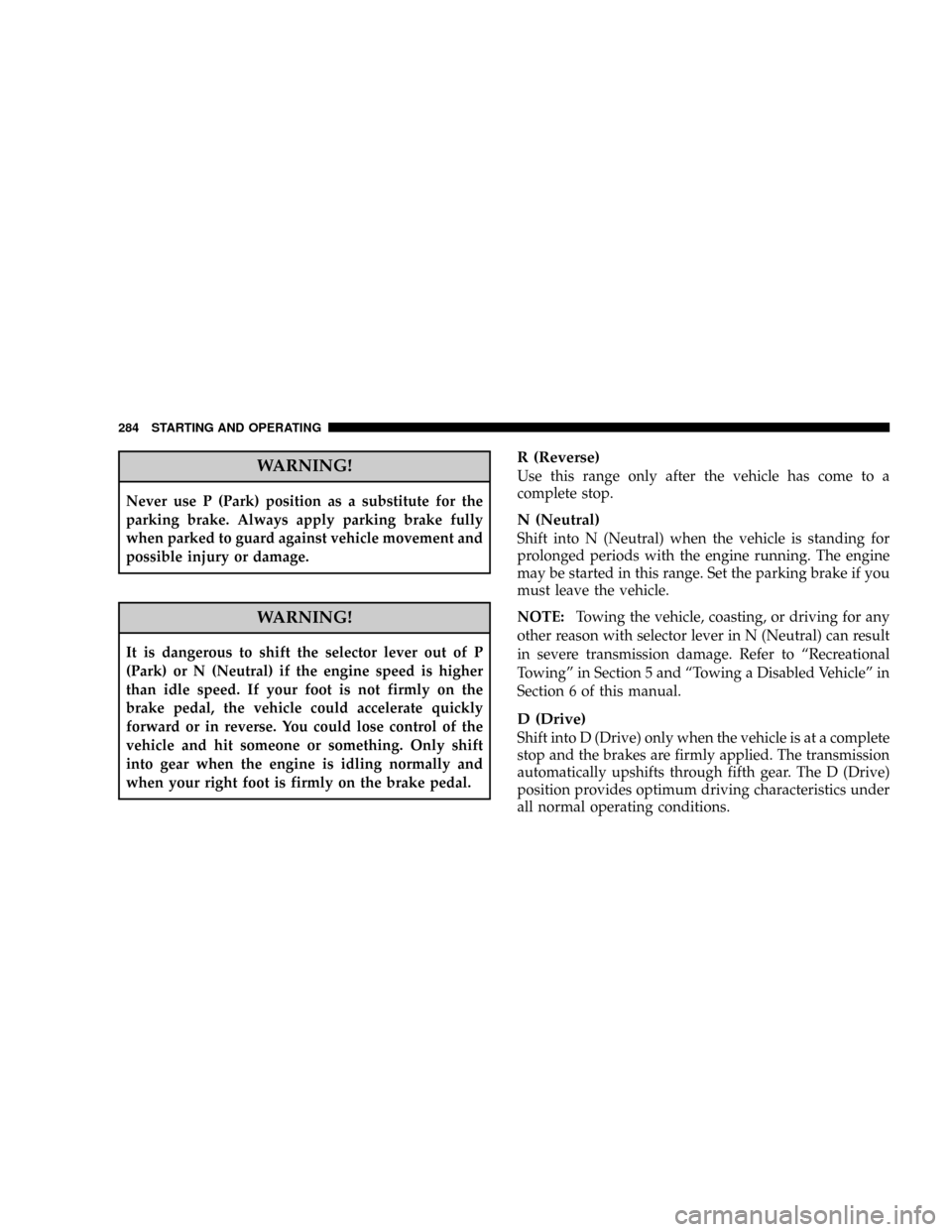
WARNING!
Never use P (Park) position as a substitute for the
parking brake. Always apply parking brake fully
when parked to guard against vehicle movement and
possible injury or damage.
WARNING!
It is dangerous to shift the selector lever out of P
(Park) or N (Neutral) if the engine speed is higher
than idle speed. If your foot is not firmly on the
brake pedal, the vehicle could accelerate quickly
forward or in reverse. You could lose control of the
vehicle and hit someone or something. Only shift
into gear when the engine is idling normally and
when your right foot is firmly on the brake pedal.
R (Reverse)
Use this range only after the vehicle has come to a
complete stop.
N (Neutral)
Shift into N (Neutral) when the vehicle is standing for
prolonged periods with the engine running. The engine
may be started in this range. Set the parking brake if you
must leave the vehicle.
NOTE:Towing the vehicle, coasting, or driving for any
other reason with selector lever in N (Neutral) can result
in severe transmission damage. Refer to ªRecreational
Towingº in Section 5 and ªTowing a Disabled Vehicleº in
Section 6 of this manual.
D (Drive)
Shift into D (Drive) only when the vehicle is at a complete
stop and the brakes are firmly applied. The transmission
automatically upshifts through fifth gear. The D (Drive)
position provides optimum driving characteristics under
all normal operating conditions.
284 STARTING AND OPERATING
Page 285 of 478

Electronic Range Select (ERS)Operation
The Electronic Range Select (ERS) shift control allows
you to move the shifter left (-) or right (+) when the
shifter is in the D (Drive) position, allowing the selection
of the desired top gear. For example, if the driver shifts
the transmission into 3 (third gear), the transmission will
never shift above third gear, but can shift down to 2
(second) or 1 (first), when needed.
When in the D (Drive) position, the first tap to the left (-),
will show the current gear. For example, if you are in D
(Drive) and are in 3rd gear, when you tap the gear shift
one time to the left (-), the display will show 3. Another
tap to the left (-) will shift the transmission into 2nd gear.
If you are in D (Drive) and are in 5th gear, the first tap to
the left (-) will display 5. Another tap to the left (-) will
shift the transmission into 4th gear.
On vehicles equipped with 4.7L or 5.7L engines, use of
ERS (or Tow/Haul mode) also enables a additional
underdrive gear which is not normally used duringthrough-gear accelerations. This additional gear im-
proves vehicle performance and cooling capability when
towing a trailer on certain grades. In ERS mode (on all
transmissions), 1st through 3rd gear are underdrive gears
and 4th gear is direct drive. ERS 5th gear (Overdrive) is
the same as the normal 4th gear.
WARNING!
Do not downshift for additional engine braking on a
slippery surface. The drive wheels could lose their
grip and the vehicle could skid.
Screen Display12345*D
Actual Gear(s)
Allowed1 1-2 1-3 1-4 1-5 1-5
* Applies to vehicles equipped with 4.7L/5.7L engines
only.
STARTING AND OPERATING 285
5
Page 287 of 478

OVER TEMPº message may display and the transmis-
sion may downshift out of Overdrive until the transmis-
sion cools down. After cool down, the transmission will
resume normal operation.
In high ambient temperatures with sustained high engine
speed and load, an upshift followed shortly thereafter by
a downshift may occur. This is a normal part of the
overheat protection strategy when operating in the
ªTow/Haulº mode.
The transmission will downshift from Overdrive to the
most desirable gear if the accelerator pedal is fully
depressed at vehicle speeds above approximately 35 mph
(56 km/h).
When To Use ªTOW/HAULº Mode Ð If Equipped
When driving in hilly areas, towing a trailer, carrying a
heavy load, etc., and frequent transmission shifting oc-
curs, press the ªTOW/HAULº switch. This will improve
performance and reduce the potential for transmissionoverheating or failure due to excessive shifting. When
operating in ªTOW/HAULº mode, the transmission will
shift to direct gear and Overdrive will be enabled under
steady cruise conditions.
The ªTOW/HAULº light will illuminate in the instru-
ment cluster to indicate when the switch has beenTOW/HAUL Switch
STARTING AND OPERATING 287
5
Page 292 of 478

WARNING!
You or others could be injured if you leave the
vehicle unattended with the transfer case in the N
(Neutral) position without first fully engaging the
parking brake. The transfer case N (Neutral) position
disengages both the front and rear driveshafts from
the powertrain and will allow the vehicle to move
regardless of the transmission position. The parking
brake should always be applied when the driver is
not in the vehicle.
Shift Positions
For additional information on the appropriate use of each
transfer case mode position, see the information below:
4HI
Four Wheel Drive High Range Ð All roads surfaces such
as ice, snow, gravel, sand, and dry hard pavement.
N (Neutral)
Neutral Ð Disengages both the front and rear driveshafts
from the powertrain. To be used for flat towing behind
another vehicle. Refer to ªRecreational Towingº in Sec-
tion 5 of this manual.
4 LOW
Four Wheel Drive Low Range Ð Low speed 4 wheel
drive. Locks the front and rear driveshafts together.
Forces the front and rear wheels to rotate at the same
speed. Additional traction and maximum pulling power
for loose, slippery road surfaces only. Do not exceed 25
mph (40 km/h).
292 STARTING AND OPERATING
Page 312 of 478

Loading
The vehicle maximum load on the tire must not exceed
the load carrying capacity of the tire on your vehicle. You
will not exceed the tire's load carrying capacity if you
adhere to the loading conditions, tire size, and cold tire
inflation pressures specified on the ªTire and Loading
Informationº placard and in the ªVehicle Loadingº sec-
tion of this manual.
NOTE:Under a maximum loaded vehicle condition,
gross axle weight ratings (GAWR's) for the front and rear
axles must not be exceeded. For further information on
GAWR's, vehicle loading, and trailer towing, refer to the
ªVehicle Loadingº section of this manual.
To determine the maximum loading conditions of your
vehicle, locate the statement ªThe combined weight of
occupants and cargo should never exceed XXX kg or XXX
lbs.º on the Tire and Loading Information placard. Thecombined weight of occupants, cargo/luggage and
trailer tongue weight (if applicable) should never exceed
the weight referenced here.
Steps for Determining Correct Load Limit
1. Locate the statement ªThe combined weight of occu-
pants and cargo should never exceed XXX poundsº on
your vehicle's placard.
2. Determine the combined weight of the driver and
passengers that will be riding in your vehicle.
3. Subtract the combined weight of the driver and pas-
sengers from XXX kilograms or XXX pounds.
4. The resulting figure equals the available amount of
cargo and luggage load capacity. For example, if ªXXXº
amount equals 1400 lbs. and there will be five 150 lb.
passengers in your vehicle, the amount of available cargo
and luggage load capacity is 650 lbs. (since 5 x 150 = 750,
and 1400 ± 750 = 650 lbs.)
312 STARTING AND OPERATING
Page 313 of 478

5. Determine the combined weight of luggage and cargo
being loaded on the vehicle. That weight may not safely
exceed the available cargo and luggage load capacity
calculated in Step 4.
6. If your vehicle will be towing a trailer, load from your
trailer will be transferred to your vehicle. Consult this
manual to determine how this reduces the available
cargo and luggage load capacity of your vehicle.NOTE:The following table shows examples on how to
calculate total load, cargo/luggage, and towing capaci-
ties of your vehicle with varying seating configurations
and number and size of occupants. This table is for
illustration purposes only and may not be accurate for
the seating and load carry capacity of your vehicle.
NOTE:For the following example, the combined weight
of occupants and cargo should never exceed 865 lbs. (392
kg).
STARTING AND OPERATING 313
5
Page 346 of 478

or rear axles has been exceeded but the total load is
within the specified GVWR. If so, weight must be shifted
from front to rear or rear to front as appropriate until the
specified weight limitations are met. Store the heavier
items down low and be sure that the weight is distributed
equally. Stow all loose items securely before driving.
Improper weight distributions can have an adverse effect
on the way your vehicle steers and handles and the way
the brakes operate.
CAUTION!
Do not load your vehicle any heavier than the GVWR
or the maximum front and rear GAWR. If you do,
parts on your vehicle can break, or it can change the
way your vehicle handles. This could cause you to
lose control. Also overloading can shorten the life of
your vehicle.
TRAILER TOWING
In this section you will find safety tips and information
on limits to the type of towing you can reasonably do
with your vehicle. Before towing a trailer carefully re-
view this information to tow your load as efficiently and
safely as possible.
To maintain warranty coverage, follow the requirements
and recommendations in this manual concerning ve-
hicles used for trailer towing.
Common Towing Definitions
The following trailer towing related definitions will assist
you in understanding the following information:
Gross Vehicle Weight Rating (GVWR)
The GVWR is the total allowable weight of your vehicle.
This includes driver, passengers, cargo and tongue
weight. The total load must be limited so that you do not
exceed the GVWR.
346 STARTING AND OPERATING
Page 348 of 478

Frontal Area
The maximum height and maximum width of the front of
a trailer.
Weight-Carrying Hitch
A weight-carrying hitch supports the trailer tongue
weight, just as if it were luggage located at a hitch ball or
some other connecting point of the vehicle. These kind of
hitches are the most popular on the market today and
they're commonly used to tow small- and medium-sized
trailers.
Weight-Distributing Hitch
A weight-distributing system works by applying lever-
age through spring (load) bars. They are typically used
for heavier loads, to distribute trailer tongue weight to
the tow vehicle's front axle and the trailer axle(s). When
used in accordance with the manufacturers' directions, it
provides for a more level ride, offering more consistent
steering and brake control thereby enhancing towingsafety. The addition of a friction/hydraulic sway control
also dampens sway caused by traffic and crosswinds and
contributes positively to tow vehicle and trailer stability.
Trailer sway control and a weight distributing (load
equalizing) hitch are recommended for heavier Tongue
Weights (TW) and may be required depending on Vehicle
and Trailer configuration/loading to comply with gross
axle weight rating (GAWR) requirements.
WARNING!
An improperly adjusted Weight Distributing Hitch
system may reduce handling, stability, braking per-
formance, and could result in an accident.
Weight Distributing Systems may not be compatible
with Surge Brake Couplers. Consult with your hitch
and trailer manufacturer or a reputable Recreational
Vehicle dealer for additional information.
348 STARTING AND OPERATING
Page 350 of 478
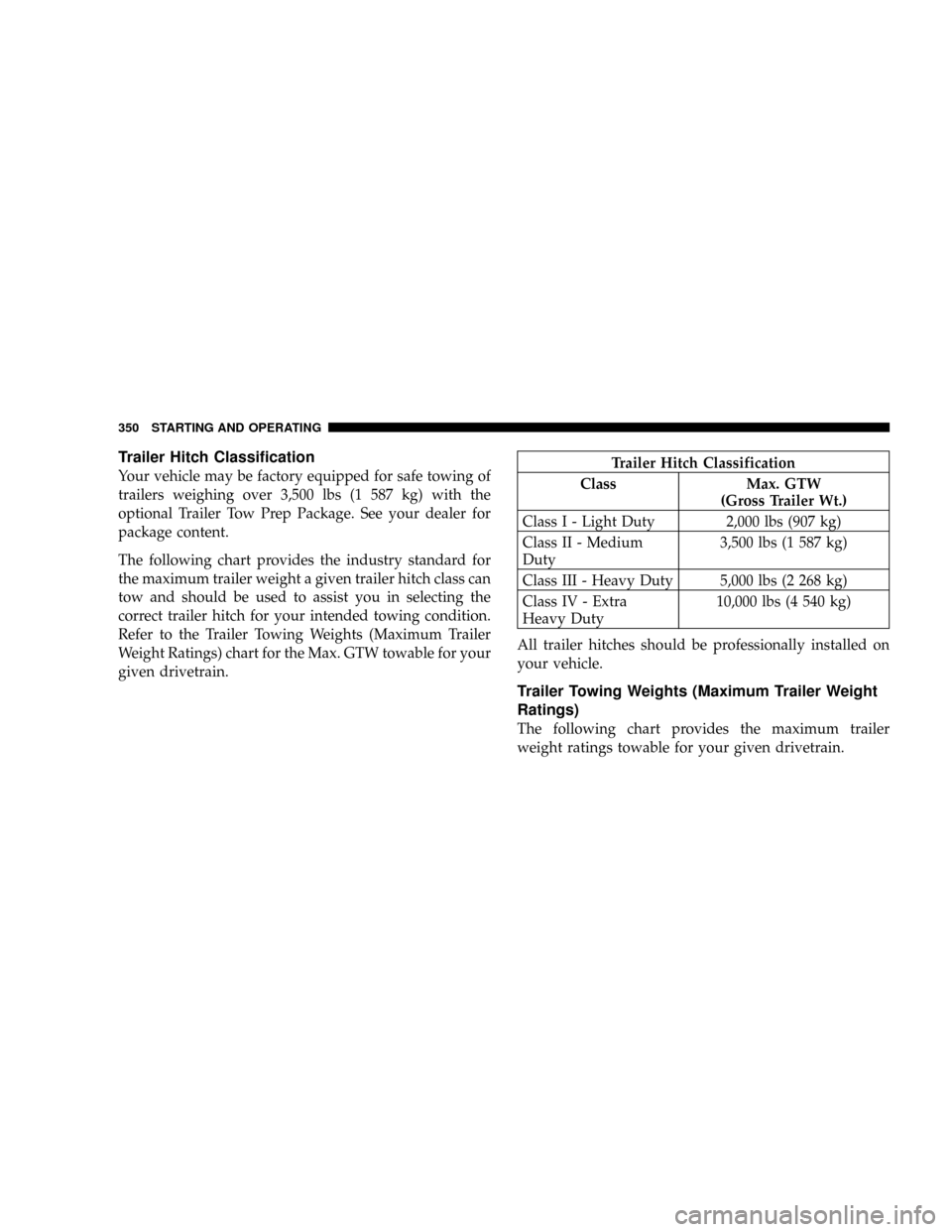
Trailer Hitch Classification
Your vehicle may be factory equipped for safe towing of
trailers weighing over 3,500 lbs (1 587 kg) with the
optional Trailer Tow Prep Package. See your dealer for
package content.
The following chart provides the industry standard for
the maximum trailer weight a given trailer hitch class can
tow and should be used to assist you in selecting the
correct trailer hitch for your intended towing condition.
Refer to the Trailer Towing Weights (Maximum Trailer
Weight Ratings) chart for the Max. GTW towable for your
given drivetrain.Trailer Hitch Classification
Class Max. GTW
(Gross Trailer Wt.)
Class I - Light Duty 2,000 lbs (907 kg)
Class II - Medium
Duty3,500 lbs (1 587 kg)
Class III - Heavy Duty 5,000 lbs (2 268 kg)
Class IV - Extra
Heavy Duty10,000 lbs (4 540 kg)
All trailer hitches should be professionally installed on
your vehicle.
Trailer Towing Weights (Maximum Trailer Weight
Ratings)
The following chart provides the maximum trailer
weight ratings towable for your given drivetrain.
350 STARTING AND OPERATING
Page 351 of 478

Engine/
TransmissionModel GCWR (Gross Com-
bined Wt. Rating)Frontal Area Max. GTW (Gross
Trailer Wt.)Max. Tongue Wt.
(See Note 1)
3.7L/
Automatic4x2 8,670 lbs (3 933 kg) 40 Sq. Ft (3.72
square meters)3,500 lbs (1 587 kg) 350 lbs (159 kg)
3.7L/
Automatic4x4 8,755 lbs (3 971 kg) 40 Sq. Ft (3.72
square meters)3,500 lbs (1 587 kg) 350 lbs (159 kg)
4.7L/
Automatic4x2 11,665 lbs (5 291 kg) 60 Sq. Ft (5.57
square meters)6,500 lbs (2 948 kg) 650 lbs (295 kg)
4.7L/
Automatic4x4 11,800 lbs (5 352 kg) 60 Sq. Ft (5.57
square meters)6,500 lbs (2 948 kg) 650 lbs (295 kg)
5.7L/
Automatic4x2 12,470 lbs (5 656 kg) 60 Sq. Ft (5.57
square meters)7,200 lbs (3 266 kg) 720 lbs (327 kg)
5.7L/
Automatic4x4 12,620 lbs (5 724 kg) 60 Sq. Ft (5.57
square meters)7,200 lbs (3 266 kg) 720 lbs (327 kg)
Refer to local laws for maximum trailer towing speeds.
NOTE:The trailer tongue weight must be considered as
part of the combined weight of occupants and cargo, and
should never exceed the weight referenced on the Tireand Loading Information placard. Refer to the ªTire±
Safety Informationº section in this manual.
STARTING AND OPERATING 351
5