brake JEEP COMMANDER 2008 1.G Workshop Manual
[x] Cancel search | Manufacturer: JEEP, Model Year: 2008, Model line: COMMANDER, Model: JEEP COMMANDER 2008 1.GPages: 478, PDF Size: 6.97 MB
Page 375 of 478
WARNING!
Battery fluid is a corrosive acid solution; do not allow
battery fluid to contact eyes, skin or clothing. Don't
lean over battery when attaching clamps or allow the
clamps to touch each other. If acid splashes in eyes or
on skin, flush contaminated area immediately with
large quantities of water.
A battery generates hydrogen gas which is flam-
mable and explosive. Keep flame or spark away from
the vent holes.
Do not use a booster battery or any other booster
source that has a greater than 12 volt system, i.e. Do
not use a 24 volt power source.
1. Remove all metal jewelry such as watch bands or
bracelets which might make an unintended electrical
contact.2. Park the booster vehicle within cable reach but with-
out letting the vehicles touch. Set the parking brake on
both vehicles, place the transmission in P (Park), and turn
the ignition OFF.
3. Turn off the heater, radio, and all unnecessary electri-
cal loads.
4. Connect one end of a jumper cable to the positive
terminal of the booster battery. Connect the other end of
the same cable to the positive terminal of the discharged
battery.
WARNING!
Do not permit vehicles to touch each other as this
could establish a ground connection and personal
injury could result.
WHAT TO DO IN EMERGENCIES 375
6
Page 380 of 478

NAir Conditioner Maintenance.............397
NPower Steering Fluid Check..............398
NBody Lubrication.....................399
NWindshield Wiper Blades................400
NWindshield Washers Ð Front And Rear.....400
NExhaust System......................401
NCooling System.......................401
NHoses And Vacuum/Vapor Harnesses.......406
NFuel System Connections................407
NBrake System........................407
NFront/Rear Axle Fluid..................410
NTransfer Case........................410
NAutomatic Transmission................411NMaintenance After Off-Road Driving........414
NAppearance Care And Protection From
Corrosion...........................415
mFuse Panel...........................419
NInterior Fuses........................419
NUnderhood Fuses (Power Distribution
Center)............................422
NUnderhood Fuses (Integrated Power
Module)............................425
mVehicle Storage........................426
mReplacement Bulbs......................427
mBulb Replacement......................428
NHead Light..........................428
NFront Turn Signal.....................430
380 MAINTAINING YOUR VEHICLE
Page 407 of 478
Pay particular attention to the hoses nearest to high heat
sources such as the exhaust manifold. Inspect hose rout-
ing to be sure hoses do not touch any heat source or
moving component that may cause heat damage or
mechanical wear.
Insure nylon tubing in these areas has not melted or
collapsed. Inspect all hose connections such as clamps
and couplings to make sure they are secure and no leaks
are present. Components should be replaced immedi-
ately if there is any evidence of degradation that could
cause failure.
Fuel System Connections
Electronic Fuel Injection high pressure fuel systems are
designed with tubes and special connects, connections
and clamps which have unique material characteristics to
provide adequate sealing and resist attack by deterio-
rated gasoline.You are urged to use only the manufactures-specified
tubes, connections and clamps, or their equivalent in
material and specification, in any fuel system servicing.
Brake System
In order to assure brake system performance, all brake
system components should be inspected periodically.
Refer to the Maintenance Schedule in Section 8 for
suggested service intervals.
WARNING!
Riding the brakes can lead to brake failure and
possibly an accident. Driving with your foot resting
or riding on the brake pedal can result in abnormally
high brake temperatures, excessive lining wear, and
possible brake damage. You wouldn't have your full
braking capacity in an emergency.
MAINTAINING YOUR VEHICLE 407
7
Page 408 of 478
Brake and Power Steering System Hoses
When servicing the vehicle for scheduled maintenance,
inspect surface of hoses for evidence of heat and me-
chanical damage. Hard and brittle rubber, cracking, tears,
cuts, abrasion, and excessive swelling suggest deteriora-
tion of the rubber. Particular attention should be made to
examining those hose surfaces nearest to high heat
sources, such as the exhaust manifold.
Inspect all hose clamps and couplings to make sure they
are secure and no leaks are present.
NOTE:Often fluids such as oil, power steering fluid,
and brake fluid are used during assembly plant opera-
tions to ease the assembly of hoses to couplings. There-
fore, oil wetness at the hose-coupling area is not neces-
sarily an indication of leakage. Actual dripping of hot
fluid when systems are under pressure (during vehicle
operation) should be noted before hose is replaced based
on leakage.NOTE:Inspection of brake hoses should be done when-
ever the brake system is serviced and every engine oil
change.
WARNING!
Worn brake hoses can burst and cause brake failure.
You could have an accident. If you see any signs of
cracking, scuffing, or worn spots, have the brake
hoses replaced immediately.
Brake Master Cylinder Ð Brake Fluid Level Check
The fluid level in the master cylinder should be checked
when performing under hood services, or immediately if
the brake system warning lamp shows system failure
Be sure to clean the top of the master cylinder area before
removing the cap. If necessary, add fluid to bring the
fluid level up to the requirements described on the brake
408 MAINTAINING YOUR VEHICLE
Page 409 of 478
fluid reservoir. With disc brakes, fluid level can be
expected to fall as the brake pads wear. However, low
fluid level may be caused by a leak and a checkup may be
needed.
Use only manufacturer's recommended brake fluid, refer
to Fluids, Lubricants, and Genuine Parts for correct fluid
type.
WARNING!
Use of a brake fluid that may have a lower initial
boiling point or unidentified as to specification, may
result in sudden brake failure during hard prolonged
braking. You could have an accident.
WARNING!
Overfilling the brake fluid reservoir can result in
spilling brake fluid on hot engine parts and the
brake fluid catching fire.
Use only brake fluid that has been in a tightly closed
container to avoid contamination from foreign matter or
moisture.
CAUTION!
Do not allow petroleum base fluid to contaminate the
brake fluid as seal damage will result.
MAINTAINING YOUR VEHICLE 409
7
Page 412 of 478

If you notice fluid loss or gear shift malfunction, have
your authorized dealer check the transmission fluid level.
CAUTION!
The fluid level is preset at the factory and it does not
require adjustment under normal operating condi-
tions. If a transmission fluid leak occurs, visit your
authorized dealer immediately. Severe damage to the
transmission may occur. Your authorized dealer has
the proper tools to adjust the fluid level accurately.
Fluid Level Check (4.7L and 5.7L Engine)
Check the fluid level while the transmission is at normal
operating temperature. This occurs after at least 15 miles
(25 km) of driving. At normal operating temperature the
fluid cannot be held comfortably between the fingertips.To check the automatic transmission fluid level properly,
the following procedure must be used:
1. Operate the engine at idle speed and normal operating
temperature.
2. The vehicle must be on level ground.
3. Fully apply the parking brake and press the brake
pedal.
4. Place the gear selector momentarily in each gear
position ending with the lever in P (Park).
5. Remove the dipstick, wipe it clean and reinsert it until
seated.
6. Remove the dipstick again and note the fluid level on
both sides. The fluid level should be between the ªHOTº
(upper) reference holes on the dipstick at normal operat-
ing temperature. The fluid level is only valid if there is a
solid coating of oil is seen on both sides of the dipstick. If
412 MAINTAINING YOUR VEHICLE
Page 413 of 478
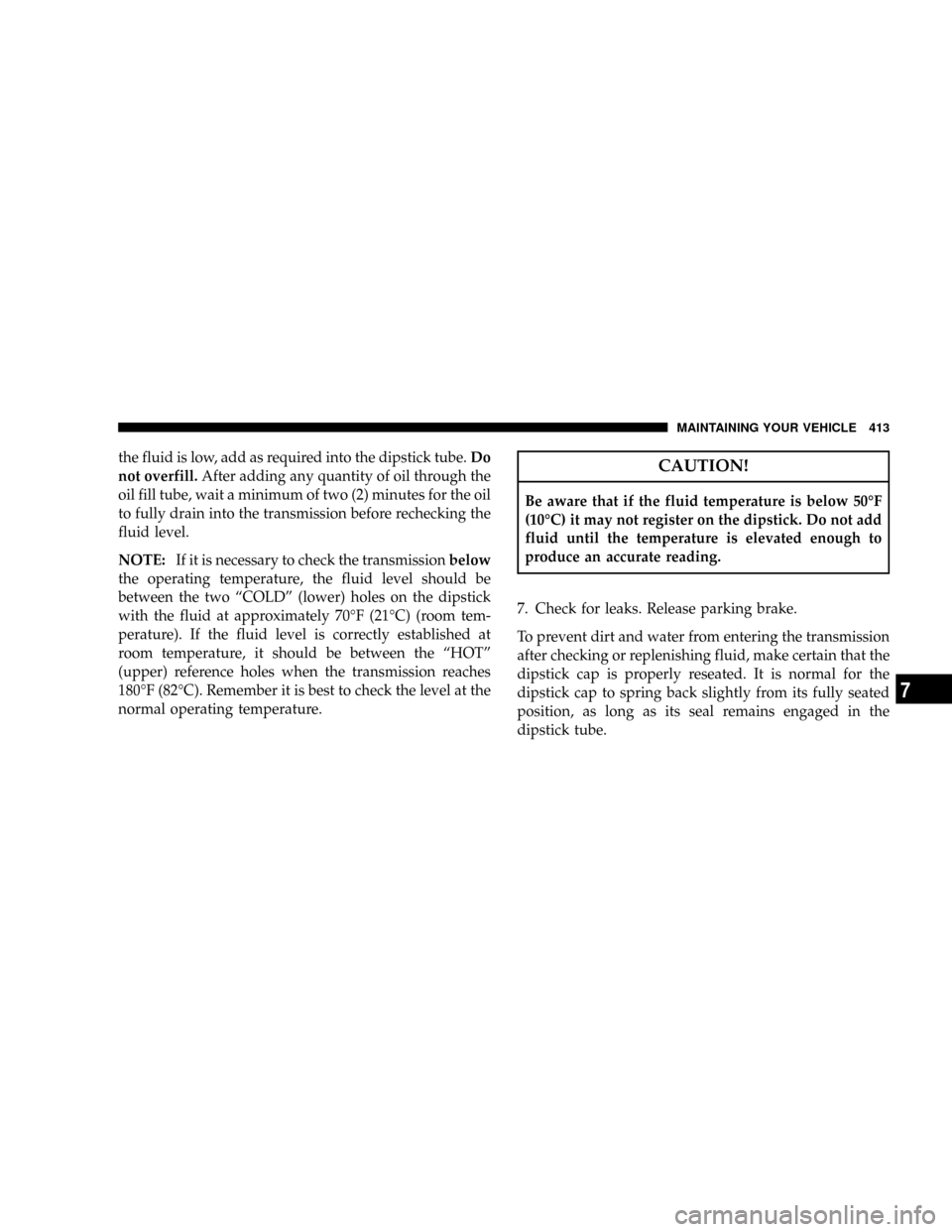
the fluid is low, add as required into the dipstick tube.Do
not overfill.After adding any quantity of oil through the
oil fill tube, wait a minimum of two (2) minutes for the oil
to fully drain into the transmission before rechecking the
fluid level.
NOTE:If it is necessary to check the transmissionbelow
the operating temperature, the fluid level should be
between the two ªCOLDº (lower) holes on the dipstick
with the fluid at approximately 70ÉF (21ÉC) (room tem-
perature). If the fluid level is correctly established at
room temperature, it should be between the ªHOTº
(upper) reference holes when the transmission reaches
180ÉF (82ÉC). Remember it is best to check the level at the
normal operating temperature.CAUTION!
Be aware that if the fluid temperature is below 50ÉF
(10ÉC) it may not register on the dipstick. Do not add
fluid until the temperature is elevated enough to
produce an accurate reading.
7. Check for leaks. Release parking brake.
To prevent dirt and water from entering the transmission
after checking or replenishing fluid, make certain that the
dipstick cap is properly reseated. It is normal for the
dipstick cap to spring back slightly from its fully seated
position, as long as its seal remains engaged in the
dipstick tube.
MAINTAINING YOUR VEHICLE 413
7
Page 414 of 478

Special Additives
Automatic Transmission Fluid (ATF) is an engineered
product and its performance may be impaired by supple-
mental additives. Therefore, do not add any fluid addi-
tives to the transmission. The only exception to this
policy is the use of special dyes to aid in detecting fluid
leaks. In addition, avoid using transmission sealers as
they may adversely affect seals.
Maintenance After Off-Road Driving
After extended operation in mud, sand or water, or
similar dirty conditions, have your brake discs, brake
linings, and axle joints inspected and cleaned as soon as
possible. This will prevent any abrasive material from
causing excessive wear or unpredictable braking action.After off-road driving, completely inspect the underbody
of your vehicle. Check tires, body structure, steering,
suspension and exhaust system for damage. Check
threaded fasteners for looseness, particularly on the
chassis, drivetrain components, steering and suspension.
Retighten, if required, to torque values specified in the
Service Manual. Also check for accumulations of vegeta-
tion or brush that could become a fire hazard, or conceal
damage to fuel lines, brake hoses, axle pinion seals, and
propeller shafts.
CAUTION!
Under frequent heavy-duty driving conditions,
change all lubricants and lubricate body compo-
nents, all driveline joints and steering linkage more
often than in normal service to prevent excessive
wear.
414 MAINTAINING YOUR VEHICLE
Page 421 of 478
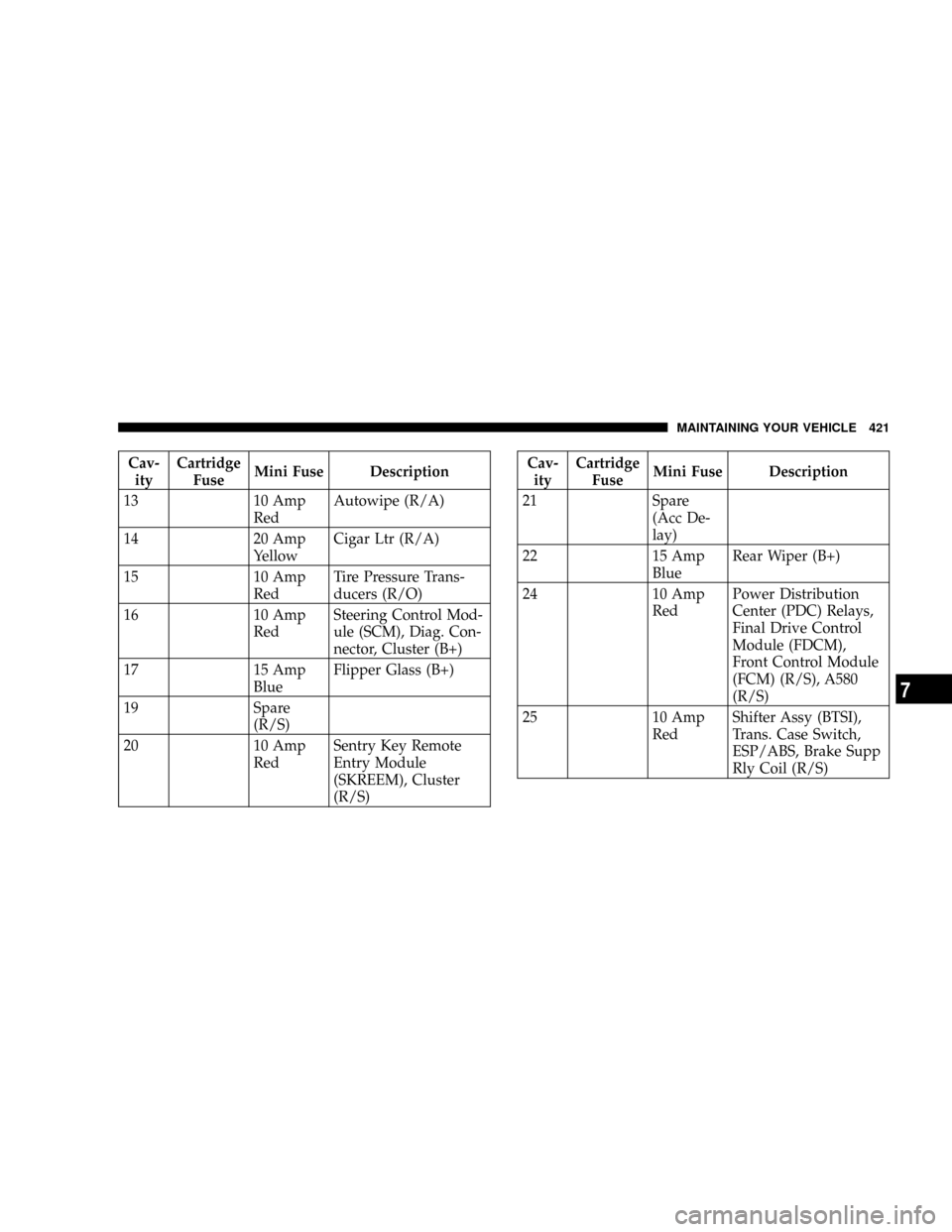
Cav-
ityCartridge
FuseMini Fuse Description
13 10 Amp
RedAutowipe (R/A)
14 20 Amp
YellowCigar Ltr (R/A)
15 10 Amp
RedTire Pressure Trans-
ducers (R/O)
16 10 Amp
RedSteering Control Mod-
ule (SCM), Diag. Con-
nector, Cluster (B+)
17 15 Amp
BlueFlipper Glass (B+)
19 Spare
(R/S)
20 10 Amp
RedSentry Key Remote
Entry Module
(SKREEM), Cluster
(R/S)Cav-
ityCartridge
FuseMini Fuse Description
21 Spare
(Acc De-
lay)
22 15 Amp
BlueRear Wiper (B+)
24 10 Amp
RedPower Distribution
Center (PDC) Relays,
Final Drive Control
Module (FDCM),
Front Control Module
(FCM) (R/S), A580
(R/S)
25 10 Amp
RedShifter Assy (BTSI),
Trans. Case Switch,
ESP/ABS, Brake Supp
Rly Coil (R/S)
MAINTAINING YOUR VEHICLE 421
7
Page 423 of 478
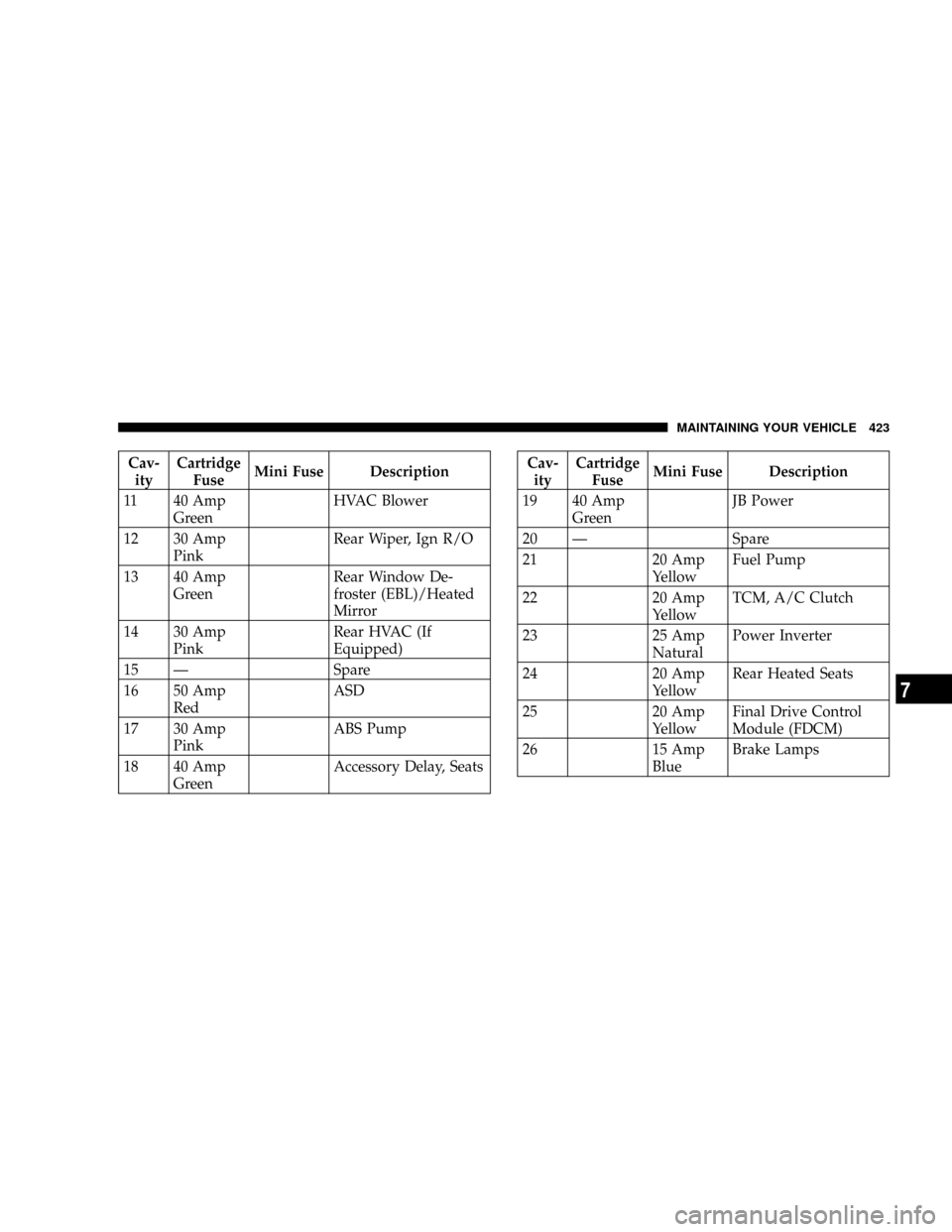
Cav-
ityCartridge
FuseMini Fuse Description
11 40 Amp
GreenHVAC Blower
12 30 Amp
PinkRear Wiper, Ign R/O
13 40 Amp
GreenRear Window De-
froster (EBL)/Heated
Mirror
14 30 Amp
PinkRear HVAC (If
Equipped)
15 Ð Spare
16 50 Amp
RedASD
17 30 Amp
PinkABS Pump
18 40 Amp
GreenAccessory Delay, SeatsCav-
ityCartridge
FuseMini Fuse Description
19 40 Amp
GreenJB Power
20 Ð Spare
21 20 Amp
YellowFuel Pump
22 20 Amp
YellowTCM, A/C Clutch
23 25 Amp
NaturalPower Inverter
24 20 Amp
YellowRear Heated Seats
25 20 Amp
YellowFinal Drive Control
Module (FDCM)
26 15 Amp
BlueBrake Lamps
MAINTAINING YOUR VEHICLE 423
7