engine JEEP COMPASS 2008 1.G Service Manual
[x] Cancel search | Manufacturer: JEEP, Model Year: 2008, Model line: COMPASS, Model: JEEP COMPASS 2008 1.GPages: 399, PDF Size: 6.59 MB
Page 218 of 399

Air Conditioning
MAX A/C
For maximum cooling use the
A/C and recirculate buttons
at the same time.
NOTE:See ªCirculation Controlº later in this section,
for proper or extended use of this position.
Air Conditioning (Normal)
Use this button to engage the
Air Conditioning. A lamp will
illuminate when the Air Con-
ditioning System is engaged.
Once the air conditioning is
engaged, use a combination
of the mode control, fan
speed control, and tempera-
ture control to achieve your
desired interior temperature.
NOTE:The air conditioning compressor will not engage
until the engine has been running for about 10 seconds.
218 UNDERSTANDING YOUR INSTRUMENT PANEL
Page 219 of 399

Circulation Control
Use this button to choose be-
tween outside air intake or
recirculation of the air inside
the vehicle. A lamp will illu-
minate when you are in recir-
culate mode. Only use the re-
circulate mode to temporarily
block out any outside odors,
smoke, or dust and to cool the
interior rapidly upon initial
start up in very hot or humid
weather.
NOTE:Continuous use of the recirculate mode may
make the inside air stuffy and window fogging may
occur. Extended use of this mode is not recommended.
In cold or damp weather, the use of the Recirculate
position will cause windows to fog on the inside becauseof moisture build up inside the vehicle. For maximum
defogging, select the Outside Air position.
NOTE:Recirculation Mode will not operate in floor, mix
or defrost modes.
Air Filtration System ± If Equipped
An air filter is included in the optional Security Group.
Filter media includes a particle filtration layer and a
charcoal layer. The filter will reduce, but not eliminate,
diesel and agricultural smells. The filter acts only on air
coming from outside the vehicle; it does not filter air
inside the passenger compartment. See the maintenance
schedule for the filter change interval. The air filter
change interval coincides with engine oil and filter
change intervals. As with oil changes, the interval is
shorter for heavy duty service or dusty conditions. See
your authorized dealer for service.
UNDERSTANDING YOUR INSTRUMENT PANEL 219
4
Page 223 of 399

STARTING AND OPERATING
CONTENTS
mStarting Procedures.....................227
NManual Transaxle.....................227
NAutomatic Transaxle...................227
NNormal Starting......................227
NExtremely Cold Weather
(Below220ÉF Or229ÉC)................228
NIf Engine Fails To Start.................228
NAfter Starting........................229
mManual Transaxle Ð If Equipped...........229NRecommended Shift Speeds..............231
NDownshifting........................231
mAutomatic Transaxle Ð If Equipped.........232
NBrake/Transmission Interlock System.......233
NAutomatic Transaxle Ignition Interlock
System.............................233
NGear Ranges For Continuously Variable
Automatic Transaxle (CVT)..............234
mAutoStick Ð If Equipped.................236
NAutoStick Operation...................236
5
Page 225 of 399

NReplacement Tires.....................263
NAlignment And Balance.................264
mTire Chains...........................265
mTire Rotation Recommendations............265
mTire Pressure Monitoring System (TPMS) Ð
If Equipped...........................266
NBase System ± If Equipped...............269
NPremium System ± If Equipped...........271
NGeneral Information...................274
mSnow Tires...........................275
mFuel Requirements......................275
NGasoline Engines.....................275
NReformulated Gasoline.................276NGasoline/Oxygenate Blends..............276
NMMT In Gasoline.....................277
NMaterials Added To Fuel................277
NFuel System Cautions..................277
NCarbon Monoxide Warnings..............278
mAdding Fuel..........................279
NFuel Filler Cap (Gas Cap)...............279
NLoose Fuel Filler Cap Message............280
mVehicle Loading........................281
NGross Vehicle Weight Rating (GVWR).......281
mTrailer Towing.........................281
NCommon Towing Definitions.............281
NTrailer Hitch Classification...............284
STARTING AND OPERATING 225
5
Page 227 of 399

STARTING PROCEDURES
Before starting your vehicle, adjust your seat, adjust both
inside and outside mirrors, and fasten your seat belts.
WARNING!
Never leave children alone in a vehicle. Leaving
children in a vehicle unattended is dangerous for a
number of reasons. A child or others could be seri-
ously or fatally injured. Don't leave the keys in the
ignition. A child could operate power windows,
other controls, or move the vehicle.
Manual Transaxle
Before starting the engine fully apply the parking brake,
press the clutch pedal to the floor, and place the gear
selector in N (Neutral).NOTE:The engine will not start unless the clutch pedal
is pressed to the floor.
NOTE:If key won't turn and steering wheel is locked,
rotate the wheel in either direction to relieve pressure on
the locking mechanism and then turn the key.
Automatic Transaxle
The gear selector must be in the P (Park) or N (Neutral)
position before you can start the engine. Apply the brakes
before shifting to any driving gear.
NOTE:You must press the brake pedal before shifting
out of P (Park).
Normal Starting
Normal starting of either a cold or a warm engine does
not require pumping or depressing the accelerator pedal.
Simply turn the ignition switch to the ªSTART'º position
and release when the engine starts. If the engine fails to
STARTING AND OPERATING 227
5
Page 228 of 399

start within 15 seconds, turn the ignition switch to the
ªOFFº position, wait 10 to 15 seconds, then repeat the
normal starting procedure.
WARNING!
Do not attempt to push or tow your vehicle to get it
started. Vehicles equipped with an automatic trans-
axle cannot be started this way. Unburned fuel could
enter the catalytic converter and once the engine has
started, ignite and damage the converter and vehicle.
If the vehicle has a discharged battery, booster cables
may be used to obtain a start from another vehicle.
This type of start can be dangerous if done improp-
erly, so follow the procedure carefully. See section 6
of this manual for jump starting instructions.
Extremely Cold Weather (below220ÉF or229ÉC)
To insure reliable starting at these temperatures, use of an
externally powered electric engine block heater (available
from your dealer) is recommended.
If Engine Fails to Start
If the engine fails to start after you have followed the
ªNORMAL STARTINGº procedure, it may be flooded.
Push the accelerator pedal all the way to the floor and
hold it there. Crank the engine for no more than 15
seconds. This should clear any excess fuel in case the
engine is flooded. Leave the ignition key in the ON
position, release the accelerator pedal and repeat the
ªNORMAL STARTINGº procedure.
228 STARTING AND OPERATING
Page 229 of 399

WARNING!
Never pour fuel or other flammable liquid into the
throttle body air inlet opening in an attempt to start
the vehicle. This could result in flash fire causing
serious personal injury.
CAUTION!
To prevent damage to the starter, do not crank the
engine for more than 15 seconds at a time. Wait 10 to
15 seconds before trying again.
After Starting
The idle speed will automatically decrease as the engine
warms up.
MANUAL TRANSAXLE Ð IF EQUIPPED
WARNING!
You or others could be injured if you leave the
vehicle unattended without having the parking
brake fully applied. The parking brake should al-
ways be applied when the driver is not in the vehicle,
especially on an incline.
STARTING AND OPERATING 229
5
Page 231 of 399
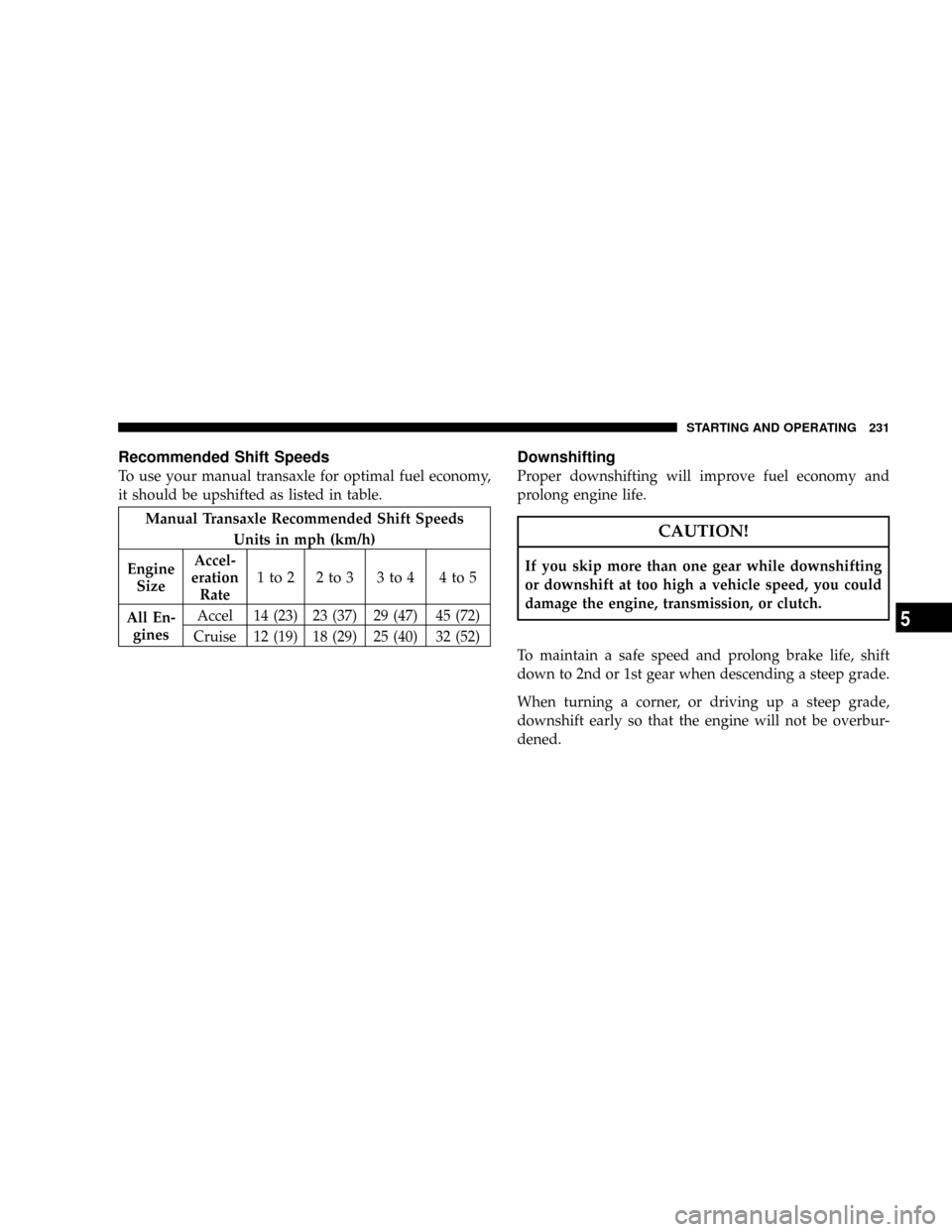
Recommended Shift Speeds
To use your manual transaxle for optimal fuel economy,
it should be upshifted as listed in table.
Manual Transaxle Recommended Shift Speeds
Units in mph (km/h)
Engine
SizeAccel-
eration
Rate1to2 2to3 3to4 4to5
All En-
ginesAccel 14 (23) 23 (37) 29 (47) 45 (72)
Cruise 12 (19) 18 (29) 25 (40) 32 (52)
Downshifting
Proper downshifting will improve fuel economy and
prolong engine life.
CAUTION!
If you skip more than one gear while downshifting
or downshift at too high a vehicle speed, you could
damage the engine, transmission, or clutch.
To maintain a safe speed and prolong brake life, shift
down to 2nd or 1st gear when descending a steep grade.
When turning a corner, or driving up a steep grade,
downshift early so that the engine will not be overbur-
dened.
STARTING AND OPERATING 231
5
Page 232 of 399

AUTOMATIC TRANSAXLE Ð IF EQUIPPED
CAUTION!
Damage to the transaxle may occur if the following
precautions are not observed:
²Shift into P (Park) only after the vehicle has come to a
complete stop.
²Shift into or out of R (Reverse) only after the vehicle
has come to a complete stop and the engine is at idle
speed.
²Do not shift from R (Reverse), P (Park), or N (Neutral)
into any forward gear when the engine is above idle
speed.
²Before shifting into any gear, make sure your foot is
firmly on the brake pedal.
NOTE:You MUST press and hold the brake pedal down
while shifting out of P (Park).
Automatic Shift Lever
232 STARTING AND OPERATING
Page 233 of 399

WARNING!
It is dangerous to shift the selector lever out of P
(Park) or N (Neutral) if the engine speed is higher
than idle speed. If your foot is not firmly on the
brake pedal, the vehicle could accelerate quickly
forward or in reverse. You could lose control of the
vehicle and hit someone or something. Only shift
into gear when the engine is idling normally and
when your right foot is firmly on the brake pedal.
Brake/Transmission Interlock System
This system prevents you from moving the gear shift out
of P (Park) and into any gear unless the brake pedal is
pressed. This system is active only while the ignition
switch is in the ON or ACC positions. Always depress the
brake pedal first,before moving the gear selector out of
P (Park).NOTE:If a malfunction occurs, the transaxle will not
shift out of park. Battery power is required to release the
brake/transmission interlock system. There is a remov-
able plug in the right side of the shifter housing that
allows you to insert your finger to override the system.
The key must be in the ignition and in the on position to
use the override lever. If this occurs obtain service as
soon as possible.
Automatic Transaxle Ignition Interlock System
This system prevents the key from being removed unless
the shift lever is in P (Park). It also prevents shifting out
of P (Park) unless the key is in the ACC or ON positions,
and the brake pedal is depressed.
NOTE:If a malfunction occurs, the system will trap the
key in the ignition cylinder to warn you that this safety
feature is inoperable. The engine can be started and
stopped but the key cannot be removed until you obtain
service.
STARTING AND OPERATING 233
5