brake fluid JEEP COMPASS 2015 1.G User Guide
[x] Cancel search | Manufacturer: JEEP, Model Year: 2015, Model line: COMPASS, Model: JEEP COMPASS 2015 1.GPages: 560, PDF Size: 11.51 MB
Page 467 of 560
MAINTAINING YOUR VEHICLE
CONTENTS
!ENGINE COMPARTMENT — 2.0L..........467
!ENGINE COMPARTMENT — 2.4L..........468
!ONBOARD DIAGNOSTIC SYSTEM — OBD II . . .469
▫Loose Fuel Filler Cap Message............469
!EMISSIONS INSPECTION AND
MAINTENANCE PROGRAMS.............470
!REPLACEMENT PARTS..................471
!DEALER SERVICE......................471
!MAINTENANCE PROCEDURES...........472
▫Engine Oil..........................473
▫Engine Oil Filter......................476
▫Engine Air Cleaner Filter................476
▫Maintenance-Free Battery...............477
▫Air Conditioner Maintenance.............478
▫Body Lubrication.....................481
▫Windshield Wiper Blades...............481
▫Adding Washer Fluid..................482
▫Exhaust System......................482
▫Cooling System......................485
▫Brake System........................491
7
Page 469 of 560
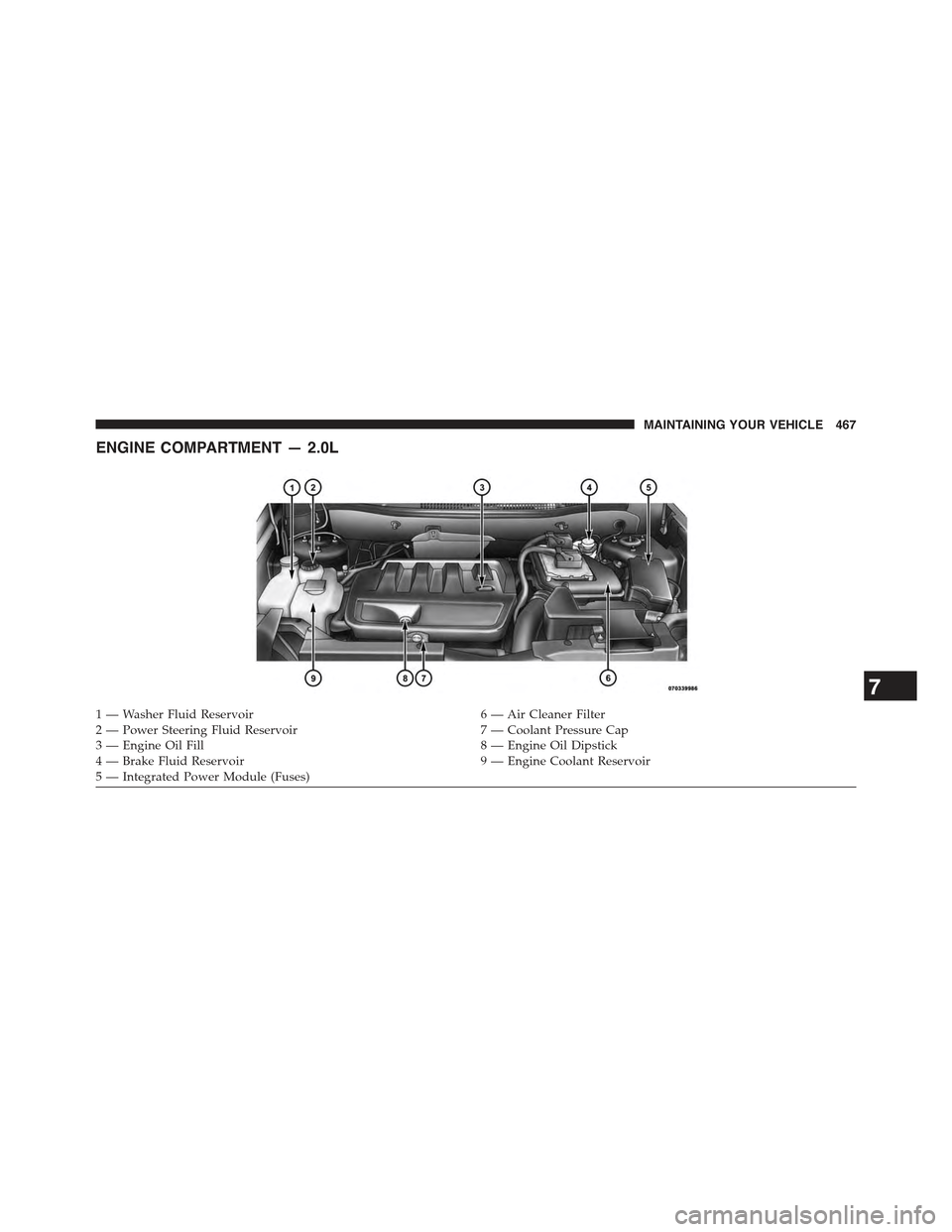
ENGINE COMPARTMENT — 2.0L
1 — Washer Fluid Reservoir6 — Air Cleaner Filter2 — Power Steering Fluid Reservoir7 — Coolant Pressure Cap3—EngineOilFill8—EngineOilDipstick4—BrakeFluidReservoir9—EngineCoolantReservoir5 — Integrated Power Module (Fuses)
7
MAINTAINING YOUR VEHICLE 467
Page 470 of 560
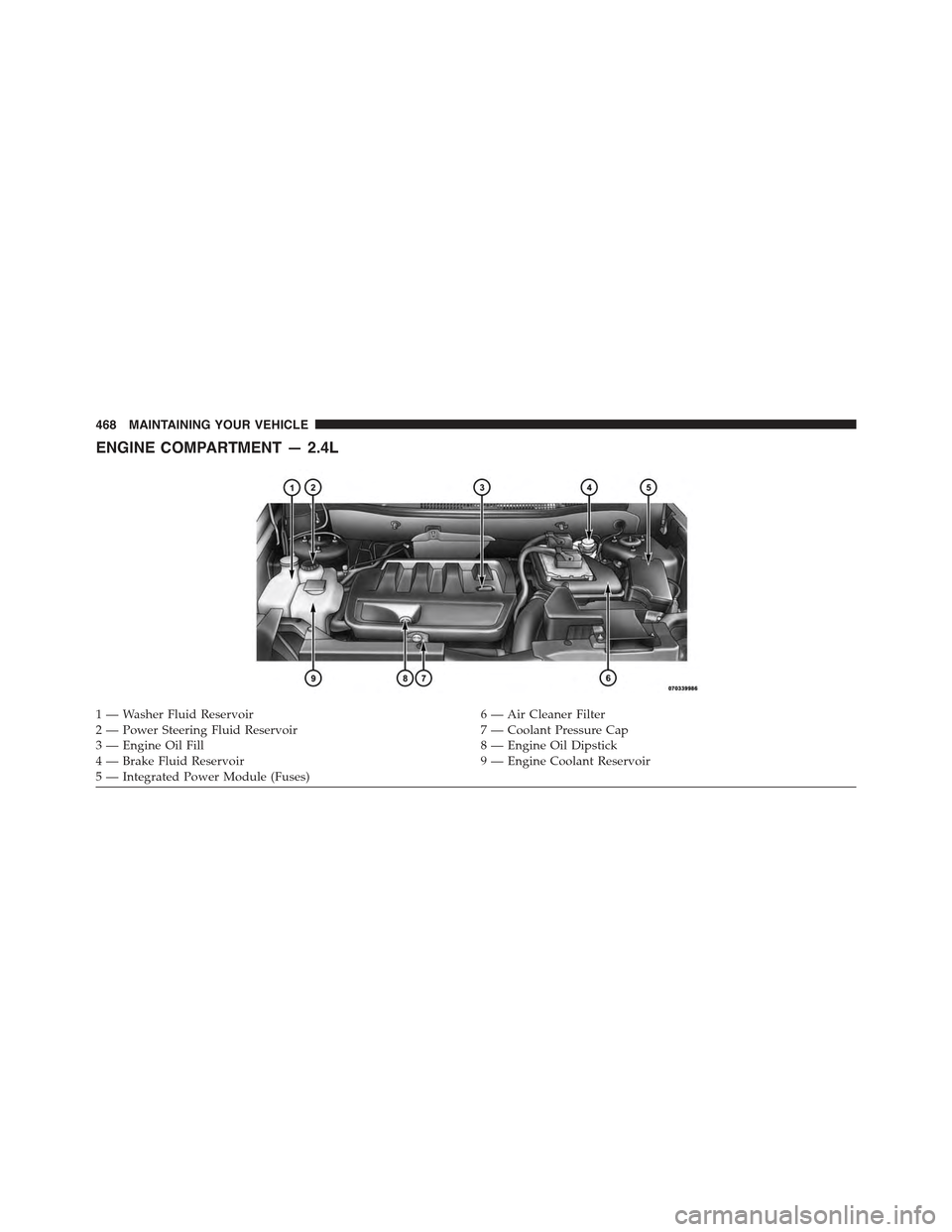
ENGINE COMPARTMENT — 2.4L
1 — Washer Fluid Reservoir6 — Air Cleaner Filter2 — Power Steering Fluid Reservoir7 — Coolant Pressure Cap3—EngineOilFill8—EngineOilDipstick4—BrakeFluidReservoir9—EngineCoolantReservoir5 — Integrated Power Module (Fuses)
468 MAINTAINING YOUR VEHICLE
Page 493 of 560
•Make sure that the coolant expansion bottle overflow
hoses are not kinked or obstructed.
•Keep the front of the radiator clean. If your vehicle is
equipped with air conditioning, keep the front of the
condenser clean.
•Do not change the thermostat for Summer or Winter
operation. If replacement is ever necessary, install
ONLY the correct type thermostat. Other designs may
result in unsatisfactory engine coolant (antifreeze)
performance, poor gas mileage, and increased emis-
sions.
Brake System
In order to assure brake system performance, all brake
system components should be inspected periodically.
Refer to the “Maintenance Schedule” for the proper
maintenance intervals.
WARNING!
Riding the brakes can lead to brake failure and
possibly a collision. Driving with your foot resting or
riding on the brake pedal can result in abnormally
high brake temperatures, excessive lining wear, and
possible brake damage. You would not have your full
braking capacity in an emergency.
Brake Master Cylinder
The fluid level in the master cylinder should be checked
when performing under hood services, or immediately if
the brake system warning light is on.
Be sure to clean the top of the master cylinder area before
removing the cap. If necessary, add fluid to bring the
fluid level up to the requirements described on the brake
7
MAINTAINING YOUR VEHICLE 491
Page 494 of 560
fluid reservoir. Fluid level can be expected to fall as the
brake pads wear. The brake fluid level should be checked
when the pads are replaced. However, low fluid level
may be caused by a leak and a checkup may be needed.
NOTE:If your vehicle is equipped with amanual trans-
mission, the brake fluid reservoir supplies fluid to both
the brake system and the clutch release system. The two
systems are separated in the reservoir, and a leak in one
system will not affect the other system. Themanual
transmissionclutch release system should not require
fluid replacement during the life of the vehicle. If the
brake fluid reservoir is low and the brake system does
not indicate any leaks or other problems, it may be a
result of a leak in the hydraulic clutch release system. See
your local authorized dealer for service.
Use only manufacturer’s recommended brake fluid. Re-
fer to “Fluids, Lubricants, and Genuine Parts” in “Main-
taining Your Vehicle” for further information.
WARNING!
•Use only manufacturer’s recommended brake
fluid. Refer to “Fluids, Lubricants, and Genuine
Parts” in “Maintaining Your Vehicle” for further
information. Using the wrong type of brake fluid
can severely damage your brake system and/or
impair its performance. The proper type of brake
fluid for your vehicle is also identified on the
original factory installed hydraulic master cylinder
reservoir.
(Continued)
492 MAINTAINING YOUR VEHICLE
Page 495 of 560
WARNING!(Continued)
•To avoid contamination from foreign matter or
moisture, use only new brake fluid or fluid that has
been in a tightly closed container. Keep the master
cylinder reservoir cap secured at all times. Brake
fluid in a open container absorbs moisture from the
air resulting in a lower boiling point. This may
cause it to boil unexpectedly during hard or pro-
longed braking, resulting in sudden brake failure.
This could result in a collision.
•Overfilling the brake fluid reservoir can result in
spilling brake fluid on hot engine parts, causing
the brake fluid to catch fire. Brake fluid can also
damage painted and vinyl surfaces, care should be
taken to avoid its contact with these surfaces.
(Continued)
WARNING!(Continued)
•Do not allow petroleum based fluid to contaminate
the brake fluid. Brake seal components could be
damaged, causing partial or complete brake failure.
This could result in a collision.
CAUTION!
Use of improper brake fluids will affect overall
clutch system performance. Improper brake fluids
may damage the clutch system resulting in loss of
clutch function and the ability to shift the transmis-
sion.7
MAINTAINING YOUR VEHICLE 493
Page 519 of 560
Chassis
ComponentFluid, Lubricant, or Genuine Part
Automatic Transmission
(CVT) — If Equipped
Use only MOPAR® CVTF+4® Continuously Variable Transmission Fluid or
equivalent. Failure to use the correct fluid may affect the function or performance
of your transmission.
Automatic Transmission
(Six-Speed) — If Equipped
Use only MOPAR® SP-IV Automatic Transmission Fluid or equivalent. Failure to
use the correct fluid may affect the function or performance of your transmission.
Manual Transmission —
If Equipped
We recommend you use MOPAR® ATF+4® Automatic Transmission Fluid.
Rear Drive Assembly (RDA) We recommend you use MOPAR® Gear & Axle Lubricant SAE 80W-90 API GL 5.
Power Transfer Unit (PTU) We recommend you use MOPAR® Gear & Axle Lubricant SAE 80W-90 API GL 5.
Brake Master Cylinder We recommend you use MOPAR® DOT 3, SAE J1703 should be used.
If DOT 3, SAE J1703 brake fluid is not available, then DOT 4 is acceptable.
Power Steering Reservoir We recommend you use MOPAR® Power Steering Fluid +4, MOPAR® ATF+4®
Automatic Transmission Fluid.
7
MAINTAINING YOUR VEHICLE 517
Page 523 of 560
Severe Duty All Models
Change Engine Oil at 4000 miles (6,500 km) if the vehicle
is operated in a dusty and off road environment. This
type of vehicle use is considered Severe Duty.
Once A Month Or Before A Long Trip:
•Check engine oil level
•Check windshield washer fluid level
•Check the tire inflation pressures and look for unusual
wear or damage
•Check the fluid levels of the coolant reservoir, brake
master cylinder, power steering and fill as needed
•Check function of all interior and exterior lights
Required Maintenance Intervals.
Refer to the maintenance schedules on the following
page for the required maintenance intervals.
At Every Oil Change Interval As Indicated By Oil
Change Indicator System:
•Change oil and filter.
•Rotate the tires.Rotate at the first sign of irregu-
lar wear, even if it occurs before the oil indicator
system turns on.
•Inspect battery and clean and tighten terminals as
required.
•Inspect brake pads, shoes, rotors, drums, hoses
and park brake.
•Inspect engine cooling system protection and
hoses.
•Inspect exhaust system.
•Inspect engine air cleaner if using in dusty or
off-road conditions.
8
MAINTENANCE
SCHEDULES
MAINTENANCE SCHEDULES 521
Page 540 of 560
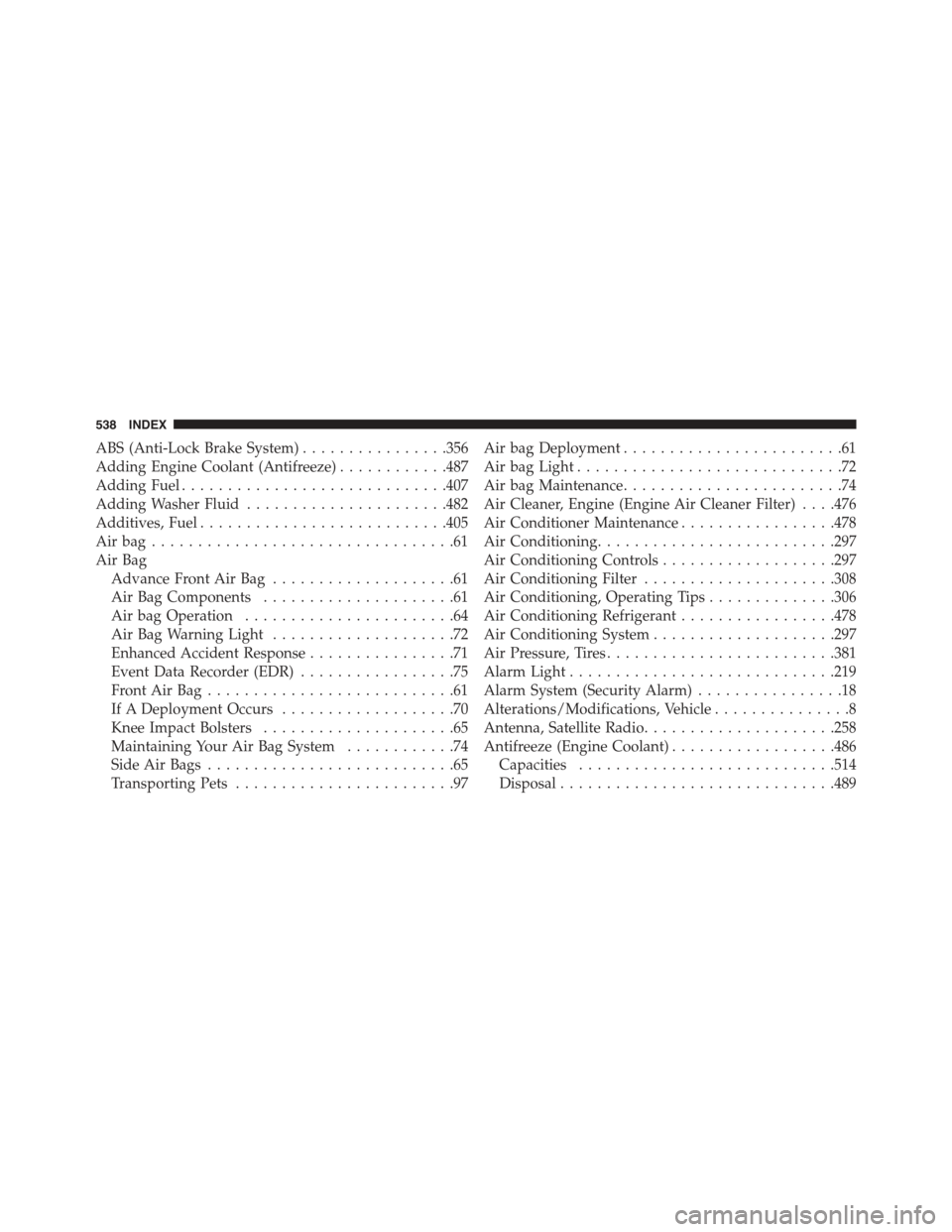
ABS (Anti-Lock Brake System)................356
Adding Engine Coolant (Antifreeze)............487
Adding Fuel.............................407
Adding Washer Fluid......................482
Additives, Fuel...........................405
Air bag . . . . . . . . . . . . . . . . . . . . . . . . . . . . . . . . .61
Air Bag
Advance Front Air Bag....................61
Air Bag Components.....................61
Air bag Operation.......................64
Air Bag Warning Light....................72
Enhanced Accident Response................71
Event Data Recorder (EDR).................75
Front Air Bag . . . . . . . . . . . . . . . . . . . . . . . . . . .61
If A Deployment Occurs...................70
Knee Impact Bolsters.....................65
Maintaining Your Air Bag System............74
Side Air Bags...........................65
Transporting Pets........................97
Air bag Deployment........................61
Air bag Light.............................72
Air bag Maintenance........................74
Air Cleaner, Engine (Engine Air Cleaner Filter) . . . .476
Air Conditioner Maintenance.................478
Air Conditioning..........................297
Air Conditioning Controls...................297
Air Conditioning Filter.....................308
Air Conditioning, Operating Tips..............306
Air Conditioning Refrigerant.................478
Air Conditioning System....................297
Air Pressure, Tires.........................381
Alarm Light.............................219
Alarm System (Security Alarm)................18
Alterations/Modifications, Vehicle...............8
Antenna, Satellite Radio.....................258
Antifreeze (Engine Coolant)..................486
Capacities............................514
Disposal..............................489
538 INDEX
Page 541 of 560
Anti-Lock Brake System (ABS)................356
Anti-Lock Warning Light....................216
Appearance Care.........................499
Assistance Towing.........................125
Automatic Dimming Mirror..................108
Automatic Door Locks......................32
Automatic Temperature Control (ATC)..........301
Automatic Transaxle........................12
Fluid Level Check.......................497
Automatic Transmission....................322
Fluid and Filter Changes..................495
Fluid Level Check.......................495
Fluid Type............................494
Gear Ranges...........................325
Special Additives.......................494
Autostick...............................337
Axle Fluid..............................517
Battery.................................477
Keyless Transmitter Replacement (RKE)........25
Belts, Seat...............................100
Body Mechanism Lubrication.................481
B-Pillar Location..........................375
Brake Assist System.......................359
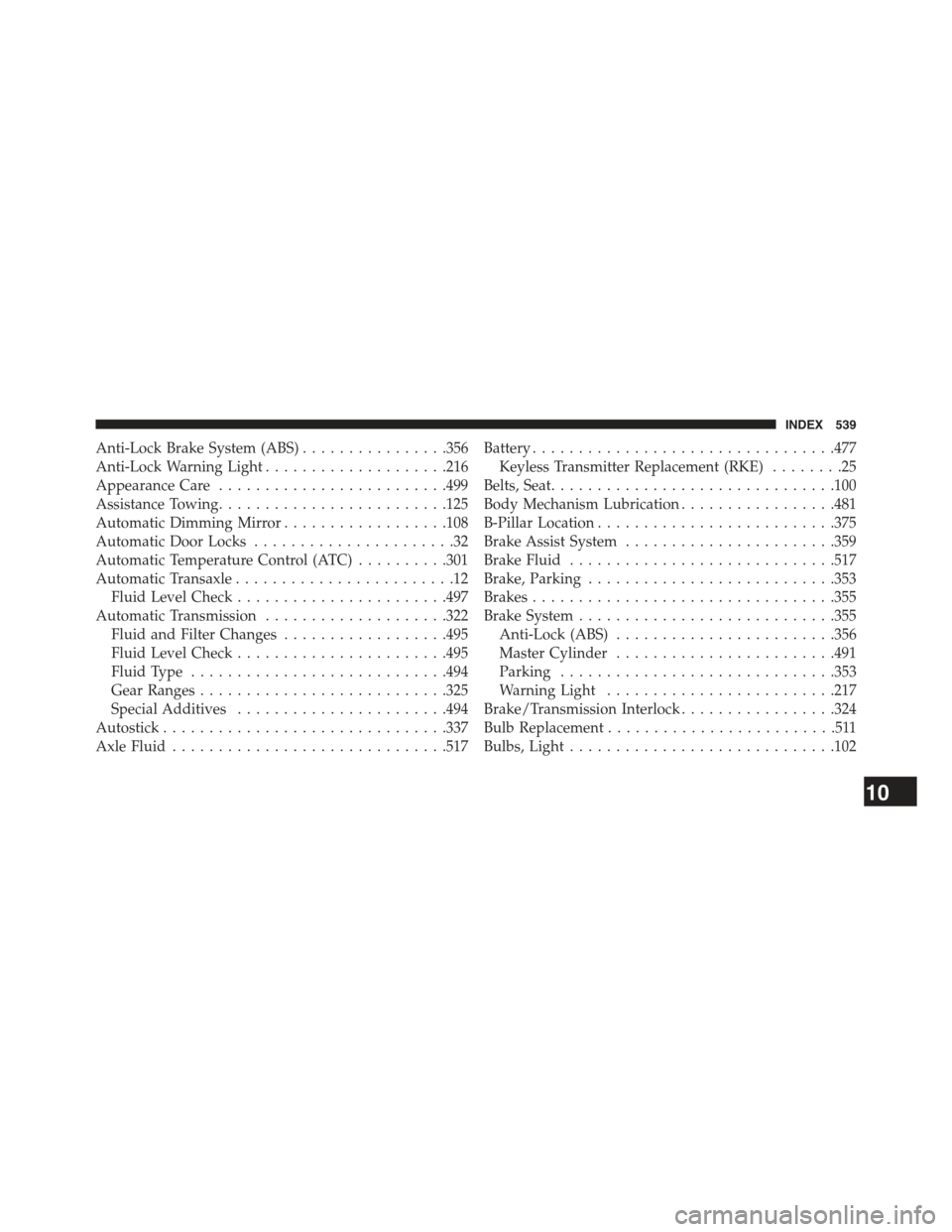
Brake Fluid.............................517
Brake, Parking...........................353
Brakes.................................355
Brake System............................355
Anti-Lock (ABS)........................356
Master Cylinder........................491
Parking..............................353
Warning Light.........................217
Brake/Transmission Interlock.................324
Bulb Replacement.........................511
Bulbs, Light.............................102
10
INDEX 539