oil JEEP COMPASS 2019 Owner handbook (in English)
[x] Cancel search | Manufacturer: JEEP, Model Year: 2019, Model line: COMPASS, Model: JEEP COMPASS 2019Pages: 362, PDF Size: 6.23 MB
Page 244 of 362
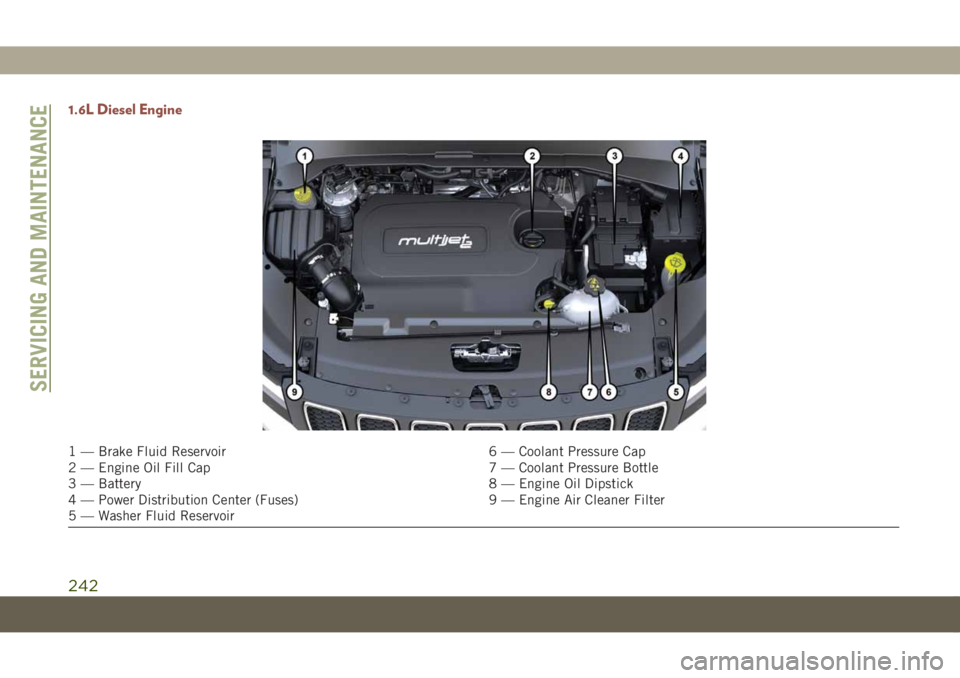
1.6L Diesel Engine
1 — Brake Fluid Reservoir 6 — Coolant Pressure Cap
2 — Engine Oil Fill Cap 7 — Coolant Pressure Bottle
3 — Battery 8 — Engine Oil Dipstick
4 — Power Distribution Center (Fuses) 9 — Engine Air Cleaner Filter
5 — Washer Fluid Reservoir
SERVICING AND MAINTENANCE
242
Page 245 of 362
Checking Oil Level
WARNING!
• Never smoke while working in the engine
compartment: gas and inflammable va-
pors may be present, with the risk of fire.
• Be very careful when working in the
engine compartment when the engine is
hot: you may get burned. Do not get too
close to the radiator cooling fan: the
electric fan may start; danger of injury.
Scarves, ties and other loose clothing
might be pulled by moving parts.
CAUTION!
• Be careful not to confuse the various
types of fluids while topping up: they are
not compatible with each other! Topping
up with an unsuitable fluid could se-
verely damage your car.
• The oil level must never exceed the MAX
mark.
• Always top up using engine oil of the
same specifications as that already in
the engine.
CAUTION!
• If the engine oil is being topped up, wait
for the engine to cool down before loos-
ening the filler cap, particularly for ve-
hicles with aluminium cap (if equipped).
WARNING: risk of burns!
• Overfilling or underfilling the crankcase
will cause aeration or loss of oil pressure.
This could damage your engine.
To assure proper engine lubrication, the en-
gine oil must be maintained at the correct
level. Check the oil level at regular intervals,
such as every fuel stop. The best time to
check the engine oil level is about five min-
utes after a fully warmed up engine is shut
off.
Checking the oil while the vehicle is on level
ground will improve the accuracy of the oil
level readings.
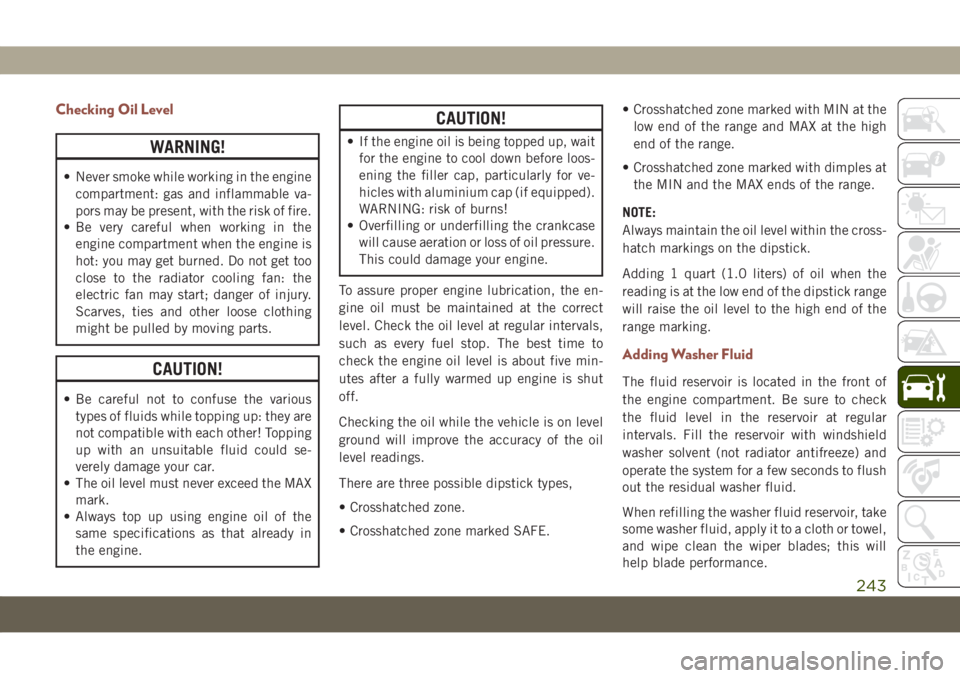
There are three possible dipstick types,
• Crosshatched zone.
• Crosshatched zone marked SAFE.• Crosshatched zone marked with MIN at the
low end of the range and MAX at the high
end of the range.
• Crosshatched zone marked with dimples at
the MIN and the MAX ends of the range.
NOTE:
Always maintain the oil level within the cross-
hatch markings on the dipstick.
Adding 1 quart (1.0 liters) of oil when the
reading is at the low end of the dipstick range
will raise the oil level to the high end of the
range marking.
Adding Washer Fluid
The fluid reservoir is located in the front of
the engine compartment. Be sure to check
the fluid level in the reservoir at regular
intervals. Fill the reservoir with windshield
washer solvent (not radiator antifreeze) and
operate the system for a few seconds to flush
out the residual washer fluid.
When refilling the washer fluid reservoir, take
some washer fluid, apply it to a cloth or towel,
and wipe clean the wiper blades; this will
help blade performance.
243
Page 248 of 362
Operation of the wipers on dry glass for long
periods may cause deterioration of the wiper
blades. Always use washer fluid when using
the wipers to remove salt or dirt from a dry
windshield or rear window.
Avoid using the wiper blades to remove frost
or ice from the windshield or rear window.
Make sure that they are not frozen to the
glass before turning them on to avoid damag-
ing the blade. Keep the wiper blade out of
contact with petroleum products such as en-
gine oil, gasoline, etc.
NOTE:
Life expectancy of wiper blades varies de-
pending on geographical area and frequency
of use. Poor performance of blades may be
present with chattering, marks, water lines or
wet spots. If any of these conditions are
present, clean the wiper blades or replace as
necessary.
Exhaust System
The best protection against carbon monoxide
entry into the vehicle body is a properly
maintained engine exhaust system.If you notice a change in the sound of the
exhaust system; or if the exhaust fumes can
be detected inside the vehicle; or when the
underside or rear of the vehicle is damaged;
have an authorized technician inspect the
complete exhaust system and adjacent body
areas for broken, damaged, deteriorated, or
mispositioned parts. Open seams or loose
connections could permit exhaust fumes to
seep into the passenger compartment. In
addition, have the exhaust system inspected
each time the vehicle is raised for lubrication
or oil change. Replace as required.
WARNING!
• Exhaust gases can injure or kill. They
contain carbon monoxide (CO), which is
colorless and odorless. Breathing it can
make you unconscious and can eventu-
ally poison you. To avoid breathing CO,
refer to “Safety Tips” in “Safety” for
further information.
•
A hot exhaust system can start a fire if
you park over materials that can burn.
Such materials might be grass or leaves
coming into contact with your exhaust
WARNING!
system. Do not park or operate your ve-
hicle in areas where your exhaust system
can contact anything that can burn.
CAUTION!
• The catalytic converter requires the use
of unleaded fuel only. Leaded gasoline
will destroy the effectiveness of the
catalyst as an emissions control device
and may seriously reduce engine perfor-
mance and cause serious damage to the
engine.
• Damage to the catalytic converter can
result if your vehicle is not kept in proper
operating condition. In the event of en-
gine malfunction, particularly involving
engine misfire or other apparent loss of
performance, have your vehicle serviced
promptly. Continued operation of your
vehicle with a severe malfunction could
cause the converter to overheat, result-
ing in possible damage to the converter
and vehicle.
SERVICING AND MAINTENANCE
246
Page 250 of 362
WARNING!
• Do not open hot engine cooling system.
Never add engine coolant (antifreeze)
when the engine is overheated. Do not
loosen or remove the cap to cool an
overheated engine. Heat causes pres-
sure to build up in the cooling system. To
prevent scalding or injury, do not remove
the pressure cap while the system is hot
or under pressure.
• Do not use a pressure cap other than the
one specified for your vehicle. Personal
injury or engine damage may result.
Brake System
In order to assure brake system performance,
all brake system components should be in-
spected periodically. Refer to the “Mainte-
nance Plan” in this section for the proper
maintenance intervals.
WARNING!
Riding the brakes can lead to brake failure
and possibly a collision. Driving with your
foot resting or riding on the brake pedal
can result in abnormally high brake tem-
peratures, excessive lining wear, and pos-
sible brake damage. You would not have
your full braking capacity in an emergency.
Brake Master Cylinder
The fluid in the master cylinder should be
checked when performing under hood ser-
vices or immediately if the “Brake Warning
Light” is illuminated.
Be sure to clean the top of the master cylin-
der area before removing the cap. If neces-
sary, add fluid to bring the fluid level up to
the requirements described on the brake
fluid reservoir. With disc brakes, fluid level
can be expected to fall as the brake pads
wear. Brake fluid level should be checked
when pads are replaced. However, low fluid
level may be caused by a leak and a checkup
may be needed.
Use only manufacturer's recommended brake
fluid. Refer to “Fluids And Lubricants” in
“Technical Specifications” for further information.
WARNING!
• Use only manufacturer's recommended
brake fluid. Refer to “Fluids And Lubri-
cants” in “Technical Specifications” for
further information. Using the wrong
type of brake fluid can severely damage
your brake system and/or impair its per-
formance. The proper type of brake fluid
for your vehicle is also identified on the
original factory installed hydraulic mas-
ter cylinder reservoir.
• To avoid contamination from foreign
matter or moisture, use only new brake
fluid or fluid that has been in a tightly
closed container. Keep the master cylin-
der reservoir cap secured at all times.
Brake fluid in a open container absorbs
moisture from the air resulting in a lower
boiling point. This may cause it to boil
unexpectedly during hard or prolonged
braking, resulting in sudden brake fail-
ure. This could result in a collision.
SERVICING AND MAINTENANCE
248
Page 256 of 362
Life Of Tire
The service life of a tire is dependent upon
varying factors including, but not limited to:
• Driving style.
• Tire pressure - Improper cold tire inflation
pressures can cause uneven wear patterns
to develop across the tire tread. These ab-
normal wear patterns will reduce tread life,
resulting in the need for earlier tire replace-
ment.
• Distance driven.
• Performance tires, tires with a speed rating
of V or higher, and Summer tires typically
have a reduced tread life. Rotation of these
tires per the vehicle scheduled mainte-
nance is highly recommended.
WARNING!
Tires and the spare tire should be replaced
after six years, regardless of the remaining
tread. Failure to follow this warning can
result in sudden tire failure. You could lose
control and have a collision resulting in
serious injury or death.NOTE:
Wheel Valve Stem must be replaced as well
when installing new tires due to wear and tear
in existing tires.
Keep dismounted tires in a cool, dry place
with as little exposure to light as possible.
Protect tires from contact with oil, grease,
and gasoline.
Replacement Tires
The tires on your new vehicle provide a bal-
ance of many characteristics. They should be
inspected regularly for wear and correct cold
tire inflation pressures. The manufacturer
strongly recommends that you use tires
equivalent to the originals in size, quality and
performance when replacement is needed.
Refer to the paragraph on “Tread Wear Indi-
cators” in this section. Refer to the Tire and
Loading Information placard or the Vehicle
Certification Label for the size designation of
your tire. The Load Index and Speed Symbol
for your tire will be found on the original
equipment tire sidewall.It is recommended to replace the two front
tires or two rear tires as a pair. Replacing just
one tire can seriously affect your vehicle’s
handling. If you ever replace a wheel, make
sure that the wheel’s specifications match
those of the original wheels.
It is recommended you contact an authorized
tire dealer or original equipment dealer with
any questions you may have on tire specifi-
cations or capability. Failure to use equiva-
lent replacement tires may adversely affect
the safety, handling, and ride of your vehicle.
WARNING!
• Do not use a tire, wheel size, load rating,
or speed rating other than that specified
for your vehicle. Some combinations of
unapproved tires and wheels may
change suspension dimensions and per-
formance characteristics, resulting in
changes to steering, handling, and brak-
ing of your vehicle. This can cause un-
predictable handling and stress to steer-
ing and suspension components. You
could lose control and have a collisionSERVICING AND MAINTENANCE
254
Page 264 of 362
WARNING!
Damaged parts must be replaced immedi-
ately. Do not disassemble or modify the
system. Seat belt assemblies must be re-
placed after a collision if they have been
damaged (i.e., bent retractor, torn web-
bing, etc.).
Plastic And Coated Parts
Use a specific product to clean vinyl
upholstery.
CAUTION!
• Direct contact of air fresheners, insect
repellents, suntan lotions, or hand sani-
tizers to the plastic, painted, or deco-
rated surfaces of the interior may cause
permanent damage. Wipe away immedi-
ately.
• Damage caused by these type of prod-
ucts may not be covered by your New
Vehicle Limited Warranty.
Cleaning Plastic Instrument Cluster Lenses
The lenses in front of the instruments in this
vehicle are molded in clear plastic. When
cleaning the lenses, care must be taken to
avoid scratching the plastic.
1. Clean with a wet soft cloth. A mild soap
solution may be used, but do not use high
alcohol content or abrasive cleaners. If
soap is used, wipe clean with a clean
damp cloth.
2. Dry with a soft cloth.
Leather Parts
Your leather upholstery can be best preserved
by regular cleaning with a damp soft cloth.
Small particles of dirt can act as an abrasive
and damage the leather upholstery and
should be removed promptly with a damp
cloth. Care should be taken to avoid soaking
your leather upholstery with any liquid.
Please do not use polishes, oils, cleaning
fluids, solvents, detergents, or ammonia-
based cleaners to clean your leather uphol-
stery. Application of a leather conditioner is
not required to maintain the original condi-
tion.NOTE:
If equipped with light colored leather, it
tends to show any foreign material, dirt, and
fabric dye transfer more so than darker col-
ors. The leather is designed for easy cleaning.
CAUTION!
Do not use Alcohol and Alcohol-based
and/or Ketone based cleaning products to
clean leather upholstery, as damage to the
upholstery may result.
Glass Surfaces
All glass surfaces should be cleaned on a
regular basis with any commercial
household-type glass cleaner. Never use an
abrasive type cleaner. Use caution when
cleaning the inside rear window equipped
with electric defrosters or windows equipped
with radio antennas. Do not use scrapers or
other sharp instruments that may scratch the
elements.
When cleaning the rear view mirror, spray
cleaner on the towel or cloth that you are
using. Do not spray cleaner directly on the
mirror.
SERVICING AND MAINTENANCE
262
Page 266 of 362
WHEEL AND TIRE TORQUE
SPECIFICATIONS
Proper lug nut/bolt torque is very important to
ensure that the wheel is properly mounted to
the vehicle. Any time a wheel has been re-
moved and reinstalled on the vehicle, the lug
nuts/bolts should be torqued using a properly
calibrated torque wrench using a high quality
six sided (hex) deep wall socket.
Torque Specifications
Lug Nut/Bolt
Torque**Lug Nut/Bolt
SizeLug Nut/Bolt
Socket Size
100 Ft-Lbs
(135 N·m)M12 x 1.25 17 mm
**Use only an authorized dealer recom-
mended lug nuts/bolts and clean or remove
any dirt or oil before tightening.Inspect the wheel mounting surface prior to
mounting the tire and remove any corrosion
or loose particles.
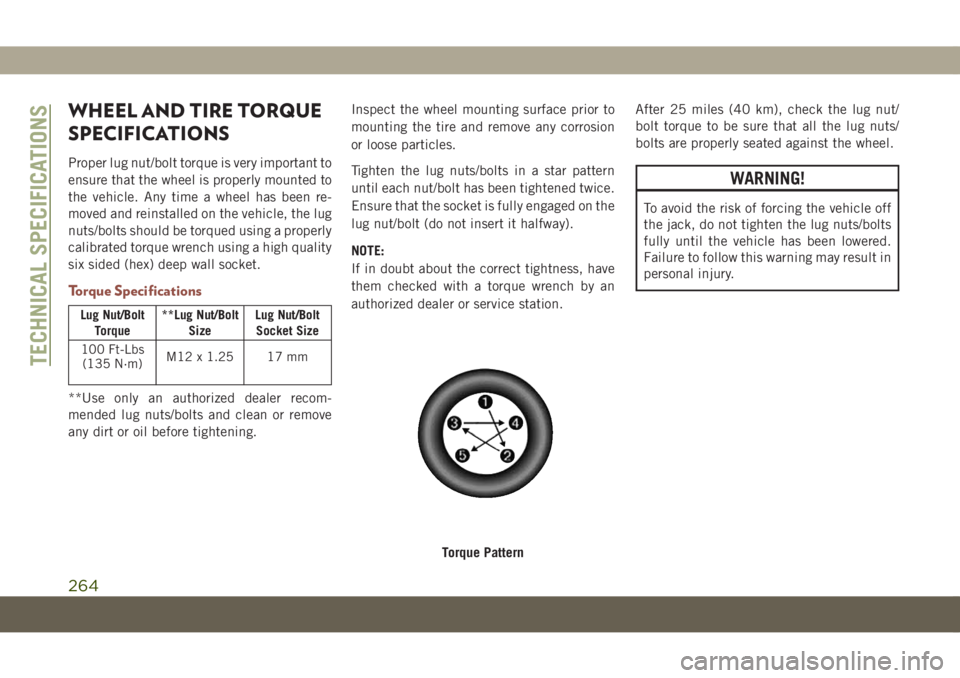
Tighten the lug nuts/bolts in a star pattern
until each nut/bolt has been tightened twice.
Ensure that the socket is fully engaged on the
lug nut/bolt (do not insert it halfway).
NOTE:
If in doubt about the correct tightness, have
them checked with a torque wrench by an
authorized dealer or service station.After 25 miles (40 km), check the lug nut/
bolt torque to be sure that all the lug nuts/
bolts are properly seated against the wheel.
WARNING!
To avoid the risk of forcing the vehicle off
the jack, do not tighten the lug nuts/bolts
fully until the vehicle has been lowered.
Failure to follow this warning may result in
personal injury.
Torque Pattern
TECHNICAL SPECIFICATIONS
264
Page 277 of 362
U.S. Metric
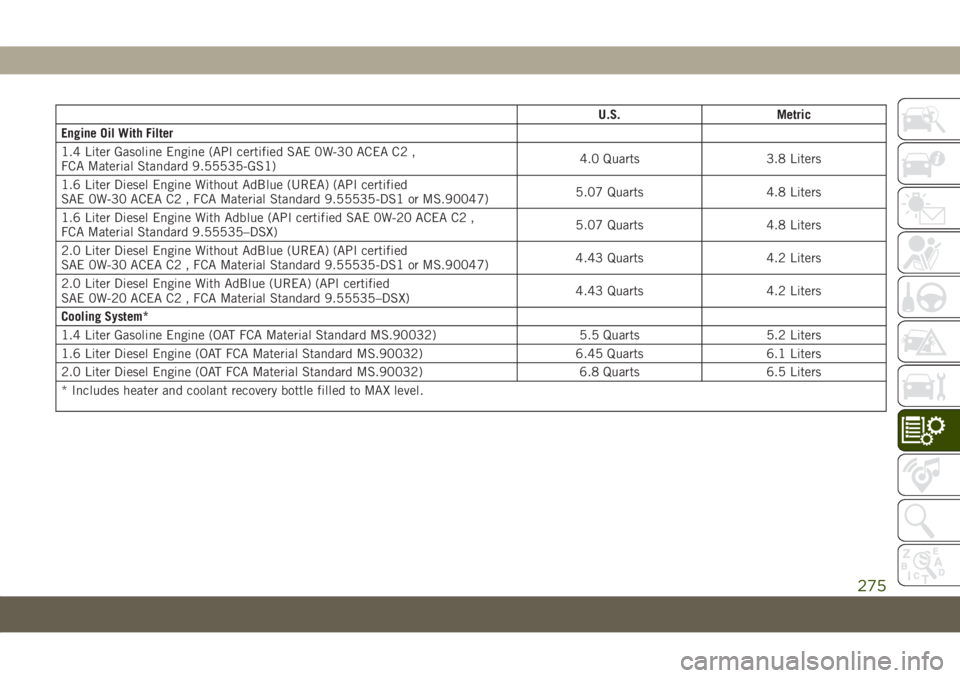
Engine Oil With Filter
1.4 Liter Gasoline Engine (API certified SAE 0W-30 ACEA C2 ,
FCA Material Standard 9.55535-GS1)4.0 Quarts 3.8 Liters
1.6 Liter Diesel Engine Without AdBlue (UREA) (API certified
SAE 0W-30 ACEA C2 , FCA Material Standard 9.55535-DS1 or MS.90047)5.07 Quarts 4.8 Liters
1.6 Liter Diesel Engine With Adblue (API certified SAE 0W-20 ACEA C2 ,
FCA Material Standard 9.55535–DSX)5.07 Quarts 4.8 Liters
2.0 Liter Diesel Engine Without AdBlue (UREA) (API certified
SAE 0W-30 ACEA C2 , FCA Material Standard 9.55535-DS1 or MS.90047)4.43 Quarts 4.2 Liters
2.0 Liter Diesel Engine With AdBlue (UREA) (API certified
SAE 0W-20 ACEA C2 , FCA Material Standard 9.55535–DSX)4.43 Quarts 4.2 Liters
Cooling System*
1.4 Liter Gasoline Engine (OAT FCA Material Standard MS.90032) 5.5 Quarts 5.2 Liters
1.6 Liter Diesel Engine (OAT FCA Material Standard MS.90032) 6.45 Quarts 6.1 Liters
2.0 Liter Diesel Engine (OAT FCA Material Standard MS.90032) 6.8 Quarts 6.5 Liters
* Includes heater and coolant recovery bottle filled to MAX level.
275
Page 278 of 362
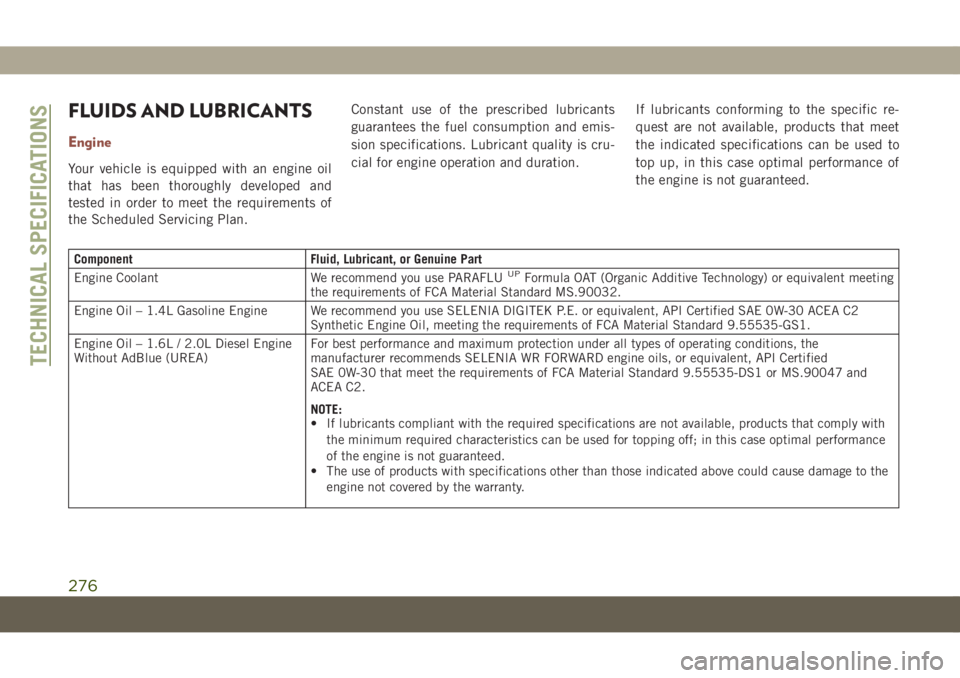
FLUIDS AND LUBRICANTS
Engine
Your vehicle is equipped with an engine oil
that has been thoroughly developed and
tested in order to meet the requirements of
the Scheduled Servicing Plan.Constant use of the prescribed lubricants
guarantees the fuel consumption and emis-
sion specifications. Lubricant quality is cru-
cial for engine operation and duration.If lubricants conforming to the specific re-
quest are not available, products that meet
the indicated specifications can be used to
top up, in this case optimal performance of
the engine is not guaranteed.
Component Fluid, Lubricant, or Genuine Part
Engine Coolant We recommend you use PARAFLUUPFormula OAT (Organic Additive Technology) or equivalent meeting
the requirements of FCA Material Standard MS.90032.
Engine Oil – 1.4L Gasoline Engine We recommend you use SELENIA DIGITEK P.E. or equivalent, API Certified SAE 0W-30 ACEA C2
Synthetic Engine Oil, meeting the requirements of FCA Material Standard 9.55535-GS1.
Engine Oil – 1.6L / 2.0L Diesel Engine
Without AdBlue (UREA)For best performance and maximum protection under all types of operating conditions, the
manufacturer recommends SELENIA WR FORWARD engine oils, or equivalent, API Certified
SAE 0W-30 that meet the requirements of FCA Material Standard 9.55535-DS1 or MS.90047 and
ACEA C2.
NOTE:
• If lubricants compliant with the required specifications are not available, products that comply with
the minimum required characteristics can be used for topping off; in this case optimal performance
of the engine is not guaranteed.
• The use of products with specifications other than those indicated above could cause damage to the
engine not covered by the warranty.
TECHNICAL SPECIFICATIONS
276
Page 279 of 362
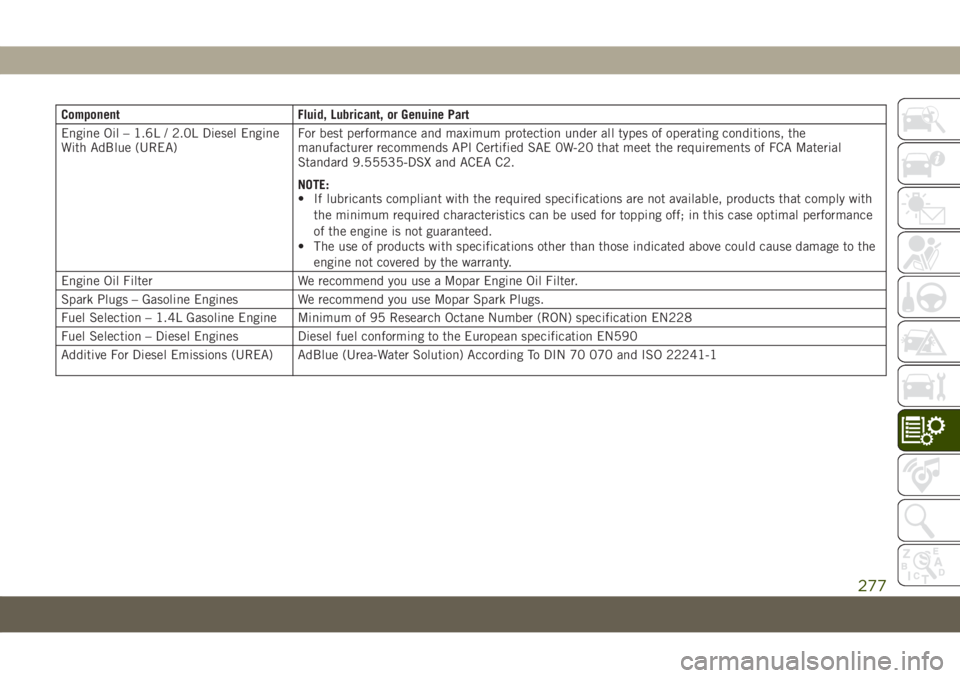
Component Fluid, Lubricant, or Genuine Part
Engine Oil – 1.6L / 2.0L Diesel Engine
With AdBlue (UREA)For best performance and maximum protection under all types of operating conditions, the
manufacturer recommends API Certified SAE 0W-20 that meet the requirements of FCA Material
Standard 9.55535-DSX and ACEA C2.
NOTE:
• If lubricants compliant with the required specifications are not available, products that comply with
the minimum required characteristics can be used for topping off; in this case optimal performance
of the engine is not guaranteed.
• The use of products with specifications other than those indicated above could cause damage to the
engine not covered by the warranty.
Engine Oil Filter We recommend you use a Mopar Engine Oil Filter.
Spark Plugs – Gasoline Engines We recommend you use Mopar Spark Plugs.
Fuel Selection – 1.4L Gasoline Engine Minimum of 95 Research Octane Number (RON) specification EN228
Fuel Selection – Diesel Engines Diesel fuel conforming to the European specification EN590
Additive For Diesel Emissions (UREA) AdBlue (Urea-Water Solution) According To DIN 70 070 and ISO 22241-1
277