brake fluid JEEP COMPASS 2023 User Guide
[x] Cancel search | Manufacturer: JEEP, Model Year: 2023, Model line: COMPASS, Model: JEEP COMPASS 2023Pages: 344, PDF Size: 18.8 MB
Page 257 of 344
IN CASE OF EMERGENCY255
Sealing A Tire With Tire Service Kit
Whenever You Stop To Use Tire Service Kit:
1. Pull over to a safe location and turn on the vehicle’s Hazard Warning Flashers.
2. Verify that the valve stem (on the wheel with the deflated tire) is in a position that is near to
the ground. This will allow the Tire Service Kit
Hose to reach the valve stem and keep the Tire
Service Kit flat on the ground. This will provide
the best positioning of the kit when injecting
the sealant into the deflated tire and running
the air pump. Move the vehicle as necessary to
place the valve stem in this position before
proceeding.
3. Place the transmission in PARK and cycle the ignition in the OFF position.
4. Apply the parking brake.
Setting Up To Use Tire Service Kit:
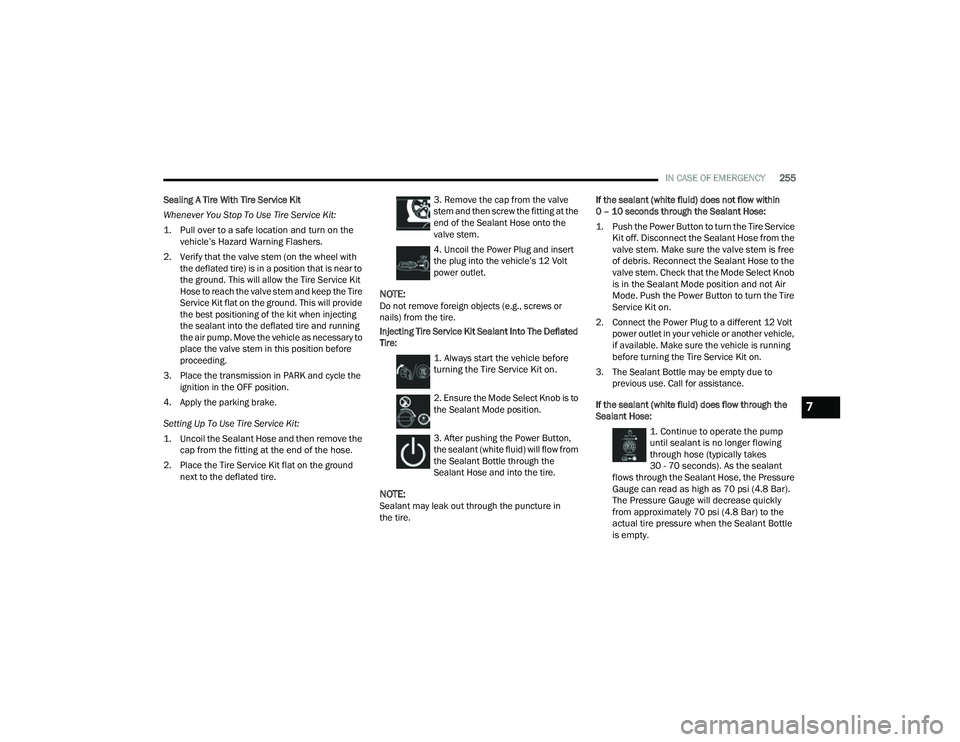
1. Uncoil the Sealant Hose and then remove the cap from the fitting at the end of the hose.
2. Place the Tire Service Kit flat on the ground next to the deflated tire. 3. Remove the cap from the valve
stem and then screw the fitting at the
end of the Sealant Hose onto the
valve stem.
4. Uncoil the Power Plug and insert
the plug into the vehicle’s 12 Volt
power outlet.
NOTE:Do not remove foreign objects (e.g., screws or
nails) from the tire.
Injecting Tire Service Kit Sealant Into The Deflated
Tire:
1. Always start the vehicle before
turning the Tire Service Kit on.
2. Ensure the Mode Select Knob is to
the Sealant Mode position.
3. After pushing the Power Button,
the sealant (white fluid) will flow from
the Sealant Bottle through the
Sealant Hose and into the tire.
NOTE:Sealant may leak out through the puncture in
the tire. If the sealant (white fluid) does not flow within
0 – 10 seconds through the Sealant Hose:
1. Push the Power Button to turn the Tire Service
Kit off. Disconnect the Sealant Hose from the
valve stem. Make sure the valve stem is free
of debris. Reconnect the Sealant Hose to the
valve stem. Check that the Mode Select Knob
is in the Sealant Mode position and not Air
Mode. Push the Power Button to turn the Tire
Service Kit on.
2. Connect the Power Plug to a different 12 Volt power outlet in your vehicle or another vehicle,
if available. Make sure the vehicle is running
before turning the Tire Service Kit on.
3. The Sealant Bottle may be empty due to previous use. Call for assistance.
If the sealant (white fluid) does flow through the
Sealant Hose:
1. Continue to operate the pump
until sealant is no longer flowing
through hose (typically takes
30 - 70 seconds). As the sealant
flows through the Sealant Hose, the Pressure
Gauge can read as high as 70 psi (4.8 Bar).
The Pressure Gauge will decrease quickly
from approximately 70 psi (4.8 Bar) to the
actual tire pressure when the Sealant Bottle
is empty.
7
22_MP_OM_EN_USC_t.book Page 255
Page 269 of 344
267
SERVICING AND MAINTENANCE
SCHEDULED SERVICING
Your vehicle is equipped with an automatic oil
change indicator system. The oil change indicator
system will remind you that it is time to take your
vehicle in for scheduled maintenance.
Based on engine operation conditions, the oil
change indicator message will illuminate in the
instrument cluster. This means that service is
required for your vehicle. Operating conditions
such as frequent short-trips, trailer tow and
extremely hot or cold ambient temperatures will
influence when the “Change Oil” or “Oil Change
Required” message is displayed. Have your vehicle
serviced as soon as possible, within the next
500 miles (805 km).An authorized dealer will reset the oil change
indicator message after completing the scheduled
oil change. If a scheduled oil change is performed
by someone other than an authorized dealer, the
message can be reset by referring to the steps
described under Instrument Cluster Display
Ú
page 77.
NOTE:Under no circumstances should oil change
intervals exceed 10,000 miles (16,000 km), one
year or 350 hours of engine run time, whichever
comes first. The 350 hours of engine run or idle
time is generally only a concern for fleet
customers.
NOTE:The Oil Change Indicator will not illuminate under
these conditions. Once A Month Or Before A Long Trip:
Check engine oil level.
Check windshield washer fluid level.
Check the tire inflation pressures and look for
unusual wear or damage. Rotate tires at the first
sign of irregular wear, even if it occurs before
the oil indicator system turns on.
Check the fluid levels of the coolant reservoir,
and brake master cylinder reservoir, and fill as
needed.
Check function of all interior and exterior lights.
8
22_MP_OM_EN_USC_t.book Page 267
Page 273 of 344
SERVICING AND MAINTENANCE271
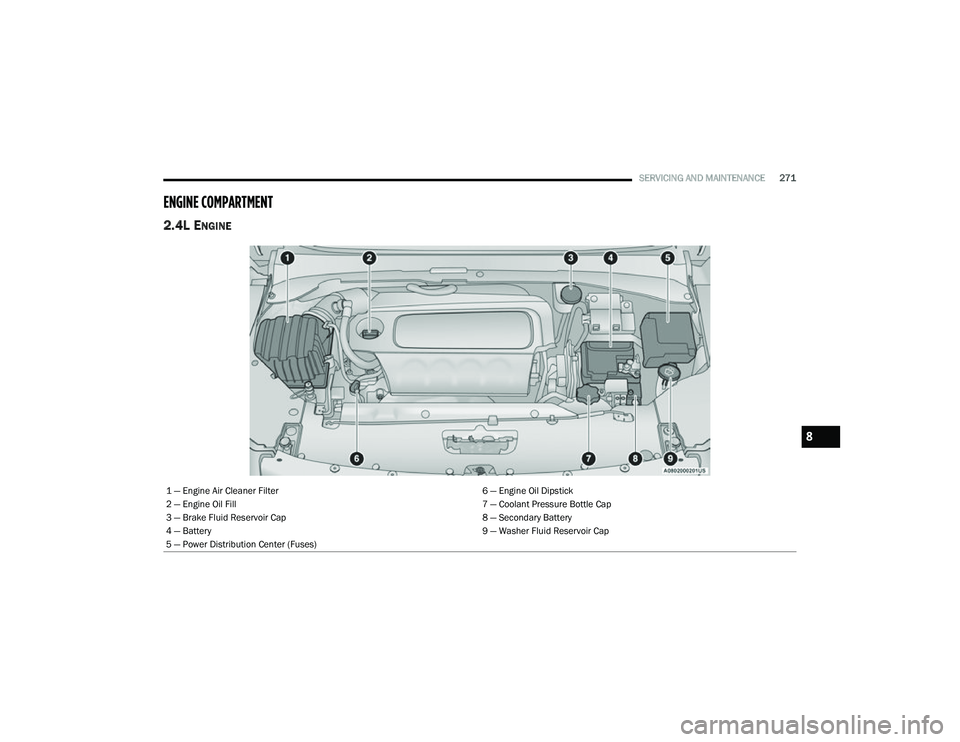
ENGINE COMPARTMENT
2.4L ENGINE
1 — Engine Air Cleaner Filter 6 — Engine Oil Dipstick
2 — Engine Oil Fill 7 — Coolant Pressure Bottle Cap
3 — Brake Fluid Reservoir Cap 8 — Secondary Battery
4 — Battery 9 — Washer Fluid Reservoir Cap
5 — Power Distribution Center (Fuses)
8
22_MP_OM_EN_USC_t.book Page 271
Page 284 of 344
282SERVICING AND MAINTENANCE
(Continued)
Do not overfill the coolant expansion bottle.
Check the coolant freeze point in the radiator
and in the coolant expansion bottle. If engine
coolant needs to be added, the contents of the
coolant expansion bottle must also be protected
against freezing.
If frequent engine coolant additions are
required, the cooling system should be pressure
tested for leaks.
Maintain engine coolant concentration at a
minimum of 50% OAT coolant (conforming to
MS.90032) and distilled water for proper corro-
sion protection of your engine which contains
aluminum components.
Make sure that the coolant expansion bottle
overflow hoses are not kinked or obstructed.
Keep the front of the radiator clean. If your
vehicle is equipped with air conditioning, keep
the front of the condenser clean.
Do not change the thermostat for Summer or
Winter operation. If replacement is ever neces -
sary, install ONLY the correct type thermostat.
Other designs may result in unsatisfactory
engine cooling performance, poor gas mileage,
and increased emissions.
BRAKE SYSTEM
In order to ensure brake system performance, all
brake system components should be inspected
periodically. For the proper maintenance intervals
Ú page 268.
Brake Master Cylinder
The fluid in the master cylinder should be checked
when performing under hood services or
immediately if the Brake Warning Light is
illuminated.
Be sure to clean the top of the master cylinder area
before removing the cap. If necessary, add fluid to
bring the fluid level up to the requirements
described on the brake fluid reservoir. With disc
brakes, fluid level can be expected to fall as the
brake pads wear. Brake fluid level should be
checked when pads are replaced. However, low
fluid level may be caused by a leak and a checkup
may be needed. Use only the manufacturer recommended brake
fluid Ú
page 324.
WARNING!
Riding the brakes can lead to brake failure and
possibly a collision. Driving with your foot resting or
riding on the brake pedal can result in abnormally
high brake temperatures, excessive lining wear,
and possible brake damage. You would not have
your full braking capacity in an emergency.
WARNING!
Use only the manufacturer recommended
brake fluid Úpage 324. Using the wrong type
of brake fluid can severely damage your brake
system and/or impair its performance. The
proper type of brake fluid for your vehicle is
also identified on the original factory installed
hydraulic master cylinder reservoir.
To avoid contamination from foreign matter or
moisture, use only new brake fluid or fluid that
has been in a tightly closed container. Keep
the master cylinder reservoir cap secured at
all times. Brake fluid in a open container
absorbs moisture from the air resulting in a
lower boiling point. This may cause it to boil
unexpectedly during hard or prolonged
braking, resulting in sudden brake failure.
This could result in a collision.
Overfilling the brake fluid reservoir can result
in spilling brake fluid on hot engine parts,
causing the brake fluid to catch fire. Brake
fluid can also damage painted and vinyl
surfaces, care should be taken to avoid its
contact with these surfaces.
22_MP_OM_EN_USC_t.book Page 282
Page 285 of 344
SERVICING AND MAINTENANCE283
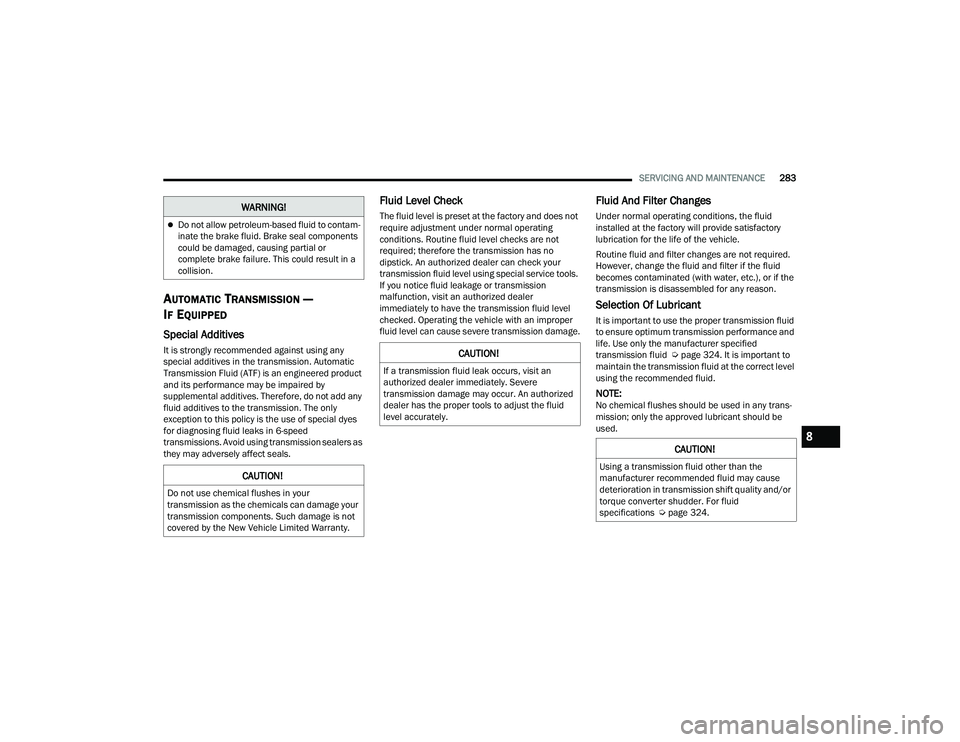
AUTOMATIC TRANSMISSION —
I
F EQUIPPED
Special Additives
It is strongly recommended against using any
special additives in the transmission. Automatic
Transmission Fluid (ATF) is an engineered product
and its performance may be impaired by
supplemental additives. Therefore, do not add any
fluid additives to the transmission. The only
exception to this policy is the use of special dyes
for diagnosing fluid leaks in 6-speed
transmissions. Avoid using transmission sealers as
they may adversely affect seals.
Fluid Level Check
The fluid level is preset at the factory and does not
require adjustment under normal operating
conditions. Routine fluid level checks are not
required; therefore the transmission has no
dipstick. An authorized dealer can check your
transmission fluid level using special service tools.
If you notice fluid leakage or transmission
malfunction, visit an authorized dealer
immediately to have the transmission fluid level
checked. Operating the vehicle with an improper
fluid level can cause severe transmission damage.
Fluid And Filter Changes
Under normal operating conditions, the fluid
installed at the factory will provide satisfactory
lubrication for the life of the vehicle.
Routine fluid and filter changes are not required.
However, change the fluid and filter if the fluid
becomes contaminated (with water, etc.), or if the
transmission is disassembled for any reason.
Selection Of Lubricant
It is important to use the proper transmission fluid
to ensure optimum transmission performance and
life. Use only the manufacturer specified
transmission fluid Ú page 324. It is important to
maintain the transmission fluid at the correct level
using the recommended fluid.
NOTE:No chemical flushes should be used in any trans -
mission; only the approved lubricant should be
used.
Do not allow petroleum-based fluid to contam -
inate the brake fluid. Brake seal components
could be damaged, causing partial or
complete brake failure. This could result in a
collision.
CAUTION!
Do not use chemical flushes in your
transmission as the chemicals can damage your
transmission components. Such damage is not
covered by the New Vehicle Limited Warranty.
WARNING!
CAUTION!
If a transmission fluid leak occurs, visit an
authorized dealer immediately. Severe
transmission damage may occur. An authorized
dealer has the proper tools to adjust the fluid
level accurately.
CAUTION!
Using a transmission fluid other than the
manufacturer recommended fluid may cause
deterioration in transmission shift quality and/or
torque converter shudder. For fluid
specifications Ú page 324.
8
22_MP_OM_EN_USC_t.book Page 283
Page 321 of 344
319
TECHNICAL SPECIFICATIONS
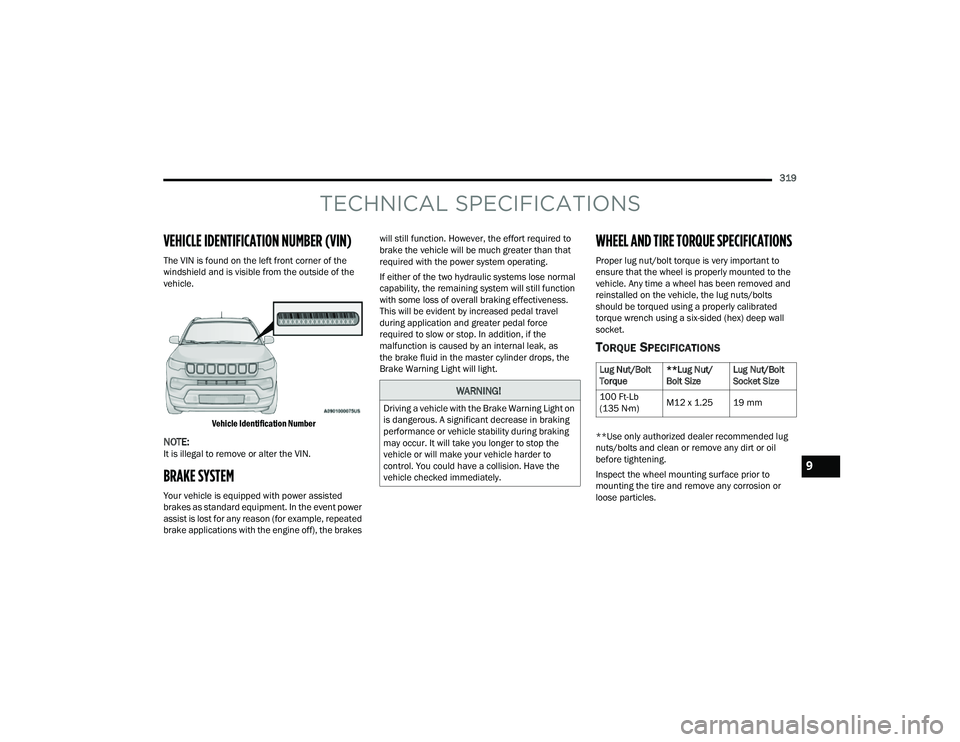
VEHICLE IDENTIFICATION NUMBER (VIN)
The VIN is found on the left front corner of the
windshield and is visible from the outside of the
vehicle.
Vehicle Identification Number
NOTE:It is illegal to remove or alter the VIN.
BRAKE SYSTEM
Your vehicle is equipped with power assisted
brakes as standard equipment. In the event power
assist is lost for any reason (for example, repeated
brake applications with the engine off), the brakes will still function. However, the effort required to
brake the vehicle will be much greater than that
required with the power system operating.
If either of the two hydraulic systems lose normal
capability, the remaining system will still function
with some loss of overall braking effectiveness.
This will be evident by increased pedal travel
during application and greater pedal force
required to slow or stop. In addition, if the
malfunction is caused by an internal leak, as
the brake fluid in the master cylinder drops, the
Brake Warning Light will light.
WHEEL AND TIRE TORQUE SPECIFICATIONS
Proper lug nut/bolt torque is very important to
ensure that the wheel is properly mounted to the
vehicle. Any time a wheel has been removed and
reinstalled on the vehicle, the lug nuts/bolts
should be torqued using a properly calibrated
torque wrench using a six-sided (hex) deep wall
socket.
TORQUE SPECIFICATIONS
**Use only authorized dealer recommended lug
nuts/bolts and clean or remove any dirt or oil
before tightening.
Inspect the wheel mounting surface prior to
mounting the tire and remove any corrosion or
loose particles.
WARNING!
Driving a vehicle with the Brake Warning Light on
is dangerous. A significant decrease in braking
performance or vehicle stability during braking
may occur. It will take you longer to stop the
vehicle or will make your vehicle harder to
control. You could have a collision. Have the
vehicle checked immediately.
Lug Nut/Bolt
Torque
**Lug Nut/
Bolt SizeLug Nut/Bolt
Socket Size
100 Ft-Lb
(135 N·m) M12 x 1.25 19 mm
9
22_MP_OM_EN_USC_t.book Page 319
Page 326 of 344
324TECHNICAL SPECIFICATIONS
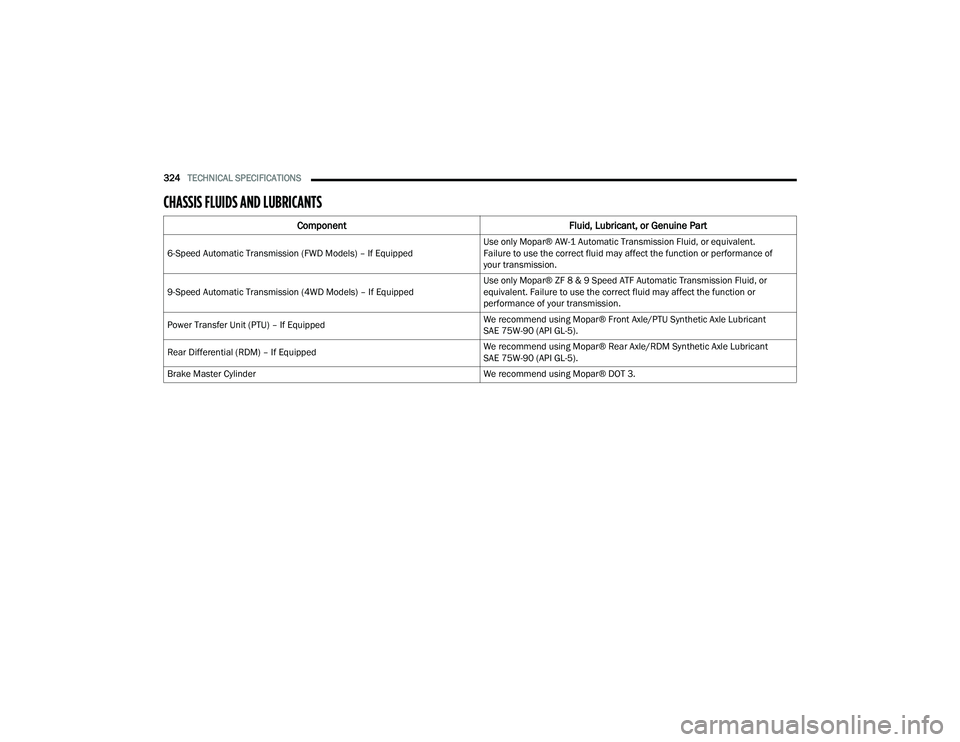
CHASSIS FLUIDS AND LUBRICANTS
Component Fluid, Lubricant, or Genuine Part
6-Speed Automatic Transmission (FWD Models) – If Equipped Use only Mopar® AW-1 Automatic Transmission Fluid, or equivalent.
Failure to use the correct fluid may affect the function or performance of
your transmission.
9-Speed Automatic Transmission (4WD Models) – If Equipped Use only Mopar® ZF 8 & 9 Speed ATF Automatic Transmission Fluid, or
equivalent. Failure to use the correct fluid may affect the function or
performance of your transmission.
Power Transfer Unit (PTU) – If Equipped We recommend using Mopar® Front Axle/PTU Synthetic Axle Lubricant
SAE 75W-90 (API GL-5).
Rear Differential (RDM) – If Equipped We recommend using Mopar® Rear Axle/RDM Synthetic Axle Lubricant
SAE 75W-90 (API GL-5).
Brake Master Cylinder We recommend using Mopar® DOT 3.
22_MP_OM_EN_USC_t.book Page 324
Page 331 of 344
329
INDEX
A
Active Lane Management System................. 145Adaptive Cruise Control (ACC)........................ 116Adding Engine Coolant (Antifreeze)............... 280Additives, Fuel............................................... 322Air Bag........................................................... 214Air Bag Operation...................................... 215Air Bag Warning Light...................... 213, 216Driver Knee Air Bag................................... 219Enhanced Accident Response......... 224, 266Event Data Recorder (EDR)....................... 266Front Air Bag............................................. 216If Deployment Occurs................................ 223Knee Impact Bolsters................................ 219Maintaining Your Air Bag System.............. 227Maintenance............................................. 227Redundant Air Bag Warning Light.............214Side Air Bags............................................. 220Transporting Pets...................................... 240Air Bag Light........................................ 213, 241Air Cleaner, Engine
(Engine Air Cleaner Filter).............................. 274Air Conditioner Maintenance......................... 274Air Conditioner Refrigerant.................. 274, 275Air Conditioner System.................................. 274Air Conditioning Filter............................. 57, 275
Air Conditioning, Operating Tips....................... 56Air Filter........................................................ 274Air PressureTires......................................................... 306AlarmArm The System.......................................... 21Disarm The System..................................... 22Security Alarm...................................... 21, 92Alarm SystemSecurity Alarm............................................. 21Alterations/ModificationsVehicle......................................................... 10Antifreeze (Engine Coolant)................. 280, 323Disposal................................................... 281Anti-Lock Brake System (ABS)...................... 187Anti-Lock Warning Light................................... 92Arming SystemSecurity Alarm............................................. 21Assist, Hill Start............................................. 193Audio Systems (Radio).................................. 164Auto Down Power Windows............................. 62Auto Hold...................................................... 105Automatic Dimming Mirror............................... 37Automatic Door Locks...................................... 25Automatic Headlights....................................... 45Automatic High Beams.................................... 45
Automatic Temperature Control (ATC)..............56Automatic Transaxle..................................... 106Automatic Transmission................................ 107Adding Fluid..................................... 283, 324Fluid And Filter Change............................. 283Fluid Change............................................. 283Fluid Level Check...................................... 283Fluid Type........................................ 283, 324Special Additives...................................... 283Automatic Transmission Limp Home Mode......25Auxiliary Electrical Outlet (Power Outlet)..........59Axle Fluid....................................................... 324Axle Lubrication............................................ 324
B
Battery................................................... 90, 272Charging System Light.................................90Keyless Key Fob Replacement....................15Battery Saver Feature......................................88Belts, Seat.................................................... 241Blind Spot Monitoring................................... 194Body Mechanism Lubrication........................ 275B-Pillar Location............................................ 303Brake Assist System..................................... 188Brake Control System, Electronic.................. 188Brake Fluid.................................................... 324
11
22_MP_OM_EN_USC_t.book Page 329
Page 332 of 344
330 Brake System
...................................... 282, 319Anti-Lock (ABS).......................................... 319Fluid Check..................................... 282, 324Master Cylinder......................................... 282Parking...................................................... 103Warning Light.............................................. 90Brake/Transmission Interlock....................... 107Brightness, Interior Lights......................... 46, 47Bulb Replacement......................................... 291Bulbs, Light.................................................... 242
C
Camera, Rear...................................... 148, 150Capacities, Fuel............................................. 323Caps, Filler Fuel........................................................... 152Oil (Engine)................................................ 271Radiator (Coolant Pressure)...................... 281Car Washes................................................... 316Carbon Monoxide Warning............................ 243Cargo Area Cover............................................. 70Cargo Load Floor............................................. 70Cargo Tie-Downs....................................... 70, 71Cellular Phone............................................... 186Certification Label......................................... 153Chains, Tire.................................................... 311Change Oil Indicator........................................ 80Changing A Flat Tire....................................... 247Chart, Tire Sizing............................................ 299
Check Engine Light
(Malfunction Indicator Light)............................ 99Checking Your Vehicle For Safety................. 240Checks, Safety.............................................. 240Child Restraint.............................................. 228Child RestraintsBooster Seats........................................... 231Child Seat Installation.............................. 239How To Stow An unused ALR Seat Belt.... 236Infant And Child Restraints....................... 230Lower Anchors And TethersFor Children......................................... 233Older Children And Child Restraints......... 230Seating Positions...................................... 232Child Safety Locks........................................... 25Clean Air Gasoline......................................... 320CleaningWheels..................................................... 315Windshield Wiper Blades.......................... 275Climate Control................................................ 50Automatic.................................................... 50Manual........................................................ 53Coin Holder...................................................... 58Cold Weather Operation............................... 101Compact Spare Tire...................................... 310ConnectorUniversal Consumer Interface (UCI)............. 58Console............................................................ 58Floor............................................................ 58
Contract, Service........................................... 326Cooling Pressure Cap (Radiator Cap)............ 281Cooling System............................................. 279Adding Coolant (Antifreeze)...................... 280Coolant Level................................... 280, 281Cooling Capacity....................................... 323Disposal Of Used Coolant......................... 281Drain, Flush, And Refill............................. 280Inspection................................................. 281Points To Remember................................ 281Pressure Cap............................................ 281Radiator Cap............................................. 281Selection Of Coolant (Antifreeze)..... 280, 323Corrosion Protection..................................... 315Cruise Control (Speed Control)...................... 116Cruise Light............................................... 97, 98Customer Assistance.................................... 325Cybersecurity................................................ 164
D
Daytime Running Lights............................43, 44Defroster, Windshield................................... 241Dimmer SwitchHeadlight..............................................43, 44DipsticksOil (Engine)............................................... 272Disabled Vehicle Towing............................... 264DisposalAntifreeze (Engine Coolant)...................... 281
22_MP_OM_EN_USC_t.book Page 330
Page 333 of 344
331
Door Ajar
................................................... 90, 91Door Ajar Light.......................................... 90, 91Driver’s Seat Back Tilt..................................... 28Driving........................................................... 161
E
Easy Entry Seats.............................................. 33Electric Brake Control System....................... 188Anti-Lock Brake System............................. 187Traction Control System.................. 191, 194Electric Parking Brake................................... 103Electrical Power Outlets................................... 59Electronic Stability Control (ESC)...................189Electronic Throttle Control Warning Light........ 91Emergency Braking........................................ 200Emergency Gas Can Refueling...................... 260Emergency, In Case Of Hazard Warning Flasher............................ 244Jacking...................................................... 247Jump Starting............................................ 258Tow Hooks................................................. 266Towing....................................................... 264Emission Control System Maintenance........... 99Engine........................................................... 271Air Cleaner................................................. 274Block Heater............................................. 102Break-In Recommendations...................... 102Checking Oil Level..................................... 272Coolant (Antifreeze)................................... 323
Cooling..................................................... 279Exhaust Gas Caution................................ 243Fails To Start............................................ 101Flooded, Starting...................................... 101Jump Starting........................................... 258Oil.................................................... 273, 323Oil Filler Cap............................................. 271Oil Filter.................................................... 274Oil Selection.................................... 273, 323Oil Synthetic............................................. 273Overheating.............................................. 261Starting..................................................... 100Enhanced Accident Response
Feature................................................ 224, 266Ethanol......................................................... 321Exhaust Gas Cautions................................... 243Exhaust System................................... 243, 278Exterior Lighting........................................ 43, 44Exterior Lights.........................................43, 242
F
FiltersAir Cleaner
................................................ 274Air Conditioning..................................57, 275Engine Oil........................................ 274, 323Engine Oil Disposal................................... 274FlashersHazard Warning........................................ 244Turn Signals.........................43, 46, 97, 242
Flash-To-Pass............................................ 43, 45Flat Tire Changing................................ 298, 310Flat Tire Stowage................................. 298, 310Flooded Engine Starting................................ 101Floor Console...................................................58Fluid Capacities............................................ 323Fluid Leaks.................................................... 242Fluid Level ChecksBrake........................................................ 282Engine Oil................................................. 272Fluid, Brake................................................... 324Fog Lights.................................................43, 46Fold-Flat Seats.................................................28Folding Rear Seats...........................................30Forward Collision Warning............................ 198Freeing A Stuck Vehicle................................. 262Fuel............................................................... 320Additives................................................... 322Clean Air................................................... 320Ethanol..................................................... 321Filler Cap (Gas Cap).................................. 152Gasoline................................................... 320Light.............................................................93Materials Added....................................... 322Methanol.................................................. 321Octane Rating.................................. 320, 323Specifications........................................... 323Tank Capacity........................................... 323Fuses............................................................ 284
11
22_MP_OM_EN_USC_t.book Page 331