oil temperature JEEP COMPASS 2023 User Guide
[x] Cancel search | Manufacturer: JEEP, Model Year: 2023, Model line: COMPASS, Model: JEEP COMPASS 2023Pages: 344, PDF Size: 18.8 MB
Page 269 of 344
267
SERVICING AND MAINTENANCE
SCHEDULED SERVICING
Your vehicle is equipped with an automatic oil
change indicator system. The oil change indicator
system will remind you that it is time to take your
vehicle in for scheduled maintenance.
Based on engine operation conditions, the oil
change indicator message will illuminate in the
instrument cluster. This means that service is
required for your vehicle. Operating conditions
such as frequent short-trips, trailer tow and
extremely hot or cold ambient temperatures will
influence when the “Change Oil” or “Oil Change
Required” message is displayed. Have your vehicle
serviced as soon as possible, within the next
500 miles (805 km).An authorized dealer will reset the oil change
indicator message after completing the scheduled
oil change. If a scheduled oil change is performed
by someone other than an authorized dealer, the
message can be reset by referring to the steps
described under Instrument Cluster Display
Ú
page 77.
NOTE:Under no circumstances should oil change
intervals exceed 10,000 miles (16,000 km), one
year or 350 hours of engine run time, whichever
comes first. The 350 hours of engine run or idle
time is generally only a concern for fleet
customers.
NOTE:The Oil Change Indicator will not illuminate under
these conditions. Once A Month Or Before A Long Trip:
Check engine oil level.
Check windshield washer fluid level.
Check the tire inflation pressures and look for
unusual wear or damage. Rotate tires at the first
sign of irregular wear, even if it occurs before
the oil indicator system turns on.
Check the fluid levels of the coolant reservoir,
and brake master cylinder reservoir, and fill as
needed.
Check function of all interior and exterior lights.
8
22_MP_OM_EN_USC_t.book Page 267
Page 274 of 344
272SERVICING AND MAINTENANCE
CHECKING OIL LEVEL
To ensure proper engine lubrication, the engine oil
must be maintained at the correct level. Check the
oil level at regular intervals, such as every fuel
stop. The best time to check the engine oil level is
about five minutes after a fully warmed up engine
is shut off.
Checking the oil while the vehicle is on level ground
will improve the accuracy of the oil level readings.
There are four possible dipstick types:
Crosshatched zone.
Crosshatched zone marked SAFE.
Crosshatched zone marked with MIN at the low
end of the range and MAX at the high end of the
range.
Crosshatched zone marked with dimples at the
MIN and the MAX ends of the range.
NOTE:Always maintain the oil level within the crosshatch
markings on the dipstick.
Adding 1 quart (1 liter) of oil when the reading is at
the low end of the dipstick range will raise the oil
level to the high end of the range marking.
ADDING WASHER FLUID
The fluid reservoir is located in the front of the
engine compartment. Be sure to check the fluid
level in the reservoir at regular intervals. Fill the
reservoir with windshield washer solvent (not
radiator antifreeze) and operate the system for a
few seconds to flush out the residual washer fluid.
When refilling the washer fluid reservoir, take
some washer fluid, apply it to a cloth or towel, and
wipe clean the wiper blades; this will help blade
performance.
To prevent freeze-up of your windshield washer
system in cold weather, select a solution or mixture
that meets or exceeds the temperature range of
your climate. This rating information can be found
on most washer fluid containers.
MAINTENANCE-FREE BATTERY
Your vehicle is equipped with a maintenance-free
battery. You will never have to add water, and
periodic maintenance is not required.
CAUTION!
Overfilling or underfilling the crankcase will
cause aeration or loss of oil pressure. This could
damage your engine.
WARNING!
Commercially available windshield washer
solvents are flammable. They could ignite and
burn you. Care must be exercised when filling or
working around the washer solution.
WARNING!
Battery fluid is a corrosive acid solution and
can burn or even blind you. Do not allow
battery fluid to contact your eyes, skin, or
clothing. Do not lean over a battery when
attaching clamps. If acid splashes in eyes or
on skin, flush the area immediately with large
amounts of water Úpage 258.
Battery gas is flammable and explosive. Keep
flame or sparks away from the battery. Do not
use a booster battery or any other booster
source with an output greater than 12 Volts.
Do not allow cable clamps to touch each
other.
Battery posts, terminals, and related accesso -
ries contain lead and lead compounds. Wash
hands after handling.
22_MP_OM_EN_USC_t.book Page 272
Page 284 of 344
282SERVICING AND MAINTENANCE
(Continued)
Do not overfill the coolant expansion bottle.
Check the coolant freeze point in the radiator
and in the coolant expansion bottle. If engine
coolant needs to be added, the contents of the
coolant expansion bottle must also be protected
against freezing.
If frequent engine coolant additions are
required, the cooling system should be pressure
tested for leaks.
Maintain engine coolant concentration at a
minimum of 50% OAT coolant (conforming to
MS.90032) and distilled water for proper corro-
sion protection of your engine which contains
aluminum components.
Make sure that the coolant expansion bottle
overflow hoses are not kinked or obstructed.
Keep the front of the radiator clean. If your
vehicle is equipped with air conditioning, keep
the front of the condenser clean.
Do not change the thermostat for Summer or
Winter operation. If replacement is ever neces -
sary, install ONLY the correct type thermostat.
Other designs may result in unsatisfactory
engine cooling performance, poor gas mileage,
and increased emissions.
BRAKE SYSTEM
In order to ensure brake system performance, all
brake system components should be inspected
periodically. For the proper maintenance intervals
Ú page 268.
Brake Master Cylinder
The fluid in the master cylinder should be checked
when performing under hood services or
immediately if the Brake Warning Light is
illuminated.
Be sure to clean the top of the master cylinder area
before removing the cap. If necessary, add fluid to
bring the fluid level up to the requirements
described on the brake fluid reservoir. With disc
brakes, fluid level can be expected to fall as the
brake pads wear. Brake fluid level should be
checked when pads are replaced. However, low
fluid level may be caused by a leak and a checkup
may be needed. Use only the manufacturer recommended brake
fluid Ú
page 324.
WARNING!
Riding the brakes can lead to brake failure and
possibly a collision. Driving with your foot resting or
riding on the brake pedal can result in abnormally
high brake temperatures, excessive lining wear,
and possible brake damage. You would not have
your full braking capacity in an emergency.
WARNING!
Use only the manufacturer recommended
brake fluid Úpage 324. Using the wrong type
of brake fluid can severely damage your brake
system and/or impair its performance. The
proper type of brake fluid for your vehicle is
also identified on the original factory installed
hydraulic master cylinder reservoir.
To avoid contamination from foreign matter or
moisture, use only new brake fluid or fluid that
has been in a tightly closed container. Keep
the master cylinder reservoir cap secured at
all times. Brake fluid in a open container
absorbs moisture from the air resulting in a
lower boiling point. This may cause it to boil
unexpectedly during hard or prolonged
braking, resulting in sudden brake failure.
This could result in a collision.
Overfilling the brake fluid reservoir can result
in spilling brake fluid on hot engine parts,
causing the brake fluid to catch fire. Brake
fluid can also damage painted and vinyl
surfaces, care should be taken to avoid its
contact with these surfaces.
22_MP_OM_EN_USC_t.book Page 282
Page 311 of 344
SERVICING AND MAINTENANCE309
Keep dismounted tires in a cool, dry place with as
little exposure to light as possible. Protect tires
from contact with oil, grease, and gasoline.
Replacement Tires
The tires on your new vehicle provide a balance of
many characteristics. They should be inspected
regularly for wear and correct cold tire inflation
pressures. The manufacturer strongly
recommends that you use tires equivalent to the
originals in size, quality and performance when
replacement is needed Ú page 308. Refer to the
Tire and Loading Information placard or the
Vehicle Certification Label for the size designation
of your tire. The Load Index and Speed Symbol for
your tire will be found on the original equipment
tire sidewall.
For more information relating to the Load Index
and Speed Symbol of a tire Ú page 298.
It is recommended to replace the two front tires or
two rear tires as a pair. Replacing just one tire can
seriously affect your vehicle’s handling. If you ever
replace a wheel, make sure that the wheel’s
specifications match those of the original wheels.
It is recommended you contact an authorized tire
dealer or original equipment dealer with any
questions you may have on tire specifications or
capability. Failure to use equivalent replacement
tires may adversely affect the safety, handling, and
ride of your vehicle.
TIRE TYPES
All Season Tires — If Equipped
All Season tires provide traction for all seasons
(Spring, Summer, Autumn, and Winter). Traction
levels may vary between different All Season tires.
All Season tires can be identified by the M+S, M&S,
M/S or MS designation on the tire sidewall. Use All
Season tires only in sets of four; failure to do so
may adversely affect the safety and handling of
your vehicle.
Summer Or Three Season Tires —
If Equipped
Summer tires provide traction in both wet and dry
conditions, and are not intended to be driven in
snow or on ice. If your vehicle is equipped with
Summer tires, be aware these tires are not
designed for Winter or cold driving conditions.
Install Winter tires on your vehicle when ambient
temperatures are less than 40°F (5°C) or if roads
are covered with ice or snow. For more
information, contact an authorized dealer.
WARNING!
Do not use a tire, wheel size, load rating, or
speed rating other than that specified for your
vehicle. Some combinations of unapproved
tires and wheels may change suspension
dimensions and performance characteristics,
resulting in changes to steering, handling, and
braking of your vehicle. This can cause unpre -
dictable handling and stress to steering and
suspension components. You could lose
control and have a collision resulting in
serious injury or death. Use only the tire and
wheel sizes with load ratings approved for
your vehicle.
Never use a tire with a smaller load index or
capacity other than what was originally
equipped on your vehicle. Using a tire with a
smaller load index could result in tire over -
loading and failure. You could lose control and
have a collision.
Failure to equip your vehicle with tires having
adequate speed capability can result in
sudden tire failure and loss of vehicle control.
CAUTION!
Replacing original tires with tires of a different
size may result in false speedometer and
odometer readings.
8
22_MP_OM_EN_USC_t.book Page 309
Page 335 of 344
333
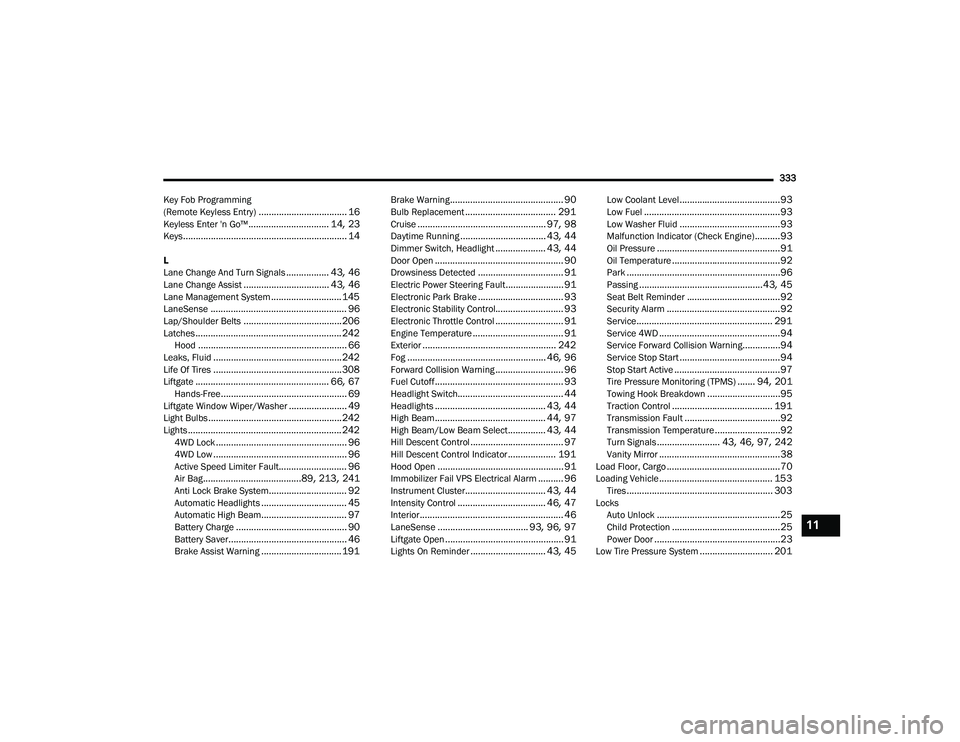
Key Fob Programming
(Remote Keyless Entry)
................................... 16Keyless Enter 'n Go™................................ 14, 23Keys................................................................. 14
L
Lane Change And Turn Signals................. 43, 46Lane Change Assist.................................. 43, 46Lane Management System............................ 145LaneSense...................................................... 96Lap/Shoulder Belts....................................... 206Latches.......................................................... 242Hood........................................................... 66Leaks, Fluid................................................... 242Life Of Tires................................................... 308Liftgate..................................................... 66, 67Hands-Free.................................................. 69Liftgate Window Wiper/Washer....................... 49Light Bulbs..................................................... 242Lights............................................................. 2424WD Lock.................................................... 964WD Low..................................................... 96Active Speed Limiter Fault........................... 96Air Bag.......................................89, 213, 241Anti Lock Brake System............................... 92Automatic Headlights.................................. 45Automatic High Beam.................................. 97Battery Charge............................................ 90Battery Saver............................................... 46Brake Assist Warning................................ 191
Brake Warning............................................. 90Bulb Replacement.................................... 291Cruise................................................... 97, 98Daytime Running.................................. 43, 44Dimmer Switch, Headlight.................... 43, 44Door Open................................................... 90Drowsiness Detected.................................. 91Electric Power Steering Fault....................... 91Electronic Park Brake.................................. 93Electronic Stability Control........................... 93Electronic Throttle Control........................... 91Engine Temperature.................................... 91Exterior..................................................... 242Fog....................................................... 46, 96Forward Collision Warning........................... 96Fuel Cutoff................................................... 93Headlight Switch.......................................... 44Headlights............................................ 43, 44High Beam............................................ 44, 97High Beam/Low Beam Select............... 43, 44Hill Descent Control..................................... 97Hill Descent Control Indicator................... 191Hood Open.................................................. 91Immobilizer Fail VPS Electrical Alarm.......... 96Instrument Cluster................................ 43, 44Intensity Control................................... 46, 47Interior......................................................... 46LaneSense.................................... 93, 96, 97Liftgate Open............................................... 91Lights On Reminder.............................. 43, 45
Low Coolant Level........................................93Low Fuel......................................................93Low Washer Fluid........................................93Malfunction Indicator (Check Engine)..........93Oil Pressure.................................................91Oil Temperature...........................................92Park.............................................................96Passing.................................................43, 45Seat Belt Reminder.....................................92Security Alarm.............................................92Service...................................................... 291Service 4WD................................................94Service Forward Collision Warning...............94Service Stop Start........................................94Stop Start Active..........................................97Tire Pressure Monitoring (TPMS)....... 94, 201Towing Hook Breakdown.............................95Traction Control........................................ 191Transmission Fault......................................92Transmission Temperature..........................92Turn Signals......................... 43, 46, 97, 242Vanity Mirror................................................38Load Floor, Cargo.............................................70Loading Vehicle............................................. 153Tires.......................................................... 303Locks Auto Unlock.................................................25Child Protection...........................................25Power Door..................................................23Low Tire Pressure System............................. 201
11
22_MP_OM_EN_USC_t.book Page 333
Page 338 of 344
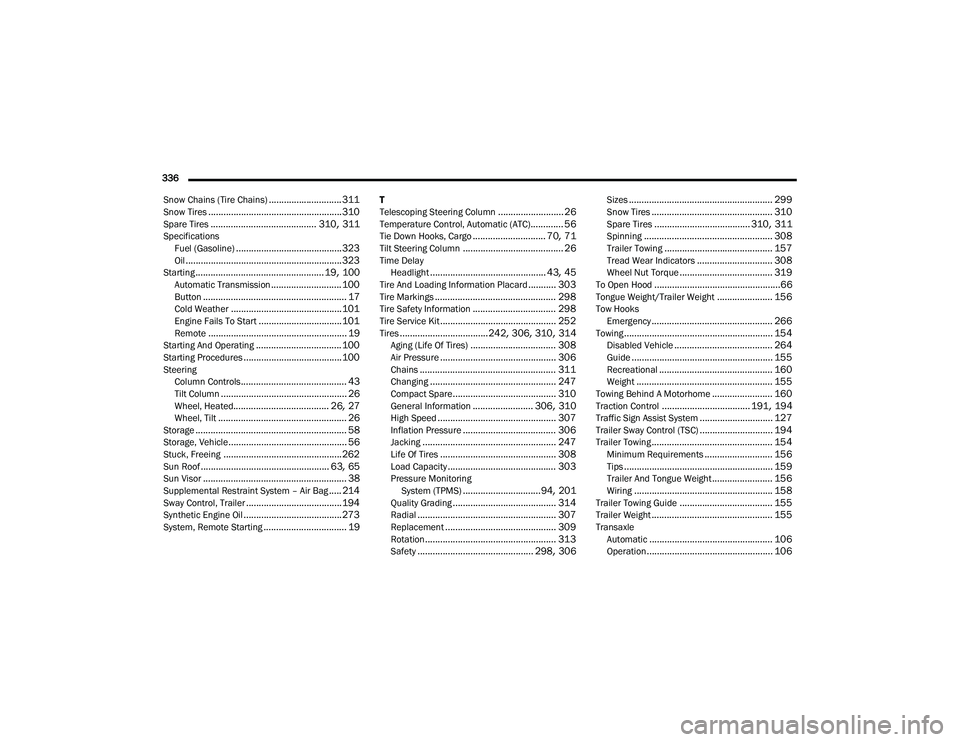
336 Snow Chains (Tire Chains)
............................. 311Snow Tires..................................................... 310Spare Tires.......................................... 310, 311Specifications Fuel (Gasoline).......................................... 323Oil.............................................................. 323Starting................................................... 19, 100Automatic Transmission............................ 100Button......................................................... 17Cold Weather............................................ 101Engine Fails To Start................................. 101Remote....................................................... 19Starting And Operating.................................. 100Starting Procedures....................................... 100SteeringColumn Controls.......................................... 43Tilt Column.................................................. 26Wheel, Heated...................................... 26, 27Wheel, Tilt................................................... 26Storage............................................................ 58Storage, Vehicle............................................... 56Stuck, Freeing............................................... 262Sun Roof................................................... 63, 65Sun Visor......................................................... 38Supplemental Restraint System – Air Bag..... 214Sway Control, Trailer...................................... 194Synthetic Engine Oil....................................... 273System, Remote Starting................................. 19
T
Telescoping Steering Column.......................... 26Temperature Control, Automatic (ATC)............. 56Tie Down Hooks, Cargo............................. 70, 71Tilt Steering Column........................................ 26Time DelayHeadlight.............................................. 43, 45Tire And Loading Information Placard........... 303Tire Markings................................................ 298Tire Safety Information................................. 298Tire Service Kit.............................................. 252Tires...................................242, 306, 310, 314Aging (Life Of Tires).................................. 308Air Pressure.............................................. 306Chains...................................................... 311Changing.................................................. 247Compact Spare......................................... 310General Information........................ 306, 310High Speed............................................... 307Inflation Pressure..................................... 306Jacking..................................................... 247Life Of Tires.............................................. 308Load Capacity........................................... 303Pressure Monitoring System (TPMS)...............................94, 201Quality Grading......................................... 314Radial....................................................... 307Replacement............................................ 309Rotation.................................................... 313Safety.............................................. 298, 306
Sizes......................................................... 299Snow Tires................................................ 310Spare Tires...................................... 310, 311Spinning................................................... 308Trailer Towing........................................... 157Tread Wear Indicators.............................. 308Wheel Nut Torque..................................... 319To Open Hood..................................................66Tongue Weight/Trailer Weight...................... 156Tow HooksEmergency................................................ 266Towing........................................................... 154Disabled Vehicle....................................... 264Guide........................................................ 155Recreational............................................. 160Weight...................................................... 155Towing Behind A Motorhome........................ 160Traction Control................................... 191, 194Traffic Sign Assist System............................. 127Trailer Sway Control (TSC)............................. 194Trailer Towing................................................ 154Minimum Requirements........................... 156Tips........................................................... 159Trailer And Tongue Weight........................ 156Wiring....................................................... 158Trailer Towing Guide..................................... 155Trailer Weight................................................ 155TransaxleAutomatic................................................. 106Operation.................................................. 106
22_MP_OM_EN_USC_t.book Page 336