climate control JEEP COMPASS 2023 Owner's Manual
[x] Cancel search | Manufacturer: JEEP, Model Year: 2023, Model line: COMPASS, Model: JEEP COMPASS 2023Pages: 344, PDF Size: 18.8 MB
Page 245 of 344
SAFETY243
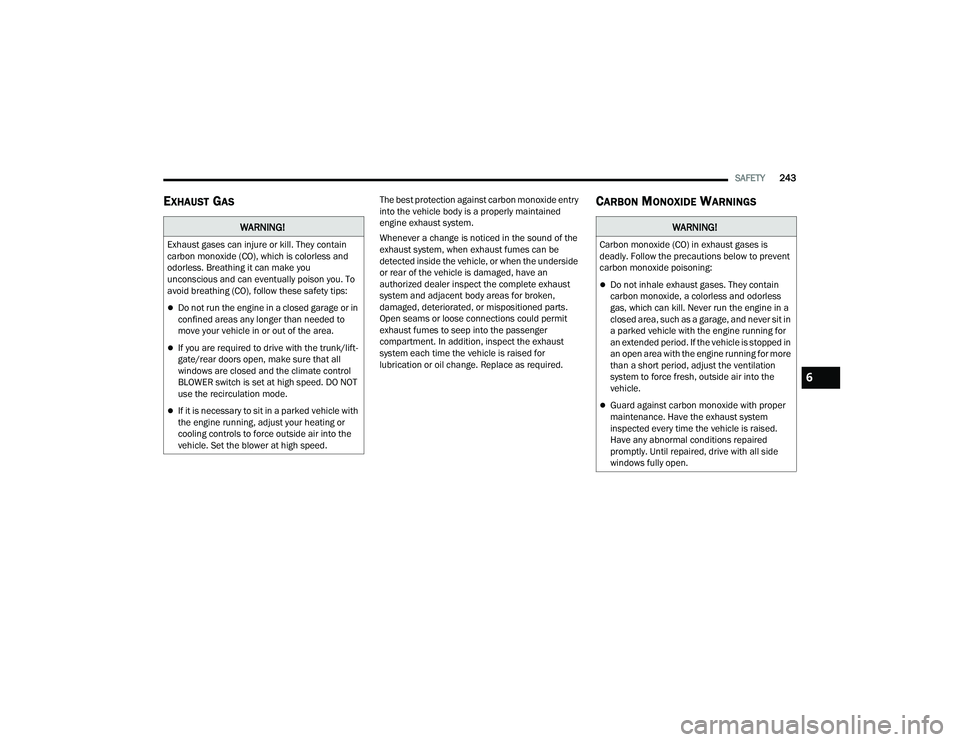
EXHAUST GAS The best protection against carbon monoxide entry
into the vehicle body is a properly maintained
engine exhaust system.
Whenever a change is noticed in the sound of the
exhaust system, when exhaust fumes can be
detected inside the vehicle, or when the underside
or rear of the vehicle is damaged, have an
authorized dealer inspect the complete exhaust
system and adjacent body areas for broken,
damaged, deteriorated, or mispositioned parts.
Open seams or loose connections could permit
exhaust fumes to seep into the passenger
compartment. In addition, inspect the exhaust
system each time the vehicle is raised for
lubrication or oil change. Replace as required.CARBON MONOXIDE WARNINGS
WARNING!
Exhaust gases can injure or kill. They contain
carbon monoxide (CO), which is colorless and
odorless. Breathing it can make you
unconscious and can eventually poison you. To
avoid breathing (CO), follow these safety tips:
Do not run the engine in a closed garage or in
confined areas any longer than needed to
move your vehicle in or out of the area.
If you are required to drive with the trunk/lift -
gate/rear doors open, make sure that all
windows are closed and the climate control
BLOWER switch is set at high speed. DO NOT
use the recirculation mode.
If it is necessary to sit in a parked vehicle with
the engine running, adjust your heating or
cooling controls to force outside air into the
vehicle. Set the blower at high speed.
WARNING!
Carbon monoxide (CO) in exhaust gases is
deadly. Follow the precautions below to prevent
carbon monoxide poisoning:
Do not inhale exhaust gases. They contain
carbon monoxide, a colorless and odorless
gas, which can kill. Never run the engine in a
closed area, such as a garage, and never sit in
a parked vehicle with the engine running for
an extended period. If the vehicle is stopped in
an open area with the engine running for more
than a short period, adjust the ventilation
system to force fresh, outside air into the
vehicle.
Guard against carbon monoxide with proper
maintenance. Have the exhaust system
inspected every time the vehicle is raised.
Have any abnormal conditions repaired
promptly. Until repaired, drive with all side
windows fully open.
6
22_MP_OM_EN_USC_t.book Page 243
Page 292 of 344
290SERVICING AND MAINTENANCE
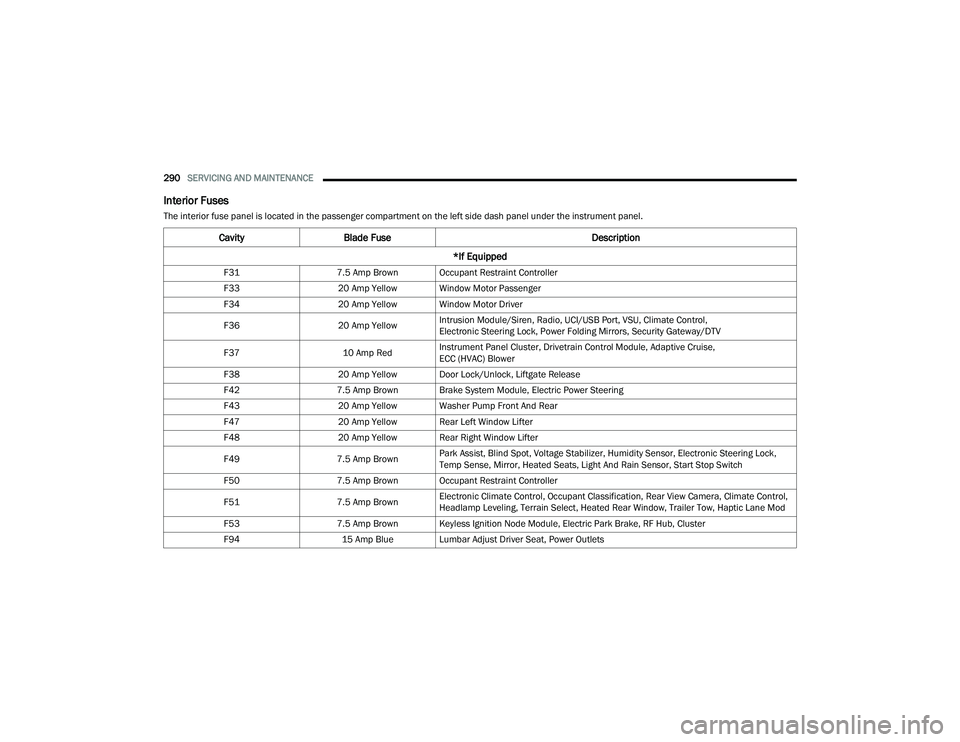
Interior Fuses
The interior fuse panel is located in the passenger compartment on the left side dash panel under the instrument panel.
CavityBlade Fuse Description
*If Equipped
F31 7.5 Amp Brown Occupant Restraint Controller
F33 20 Amp Yellow Window Motor Passenger
F34 20 Amp Yellow Window Motor Driver
F36 20 Amp YellowIntrusion Module/Siren, Radio, UCI/USB Port, VSU, Climate Control,
Electronic Steering Lock, Power Folding Mirrors, Security Gateway/DTV
F37 10 Amp RedInstrument Panel Cluster, Drivetrain Control Module, Adaptive Cruise,
ECC (HVAC) Blower
F38 20 Amp Yellow Door Lock/Unlock, Liftgate Release
F42 7.5 Amp Brown Brake System Module, Electric Power Steering
F43 20 Amp Yellow Washer Pump Front And Rear
F47 20 Amp Yellow Rear Left Window Lifter
F48 20 Amp Yellow Rear Right Window Lifter
F49 7.5 Amp BrownPark Assist, Blind Spot, Voltage Stabilizer, Humidity Sensor, Electronic Steering Lock,
Temp Sense, Mirror, Heated Seats, Light And Rain Sensor, Start Stop Switch
F50 7.5 Amp Brown Occupant Restraint Controller
F51 7.5 Amp BrownElectronic Climate Control, Occupant Classification, Rear View Camera, Climate Control,
Headlamp Leveling, Terrain Select, Heated Rear Window, Trailer Tow, Haptic Lane Mod
F53 7.5 Amp Brown Keyless Ignition Node Module, Electric Park Brake, RF Hub, Cluster
F94 15 Amp Blue Lumbar Adjust Driver Seat, Power Outlets
22_MP_OM_EN_USC_t.book Page 290
Page 316 of 344
314SERVICING AND MAINTENANCE
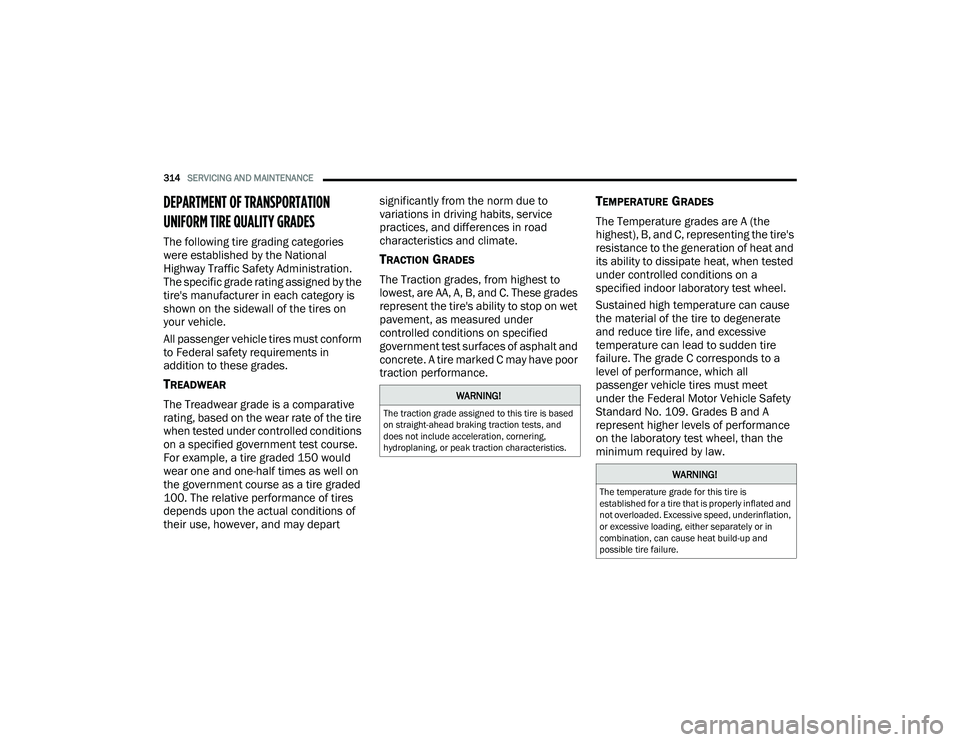
DEPARTMENT OF TRANSPORTATION
UNIFORM TIRE QUALITY GRADES
The following tire grading categories
were established by the National
Highway Traffic Safety Administration.
The specific grade rating assigned by the
tire's manufacturer in each category is
shown on the sidewall of the tires on
your vehicle.
All passenger vehicle tires must conform
to Federal safety requirements in
addition to these grades.
TREADWEAR
The Treadwear grade is a comparative
rating, based on the wear rate of the tire
when tested under controlled conditions
on a specified government test course.
For example, a tire graded 150 would
wear one and one-half times as well on
the government course as a tire graded
100. The relative performance of tires
depends upon the actual conditions of
their use, however, and may depart significantly from the norm due to
variations in driving habits, service
practices, and differences in road
characteristics and climate.
TRACTION GRADES
The Traction grades, from highest to
lowest, are AA, A, B, and C. These grades
represent the tire's ability to stop on wet
pavement, as measured under
controlled conditions on specified
government test surfaces of asphalt and
concrete. A tire marked C may have poor
traction performance.
TEMPERATURE GRADES
The Temperature grades are A (the
highest), B, and C, representing the tire's
resistance to the generation of heat and
its ability to dissipate heat, when tested
under controlled conditions on a
specified indoor laboratory test wheel.
Sustained high temperature can cause
the material of the tire to degenerate
and reduce tire life, and excessive
temperature can lead to sudden tire
failure. The grade C corresponds to a
level of performance, which all
passenger vehicle tires must meet
under the Federal Motor Vehicle Safety
Standard No. 109. Grades B and A
represent higher levels of performance
on the laboratory test wheel, than the
minimum required by law.
WARNING!
The traction grade assigned to this tire is based
on straight-ahead braking traction tests, and
does not include acceleration, cornering,
hydroplaning, or peak traction characteristics.
WARNING!
The temperature grade for this tire is
established for a tire that is properly inflated and
not overloaded. Excessive speed, underinflation,
or excessive loading, either separately or in
combination, can cause heat build-up and
possible tire failure.
22_MP_OM_EN_USC_t.book Page 314
Page 332 of 344
330 Brake System
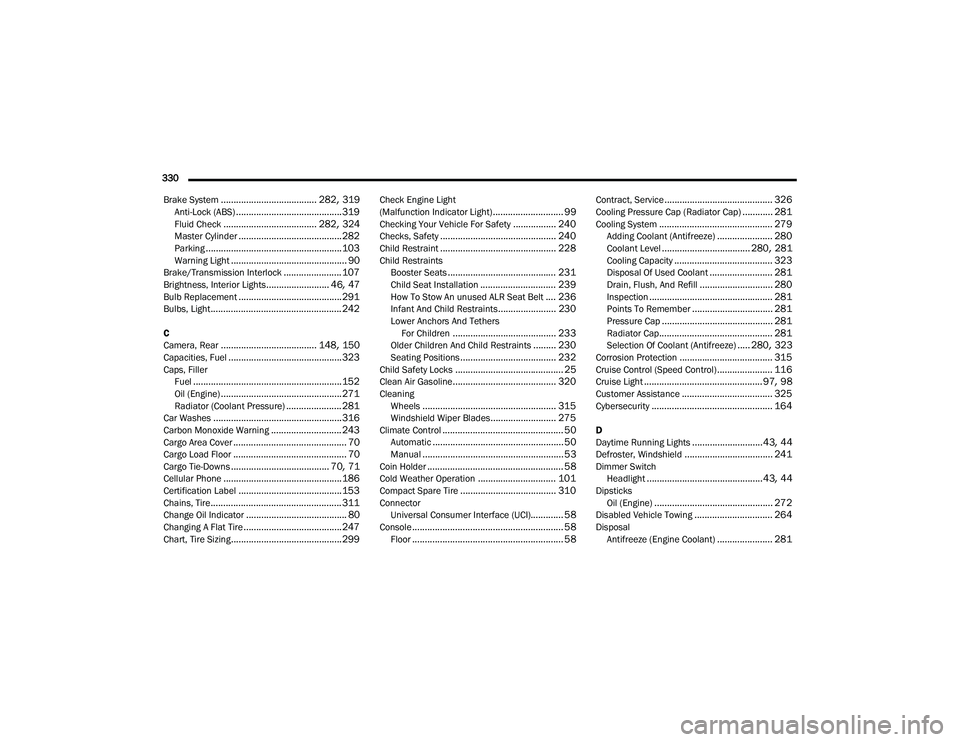
...................................... 282, 319Anti-Lock (ABS).......................................... 319Fluid Check..................................... 282, 324Master Cylinder......................................... 282Parking...................................................... 103Warning Light.............................................. 90Brake/Transmission Interlock....................... 107Brightness, Interior Lights......................... 46, 47Bulb Replacement......................................... 291Bulbs, Light.................................................... 242
C
Camera, Rear...................................... 148, 150Capacities, Fuel............................................. 323Caps, Filler Fuel........................................................... 152Oil (Engine)................................................ 271Radiator (Coolant Pressure)...................... 281Car Washes................................................... 316Carbon Monoxide Warning............................ 243Cargo Area Cover............................................. 70Cargo Load Floor............................................. 70Cargo Tie-Downs....................................... 70, 71Cellular Phone............................................... 186Certification Label......................................... 153Chains, Tire.................................................... 311Change Oil Indicator........................................ 80Changing A Flat Tire....................................... 247Chart, Tire Sizing............................................ 299
Check Engine Light
(Malfunction Indicator Light)............................ 99Checking Your Vehicle For Safety................. 240Checks, Safety.............................................. 240Child Restraint.............................................. 228Child RestraintsBooster Seats........................................... 231Child Seat Installation.............................. 239How To Stow An unused ALR Seat Belt.... 236Infant And Child Restraints....................... 230Lower Anchors And TethersFor Children......................................... 233Older Children And Child Restraints......... 230Seating Positions...................................... 232Child Safety Locks........................................... 25Clean Air Gasoline......................................... 320CleaningWheels..................................................... 315Windshield Wiper Blades.......................... 275Climate Control................................................ 50Automatic.................................................... 50Manual........................................................ 53Coin Holder...................................................... 58Cold Weather Operation............................... 101Compact Spare Tire...................................... 310ConnectorUniversal Consumer Interface (UCI)............. 58Console............................................................ 58Floor............................................................ 58
Contract, Service........................................... 326Cooling Pressure Cap (Radiator Cap)............ 281Cooling System............................................. 279Adding Coolant (Antifreeze)...................... 280Coolant Level................................... 280, 281Cooling Capacity....................................... 323Disposal Of Used Coolant......................... 281Drain, Flush, And Refill............................. 280Inspection................................................. 281Points To Remember................................ 281Pressure Cap............................................ 281Radiator Cap............................................. 281Selection Of Coolant (Antifreeze)..... 280, 323Corrosion Protection..................................... 315Cruise Control (Speed Control)...................... 116Cruise Light............................................... 97, 98Customer Assistance.................................... 325Cybersecurity................................................ 164
D
Daytime Running Lights............................43, 44Defroster, Windshield................................... 241Dimmer SwitchHeadlight..............................................43, 44DipsticksOil (Engine)............................................... 272Disabled Vehicle Towing............................... 264DisposalAntifreeze (Engine Coolant)...................... 281
22_MP_OM_EN_USC_t.book Page 330