lock JEEP COMPASS 2023 Manual Online
[x] Cancel search | Manufacturer: JEEP, Model Year: 2023, Model line: COMPASS, Model: JEEP COMPASS 2023Pages: 344, PDF Size: 18.8 MB
Page 244 of 344
242SAFETY
(Continued)
PERIODIC SAFETY CHECKS YOU SHOULD
M
AKE OUTSIDE THE VEHICLE
Tires
Examine tires for excessive tread wear and uneven
wear patterns. Check for stones, nails, glass, or
other objects lodged in the tread or sidewall.
Inspect the tread for cuts and cracks. Inspect
sidewalls for cuts, cracks, and bulges. Check the
lug nut/bolt torque for tightness. Check the tires
(including spare) for proper cold inflation pressure.
Lights
Have someone observe the operation of brake
lights and exterior lights while you work the
controls. Check turn signal and high beam
indicator lights on the instrument panel.
Door Latches
Check for proper closing, latching, and locking.
Fluid Leaks
Check area under the vehicle after overnight
parking for fuel, coolant, oil, or other fluid leaks.
Also, if gasoline fumes are detected or if fuel or
brake fluid leaks are suspected, the cause should
be located and corrected immediately.
ONLY use the driver’s side floor mat on the
driver’s side floor area. To check for interfer -
ence, with the vehicle properly parked with the
engine off, fully depress the accelerator, the
brake, and the clutch pedal (if present) to
check for interference. If your floor mat inter -
feres with the operation of any pedal, or is not
secure to the floor, remove the floor mat from
the vehicle and place the floor mat in your
trunk.
ONLY use the passenger’s side floor mat on
the passenger’s side floor area.
ALWAYS make sure objects cannot fall or slide
into the driver’s side floor area when the
vehicle is moving. Objects can become
trapped under accelerator, brake, or clutch
pedals and could cause a loss of vehicle
control.
WARNING!
NEVER place any objects under the floor mat
(e.g., towels, keys, etc.). These objects could
change the position of the floor mat and may
cause interference with the accelerator,
brake, or clutch pedals.
If the vehicle carpet has been removed and
re-installed, always properly attach carpet to
the floor and check the floor mat fasteners are
secure to the vehicle carpet. Fully depress
each pedal to check for interference with the
accelerator, brake, or clutch pedals then
re-install the floor mats.
It is recommended to only use mild soap and
water to clean your floor mats. After cleaning,
always check your floor mat has been properly
installed and is secured to your vehicle using
the floor mat fasteners by lightly pulling mat.
WARNING!
22_MP_OM_EN_USC_t.book Page 242
Page 250 of 344
248IN CASE OF EMERGENCY
PREPARATIONS FOR JACKING
1. Park the vehicle on a firm level surface as far
from the edge of the roadway as possible.
Avoid icy or slippery areas.
2. Turn on the Hazard Warning Flashers.
3. Apply the parking brake.
4. Place the ignition in the OFF position. 5. Block both the front and rear of the wheel
diagonally opposite the jacking position. For
example, if the driver’s front wheel is being
changed, block the passenger’s rear wheel.
Wheel Blocked
NOTE:Passengers should not remain in the vehicle when
the vehicle is being lifted or raised.
JACK LOCATION/SPARE TIRE STOWAGE
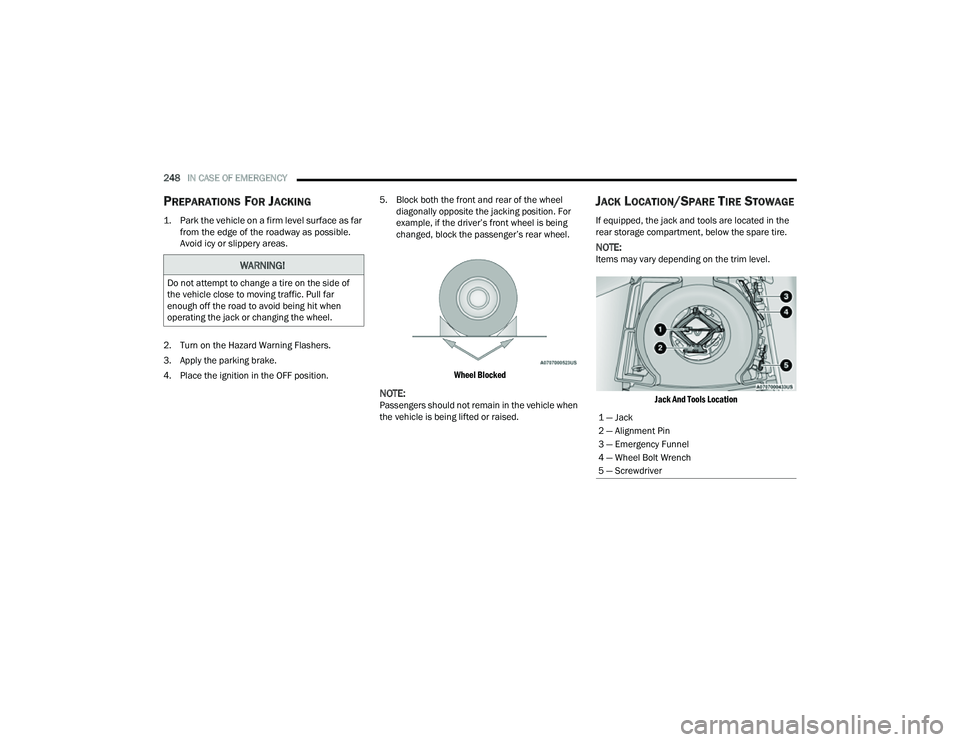
If equipped, the jack and tools are located in the
rear storage compartment, below the spare tire.
NOTE:Items may vary depending on the trim level.
Jack And Tools Location
WARNING!
Do not attempt to change a tire on the side of
the vehicle close to moving traffic. Pull far
enough off the road to avoid being hit when
operating the jack or changing the wheel.
1 — Jack
2 — Alignment Pin
3 — Emergency Funnel
4 — Wheel Bolt Wrench
5 — Screwdriver
22_MP_OM_EN_USC_t.book Page 248
Page 251 of 344
IN CASE OF EMERGENCY249
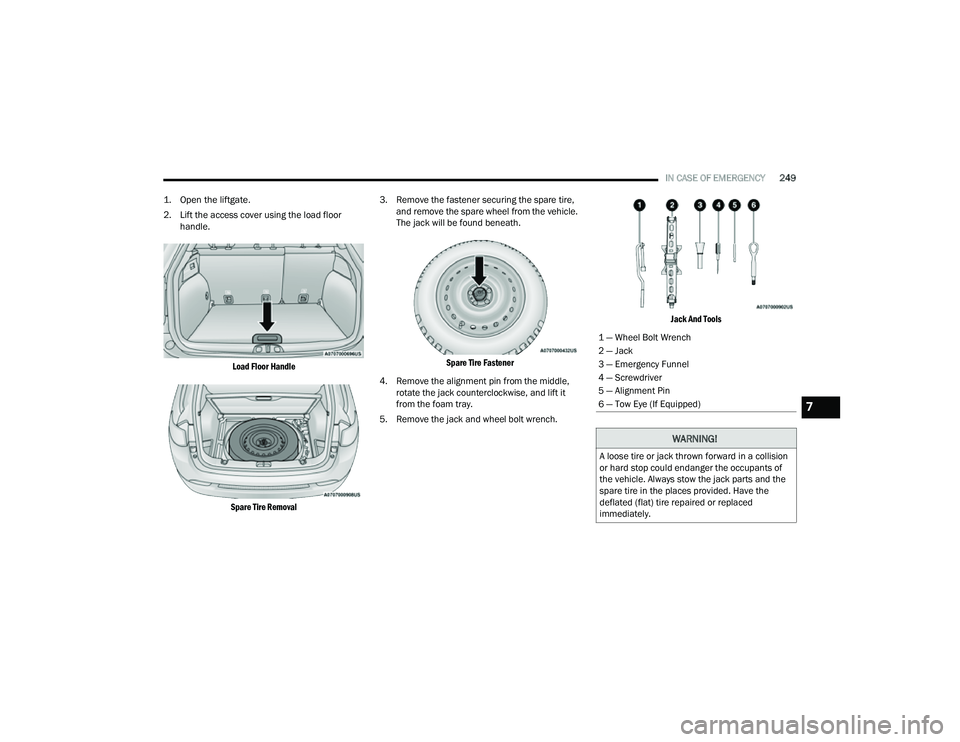
1. Open the liftgate.
2. Lift the access cover using the load floor handle.
Load Floor Handle
Spare Tire Removal
3. Remove the fastener securing the spare tire,
and remove the spare wheel from the vehicle.
The jack will be found beneath.
Spare Tire Fastener
4. Remove the alignment pin from the middle, rotate the jack counterclockwise, and lift it
from the foam tray.
5. Remove the jack and wheel bolt wrench.
Jack And Tools
1 — Wheel Bolt Wrench
2 — Jack
3 — Emergency Funnel
4 — Screwdriver
5 — Alignment Pin
6 — Tow Eye (If Equipped)
WARNING!
A loose tire or jack thrown forward in a collision
or hard stop could endanger the occupants of
the vehicle. Always stow the jack parts and the
spare tire in the places provided. Have the
deflated (flat) tire repaired or replaced
immediately.
7
22_MP_OM_EN_USC_t.book Page 249
Page 252 of 344
250IN CASE OF EMERGENCY
(Continued)
JACKING INSTRUCTIONS
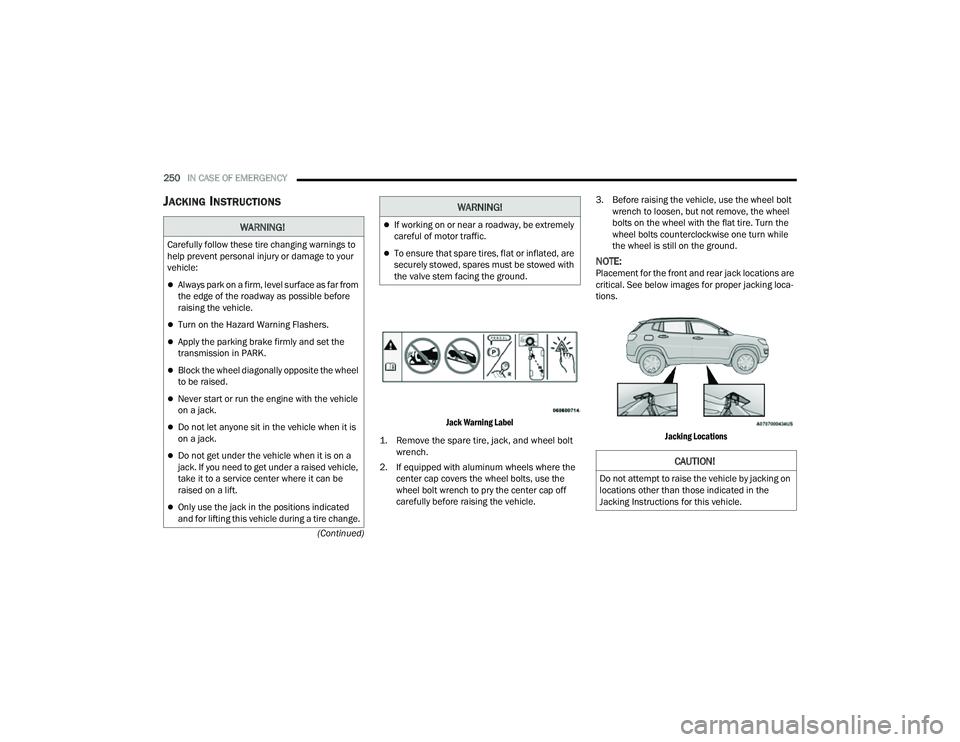
Jack Warning Label
1. Remove the spare tire, jack, and wheel bolt wrench.
2. If equipped with aluminum wheels where the center cap covers the wheel bolts, use the
wheel bolt wrench to pry the center cap off
carefully before raising the vehicle. 3. Before raising the vehicle, use the wheel bolt
wrench to loosen, but not remove, the wheel
bolts on the wheel with the flat tire. Turn the
wheel bolts counterclockwise one turn while
the wheel is still on the ground.
NOTE:Placement for the front and rear jack locations are
critical. See below images for proper jacking loca -
tions.
Jacking Locations
WARNING!
Carefully follow these tire changing warnings to
help prevent personal injury or damage to your
vehicle:
Always park on a firm, level surface as far from
the edge of the roadway as possible before
raising the vehicle.
Turn on the Hazard Warning Flashers.
Apply the parking brake firmly and set the
transmission in PARK.
Block the wheel diagonally opposite the wheel
to be raised.
Never start or run the engine with the vehicle
on a jack.
Do not let anyone sit in the vehicle when it is
on a jack.
Do not get under the vehicle when it is on a
jack. If you need to get under a raised vehicle,
take it to a service center where it can be
raised on a lift.
Only use the jack in the positions indicated
and for lifting this vehicle during a tire change.
If working on or near a roadway, be extremely
careful of motor traffic.
To ensure that spare tires, flat or inflated, are
securely stowed, spares must be stowed with
the valve stem facing the ground.
WARNING!
CAUTION!
Do not attempt to raise the vehicle by jacking on
locations other than those indicated in the
Jacking Instructions for this vehicle.
22_MP_OM_EN_USC_t.book Page 250
Page 253 of 344
IN CASE OF EMERGENCY251
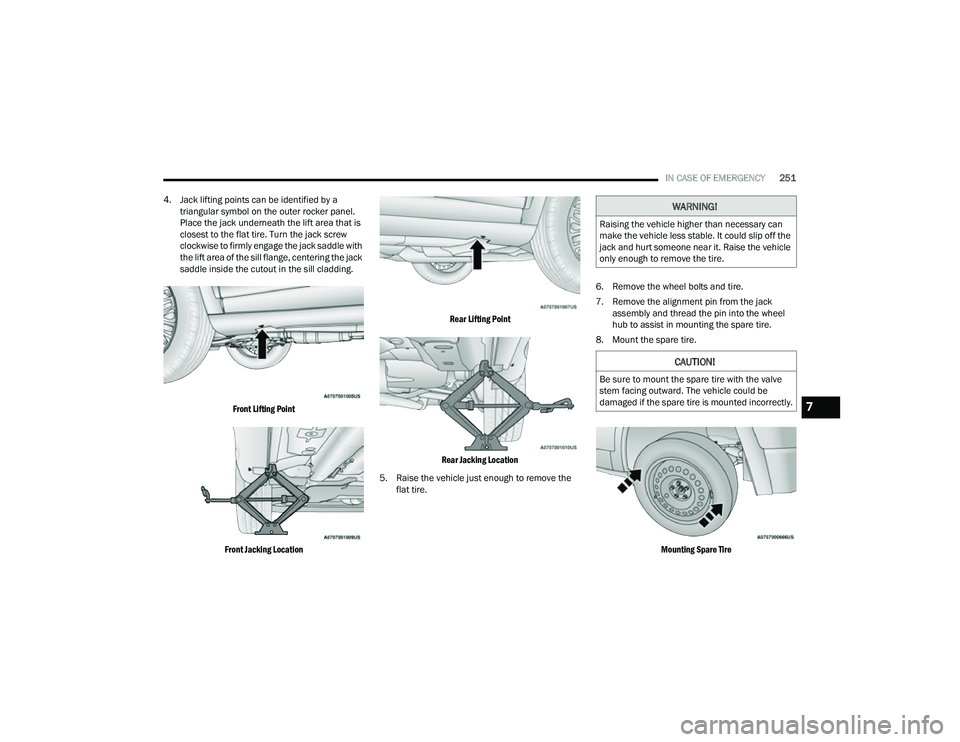
4. Jack lifting points can be identified by a triangular symbol on the outer rocker panel.
Place the jack underneath the lift area that is
closest to the flat tire. Turn the jack screw
clockwise to firmly engage the jack saddle with
the lift area of the sill flange, centering the jack
saddle inside the cutout in the sill cladding.
Front Lifting Point
Front Jacking Location Rear Lifting Point
Rear Jacking Location
5. Raise the vehicle just enough to remove the flat tire. 6. Remove the wheel bolts and tire.
7. Remove the alignment pin from the jack
assembly and thread the pin into the wheel
hub to assist in mounting the spare tire.
8. Mount the spare tire.
Mounting Spare Tire
WARNING!
Raising the vehicle higher than necessary can
make the vehicle less stable. It could slip off the
jack and hurt someone near it. Raise the vehicle
only enough to remove the tire.
CAUTION!
Be sure to mount the spare tire with the valve
stem facing outward. The vehicle could be
damaged if the spare tire is mounted incorrectly.
7
22_MP_OM_EN_USC_t.book Page 251
Page 254 of 344
252IN CASE OF EMERGENCY
NOTE:
For vehicles equipped, do not attempt to
install a center cap or wheel cover on the
compact spare.
For additional warnings, cautions, and infor -
mation about the spare tire, its use, and
operation Ú page 298.
9. Install and lightly tighten the wheel bolts.
10. Lower the vehicle to the ground by turning the jack handle counterclockwise.
11. Finish tightening the wheel bolts. Push down on the wrench while at the end of the handle
for increased leverage. Tighten the wheel bolts
in a star pattern until each wheel bolt has been
tightened twice Úpage 319. If in doubt about
the correct tightness, have them checked with
a torque wrench by an authorized dealer or at
a service station. 12. Lower the jack until it is free. Remove the
wheel blocks. Reassemble the lug wrench to
the jack assembly and stow it in the spare tire
area. Secure the assembly using the means
provided. Release the parking brake before
driving the vehicle.
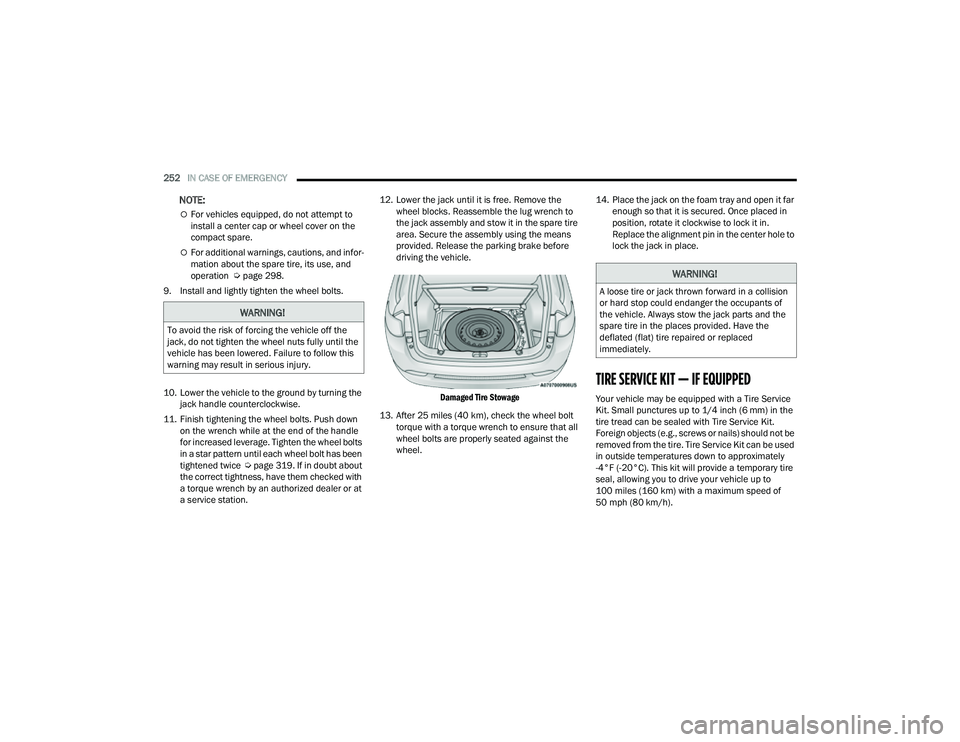
Damaged Tire Stowage
13. After 25 miles (40 km), check the wheel bolt torque with a torque wrench to ensure that all
wheel bolts are properly seated against the
wheel. 14. Place the jack on the foam tray and open it far
enough so that it is secured. Once placed in
position, rotate it clockwise to lock it in.
Replace the alignment pin in the center hole to
lock the jack in place.
TIRE SERVICE KIT — IF EQUIPPED
Your vehicle may be equipped with a Tire Service
Kit. Small punctures up to 1/4 inch (6 mm) in the
tire tread can be sealed with Tire Service Kit.
Foreign objects (e.g., screws or nails) should not be
removed from the tire. Tire Service Kit can be used
in outside temperatures down to approximately
-4°F (-20°C). This kit will provide a temporary tire
seal, allowing you to drive your vehicle up to
100 miles (160 km) with a maximum speed of
50 mph (80 km/h).
WARNING!
To avoid the risk of forcing the vehicle off the
jack, do not tighten the wheel nuts fully until the
vehicle has been lowered. Failure to follow this
warning may result in serious injury.
WARNING!
A loose tire or jack thrown forward in a collision
or hard stop could endanger the occupants of
the vehicle. Always stow the jack parts and the
spare tire in the places provided. Have the
deflated (flat) tire repaired or replaced
immediately.
22_MP_OM_EN_USC_t.book Page 252
Page 264 of 344
262IN CASE OF EMERGENCY
GEAR SELECTOR OVERRIDE
If a malfunction occurs, and the gear selector
cannot be moved out of the PARK position, you can
use the following procedure to temporarily move
the gear selector:
1. Turn the engine OFF.
2. Apply the parking brake.
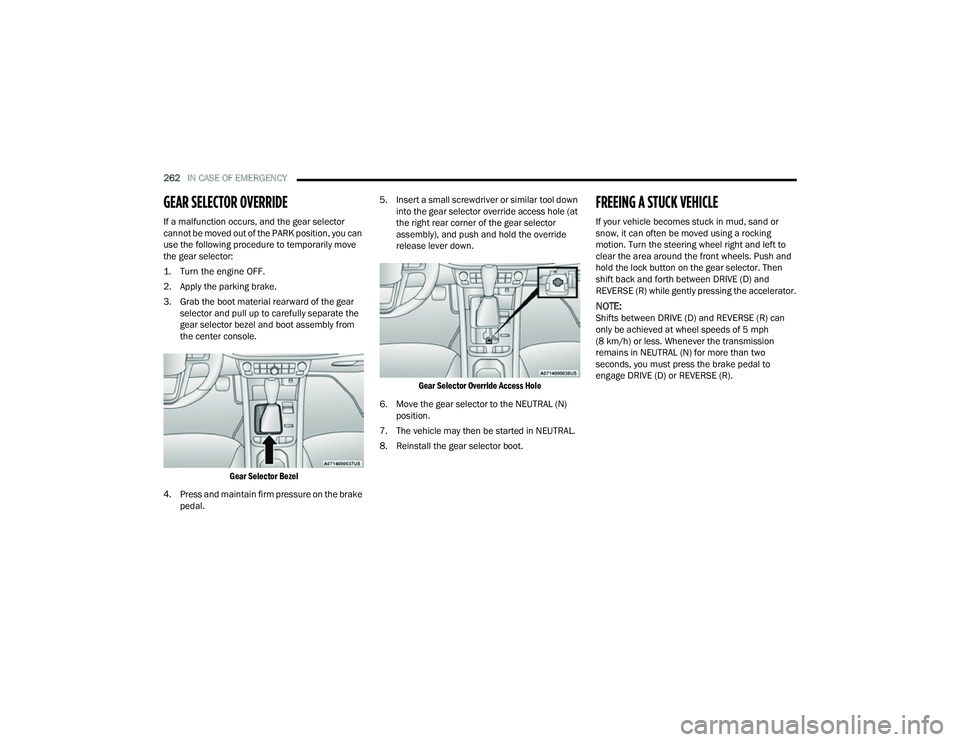
3. Grab the boot material rearward of the gear
selector and pull up to carefully separate the
gear selector bezel and boot assembly from
the center console.
Gear Selector Bezel
4. Press and maintain firm pressure on the brake pedal. 5. Insert a small screwdriver or similar tool down
into the gear selector override access hole (at
the right rear corner of the gear selector
assembly), and push and hold the override
release lever down.
Gear Selector Override Access Hole
6. Move the gear selector to the NEUTRAL (N) position.
7. The vehicle may then be started in NEUTRAL.
8. Reinstall the gear selector boot.
FREEING A STUCK VEHICLE
If your vehicle becomes stuck in mud, sand or
snow, it can often be moved using a rocking
motion. Turn the steering wheel right and left to
clear the area around the front wheels. Push and
hold the lock button on the gear selector. Then
shift back and forth between DRIVE (D) and
REVERSE (R) while gently pressing the accelerator.
NOTE:Shifts between DRIVE (D) and REVERSE (R) can
only be achieved at wheel speeds of 5 mph
(8 km/h) or less. Whenever the transmission
remains in NEUTRAL (N) for more than two
seconds, you must press the brake pedal to
engage DRIVE (D) or REVERSE (R).
22_MP_OM_EN_USC_t.book Page 262
Page 277 of 344
SERVICING AND MAINTENANCE275
Refrigerant Recovery And Recycling
R-134a — If Equipped
R-134a Air Conditioning Refrigerant is a Hydrofluo -
rocarbon (HFC) that is an ozone-friendly
substance. It is recommended that air conditioning
service be performed by an authorized dealer or
other service facilities using recovery and recycling
equipment.
NOTE:Use only the manufacturer approved A/C system
PAG compressor oil and refrigerants.
Refrigerant Recovery And Recycling
R-1234yf — If Equipped
R-1234yf Air Conditioning Refrigerant is a
Hydrofluoroolefin (HFO) that is endorsed by the
Environmental Protection Agency and is an
ozone-friendly substance with a low
global-warming potential. It is recommended that
air conditioning service be performed by an
authorized dealer using recovery and recycling
equipment.
NOTE:Use only the manufacturer approved A/C system
PAG compressor oil, and refrigerants.
Cabin Air Filter
See an authorized dealer for service.
BODY LUBRICATION
Locks and all body pivot points, including such
items as seat tracks, door hinge pivot points and
rollers, liftgate, tailgate, decklid, sliding doors and
hood hinges, should be lubricated periodically with
a lithium-based grease, such as Mopar® Spray
White Lube to ensure quiet, easy operation and to
protect against rust and wear. Prior to the
application of any lubricant, the parts concerned
should be wiped clean to remove dust and grit;
after lubricating, excess oil and grease should be
removed. Particular attention should also be given
to hood latching components to ensure proper
function. When performing other underhood
services, the hood latch, release mechanism and
safety catch should be cleaned and lubricated.
The external lock cylinders should be lubricated
twice a year, preferably in the Autumn and Spring.
Apply a small amount of a high quality lubricant,
such as Mopar® Lock Cylinder Lubricant directly
into the lock cylinder.
WIPER BLADES
Clean the rubber edges of the wiper blades and the
windshield and rear window periodically with a
sponge or soft cloth and a mild nonabrasive
cleaner. This will remove accumulations of salt,
waxes, or road film, and help reduce streaking and
smearing.
Operation of the wipers on dry glass for long
periods may cause deterioration of the wiper
blades. Always use washer fluid when using the
wipers to remove salt or dirt from a dry windshield
or rear window.
Avoid using the wiper blades to remove frost or ice
from the windshield or rear window. Make sure
that they are not frozen to the glass before turning
them on to avoid damaging the blade. Keep the
wiper blade out of contact with petroleum products
such as engine oil, gasoline, etc.
NOTE:Life expectancy of wiper blades varies depending
on geographical area and frequency of use. If chat -
tering, marks, water lines or wet spots are present,
clean the wiper blades or replace as necessary.8
22_MP_OM_EN_USC_t.book Page 275
Page 278 of 344
276SERVICING AND MAINTENANCE
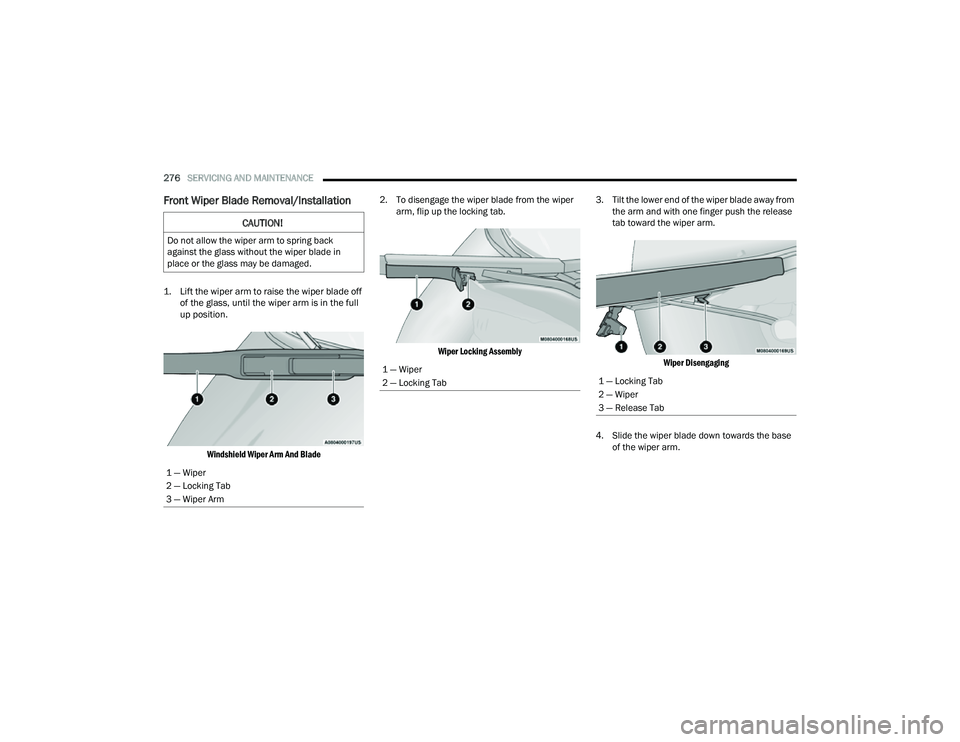
Front Wiper Blade Removal/Installation
1. Lift the wiper arm to raise the wiper blade off
of the glass, until the wiper arm is in the full
up position.
Windshield Wiper Arm And Blade
2. To disengage the wiper blade from the wiper
arm, flip up the locking tab.
Wiper Locking Assembly
3. Tilt the lower end of the wiper blade away from
the arm and with one finger push the release
tab toward the wiper arm.
Wiper Disengaging
4. Slide the wiper blade down towards the base of the wiper arm.
CAUTION!
Do not allow the wiper arm to spring back
against the glass without the wiper blade in
place or the glass may be damaged.
1 — Wiper
2 — Locking Tab
3 — Wiper Arm
1 — Wiper
2 — Locking Tab1 — Locking Tab
2 — Wiper
3 — Release Tab
22_MP_OM_EN_USC_t.book Page 276
Page 279 of 344
SERVICING AND MAINTENANCE277
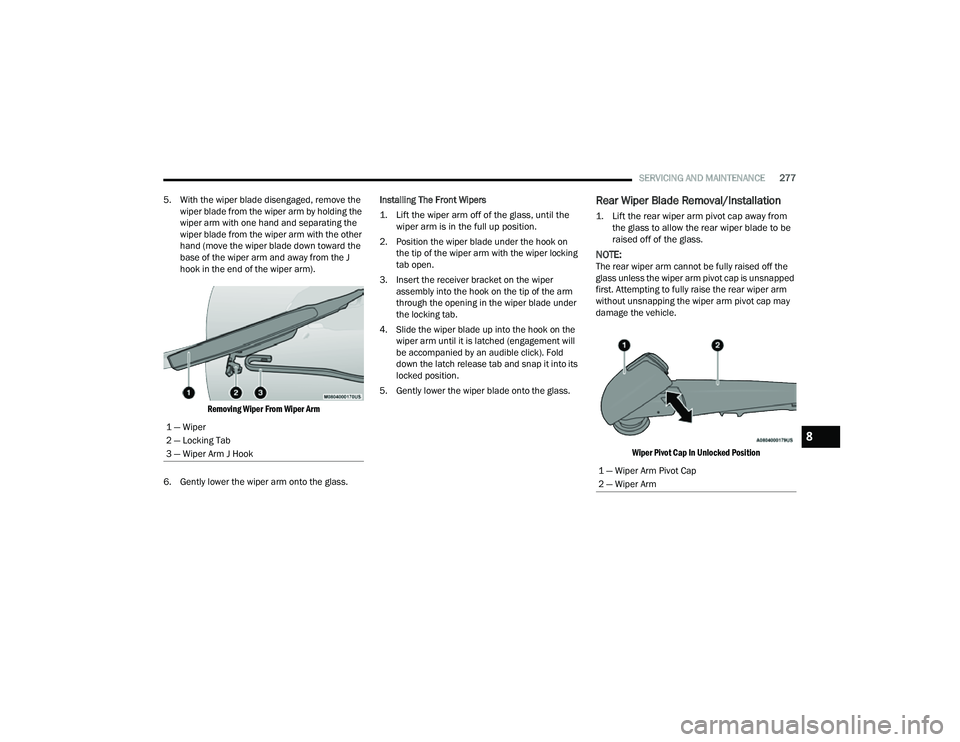
5. With the wiper blade disengaged, remove the wiper blade from the wiper arm by holding the
wiper arm with one hand and separating the
wiper blade from the wiper arm with the other
hand (move the wiper blade down toward the
base of the wiper arm and away from the J
hook in the end of the wiper arm).
Removing Wiper From Wiper Arm
6. Gently lower the wiper arm onto the glass. Installing The Front Wipers
1. Lift the wiper arm off of the glass, until the
wiper arm is in the full up position.
2. Position the wiper blade under the hook on the tip of the wiper arm with the wiper locking
tab open.
3. Insert the receiver bracket on the wiper assembly into the hook on the tip of the arm
through the opening in the wiper blade under
the locking tab.
4. Slide the wiper blade up into the hook on the wiper arm until it is latched (engagement will
be accompanied by an audible click). Fold
down the latch release tab and snap it into its
locked position.
5. Gently lower the wiper blade onto the glass.
Rear Wiper Blade Removal/Installation
1. Lift the rear wiper arm pivot cap away from the glass to allow the rear wiper blade to be
raised off of the glass.
NOTE:The rear wiper arm cannot be fully raised off the
glass unless the wiper arm pivot cap is unsnapped
first. Attempting to fully raise the rear wiper arm
without unsnapping the wiper arm pivot cap may
damage the vehicle.
Wiper Pivot Cap In Unlocked Position
1 — Wiper
2 — Locking Tab
3 — Wiper Arm J Hook
1 — Wiper Arm Pivot Cap
2 — Wiper Arm
8
22_MP_OM_EN_USC_t.book Page 277