light JEEP DJ 1953 Service Manual
[x] Cancel search | Manufacturer: JEEP, Model Year: 1953, Model line: DJ, Model: JEEP DJ 1953Pages: 376, PDF Size: 19.96 MB
Page 224 of 376
H
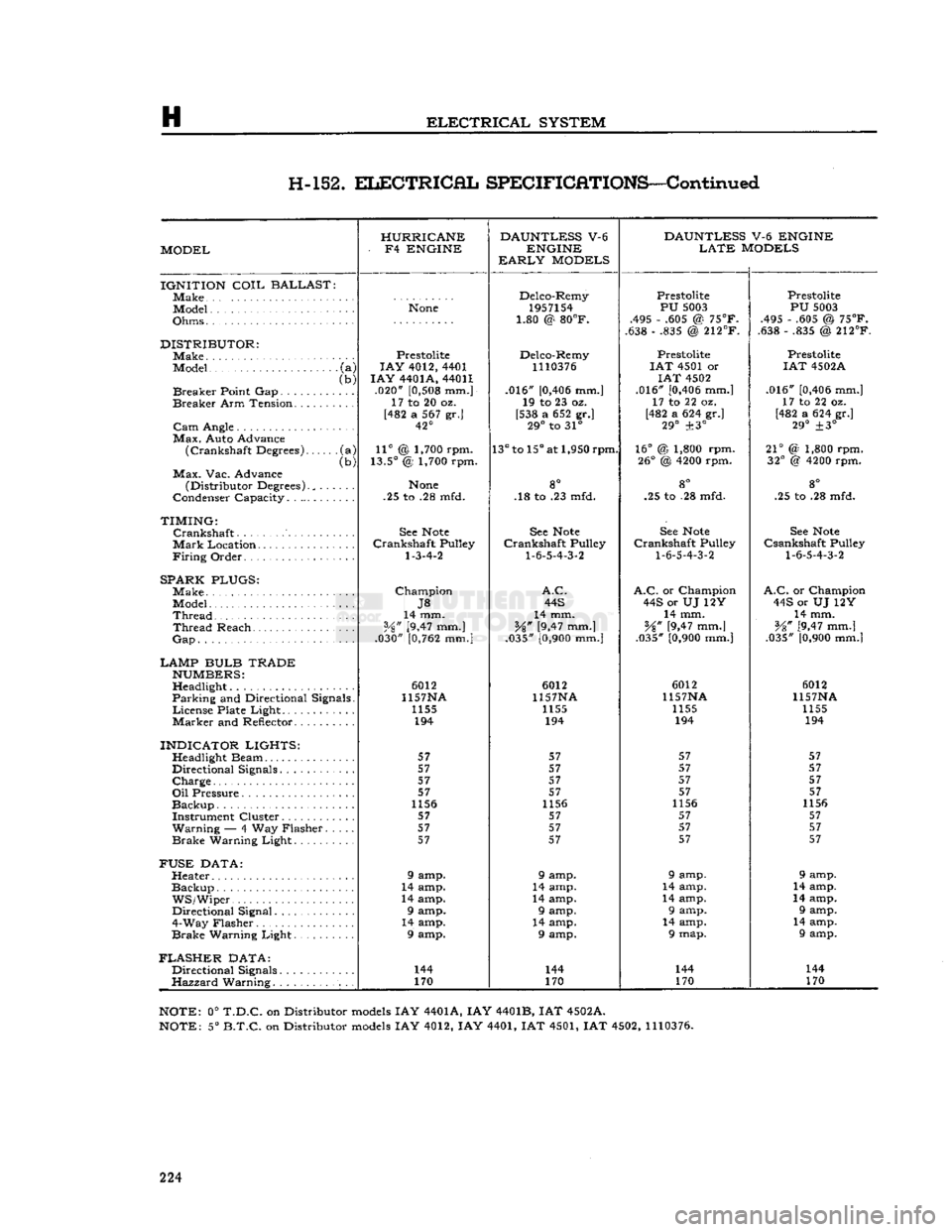
ELECTRICAL
SYSTEM
H-152.
ELECTRICAL
SPECIFICATIONS—Continued
HURRICANE DAUNTLESS
V-6
DAUNTLESS
V-6 ENGINE
MODEL -
F4
ENGINE
ENGINE
LATE
MODELS
EARLY
MODELS
IGNITION
COIL
BALLAST
]Make Delco-Remy
Prestolite Prestolite
Model
None
1957154
PU
5003
PU
5003
Ohms • • 1.80 @
80°F.
.495 - .605 @
75°F.
.495 - .605 @
75°F.
1.80 @
80°F.
.638 - .835 @
212°F.
.638 - .835 @
212°F.
DISTRIBUTOR:
Prestolite Delco-Remy Prestolite Prestolite
Model
•
(a)
LAY
4012, 4401
1110376
I
AT
4501 or
IAT
4502A
(b)
I
AY
4401A, 44011
IAT
4502
Breaker
Point Gap (b)
.020"
[0,508
mm.] .016"
[0,406
mm.] .016"
[0,406
mm.]
.016"
[0,406
mm.]
Breaker
Arm Tension. ..... 17 to 20 oz.
19 to 23 oz. 17 to 22 oz. 17 to 22 oz.
[482 a 567 gr.] [538 a 652 gr.] [482 a 624 gr.]
[482 a 624 gr.]
42° 29°
to 31°
29°
±3°
29°
±3°
Max.
Auto Advance
(Crankshaft
Degrees) •(a)
11°
@ 1,700 rpm.
13°
to
15°
at 1,950 rpm.
16°
@ 1,800 rpm.
21°
(2 1,800 rpm.
(Crankshaft
Degrees)
(b)
13.5°
@ 1,700 rpm.
26°
@
4200
rpm.
32°
@
4200
rpm.
Max.
Vac. Advance go
(Distributor Degrees)., . .
None
8° 8°
go
Condenser Capacity. . .25 to .28 mfd. .18 to .23 mfd. .25 to .28 mfd. .25 to .28 mfd.
TIMING:
Crankshaft
See
Note
See
Note
See
Note
See
Note
Mark
Location............
Crankshaft
Pulley
Crankshaft
Pulley
Crankshaft
Pulley
Csankshaft
Pulley
Firing
Order
1-3-4-2
1-6-5-4-3-2
1-6-5-4-3-2 1-6-5-4-3-2
SPARK PLUGS:
Make
Champion
A.C. A.C.
or Champion
A.C.
or Champion
J8
44S
44S or UJ 12Y 44S or UJ 12Y
Thread
14 mm.
14 mm. 14 mm. 14 mm.
Thread
Reach
Vz"
[9,47 mm.]
%"
[9,47 mm.]
¥%"
[9,47 mm.]
V8" [9,47 mm.]
Gap
.030"
[0,762
mm.]
.035"
[0,900
mm.] .035"
[0,900
mm.] .035"
[0,900
mm.|
LAMP BULB TRADE
NUMBERS:
Headlight 6012
6012 6012 6012
Parking
and Directional Signals. 1157NA
1157NA 1157NA 1157NA
License
Plate Light........ 1155
1155 1155 1155
Marker
and Reflector 194
194 194 194
INDICATOR LIGHTS:
57 57 57 57
Directional Signals........ 57
57 57 57
Charge
57
57 57 57
57 57 57 57
1156 1156 1156 1156
Instrument Cluster 57 57 57 57
Warning
— 4 Way Flasher. . 57
57 57 57
Brake
Warning Light 57
57 57 57
FUSE
DATA:
Heater 9 amp. 9 amp. 9 amp. 9 amp.
Backup
14 amp. 14 amp. 14 amp. 14 amp.
WS/Wiper.
14 amp. 14 amp. 14 amp. 14 amp.
Directional Signal 9 amp. 9 amp. 9 amp. 9 amp.
4-Way Flasher 14 amp. 14 amp. 14 amp. 14 amp.
Brake
Warning Light 9 amp. 9 amp. 9 map. 9 amp.
FLASHER
DATA:
Directional Signals. 144
144 144 144
Hazzard
Warning. 170
170 170 170
NOTE:
0°
T.D.C.
on Distributor
models
IAY 4401A, IAY 4401B, IAT 4502A.
NOTE:
5°
B.T.C.
on Distributor
models
IAY 4012, IAY 4401, IAT 4501, IAT 4502,
1110376.
224
Page 229 of 376
'Jeep'
UNIVERSAL
SERIES SERVICE
MANUAL
I
Note:
The clutch release bearing is lubricated at
time of assembly and no attempt should be made
to lubricate it Refer to Fig. 1-23 when lubricating
the clutch throwout bearing collar. c. Reassembly
To
assemble the clutch to the flywheel, first put
a
small amount of light cup grease in the flywheel
pilot bushing, install the driven plate, with short
end of hub toward the flywheel, then place the pressure plate assembly in position.
With
a clutch
plate aligning arbor or a spare transmission main
shaft, align the driven plate splines leaving the
arbor
in position while tightening the pressure plate
screws evenly.
Next, assemble the flywheel housing to the
engine
and
reinstall the transmission and transfer case or
install
the
engine
in the vehicle, depending on the
procedure of removal. Make sure that the clutch
release bearing
carrier
return spring is hooked in place. For the remainder of the assembly reverse
the operations that were used in removing the
transmission and transfer case or the
engine
referring
to the instructions given in Section J for the transmission and Section D and Dl for the
engine.
d.
Adjust the clutch control cable so there is 3A" [19,05 mm.] free pedal travel. (Refer to Par. 1-3)
1-10.
CLUTCH
—
DAUNTLESS
V-6
ENGINE
•
Diaphragm Spring Type
(Early
Models)
*
Jeep' vehicles equipped with a Dauntless V-6 en
gine
use a 10.4" [26,4 cm.] single-plate, dry-disc
clutch,
incorporating a diaphragm-type spring as
sembly.
When
the clutch pedal is depressed, it
moves
the
clutch
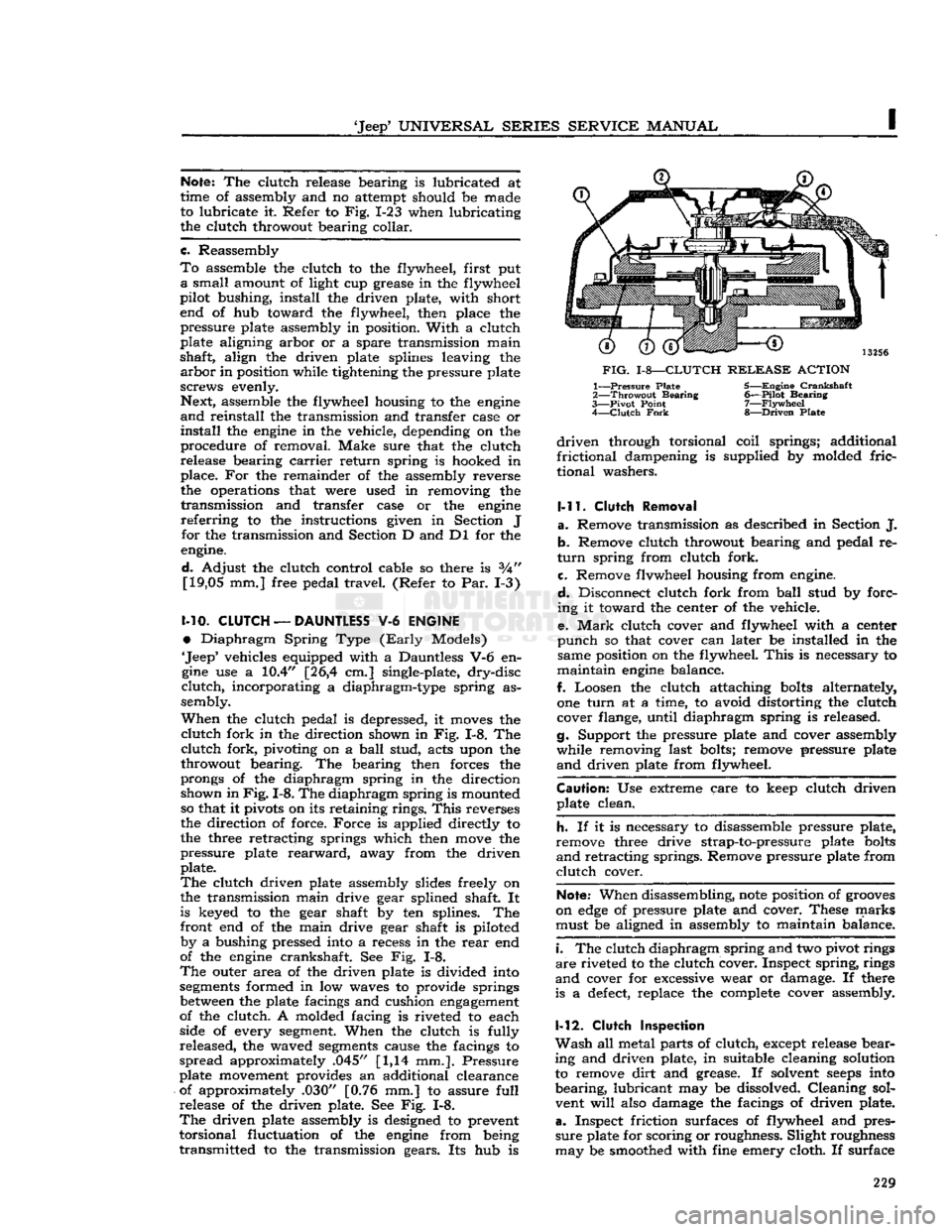
fork in the direction shown in Fig. 1-8. The
clutch
fork, pivoting on a
ball
stud, acts upon the
throwout bearing. The bearing then forces the
prongs of the diaphragm spring in the direction shown in
Fig.
1-8. The diaphragm spring is mounted
so that it pivots on its retaining rings.
This
reverses
the direction of force.
Force
is applied directly to
the three retracting springs which then
move
the
pressure plate
rearward,
away from the driven plate.
The
clutch driven plate assembly slides freely on
the transmission main drive gear splined shaft. It is keyed to the gear shaft by ten splines. The
front end of the main drive gear shaft is piloted by a bushing pressed into a recess in the
rear
end
of the
engine
crankshaft. See Fig. 1-8.
The
outer area of the driven plate is divided into
segments
formed in low waves to provide springs
between
the plate facings and cushion
engagement
of the clutch. A molded facing is riveted to each
side of every
segment.
When the clutch is fully
released, the waved
segments
cause the facings to
spread
approximately .045" [1,14 mm.]. Pressure
plate movement provides an additional clearance
of approximately .030" [0.76 mm.] to assure
full
release of the driven plate. See Fig. 1-8.
The
driven plate assembly is designed to prevent
torsional fluctuation of the
engine
from being
transmitted to the transmission gears. Its hub is
FIG.
1-8—CLUTCH
RELEASE
ACTION
1—
Pressure
Plate 5—Engine
Crankshaft
2—
Throwout
Bearing
6—Pilot
Bearing
3—
Pivot
Point
7—Flywheel
4—
Clutch
Fork
8—Driven
Plate
driven
through torsional coil springs; additional
frictional
dampening is supplied by molded
fric-
tional washers.
1-11.
Clutch
Removal
a.
Remove transmission as described in Section J. b. Remove clutch throwout bearing and pedal re
turn
spring from clutch fork.
c. Remove flvwheel housing from engine.
d.
Disconnect clutch fork from
ball
stud by forc
ing it toward the center of the vehicle.
e.
Mark
clutch cover and flywheel with a center
punch
so that cover can later be installed in the same position on the flywheel.
This
is necessary to
maintain
engine
balance.
f. Loosen the clutch attaching
bolts
alternately,
one
turn
at a time, to avoid distorting the clutch
cover flange, until diaphragm spring is released.
g. Support the pressure plate and cover assembly
while removing last bolts; remove pressure plate
and
driven plate from flywheel.
Caution:
Use extreme care to keep clutch driven plate clean.
h.
If it is necessary to disassemble pressure plate,
remove three drive strap-to-pressure plate
bolts
and
retracting springs. Remove pressure plate from
clutch
cover.
Note:
When disassembling,
note
position of
grooves
on
edge
of pressure plate and cover. These marks must be aligned in assembly to maintain balance.
i.
The clutch diaphragm spring and two pivot rings
are
riveted to the clutch cover. Inspect spring, rings
and
cover for excessive wear or damage. If there
is a
defect,
replace the complete cover assembly.
1-12.
Clutch
inspection
Wash
all metal parts of clutch, except release bear
ing and driven plate, in suitable cleaning solution to remove
dirt
and grease. If solvent
seeps
into
bearing,
lubricant may be dissolved. Cleaning sol
vent
will
also damage the facings of driven plate,
a.
Inspect friction surfaces of flywheel and pres
sure
plate for scoring or roughness. Slight roughness
may be smoothed with fine emery cloth. If surface 229
Page 230 of 376
CLUTCH
is deeply scored or grooved, the part should be
replaced.
b. Inspect driven plate for wear or damage to fac
ings,
loose
rivets, broken or
loose
torsion springs,
and
flattened cushion springs. If facings are worn
near
rivets or are oily, replace the plate assembly.
A
slight amount of oil on clutch facings
will
cause
clutch
grab and chatter; excessive oil on facings
will
cause slippage. It is not practical to remove
oil
with solvents or by buffing since oil
will
con
tinue to bleed from facing material when hot. If
oil
is found on driven plate facings, examine trans
mission drainback hole, pilot bushing,
engine
rear
main
bearing and other points of possible oil leakage. Test the fit of driven plate hub on trans
mission main drive gear for an easy sliding fit.
c. Inspect clutch release bearing for scoring or ex cessive wear on front contact face. Test for rough
ness
of balls and races by pressing and turning
front race slowly. Inspect main drive gear pilot
bushing in crankshaft. Replace bushing if it is rough or worn. Regardless of whether the old plate
or
a new plate is to be installed, check the plate
for runout. Slide the driven plate, front side first,
over the transmission main drive gear shaft so that
it
is tight on the spline. Index a
dial
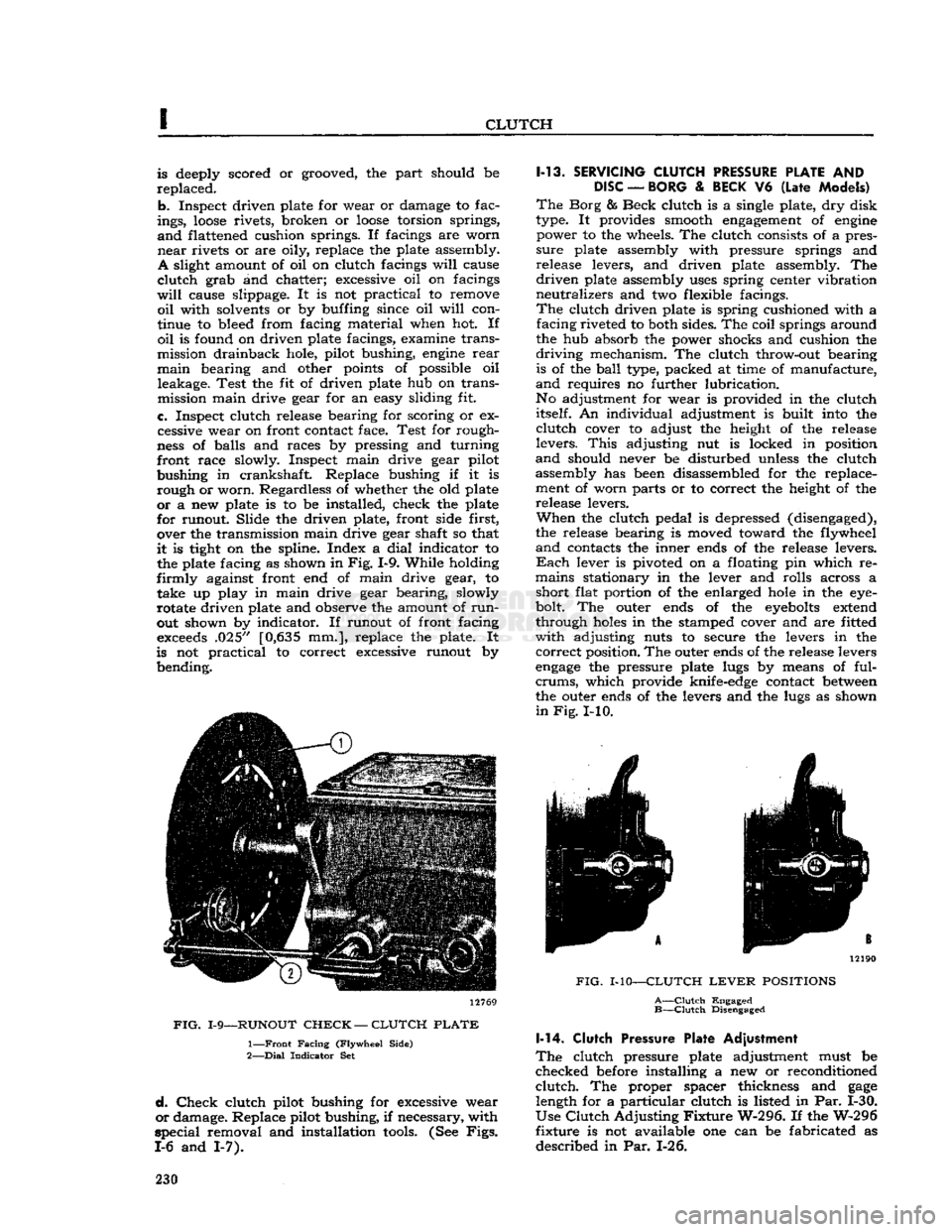
indicator to the plate facing as shown in
Fig.
1-9. While holding
firmly
against front end of main drive gear, to take up play in main drive gear bearing, slowly
rotate driven plate and observe the amount of
run
out shown by indicator. If runout of front facing
exceeds
.025" [0,635 mm.], replace the plate. It
is not practical to correct excessive runout by bending. 12769
FIG.
1-9—RUNOUT
CHECK
—
CLUTCH
PLATE
1—
Front
Facing
(Flywheel
Side)
2—
Dial
Indicator
Set
d.
Check
clutch pilot bushing for excessive wear
or
damage. Replace pilot bushing, if necessary, with
special
removal and installation
tools.
(See
Figs.
1-6 and 1-7). 1-13.
SERVICING
CLUTCH
PRESSURE
PLATE
AND
DISC
—
BORG
&
BECK
V6
(Late
Models)
The
Borg & Beck clutch is a single plate, dry disk
type. It provides smooth
engagement
of
engine
power to the wheels. The clutch consists of a pres
sure
plate assembly with pressure springs and
release levers, and driven plate assembly. The
driven
plate assembly
uses
spring center vibration
neutralizes and two flexible facings.
The
clutch driven plate is spring cushioned with a facing riveted to both sides. The coil springs around
the hub absorb the power shocks and cushion the
driving
mechanism. The clutch throw-out bearing is of the
ball
type, packed at time of manufacture,
and
requires no further lubrication.
No adjustment for wear is provided in the clutch itself. An individual adjustment is built into the
clutch
cover to adjust the height of the release
levers.
This
adjusting nut is locked in position
and
should never be disturbed unless the clutch assembly has been disassembled for the replace
ment of worn parts or to correct the height of the release levers.
When
the clutch pedal is depressed (disengaged),
the release bearing is moved toward the flywheel
and
contacts the inner ends of the release levers.
Each
lever is pivoted on a floating pin which re
mains stationary in the lever and rolls across a short flat portion of the enlarged
hole
in the eye-
bolt. The outer ends of the
eyebolts
extend
through
holes
in the stamped cover and are fitted
with
adjusting nuts to secure the levers in the
correct
position. The outer ends of the release levers
engage
the pressure plate lugs by means of ful-
crums,
which provide knife-edge contact
between
the outer ends of the levers and the lugs as shown
in
Fig.
I-10. 12190
FIG.
MO—CLUTCH
LEVER
POSITIONS
A—Clutch
Engaged
B—Clutch
Disengaged 1-14.
Clutch
Pressure Plate Adjustment
The
clutch pressure plate adjustment must be
checked before installing a new or reconditioned
clutch.
The proper spacer thickness and
gage
length for a particular clutch is listed in Par. 1-30.
Use
Clutch
Adjusting
Fixture
W-296. If the W-296
fixture is not available one can be fabricated as
described in Par. 1-26. 230
Page 232 of 376
CLUTCH
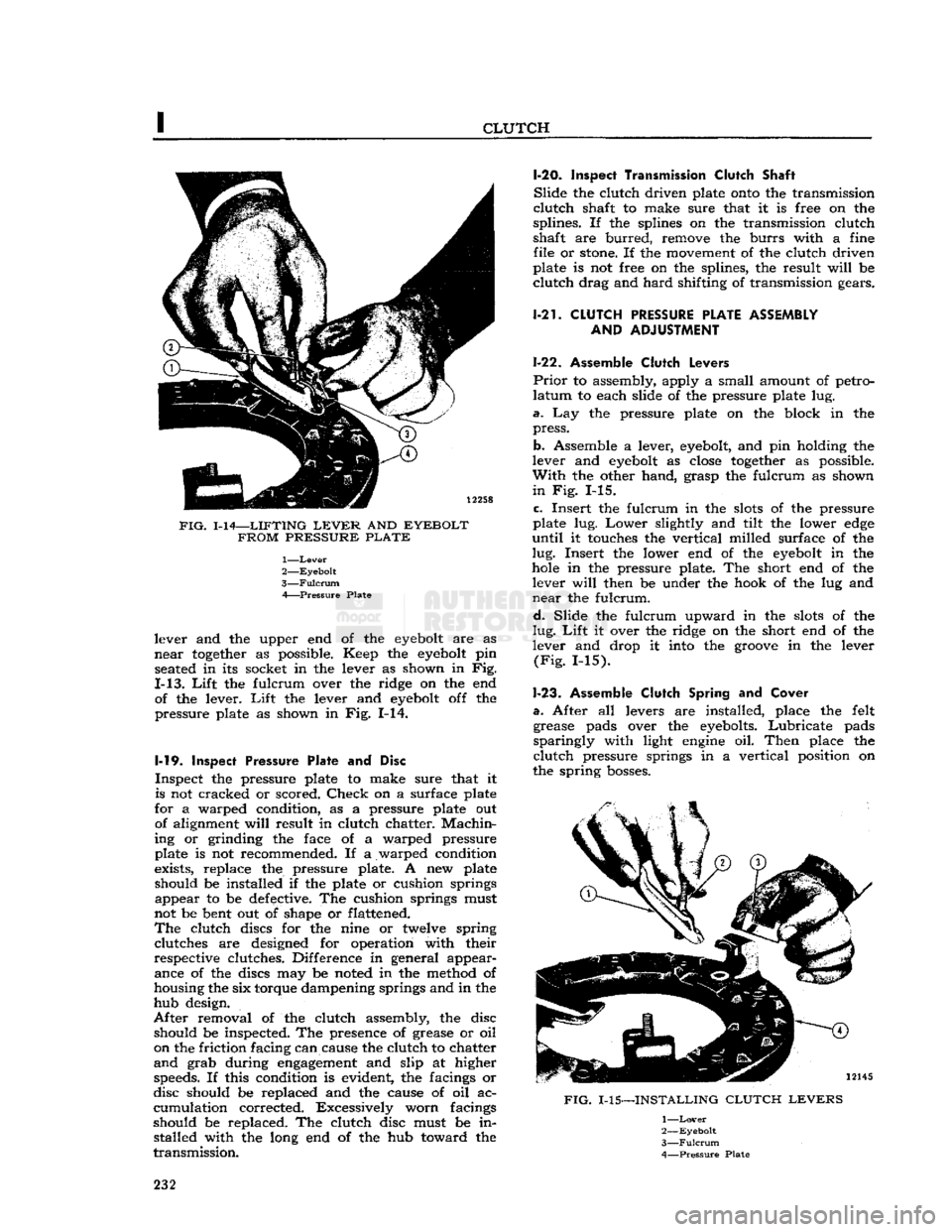
FIG.
1-14—LIFTING
LEVER
AND
EYEBOLT FROM PRESSURE PLATE
1—
Lever
2—
Eyebolt
3—
Fulcrum
A Pressure Plate
lever and the upper end of the
eyebolt
are as
near
together
as possible. Keep the
eyebolt
pin seated in its socket in the lever as shown in Fig.
1-13.
Lift
the fulcrum over the ridge on the end of the lever.
Lift
the lever and
eyebolt
off the
pressure plate as shown in Fig. 1-14.
1-19.
Inspect
Pressure Plate and Disc
Inspect the pressure plate to make sure that it is not cracked or scored.
Check
on a surface plate
for a warped condition, as a pressure plate out of alignment
will
result in clutch chatter.
Machin
ing or grinding the face of a warped pressure
plate is not recommended. If a warped condition
exists, replace the pressure plate. A new plate
should be installed if the plate or cushion springs appear to be defective. The cushion springs must
not be bent out of shape or flattened.
The
clutch discs for the nine or twelve spring clutches are designed for operation with their
respective clutches. Difference in general appear ance of the discs may be noted in the method of
housing the six torque dampening springs and in the
hub design.
After
removal of the clutch assembly, the disc should be inspected. The presence of grease or oil
on the friction facing can cause the clutch to chatter
and
grab during
engagement
and slip at higher speeds. If this condition is evident, the facings or
disc should be replaced and the cause of oil ac
cumulation corrected. Excessively worn facings
should be replaced. The clutch disc must be in stalled with the long end of the hub toward the
transmission.
1-20.
Inspect Transmission Clutch
Shaft
Slide
the clutch driven plate
onto
the transmission
clutch
shaft to make sure that it is free on the
splines. If the splines on the transmission clutch
shaft are
burred,
remove the
burrs
with a fine file or
stone.
If the movement of the clutch driven
plate is not free on the splines, the result
will
be
clutch
drag and
hard
shifting of transmission gears.
1-21.
CLUTCH
PRESSURE
PLATE ASSEMBLY AND
ADJUSTMENT
1-22. Assemble
Clutch
Levers
Prior
to assembly, apply a small amount of petro
latum
to each slide of the pressure plate lug.
a.
Lay the pressure plate on the block in the
press.
b. Assemble a lever,
eyebolt,
and pin holding the
lever and
eyebolt
as
close
together
as possible.
With
the other hand, grasp the fulcrum as shown
in
Fig. 1-15.
c.
Insert the fulcrum in the
slots
of the pressure
plate lug.
Lower
slightly and tilt the lower
edge
until
it touches the vertical milled surface of the
lug.
Insert the lower end of the
eyebolt
in the
hole
in the pressure plate. The short end of the lever
will
then be under the hook of the lug and
near
the fulcrum.
d.
Slide the fulcrum upward in the
slots
of the
lug.
Lift
it over the ridge on the short end of the
lever and drop it into the
groove
in the lever
(Fig.
1-15).
1-23.
Assemble
Clutch
Spring and
Cover
a.
After all levers are installed, place the felt grease pads over the eyebolts.
Lubricate
pads
sparingly
with light
engine
oil.
Then
place the
clutch
pressure springs in a vertical position on
the spring
bosses.
FIG.
1-15—INSTALLING
CLUTCH LEVERS
1—
Lover
2—
Eyebolt
3—
Fulcrum
4—
Pressure
Plate
232
Page 235 of 376
![JEEP DJ 1953 Service Manual
Jeep
UNIVERSAL
SERIES
SERVICE
MANUAL
I thickness: .285"
[0,724
cm.], .305"
[0,775
cm.].
Each
spacer should be hardened and ground to size, and then have the dimensional thickness
sta](/img/16/57041/w960_57041-234.png "JEEP DJ 1953 Service Manual
Jeep
UNIVERSAL
SERIES
SERVICE
MANUAL
I thickness: .285\"
[0,724
cm.], .305\"
[0,775
cm.].
Each
spacer should be hardened and ground to size, and then have the dimensional thickness
sta")
'Jeep'
UNIVERSAL
SERIES
SERVICE
MANUAL
I thickness: .285"
[0,724
cm.], .305"
[0,775
cm.].
Each
spacer should be hardened and ground to size, and then have the dimensional thickness
stamped thereon.
c.
From
flat bar stock at least Vfe" [3 mm.] thick,
make a
gauge
as shown in Fig. 1-22. Harden, grind
to size, and stamp sizes on the
gauge.
1-27.
Clutch Installation
a.
Very
sparingly, apply wheel bearing lubricant
to inner surface of pilot bushing in crankshaft.
Caution:
If
excessive
lubricant is applied to pilot bushing, it
will
run out on face of flywheel when
hot and
ruin
the driven plate facings.
b. Make sure that splines in the driven plate hub
are
clean; apply a light coat of lubricant to splines
of hub and transmission drive gear shaft. Slide plate over gear shaft several times; remove plate
from shaft and wipe off
excess
lubricant.
Caution:
Driven plate facings must be kept clean
and
dry.
c.
Fill
groove
in throwout bearing collar with wheel bearing lubricant. See Fig. 1-23. Make sure
that front bearing retainer of transmission is clean;
apply a light coat of wheel bearing lubricant. Slide
throwout bearing over bearing retainer several times. Remove bearing from retainer and wipe off
excess
lubricant.
12736
FIG.
1-23—LUBRICATION
POINTS
—
CLUTCH
THROWOUT
BEARING
COLLAR
1—Coat
This
Groove 2—Pack
This
Recess
d.
Clean
and apply wheel bearing lubricant to ball
stud in flywheel housing and to the
seat
in clutch
fork.
e.
If disassembled, install pressure plate in the cover assembly, lining up the
groove
on its
edge
with the
groove
on the
edge
of the cover.
Install
pressure plate retracting springs, and the three
drive
strap-to-pressure plate
bolts
and lock washers.
Torque
bolts
11 lb-ft. [1,51 kg-m.].
Note:
The diaphragm
type
clutch assembly is fac
tory calibrated and requires no adjustment
before
installation. Refer to Par. 1-14 to adjust Borg and
Beck
coil spring
type
clutch assembly.
f.
Install
the pressure plate and driven plate on
flywheel. Support both assemblies with a spare
main
drive gear.
Note:
Be certain that
mark
on clutch cover is
aligned with the
mark
made on the flywheel during
clutch removal.
g.
Install
clutch attaching
bolts
and tighten alter nately so that clutch is drawn squarely
into
position
on flywheel.
Each
bolt
must be
tightened
one turn at a time to avoid bending the clutch cover flange.
Torque
bolts
30 to 40 lb-ft. [4,1 a 5,5 kg-m.].
h.
Lubricate
the ball stud and clutch fork with
wheel bearing lubricant and install clutch fork.
Note:
Be certain that fork retaining spring is
tight
on pivot ball stud.
i.
Install
flywheel housing on
engine
cylinder
block.
Caution:
Be certain that dowel pins are installed
in
cylinder block.
j.
Lubricate
the recess on the inside of the throw-
out bearing collar. Be careful not to use too much
lubricant.
See Fig. 1-23.
Caution:
Make certain that the lips of the spring
retainer (attached to the clutch fork) are in
groove
of the bearing. See Fig. 1-24.
k.
Install
throwout bearing assembly and connect
clutch linkage.
I.
Install
transmission as described in Section J. m. Adjust clutch for %"
[19,05
mm.] free travel,
see
Par.
1-3. 235
Page 240 of 376
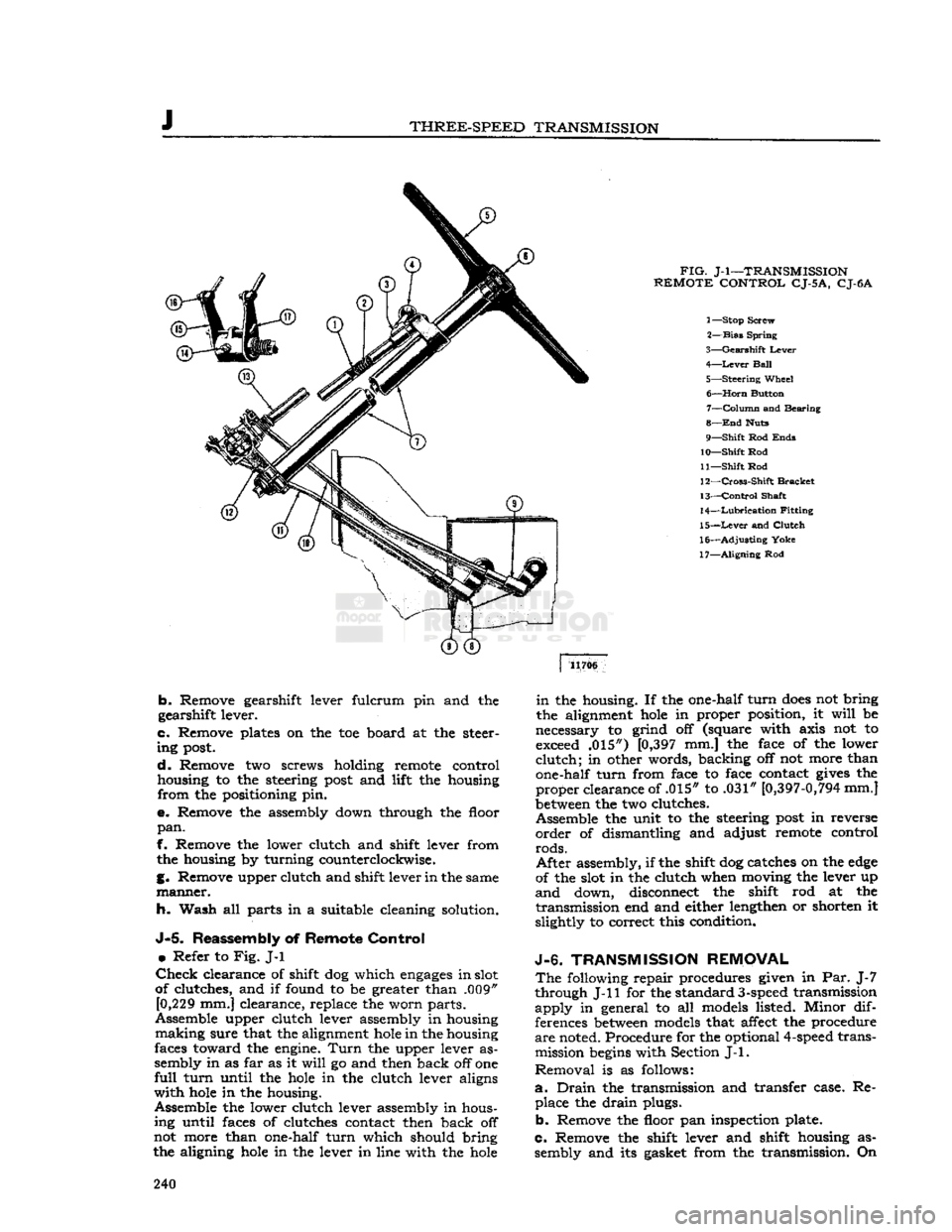
THREE-SPEED
TRANSMISSION
FIG.
J-l—TRANSMISSION
REMOTE
CONTROL
CJ-5
A,
CJ-6A
1— Stop Screw
2—
Bias
Spring
3—
Gearshift
Lever
4—
Lever
Ball
5—
Steering
Wheel 6—
Horn
Button 7—
Column
and Bearing
8—
End
Huts
9—
Shift
Rod
Ends
10—
Shift
Rod
11—
Shift
Rod
12—
Cross-Shift
Bracket
13—
Control
Shaft
14—
Lubrication
Fitting
15—
Lever
and
Clutch
16—
Adjusting
Yoke
17—
Aligning
Rod 11706
b.
Remove gearshift lever fulcrum pin and the
gearshift lever.
c.
Remove plates on the toe board at the steer
ing
post.
d.
Remove two screws holding remote control
housing to the steering
post
and lift the housing
from
the positioning pin.
e.
Remove the assembly down through the floor
pan.
f. Remove the lower clutch and shift lever from the housing by turning counterclockwise.
g. Remove upper clutch and shift lever in the same
manner.
h. Wash all parts in a suitable cleaning solution.
J-5.
Reassembly of
Remote
Control
•
Refer to
Fig.
J-l
Check
clearance of shift dog which
engages
in slot
of clutches, and if found to be greater than .009" [0,229 mm.] clearance, replace the worn parts.
Assemble upper clutch lever assembly in housing
making
sure that the alignment
hole
in the housing
faces toward the engine.
Turn
the upper lever as
sembly in as far as it
will
go and then back off one
full
turn
until the
hole
in the clutch lever aligns
with
hole
in the housing.
Assemble the lower clutch lever assembly in hous ing until faces of clutches contact then back off
not more than one-half
turn
which should bring
the aligning
hole
in the lever in line with the
hole
in
the housing. If the one-half
turn
does
not bring
the alignment
hole
in proper position, it
will
be
necessary to grind off (square with axis not to exceed .015") [0,397 mm.] the face of the lower
clutch;
in other words, backing off not more than
one-half
turn
from face to face contact
gives
the
proper
clearance of .015" to .031"
[0,397-0,794
mm.]
between
the two clutches.
Assemble the unit to the steering
post
in reverse
order
of dismantling and adjust remote control
rods.
After
assembly, if the shift dog catches on the
edge
of the slot in the clutch when moving the lever up
and
down, disconnect the shift rod at the
transmission
end and either lengthen or shorten it
slightly to correct this condition.
J-6.
TRANSMISSION
REMOVAL
The
following repair procedures given in Par. J-7
through J-ll for the standard
3-speed
transmission
apply
in general to all models listed. Minor dif
ferences
between
models that affect the procedure
are
noted. Procedure for the optional
4-speed
transmission
begins
with Section
J-l.
Removal
is as follows:
a.
Drain
the transmission and transfer case. Re place the
drain
plugs.
b.
Remove the floor pan inspection plate.
c.
Remove the shift lever and shift housing as sembly and its gasket from the transmission. On 240
Page 245 of 376
'Jeep*
UNIVERSAL
SERIES'
SERVICE
MANUAL
lightly
on the end of the
mainshaft
to
loosen
the
gear
and
separate
the two
units.
J-8.
Disassembly
—
T90,
T86AA
®
Refer to Fig. J-5, J-7
a. If the transfer
case
is
attached,
separate
it from
the
transmission
as
outlined
in Par. J-7. b.
Remove
the
shift
housing
and
gasket
from the
top of the
transmission
case.
The
shift
housing
can
be
disassembled,
if
necessary,
at
this
point
by re
moving
the
shift
rails and forks from the
shift
housing.
Use care not to
lose
the
poppet
balls
and
springs.
Note;
On
CJ-5
A
and
C
J-6A
models
equipped
with
side-shift
remote-control
transmission
it is
neces
sary to
remove
the main drive
gear
before
the
shift
forks can be
removed.
e.
Remove
the
three
screws
and
washers
attaching
the
front
main drive
gear
bearing
retainer to the
transmission.
Remove
the retainer and
gasket,
d.
Remove
the two
socket-head
screws
from the
front
end of the
transmission
case.
These
screws
support
the oil
collector
inside
the
case.
Note:
The oil
collector
has
been
discontinued
in
late
production
transmission
assemblies.
11881
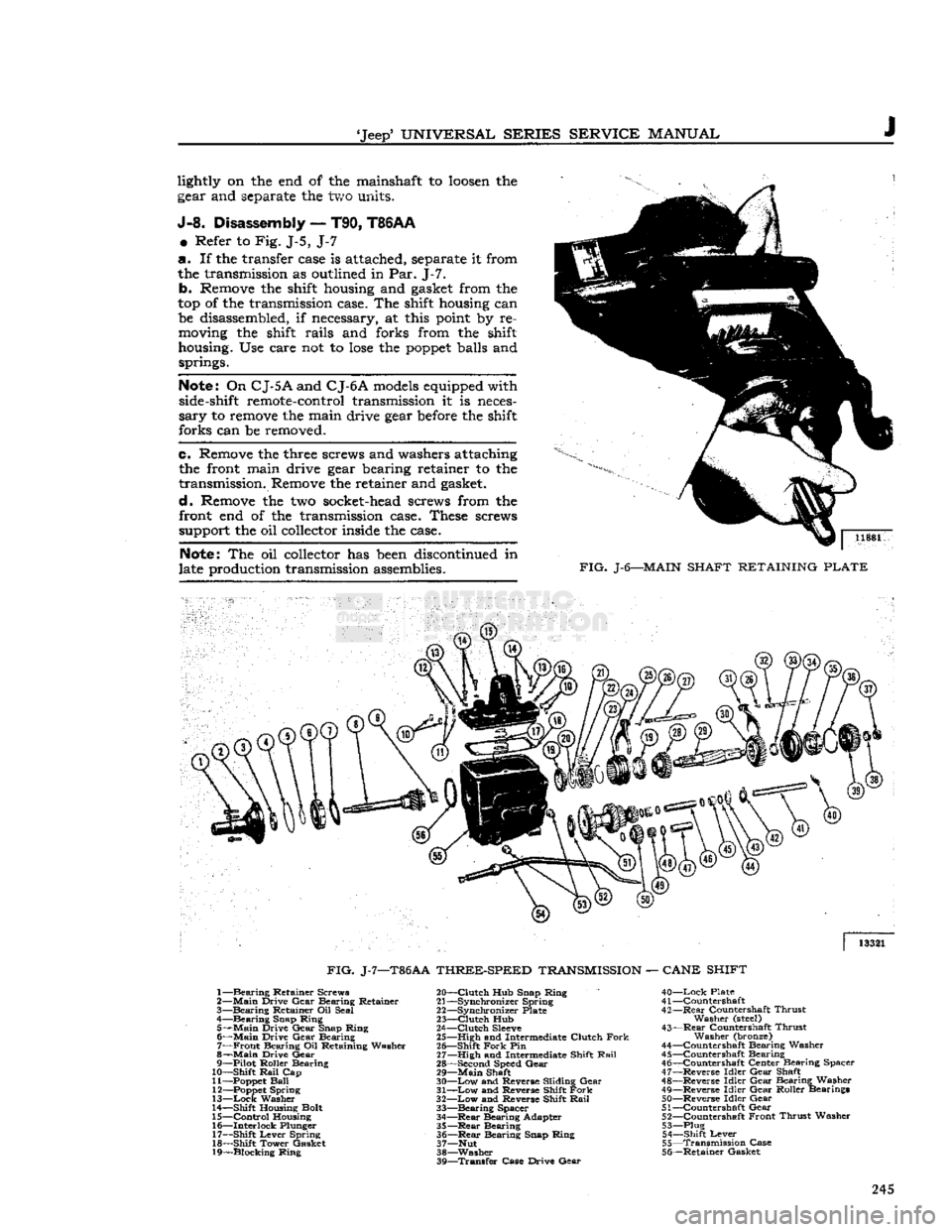
FIG.
J-6—MAIN
SHAFT
RETAINING
PLATE
13321
FIG.
J-7—T86AA
THREE-SPEED
TRANSMISSION
—
CANE
SHIFT
1—
Bearing
Retainer Screws
2—
Main
Drive Gear Bearing Retainer
3—
Bearing
Retainer Oil Seal
,
4—Bearing Snap Ring
5—
Main
Drive Gear Snap Ring 6—
Main
Drive Gear Bearing 7—
Front
Bearing Oil Retaining Washer
8—
Main
Drive Gear
9— Pilot Roller Bearing
10— Shift
Rail
Cap
11—
Poppet
Ball
12—
Poppet
Spring
13—
Lock
Washer
14— Shift Housing Bolt
15—
Control
Housing 16— Interlock Plunger
17— Shift Lever Spring
18— Shift Tower Gasket
19— Blocking Ring 20—
Clutch
Hub Snap Ring
21— Synchronizer Spring
22— Synchronizer Plate
23—
Clutch
Hub
24—
Clutch
Sleeve
25— High and Intermediate Clutch
Fork
26— Shift
Fork
Pin
27— High and Intermediate Shift
Rail
28— Second Speed Gear 29—
Main
Shaft
30—
Low
and Reverse Sliding Gear
31—
Low
and Reverse Shift
Fork
32—
Low
and Reverse Shift
Rail
33—
Bearing
Spacer
34—
—Rear
Bearing Adapter
35—Rear
Bearing 36—
Rear
Bearing Snap Ring
37— Nut
38—Washer 39—
Transfer
Case Drive Gear
40—Lock
Plate
41 —Countershaft
42—
Rear
Countershaft Thrust Washer
(steel)
43—
Rear
Countershaft Thrust Washer (bronze)
44— Countershaft Bearing Washer
45— Countershaft Bearing 46— Countershaft Center Bearing Spacer
47— Reverse Idler Gear Shaft
48— Reverse Idler Gear Bearing Washer
49— Reverse Idler Gear Roller Bearings 50— Reverse Idler Gear
51— Countershaft Gear 52— Countershaft Front Thrust Washer
53— Plug 54— Shift Lever
55—
Transmission
Case
56— Retainer Gasket 245
Page 246 of 376
J
THREE-SPEED
TRANSMISSION
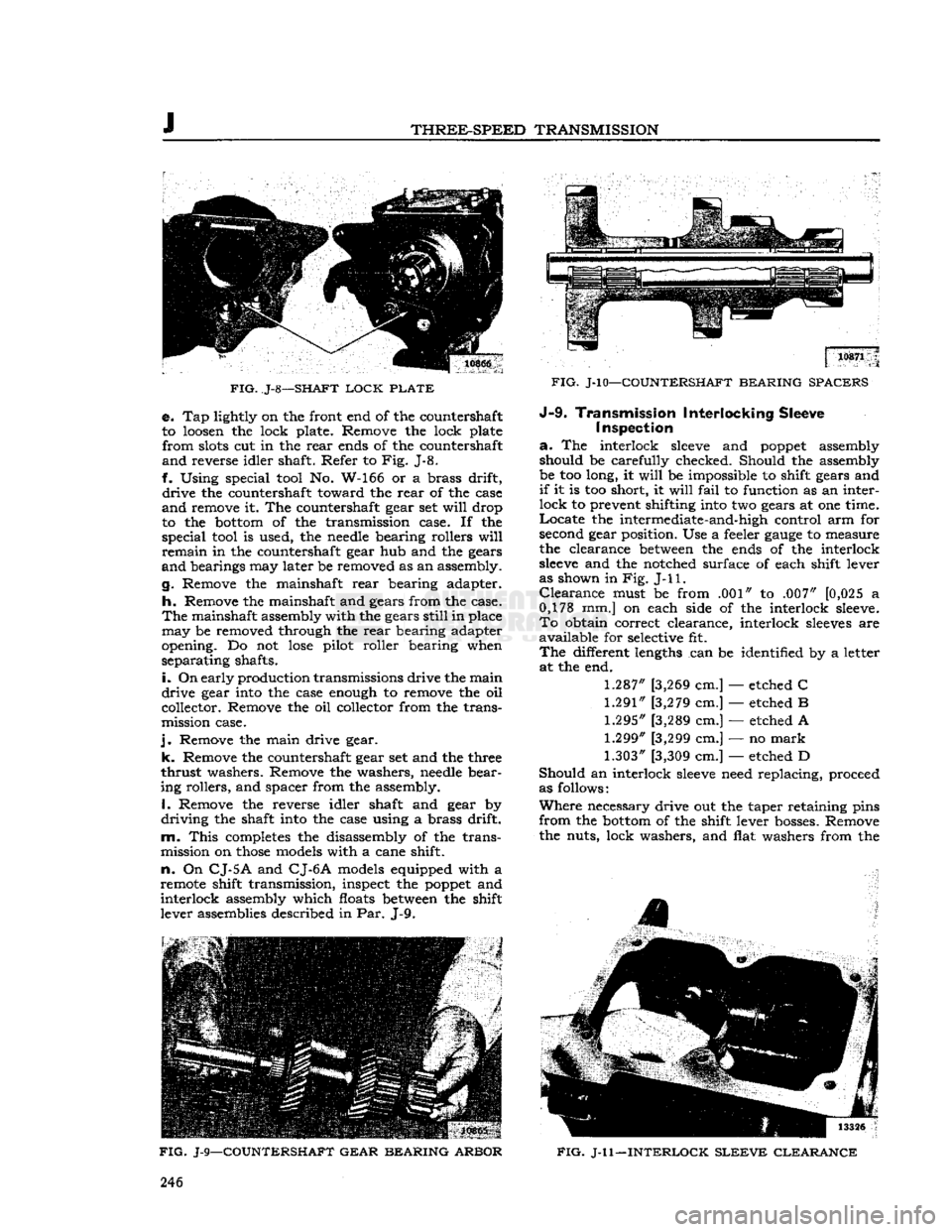
FIG.
J-8—SHAFT
LOCK
PLATE
e. Tap lightly on the front end of the countershaft
to loosen the lock plate. Remove the lock plate
from
slots cut in the
rear
ends of the countershaft
and
reverse idler shaft. Refer to Fig. J-8.
f. Using special tool No. W-166 or a brass drift,
drive
the countershaft toward the
rear
of the case
and
remove it. The countershaft gear set
will
drop
to the bottom of the transmission case. If the
special
tool is used, the needle bearing rollers
will
remain
in the countershaft gear hub and the gears
and
bearings may later be removed as an assembly.
g. Remove the mainshaft
rear
bearing adapter.
h.
Remove the mainshaft and gears from the case.
The
mainshaft assembly with the gears
still
in place
may
be removed through the
rear
bearing adapter
opening. Do not
lose
pilot roller bearing when
separating
shafts.
i.
On
early production transmissions drive the main
drive
gear into the case enough to remove the oil
collector. Remove the oil collector from the trans
mission case.
j.
Remove the main drive gear,
k.
Remove the countershaft gear set and the three
thrust
washers. Remove the washers, needle bear
ing rollers, and spacer from the assembly. 1, Remove the reverse idler shaft and gear by
driving
the shaft into the case using a brass drift,
m.
This
completes the disassembly of the trans
mission on
those
models with a cane shift,
n.
On
CJ-5
A
and
CJ-6 A
models equipped with a
remote shift transmission, inspect the poppet and
interlock
assembly which floats between the shift
lever assemblies described in Par. J-9.
FIG.
J-9—COUNTERSHAFT GEAR BEARING ARBOR
FIG.
J-l0—COUNTERSHAFT BEARING SPACERS J-9-
Transmission Interlocking Sleeve
I
inspection
a.
The interlock
sleeve
and poppet assembly should be carefully checked. Should the assembly
be too long, it
will
be impossible to shift gears and
if
it is too short, it
will
fail
to function as an inter
lock
to prevent shifting into two gears at one time.
Locate
the intermediate-and-high control arm for
second gear position. Use a feeler
gauge
to measure
the clearance between the ends of the interlock
sleeve
and the notched surface of each shift lever
as shown in Fig.
J-l
1.
Clearance
must be from .001" to .007" [0,025 a
0,178 mm.] on each side of the interlock sleeve.
To
obtain correct clearance, interlock
sleeves
are
available
for selective fit.
The
different lengths can be identified by a letter at the end.
1.287"
[3,269 cm.] — etched C
1.291"
[3,279 cm.] — etched B
1.295"
[3,289 cm.] — etched A
1.299"
[3,299 cm.] — no
mark
1.303"
[3,309 cm.] — etched D
Should
an interlock
sleeve
need replacing, proceed
as follows:
Where
necessary drive out the taper retaining pins
from
the bottom of the shift lever bosses. Remove
the nuts, lock washers, and flat washers from the
4
FIG.
J-l 1—INTERLOCK
SLEEVE
CLEARANCE
246
Page 251 of 376
'Jeep'
UNIVERSAL
SERIES
SERVICE
MANUAL
J
flat washer, lock washer and nut.
q.
Check
the
complete
transmission for operation.
r.
Install
transmission case cover.
J-15.
T14A
TRANSMISSION
The
T14A is a three
speed
fully synchronized (all
forward
gears) transmission with helical drive gears
throughout.
The
main drive gear is supported by a
ball
bearing at the front end of the transmission case and is
piloted at its front end in an oil impregnated bush
ing mounted in the crankshaft.
The
front end of the mainshaft is piloted in a row
of
roller
bearings set
into
the hollow end of the main
drive
gear and the
rear
end is
carried
by a
ball
bearing
mounted in the
rear
transmission case.
The
counter gear is
carried
on a single row of
rollers
at both ends. The reverse idler gear is
carried
on a single row of rollers in the center.
Thrust
is
taken
on thrust washers located
between
the
ends
of the counter and reverse idler gear and the thrust
bosses
in the case.
The
three forward gears (low, second, third) are
fully
synchronized. The synchronizer assemblies
consist of
clutch
hubs, clutch
sleeves,
clutch springs,
and
three synchronizer plates and are retained on
the mainshaft by a
select
fit snap
ring.
The
shift is manual through a cane shift lever and
interlock
assembly to the
rearward
shift fork
operating low and reverse gear and to the forward
shift fork operating second and
third
gear.
J-16.
TRANSMISSION
DISASSEMBLY
—
T14A
Refer
to Fig. J-13.
a.
If the transfer case is attached, separate it from
the transmission by removing the five capscrews
and
lockwashers.
b.
Remove cane shift housing cover and gasket
from
top of transmission case. The shift housing
cover can be disassembled if necessary, at this
point, by removing the shift
rails,
poppet
balls,
springs,
and shift forks. Refer to Fig. J-14.
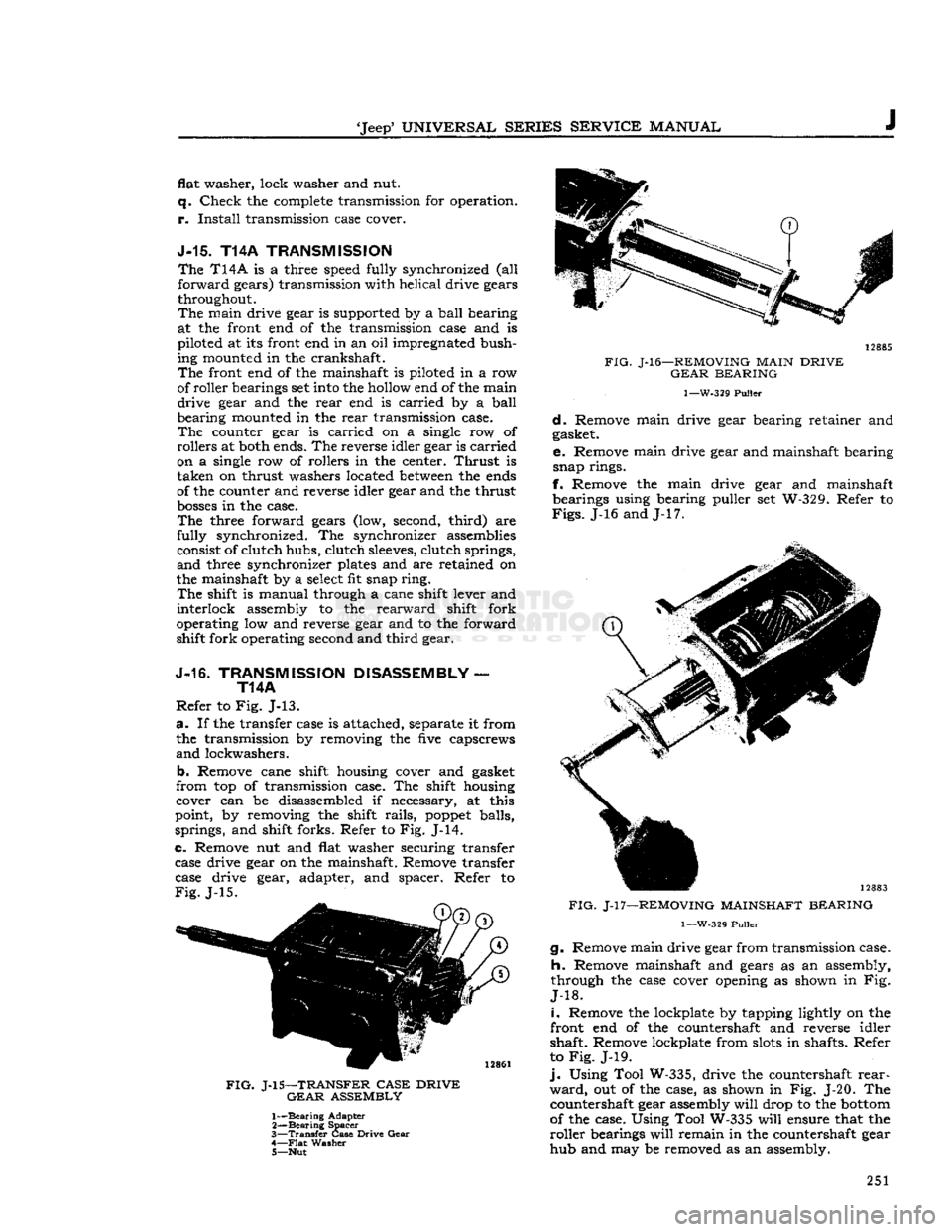
c.
Remove nut and flat washer securing transfer case drive gear on the mainshaft. Remove transfer case drive gear, adapter, and spacer. Refer to
Fig.
J-15.
FIG.
J-15—TRANSFER
CASE
DRIVE
GEAR
ASSEMBLY
1—
Bearing
Adapter
2—
Bearing
Spacer
3—
Transfer
Case
Drive
Gear
4—
Flat
Washer 5— Nut
12885
FIG.
J-16—REMOVING
MAIN
DRIVE
GEAR
BEARING
1—W-329 Puller
d.
Remove main drive gear bearing retainer and
gasket. e. Remove main drive gear and mainshaft bearing snap rings.
f. Remove the main drive gear and mainshaft
bearings using bearing puller set W-329. Refer to
Figs.
J-16 and J-l7.
FIG.
J-17—REMOVING
MAINSHAFT
BEARING
1—W-329
Puller g. Remove main drive gear from transmission case.
h.
Remove mainshaft and gears as an assembly,
through the case cover opening as shown in Fig.
J-18.
i.
Remove the lockplate by tapping lightly on the
front end of the countershaft and reverse idler
shaft. Remove lockplate from
slots
in shafts. Refer
to
Fig.
J-19.
j.
Using Tool W-335, drive the countershaft
rear
ward,
out of the case, as shown in Fig. J-20. The countershaft gear assembly
will
drop to the
bottom
of the case. Using Tool W-335
will
ensure that the
roller
bearings
will
remain in the countershaft gear
hub and may be removed as an assembly. 251
Page 263 of 376
![JEEP DJ 1953 Service Manual
Jeep*
UNIVERSAL
SERIES
SERVICE
MANUAL
Jl
necessity for assembly, one should be made at this
time to assist on disassembly. One can be made by
using a \Y%N [2,86 cm.] diameter steel rod cut](/img/16/57041/w960_57041-262.png "JEEP DJ 1953 Service Manual
Jeep*
UNIVERSAL
SERIES
SERVICE
MANUAL
Jl
necessity for assembly, one should be made at this
time to assist on disassembly. One can be made by
using a \Y%N [2,86 cm.] diameter steel rod cut")
'Jeep*
UNIVERSAL
SERIES
SERVICE
MANUAL
Jl
necessity for assembly, one should be made at this
time to assist on disassembly. One can be made by
using a \Y%N [2,86 cm.] diameter steel rod cut to
9.850*
{25,02
cm.] long.
Break
sharp
edges
with a
mill
file.) Keep the dummy shaft in contact with
the countershaft at all times to prevent dropping
the bearing rollers or thrust washers,
z.
With
the dummy shaft in position, place the
transmission
case on its side and carefully
roll
the countershaft gear cluster out of the case,
aa.
Complete the disassembly by removing the dummy shaft, thrust washers, four
sets
of bearing
rollers,
and spacers.
bb.
To disassemble the reverse idler gear assembly,
remove one of the snap rings and tap out the
washers,
both
sets
of bearing rollers, center spacer,
and
sleeve.
Remove the remaining snap
ring.
J1-4.
4-Speed
Transmission
Control
Housing
Disassembly
•
Refer to Fig. Jl-5.
The
gearshift lever, spring, and spring seat were previously removed for removal of the transmission
from
the vehicle.
a.
Remove the lock pins from the gearshift forks
and
gearshift rod ends. Remove the expansion plugs
from
the front and
rear
of the gearshift lever base. Remove back-up light switch.
b.
Remove the center (third and high) gearshift
rod
first. Drive this gearshift rod out the
rear
of the gearshift lever base. As the gearshift rod is
withdrawn
from the center section of the gearshift base, remove the interlock pin from the cross
over
hole
in the gearshift rod. Before the gearshift
rod
is removed from the center section of the gear
shift base, place a finger over the
hole
to prevent
loss
of the
ball
and spring.
Then
remove the rod.
c»
Remove the low- and second-speed gearshift rod
in
the same manner.
d.
Remove the gearshift rod lock balls and springs
and.
with a piece of
wire,
push the two gearshift rod
interlock
plungers out of the pockets in the center
section of the gearshift base.
In
the reverse gearshift rod end is a spring-loaded
plunger which prevents the
driver
from accidentally
shifting into reverse gear. Should this part require
servicing,
proceed as follows:
Remove the cotter key from the rod end assembly
and
at the same time hold a finger over the
hole
to prevent
loss
of the spring.
Then
shake out the
spring
and
ball.
Compress the plunger and spring
until
the C-washer
groove
just clears the end of
the casting. Remove the C-washer.
J1-5.
4-speed
Transmission Reassembly •
Refer to Fig. Jl-1.
Assemble the unit in the reverse order of dis
assembly noting the following points:
a.
Assemble the countershaft assembly with the
fabricated
dummy shaft. The bronze front thrust
washer
and the steel backed bronze
rear
thrust
washer
should be coated with stiff lubricant and
installed
with the lugs
engaged
in the notches
in
the end of the gear cluster. Place the assembly
in
the transmission case and install the counter
shaft from the
rear,
keeping the countershaft and
dummy shaft in contact to prevent dropping
bearing
rollers or washers. Tap the countershaft
lightly into position in the front of the case but
do not seat it until the reverse idler gear assembly
and
shaft have been installed in the case.
b.
Install
the reverse idler gear shaft in the case
until
the lock plate slot is adjacent to the slot in
the countershaft. Insert the lock plate in the
slots
of the shafts making sure the plate ends are square
with
the slots.
Install
the lock plate screw and
lockwasher
to act as a pilot while tapping the
shafts alternately into position in the case. Tighten
the lock plate screw securely.
c.
Begin assembly of the second speed synchronizer assembly (see
Fig.
Jl-6) by installing the low-and
-
second-speed clutch hub in the low-and-second-
speed gear.
Install
the retaining ring in the speed gear.
Install
the retaining ring in the low and
FIG.
Jl
-6—ASSEMBLING
SECOND-SPEED
SYNCHRONIZER
1—
Low
and Second
Clutch
Gear
2—
Ball
3—
Low
and Second
Clutch
Hub
4—
Shifting
Plate
second speed gear. Slide the hub out of the gear
in
the direction
opposite
the shift fork
groove
until
the
holes
in the hub are clear of the gear.
Install
the shifter plates and springs. Push the
hub back into the gear until the springs touch the
internal
teeth
of the gear. Push one of the shifter
plates toward the center of the gear while installing
ball.
See
Fig.
Jl-6 .
This
will
hold the
ball
in position.
Install
the other two balls in the same manner.
Be
careful when rotating the assembly to prevent the hub from slipping out of the gear. When the
balls
are installed, push the hub into the gear
until
the balls snap into the neutral position.
d.
Assemble the
direct
-
and
-
third
synchronizer as
sembly in accordance with the instructions given
in
Section J, Par.
J-lle.
e.
Start
assembly of the mainshaft assembly by 263