fuel cap JEEP DJ 1953 Owner's Manual
[x] Cancel search | Manufacturer: JEEP, Model Year: 1953, Model line: DJ, Model: JEEP DJ 1953Pages: 376, PDF Size: 19.96 MB
Page 110 of 376
E
FUEL
SYSTEM
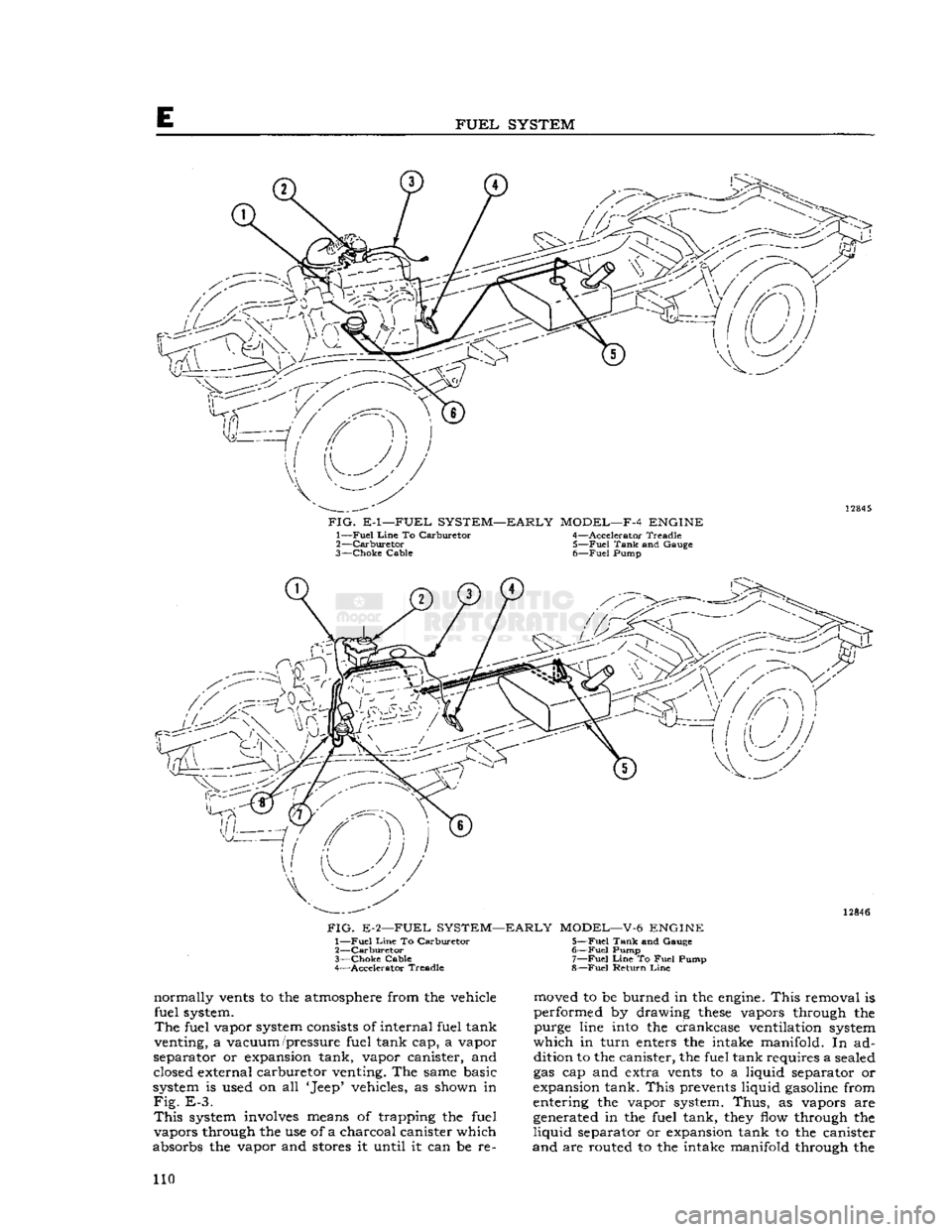
FIG.
E-1—FUEL SYSTEM—EARLY MODEL—F-4 ENGINE 1—
Fuel
Line
To Carburetor 4—Accelerator Treadle
2— Carburetor 5—Fuel Tank and Gauge
3— Choke Cable 6—Fuel Pump
FIG.
E-2—FUEL SYSTEM—EARLY
MODEL—V-6
ENGINE 1—
Fuel
Line
To Carburetor 5—Fuel Tank and Gauge
2—
Carburetor 6—Fuel Pump
3— Choke Cable 7—Fuel
Line
To Fuel Pump
4—
Accelerator
Treadle 8—Fuel Return
Line
normally
vents
to the atmosphere from the vehicle
fuel system.
The
fuel vapor system consists of internal fuel tank
venting, a vacuum /pressure fuel tank cap, a vapor
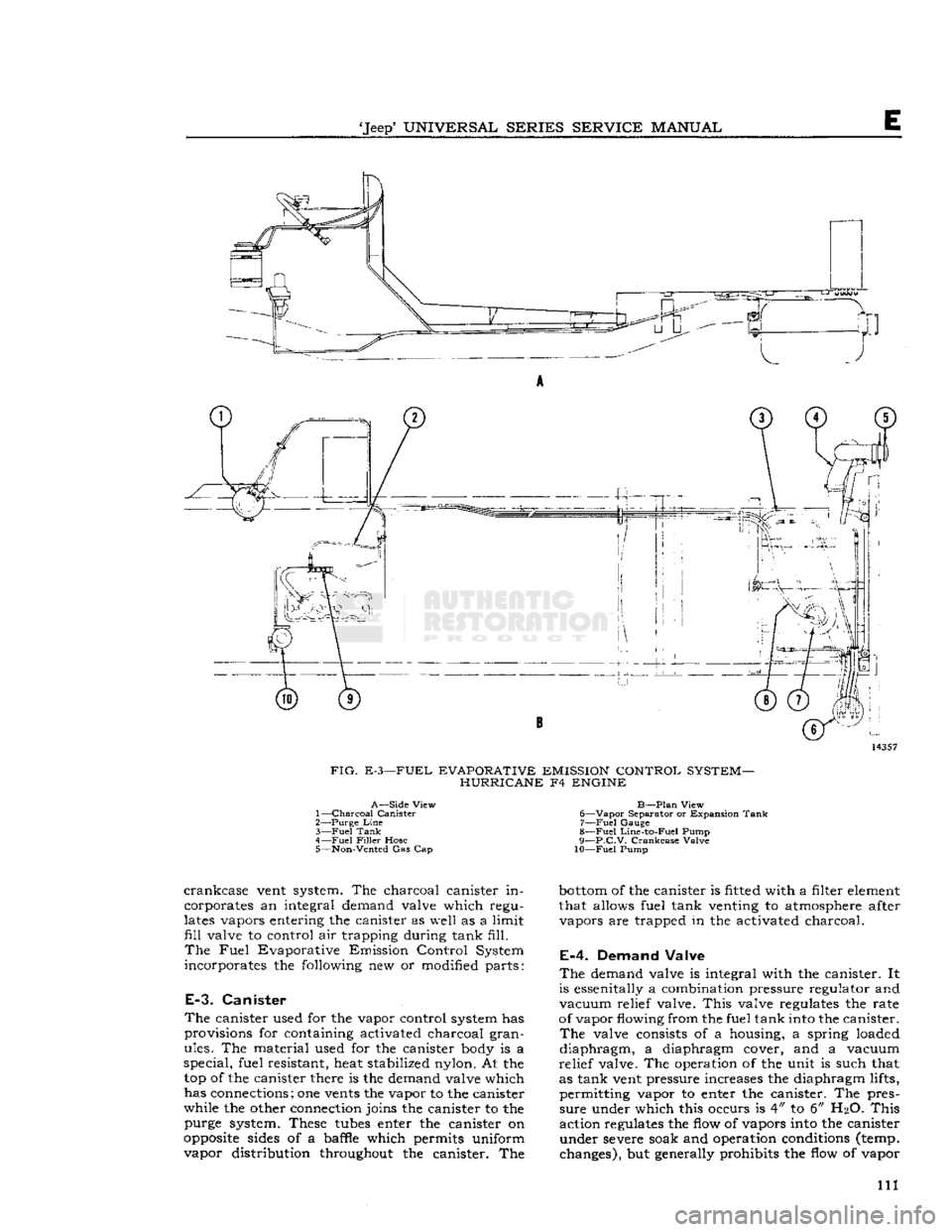
separator or expansion tank, vapor canister, and closed external carburetor venting. The same basic
system is used on all 'Jeep' vehicles, as shown in
Fig. E-3.
This
system involves means of trapping the fuel
vapors through the use of a charcoal canister which
absorbs the vapor and stores it until it can be re moved to be burned in the
engine.
This
removal is
performed by drawing
these
vapors through the purge line
into
the crankcase ventilation system
which
in
turn
enters the intake manifold. In ad dition to the canister, the fuel tank requires a sealed
gas cap and extra
vents
to a liquid separator or
expansion tank.
This
prevents liquid
gasoline
from entering the vapor system.
Thus,
as vapors are generated in the fuel tank,
they
flow through the
liquid
separator or expansion tank to the canister
and
are routed to the intake manifold through the 110
Page 111 of 376
'Jeep*
UNIVERSAL
SERIES
SERVICE
MANUAL
E
FIG.
E-3—FUEL EVAPORATIVE EMISSION CONTROL SYSTEM- HURRICANE F4 ENGINE
A—Side
View
1—
Charcoal Canister
2— Purge
Line
3—
Fuel
Tank
4—
Fuel
Filler
Hose 5—
Non-Vented
Gas Cap
B—Plan
View
6—
Vapor
Separator
or Expansion Tank 7—
Fuel
Gauge
8—
Fuel
Line-to-Fuel Pump
9—
p.C.V.
Crankcase
Valve
10—Fuel
Pump
crankcase
vent system. The charcoal canister in
corporates an integral demand valve
which
regu
lates
vapors entering the canister as
well
as a
limit
fill
valve
to control air trapping during tank
fill.
The
Fuel
Evaporative Emission Control System
incorporates the following new or modified parts:
E-3.
Canister
The canister used for the vapor control system has
provisions for containing activated charcoal gran ules. The material used for the canister body is a
special,
fuel resistant, heat stabilized nylon. At the top of the canister there is the demand valve which
has connections; one vents the vapor to the canister
while the other connection joins the canister to the purge system. These
tubes
enter the canister on
opposite
sides of a baffle which permits uniform
vapor distribution throughout the canister. The
bottom
of the canister is fitted with a filter element
that allows fuel tank venting to atmosphere after vapors are trapped in the activated charcoal.
E-4.
Demand Valve
The
demand valve is integral with the canister. It
is essenitally a combination pressure regulator and
vacuum
relief valve.
This
valve regulates the rate
of vapor
flowing
from the fuel tank into the canister.
The
valve consists of a housing, a spring loaded
diaphragm,
a diaphragm cover, and a vacuum
relief
valve. The operation of the unit is such that
as tank vent pressure increases the diaphragm lifts,
permitting vapor to enter the canister. The pres
sure
under which this occurs is 4" to 6"
H2O.
This
action regulates the flow of vapors into the canister
under severe soak and operation conditions (temp, changes), but generally prohibits the flow of vapor 111
Page 112 of 376
E
FUEL
SYSTEM
9
©
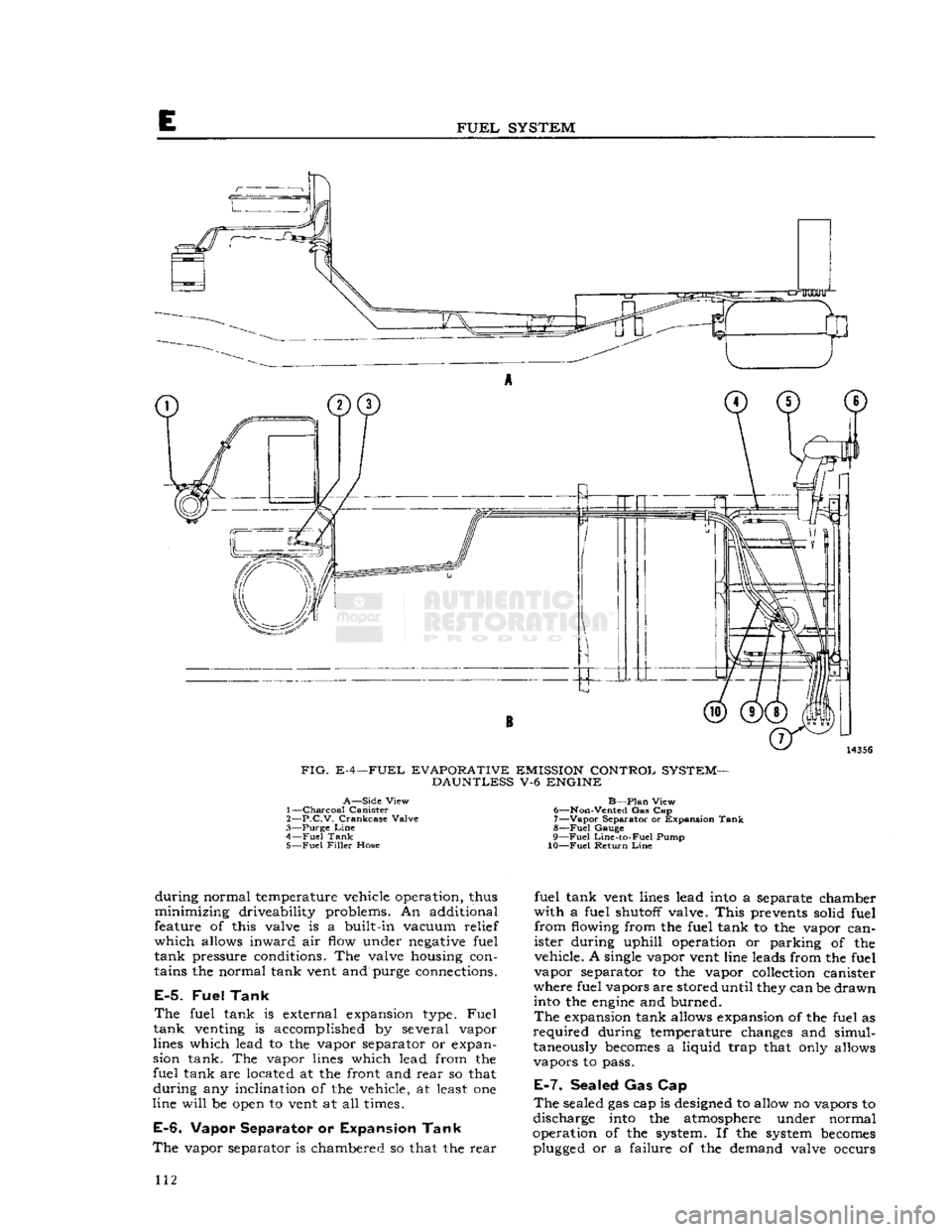
FIG.
E-4—FUEL
EVAPORATIVE
EMISSION
CONTROL
SYSTEM-
DAUNTLESS
V-6
ENGINE
A—Side
View
1—
Charcoal
Canister
2—
P.C.V.
Crankcase
Valve
3—
Purge
Line
4—
Fuel
Tank
5—
Fuel
Filler
Hose
B—Plan
View
6—
Non-Vented
Gas Cap 7—
Vapor
Separator or Expansion
Tank
g—Fuei
Gauge
9—Fuel
Line-to-Fuel
Pump
10—Fuei
Return
Line
during
normal temperature vehicle operation, thus
minimizing
driveability problems. An additional
feature of this valve is a built-in vacuum relief
which
allows inward air flow under negative fuel
tank
pressure conditions. The valve housing con
tains the normal tank vent and purge connections.
E-5.
Fuel Tank
The
fuel tank is external expansion type.
Fuel
tank
venting is accomplished by several vapor
lines which lead to the vapor separator or expan
sion tank. The vapor lines which lead from the
fuel tank are located at the front and
rear
so that
during
any inclination of the vehicle, at least one
line
will
be open to vent at all times.
E-6.
Vapor Separator
or
Expansion Tank
The
vapor separator is chambered so that the
rear
fuel tank vent lines lead into a separate chamber
with
a fuel shutofl valve.
This
prevents solid fuel
from
flowing from the fuel tank to the vapor can
ister during uphill operation or parking of the
vehicle. A single vapor vent line leads from the fuel
vapor separator to the vapor collection canister
where fuel vapors are stored until they can be drawn into the
engine
and burned.
The
expansion tank allows expansion of the fuel as
required
during temperature changes and simul taneously
becomes
a liquid trap that only allows
vapors to pass.
E-7.
Sealed
Gas Cap
The
sealed gas cap is designed to allow no vapors to
discharge into the atmosphere under normal
operation of the system. If the system
becomes
plugged or a failure of the demand valve occurs 112
Page 113 of 376
'Jeep*
UNIVERSAL
SERIES
SERVICE
MANUAL
E
there is a relief valve that
opens
to reduce high
(dangerous) pressures in the fuel tank. In con
junction
with the pressure relief valve there is a
vacuum
relief valve to
stop
collapse of the fuel
tank
in case of a plugged system or failure of the demand valve. When replacing the gas cap, the
same type must be used as originally installed.
E-8.
System Inspection Test
The
fuel emission vent system should be checked
carefully
to ensure the absence of any leaks to the
atmosphere of either liquid or vapor which might
affect the accuracy, safety, or performance of the control system.
To
assure that the sealed system has been properly
installed,
the following
test
procedure has been
developed.
Disconnect the vent line from the fuel tank system
to the activated charcoal canister, induce l/i p.s.i.
air
pressure. If this pressure can be maintained for
a
few seconds the vent system is assured to be sealed. DO NOT add air pressure to the canister
because damage can occur to the demand valve if
care
is not taken.
E-9.
Servicing the System
Periodic
Maintenance — Replace carbon canister filter at
12,000
miles
[19,200
km.] or 12 month intervals (more
often
for operation in dusty areas).
This
is the only regular maintenance service
required.
Canister
Filter
Replacement — Disconnect
hoses
from
top of canister, remove canister from mount
-
t
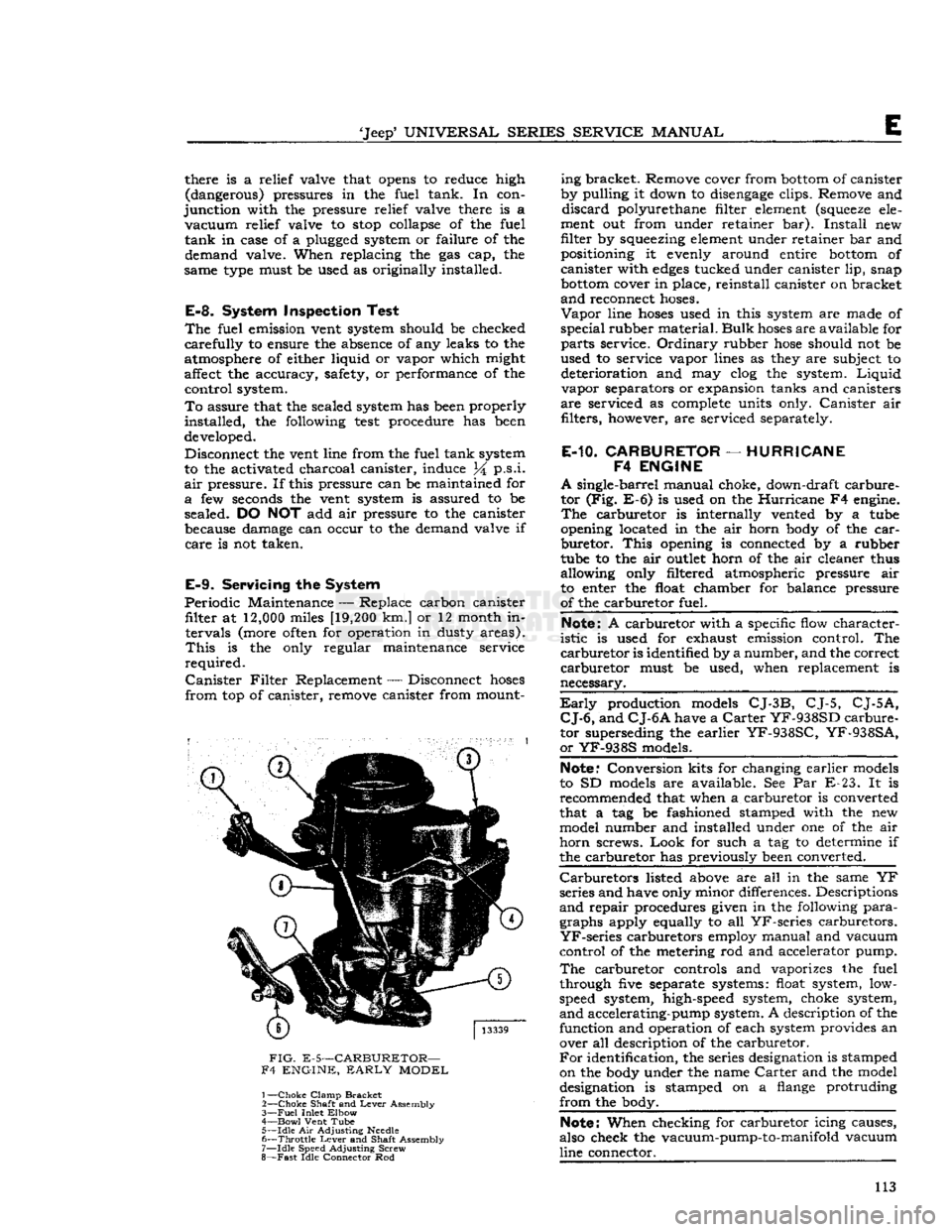
FIG.
E-5—CARBURETOR—
F4 ENGINE,
EARLY
MODEL
1—
Choke
Clamp
Bracket
2—
Choke
Shaft and
Lever
Assembly
3—
Fuel
Inlet
Elbow
4—
Bowl
Vent Tube 5—
Idle
Air Adjusting
Needle
6—
Throttle
Lever
and Shaft Assembly
7—
Idle
Speed Adjusting Screw
8—
Fast
Idle Connector Rod ing bracket. Remove cover from
bottom
of canister
by pulling it down to
disengage
clips. Remove and
discard
polyurethane filter element
(squeeze
ele
ment out from under retainer bar).
Install
new
filter by squeezing element under retainer bar and positioning it evenly around entire
bottom
of
canister with
edges
tucked under canister lip, snap
bottom
cover in place, reinstall canister on bracket
and
reconnect
hoses.
Vapor
line
hoses
used in this system are made of
special
rubber material.
Bulk
hoses
are available for
parts
service.
Ordinary
rubber
hose
should not be
used to service vapor lines as they are subject to deterioration and may clog the system.
Liquid
vapor separators or expansion tanks and canisters
are
serviced as complete units only.
Canister
air filters, however, are serviced separately.
E-10.
CARBURETOR
—
HURRICANE
F4
ENGINE
A
single-barrel manual choke, down-draft carbure
tor (Fig. E-6) is used on the
Hurricane
F4 engine.
The
carburetor is internally vented by a tube
opening located in the air horn body of the
car
buretor.
This
opening is connected by a rubber
tube to the air
outlet
horn of the air cleaner thus
allowing only filtered atmospheric pressure air
to enter the float chamber for balance pressure
of the carburetor fuel.
Note:
A carburetor with a specific flow character
istic
is used for exhaust emission control. The
carburetor
is identified by a number, and the correct
carburetor
must be used, when replacement is
necessary.
Early
production models
CJ-3B,
CJ-5,
CJ-5A,
CJ-6,
and
CJ-6A
have a
Carter
YF-938SD
carbure
tor superseding the earlier
YF-938SC,
YF-938SA,
or
YF-938S
models.
Note."
Conversion kits for changing earlier models
to SD models are available. See Par E-23. It is recommended that when a carburetor is converted
that a tag be fashioned stamped with the new model number and installed under one of the air
horn
screws.
Look
for such a tag to determine if
the carburetor has previously been converted.
Carburetors
listed above are all in the same YF
series and have only minor differences. Descriptions
and
repair procedures given in the following
para
graphs apply equally to all
YF-series
carburetors.
YF-series
carburetors employ manual and vacuum
control of the metering rod and accelerator pump.
The
carburetor controls and vaporizes the fuel
through five separate systems: float system, low-
speed system, high-speed system, choke system,
and
accelerating-pump system. A description of the function and operation of each system provides an over all description of the carburetor.
For
identification, the series designation is stamped
on the body under the name
Carter
and the model
designation is stamped on a flange protruding
from
the body.
Note:
When checking for carburetor icing causes,
also check the vacuum-pump-to-manifold vacuum
line connector. 113
Page 114 of 376
FUEL
SYSTEM
14261
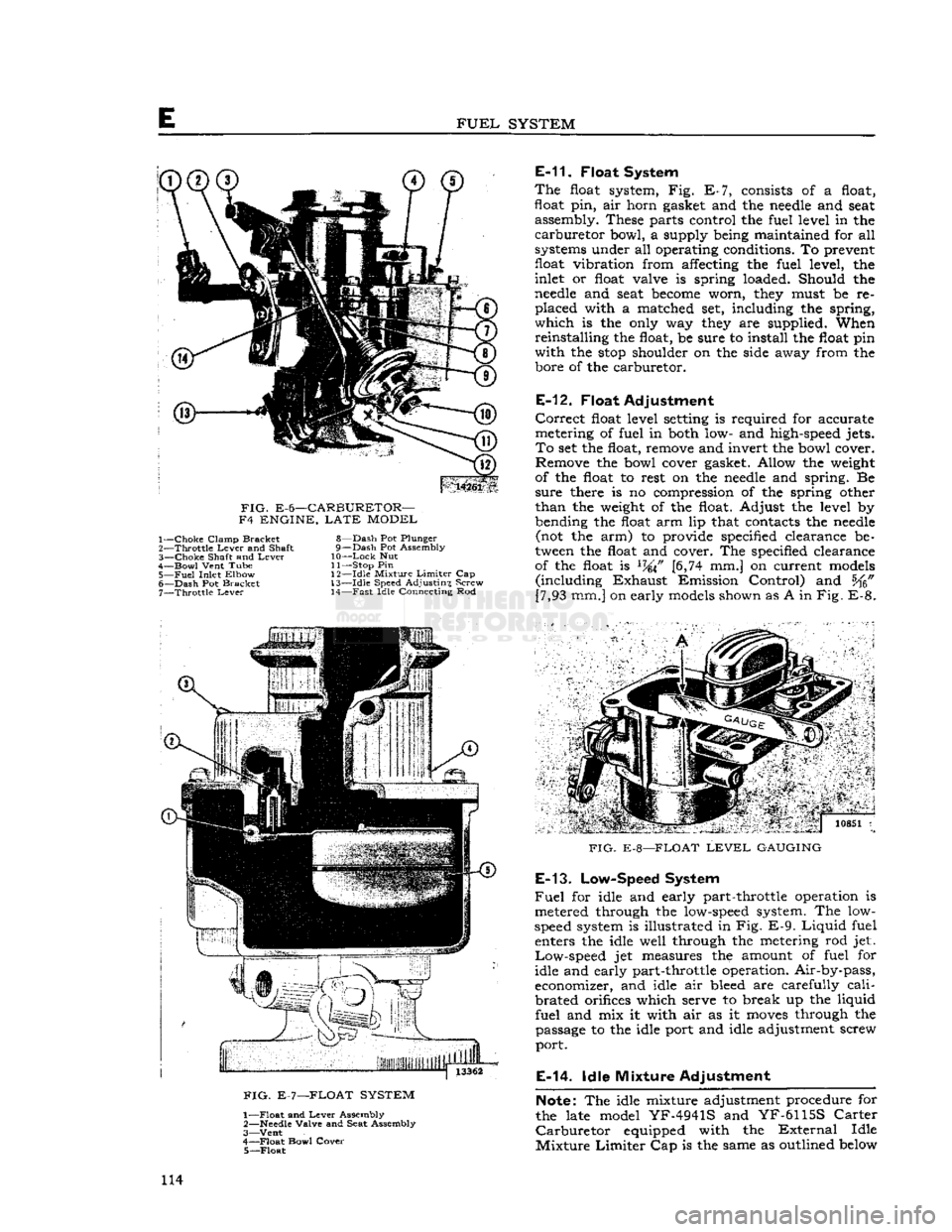
FIG.
E-6—CARBURETOR—
F4 ENGINE,
LATE
MODEL 1—
Choke
Clamp Bracket
2—
Throttle
Lever
and Shaft
3—
Choke
Shaft and
Lever
4—
Bowl
Vent Tube
5—
Fuel
Inlet Elbow
6—
Dash
Pot Bracket 7—
Throttle
Lever
8—
Dash
Pot Plunger
9—
Dash
Pot Assembly
10—
Lock
Nut
11— Stop Pin
1
2—Idle Mixture
Limiter
Cap
13—
Idle
Speed Adjusting Screw 14—
Fast
Idle Connecting Rod
E-11.
Float System
The
float system, Fig. E-7, consists of a float,
float
pin,
air horn gasket and the
needle
and seat assembly. These parts control the fuel level in the
carburetor
bowl, a supply being maintained for all
systems under all operating conditions. To prevent
float
vibration
from affecting the fuel level, the
inlet or float valve is spring loaded. Should the
needle
and seat
become
worn, they must be re
placed
with a matched set, including the spring,
which
is the only way they are supplied. When
reinstalling
the float, be sure to install the float pin
with
the
stop
shoulder on the side away from the bore of the carburetor.
E-12.
Float Adjustment
Correct
float level setting is required for accurate
metering of fuel in both low- and high-speed jets.
To
set the float, remove and invert the bowl cover. Remove the bowl cover gasket. Allow the weight
of the float to rest on the
needle
and spring. Be
sure
there is no compression of the spring other
than
the weight of the float. Adjust the level by
bending the float arm lip that contacts the
needle
(not the arm) to provide specified clearance be
tween the float and cover. The specified clearance of the float is
L74\F
[6,74 mm.] on current models
(including
Exhaust
Emission Control) and [7,93 mm.] on early models shown as A in
Fig.
E-8.
FIG.
E-7—FLOAT SYSTEM
1—
Float
and
Lever
Assembly
2—
Needle
Valve and Seat Assembly
3—
Vent
4—
Float
Bowl Cover 5—
Float
7 '.. j
io8Si
i
FIG.
E-8—FLOAT
LEVEL
GAUGING
E-13.
Low-Speed System
Fuel
for idle and early part-throttle operation is
metered through the low-speed system. The low-
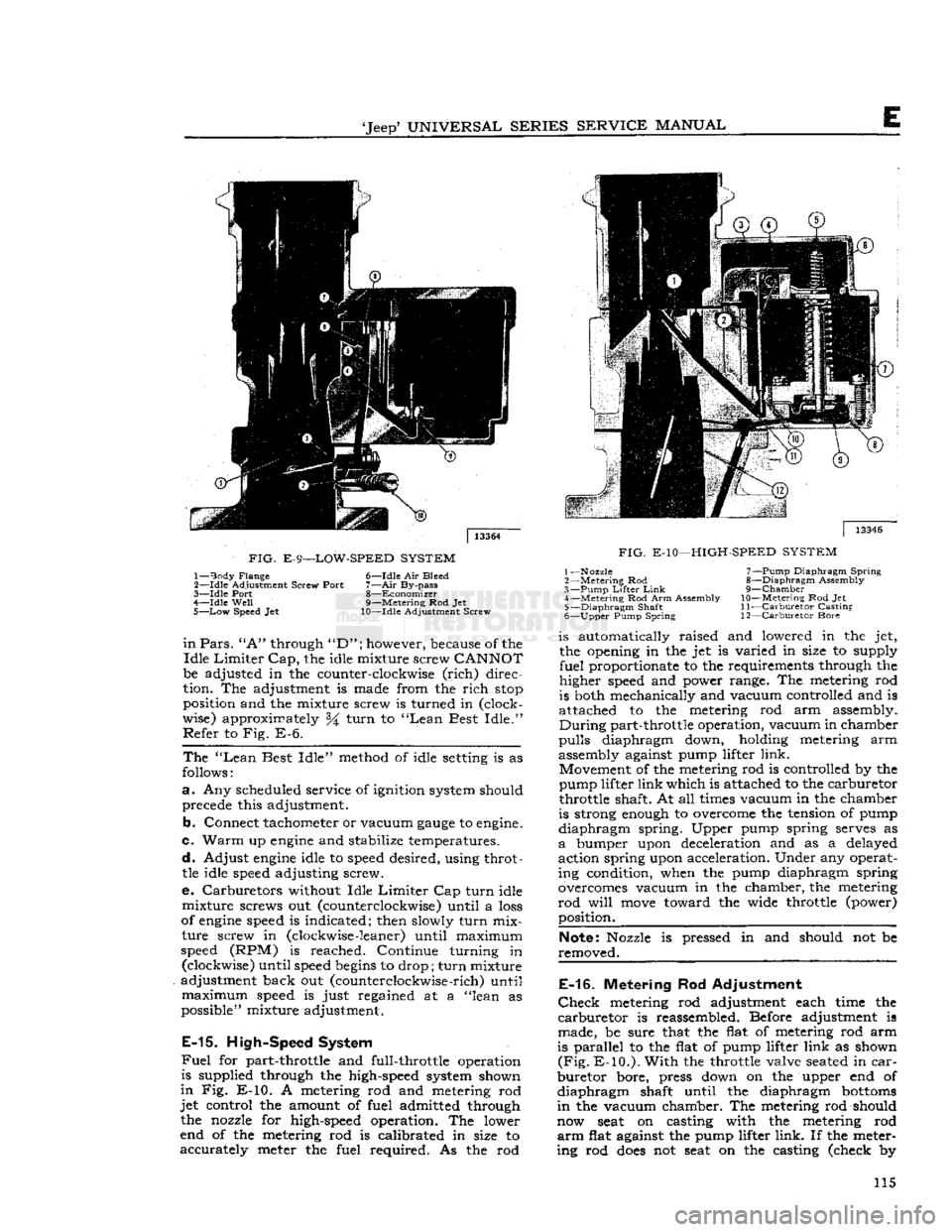
speed system is illustrated in Fig.
E-9.
Liquid
fuel enters the idle well through the metering rod jet.
Low-speed
jet measures the amount of fuel for
idle and early part-throttle operation. Air-by-pass,
economizer, and idle air bleed are carefully
cali
brated
orifices which serve to break up the liquid
fuel
and mix it with air as it
moves
through the passage to the idle port and idle adjustment screw
port.
E-14.
Idle Mixture Adjustment
Note:
The idle mixture adjustment procedure for
the late model
YF-4941S
and
YF-6115S
Carter
Carburetor
equipped with the
External
Idle
Mixture
Limiter
Cap is the same as outlined below 114
Page 115 of 376
'Jeep*
UNIVERSAL
SERIES
SERVICE
MANUAL
E
FIG.
E-9—LOW-SPEED
SYSTEM
1—
Body
Flange 6—Idle Air Bleed
2—
-Idle
Adjustment Screw Port
7—Air
By-pass
3—
Idle
Port 8—Economizer
4—
Idle
Well
9—Metering Rod Jet
5—
Low
Speed Jet 10—Idle Adjustment Screw
in
Pars.
"A"
through
"D";
however, because of the
Idle
Limiter
Cap,
the idle mixture screw
CANNOT
be adjusted in the counter-clockwise
(rich)
direc
tion. The adjustment is made from the
rich
stop
position and the mixture screw is turned in (clock
wise) approximately %
turn
to
"Lean
Best
Idle."
Refer
to Fig. E-6.
The
"Lean
Best
Idle"
method of idle
setting
is as
follows:
a.
Any scheduled service of ignition system should precede this adjustment.
b.
Connect tachometer or vacuum
gauge
to
engine.
c.
Warm
up
engine
and stabilize temperatures.
d.
Adjust
engine
idle to
speed
desired, using throttle idle
speed
adjusting screw.
e. Carburetors without Idle
Limiter
Cap
turn
idle
mixture
screws out (counterclockwise) until a
loss
of
engine
speed
is indicated; then slowly
turn
mix
ture
screw in (clockwise
-leaner)
until maximum
speed
(RPM) is reached. Continue turning in (clockwise) until
speed
begins
to drop;
turn
mixture
adjustment back out (counterclockwise
-rich)
until
maximum
speed
is just regained at a "lean as
possible" mixture adjustment.
E-15.
High-Speed System
Fuel
for part-throttle and full-throttle operation
is supplied through the high-speed system shown
in
Fig. E-10. A metering rod and metering rod
jet
control the amount of fuel admitted through the nozzle for high-speed operation. The lower
end of the metering rod is calibrated in size to
accurately
meter the fuel required. As the rod
|
13346
FIG.
E-10—HIGH-SPEED
SYSTEM
1—Nozzle 7—Pump Diaphragm
Spring
2
—Metering
Rod 8—Diaphragm Assembly
3—
Pump
Lifter
Link
9—Chamber
4—
Metering
Rod Arm Assembly
10—Metering
Rod Jet 5—
Diaphragm
Shaft
11—Carburetor
Casting
6—
Upper
Pump Spring 12—Carburetor Bore is automatically raised and lowered in the jet,
the opening in the jet is varied in size to supply
fuel
proportionate to the requirements through the
higher
speed
and power range. The metering rod
is both mechanically and vacuum controlled and is
attached to the metering rod arm assembly.
During
part-throttle operation, vacuum in chamber
pulls
diaphragm down, holding metering arm
assembly against pump lifter
link.
Movement of the metering rod is controlled by the
pump lifter
link
which is attached to the carburetor
throttle shaft. At all
times
vacuum in the chamber
is strong
enough
to overcome the tension of pump
diaphragm
spring. Upper pump spring serves as
a
bumper upon deceleration and as a delayed
action spring upon acceleration. Under any operat ing condition, when the pump diaphragm spring
overcomes vacuum in the chamber, the metering
rod
will
move
toward the wide throttle (power) position.
Note:
Nozzle is pressed in and should not be
removed.
E-16.
Metering Rod Adjustment
Check
metering rod adjustment each time the
carburetor
is reassembled. Before adjustment is
made, be sure that the flat of metering rod arm
is parallel to the flat of pump lifter
link
as shown
(Fig.
E-10.).
With
the throttle valve
seated
in
car
buretor
bore, press down on the upper end of
diaphragm
shaft until the diaphragm
bottoms
in
the vacuum chamber. The metering rod should
now
seat
on casting with the metering rod
arm
flat against the pump lifter
link.
If the meter
ing rod
does
not
seat
on the casting (check by 115
Page 116 of 376
E
FUEL
SYSTEM
pressing downward on metering rod) or
seats
be
fore the metering rod arm makes flat contact with the pump lifter link, make adjustment by bending
the lip on the metering rod arm.
E-17.
Choke System
The
choke system consists of a manually-operated
choke valve, a fast-idle connecting rod, and a fast-
idle arm. The choke valve is offset-spring loaded to prevent over-choking during the starting warm-
up period. When the choke valve is moved to a closed position for starting, the fast idle connector
rod
in Fig. E-ll revolves the fast idle link.
This
action increases the
engine
idle speed to prevent stalling during the warm-up period. A fast-idle
connector rod return spring prevents partial closing
of the choke valve. pump lifter which is connected to the throttle.
This
movement forces fuel from the chamber
above the diaphragm through discharge pump check valve and discharge pump jet.
This
auxiliary discharge of fuel supplies
engine
requirements for
quick
acceleration and heavy loads. When the
throttle is closed, the diaphragm is again pulled
down by high vacuum and another measured
charge of fuel enters the chamber above the
diaphragm
through the intake passage to be
available for the next cycle of operation.
Note:
The pump jet (see insert drawing in Fig.
E-12)
projecting into the air stream is permanently pressed into the carburetor body and should not
be removed. Also, carburetor design makes it im possible to adjust the pump stroke.
FIG.
E-ll—FAST
IDLE
ADJUSTMENT
1—Fast
Idle
Connector Rod
2—Fast
Idle
Link
E-18.
Fast
Idle Adjustment
With
the choke held in wide open position, lip (No. 1) (Fig.
E-ll)
on the fast-idle rod should con
tact the
boss
on the body casting. Adjust by bend
ing the fast-idle link at
offset
as shown by (No. 2).
E-19.
Accelerating Pump System
The
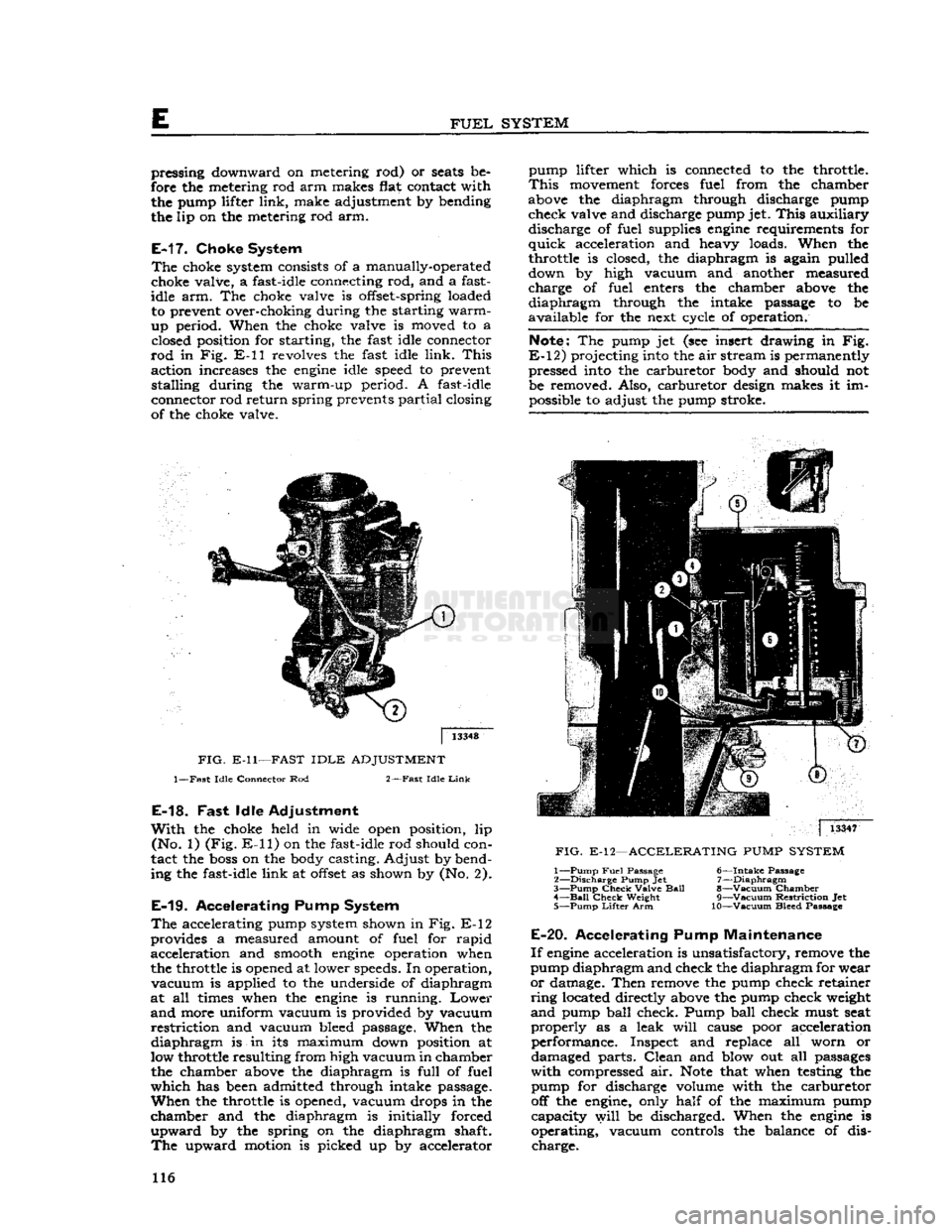
accelerating pump system shown in Fig. E-12
provides a measured amount of fuel for rapid acceleration and smooth
engine
operation when
the throttle is opened at lower speeds. In operation,
vacuum
is applied to the underside of diaphragm
at all times when the
engine
is running.
Lower
and
more uniform vacuum is provided by vacuum
restriction
and vacuum bleed passage. When the
diaphragm
is in its maximum down position at
low throttle resulting from high vacuum in chamber the chamber above the diaphragm is full of fuel
which
has been admitted through intake passage.
When
the throttle is opened, vacuum drops in the
chamber and the diaphragm is initially forced
upward
by the spring on the diaphragm shaft.
The
upward motion is picked up by accelerator
|
13347
FIG.
E-12—ACCELERATING
PUMP
SYSTEM
1—
Pump
Fuel
Passage
6—Intake
Passage
2—
Discharge
Pump Jet 7—Diaphragm
3—
Pump
Check
Valve
Ball
8—Vacuum Chamber 4—
Bail
Check
Weight
9—Vacuum
Restriction
Jet
5—
Pump
Lifter
Arm 10—Vacuum Bleed Passage
E-20.
Accelerating Pump Maintenance
If
engine
acceleration is unsatisfactory, remove the
pump diaphragm and check the diaphragm for wear
or
damage. Then remove the pump check retainer
ring
located directly above the pump check weight
and
pump ball check. Pump ball check must seat
properly
as a leak
will
cause poor acceleration performance. Inspect and replace all worn or
damaged parts.
Clean
and blow out all passages
with
compressed air.
Note
that when testing the pump for discharge volume with the carburetor
off the engine, only half of the maximum pump capacity
will
be discharged. When the
engine
is
operating, vacuum controls the balance of dis charge. 116
Page 122 of 376
E
FUEL
SYSTEM
port into the venturi.
The
check
ball
in the pump plunger head is a vapor
vent for the pump well. Without this vent, vapor
pressure in the pump would force fuel from the
pump system into the
engine
manifold, causing
hard
starting when the
engine
is hot.
There
is another
hole
in the pump lever, into which
the accelerator pump rod can be inserted to pro vide quicker pump action.
This
adjustment setting
is used only in extreme cold temperature condi tions. The pump discharge check
ball
in the dis
charge passage prevents discharge of fuel from the
pump nozzles when the accelerator pump is in
operative.
E-31.
Choke System
The
choke system consists of a manually-operated
choke valve, a fast-idle connecting rod, and a fast-
idle arm. The choke valve is offset-spring loaded
to prevent over-choking during the starting
warm-
up period. When the choke valve is moved to a
closed position for starting, the fast idle connector
rod
revolves the fast idle
link.
This
action increases
the
engine
idle speed to prevent stalling during the
warm-up
period. A fast-idle connector rod return
spring
prevents
partial
closing of the choke valve.
E-32.
Carburetor
Removal
a.
Remove attaching wing nut and air cleaner from
carburetor.
b. Remove throttle cable from
ball
stud on throttle
lever adapter.
c.
Disconnect fuel line from carburetor inlet fitting.
d.
Disconnect positive crankcase ventilator
hose
from
nipple on carburetor body.
e. Disconnect distributor vacuum line from throttle body of carburetor.
f. Remove four attaching cap screws, carburetor,
and
gasket from intake manifold.
E-33.
Air
Horn
Body Removal and Disassembly
a.
Remove attaching screws, and carefully lift air
horn
body upward to remove from fuel bowl body.
b. Place air horn body in inverted position on
bench. Remove float hinge pin and lift float as sembly from cover. Remove inlet valve
needle
from
float arm. Remove
needle
seat, fiber gasket
and
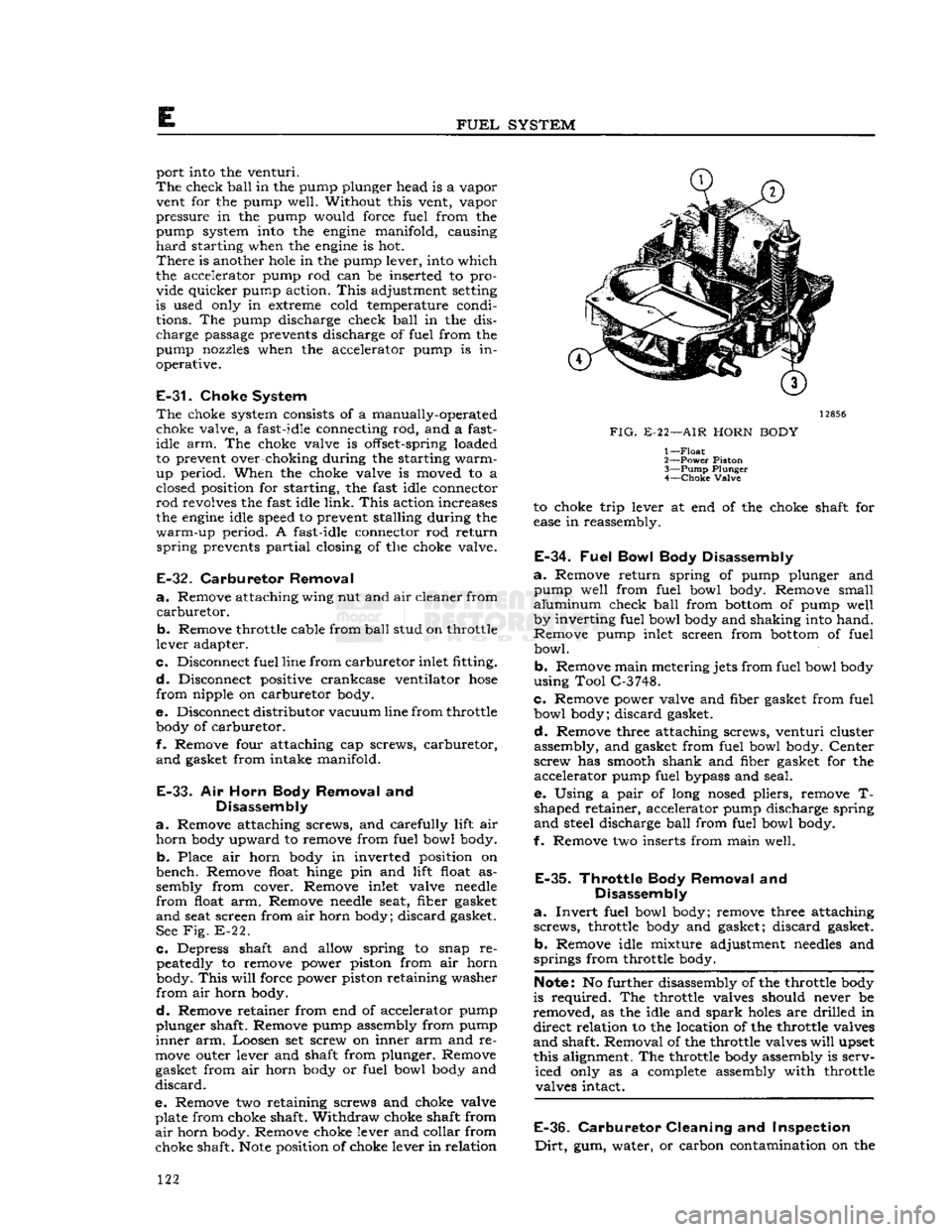
seat screen from air horn body; discard gasket. See Fig. E-22.
c.
Depress shaft and allow spring to snap re peatedly to remove power piston from air horn body.
This
will
force power piston retaining washer
from
air horn body.
d.
Remove retainer from end of accelerator pump
plunger shaft. Remove pump assembly from pump
inner
arm. Loosen set screw on inner arm and re
move
outer lever and shaft from plunger. Remove gasket from air horn body or fuel bowl body and
discard.
e. Remove two retaining screws and choke valve plate from choke shaft. Withdraw choke shaft from
air
horn body. Remove choke lever and collar from
choke shaft.
Note
position of choke lever in relation
12856
FIG.
E-22—AIR HORN BODY
1
—
Float
2— Power Piston
3—
Pump
Plunger
4—
Choke
Valve to choke trip lever at end of the choke shaft for
ease
in reassembly.
E-34.
Fuel
Bowl Body Disassembly
a.
Remove return spring of pump plunger and pump well from fuel bowl body. Remove small
aluminum
check
ball
from
bottom
of pump well
by inverting fuel bowl body and shaking into hand. Remove pump inlet screen from
bottom
of fuel bowl.
b. Remove main metering jets from fuel bowl body
using Tool C-3748.
c.
Remove power valve and fiber gasket from fuel bowl body; discard gasket.
d.
Remove three attaching screws, venturi cluster
assembly, and gasket from fuel bowl body. Center
screw has smooth shank and fiber gasket for the accelerator pump fuel bypass and seal.
e. Using a
pair
of long nosed pliers, remove T-
shaped retainer, accelerator pump discharge spring
and
steel discharge
ball
from fuel bowl body.
f. Remove two inserts from main well.
E-35.
Throttle Body Removal and Disassembly
a.
Invert
fuel bowl body; remove three attaching
screws,
throttle body and gasket; discard gasket.
b. Remove idle mixture adjustment
needles
and
springs from throttle body.
Note:
No further disassembly of the throttle body
is required. The throttle valves should never be
removed, as the idle and
spark
holes
are drilled in
direct
relation to the location of the throttle valves
and
shaft. Removal of the throttle valves
will
upset
this alignment. The throttle body assembly is serv iced only as a complete assembly with throttle valves intact.
E-36.
Carburetor
Cleaning and Inspection
Dirt,
gum, water, or carbon contamination on the 122
Page 127 of 376
'Jeep'
UNIVERSAL
SERIES
SERVICE
MANUAL
E
E-47.
Reassembly
•
Refer to Fig. E-29.
Install
the valve gaskets, valves, valve retainer and
secure them with the valve retainer screws. Make
sure that the inlet and
outlet
valves are in their proper positions. Place the diaphragm spring re
tainer in position on the diaphragm
pull
rod
and
install diaphragm spring. Position the
dia
phragm assembly in pump
body
and attach the
cover to pump body, with file marks aligned, with
the six attaching screws. Do not draw the screws
up tight.
Install
rocker arm spring, rocker arm
pin
washers, rocker arm and rocker arm pin.
With
rocker
arm positioned on the diaphragm rod, draw
the six pump
body
screws up evenly and securely.
Install
the filter screen, cork gasket and sediment
bowl and secure them firmly with the thumb screw
on the bowl clamp.
E-48.
Vacuum
Pump
The
double-action fuel pump resembles two single-
action pumps placed one
above
the other. A single
fuel pump rocker arm actuates the two separate diaphragms. One diaphragm is part of the fuel
delivery pump and operates as described in Par.
E-45.
The other diaphragm is part of the vacuum
pump and operates as described here.
As
the actuating lever forces the diaphragm upward against spring pressure, air is forced through the
outlet
port
into
the
engine's
intake manifold. On
the return stroke, spring pressure forces the
dia
phragm downward, creating a
partial
vacuum and
opening the inlet valve. In this manner, air is pumped out of the windshield wiper motor and
into
the intake manifold. When the wiper motor is shut off, manifold vacuum holds the diaphragm against its spring so that the
full
motion of the actuating
lever is not accompanied by a
complete
up-and-
down motion of the diaphragm.
When
the windshield wiper motor is turned on, but manifold vacuum is greater than the vacuum
created by the
booster
pump, air
flows
from the
wiper motor through both valves of the vacuum
booster.
As manifold vacuum drops off as a result
of the
engine
operating under low
speed
and high load, the vacuum created by the vacuum
booster
will
be greater than
engine
intake manifold vacuum
and
the pump
will
operate the wiper motor when the wiper control switch is turned on.
•
Refer to Fig. E-29. Remove the
eight
cover attaching screws and
lockwashers, and remove the cover, diaphragm
spring
and spring seat. Detach the diaphragm rod
from the rocker arm and remove the diaphragm.
The
valve assemblies are pressed
into
the cover
and
body
and lightly staked. They may be removed
with the point of a knife blade. If installing new valves be sure the inlet and
outlet
valves are
correctly positioned and stake them lightly with
a
small punch.
Assemble the vacuum pump in the reverse order
of disassembly, drawing the cover attaching screws up evenly and tightly.
E-49.
Fuel
Pump
Testing
Four
tests
are presented in following paragraphs to
test
for proper operation of the fuel pump. In addi
tion, check the following:
a.
Check
for secure mounting of the fuel pump.
The
rocker arm may be working the entire pump
up and down, rather than just the pump
dia
phragms.
b. Remove and clean the fuel sediment bowl.
c.
Check
all fuel lines.
E-50.
Volume
Check
To
measure fuel pump capacity (amount of fuel
delivered in a given time) disconnect the pump-to-
carburetor
line at the carburetor end. Place the
open
end of the line in a suitable container.
Start
the
engine
and operate at normal idle speed.
Delivery
should be one quart U.S. [1 ltr.] within
one minute.
E-51.
Pressure
Check
To
measure fuel pump pressure (force of fuel de
livery)
disconnect the pump-to-carburetor line
at the carburetor end. Plug a pressure
gauge
and T-fitting
into
the
open
end of this line and
into
the
carburetor.
Start
the
engine
and operate at normal
idle speed. Pressure should be 2J4 to 3% psi.
[0,716
a
0,264
kg-cm2] at 1800 rpm. and at 16"
[406 mm.]
above
the
outlet.
E-52.
Vacuum
Check
To
measure fuel pump vacuum (pull of. the pump
at the inlet side) disconnect the pump-to-fuel-tank
line at the fuel pump. Attach a vacuum
gauge
to the fuel pump inlet.
Start
the
engine,
accelerate to
specified speed, and hold this
engine
speed
while
taking a
gauge
reading. Permissible
gauge
reading
is 8* [203 mm.] of mercury [Hg] at 1200 rpm. and
10j^'
[267 mm.] at 1800 rpm.
E-53.
Vacuum
Booster
Check
To
test
the condition of the vacuum
booster
pump,
disconnect both inlet and
outlet
lines at the pump.
Attach
a vacuum
gauge
to the windshield wiper
connection at the pump.
Start
the
engine,
accelerate
to
2000
rpm., and hold this
engine
speed
while taking a
gauge
reading. Permissible
gauge
reading
is 10* to 14" [254 a 356 cm.] of mercury [Hg].
E-54.'
FUEL
PUMP
(SINGLE-ACTION)
—
HURRICANE
F4
ENGINE
•
Early
Models.
Vehicles with electric windshield wiper motors are
equipped with a single-action fuel pump (Fig.
E-30).
The fuel pump cam lever is activated by an eccentric on the
engine
camshaft. When the
car
buretor float
needle
valve closes, accumulation of
fuel in the pump
extends
the diaphragm spring.
This
action causes the rocker arm linkage to be
come
inoperative until the pressure on the
dia
phragm and spring is reduced. The fuel pump dis
charge pressure is thus controlled by the diaphragm
spring.
This
provides a steady supply of fuel to the
carburetor
at a fairly constant pressure. 127
Page 129 of 376
'Jeep9
UNIVERSAL
SERIES
SERVICE
MANUAL
E-59.
Fuel
Pump Installation
a.
Make certain mating surfaces of fuel pump and
engine
cylinder case are clean. Cement a new gasket
to mounting
flange
of fuel pump.
b. Position fuel pump on cylinder block, so that
cam
lever of pump rests on fuel pump cam of cam
shaft. Secure pump to block with two cap screws
and
lock washers.
c. Connect intake and
outlet
fuel lines to fuel
pump.
E-60.
FUEL
PUMP
(SINGLE-ACTION)
—
HURRICANE
F4
ENGINE
•
Late
Models.
The
Hurricane F4
engine
is equipped with a single-
action fuel pump (Fig.
E-31).
The fuel pump cam lever is activated by an eccentric on the
engine
camshaft. When the carburetor float
needle
valve
closes, accumulation of fuel in the pump
extends
the diaphragm spring.
This
action causes the rocker
arm
linkage to
become
inoperative until the pres
sure on the diaphragm and spring is reduced. The fuel pump discharge pressure is thus controlled by
the diaphragm spring.
This
provides a steady sup ply of fuel to the carburetor at a fairly constant
pressure.
E-61.
Fuel
Pump Removal
To
remove the fuel pump from the
engine,
dis
connect the inlet and
outlet
fuel lines. Remove
the two fuel pump
body
attaching nuts, lock washers, and washers, and pull the fuel pump and
gasket free of the
engine.
E-62.
Fuel
Pump Disassembly
Note:
The fuel pump is serviced with a repair kit.
Individual
service parts are also available. The
valves are not replaceable but are serviced as part
of the valve housing.
•
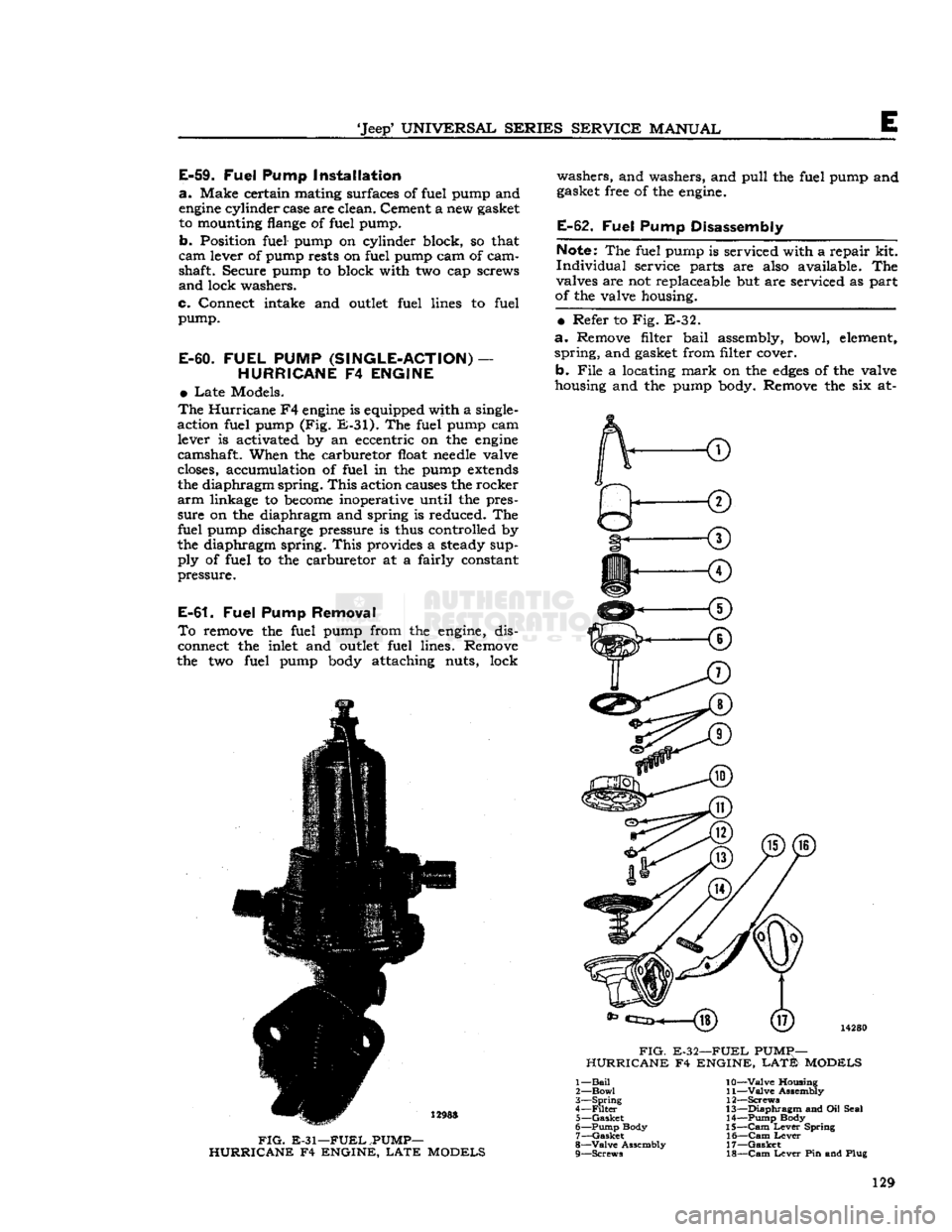
Refer to Fig. E-32.
a.
Remove filter bail assembly, bowl,
element,
spring,
and gasket from filter cover. b.
File
a locating
mark
on the
edges
of the valve
housing and the pump body. Remove the six at-
14280
FIG.
E-32—FUEL
PUMp—
HURRICANE F4 ENGINE,
LATE
MODELS
12988
FIG.
E-31—FUEL
.PUMP-
HURRICANE F4 ENGINE,
LATE
MODELS 1—
Bail
2—
Bowl
3—
Spring
4—
Filter
5—
Gasket
6— Pump Body 7—
Gasket
8—
Valve
Assembly 9— Screws 10—
Valve
Housing
11—
Valve
Assembly
12— Screws
13—
Diaphragm
and Oil Seal 14— Pump Body
15—
Cam
Lever
Spring 16—
Cam
Lever
17—
Gasket
18—
Cam
Lever
Pin and Plug 129