oil change JEEP GLADIATOR 2023 User Guide
[x] Cancel search | Manufacturer: JEEP, Model Year: 2023, Model line: GLADIATOR, Model: JEEP GLADIATOR 2023Pages: 448, PDF Size: 17.37 MB
Page 356 of 448

354SERVICING AND MAINTENANCE
MAINTENANCE PLAN
Refer to the maintenance plan for the required maintenance intervals.
NOTE:Using white lithium grease, lubricate the door hinge joints twice a year to prevent premature wear.
At Every Oil Change Interval As Indicated By Oil Change Indicator System:
Change oil and filter.
Rotate the tires at the first sign of irregular wear, even if it occurs before the oil indicator system turns on.
Inspect battery and clean and tighten terminals as required.
Inspect the CV/Universal joints.
Inspect brake pads, shoes, rotors, drums, hoses and parking brake.
Inspect engine cooling system protection and hoses.
Inspect exhaust system.
Inspect engine air cleaner filter if using in dusty or off-road conditions, replace engine air cleaner filter if necessary.
Inspect all door latches for presence of grease, reapply if necessary.
23_JT_OM_EN_USC_t.book Page 354
Page 359 of 448

SERVICING AND MAINTENANCE357
SCHEDULED SERVICING — DIESEL ENGINE
Your vehicle is equipped with an automatic oil
change indicator system. The oil change indicator
system will remind you that it is time to take your
vehicle in for scheduled maintenance.
Based on engine operation conditions, the oil
change indicator message will illuminate. This
means that service is required for your vehicle.
Operating conditions such as frequent short-trips,
trailer tow, extremely hot or cold ambient
temperatures will influence when the “Oil Change
Required” message is displayed. Have your vehicle
serviced as soon as possible, within the next
500 miles (805 km).
An authorized dealer will reset the oil change
indicator message after completing the scheduled
oil change. If a scheduled oil change is performed
by someone other than an authorized dealer, to
reset the message Úpage 121.
NOTE:Under no circumstances should oil change
intervals exceed 10,000 miles (16,000 km) or
12 months, whichever comes first.
Engine Oil Filter Replacement
Residual oil in the housing may spill from the
housing when the new filter is installed if the
residual oil is not either removed from the housing
or enough time has not elapsed to allow the oil to
drain back into the engine. When servicing the oil
filter on this engine, open the filter cap
approximately six turns until the cap o-ring is
visible and stop. Wait five minutes with the cap in
this position to allow dirty engine oil to drain back
into the engine. After five minutes, the cap and
filter assembly can be removed and discarded. Once A Month Or Before A Long Trip:Check engine oil level
Check windshield washer fluid level
Check the tire pressures and look for unusual
wear or damage
Check the fluid levels of the coolant reservoir,
brake master cylinder, and fill as needed
Check function of all interior and exterior lights
8
23_JT_OM_EN_USC_t.book Page 357
Page 360 of 448

358SERVICING AND MAINTENANCE
MAINTENANCE PLAN — DIESEL FUEL UP TO B5 BIODIESEL
Refer to the Maintenance Plans for required maintenance.
At Every Oil Change Interval As Indicated By Oil Change Indicator System:
Change oil and filter.
Completely fill the Diesel Exhaust Fluid tank.
Drain water from fuel filter assembly.
Rotate the tires at the first sign of irregular wear, even if it occurs before the oil indicator system turns on.
Inspect battery and clean and tighten terminals as required.
Inspect the CV/Universal joints.
Inspect brake pads, shoes, rotors, drums, hoses and parking brake.
Inspect engine cooling system protection and hoses.
Inspect exhaust system.
Inspect engine air cleaner filter if using in dusty or off-road conditions, replace engine air cleaner filter if necessary.
At Every Second Oil Change Interval As Indicated By Oil Change Indicator System:
Change fuel filter.
23_JT_OM_EN_USC_t.book Page 358
Page 362 of 448

360SERVICING AND MAINTENANCE
Replace fuel filters and drain water from the fuel filter
assembly. Under normal conditions the diesel fuel filter should be replaced every other oil change and
must not exceed 20,000 miles (32,000 km) if using diesel fuel up to B5. If the vehicle is being used in severe operating conditions, or in certain geographical areas of the country
(Pennsylvania, New York, Ohio, Maryland, West Virginia, Arkansas, Oklahoma, Kansas, Iowa,
Missouri and Nebraska) due to fuel cleanliness issues, it is recommended to replace the fuel filter every oil change and must not exceed 10,000 miles.
Replace engine air cleaner filter. XXXXX
Replace the cabin air filter. To be replaced every 12,000 miles (19,000 km).
Flush and replace the engine coolant at 10 years or
150,000 miles (240,000 km) whichever comes first. X
X
Replace accessory drive belt(s). X
Change transfer case fluid if using your vehicle for any of
the following: police, taxi, fleet, or frequent trailer towing. X
X
Mileage Or Time Passed (Whichever Comes First)
10,000
20,000
30,000
40,000
50,000
60,000
70,000
80,000
90,000
100,000
110,000
120,000
130,000
140,000
150,000
Or Years: 1 2 3 4 5 6 7 8 9 10 11 12 13 14 15
Or Kilometers:
16,000
32,000
48,000
64,000
80,000
96,000
112,000
128,000
144,000
160,000
176,000
192,000
208,000
224,000
240,000
23_JT_OM_EN_USC_t.book Page 360
Page 363 of 448

SERVICING AND MAINTENANCE361
ADDITIONAL MAINTENANCE — B6 TO B20 BIODIESEL
NOTE:
Under no circumstances should oil change intervals exceed 8,000 miles (12,875 km) or six months, whichever comes first when using biodiesel blends
greater than 5% (B5).
The owner is required to monitor mileage for B6-B20 biodiesel, the automatic oil change indicator system does not reflect the use of biofuels.
Fuel filter change interval is maintained at every second oil change. This is especially important with biodiesel usage.
For more information on using biodiesel Ú page 422.
WARNING!
You can be badly injured working on or around a motor vehicle. Do only service work for which you have the knowledge and the right equipment. If you have
any doubt about your ability to perform a service job, take your vehicle to a competent mechanic.
Failure to properly inspect and maintain your vehicle could result in a component malfunction and affect vehicle handling and performance. This could cause
an accident.
8
23_JT_OM_EN_USC_t.book Page 361
Page 368 of 448
366SERVICING AND MAINTENANCE
American Petroleum Institute (API)
Approved Engine Oil
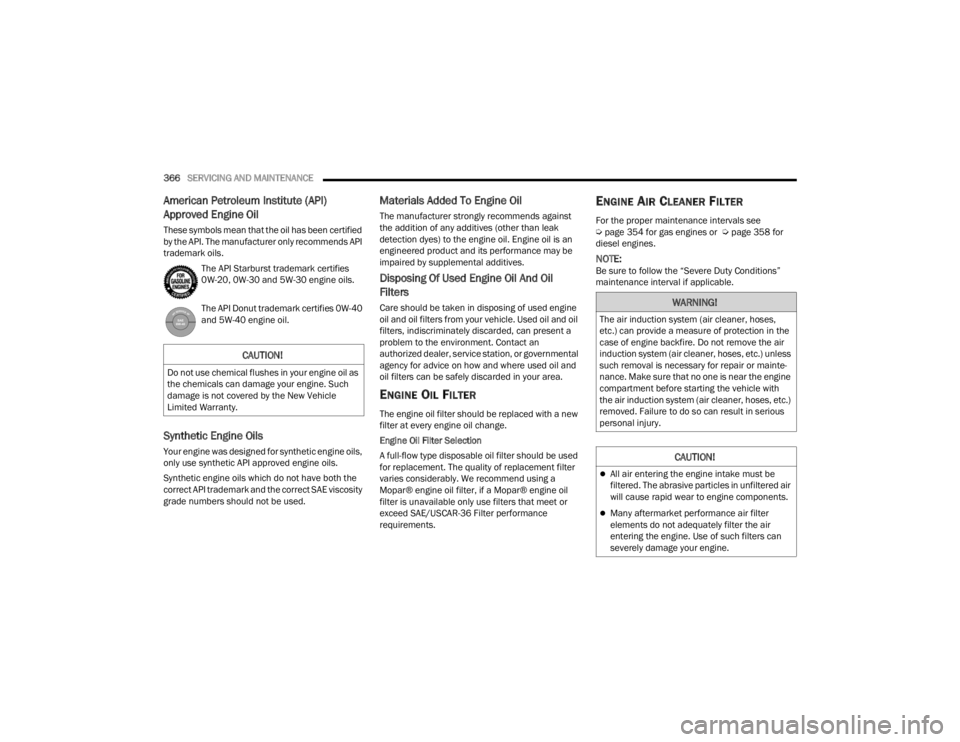
These symbols mean that the oil has been certified
by the API. The manufacturer only recommends API
trademark oils.
The API Starburst trademark certifies
0W-20, 0W-30 and 5W-30 engine oils.
The API Donut trademark certifies 0W-40
and 5W-40 engine oil.
Synthetic Engine Oils
Your engine was designed for synthetic engine oils,
only use synthetic API approved engine oils.
Synthetic engine oils which do not have both the
correct API trademark and the correct SAE viscosity
grade numbers should not be used.
Materials Added To Engine Oil
The manufacturer strongly recommends against
the addition of any additives (other than leak
detection dyes) to the engine oil. Engine oil is an
engineered product and its performance may be
impaired by supplemental additives.
Disposing Of Used Engine Oil And Oil
Filters
Care should be taken in disposing of used engine
oil and oil filters from your vehicle. Used oil and oil
filters, indiscriminately discarded, can present a
problem to the environment. Contact an
authorized dealer, service station, or governmental
agency for advice on how and where used oil and
oil filters can be safely discarded in your area.
ENGINE OIL FILTER
The engine oil filter should be replaced with a new
filter at every engine oil change.
Engine Oil Filter Selection
A full-flow type disposable oil filter should be used
for replacement. The quality of replacement filter
varies considerably. We recommend using a
Mopar® engine oil filter, if a Mopar® engine oil
filter is unavailable only use filters that meet or
exceed SAE/USCAR-36 Filter performance
requirements.
ENGINE AIR CLEANER FILTER
For the proper maintenance intervals see
Úpage 354 for gas engines or Ú page 358 for
diesel engines.
NOTE:Be sure to follow the “Severe Duty Conditions”
maintenance interval if applicable.
CAUTION!
Do not use chemical flushes in your engine oil as
the chemicals can damage your engine. Such
damage is not covered by the New Vehicle
Limited Warranty.
WARNING!
The air induction system (air cleaner, hoses,
etc.) can provide a measure of protection in the
case of engine backfire. Do not remove the air
induction system (air cleaner, hoses, etc.) unless
such removal is necessary for repair or mainte -
nance. Make sure that no one is near the engine
compartment before starting the vehicle with
the air induction system (air cleaner, hoses, etc.)
removed. Failure to do so can result in serious
personal injury.
CAUTION!
All air entering the engine intake must be
filtered. The abrasive particles in unfiltered air
will cause rapid wear to engine components.
Many aftermarket performance air filter
elements do not adequately filter the air
entering the engine. Use of such filters can
severely damage your engine.
23_JT_OM_EN_USC_t.book Page 366
Page 378 of 448
376SERVICING AND MAINTENANCE
(Continued)
EXHAUST SYSTEM
The best protection against carbon monoxide entry
into the vehicle body is a properly maintained
engine exhaust system.
If you notice a change in the sound of the exhaust
system, or if the exhaust fumes can be detected
inside the vehicle, or when the underside or rear of
the vehicle is damaged, have an authorized
technician inspect the complete exhaust system
and adjacent body areas for broken, damaged,
deteriorated, or mispositioned parts. Open seams
or loose connections could permit exhaust fumes
to seep into the passenger compartment. In
addition, have the exhaust system inspected each
time the vehicle is raised for lubrication or oil
change. Replace as required. Under normal operating conditions, the catalytic
converter will not require maintenance. However, it
is important to keep the engine properly tuned to
ensure proper catalyst operation and prevent
possible catalyst damage.
NOTE:Intentional tampering with emissions control
systems can result in civil penalties being
assessed against you.
In unusual situations involving grossly
malfunctioning engine operation, a scorching odor
may suggest severe and abnormal catalyst
overheating. If this occurs, stop the vehicle, turn off
the engine and allow it to cool. Service, including a
tune-up to manufacturer's specifications, should
be obtained immediately.
To minimize the possibility of catalytic converter
damage:
Do not interrupt the ignition when the transmis
-
sion is in gear and the vehicle is in motion.
Do not try to start the vehicle by pushing or
towing the vehicle.
Do not idle the engine with any ignition compo -
nents disconnected or removed, such as when
diagnostic testing, or for prolonged periods
during very rough idle or malfunctioning oper -
ating conditions.
WARNING!
Exhaust gases can injure or kill. They contain
Carbon Monoxide (CO), which is colorless and
odorless. Breathing it can make you uncon -
scious and can eventually poison you. To
avoid breathing CO see Ú page 328.
A hot exhaust system can start a fire if you
park over materials that can burn, such as
grass or leaves, and those items that come
into contact with your exhaust system. Do not
park or operate your vehicle in areas where
your exhaust system can contact anything that
can burn.
CAUTION!
The catalytic converter requires the use of
unleaded fuel only. Leaded gasoline will
destroy the effectiveness of the catalyst as an
emissions control device, may seriously
reduce engine performance and cause
serious damage to the engine.
Damage to the catalytic converter can result if
your vehicle is not kept in proper operating
condition. In the event of engine malfunction,
particularly involving engine misfire or other
apparent loss of performance, have your
vehicle serviced promptly. Continued opera -
tion of your vehicle with a severe malfunction
could cause the converter to overheat,
resulting in possible damage to the converter
and vehicle.
WARNING!
23_JT_OM_EN_USC_t.book Page 376
Page 424 of 448

422TECHNICAL SPECIFICATIONS
BIODIESEL FUEL REQUIREMENTS
A maximum blend of 5% biodiesel meeting ASTM
specification D975 is recommended for use with
your diesel engine. If frequent operation with
biodiesel blends that are between 6% and 20%
(B6–B20) is desired, the maintenance schedule is
subject to shorter intervals.
The oil and filter change along with fuel filter
replacement is subject to shorter intervals when
operating your engine on biodiesel greater than
5%. Do not use biodiesel greater than 20%.
For regular use of biodiesel blends between 6%
and 20% (B6–B20) it is important that you
understand and comply with these requirements
Úpage 358.
Biodiesel is a fuel produced from renewable
resources typically derived from animal fat,
rapeseed oil (Rapeseed Methyl Ester (RME) base),
or soybean oil (Soy Methyl Ester (SME or SOME)
base). Biodiesel fuel has inherent limitations which
require that you understand and adhere to the
following requirements if you use blends of
biodiesel between 6% and 20% (B6–B20). There
are no unique restrictions for the use of B5.
Biodiesel Fuel Properties — Low Ambient
Temperatures
Biodiesel fuel may gel or solidify at low ambient
temperatures, which may pose problems for both
storage and operation. Precautions can be
necessary at low ambient temperatures, such as
storing the fuel in a heated building or a heated
storage tank, or using cold temperature additives.
Fuel Quality — Must Comply With ASTM
Standards
The quality of Biodiesel fuel may vary widely. Only
fuel produced by a BQ9000 supplier to the
following specifications may be blended to meet
biodiesel blend B6 – B20 fuel meeting ASTM
specification D-7467:
Petrodiesel fuel meeting ASTM specification
D-975 and biodiesel fuel (B100) meeting ASTM
specification D-6751
Fuel Oxidation Stability — Must Use Fuel
Within Six Months Of Manufacture
Biodiesel fuel has poor oxidation stability which
can result in long term storage problems. Fuel
produced to approved ASTM standards, if stored
properly, provides for protection against fuel
oxidation for up to six months.
CAUTION!
Failure to comply with Oil Change requirements
for vehicles operating on biodiesel blends
between 6% and 20% (B6–B20) will result in
premature engine wear. Such wear is not
covered by the New Vehicle Limited Warranty.
CAUTION!
Use of blends greater than 20% is not approved.
Use of blends greater than 20% can result in
engine damage. Such damage is not covered by
the New Vehicle Limited Warranty.
CAUTION!
In the event that the vehicle is filled with
biodiesel and not used for more than a month,
the fuel should either be used up by driving (up
to quarter tank) and filled with standard diesel
blends with less than 5% that is normally
available. This will help prevent the fuel filter
clogging and potential damage to the fuel
injection system due to degraded biodiesel,
which is not covered by the New Vehicle Limited
Warranty.
23_JT_OM_EN_USC_t.book Page 422
Page 425 of 448

TECHNICAL SPECIFICATIONS423
Fuel Water Separation — Must Use
Mopar® Approved Fuel Filter Elements
Biodiesel fuel has a natural affinity to water and
water accelerates microbial growth. Your Mopar®
filtration system is designed to provide adequate
fuel water separation capabilities.
Fuel In Oil Dilution — Must Adhere To
Required Oil Change Interval
Fuel dilution of lubricating oil has been observed
with the use of biodiesel fuel. Fuel in oil must not
exceed 5%. To ensure this limit is met your oil
change interval must be maintained within the
suggested schedule. The regular use of biodiesel
between 6% and 20% requires intervals shorter
than the outlined 10,000 miles (16,000 km) and must not exceed the suggested schedule. When
routinely operating on biodiesel between 6% and
20%, oil and filter replacement intervals must not
exceed 8,000 miles (13,000 km) or six months,
which ever comes first.
Biodiesel Fuel Filter Change Intervals
The use of biodiesel requires more frequent fuel
filter change intervals. When operating on
biodiesel between 6% and 20%, fuel filter
replacement intervals should be every second oil
change, and must not exceed 16,000 miles
(25,750 km).
NOTE:Under no circumstances should oil change
intervals exceed 8,000 miles (12,875 km) or six
months, if regular operation occurs with 6% - 20%
biodiesel blends. Under no circumstances should
fuel filter replacement intervals exceed every
second oil change and must not exceed
16,000 miles (25,750 km), if regular operation
occurs with 6% - 20% biodiesel blends. Failure to
comply with these Oil Change and fuel filter
requirements for vehicles operating on biodiesel
blends up to B20 may result in premature engine
wear. Such wear is not covered by the New Vehicle
Limited Warranty. The engine may suffer severe
damage if operated with concentrations of
biodiesel higher than 20%.
FLUID CAPACITIES
US
Metric
Fuel (Approximate)
3.6L Gasoline Engine 22.0 gal83.0 L
Engine Oil with Filter
3.6L Gasoline Engine 5.0 qt4.7 L
Cooling System *
3.6L Gasoline Engine 13.0 qt12.3 L
*Includes coolant recovery bottle filled to MAX level.
9
23_JT_OM_EN_USC_t.book Page 423
Page 439 of 448

437
Headlights Automatic
.................................................... 58Bulb Replacement..................................... 393Cleaning.................................................... 412High Beam/Low Beam Select Switch.......... 57Lights On Reminder............................ 58, 140Passing........................................................ 58Replacing.................................................. 393Switch......................................................... 56Heated Mirrors................................................ 52Heated Seats................................................... 47Heated Steering Wheel.................................... 42High Beam/Low Beam Select (Dimmer)
Switch.............................................................. 57Hill Start Assist.............................................. 283HitchesTrailer Towing............................................ 199HomeLink (Garage Door Opener).................... 52Hood Prop...................................................... 109Hood Release................................................ 109
I
Ignition............................................................ 18Switch......................................................... 18Ignition Park Interlock.................................... 156In Case Of Emergency................................... 332Inside Rearview Mirror..................................... 50
Instrument ClusterAudio........................................................ 125Display...................................................... 121Driver Assist............................................. 124Engine Oil Reset....................................... 122Fuel Economy........................................... 125Off Road................................................... 124Screen Setup............................................ 126Speedometer............................................ 124Stop Start................................................. 125Stored Messages...................................... 125Trip........................................................... 125Vehicle Info............................................... 124Instrument Panel Lens Cleaning................... 417Integrated Power Module (Fuses)................. 383Interior And Instrument Lights......................... 59Interior Appearance Care.............................. 414Interior Lights................................................... 59Intervention Regeneration Strategy.............. 371InverterPower.......................................................... 78
J
Jack Location................................................ 336Jack Operation.............................................. 339Jacking and Tire Changing
S
..................... 335Jacking Instructions...................................... 339
Jeep Wireless Speaker..............................72, 76Charging......................................................73Location.......................................................73Pairing.........................................................75Resetting.....................................................75Speakerphone.............................................75Waterproof Features....................................76Jump Starting................................................ 343
K
Key Fob............................................................15Arm The System...........................................23Disarm The System......................................23Programming Additional Key Fobs...............17Key Fob Battery Service (Remote Keyless
Entry)...............................................................16Key Fob Programming (Remote Keyless
Entry)...............................................................17Keyless Enter 'n Go™.......................................25Passive Entry...............................................25Keys.................................................................15Replacement...............................................17
L
Lane Change Assist..........................................59Lap/Shoulder Belts....................................... 300Latches......................................................... 330Hood......................................................... 10911
23_JT_OM_EN_USC_t.book Page 437