child restraint JEEP GLADIATOR 2023 Owner's Manual
[x] Cancel search | Manufacturer: JEEP, Model Year: 2023, Model line: GLADIATOR, Model: JEEP GLADIATOR 2023Pages: 448, PDF Size: 17.37 MB
Page 325 of 448
SAFETY323
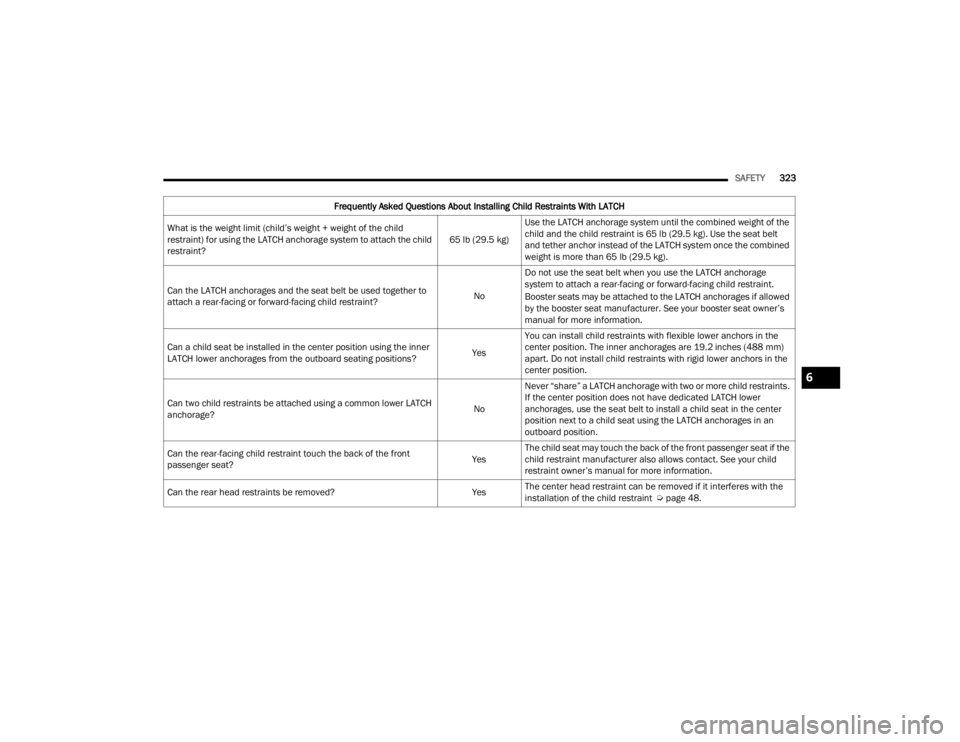
Frequently Asked Questions About Installing Child Restraints With LATCH
What is the weight limit (child’s weight + weight of the child
restraint) for using the LATCH anchorage system to attach the child
restraint? 65 lb (29.5 kg)Use the LATCH anchorage system until the combined weight of the
child and the child restraint is 65 lb (29.5 kg). Use the seat belt
and tether anchor instead of the LATCH system once the combined
weight is more than 65 lb (29.5 kg).
Can the LATCH anchorages and the seat belt be used together to
attach a rear-facing or forward-facing child restraint? NoDo not use the seat belt when you use the LATCH anchorage
system to attach a rear-facing or forward-facing child restraint.
Booster seats may be attached to the LATCH anchorages if allowed
by the booster seat manufacturer. See your booster seat owner’s
manual for more information.
Can a child seat be installed in the center position using the inner
LATCH lower anchorages from the outboard seating positions? YesYou can install child restraints with flexible lower anchors in the
center position. The inner anchorages are 19.2 inches (488 mm)
apart. Do not install child restraints with rigid lower anchors in the
center position.
Can two child restraints be attached using a common lower LATCH
anchorage? NoNever “share” a LATCH anchorage with two or more child restraints.
If the center position does not have dedicated LATCH lower
anchorages, use the seat belt to install a child seat in the center
position next to a child seat using the LATCH anchorages in an
outboard position.
Can the rear-facing child restraint touch the back of the front
passenger seat? YesThe child seat may touch the back of the front passenger seat if the
child restraint manufacturer also allows contact. See your child
restraint owner’s manual for more information.
Can the rear head restraints be removed? YesThe center head restraint can be removed if it interferes with the
installation of the child restraint Ú
page 48.
6
23_JT_OM_EN_USC_t.book Page 323
Page 326 of 448
324SAFETY
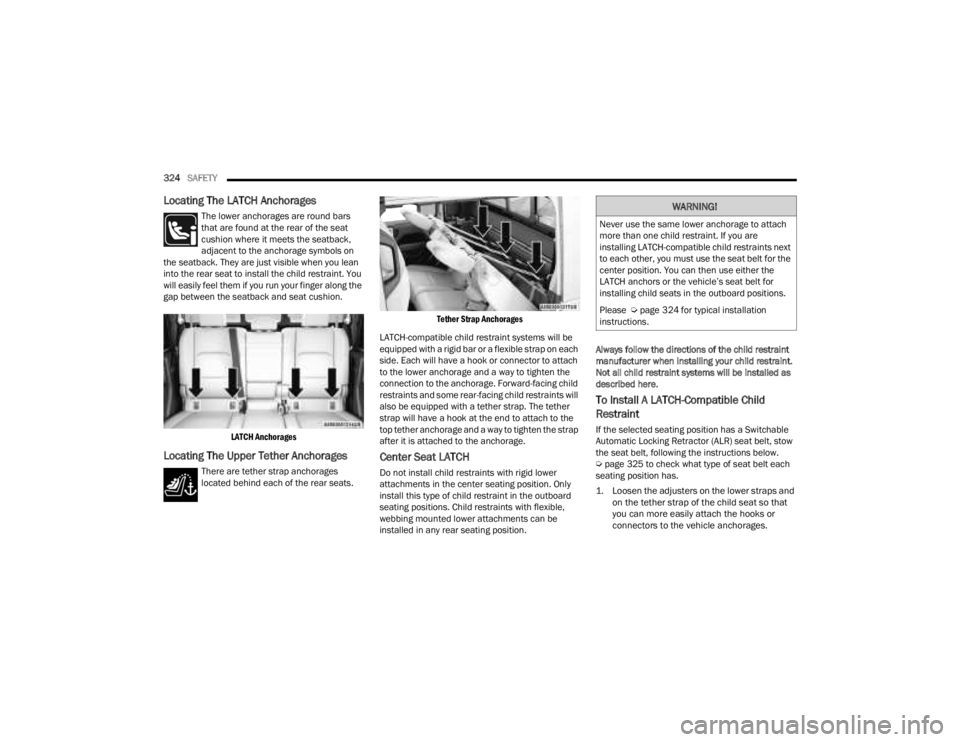
Locating The LATCH Anchorages
The lower anchorages are round bars
that are found at the rear of the seat
cushion where it meets the seatback,
adjacent to the anchorage symbols on
the seatback. They are just visible when you lean
into the rear seat to install the child restraint. You
will easily feel them if you run your finger along the
gap between the seatback and seat cushion.
LATCH Anchorages
Locating The Upper Tether Anchorages
There are tether strap anchorages
located behind each of the rear seats.
Tether Strap Anchorages
LATCH-compatible child restraint systems will be
equipped with a rigid bar or a flexible strap on each
side. Each will have a hook or connector to attach
to the lower anchorage and a way to tighten the
connection to the anchorage. Forward-facing child
restraints and some rear-facing child restraints will
also be equipped with a tether strap. The tether
strap will have a hook at the end to attach to the
top tether anchorage and a way to tighten the strap
after it is attached to the anchorage.
Center Seat LATCH
Do not install child restraints with rigid lower
attachments in the center seating position. Only
install this type of child restraint in the outboard
seating positions. Child restraints with flexible,
webbing mounted lower attachments can be
installed in any rear seating position. Always follow the directions of the child restraint
manufacturer when installing your child restraint.
Not all child restraint systems will be installed as
described here.
To Install A LATCH-Compatible Child
Restraint
If the selected seating position has a Switchable
Automatic Locking Retractor (ALR) seat belt, stow
the seat belt, following the instructions below.
Ú
page 325 to check what type of seat belt each
seating position has.
1. Loosen the adjusters on the lower straps and on the tether strap of the child seat so that
you can more easily attach the hooks or
connectors to the vehicle anchorages.
WARNING!
Never use the same lower anchorage to attach
more than one child restraint. If you are
installing LATCH-compatible child restraints next
to each other, you must use the seat belt for the
center position. You can then use either the
LATCH anchors or the vehicle’s seat belt for
installing child seats in the outboard positions.
Please Ú page 324 for typical installation
instructions.
23_JT_OM_EN_USC_t.book Page 324
Page 327 of 448
SAFETY325
(Continued)
2. Place the child seat between the lower
anchorages for that seating position. If the
second row seat can be reclined, you may
recline the seat and/or raise the head restraint
(if adjustable) to get a better fit. If the rear seat
can be moved forward and rearward in the
vehicle, you may wish to move it to its
rear-most position to make room for the child
seat. You may also move the front seat forward
to allow more room for the child seat.
3. Attach the lower hooks or connectors of the child restraint to the lower anchorages in the
selected seating position.
4. If the child restraint has a tether strap, connect it to the top tether anchorage. See
Úpage 327 for directions to attach a tether
anchor.
5. Tighten all of the straps as you push the child restraint rearward and downward into the
seat. Remove slack in the straps according to
the child restraint manufacturer’s instructions.
6. Test that the child restraint is installed tightly by pulling back and forth on the child seat at
the belt path. It should not move more than
1 inch (25.4 mm) in any direction.
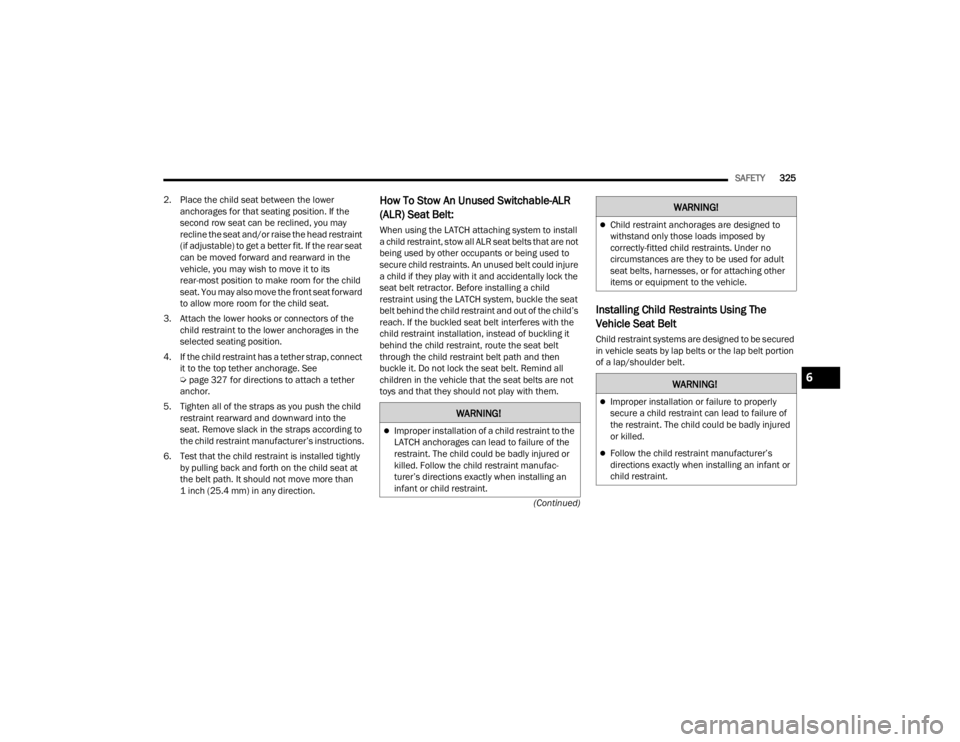
How To Stow An Unused Switchable-ALR
(ALR) Seat Belt:
When using the LATCH attaching system to install
a child restraint, stow all ALR seat belts that are not
being used by other occupants or being used to
secure child restraints. An unused belt could injure
a child if they play with it and accidentally lock the
seat belt retractor. Before installing a child
restraint using the LATCH system, buckle the seat
belt behind the child restraint and out of the child’s
reach. If the buckled seat belt interferes with the
child restraint installation, instead of buckling it
behind the child restraint, route the seat belt
through the child restraint belt path and then
buckle it. Do not lock the seat belt. Remind all
children in the vehicle that the seat belts are not
toys and that they should not play with them.
Installing Child Restraints Using The
Vehicle Seat Belt
Child restraint systems are designed to be secured
in vehicle seats by lap belts or the lap belt portion
of a lap/shoulder belt.
WARNING!
Improper installation of a child restraint to the
LATCH anchorages can lead to failure of the
restraint. The child could be badly injured or
killed. Follow the child restraint manufac -
turer’s directions exactly when installing an
infant or child restraint.
Child restraint anchorages are designed to
withstand only those loads imposed by
correctly-fitted child restraints. Under no
circumstances are they to be used for adult
seat belts, harnesses, or for attaching other
items or equipment to the vehicle.
WARNING!
Improper installation or failure to properly
secure a child restraint can lead to failure of
the restraint. The child could be badly injured
or killed.
Follow the child restraint manufacturer’s
directions exactly when installing an infant or
child restraint.
WARNING!
6
23_JT_OM_EN_USC_t.book Page 325
Page 328 of 448
326SAFETY
The seat belts in the passenger seating positions
are equipped with a Switchable Automatic Locking
Retractor (ALR) that is designed to keep the lap
portion of the seat belt tight around the child
restraint so that it is not necessary to use a locking
clip. The ALR retractor can be “switched” into a
locked mode by pulling all of the webbing out of the
retractor and then letting the webbing retract back
into the retractor. If it is locked, the ALR will make
a clicking noise while the webbing is pulled back
into the retractor. See the “Automatic Locking Mode” description
Ú
page 304 for additional information on ALR.
Please see the table below and the following
sections for more information.
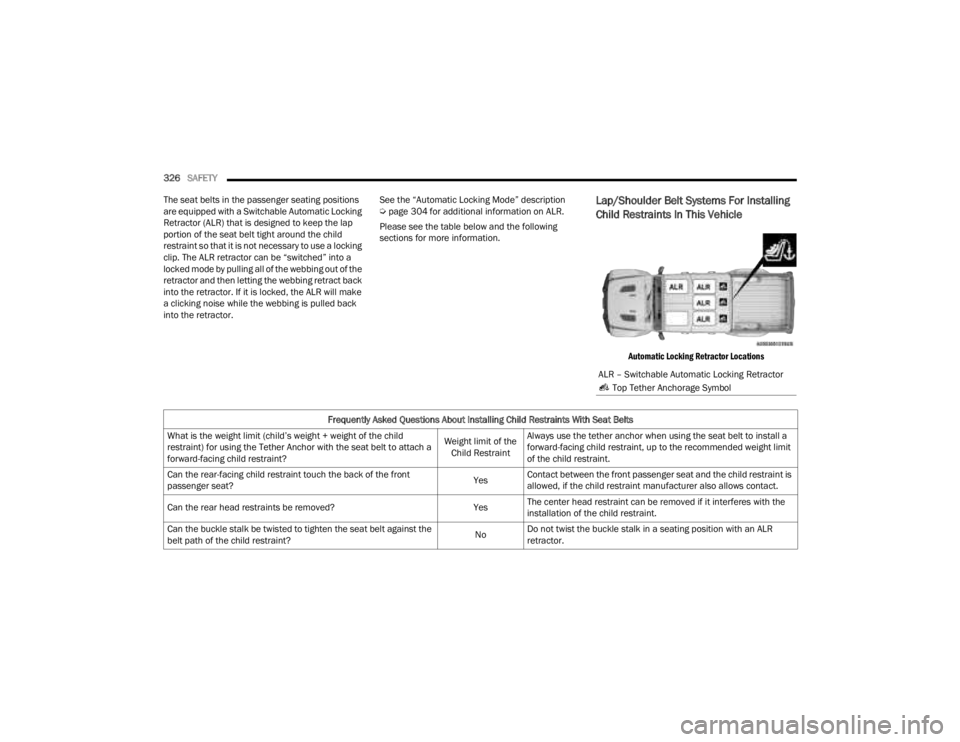
Lap/Shoulder Belt Systems For Installing
Child Restraints In This Vehicle
Automatic Locking Retractor Locations
ALR – Switchable Automatic Locking Retractor Top Tether Anchorage Symbol
Frequently Asked Questions About Installing Child Restraints With Seat Belts
What is the weight limit (child’s weight + weight of the child
restraint) for using the Tether Anchor with the seat belt to attach a
forward-facing child restraint? Weight limit of the
Child Restraint Always use the tether anchor when using the seat belt to install a
forward-facing child restraint, up to the recommended weight limit
of the child restraint.
Can the rear-facing child restraint touch the back of the front
passenger seat? YesContact between the front passenger seat and the child restraint is
allowed, if the child restraint manufacturer also allows contact.
Can the rear head restraints be removed? YesThe center head restraint can be removed if it interferes with the
installation of the child restraint.
Can the buckle stalk be twisted to tighten the seat belt against the
belt path of the child restraint? NoDo not twist the buckle stalk in a seating position with an ALR
retractor.
23_JT_OM_EN_USC_t.book Page 326
Page 329 of 448
SAFETY327
Installing A Child Restraint With A
Switchable Automatic Locking Retractor
(ALR):
Child restraint systems are designed to be secured
in vehicle seats by lap belts or the lap belt portion
of a lap/shoulder belt.
1. Place the child seat in the center of the
seating position. If the second row seat can
be reclined, you may recline the seat and/or
raise the head restraint (if adjustable) to get a
better fit. If the rear seat can be moved
forward and rearward in the vehicle, you may
wish to move it to its rear-most position to
make room for the child seat. You may also
move the front seat forward to allow more
room for the child seat.
2. Pull enough of the seat belt webbing from the
retractor to pass it through the belt path of the
child restraint. Do not twist the belt webbing in
the belt path.
3. Slide the latch plate into the buckle until you hear a “click.”
4. Pull on the webbing to make the lap portion tight against the child seat.
5. To lock the seat belt, pull down on the shoulder part of the belt until you have pulled all the
seat belt webbing out of the retractor. Then,
allow the webbing to retract back into the
retractor. As the webbing retracts, you will hear
a clicking sound. This means the seat belt is
now in the Automatic Locking mode.
6. Try to pull the webbing out of the retractor. If it is locked, you should not be able to pull out any
webbing. If the retractor is not
locked, repeat
step 5.
7. Finally, pull up on any excess webbing to tighten the lap portion around the child
restraint while you push the child restraint
rearward and downward into the vehicle seat.
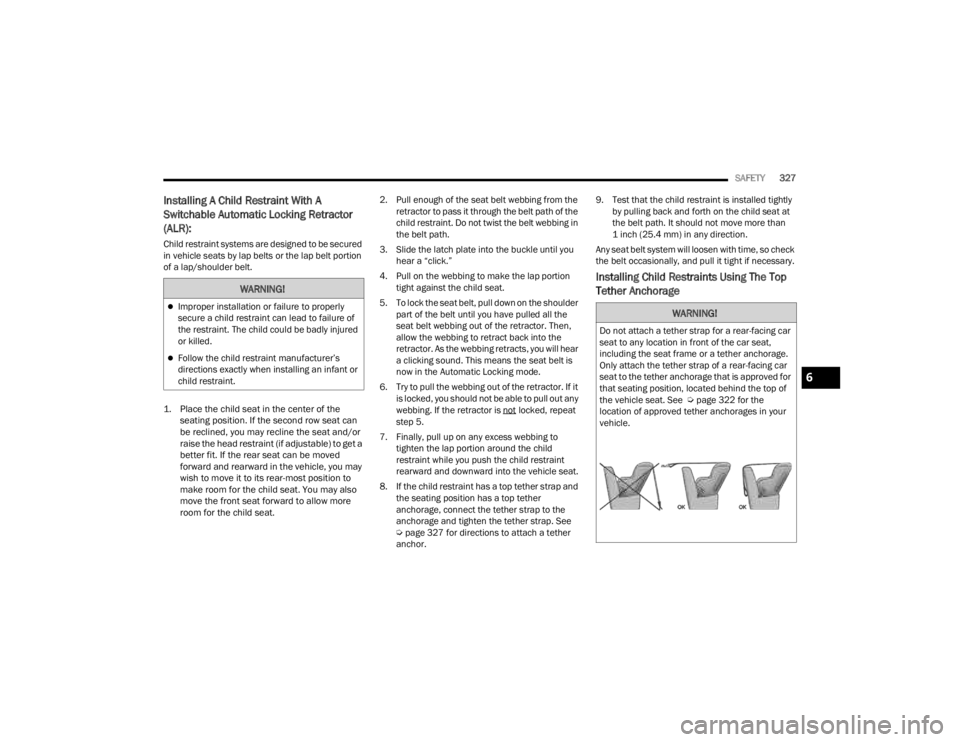
8. If the child restraint has a top tether strap and the seating position has a top tether
anchorage, connect the tether strap to the
anchorage and tighten the tether strap. See
Úpage 327 for directions to attach a tether
anchor. 9. Test that the child restraint is installed tightly
by pulling back and forth on the child seat at
the belt path. It should not move more than
1 inch (25.4 mm) in any direction.
Any seat belt system will loosen with time, so check
the belt occasionally, and pull it tight if necessary.
Installing Child Restraints Using The Top
Tether AnchorageWARNING!
Improper installation or failure to properly
secure a child restraint can lead to failure of
the restraint. The child could be badly injured
or killed.
Follow the child restraint manufacturer’s
directions exactly when installing an infant or
child restraint.
WARNING!
Do not attach a tether strap for a rear-facing car
seat to any location in front of the car seat,
including the seat frame or a tether anchorage.
Only attach the tether strap of a rear-facing car
seat to the tether anchorage that is approved for
that seating position, located behind the top of
the vehicle seat. See Ú page 322 for the
location of approved tether anchorages in your
vehicle.
6
23_JT_OM_EN_USC_t.book Page 327
Page 330 of 448
328SAFETY
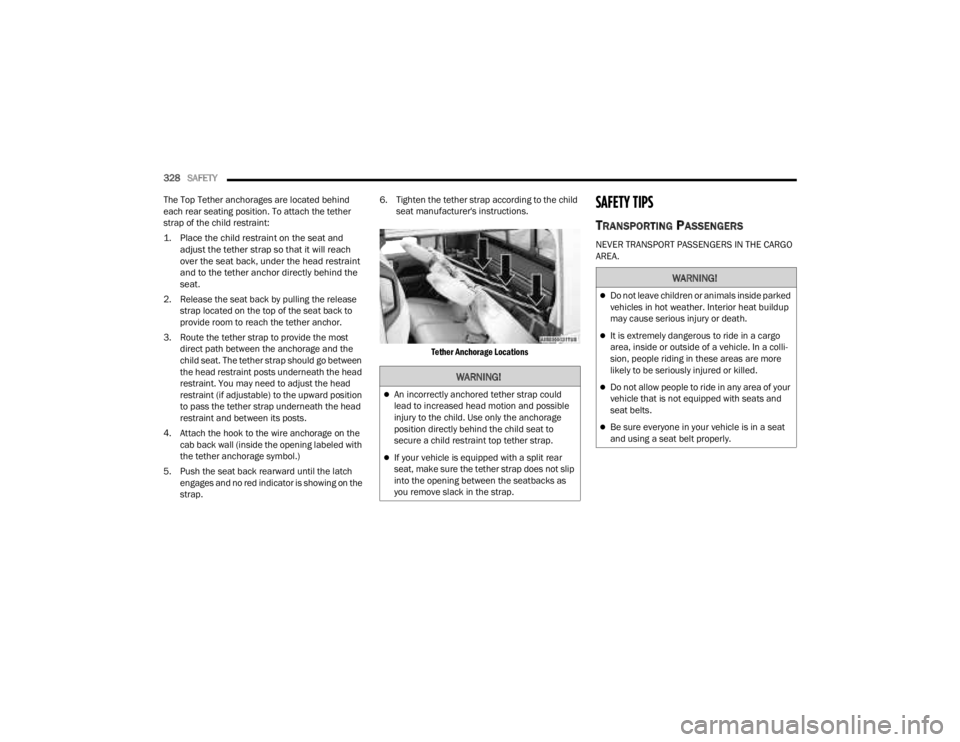
The Top Tether anchorages are located behind
each rear seating position. To attach the tether
strap of the child restraint:
1. Place the child restraint on the seat and adjust the tether strap so that it will reach
over the seat back, under the head restraint
and to the tether anchor directly behind the
seat.
2. Release the seat back by pulling the release strap located on the top of the seat back to
provide room to reach the tether anchor.
3. Route the tether strap to provide the most direct path between the anchorage and the
child seat. The tether strap should go between
the head restraint posts underneath the head
restraint. You may need to adjust the head
restraint (if adjustable) to the upward position
to pass the tether strap underneath the head
restraint and between its posts.
4. Attach the hook to the wire anchorage on the cab back wall (inside the opening labeled with
the tether anchorage symbol.)
5. Push the seat back rearward until the latch engages and no red indicator is showing on the
strap. 6. Tighten the tether strap according to the child
seat manufacturer's instructions.
Tether Anchorage Locations
SAFETY TIPS
TRANSPORTING PASSENGERS
NEVER TRANSPORT PASSENGERS IN THE CARGO
AREA.
WARNING!
An incorrectly anchored tether strap could
lead to increased head motion and possible
injury to the child. Use only the anchorage
position directly behind the child seat to
secure a child restraint top tether strap.
If your vehicle is equipped with a split rear
seat, make sure the tether strap does not slip
into the opening between the seatbacks as
you remove slack in the strap.
WARNING!
Do not leave children or animals inside parked
vehicles in hot weather. Interior heat buildup
may cause serious injury or death.
It is extremely dangerous to ride in a cargo
area, inside or outside of a vehicle. In a colli -
sion, people riding in these areas are more
likely to be seriously injured or killed.
Do not allow people to ride in any area of your
vehicle that is not equipped with seats and
seat belts.
Be sure everyone in your vehicle is in a seat
and using a seat belt properly.
23_JT_OM_EN_USC_t.book Page 328
Page 436 of 448
434
Belts, Seat
..................................................... 329Blind Spot Monitoring.................................... 287Bluetooth Connecting To A Particular Mobile Phone Or Audio Device After Pairing
................248Body Mechanism Lubrication........................ 374B-Pillar Location............................................. 400Brake Assist System...................................... 280Brake Control System.................................... 280Brake Fluid.......................................... 380, 426Brake System...................................... 380, 418Anti-Lock (ABS).......................................... 418Fluid Check............................................... 380Master Cylinder......................................... 380Parking...................................................... 152Warning Light............................................ 132Brake/Transmission Interlock....................... 157Bulb Replacement............................... 392, 393Bulbs, Light.......................................... 330, 392Bumper End Cap Removal............................. 208
C
Camera, Rear................................................ 189Capacities, Fluid............................................ 423Caps, FillerFuel........................................................... 191Oil (Engine)................................................ 362Radiator (Coolant Pressure)...................... 378Car Washes................................................... 412Carbon Monoxide Warning............................ 331
Carpet Safety Information............................. 414Carpeting...................................................... 415CD................................................................. 242Cellular Phone.............................................. 276Center High Mounted Stop Light................... 395Certification Label......................................... 195Chains, Tire................................................... 408Charge Air Cooler.......................................... 379Chart, Tire Sizing........................................... 397Checking Your Vehicle For Safety................. 328Checks, Safety.............................................. 328Child Restraint.............................................. 318Child RestraintsBooster Seats........................................... 321Child Seat Installation.............................. 327How To Stow An unused ALR Seat Belt.... 325Infant And Child Restraints....................... 320Locating The LATCH Anchorages.............. 324Lower Anchors And Tethers For Children.. 322Older Children And Child Restraints......... 320Seating Positions...................................... 321Clean Air Gasoline......................................... 419CleaningWheels..................................................... 407Climate Control................................................ 61Automatic.................................................... 62Manual........................................................ 64CNG And LP Fuel System Modifications........ 420Cold Weather Operation............................... 146Compact Spare Tire...................................... 406
Connected Services...................................... 258Connected Services FAQ............................... 272Connected Services Features....................... 261Connected Services, Getting Started............ 260Connected Services, Introduction................. 258ConnectorUCI...............................................................71Universal Consumer Interface (UCI).............71Console............................................................69Floor............................................................69Contract, Service........................................... 430Controls........................................................ 234Cooling Pressure Cap (Radiator Cap)............ 378Cooling System............................................. 377Adding Coolant (Antifreeze)...................... 378Coolant Level............................................ 379Cooling Capacity....................................... 423Disposal Of Used Coolant......................... 378Drain, Flush, And Refill............................. 377Inspection........................................ 377, 379Points To Remember................................ 379Pressure Cap............................................ 378Radiator Cap............................................. 378Selection Of Coolant (Antifreeze)......................... 377, 423, 424Corrosion Protection..................................... 411Cruise Control (Speed
Control)............................. 139, 140, 141, 173Customer Assistance.................................... 428Cybersecurity................................................ 214
23_JT_OM_EN_USC_t.book Page 434
Page 442 of 448
440
Rear Cargo Area Utility Rails
.......................... 111Rear Cross Path............................................. 290Rear Door Removal
S
................................... 32Rear ParkSense System................................ 184Rear Seats, Stadium Position.......................... 46Recreational Towing...................................... 205Shifting Into Transfer Case Neutral (N)..... 206Shifting Out Of Transfer Case Neutral (N).. 207Reformulated Gasoline.................................. 419Refrigerant.................................................... 373Registering SiriusXM Guardian...................... 259Release, Hood............................................... 109Reminder, Seat Belt...................................... 300Remote Control Starting System........................................... 20Remote Features, Door Lock/Unlock.. 265, 272Remote Features, Horn And Lights................266Remote Features, Starting.................. 265, 274Remote Keyless EntryArm The Alarm............................................. 23Disarm The Alarm........................................ 23Programming Additional Key Fobs.............. 17Remote Sound System (Radio) Control......... 233Remote Start (Diesel)...................................... 22Remote Start (Gas).......................................... 20Remote StartingExit Remote Start Mode.............................. 21Uconnect Customer Programmable Features.................................................. 21Uconnect Settings....................................... 21
Remote Starting System........................... 20, 22Removable Doors..................................... 28, 32Front............................................................ 28Rear............................................................. 32Removing The Hard Top
S
............................ 98Removing The Soft Top
S
............................. 92Replacement Bulbs...................................... 392Replacement Keys........................................... 17Replacement Tires........................................ 404Reporting Safety Defects.............................. 431Restraints, Child........................................... 318Restraints, Head.............................................. 48Roadside Assistance............................ 266, 272Roll Over Warning............................................ 10Roof Type Carrier.......................................... 115Rotation, Tires.............................................. 409
S
Safety........................................................... 232Safety Checks Inside Vehicle........................ 329Safety Checks Outside Vehicle..................... 330Safety Defects, Reporting............................. 431Safety Features............................................. 232Safety Information, Tire................................ 395Safety Tips.................................................... 328Safety, Exhaust Gas...................................... 331Satellite Radio.............................................. 235Saved Radio Stations................................... 240Schedule, Maintenance....................... 353, 357Seat Belt Reminder....................................... 134
Seat Belts............................................ 300, 329Adjustable Shoulder Belt.......................... 303Adjustable Upper Shoulder Anchorage..... 303Adjustable Upper Shoulder Belt Anchorage............................................ 303Automatic Locking Retractor (ALR)........... 304Child Restraints........................................ 318Energy Management Feature................... 304Extender................................................... 304Front Seat........................................ 300, 302Inspection................................................. 329Lap/Shoulder Belt Operation.................... 302Lap/Shoulder Belt Untwisting................... 303Lap/Shoulder Belts................................... 300Operating Instructions.............................. 302Pregnant Women...................................... 304Pretensioners........................................... 304Rear Seat.................................................. 300Reminder...................... 134, 140, 141, 300Seat Belt Extender.................................... 304Seat Belt Pretensioner.............................. 304Untwisting Procedure................................ 303Seat Belts Maintenance................................ 416Seats................................................................43Adjustment..................................................43Heated.........................................................47Height Adjustment.......................................44Rear Folding................................................43Tilting...........................................................43
23_JT_OM_EN_USC_t.book Page 440