weight JEEP GLADIATOR 2023 Owner's Manual
[x] Cancel search | Manufacturer: JEEP, Model Year: 2023, Model line: GLADIATOR, Model: JEEP GLADIATOR 2023Pages: 448, PDF Size: 17.37 MB
Page 316 of 448
314SAFETY
start the vehicle, or it comes on as you drive, take
the vehicle to an authorized dealer for service
immediately. The passenger seat assembly contains critical OCS
components that may affect Passenger Advanced
Front Air Bag inflation. In order for the OCS to
properly classify the seated weight of a front seat
passenger, the OCS components must function as
designed. Do not make any modifications to the
front passenger seat components, assembly, or to
the seat cover. If the seat, trim cover, or cushion
needs service for any reason, take the vehicle to
an authorized dealer. Only FCA US LLC approved
seat accessories may be used.
The following requirements must be strictly
followed:
Do not modify the front passenger seat
assembly or components in any way.
Do not use prior or future model year seat
covers or cushions not designated by FCA US
LLC for the specific model being repaired.
Always use the correct seat cover and cushion
specified for the vehicle.
Do not replace the seat cover or cushion with an
aftermarket seat cover or cushion.
Do not add a secondary seat cover or mat.
At no time should any Supplemental Restraint
System (SRS) component or SRS related
component or fastener be modified or replaced
with any part except those which are approved
by FCA US LLC.
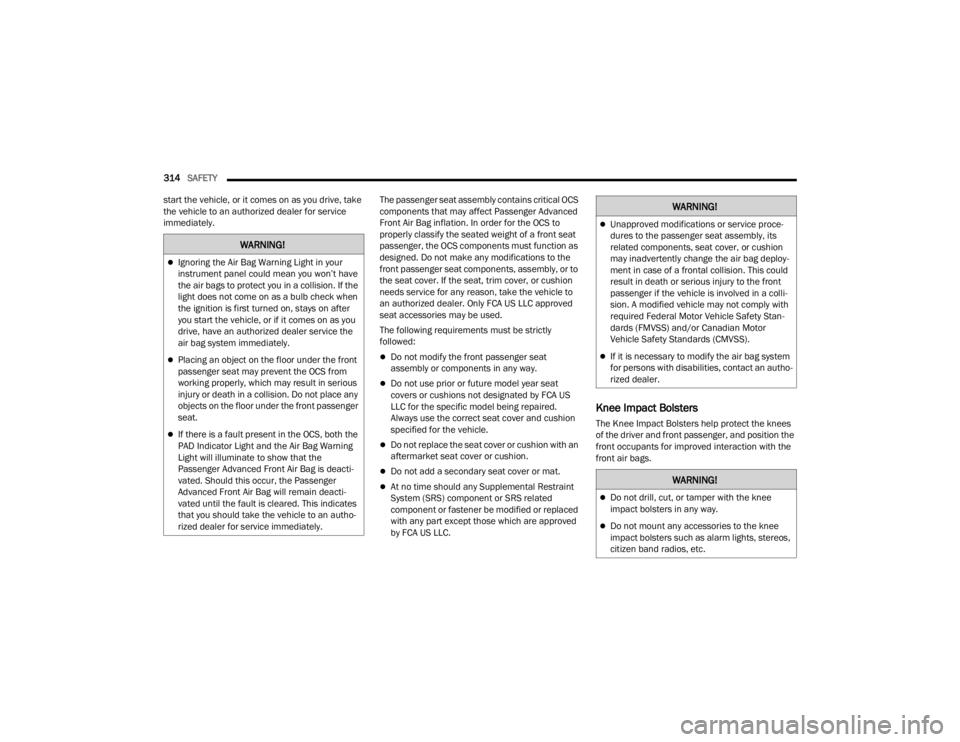
Knee Impact Bolsters
The Knee Impact Bolsters help protect the knees
of the driver and front passenger, and position the
front occupants for improved interaction with the
front air bags.
WARNING!
Ignoring the Air Bag Warning Light in your
instrument panel could mean you won’t have
the air bags to protect you in a collision. If the
light does not come on as a bulb check when
the ignition is first turned on, stays on after
you start the vehicle, or if it comes on as you
drive, have an authorized dealer service the
air bag system immediately.
Placing an object on the floor under the front
passenger seat may prevent the OCS from
working properly, which may result in serious
injury or death in a collision. Do not place any
objects on the floor under the front passenger
seat.
If there is a fault present in the OCS, both the
PAD Indicator Light and the Air Bag Warning
Light will illuminate to show that the
Passenger Advanced Front Air Bag is deacti
-
vated. Should this occur, the Passenger
Advanced Front Air Bag will remain deacti-
vated until the fault is cleared. This indicates
that you should take the vehicle to an autho -
rized dealer for service immediately.
WARNING!
Unapproved modifications or service proce-
dures to the passenger seat assembly, its
related components, seat cover, or cushion
may inadvertently change the air bag deploy -
ment in case of a frontal collision. This could
result in death or serious injury to the front
passenger if the vehicle is involved in a colli -
sion. A modified vehicle may not comply with
required Federal Motor Vehicle Safety Stan -
dards (FMVSS) and/or Canadian Motor
Vehicle Safety Standards (CMVSS).
If it is necessary to modify the air bag system
for persons with disabilities, contact an autho -
rized dealer.
WARNING!
Do not drill, cut, or tamper with the knee
impact bolsters in any way.
Do not mount any accessories to the knee
impact bolsters such as alarm lights, stereos,
citizen band radios, etc.
23_JT_OM_EN_USC_t.book Page 314
Page 321 of 448
SAFETY319
There are different sizes and types of restraints for children from newborn size to the child almost large enough for an adult safety belt. Always check the child
seat Owner’s Manual to make sure you have the correct seat for your child. Carefully read and follow all the instructions and warnings in the child restraint
Owner’s Manual and on all the labels attached to the child restraint.
Before buying any restraint system, make sure that it has a label certifying that it meets all applicable Safety Standards. You should also make sure that you can
install it in the vehicle where you will use it.
NOTE:
For additional information, refer to http://www.nhtsa.gov/parents-and-caregivers or call: 1–888–327–4236
Canadian residents should refer to Transport Canada’s website for additional information: https://www.tc.gc.ca/en/services/road/child-car-seat-safety.html
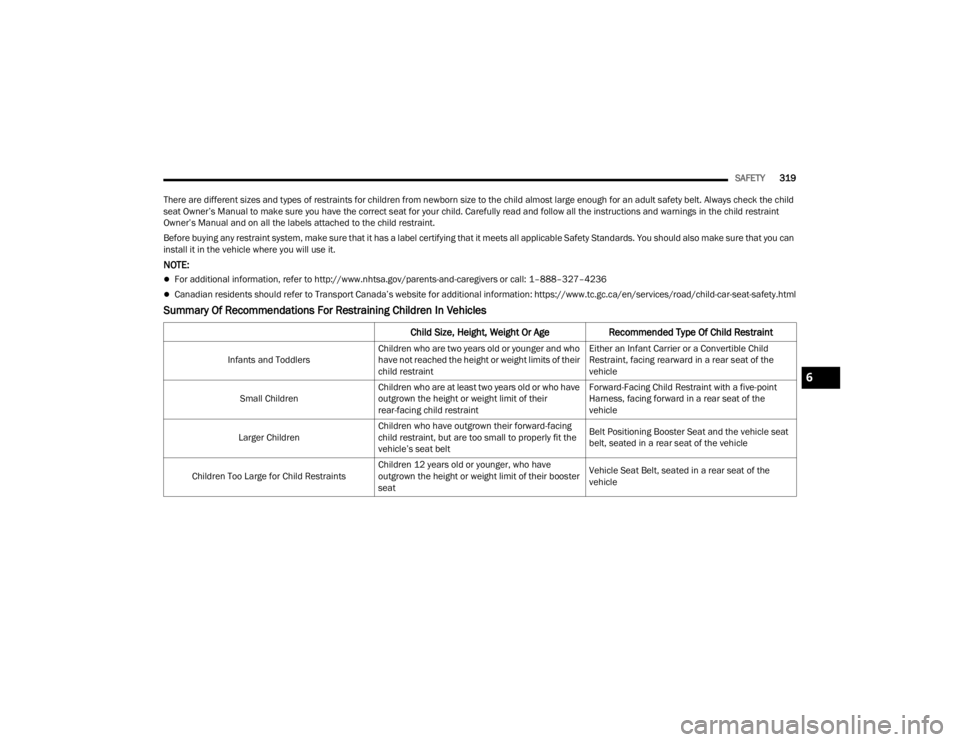
Summary Of Recommendations For Restraining Children In Vehicles
Child Size, Height, Weight Or Age Recommended Type Of Child Restraint
Infants and ToddlersChildren who are two years old or younger and who
have not reached the height or weight limits of their
child restraint Either an Infant Carrier or a Convertible Child
Restraint, facing rearward in a rear seat of the
vehicle
Small Children Children who are at least two years old or who have
outgrown the height or weight limit of their
rear-facing child restraint Forward-Facing Child Restraint with a five-point
Harness, facing forward in a rear seat of the
vehicle
Larger Children Children who have outgrown their forward-facing
child restraint, but are too small to properly fit the
vehicle’s seat belt Belt Positioning Booster Seat and the vehicle seat
belt, seated in a rear seat of the vehicle
Children Too Large for Child Restraints Children 12 years old or younger, who have
outgrown the height or weight limit of their booster
seat Vehicle Seat Belt, seated in a rear seat of the
vehicle
6
23_JT_OM_EN_USC_t.book Page 319
Page 322 of 448
320SAFETY
(Continued)
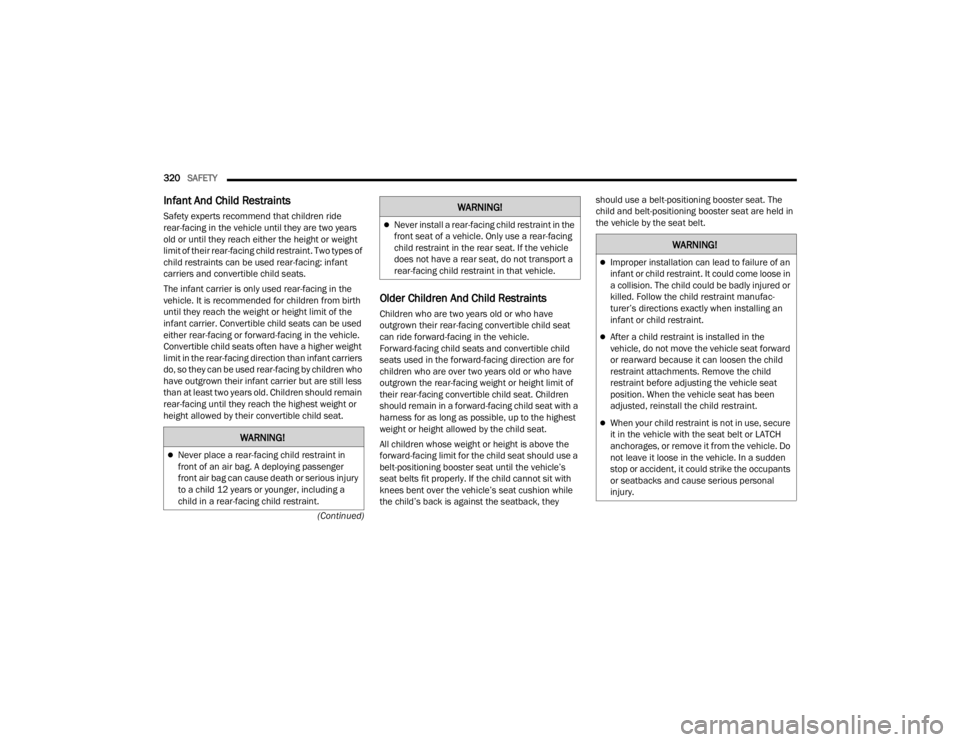
Infant And Child Restraints
Safety experts recommend that children ride
rear-facing in the vehicle until they are two years
old or until they reach either the height or weight
limit of their rear-facing child restraint. Two types of
child restraints can be used rear-facing: infant
carriers and convertible child seats.
The infant carrier is only used rear-facing in the
vehicle. It is recommended for children from birth
until they reach the weight or height limit of the
infant carrier. Convertible child seats can be used
either rear-facing or forward-facing in the vehicle.
Convertible child seats often have a higher weight
limit in the rear-facing direction than infant carriers
do, so they can be used rear-facing by children who
have outgrown their infant carrier but are still less
than at least two years old. Children should remain
rear-facing until they reach the highest weight or
height allowed by their convertible child seat.
Older Children And Child Restraints
Children who are two years old or who have
outgrown their rear-facing convertible child seat
can ride forward-facing in the vehicle.
Forward-facing child seats and convertible child
seats used in the forward-facing direction are for
children who are over two years old or who have
outgrown the rear-facing weight or height limit of
their rear-facing convertible child seat. Children
should remain in a forward-facing child seat with a
harness for as long as possible, up to the highest
weight or height allowed by the child seat.
All children whose weight or height is above the
forward-facing limit for the child seat should use a
belt-positioning booster seat until the vehicle’s
seat belts fit properly. If the child cannot sit with
knees bent over the vehicle’s seat cushion while
the child’s back is against the seatback, they should use a belt-positioning booster seat. The
child and belt-positioning booster seat are held in
the vehicle by the seat belt.
WARNING!
Never place a rear-facing child restraint in
front of an air bag. A deploying passenger
front air bag can cause death or serious injury
to a child 12 years or younger, including a
child in a rear-facing child restraint.
Never install a rear-facing child restraint in the
front seat of a vehicle. Only use a rear-facing
child restraint in the rear seat. If the vehicle
does not have a rear seat, do not transport a
rear-facing child restraint in that vehicle.
WARNING!
WARNING!
Improper installation can lead to failure of an
infant or child restraint. It could come loose in
a collision. The child could be badly injured or
killed. Follow the child restraint manufac
-
turer’s directions exactly when installing an
infant or child restraint.
After a child restraint is installed in the
vehicle, do not move the vehicle seat forward
or rearward because it can loosen the child
restraint attachments. Remove the child
restraint before adjusting the vehicle seat
position. When the vehicle seat has been
adjusted, reinstall the child restraint.
When your child restraint is not in use, secure
it in the vehicle with the seat belt or LATCH
anchorages, or remove it from the vehicle. Do
not leave it loose in the vehicle. In a sudden
stop or accident, it could strike the occupants
or seatbacks and cause serious personal
injury.
23_JT_OM_EN_USC_t.book Page 320
Page 323 of 448
SAFETY321
Children Too Large For Booster Seats
Children who are large enough to wear the
shoulder belt comfortably, and whose legs are long
enough to bend over the front of the seat when
their back is against the seatback, should use the
seat belt in a rear seat. Use this simple 5-step test
to decide whether the child can use the vehicle’s
seat belt alone:
1. Can the child sit all the way back against the
back of the vehicle seat?
2. Do the child’s knees bend comfortably over the front of the vehicle seat while the child is
still sitting all the way back? 3. Does the shoulder belt cross the child’s
shoulder between the neck and arm?
4. Is the lap part of the belt as low as possible, touching the child’s thighs and not the
stomach?
5. Can the child stay seated like this for the whole trip?
If the answer to any of these questions was “no”,
then the child still needs to use a booster seat in
this vehicle. If the child is using the lap/shoulder
belt, check seat belt fit periodically and make sure
the seat belt buckle is latched. A child’s squirming
or slouching can move the belt out of position. If the shoulder belt contacts the face or neck, move
the child closer to the center of the vehicle, or use
a booster seat to position the seat belt on the child
correctly.
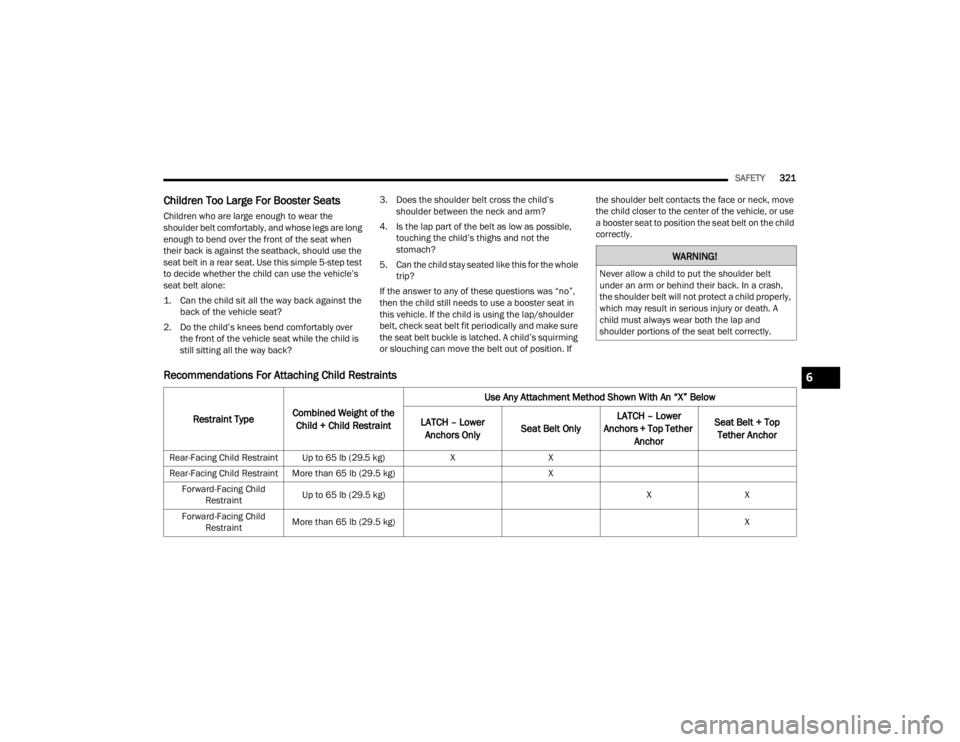
Recommendations For Attaching Child Restraints
WARNING!
Never allow a child to put the shoulder belt
under an arm or behind their back. In a crash,
the shoulder belt will not protect a child properly,
which may result in serious injury or death. A
child must always wear both the lap and
shoulder portions of the seat belt correctly.
Restraint Type
Combined Weight of the
Child + Child Restraint Use Any Attachment Method Shown With An “X” Below
LATCH – Lower Anchors Only Seat Belt Only LATCH – Lower
Anchors + Top Tether Anchor Seat Belt + Top
Tether Anchor
Rear-Facing Child Restraint Up to 65 lb (29.5 kg) XX
Rear-Facing Child Restraint More than 65 lb (29.5 kg) X
Forward-Facing Child Restraint Up to 65 lb (29.5 kg)
XX
Forward-Facing Child Restraint More than 65 lb (29.5 kg)
X
6
23_JT_OM_EN_USC_t.book Page 321
Page 325 of 448
SAFETY323
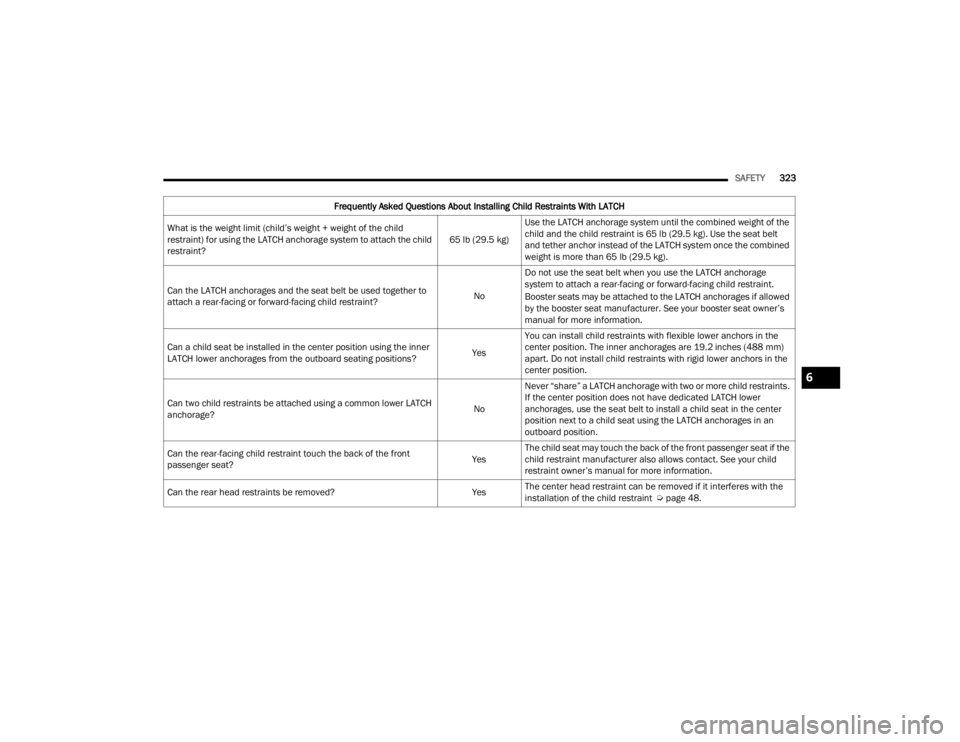
Frequently Asked Questions About Installing Child Restraints With LATCH
What is the weight limit (child’s weight + weight of the child
restraint) for using the LATCH anchorage system to attach the child
restraint? 65 lb (29.5 kg)Use the LATCH anchorage system until the combined weight of the
child and the child restraint is 65 lb (29.5 kg). Use the seat belt
and tether anchor instead of the LATCH system once the combined
weight is more than 65 lb (29.5 kg).
Can the LATCH anchorages and the seat belt be used together to
attach a rear-facing or forward-facing child restraint? NoDo not use the seat belt when you use the LATCH anchorage
system to attach a rear-facing or forward-facing child restraint.
Booster seats may be attached to the LATCH anchorages if allowed
by the booster seat manufacturer. See your booster seat owner’s
manual for more information.
Can a child seat be installed in the center position using the inner
LATCH lower anchorages from the outboard seating positions? YesYou can install child restraints with flexible lower anchors in the
center position. The inner anchorages are 19.2 inches (488 mm)
apart. Do not install child restraints with rigid lower anchors in the
center position.
Can two child restraints be attached using a common lower LATCH
anchorage? NoNever “share” a LATCH anchorage with two or more child restraints.
If the center position does not have dedicated LATCH lower
anchorages, use the seat belt to install a child seat in the center
position next to a child seat using the LATCH anchorages in an
outboard position.
Can the rear-facing child restraint touch the back of the front
passenger seat? YesThe child seat may touch the back of the front passenger seat if the
child restraint manufacturer also allows contact. See your child
restraint owner’s manual for more information.
Can the rear head restraints be removed? YesThe center head restraint can be removed if it interferes with the
installation of the child restraint Ú
page 48.
6
23_JT_OM_EN_USC_t.book Page 323
Page 328 of 448
326SAFETY
The seat belts in the passenger seating positions
are equipped with a Switchable Automatic Locking
Retractor (ALR) that is designed to keep the lap
portion of the seat belt tight around the child
restraint so that it is not necessary to use a locking
clip. The ALR retractor can be “switched” into a
locked mode by pulling all of the webbing out of the
retractor and then letting the webbing retract back
into the retractor. If it is locked, the ALR will make
a clicking noise while the webbing is pulled back
into the retractor. See the “Automatic Locking Mode” description
Ú
page 304 for additional information on ALR.
Please see the table below and the following
sections for more information.
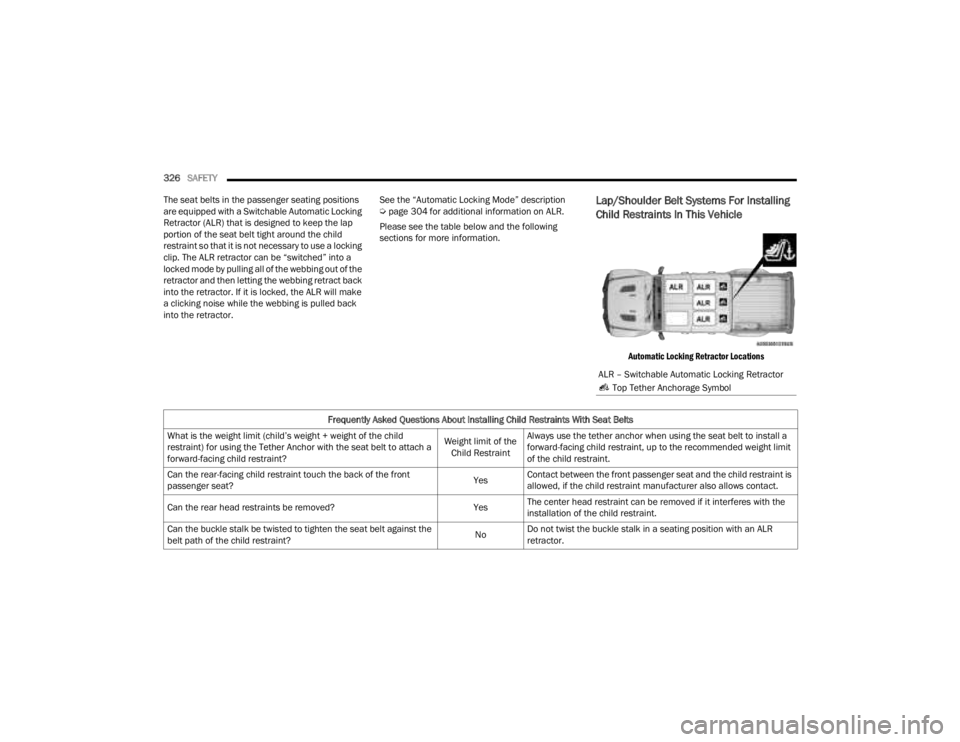
Lap/Shoulder Belt Systems For Installing
Child Restraints In This Vehicle
Automatic Locking Retractor Locations
ALR – Switchable Automatic Locking Retractor Top Tether Anchorage Symbol
Frequently Asked Questions About Installing Child Restraints With Seat Belts
What is the weight limit (child’s weight + weight of the child
restraint) for using the Tether Anchor with the seat belt to attach a
forward-facing child restraint? Weight limit of the
Child Restraint Always use the tether anchor when using the seat belt to install a
forward-facing child restraint, up to the recommended weight limit
of the child restraint.
Can the rear-facing child restraint touch the back of the front
passenger seat? YesContact between the front passenger seat and the child restraint is
allowed, if the child restraint manufacturer also allows contact.
Can the rear head restraints be removed? YesThe center head restraint can be removed if it interferes with the
installation of the child restraint.
Can the buckle stalk be twisted to tighten the seat belt against the
belt path of the child restraint? NoDo not twist the buckle stalk in a seating position with an ALR
retractor.
23_JT_OM_EN_USC_t.book Page 326
Page 402 of 448
400SERVICING AND MAINTENANCE
Tire Loading And Tire Pressure
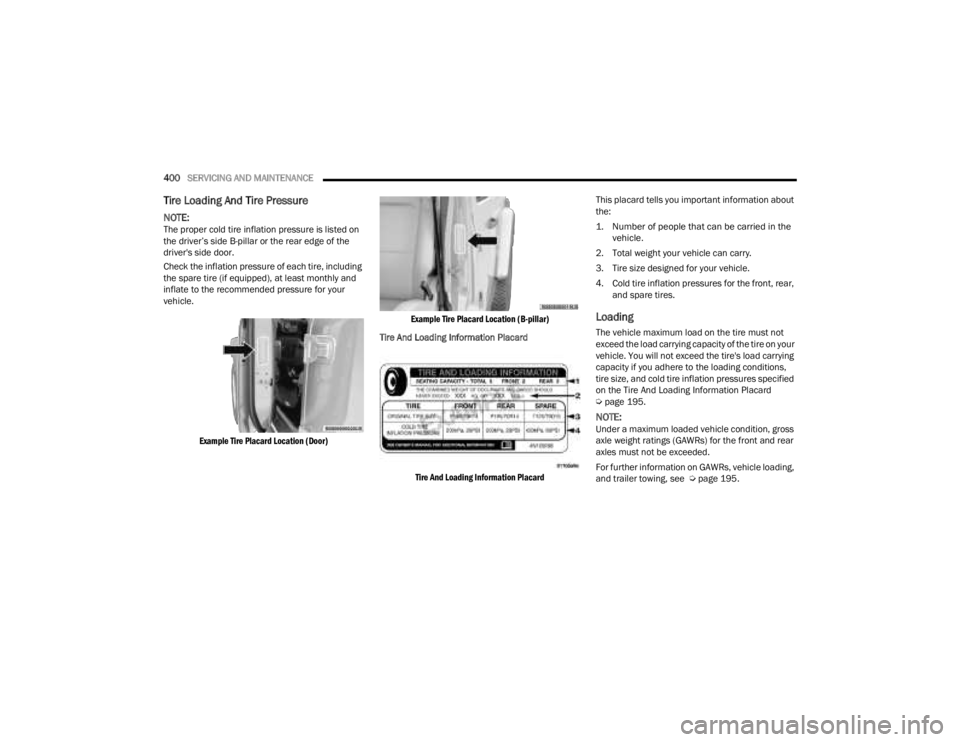
NOTE:The proper cold tire inflation pressure is listed on
the driver’s side B-pillar or the rear edge of the
driver's side door.
Check the inflation pressure of each tire, including
the spare tire (if equipped), at least monthly and
inflate to the recommended pressure for your
vehicle.
Example Tire Placard Location (Door) Example Tire Placard Location (B-pillar)
Tire And Loading Information Placard
Tire And Loading Information Placard
This placard tells you important information about
the:
1. Number of people that can be carried in the
vehicle.
2. Total weight your vehicle can carry.
3. Tire size designed for your vehicle.
4. Cold tire inflation pressures for the front, rear, and spare tires.
Loading
The vehicle maximum load on the tire must not
exceed the load carrying capacity of the tire on your
vehicle. You will not exceed the tire's load carrying
capacity if you adhere to the loading conditions,
tire size, and cold tire inflation pressures specified
on the Tire And Loading Information Placard
Úpage 195.
NOTE:Under a maximum loaded vehicle condition, gross
axle weight ratings (GAWRs) for the front and rear
axles must not be exceeded.
For further information on GAWRs, vehicle loading,
and trailer towing, see Ú page 195.
23_JT_OM_EN_USC_t.book Page 400
Page 403 of 448
SERVICING AND MAINTENANCE401
To determine the maximum loading conditions of
your vehicle, locate the statement “The combined
weight of occupants and cargo should never
exceed XXX kg or XXX lbs” on the Tire And Loading
Information Placard. The combined weight of
occupants, cargo/luggage and trailer tongue
weight (if applicable) should never exceed the
weight referenced here.
Steps For Determining Correct Load Limit—
(1) Locate the statement “The combined
weight of occupants and cargo should
never exceed XXX kg or XXX lbs.” on your
vehicle's placard.
(2) Determine the combined weight of
the driver and passengers that will be
riding in your vehicle.
(3) Subtract the combined weight of the
driver and passengers from XXX kg or
XXX lbs.
(4) The resulting figure equals the
available amount of cargo and luggage
load capacity. For example, if “XXX”
amount equals 1400 lbs. and there will
be five 150 lbs passengers in your
vehicle, the amount of available cargo and luggage load capacity is 650 lbs.
(1400-750 (5x150) = 650 lbs.)
(5) Determine the combined weight of
luggage and cargo being loaded on the
vehicle. That weight may not safely
exceed the available cargo and luggage
load capacity calculated in Step 4.
(6) If your vehicle will be towing a trailer,
load from your trailer will be transferred
to your vehicle. Consult this manual to
determine how this reduces the
available cargo and luggage load
capacity of your vehicle.
Metric Example For Load Limit
For example, if “XXX” amount equals 635 kg and
there will be five 68 kg passengers in your vehicle,
the amount of available cargo and luggage load
capacity is 295 kg (635-340 (5x68) = 295 kg) as
shown in step 4.
NOTE:
If your vehicle will be towing a trailer, load from
your trailer will be transferred to your vehicle.
The following table shows examples on how to
calculate total load, cargo/luggage, and towing
capacities of your vehicle with varying seating
configurations and number and size of occu
-pants. This table is for illustration purposes only
and may not be accurate for the seating and
load carry capacity of your vehicle.
For the following example, the combined weight
of occupants and cargo should never exceed
865 lbs (392 kg).
TIRES — GENERAL INFORMATION
Tire Pressure
Proper tire inflation pressure is essential to the
safe and satisfactory operation of your vehicle.
Four primary areas are affected by improper tire
pressure:
Safety
Fuel Economy
Tread Wear
Ride Comfort and Vehicle Stability
WARNING!
Overloading of your tires is dangerous.
Overloading can cause tire failure, affect vehicle
handling, and increase your stopping distance.
Use tires of the recommended load capacity for
your vehicle. Never overload them.
8
23_JT_OM_EN_USC_t.book Page 401
Page 438 of 448

436
Ethanol
.......................................................... 420Exhaust Gas Caution..................................... 331Exhaust Gas Cautions.................................... 331Exhaust System................................... 331, 376Exterior Lights......................................... 56, 330
F
Fabric Care.................................................... 413Fabric Top...................................................... 413Family Alerts.................................................. 271Fastener Bin.................................................... 70Filters Air Cleaner................................................. 366Air Conditioning.................................. 68, 373Engine Fuel............................................... 368Engine Oil........................................ 366, 424Engine Oil Disposal................................... 366FlashersHazard Warning......................................... 332Turn Signal................................................ 330Turn Signals.................................... 394, 395Flash-To-Pass.................................................. 58Flooded Engine Starting................................ 147Fluid Capacities............................................. 423Fluid Leaks.................................................... 330Fluid LevelManual Transmission................................ 381Fluid Level Checks......................................... 380Brake........................................................ 380Engine Oil.................................................. 364
Fluid, Brake.................................................. 426Fog Lights..................................... 58, 140, 394Fog Lights, Service........................................ 394Fold-Flat Seats................................................. 43Folding Rear Seats........................................... 44Folding Windshield....................................... 106Forward Collision Warning................... 139, 291Four Wheel Drive.......................................... 161Operation................................................. 161Shifting..................................................... 161System..................................................... 161Four Wheel Drive Operation.......................... 163Four-Way Hazard Flasher.............................. 332Freedom Panels............................................... 97Freeing A Stuck Vehicle................................ 349Front Axle (Differential)................................. 380Front Door Removal
S
.................................. 28Front View Camera....................................... 190Fuel...................................................... 419, 421Adding............................................. 191, 192Additives................................................... 419Clean Air................................................... 419Ethanol..................................................... 420Filler Cap (Gas Cap)......................... 136, 191Filter......................................................... 368Gasoline................................................... 419Materials Added....................................... 419Methanol.................................................. 420Octane Rating.................................. 419, 424Requirements.................................. 421, 423
Specifications.................................. 421, 424Tank Capacity........................................... 423Fuel Filter Replacement................................ 369Fuel System Cautions................................... 420Fueling................................................. 191, 192Fuses............................................................ 382
G
Garage Door Opener (HomeLink).....................52Gas Cap (Fuel Filler Cap)...................... 191, 192Gasoline Instrument Clusters
S
................. 118Gasoline, (Fuel)............................................. 419Gasoline, Clean Air........................................ 419Gasoline, Reformulated................................ 419GaugesVoltage...................................................... 149Gear Ranges........................................ 154, 157Glass Cleaning.............................................. 417Gross Vehicle Weight Rating......................... 197GVWR............................................................ 196
H
Half-Door Installation.......................................35Half-Doors — If Equipped
S
...........................36Hard Top..........................................................82Hard Top Front Panel(s) Removal
S
..............95Hazard Warning Flashers.............................. 332Head Restraints...............................................48
23_JT_OM_EN_USC_t.book Page 436
Page 444 of 448

442
Tires
................................... 330, 401, 406, 410Aging (Life Of Tires)................................... 404Air Pressure............................................... 401Chains....................................................... 408Changing................................................... 335Compact Spare......................................... 406General Information........................ 401, 406High Speed................................................ 403Inflation Pressure...................................... 402Life Of Tires............................................... 404Load Capacity............................................ 400Pressure Monitoring System (TPMS)........................................ 137, 294Quality Grading.......................................... 410Radial........................................................ 403Replacement............................................. 404Rotation.................................................... 409Safety.............................................. 395, 401Sizes.......................................................... 397Snow Tires................................................. 406Spare Tires............................. 338, 406, 407Spinning.................................................... 403Tread Wear Indicators............................... 404Wheel Nut Torque..................................... 418To Open Hood................................................ 109Tongue Weight/Trailer Weight....................... 202Tonneau Cover.............................................. 112Install........................................................ 112Removal.................................................... 114
TopDual............................................................. 82Hard............................................................ 82Removable.................................................. 82Soft.............................................................. 82Tow HooksEmergency................................................ 351Towing........................................ 197, 199, 350Disabled Vehicle....................................... 350Recreational............................................. 205Weight...................................................... 199Towing Behind A Motorhome........................ 205Towing Tips................................................... 204Trac-LokRear Axle.................................................. 165Traction Control............................................ 286TrailCam System........................................... 190Trailer Sway Control (TSC)............................. 286Trailer Towing............................................... 197Hitches..................................................... 199Minimum Requirements........................... 202Trailer And Tongue Weight............... 199, 202Wiring....................................................... 203Trailer Towing Guide..................................... 199Trailer Weight................................................ 199Transfer Case............................................... 381Fluid......................................................... 426Four-Wheel-Drive-Operation............ 161, 163Maintenance............................................ 381
Transmission................................................. 157Automatic........................................ 157, 381Fluid.......................................................... 426Maintenance............................................ 381Manual..................................................... 153Shifting..................................................... 155Transporting Pets.......................................... 329Tread Wear Indicators................................... 404Turn Signals................................140, 394, 395
U
UCI Connector..................................................71UconnectPhone Call Features................................. 249Things You Should Know About Your Uconnect Phone................................... 252Uconnect Settings............................. 21, 215Uconnect Phone................................... 246, 247Answer Or Ignore An Incoming Call — Call Currently In Progress..................... 251Answer Or Ignore An Incoming Call —No Call Currently In Progress................ 250Bluetooth Communication Link................ 254Call Continuation...................................... 252Call Controls............................................. 250Call Termination....................................... 252Cancel Command..................................... 246Connecting To A Particular Mobile Phone Or Audio Device After Pairing..... 248Help Command......................................... 246
23_JT_OM_EN_USC_t.book Page 442