weight JEEP GLADIATOR 2023 User Guide
[x] Cancel search | Manufacturer: JEEP, Model Year: 2023, Model line: GLADIATOR, Model: JEEP GLADIATOR 2023Pages: 448, PDF Size: 17.37 MB
Page 204 of 448
202STARTING AND OPERATING
(Continued)
TRAILER AND TONGUE WEIGHT
Never exceed the maximum tongue weight
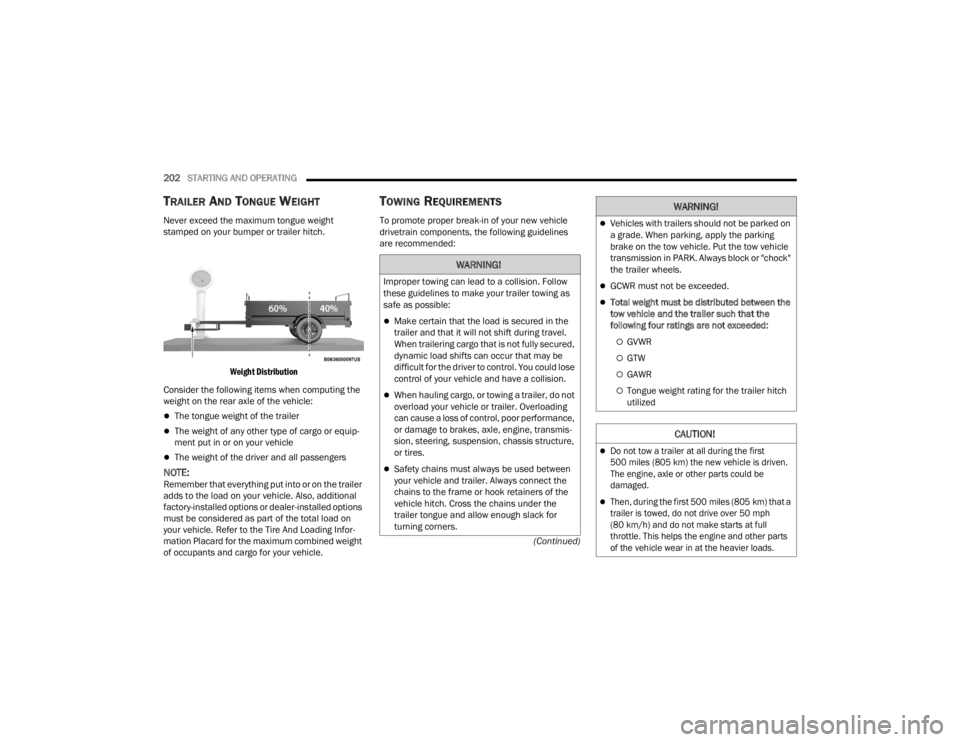
stamped on your bumper or trailer hitch.
Weight Distribution
Consider the following items when computing the
weight on the rear axle of the vehicle:
The tongue weight of the trailer
The weight of any other type of cargo or equip -
ment put in or on your vehicle
The weight of the driver and all passengers
NOTE:Remember that everything put into or on the trailer
adds to the load on your vehicle. Also, additional
factory-installed options or dealer-installed options
must be considered as part of the total load on
your vehicle. Refer to the Tire And Loading Infor -
mation Placard for the maximum combined weight
of occupants and cargo for your vehicle.
TOWING REQUIREMENTS
To promote proper break-in of your new vehicle
drivetrain components, the following guidelines
are recommended:
WARNING!
Improper towing can lead to a collision. Follow
these guidelines to make your trailer towing as
safe as possible:
Make certain that the load is secured in the
trailer and that it will not shift during travel.
When trailering cargo that is not fully secured,
dynamic load shifts can occur that may be
difficult for the driver to control. You could lose
control of your vehicle and have a collision.
When hauling cargo, or towing a trailer, do not
overload your vehicle or trailer. Overloading
can cause a loss of control, poor performance,
or damage to brakes, axle, engine, transmis -
sion, steering, suspension, chassis structure,
or tires.
Safety chains must always be used between
your vehicle and trailer. Always connect the
chains to the frame or hook retainers of the
vehicle hitch. Cross the chains under the
trailer tongue and allow enough slack for
turning corners.
Vehicles with trailers should not be parked on
a grade. When parking, apply the parking
brake on the tow vehicle. Put the tow vehicle
transmission in PARK. Always block or "chock"
the trailer wheels.
GCWR must not be exceeded.
Total weight must be distributed between the
tow vehicle and the trailer such that the
following four ratings are not exceeded:
GVWR
GTW
GAWR
Tongue weight rating for the trailer hitch
utilized
CAUTION!
Do not tow a trailer at all during the first
500 miles (805 km) the new vehicle is driven.
The engine, axle or other parts could be
damaged.
Then, during the first 500 miles (805 km) that a
trailer is towed, do not drive over 50 mph
(80 km/h) and do not make starts at full
throttle. This helps the engine and other parts
of the vehicle wear in at the heavier loads.
WARNING!
23_JT_OM_EN_USC_t.book Page 202
Page 212 of 448

210STARTING AND OPERATING
until it makes contact with the object. Apply the
throttle lightly while holding a light brake pressure
and ease the vehicle up and over the object.
USING A SPOTTER
There are many times where it is hard to see the
obstacle or determine the correct path.
Determining the correct path can be extremely
difficult when you are confronting many obstacles.
In these cases have someone guide you over,
through, or around the obstacle. Have the person
stand a safe distance in front of you where they
can see the obstacle, watch your tires and
undercarriage, and guide you through.
CROSSING LARGE ROCKS
When approaching large rocks, choose a path
which ensures you drive over the largest of them
with your tires. This will lift your undercarriage over
the obstacle. The tread of the tire is tougher and
thicker than the side wall and is designed to take
the abuse. Always look ahead and make every
effort to cross the large rocks with your tires.
CROSSING A RAVINE, GULLY, DITCH,
WASHOUT OR RUT
When crossing a ravine, gully, ditch, washout or a
large rut, the angled approach is the key to
maintaining your vehicle's mobility. Approach
these obstacles at a 45-degree angle and let each
tire go through the obstacle independently. You
need to use caution when crossing large obstacles
with steep sides. Do not attempt to cross any large
obstacle with steep sides at an angle great enough
to put the vehicle at risk of a rollover. If you get
caught in a rut, dig a small trench to the right or left
at a 45-degree angle ahead of the front tires. Use
the removed dirt to fill the rut ahead of the turnout
you just created. You should now be able to drive
out following the trench you just created at a
45-degree angle.
CROSSING LOGS
To cross a log, approach it at a slight angle
(approximately 10 to 15 degrees). This allows one
front tire to be on top of the log while the other just
starts to climb the log. While climbing the log,
modulate your brake and accelerator to avoid
spinning the log out from under your tires. Then
ease the vehicle off the log using your brakes.
GETTING HIGH-CENTERED
If you get hung up or high-centered on an object,
get out of the vehicle and try to determine what the
vehicle is hung up on, where it is contacting the
underbody and what is the best direction to
recover the vehicle. Depending on what you are in
contact with, jack the vehicle up and place a few
rocks under the tires so the weight is off of the high
point when you let the vehicle down. You can also
try rocking the vehicle or winching the vehicle off
the object.
WARNING!
Crossing obstacles can cause abrupt steering
system loading which could cause you to lose
control of your vehicle.
CAUTION!
Never attempt to straddle a rock that is large
enough to strike your axles or undercarriage.
Never attempt to drive over a rock which is
large enough to contact the door sills.
WARNING!
There is an increased risk of rollover when
crossing an obstacle, at any angle, with steep
sides.
CAUTION!
Do not attempt to cross a log with a greater
diameter than the running ground clearance or
the vehicle will become high-centered.
CAUTION!
Winching or rocking the vehicle off hard objects
increases the risk of underbody damage.
23_JT_OM_EN_USC_t.book Page 210
Page 213 of 448

STARTING AND OPERATING211
Hill Climbing
Hill climbing requires good judgment and a good
understanding of your abilities and your vehicle's
limitations. Hills can cause serious problems.
Some are just too steep to climb and should not be
attempted. You should always feel confident with
the vehicle and your abilities. You should always
climb hills straight up and down. Never attempt to
climb a hill on an angle.
BEFORE CLIMBING A STEEP HILL
As you approach a hill, consider its grade or
steepness. Determine if it is too steep. Look to see
what the traction is on the hill side trail. Is the trail
straight up and down? What is on top and the other
side? Are there ruts, rocks, branches or other
obstacles on the path? Can you safely recover the
vehicle if something goes wrong? If everything
looks good and you feel confident, shift the
transmission into a lower gear with 4L engaged,
and proceed with caution, maintaining your
momentum as you climb the hill.
DRIVING UP HILL
Once you have determined your ability to proceed
and have shifted into the appropriate gear, line
your vehicle up for the straightest possible run.
Accelerate with an easy constant throttle and apply
more power as you start up the hill. Do not race
forward into a steep grade; the abrupt change of grade could cause you to lose control. If the front
end begins to bounce, ease off the throttle slightly
to bring all four tires back on the ground. As you
approach the crest of the hill, ease off the throttle
and slowly proceed over the top. If the wheels start
to slip as you approach the crest of a hill, ease off
the accelerator and maintain headway by turning
the steering wheel no more than a quarter turn
quickly back and forth. This will provide a fresh
"bite" into the surface and will usually provide
enough traction to complete the climb. If you do
not make it to the top, place the vehicle in
REVERSE and back straight down the grade using
engine resistance along with the vehicle brakes.
DRIVING DOWNHILL
Before driving down a steep hill, you need to
determine if it is too steep for a safe descent. What
is the surface traction? Is the grade too steep to
maintain a slow, controlled descent? Are there
obstacles? Is it a straight descent? Is there plenty
of distance at the base of the hill to regain control
if the vehicle descends too fast? If you feel
confident in your ability to proceed, then make sure you are in 4L and proceed with caution. Allow
engine braking to control the descent and apply
your brakes, if necessary, but do not allow the tires
to lock.
DRIVING ACROSS AN INCLINE
If at all possible, avoid driving across an incline. If
it is necessary, know your vehicle's abilities. Driving
across an incline places more weight on the
downhill wheels, which increases the possibilities
of a downhill slide or rollover. Make sure the
surface has good traction with firm and stable
soils. If possible, transverse the incline at an angle
heading slightly up or down.WARNING!
Never attempt to climb a hill at an angle or turn
around on a steep grade. Driving across an
incline increases the risk of a rollover, which may
result in severe injury.
WARNING!
Do not descend a steep grade in NEUTRAL. Use
vehicle brakes in conjunction with engine
braking. Descending a grade too fast could
cause you to lose control and be seriously
injured or killed.
WARNING!
Driving across an incline increases the risk of a
rollover, which may result in severe injury.
4
23_JT_OM_EN_USC_t.book Page 211
Page 289 of 448
SAFETY287
NOTE:TSC cannot stop all trailers from swaying. Always
use caution when towing a trailer and follow the
trailer tongue weight recommendations. See
Úpage 197 for further information.
When TSC is functioning, the ESC Activation/
Malfunction Indicator Light will flash, the engine
power may be reduced, and you may feel the
brakes being applied to individual wheels to
attempt to stop the trailer from swaying. TSC is
disabled when the ESC system is in the “Partial
Off” or “Full Off” modes.
AUXILIARY DRIVING SYSTEMS
BLIND SPOT MONITORING (BSM) —
I
F EQUIPPED
The BSM system uses two radar sensors, located
inside the taillights, to detect highway licensable
vehicles (automobiles, trucks, motorcycles, etc.)
that enter the blind spot zones from the rear/front/
side of the vehicle.
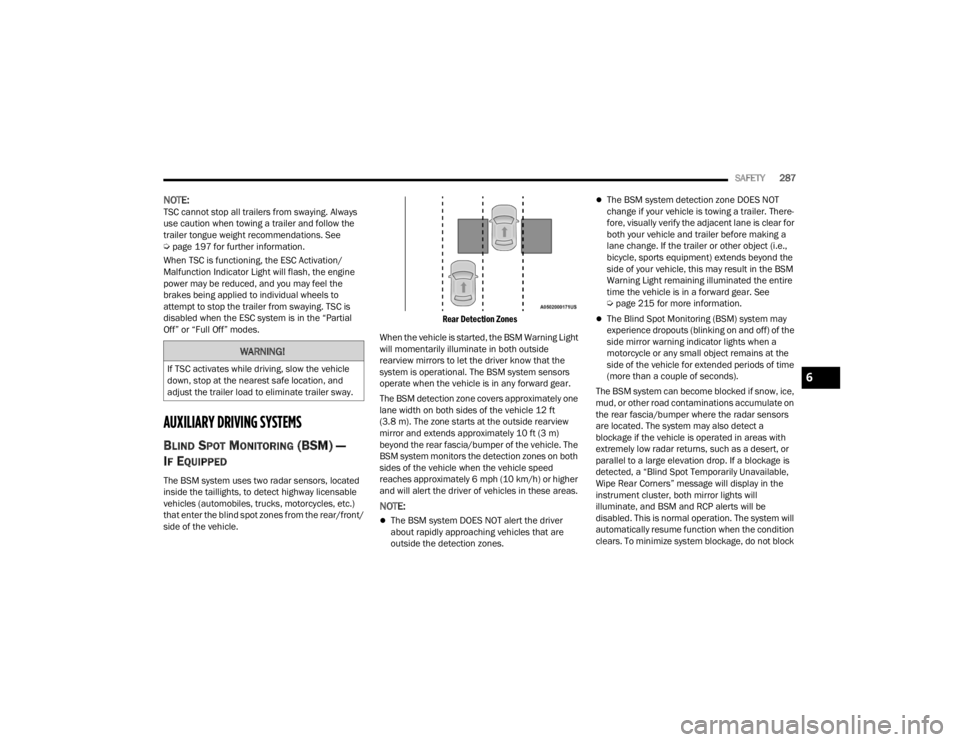
Rear Detection Zones
When the vehicle is started, the BSM Warning Light
will momentarily illuminate in both outside
rearview mirrors to let the driver know that the
system is operational. The BSM system sensors
operate when the vehicle is in any forward gear.
The BSM detection zone covers approximately one
lane width on both sides of the vehicle 12 ft
(3.8 m). The zone starts at the outside rearview
mirror and extends approximately 10 ft (3 m)
beyond the rear fascia/bumper of the vehicle. The
BSM system monitors the detection zones on both
sides of the vehicle when the vehicle speed
reaches approximately 6 mph (10 km/h) or higher
and will alert the driver of vehicles in these areas.
NOTE:
The BSM system DOES NOT alert the driver
about rapidly approaching vehicles that are
outside the detection zones.
The BSM system detection zone DOES NOT
change if your vehicle is towing a trailer. There -
fore, visually verify the adjacent lane is clear for
both your vehicle and trailer before making a
lane change. If the trailer or other object (i.e.,
bicycle, sports equipment) extends beyond the
side of your vehicle, this may result in the BSM
Warning Light remaining illuminated the entire
time the vehicle is in a forward gear. See
Ú page 215 for more information.
The Blind Spot Monitoring (BSM) system may
experience dropouts (blinking on and off) of the
side mirror warning indicator lights when a
motorcycle or any small object remains at the
side of the vehicle for extended periods of time
(more than a couple of seconds).
The BSM system can become blocked if snow, ice,
mud, or other road contaminations accumulate on
the rear fascia/bumper where the radar sensors
are located. The system may also detect a
blockage if the vehicle is operated in areas with
extremely low radar returns, such as a desert, or
parallel to a large elevation drop. If a blockage is
detected, a “Blind Spot Temporarily Unavailable,
Wipe Rear Corners” message will display in the
instrument cluster, both mirror lights will
illuminate, and BSM and RCP alerts will be
disabled. This is normal operation. The system will
automatically resume function when the condition
clears. To minimize system blockage, do not block
WARNING!
If TSC activates while driving, slow the vehicle
down, stop at the nearest safe location, and
adjust the trailer load to eliminate trailer sway.6
23_JT_OM_EN_USC_t.book Page 287
Page 310 of 448

308SAFETY
Driver And Passenger Front Air Bag
Features
The Advanced Front Air Bag system has multistage
driver and front passenger air bags. This system
provides output appropriate to the severity and
type of collision as determined by the Occupant
Restraint Controller (ORC), which may receive
information from the front impact sensors (if
equipped) or other system components.
The first stage inflator is triggered immediately
during an impact that requires air bag deployment.
A low energy output is used in less severe
collisions. A higher energy output is used for more
severe collisions.
This vehicle may be equipped with a driver and/or
front passenger seat belt buckle switch that
detects whether the driver or front passenger seat
belt is buckled. The seat belt buckle switch may
adjust the inflation rate of the Advanced Front Air
Bags. This vehicle may be equipped with driver and/or
front passenger seat track position sensors that
may adjust the inflation rate of the Advanced Front
Air Bags based upon seat position.
This vehicle has an Occupant Classification
System (“OCS”) in the front passenger seat. The
OCS is designed to activate or deactivate the
Passenger Advanced Front Air Bag depending on
the occupant’s seated weight. It is designed to
deactivate the Passenger Advanced Front Air Bag
for an unoccupied seat and for occupants whose
seated weight classifies them in a category other
than a properly seated adult. This could be a child,
teenager, or even an adult.
The Passenger Air Bag Disable (“PAD”) Indicator
Light (an amber light located on the overhead
sports bar) tells the driver and front passenger
when the Passenger Advanced Front Air Bag is
deactivated. The PAD Indicator Light illuminates
the words “PASSENGER AIR BAG OFF” to show that
the Passenger Advanced Front Air Bag will not
deploy during a collision.
NOTE:When the front passenger seat is empty or when
very light objects are placed on the seat, the
Passenger Advanced Front Air Bag will not deploy
even though the Passenger Air Bag Disable (PAD)
System Indicator Light is NOT illuminated.
Front Air Bag Operation
Front Air Bags are designed to provide additional
protection by supplementing the seat belts. Front
air bags are not expected to reduce the risk of
injury in rear, side, or rollover collisions. The front
air bags will not deploy in all frontal collisions,
including some that may produce substantial
Never install a rear-facing child restraint in the
front seat of a vehicle. Only use a rear-facing
child restraint in the rear seat. If the vehicle
does not have a rear seat, do not transport a
rear-facing child restraint in that vehicle.
WARNING!WARNING!
No objects should be placed over or near the
air bag on the instrument panel or steering
wheel because any such objects could cause
harm if the vehicle is in a collision severe
enough to cause the air bag to inflate.
Do not put anything on or around the air bag
covers or attempt to open them manually. You
may damage the air bags and you could be
injured because the air bags may no longer be
functional. The protective covers for the air
bag cushions are designed to open only when
the air bags are inflating.
Relying on the air bags alone could lead to
more severe injuries in a collision. The air
bags work with your seat belt to restrain you
properly. In some collisions, air bags won’t
deploy at all. Always wear your seat belts even
though you have air bags.
23_JT_OM_EN_USC_t.book Page 308
Page 311 of 448
SAFETY309
vehicle damage — for example, some pole
collisions, truck underrides, and angle offset
collisions.
On the other hand, depending on the type and
location of impact, front air bags may deploy in
crashes with little vehicle front-end damage but
that produce a severe initial deceleration.
Because air bag sensors measure vehicle
deceleration over time, vehicle speed and damage
by themselves are not good indicators of whether
or not an air bag should have deployed.
Seat belts are necessary for your protection in all
collisions, and also are needed to help keep you in
position, away from an inflating air bag.
When the Occupant Restraint Controller (ORC)
detects a collision requiring the front air bags, it
signals the inflator units. A large quantity of
non-toxic gas is generated to inflate the front air
bags.
The steering wheel hub trim cover and the upper
passenger side of the instrument panel separate
and fold out of the way as the air bags inflate to
their full size. The front air bags fully inflate in less
time than it takes to blink your eyes. The front air
bags then quickly deflate while helping to restrain
the driver and front passenger.
Occupant Classification System (OCS) —
Front Passenger Seat
The Occupant Classification System (OCS) is part
of a Federally regulated safety system for this
vehicle. It is designed to activate or deactivate the
Passenger Advanced Front Air Bag depending on
the occupant’s seated weight. It is designed to
deactivate the Passenger Advanced Front Air Bag
for an unoccupied seat and for occupants whose
seated weight classifies them in a category other
than a properly seated adult. This could be a child,
teenager, or even an adult.
The Occupant Classification System (OCS)
Consists Of The Following:
Occupant Restraint Controller (ORC)
Occupant Classification Module (OCM) and
Sensor located in the front passenger seat
Passenger Air Bag Disabled (PAD) Indicator
Light – an amber light located on the overhead
sports bar
Air Bag Warning Light
Passenger Seat Belt
Occupant Classification Module (OCM) And Sensor
The Occupant Classification Module (OCM) is
located underneath the front passenger seat. The
Sensor is located beneath the passenger seat
cushion foam. Any weight on the seat will be
sensed by the Sensor. The OCM uses input from the Sensor to determine the front passenger’s
most probable classification. The OCM
communicates this information to the ORC. The
ORC uses the classification to determine whether
it should activate or deactivate the Passenger
Advanced Front Air Bag. In order for the OCS to
operate as designed, it is important for the front
passenger to be seated properly and properly
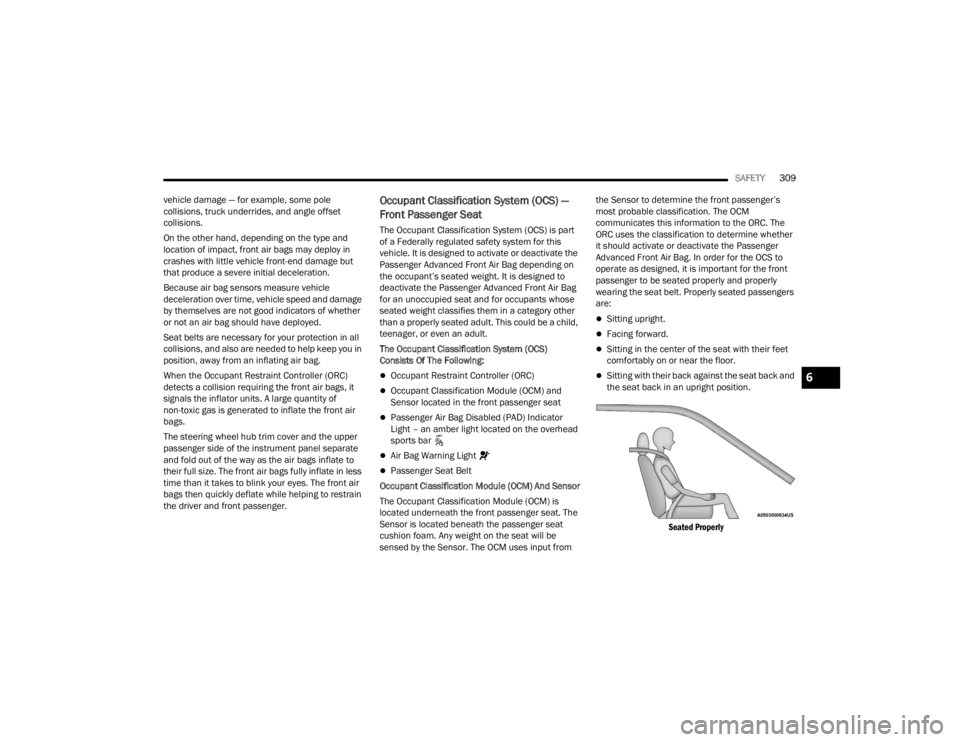
wearing the seat belt. Properly seated passengers
are:
Sitting upright.
Facing forward.
Sitting in the center of the seat with their feet
comfortably on or near the floor.
Sitting with their back against the seat back and
the seat back in an upright position.
Seated Properly
6
23_JT_OM_EN_USC_t.book Page 309
Page 312 of 448

310SAFETY
The OCS may deactivate the deployment of the Passenger Advanced Front Air Bag if the OCS estimates that:
The front passenger seat is unoccupied or has very light objects in it.
The front passenger seat is occupied by a rear-facing child restraint.
The front passenger seat is occupied by a child, including a child seated in a forward-facing child restraint or booster seat.
The front passenger seat is occupied by a small passenger, including a child or small adult.
The front passenger is not properly seated or his or her weight is taken off of the seat for a period of time.
* When the front passenger seat is empty or when very light objects are placed on the seat and the seat belt is unbuckled, the Passenger Advanced Front Air Bag will not deploy even
though the PAD System Indicator Light is NOT illuminated.
** It is possible for a child to be classified as an adult, allowing the deployment of the Passenger Advanced Front Air Bag. Never allow children to ride in the front passenger seat and
never install a child restraint system, including a rear-facing child restraint, in the front passenger seat.
Passenger Air Bag Disable (PAD) System
Front Passenger Seat Occupant Status Front Passenger Advanced Air Bag Disabled
Indicator Light (“PAD”) Status Front Passenger Air Bag Status
Unoccupied seat* Unbuckled NOT ILLUMINATEDDEACTIVATED
Unoccupied seat* Buckled “PASSENGER AIR BAG OFF” DEACTIVATED
Grocery bags, heavy briefcases, and other relatively light objects “PASSENGER AIR BAG OFF”
DEACTIVATED
Rear-facing child restraint** “PASSENGER AIR BAG OFF” DEACTIVATED
Child, including a child in a forward-facing child restraint or booster seat** “PASSENGER AIR BAG OFF”
DEACTIVATED
Small adult “PASSENGER AIR BAG OFF” DEACTIVATED
Properly seated adult NOT ILLUMINATED ACTIVATED
23_JT_OM_EN_USC_t.book Page 310
Page 313 of 448

SAFETY311
Passenger Advanced Front Air Bag Disabled (PAD)
Indicator Light
The Passenger Advanced Front Air Bag Disabled
(PAD) Indicator Light (an amber light located on the
overhead sports bar) tells the driver and front
passenger when the Passenger Advanced Front Air
Bag is deactivated. The PAD Indicator light
illuminates the words “PASSENGER AIR BAG OFF”
to show that the Passenger Advanced Front Air Bag
will not deploy during a collision. When the front
passenger seat is empty or when very light objects
are placed on the seat and the seat belt is
unbuckled, the Passenger Advanced Front Air Bag
will not deploy even though the PAD indicator light
is NOT illuminated. The PAD indicator light should not be illuminated
when an adult passenger is properly seated in the
front passenger seat. The driver and adult
passenger should verify that the PAD Indicator
Light is not illuminated when an adult is riding in
the front passenger seat. If an adult is not seated
properly, the Passenger Advanced Front Air Bag
may deactivate and the PAD Indicator Light will be
illuminated.
The PAD Indicator Light should be illuminated and
the Passenger Advanced Front Air Bag should be
deactivated for most properly seated and
restrained children in the passenger seat and for
most properly installed child restraint systems.
However, under certain conditions, even with a
properly installed child restraint system, the PAD
Indicator Light may not be illuminated, even
though the Passenger Advanced Front Air Bag is
deactivated. This can occur if the child restraint is
lighter than the lightest weight necessary to
illuminate the PAD Indicator Light.
NEVER assume
the Passenger Advanced Front Air Bag is
deactivated unless the PAD Indicator Light is
illuminated with the words “PASSENGER AIR BAG
OFF.”
NOTE:If the seat belt is buckled for an empty seat, the
PAD Indicator Light will illuminate. If The PAD Indicator Light Is Illuminated For An
Adult Passenger:
If an adult passenger is seated in the front
passenger seat and the PAD Indicator Light is
illuminated, the passenger may be sitting
improperly. Follow the steps below to allow the
OCS to detect the adult passenger’s seated weight
to activate the Passenger Advanced Front Air Bag:
1. Turn off the vehicle and have the adult
passenger step out of the vehicle.
2. Remove any extra materials from the passenger seat, such as cushions, pads, seat
covers, seat massagers, blankets, extra
clothing, etc.
3. Place the seatback in the full upright position.
4. Have the adult passenger sit in the center of the seat, with the passenger’s feet
comfortably on or near the floor, and with their
back against the seatback.
5. Restart the vehicle and have the passenger remain in this seated position for two to three
minutes after restarting the vehicle.
WARNING!
Never place a rear-facing child restraint in
front of an air bag. A deploying passenger
front air bag can cause death or serious injury
to a child 12 years or younger, including a
child in a rear-facing child restraint.
Never install a rear-facing child restraint in the
front seat of a vehicle. Only use a rear-facing
child restraint in the rear seat. If the vehicle
does not have a rear seat, do not transport a
rear-facing child restraint in that vehicle.
6
23_JT_OM_EN_USC_t.book Page 311
Page 314 of 448

312SAFETY
Lighter Weight Passengers (Including Small Adults)
When a lighter weight passenger, including a small
adult, occupies the passenger seat, the Passenger
Advanced Front Air Bag may be deactivated.
Therefore, the Passenger Advanced Front Air Bag may or may not be activated for a lighter weight
passenger, including a small adult (depending on
size) who is seated in the passenger seat. This
does not mean that the OCS is working improperly.
The driver and passenger must always use the PAD
Indicator Light as a determination of whether the
Passenger Advanced Front Air Bag is activated or
deactivated. If the PAD Indicator Light is
illuminated with the words “PASSENGER AIR BAG
OFF” when an adult is in the front passenger seat,
have the passenger reposition his or her body in
the seat until the PAD Indicator Light goes out.
If the PAD Indicator Light is illuminated with the
words “PASSENGER AIR BAG OFF” the Passenger
Advanced Front Air Bag will not inflate in the event
of a collision.
Do Not Decrease OR Increase The Front
Passenger’s Seated Weight On The Front
Passenger Seat
The front passenger’s seated weight must be
properly positioned on the front passenger seat.
Failure to do so may result in serious injury or
death. The OCS determines the most probable
classification of the occupant that it detects. The
OCS will detect the front passenger’s decreased or
increased seated weight, which may result in
deactivation or activation of the Passenger
Advanced Front Air Bag in a collision. This does not
mean that the OCS is working improperly.
Decreasing the front passenger’s seated weight on the front passenger seat may result in deactivation
of the Passenger Advanced Front Air Bag causing
serious injury or death. Increasing the front
passenger’s seated weight on the front passenger
seat may result in activation of the Passenger
Advanced Front Air Bag. Examples of improper
front passenger seating include:
The front passenger’s weight is transferred to
another part of the vehicle (like the door, arm
rest or instrument panel).
The front passenger leans forward, sideways, or
turns to face the rear of the vehicle.
The front passenger’s seatback is not in the full
upright position.
The front passenger carries or holds an object
while seated (e.g., backpack, box, etc.).
Objects are lodged under the front passenger
seat.
Objects are lodged between the front passenger
seat and center console.
Accessories that may change the seated weight
on the front passenger seat are attached to the
front passenger seat.
Anything that may decrease or increase the
front passenger’s seated weight.
WARNING!
If the PAD Indicator Light remains illuminated
for an adult passenger, have an authorized
dealer service the air bag system immediately.
Failure to do so may cause serious injury or
death. If the PAD Indicator Light is illuminated
with the words "PASSENGER AIR BAG OFF,"
the Passenger Advanced Front Air Bag will not
deploy in the event of a collision.
Never place a rear-facing child restraint in
front of an air bag. A deploying passenger
front air bag can cause death or serious injury
to a child 12 years or younger, including a
child in a rear-facing child restraint.
Never install a rear-facing child restraint in the
front seat of a vehicle. Only use a rear-facing
child restraint in the rear seat. If the vehicle
does not have a rear seat, do not transport a
rear-facing child restraint in that vehicle.
Children 12 years or younger should always
ride buckled up in the rear seat of a vehicle
with a rear seat.
23_JT_OM_EN_USC_t.book Page 312
Page 315 of 448
SAFETY313
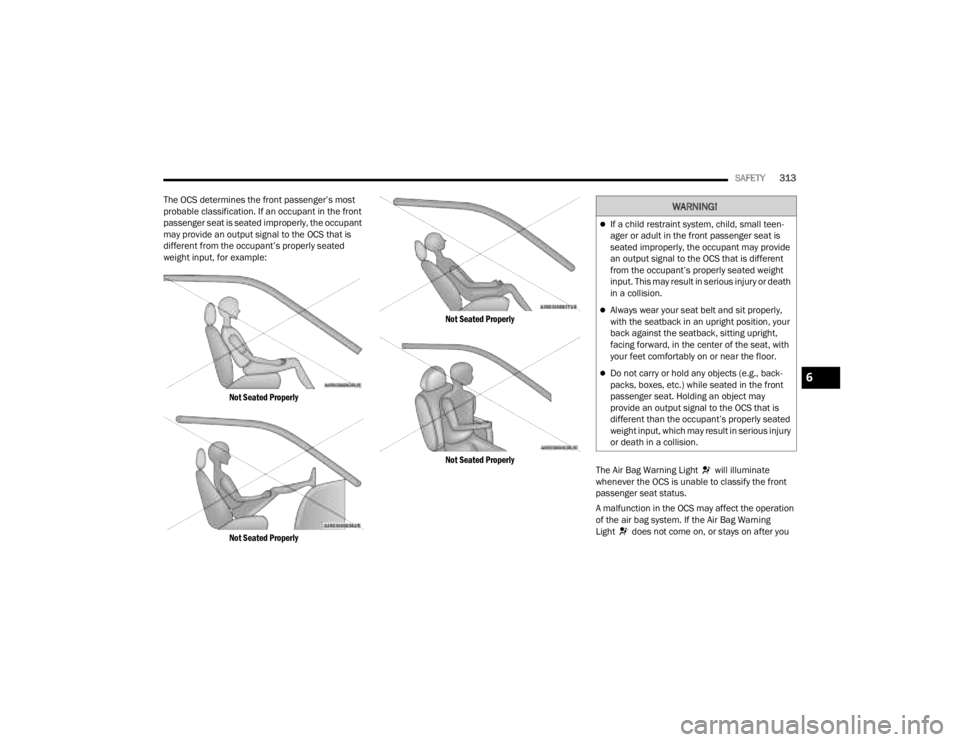
The OCS determines the front passenger’s most
probable classification. If an occupant in the front
passenger seat is seated improperly, the occupant
may provide an output signal to the OCS that is
different from the occupant’s properly seated
weight input, for example:
Not Seated Properly
Not Seated Properly Not Seated Properly
Not Seated Properly
The Air Bag Warning Light will illuminate
whenever the OCS is unable to classify the front
passenger seat status.
A malfunction in the OCS may affect the operation
of the air bag system. If the Air Bag Warning
Light does not come on, or stays on after you
WARNING!
If a child restraint system, child, small teen -
ager or adult in the front passenger seat is
seated improperly, the occupant may provide
an output signal to the OCS that is different
from the occupant’s properly seated weight
input. This may result in serious injury or death
in a collision.
Always wear your seat belt and sit properly,
with the seatback in an upright position, your
back against the seatback, sitting upright,
facing forward, in the center of the seat, with
your feet comfortably on or near the floor.
Do not carry or hold any objects (e.g., back -
packs, boxes, etc.) while seated in the front
passenger seat. Holding an object may
provide an output signal to the OCS that is
different than the occupant’s properly seated
weight input, which may result in serious injury
or death in a collision.6
23_JT_OM_EN_USC_t.book Page 313