fuel pressure JEEP GRAND CHEROKEE 2007 WK / 3.G SRT Owners Manual
[x] Cancel search | Manufacturer: JEEP, Model Year: 2007, Model line: GRAND CHEROKEE, Model: JEEP GRAND CHEROKEE 2007 WK / 3.GPages: 395, PDF Size: 6.1 MB
Page 67 of 395
Safety Checks You Should Make Outside The
Vehicle
Tires
Examine tires for excessive tread wear or uneven wear
patterns. Check for stones, nails, glass, or other objects
lodged in the tread. Inspect for tread cuts or sidewall
cracks. Check wheel nuts for tightness and tires (includ-
ing spare) for proper pressure.
Lights
Have someone observe the operation of all exterior lights
while you work the controls. Check turn signal and high
beam indicator lights on the instrument panel.
Fluid Leaks
Check area under vehicle after overnight parking for fuel,
coolant, oil or other fluid leaks. Also, if gasoline fumes
are detected, the cause should be located and corrected
immediately.
THINGS TO KNOW BEFORE STARTING YOUR VEHICLE 67
2
Page 175 of 395
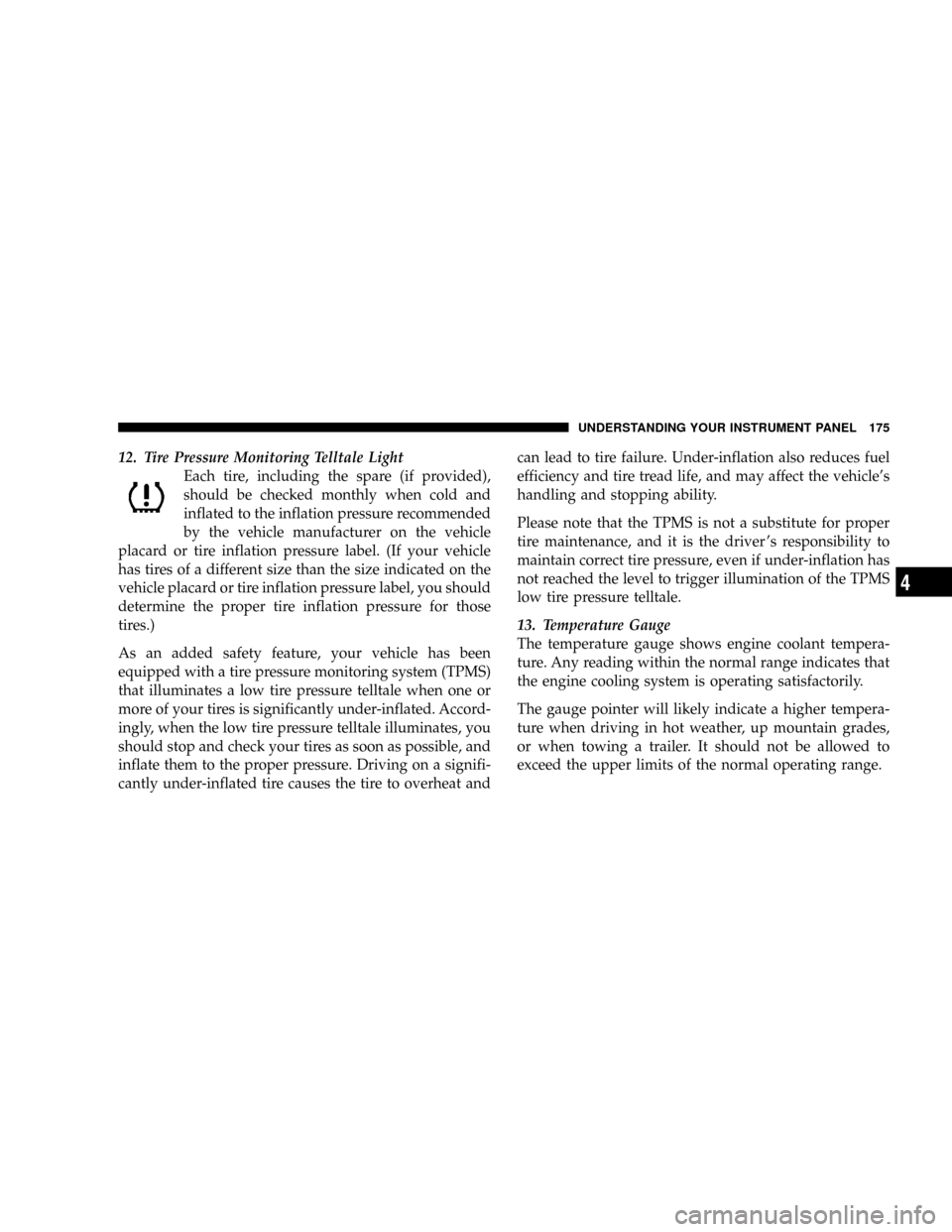
12. Tire Pressure Monitoring Telltale Light
Each tire, including the spare (if provided),
should be checked monthly when cold and
inflated to the inflation pressure recommended
by the vehicle manufacturer on the vehicle
placard or tire inflation pressure label. (If your vehicle
has tires of a different size than the size indicated on the
vehicle placard or tire inflation pressure label, you should
determine the proper tire inflation pressure for those
tires.)
As an added safety feature, your vehicle has been
equipped with a tire pressure monitoring system (TPMS)
that illuminates a low tire pressure telltale when one or
more of your tires is significantly under-inflated. Accord-
ingly, when the low tire pressure telltale illuminates, you
should stop and check your tires as soon as possible, and
inflate them to the proper pressure. Driving on a signifi-
cantly under-inflated tire causes the tire to overheat andcan lead to tire failure. Under-inflation also reduces fuel
efficiency and tire tread life, and may affect the vehicle's
handling and stopping ability.
Please note that the TPMS is not a substitute for proper
tire maintenance, and it is the driver 's responsibility to
maintain correct tire pressure, even if under-inflation has
not reached the level to trigger illumination of the TPMS
low tire pressure telltale.
13. Temperature Gauge
The temperature gauge shows engine coolant tempera-
ture. Any reading within the normal range indicates that
the engine cooling system is operating satisfactorily.
The gauge pointer will likely indicate a higher tempera-
ture when driving in hot weather, up mountain grades,
or when towing a trailer. It should not be allowed to
exceed the upper limits of the normal operating range.
UNDERSTANDING YOUR INSTRUMENT PANEL 175
4
Page 232 of 395
NTire Identification Number (TIN)..........253
NTire Loading And Tire Pressure...........254
mTires Ð General Information...............258
NRun Flat Tires........................258
NTire Pressure.........................258
NTire Inflation Pressures.................260
NTire Pressures For High Speed Operation....261
NRadial-Ply Tires......................262
NTire Spinning........................263
NTread Wear Indicators..................263
NLife Of Tire.........................264
NReplacement Tires.....................265
NAlignment And Balance.................266mTire Rotation Recommendations............266
mTire Pressure Monitor System (TPMS)........266
NPremium System......................266
NGeneral Information...................270
mFuel Requirements......................270
NReformulated Gasoline.................271
NGasoline/Oxygenate Blends..............271
NMMT In Gasoline.....................272
NMaterials Added To Fuel................272
NFuel System Cautions..................273
NCarbon Monoxide Warnings..............273
mAdding Fuel..........................274
NFuel Filler Cap (Gas Cap)...............274
232 STARTING AND OPERATING
Page 259 of 395
1. SafetyÐ
WARNING!
Improperly inflated tires are dangerous and can cause
accidents.
²Under inflation increases tire flexing and can result in
tire failure.
²Over inflation reduces a tire's ability to cushion
shock. Objects on the road and chuck holes can cause
damage that results in tire failure.
²Unequal tire pressures can cause steering problems.
You could lose control of your vehicle.
²Overinflated or under inflated tires can affect vehicle
handling and can fail suddenly, resulting in loss of
vehicle control.
²Unequal tire pressures from one side of the vehicle to
the other can cause the vehicle to drift to the right or
left.
Always drive with each tire properly inflated.
2. EconomyÐ
Improper inflation pressures can cause uneven wear
patterns to develop across the tire tread. These abnormal
wear patterns will reduce tread life resulting in a need for
earlier tire replacement. Under inflation also increases
tire rolling resistance and results in higher fuel consump-
tion.
3. Ride Comfort and Vehicle StabilityÐ
Proper tire inflation contributes to a comfortable ride.
Over inflation produces a jarring and uncomfortable ride.
Both under inflation and over inflation affect the stability
of the vehicle and can produce a feeling of sluggish
response or over responsiveness in the steering.
Unequal tire pressures can cause erratic and unpredict-
able steering response.
Unequal tire pressure from side to side may cause the
vehicle to drift left or right.
STARTING AND OPERATING 259
5
Page 270 of 395
General Information
This device complies with part 15 of the FCC rules and
RSS 210 of Industry Canada. Operation is subject to the
following conditions:
²This device may not cause harmful interference.
²This device must accept any interference received,
including interference that may cause undesired op-
eration.
The tire pressure sensors are covered under one of the
following licenses:
United States.....................KR5S120123
Canada........................2671-S120123
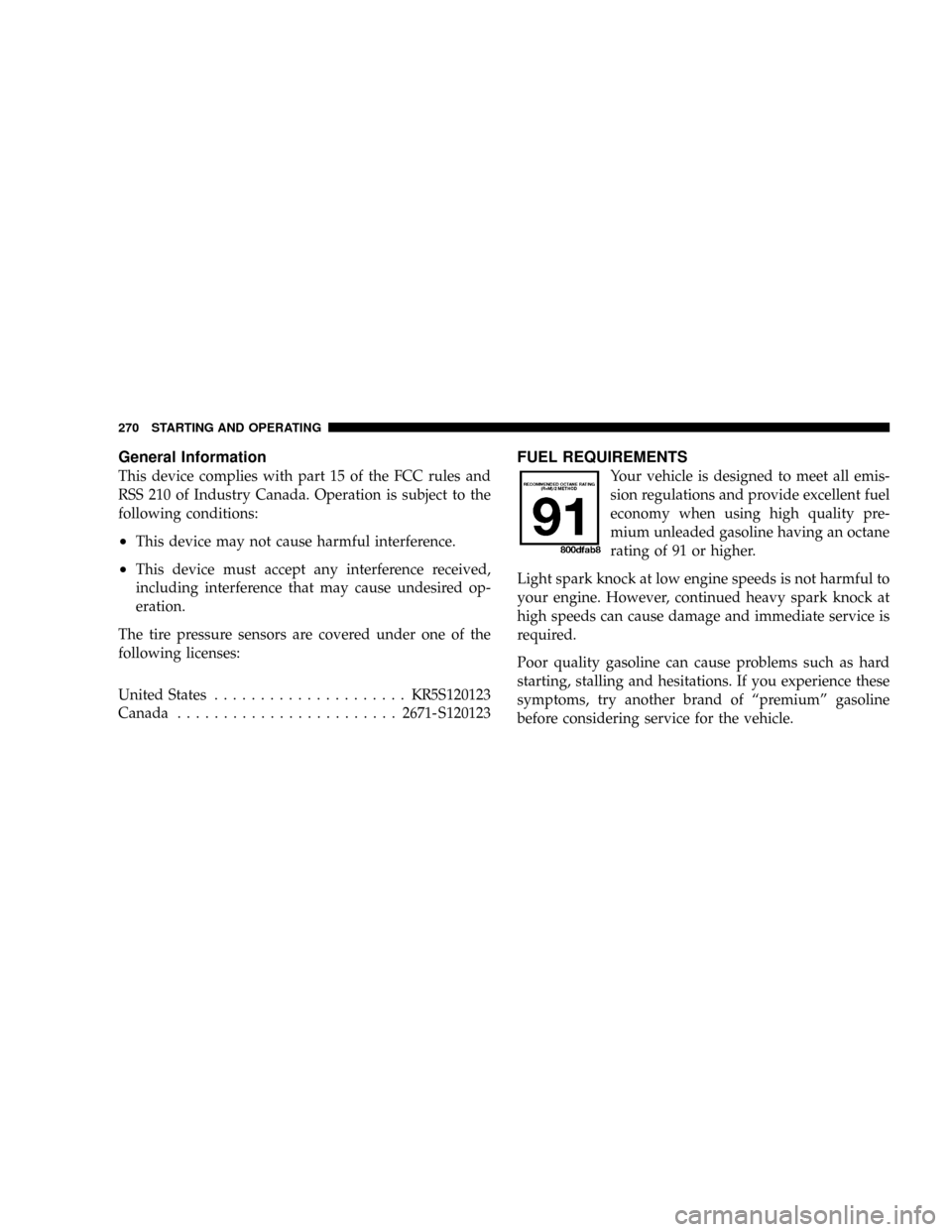
FUEL REQUIREMENTS
Your vehicle is designed to meet all emis-
sion regulations and provide excellent fuel
economy when using high quality pre-
mium unleaded gasoline having an octane
rating of 91 or higher.
Light spark knock at low engine speeds is not harmful to
your engine. However, continued heavy spark knock at
high speeds can cause damage and immediate service is
required.
Poor quality gasoline can cause problems such as hard
starting, stalling and hesitations. If you experience these
symptoms, try another brand of ªpremiumº gasoline
before considering service for the vehicle.
270 STARTING AND OPERATING
Page 327 of 395
CAUTION!
Do not allow petroleum base fluid to contaminate
the brake fluid, all brake seal components could be
damaged causing partial or complete brake failure.
Fuel System Hoses
Electronic Fuel Injection high pressure fuel systems are
designed with hoses and quick connect fittings which
have unique material characteristics to provide adequate
sealing and resist attack by deteriorated gasoline.
You are urged to use only the manufacturer's specified
hoses with quick connect fittings, or their equivalent in
material and specification, in any fuel system servicing. It
is mandatory to replace any damaged hoses or quick
connect fittings that have been removed during service.Care should be taken in installing quick connect fittings
to insure they are properly installed and fully connected.
See your authorized dealer for service.
Automatic Transmission
Fluid Level Check
Regular automatic transmission fluid level checks are not
required. For this reason the dipstick is omitted.
If you notice fluid loss or gear shift malfunction, have
your authorized dealer check the transmission fluid level.
MAINTAINING YOUR VEHICLE 327
7
Page 378 of 395
ABS (Anti-Lock Brake System)............173,245
Adding Engine Coolant (Antifreeze).......... 320
Adding Fuel........................... 274
Adding Washer Fluid..................... 165
Additives, Fuel......................... 272
Adjustable Pedals....................... 126
Air Conditioner Maintenance............... 313
Air Conditioning, Operating Tips............ 228
Air Conditioning Refrigerant............... 314
Air Pressure, Tires....................... 260
Airbag................................ 43
Airbag Deployment....................... 50
Airbag Light.......................52,66,173
Airbag Maintenance....................... 51
Alarm (Security Alarm).................18,174
Alarm System (Security Alarm)............... 18
Alignment and Balance................... 266
Alterations/Modifications, Vehicle............. 9
Antenna, Satellite Radio................... 218Antifreeze (Engine Coolant)..............319,346
Disposal............................ 321
Anti-Lock Brake System (ABS)............131,245
Anti-Lock Warning Light.................. 173
Anti-Theft System.....................18,174
Appearance Care........................ 329
Auto Down Power Windows................ 30
Automatic Dimming Mirror................. 74
Automatic Door Locks..................... 27
Automatic Headlights..................... 115
Automatic Temperature Control (ATC)......... 222
Automatic Transmission.............239,327,328
Adding Fluid......................... 328
Fluid and Filter Changes................. 328
Fluid Change......................... 328
Fluid Level Check...................... 327
Autostick............................. 241
Auxiliary Electrical Outlet (Power Outlet)...... 155
Auxiliary Power Outlet................... 155
378 INDEX
Page 379 of 395
Battery............................... 312
Emergency Starting..................... 293
Keyless Transmitter Replacement (RKE)....... 23
Saving Feature (Protection)............... 114
Bearings.............................. 329
Belts, Drive............................ 309
Belts, Seat.............................. 35
Body Mechanism Lubrication............... 316
B-Pillar Location........................ 254
Brake Assist System...................... 132
Brake Control System, Electronic............. 131
Brake System........................... 324
Anti-Lock (ABS)....................131,245
Fluid Check.......................... 325
Hoses.............................. 324
Parking............................. 244
Warning Light........................ 172
Brake/Transmission Interlock............... 238
Break-In Recommendations, New Vehicle........ 64Bulb Replacement.....................340,341
Camera, Rear........................... 143
Capacities, Fluid........................ 346
Caps, Filler
Fuel................................ 274
Radiator (Coolant Pressure)............... 321
Car Washes............................ 330
Carbon Monoxide Warning............65,146,273
Cargo Area Cover....................... 159
Cargo Area Features...................... 158
Cargo Compartment...................... 158
Light............................... 158
Cargo Light............................ 158
Cargo Load Floor........................ 163
Cargo Tie-Downs........................ 161
Catalytic Converter...................... 310
Caution, Exhaust Gas..................... 146
CD (Compact Disc) Player................. 195
INDEX 379
10
Page 395 of 395

INTRODUCTION INTRODUCTION Roll Over WarningHOW TO USE THIS MANUAL WARNINGS AND CAUTIONS VEHICLE IDENTIFICATION NUMBER VEHICLE MODIFICATIONS / ALTERATIONS THINGS TO KNOW BEFORE STARTING YOUR VEHICLE A WORD
ABOUT YOUR KEYS Ignition Key RemovalKey-In-Ignition ReminderSENTRY KEY IMMOBILIZER SYSTEM Important Note About ServiceReplacement KeysCustomer Key ProgrammingGeneral InformationSECURITY ALARM SYSTEM - IF EQUIPPED To Set the Alarm
To Disarm the SystemILLUMINATED ENTRY REMOTE KEYLESS ENTRY To Unlock the DoorsTo Lock the DoorsTo Release the Liftgate Flipper GlassUsing The Panic AlarmGeneral InformationTransmitter Battery ServiceREMOTE STARTING SYSTEM - IF EQUIPPED
DOOR LOCKS Manual Door LocksPower Door Locks - If EquippedChild Protection Door LockWINDOWS Power WindowsWind BuffetingLIFTGATE Liftgate FlipperGlassOCCUPANT RESTRAINTS Lap/Shoulder BeltsLap/Shoulder Belt Operating InstructionsAdjustable Upper
Shoulder Belt AnchorageAutomatic Locking Mode - If EquippedEnergy Management FeatureSeat Belt PretensionersSeat Belts and Pregnant WomenSeat Belt ExtenderDriver And Front Passenger Supplemental Restraint Systems (SRS) Child RestraintENGINE BREAK-IN
RECOMMENDATIONS SAFETY TIPS Exhaust GasSafety Checks You Should Make Inside The VehicleSafety Checks You Should Make Outside The VehicleUNDERSTANDING THE FEATURES OF YOUR VEHICLE MIRRORS Automatic Dimming MirrorOutside Mirrors
Exterior Mirrors Folding FeatureDrivers Outside Automatic Dimming Mirror - If EquippedPower Remote Control Outside MirrorsHeated Remote ControlMirrors - If EquippedLighted Vanity Mirrors - If EquippedHANDS-FREE COMMUNICATION (UConnect) - IF EQUIPPED
OperationsPhone Call FeaturesUConnect System FeaturesAdvanced Phone ConnectivityThings You Should Know About Your UConnect SystemSEATS Front Manual Seat AdjustmentFront Seat Adjustment - ReclineManual Lumbar Support Adjustment8 - Way Drivers Power
Seat4 - Way Passengers Power Seat - If EquippedHead RestraintsHeated Seats-If Equipped60/40 Split Rear SeatDRIVER MEMORY SEAT - IF EQUIPPED SettingMemory Positions and Linking Remote Keyless Entry Transmitter to MemoryMemory Position RecallTo Disable
A Transmitter Linked to MemoryEasy Entry/Exit SeatTO OPEN AND CLOSE THE HOOD LIGHTS Multi-Function Control LeverBattery Saver Feature-Exterior/Interior LightsHeadlights and Parking LightsAutomatic Headlight System - If EquippedSmartBeams - If Equipped
Instrument Panel and Interior LightsDaytime Running Lights - If EquippedLights-On ReminderFog Lights - If EquippedTurn SignalsHigh Beam SwitchPassing LightHeadlight Time DelayInterior LightsFront Map/Reading LightsWINDSHIELD WIPERS AND WASHERS Mist
Speed Sensitive Intermittent Wiper SystemRain Sensing Wipers-If EquippedTILT STEERING COLUMN ADJUSTABLE PEDALS - IF EQUIPPED ELECTRONIC SPEED CONTROL To ActivateTo Set at a Desired SpeedTo DeactivateTo Resume SpeedTo Vary the Speed
SettingTo Accelerate for PassingDriving Up or Down HillsELECTRONIC BRAKE CONTROL SYSTEM ABS (Anti-Lock Brake System)TCS (Traction Control System)BAS (Brake Assist System)ERM (Electronic Roll Mitigation)ESP (Electronic Stability Program)ESP/BAS
Warning Lamp and ESP/TCS Indicator LightREAR PARK ASSIST SYSTEM- IF EQUIPPED Rear Park Assist SensorsRear Park Assist Warning DisplayEnable/Disable the Rear Park Assist SystemService the Rear Park Assist SystemCleaning the Rear Park Assist System
REAR CAMERA - IF EQUIPPED Turning the Rear Camera OnTurning the Rear Camera OffOVERHEAD CONSOLE Courtesy/Reading LightsSunglasses StorageGARAGE DOOR OPENER Programming HomeLinkCanadian Programming/Gate ProgrammingUsing HomeLink
Erasing HomeLink ButtonsReprogramming a Single HomeLink ButtonSecurityPOWER SUNROOF - IF EQUIPPED Opening Sunroof - ExpressClosing Sunroof - ExpressPinch Protect FeaturePinch Protect OverrideVenting Sunroof - ExpressSunshade OperationWind
BuffetingSunroof MaintenanceIgnition Off OperationSunroof Fully ClosedPOWER OUTLET CUP HOLDERS CARGO AREA FEATURES Cargo LightRear Storage CompartmentRetractable Cargo Area CoverCargo Tie-Down HooksCargo Load FloorREAR WINDOW
FEATURES Rear Window Wiper/Washer - If EquippedRear Window Defroster - If EquippedUNDERSTANDING YOUR INSTRUMENT PANEL INSTRUMENT PANEL AND CONTROLS INSTRUMENT CLUSTER INSTRUMENT CLUSTER DESCRIPTION ELECTRONIC
VEHICLE INFORMATION CENTER Customer Programmable FeaturesCompass/Temperature/Trip ComputerTrip ComputerRADIO GENERAL INFORMATION Radio Broadcast SignalsTwo Types of SignalsElectrical DisturbancesAM ReceptionFM ReceptionSALES CODE
RAQ - AM/FM/CD (6-DISC) RADIO WITH OPTIONAL SATELLITE RADIO, HANDS FREE PHONE, AND VEHICLE ENTERTAINMENT SYSTEMS (VES) CAPABILITIES Operating Instructions - Radio ModeOperation Instructions - (CD MODE for CD Audio Play)LOAD/EJECT
Button (CD Mode for CD Audio Play)Notes On Playing MP3 FilesOperation Instructions - (CD Mode for MP3 Audio Play)LOAD/EJECT Button (CD Mode for MP3 Play)SALES CODE REC - AM/FM/CD (6-DISC) RADIO WITH NAVIGATION SYSTEM Operating Instructions
- Satellite Radio (If Equipped)REC Setting the ClockAudio Clock DisplayVIDEO ENTERTAINMENT SYSTEM (SALES CODE XRV) - IF EQUIPPED SATELLITE RADIO - IF EQUIPPED System ActivationElectronic Serial Number/Sirius Identification Number (ESN/SID)
Selecting Satellite Mode in RAQ RadiosSelecting a ChannelStoring and Selecting Pre-Set ChannelsUsing the PTY (Program Type) Button - If EquippedPTY Button SCANPTY Button SEEKSatellite AntennaReception QualityREMOTE SOUND SYSTEM CONTROLS Radio
OperationCD PlayerCD/DVD DISC MAINTENANCE RADIO OPERATION AND CELLULAR PHONES CLIMATE CONTROLS Automatic Temperature ControlOperating TipsSTARTING AND OPERATING STARTING PROCEDURES Normal StartingExtreme Cold Weather
(below -20 degrees F (-29 degrees C)If Engine Fails to StartAfter StartingAUTOMATIC TRANSMISSION Brake/Transmission Interlock System5-Speed Automatic TransmissionGear RangesRocking the VehicleAUTOSTICK Autostick OperationAutostick General Information
PARKING BRAKE ANTI-LOCK BRAKE SYSTEM POWER STEERING TIRE SAFETY INFORMATION Tire Markings Tire Identification Number (TIN)Tire Loading and Tire PressureTIRES - GENERAL INFORMATION Run Flat TiresTire PressureTire Inflation PressuresTire
Pressures for High Speed OperationRadial-Ply TiresTire SpinningTread Wear IndicatorsLife of TireReplacement TiresAlignment and BalanceTIRE ROTATION RECOMMENDATIONS TIRE PRESSURE MONITOR SYSTEM (TPMS) Premium SystemGeneral InformationFUEL
REQUIREMENTS Reformulated GasolineGasoline/Oxygenate BlendsMMT In GasolineMaterials Added to FuelFuel System CautionsCarbon Monoxide WarningsADDING FUEL Fuel Filler Cap (Gas Cap)TRAILER TOWING Common Towing DefinitionsTrailer Hitch
ClassificationTrailer Towing Weights (Maximum Trailer Weight Ratings)Trailer and Tongue WeightTowing RequirementsTowing TipsRECREATIONAL TOWING (BEHIND MOTORHOME, ETC.) WHAT TO DO IN EMERGENCIES HAZARD WARNING FLASHERS IF YOUR
ENGINE OVERHEATS JUMP STARTING MAINTAINING YOUR VEHICLE ENGINE COMPARTMENT - 6.1L ONBOARD DIAGNOSTIC SYSTEM - OBD II Loose Fuel Filler Cap MessageEMISSIONS INSPECTION AND MAINTENANCE PROGRAMS REPLACEMENT PARTS
DEALER SERVICE MAINTENANCE PROCEDURES Engine OilEngine Oil FilterDrive Belts - Check Condition and TensionerSpark PlugsEngine Air Cleaner FilterFuel FilterCatalytic ConverterMaintenance-Free BatteryAir Conditioner MaintenancePower Steering Fluid Check
Body LubricationWindshield Wiper BladesWindshield Washers - Front and RearExhaust SystemCooling SystemHoses And Vacuum/Vapor HarnessesBrake SystemBrake Fluid Level CheckFuel System HosesAutomatic TransmissionFront And Rear Wheel Bearings
Appearance Care And Protection From CorrosionFUSE PANEL Interior FusesUnderhood Fuses (Power Distribution Center) Underhood Fuses (Integrated Power Module) VEHICLE STORAGE REPLACEMENT BULBS BULB REPLACEMENT Head LightFront Turn Signal
Front Fog LightRear Tail, Stop, Turn Signal, and Back-Up LightsCenter High Mounted Stop Light (CHMSL)FLUID CAPACITIES FLUIDS, LUBRICANTS, AND GENUINE PARTS EngineChassisMAINTENANCE SCHEDULES EMISSION CONTROL SYSTEM MAINTENANCE MAINTENANCE SCHEDULES Schedule BSchedule AIF YOU NEED CONSUMER ASSISTANCE SUGGESTIONS FOR OBTAINING SERVICE FOR YOUR VEHICLE Prepare For The AppointmentPrepare A ListBe Reasonable With RequestsIF YOU NEED ASSISTANCE
WARRANTY INFORMATION (U.S. Vehicles Only) MOPAR PARTS REPORTING SAFETY DEFECTS In CanadaPUBLICATION ORDER FORMS DEPARTMENT OF TRANSPORTATION UNIFORM TIRE QUALITY GRADES TreadwearTraction GradesTemperature Grades
INDEX