transmission JEEP GRAND CHEROKEE 2012 WK2 / 4.G Owner's Manual
[x] Cancel search | Manufacturer: JEEP, Model Year: 2012, Model line: GRAND CHEROKEE, Model: JEEP GRAND CHEROKEE 2012 WK2 / 4.GPages: 148, PDF Size: 5.91 MB
Page 94 of 148
WARNING!
You or others could be injured if you leave the vehicle unattended
with the transfer case in the NEUTRAL position without first fully
engaging the parking brake. The transfer case NEUTRAL position
disengages both the front and rear driveshafts from the powertrain
and will allow the vehicle to move even if the transmission is in PARK.
The parking brake should always beapplied when the driver is not in
the vehicle.
UTILITY
92
Page 95 of 148
AUTOSTICK®
• AutoStick® is a driver-interactivetransmission feature that offers
manual gear shifting to provide
youwithmorecontrolofthe
vehicle. AutoStick® allows you to
maximize engine braking,
eliminate undesirable upshifts and
downshifts, and improve overall
vehicle performance.
• This system can also provide you with more control during passing,
city driving, cold slippery
conditions, mountain driving,
trailer towing, and many other
situations.
Operation
• When the shift lever is in the DRIVE position, the transmission willoperate automatically, shifting between the five available gears. To
engage AutoStick®, simply tap the shift lever to the right or left (+/-)
while in the DRIVE position, or tap one of the steering wheel-mounted
shift paddles (+/-). Tapping (-) to enter AutoStick® mode will downshift
the transmission to the next lower gear, while using (+) to enter
AutoStick® mode will retain the current gear. When AutoStick® is active,
the current transmission gear is displayed in the instrument cluster. In
AutoStick® mode, the transmission will shift up or down when (+/-) is
manually selected by the driver (using the shift lever, or the shift
paddles), unless an engine lugging or overspeed condition would result.
It will remain in the selected gear until another upshift or downshift is
chosen, except as described below:
• Normally, in AutoStick® mode, the transmission will automatically shift up when maximum engine speed is reached. If, h owever, AutoStick® is
engaged while in SPORT mode, the transmission will remain in the
selected gear even when maximum engine speed is reached. The
transmission will upshift only when commanded by the driver.
• The transmission will automatically downshift as the vehicle slows (to prevent engine lugging) and will display the current gear.
• The transmission will automatically downshift to first gear when coming to a stop. After a stop, the driver should manually upshift (+) the
transmission as the vehicle is accelerated.
• You can start out in first or second gear. Tapping (+) (at a stop) will allow starting in second gear. Starting out in second gear is helpful in
snowy or icy conditions.
• The system will ignore attempts to upshift at too low of a vehicle speed.
• Avoid using speed control when AutoStick® is engaged.
SRT8
93
Page 96 of 148
• Transmission shifting will be more noticeable when AutoStick® isengaged.
• To disengage AutoStick® mode, hold the shift lever to the right or press and hold the (+) shift paddle until “D” is once again displayed in the
instrument cluster. You can shift in or out of the AutoStick® mode at any
time without taking your foot off the accelerator pedal.
WARNING!
Do not downshift for additional engine braking on a slippery surface.
The drive wheels could lose their grip and the vehicle could skid,
causing a collision or personal injury.
SELEC-TRACK™
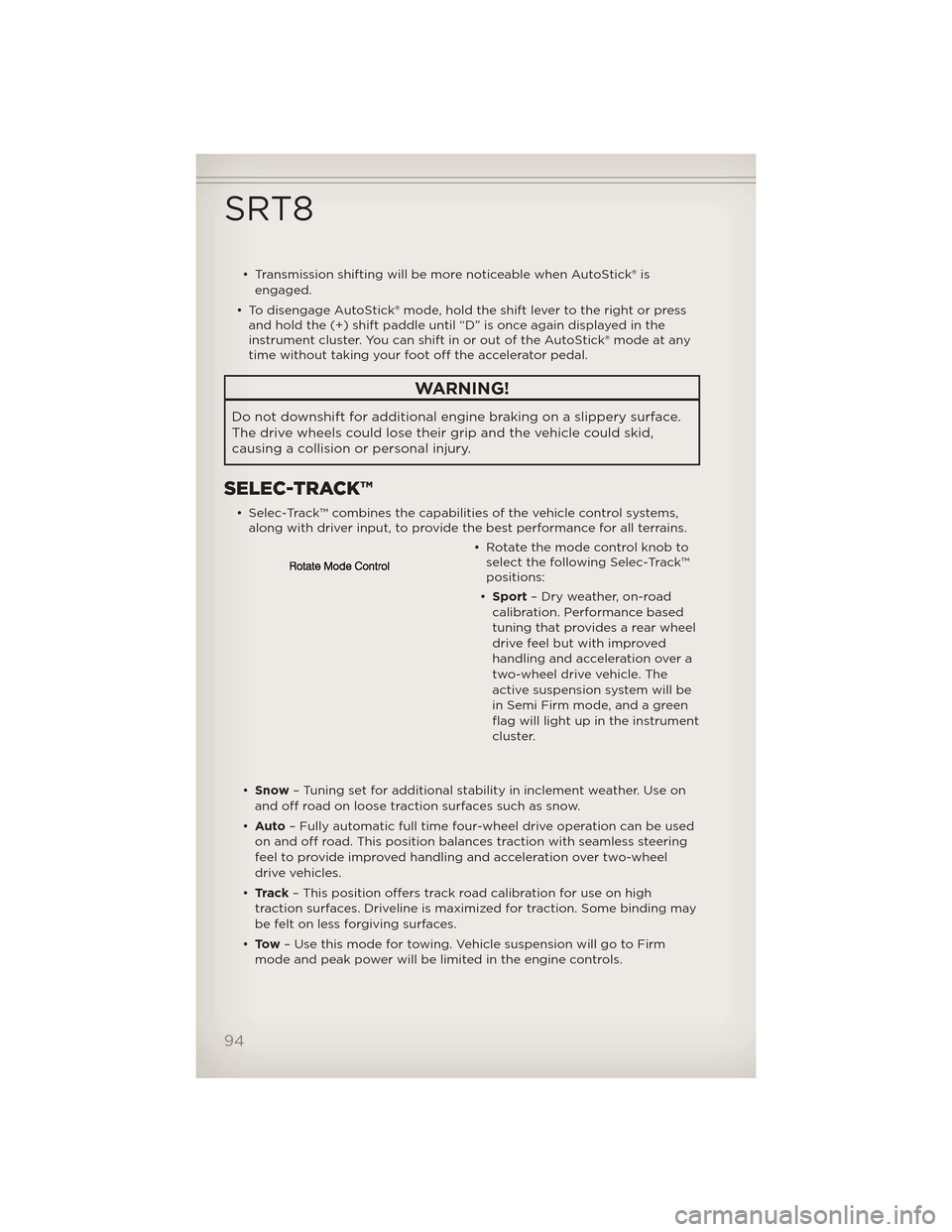
• Selec-Track™ combines the capabilities of the vehicle control systems,along with driver input, to provide the best performance for all terrains.
• Rotate the mode control knob toselect the following Selec-Track™
positions:
• Sport – Dry weather, on-road
calibration. Performance based
tuning that provides a rear wheel
drive feel but with improved
handling and acceleration over a
two-wheel drive vehicle. The
active suspension system will be
in Semi Firm mode, and a green
flag will light up in the instrument
cluster.
• Snow – Tuning set for additional stability in inclement weather. Use on
and off road on loose traction surfaces such as snow.
• Auto – Fully automatic full time four-wheel drive operation can be used
on and off road. This position balances traction with seamless steering
feel to provide improved handling and acceleration over two-wheel
drive vehicles.
• Track – This position offers track road calibration for use on high
traction surfaces. Driveline is maximized for traction. Some binding may
be felt on less forgiving surfaces.
• To w – Use this mode for towing. Vehicle suspension will go to Firm
mode and peak power will be limited in the engine controls.
SRT8
94
Page 103 of 148
IF YOUR ENGINE OVERHEATS
• In any of the following situations, you can reduce the potential foroverheating by taking the appropriate action.
• On the highways — slow down.
• In city traffic — while stopped, place the transmission in NEUTRAL, but do not increase engine idle speed.
NOTE: There are steps that you can take to slow down an impending
overheat condition:
• If your air conditioner (A/C) is on, turn it off. The A/C system adds heat to the engine cooling system and turning the A/C off can help remove this
heat.
• You can also turn the temperature control to maximum heat, the mode control to floor and the blower control to high. This allows the heater core
to act as a supplement to the radiator and aids in removing heat from the
engine cooling system.
CAUTION!
Driving with a hot cooling system could damage your vehicle. If the
temperature gauge reads 240°F (116 °C) or greater pull over and stop
the vehicle. Idle the vehicle with the air conditioner turned off until the
pointer drops back into the normal range 200–230°F (93–110°C). If
the pointer remains at 240°F (116°C) or greater and you hear a chime,
turn the engine off immediately and call for service.
WARNING!
You or others can be badly burned by hot engine coolant (antifreeze)
or steam from your radiator. If you see or hear steam coming from
under the hood, do not open the hood until the radiator has had time
to cool. Never try to open a cooling system pressure cap when the
radiator or coolant bottle is hot.
WHAT TO DO IN EMERGENCIES
101
Page 109 of 148
Road Tire Installation
1. Mount the road tire on the axle.
2. Install the remaining lug nuts with the cone shaped end of the nuttoward the wheel. Lightly tighten the lug nuts.
3. Lower the vehicle to the ground by turning the jack handle counterclockwise.
4. Finish tightening the lug nuts. Push down on the wrench while at the end of the handle for increased leverage. Tighten the lug nuts in a star
pattern until each nut has been tightened twice. The correct tightness of
each lug nut is 110 ft/lbs (150 N·m). If in doubt about the correct
tightness, have them checked with a torque wrench by your authorized
dealer or service station.
5. After 25 miles (40 km) check the lug nut torque with a torque wrench to ensure that all lug nuts are properly seated against the wheel.
CAUTION!
• Do not attempt to raise the vehicle by jacking on locations otherthan those indicated in the Jacking Instructions for this vehicle.
• Be sure to mount the spare tire with the valve stem facing outward. The vehicle could be damaged if the spare tire is mounted
incorrectly.
WARNING!
• Do not attempt to change a tire on the side of the vehicle close tomoving traffic. Pull far enough off the road to avoid the danger of
being hit when operating the jack or changing the wheel.
• Being under a jacked-up vehicle is dangerous. The vehicle could slip off the jack and fall on you. You could be crushed. Never put any
part of your body under a vehicle that is on a jack. If you need to
get under a raised vehicle, take it to a service center where it can be
raised on a lift.
• Never start or run the engine while the vehicle is on a jack.
• The jack is designed to be used as a tool for changing tires only. The jack should not be used to lift the vehicle for service purposes. The
vehicle should be jacked on a firm level surface only. Avoid ice or
slippery areas.
• Always park on a firm, level surface as far from the edge of the
roadway as possible before raising the vehicle.
• Turn on the Hazard Warning flasher.
• Block the wheel diagonally opposite the wheel to be raised.
• Set the parking brake firmly and set an automatic transmission in PARK.
(Continued)
WHAT TO DO IN EMERGENCIES
107
Page 111 of 148
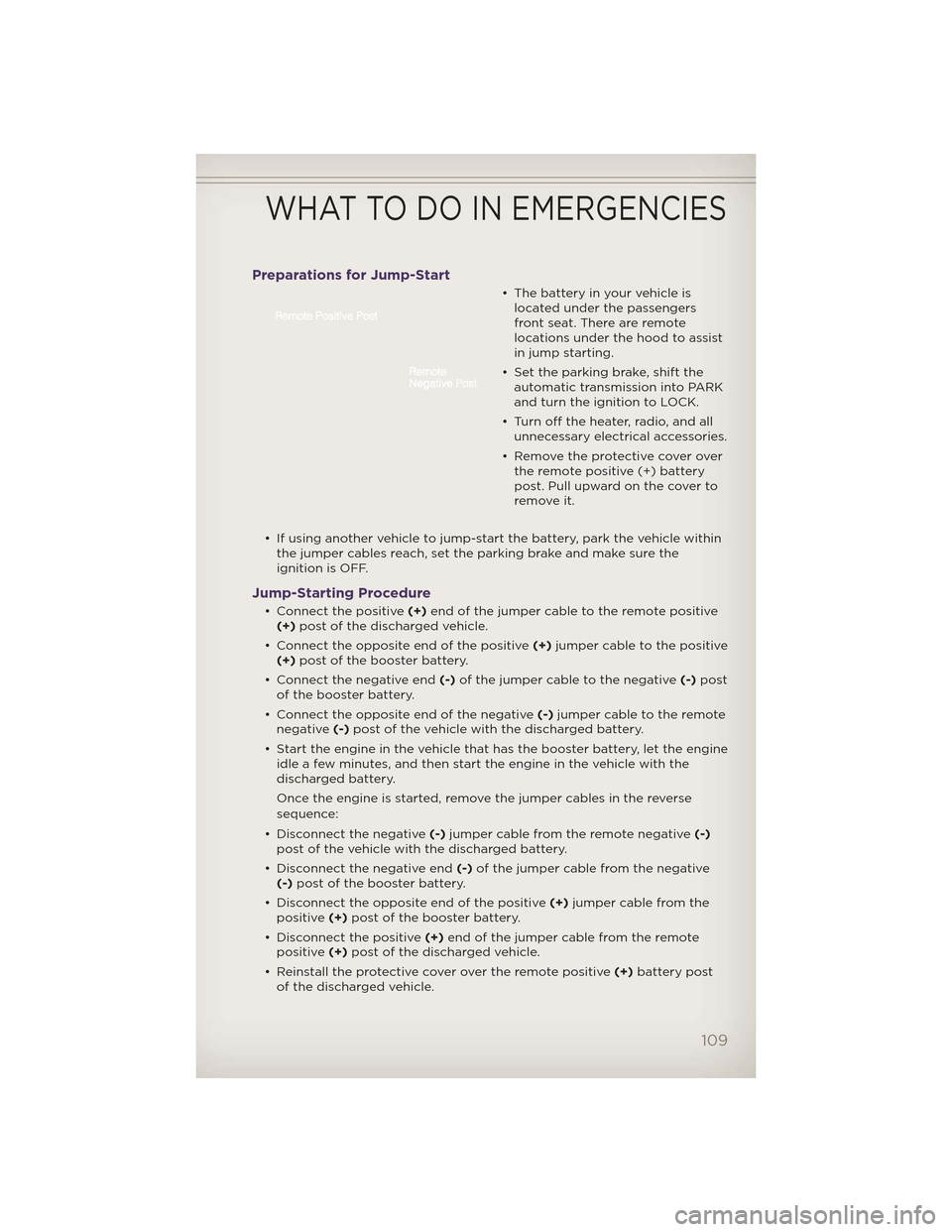
Preparations for Jump-Start
• The battery in your vehicle islocated under the passengers
front seat. There are remote
locations under the hood to assist
in jump starting.
• Set the parking brake, shift the automatic transmission into PARK
and turn the ignition to LOCK.
• Turn off the heater, radio, and all unnecessary electrical accessories.
• Remove the protective cover over the remote positive (+) battery
post. Pull upward on the cover to
remove it.
• If using another vehicle to jump-start the battery, park the vehicle within the jumper cables reach, set the parking brake and make sure the
ignition is OFF.
Jump-Starting Procedure
• Connect the positive (+)end of the jumper cable to the remote positive
(+) post of the discharged vehicle.
• Connect the opposite end of the positive (+)jumper cable to the positive
(+) post of the booster battery.
• Connect the negative end (-)of the jumper cable to the negative (-)post
of the booster battery.
• Connect the opposite end of the negative (-)jumper cable to the remote
negative (-)post of the vehicle with the discharged battery.
• Start the engine in the vehicle that has the booster battery, let the engine idle a few minutes, and then start the engine in the vehicle with the
discharged battery.
Once the engine is started, remove the jumper cables in the reverse
sequence:
• Disconnect the negative (-)jumper cable from the remote negative (-)
post of the vehicle with the discharged battery.
• Disconnect the negative end (-)of the jumper cable from the negative
(-) post of the booster battery.
• Disconnect the opposite end of the positive (+)jumper cable from the
positive (+)post of the booster battery.
• Disconnect the positive (+)end of the jumper cable from the remote
positive (+)post of the discharged vehicle.
• Reinstall the protective cover over the remote positive (+)battery post
of the discharged vehicle.
WHAT TO DO IN EMERGENCIES
109
Page 121 of 148
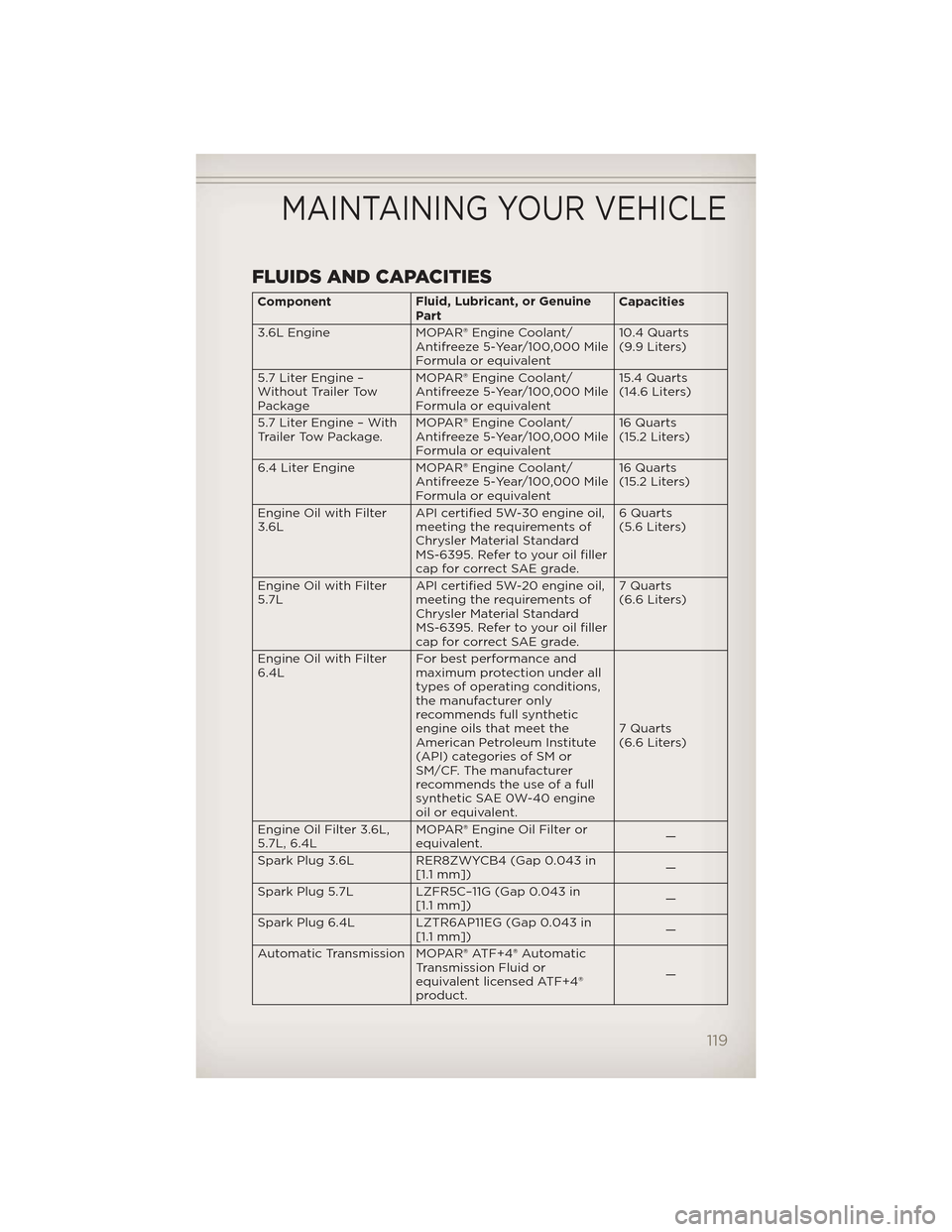
FLUIDS AND CAPACITIES
ComponentFluid, Lubricant, or Genuine
Part Capacities
3.6L Engine MOPAR® Engine Coolant/ Antifreeze 5-Year/100,000 Mile
Formula or equivalent 10.4 Quarts
(9.9 Liters)
5.7 Liter Engine –
Without Trailer Tow
Package MOPAR® Engine Coolant/
Antifreeze 5-Year/100,000 Mile
Formula or equivalent 15.4 Quarts
(14.6 Liters)
5.7 Liter Engine – With
Trailer Tow Package. MOPAR® Engine Coolant/
Antifreeze 5-Year/100,000 Mile
Formula or equivalent 16 Quarts
(15.2 Liters)
6.4 Liter Engine MOPAR® Engine Coolant/ Antifreeze 5-Year/100,000 Mile
Formula or equivalent 16 Quarts
(15.2 Liters)
Engine Oil with Filter
3.6L API certified 5W-30 engine oil,
meeting the requirements of
Chrysler Material Standard
MS-6395. Refer to your oil filler
cap for correct SAE grade. 6 Quarts
(5.6 Liters)
Engine Oil with Filter
5.7L API certified 5W-20 engine oil,
meeting the requirements of
Chrysler Material Standard
MS-6395. Refer to your oil filler
cap for correct SAE grade. 7 Quarts
(6.6 Liters)
Engine Oil with Filter
6.4L For best performance and
maximum protection under all
types of operating conditions,
the manufacturer only
recommends full synthetic
engine oils that meet the
American Petroleum Institute
(API) categories of SM or
SM/CF. The manufacturer
recommends the use of a full
synthetic SAE 0W-40 engine
oil or equivalent. 7 Quarts
(6.6 Liters)
Engine Oil Filter 3.6L,
5.7L, 6.4L MOPAR® Engine Oil Filter or
equivalent.
—
Spark Plug 3.6L RER8ZWYCB4 (Gap 0.043 in [1.1 mm]) —
Spark Plug 5.7L LZFR5C–11G (Gap 0.043 in [1.1 mm]) —
Spark Plug 6.4L LZTR6AP11EG (Gap 0.043 in [1.1 mm]) —
Automatic Transmission MOPAR® ATF+4® Automatic Transmission Fluid or
equivalent licensed ATF+4®
product. —
MAINTAINING YOUR VEHICLE
119
Page 122 of 148
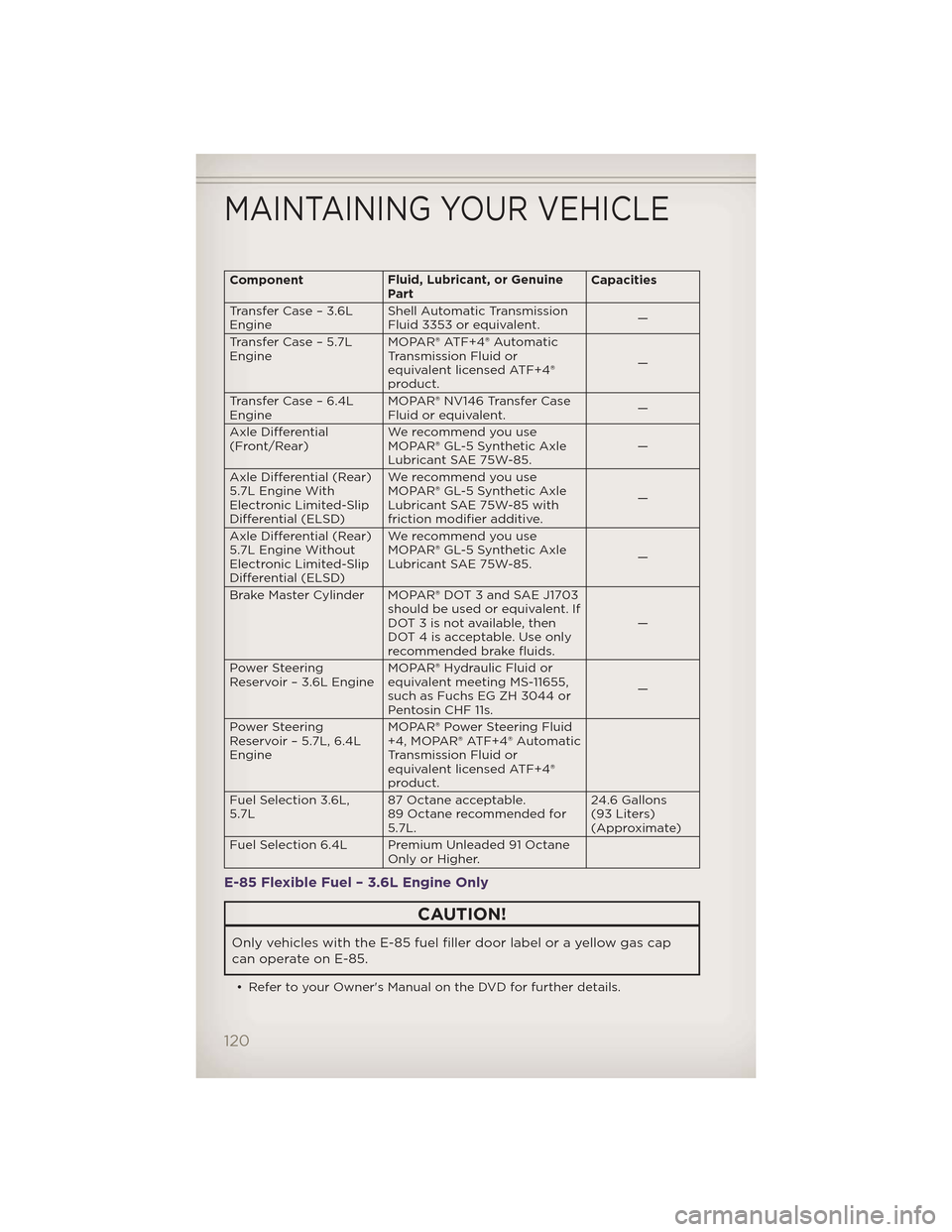
ComponentFluid, Lubricant, or Genuine
Part Capacities
Transfer Case – 3.6L
Engine Shell Automatic Transmission
Fluid 3353 or equivalent.
—
Transfer Case – 5.7L
Engine MOPAR® ATF+4® Automatic
Transmission Fluid or
equivalent licensed ATF+4®
product. —
Transfer Case – 6.4L
Engine MOPAR® NV146 Transfer Case
Fluid or equivalent.
—
Axle Differential
(Front/Rear) We recommend you use
MOPAR® GL-5 Synthetic Axle
Lubricant SAE 75W-85. —
Axle Differential (Rear)
5.7L Engine With
Electronic Limited-Slip
Differential (ELSD) We recommend you use
MOPAR® GL-5 Synthetic Axle
Lubricant SAE 75W-85 with
friction modifier additive.
—
Axle Differential (Rear)
5.7L Engine Without
Electronic Limited-Slip
Differential (ELSD) We recommend you use
MOPAR® GL-5 Synthetic Axle
Lubricant SAE 75W-85.
—
Brake Master Cylinder MOPAR® DOT 3 and SAE J1703 should be used or equivalent. If
DOT 3 is not available, then
DOT 4 is acceptable. Use only
recommended brake fluids. —
Power Steering
Reservoir – 3.6L Engine MOPAR® Hydraulic Fluid or
equivalent meeting MS-11655,
such as Fuchs EG ZH 3044 or
Pentosin CHF 11s. —
Power Steering
Reservoir – 5.7L, 6.4L
Engine MOPAR® Power Steering Fluid
+4, MOPAR® ATF+4® Automatic
Transmission Fluid or
equivalent licensed ATF+4®
product.
Fuel Selection 3.6L,
5.7L 87 Octane acceptable.
89 Octane recommended for
5.7L. 24.6 Gallons
(93 Liters)
(Approximate)
Fuel Selection 6.4L Premium Unleaded 91 Octane Only or Higher.
E-85 Flexible Fuel – 3.6L Engine Only
CAUTION!
Only vehicles with the E-85 fuel filler door label or a yellow gas cap
can operate on E-85.
• Refer to your Owner's Manual on the DVD for further details.
MAINTAINING YOUR VEHICLE
120
Page 123 of 148
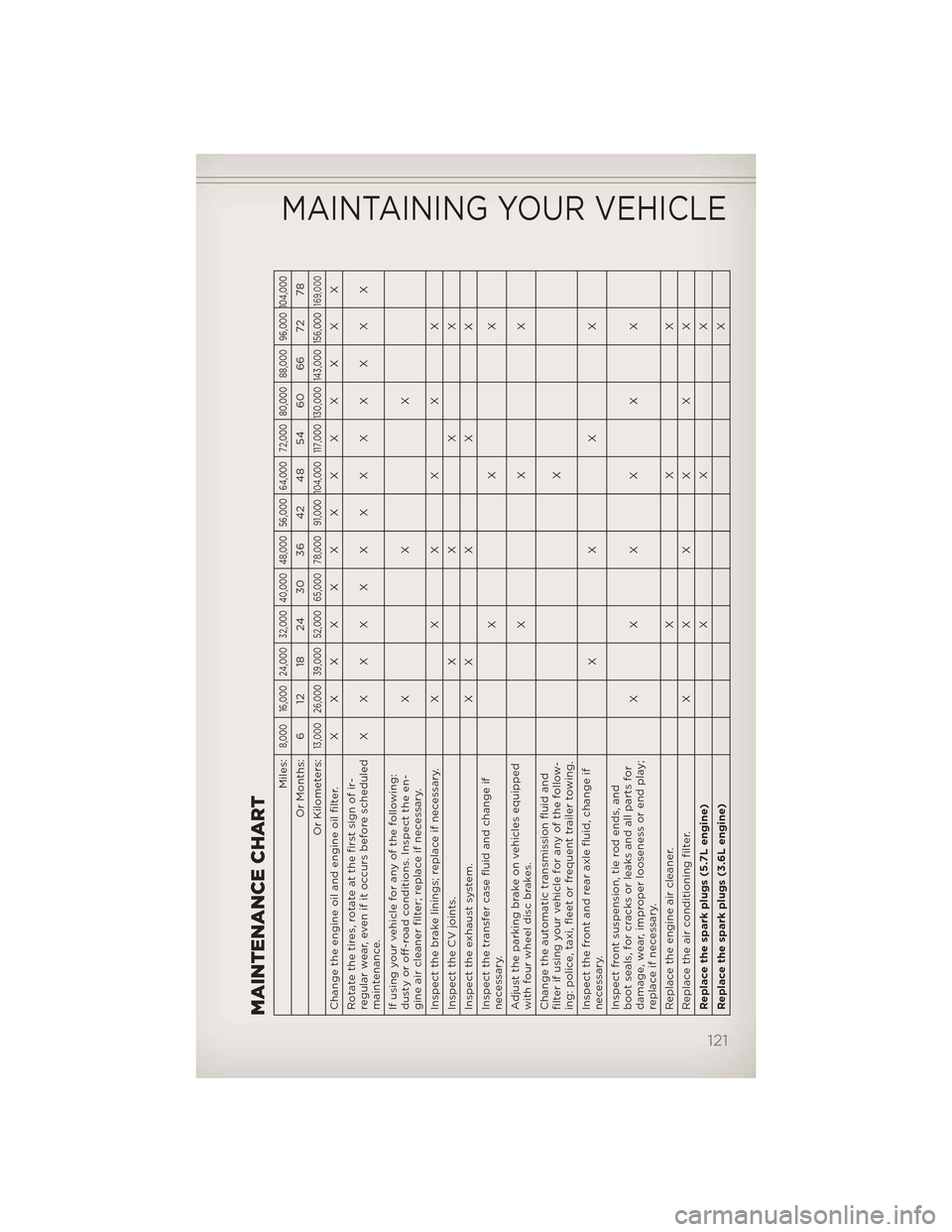
MAINTENANCE CHART
Miles:
8,000 16,000 24,000 32,000 40,000 48,000 56,000 64,000 72,000 80,000 88,000 96,000 104,000
Or Months: 6 12 18 24 30 36 42 48 54 60 66 72 78
Or Kilometers:
13,000 26,000 39,000 52,000 65,000 78,000 91,000 104,000 117,000 130,000 143,000 156,000
169,000
Change the engine oil and engine oil filter. XXXXXXXXXXXXX
Rotate the tires, rotate at the first sign of ir-
regular wear, even if it occurs before scheduled
maintenance. XXXXXXXXXXXXX
If using your vehicle for any of the following:
dusty or off-road conditions. Inspect the en-
gine air cleaner filter; replace if necessary. XXX
Inspect the brake linings; replace if necessary. XXXXXX
InspecttheCVjoints. XXXX
Inspecttheexhaustsystem. XXXXX
Inspect the transfer case fluid and change if
necessary. XXX
Adjust the parking brake on vehicles equipped
with four wheel disc brakes. XXX
Change the automatic transmission fluid and
filter if using your vehicle for any of the follow-
ing: police, taxi, fleet or frequent trailer towing. X
Inspect the front and rear axle fluid, change if
necessary. XXXX
Inspect front suspension, tie rod ends, and
boot seals, for cracks or leaks and all parts for
damage, wear, improper looseness or end play;
replace if necessary. XXXXXX
Replace the engine air cleaner. X X X
Replace the air conditioning filter. XXXXXX
Replace the spark plugs (5.7L engine) XXX
Replace the spark plugs (3.6L engine) X
MAINTAINING YOUR VEHICLE
121
Page 126 of 148
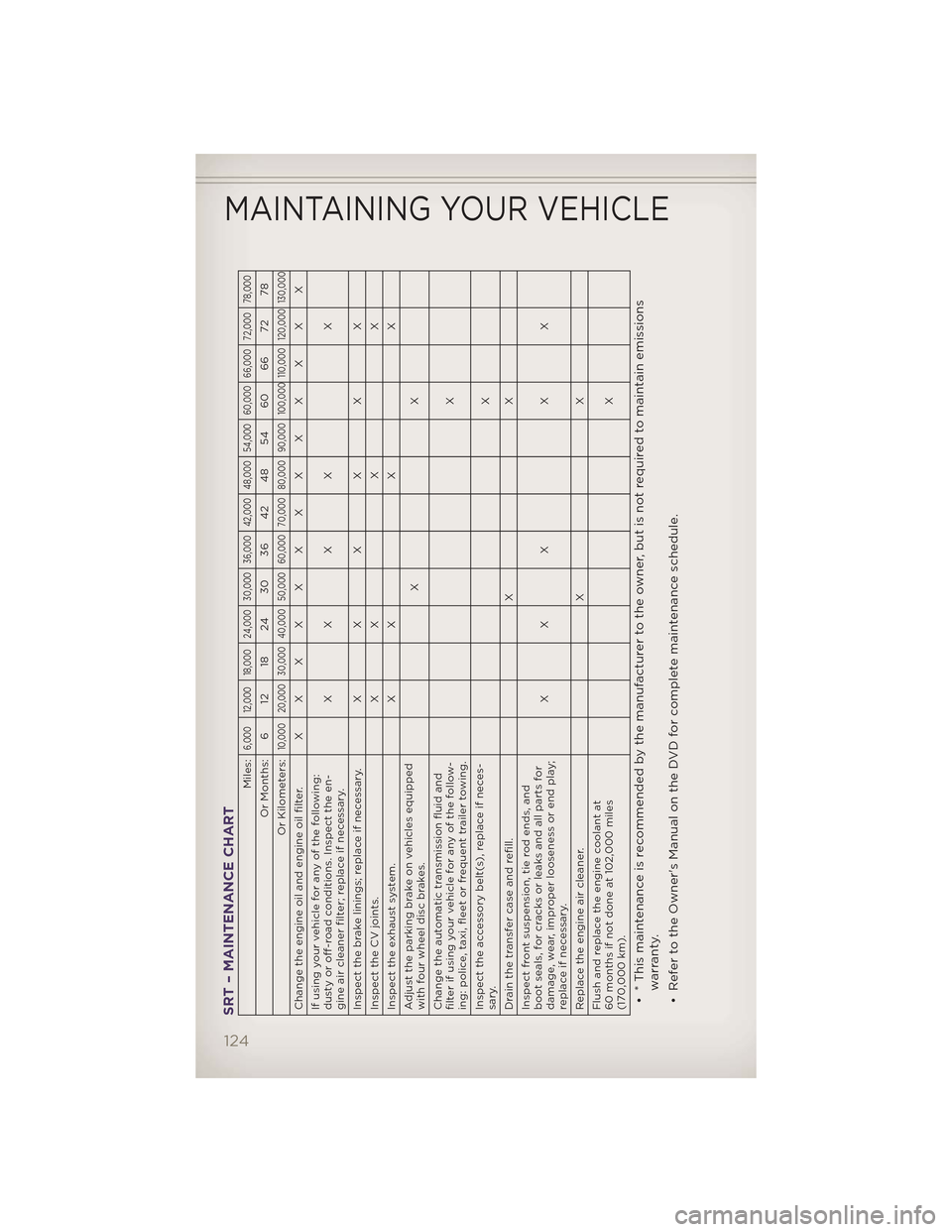
SRT – MAINTENANCE CHART
Miles:
6,000 12,000 18,000 24,000 30,000 36,000 42,000 48,000 54,000 60,000 66,000 72,000 78,000
Or Months: 6 12 18 24 30 36 42 48 54 60 66 72 78
Or Kilometers:
10,000 20,000 30,000 40,000 50,000 60,000 70,000 80,000 90,000 100,000 110,000 120,000 130,000
Change the engine oil and engine oil filter. XXXXXXXXXXXXX
If using your vehicle for any of the following:
dusty or off-road conditions. Inspect the en-
gine air cleaner filter; replace if necessary. XXXX X
Inspect the brake linings; replace if necessary. X X XXXX
Inspect the CV joints. X X X X
Inspect the exhaust system. X X X X
Adjust the parking brake on vehicles equipped
with four wheel disc brakes. XX
Change the automatic transmission fluid and
filter if using your vehicle for any of the follow-
ing: police, taxi, fleet or frequent trailer towing. X
Inspect the accessory belt(s), replace if neces-
sary. X
Drain the transfer case and refill. X X
Inspect front suspension, tie rod ends, and
boot seals, for cracks or leaks and all parts for
damage, wear, improper looseness or end play;
replace if necessary. XXX XX
Replace the engine air cleaner. X X
Flush and replace the engine coolant at
60 months if not done at 102,000 miles
(170,000 km). X• * This maintenance is recommended by the manufacturer to the owner, but is not required to maintain emissions
warranty.
• Refer to the Owner's Manual on the DVD for complete maintenance schedule.
MAINTAINING YOUR VEHICLE
124