transmission JEEP GRAND CHEROKEE 2014 WK2 / 4.G Owner's Manual
[x] Cancel search | Manufacturer: JEEP, Model Year: 2014, Model line: GRAND CHEROKEE, Model: JEEP GRAND CHEROKEE 2014 WK2 / 4.GPages: 220, PDF Size: 6.12 MB
Page 160 of 220
IF YOUR ENGINE OVERHEATS
In any of the following situations, you can reduce the potential for overheating by
taking the appropriate action:
• On the highways — slow down.
• In city traffic — while stopped, shift the transmission to NEUTRAL, but do not
increase engine idle speed.
NOTE:
There are steps that you can take to slow down an impending overheat condition:
• If your air conditioner (A/C) is on, turn it off. The A/C system adds heat to the
engine cooling system and turning the A/C off can help remove this heat.
•
You can also turn the temperature control to maximum heat, the mode control to floor
and the blower control to high. This allows the heater core to act as a supplement to
the radiator and aids in removing heat from the engine cooling system.
CAUTION!
Driving with a hot cooling system could damage your vehicle. If the temperature
gauge reads HOT (H), pull over and stop the vehicle. Idle the vehicle with the air
conditioner turned off until the pointer drops back into the normal range. If the
pointer remains on HOT (H), and you hear continuous chimes, turn the engine off
immediately, and call for service.
WARNING!
You or others can be badly burned by hot engine coolant (antifreeze) or steam from
your radiator. If you see or hear steam coming from under the hood, do not open
the hood until the radiator has had time to cool. Never try to open a cooling system
pressure cap when the radiator or coolant bottle is hot.
JACKING AND TIRE CHANGING
Run Flat Tires — SRT Only
This vehicle is equipped with “run flat” tires. Run flat tires allow the vehicle to be
driven approximately 50 miles (80km) at 55 mph (88km/h). Tire service should be
obtained to avoid prolonged run flat feature usage.
NOTE:
This vehicle may be equipped with a spare tire. The spare tire must be used for the
rear wheel(s) only. For a flat front tire, move the rear tire to the front and use the spare
tire on the rear.
WHAT TO DO IN EMERGENCIES
158
Page 166 of 220
WARNING!
• Do not attempt to change a tire on the side of the vehicle close to moving
traffic. Pull far enough off the road to avoid the danger of being hit when
operating the jack or changing the wheel.
• Being under a jacked-up vehicle is dangerous. The vehicle could slip off the
jack and fall on you. You could be crushed. Never put any part of your body
under a vehicle that is on a jack. If you need to get under a raised vehicle, take
it to a service center where it can be raised on a lift.
• Never start or run the engine while the vehicle is on a jack.
• The jack is designed to be used as a tool for changing tires only. The jack
should not be used to lift the vehicle for service purposes. The vehicle should
be jacked on a firm level surface only. Avoid ice or slippery areas.
• Always park on a firm, level surface as far from the edge of the roadway as
possible before raising the vehicle.
• Turn on the Hazard Warning flasher.
• Block the wheel diagonally opposite the wheel to be raised.
• Set the parking brake firmly and set an automatic transmission in PARK.
• Do not let anyone sit in the vehicle when it is on a jack.
• Do not get under the vehicle when it is on a jack.
• Only use the jack in the positions indicated and for lifting this vehicle during
a tire change.
• If working on or near a roadway, be extremely careful of motor traffic.
• To assure that spare tires, flat or inflated, are securely stowed, spares must be
stowed with the valve stem facing the ground.
• Carefully follow these tire changing warnings to help prevent personal injury or
damage to your vehicle.
• Raising the vehicle higher than necessary can make the vehicle less stable. It
could slip off the jack and hurt someone near it. Raise the vehicle only enough
to remove the tire.
• To avoid the risk of forcing the vehicle off the jack, do not tighten the wheel
nuts fully until the vehicle has been lowered. Failure to follow this warning may
result in personal injury.
• A loose tire or jack, thrown forward in a collision or hard stop could endanger
the occupants of the vehicle. Always stow the jack parts and the spare tire in
the places provided. Have the deflated (flat) tire repaired or replaced imme-
diately.
WHAT TO DO IN EMERGENCIES
164
Page 167 of 220
BATTERY LOCATION
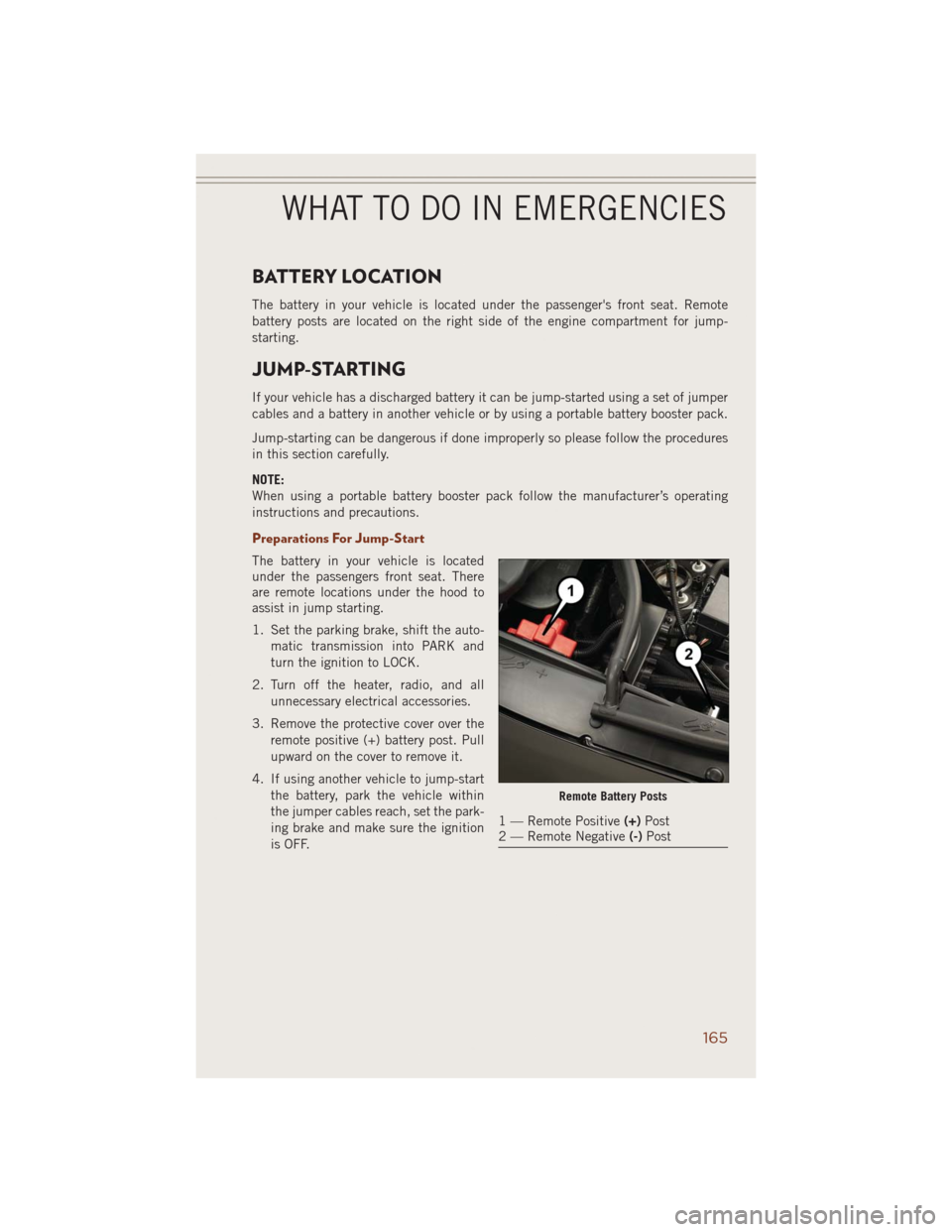
The battery in your vehicle is located under the passenger's front seat. Remote
battery posts are located on the right side of the engine compartment for jump-
starting.
JUMP-STARTING
If your vehicle has a discharged battery it can be jump-started using a set of jumper
cables and a battery in another vehicle or by using a portable battery booster pack.
Jump-starting can be dangerous if done improperly so please follow the procedures
in this section carefully.
NOTE:
When using a portable battery booster pack follow the manufacturer’s operating
instructions and precautions.
Preparations For Jump-Start
The battery in your vehicle is located
under the passengers front seat. There
are remote locations under the hood to
assist in jump starting.
1. Set the parking brake, shift the auto-
matic transmission into PARK and
turn the ignition to LOCK.
2. Turn off the heater, radio, and all
unnecessary electrical accessories.
3. Remove the protective cover over the
remote positive (+) battery post. Pull
upward on the cover to remove it.
4. If using another vehicle to jump-start
the battery, park the vehicle within
the jumper cables reach, set the park-
ing brake and make sure the ignition
is OFF.
Remote Battery Posts
1 — Remote Positive(+)Post
2 — Remote Negative(-)Post
WHAT TO DO IN EMERGENCIES
165
Page 170 of 220
MANUAL PARK RELEASE 8-SPEED
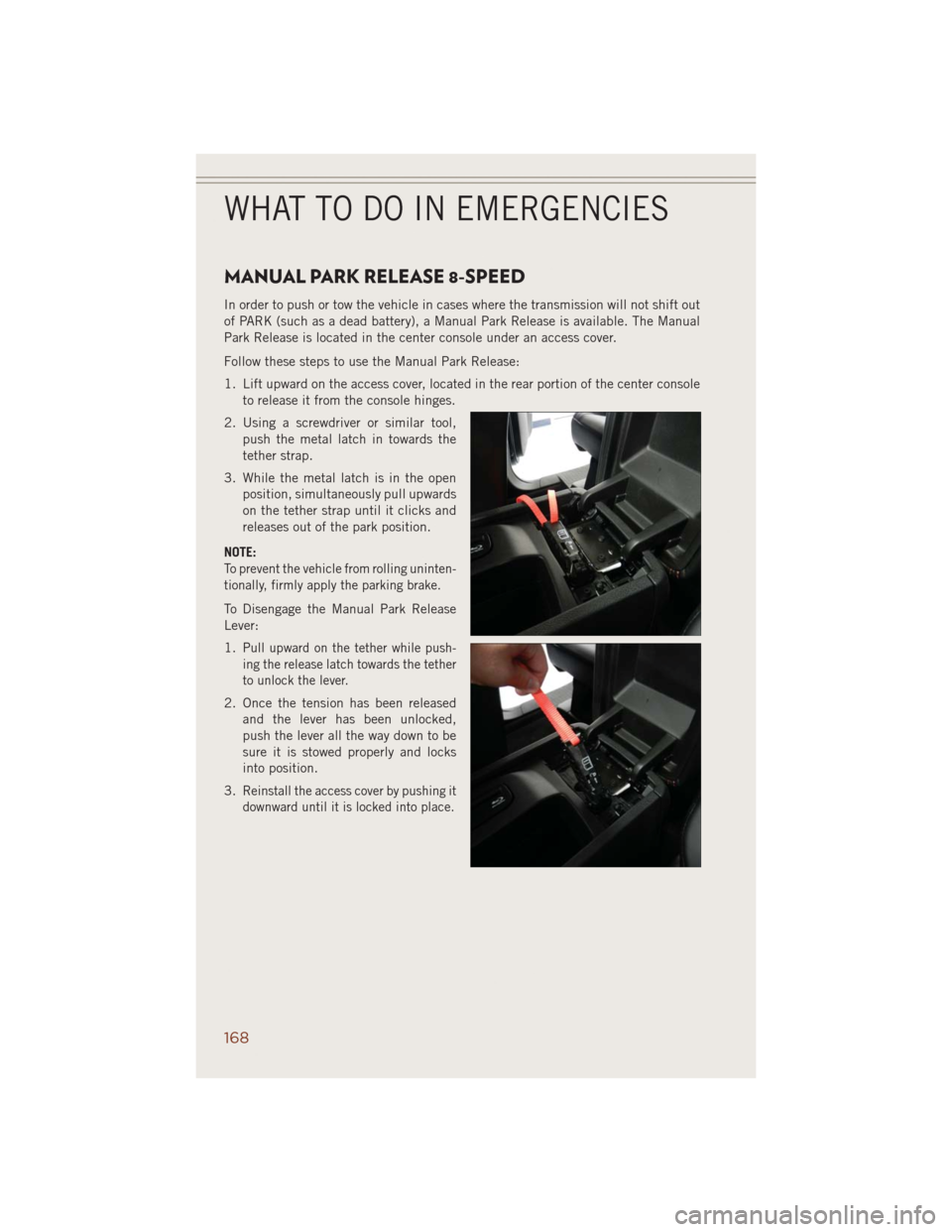
In order to push or tow the vehicle in cases where the transmission will not shift out
of PARK (such as a dead battery), a Manual Park Release is available. The Manual
Park Release is located in the center console under an access cover.
Follow these steps to use the Manual Park Release:
1. Lift upward on the access cover, located in the rear portion of the center console
to release it from the console hinges.
2. Using a screwdriver or similar tool,
push the metal latch in towards the
tether strap.
3. While the metal latch is in the open
position, simultaneously pull upwards
on the tether strap until it clicks and
releases out of the park position.
NOTE:
To prevent the vehicle from rolling uninten-
tionally, firmly apply the parking brake.
To Disengage the Manual Park Release
Lever:
1.
Pull upward on the tether while push-
ing the release latch towards the tether
to unlock the lever.
2. Once the tension has been released
and the lever has been unlocked,
push the lever all the way down to be
sure it is stowed properly and locks
into position.
3.
Reinstall the access cover by pushing it
downward until it is locked into place.
WHAT TO DO IN EMERGENCIES
168
Page 171 of 220
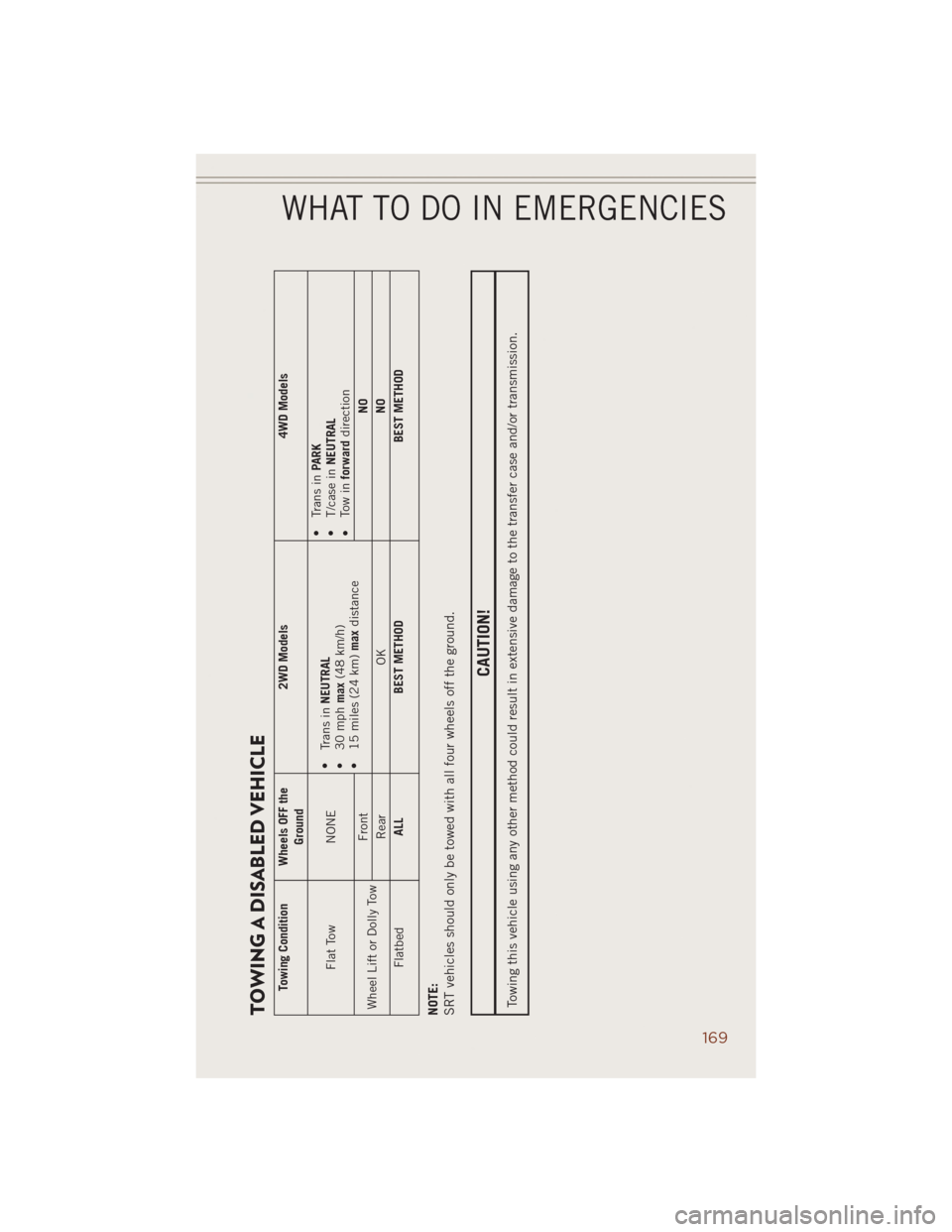
TOWING A DISABLED VEHICLE
Towing Condition Wheels OFF the
Ground2WD Models 4WD Models
Flat Tow NONE•
Trans inNEUTRAL
• 30 mphmax(48 km/h)
• 15 miles (24 km)maxdistance•
Trans inPARK
• T/case inNEUTRAL
• Tow inforwarddirection
Wheel Lift or Dolly TowFrontNO
Rear OKNO
FlatbedALL BEST METHOD BEST METHOD
NOTE:
SRT vehicles should only be towed with all four wheels off the ground.
CAUTION!
Towing this vehicle using any other method could result in extensive damage to the transfer case and/or transmission.
WHAT TO DO IN EMERGENCIES
169
Page 180 of 220
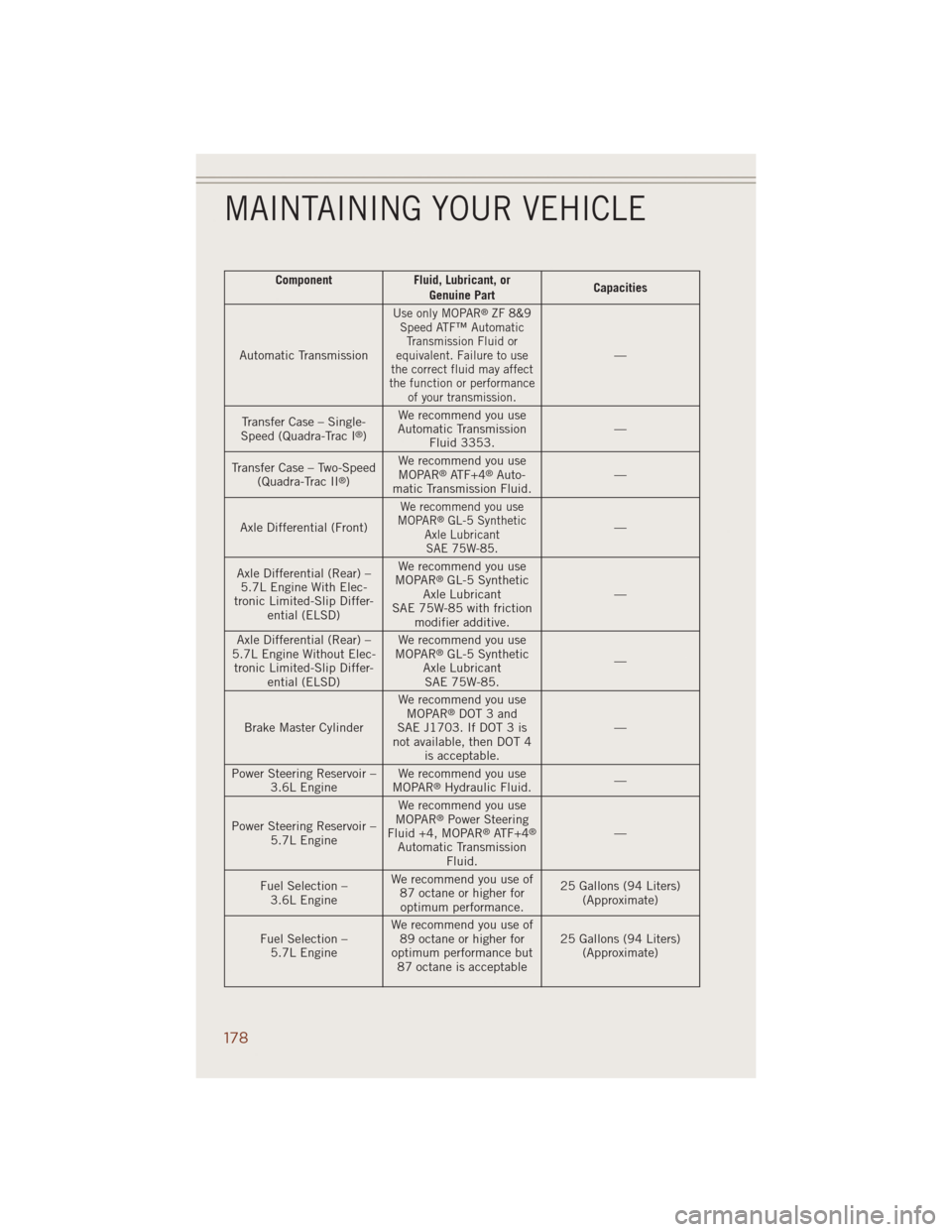
Component Fluid, Lubricant, or
Genuine PartCapacities
Automatic Transmission
Use only MOPAR®ZF 8&9
Speed ATF™ Automatic
Transmission Fluid or
equivalent. Failure to use
the correct fluid may affect
the function or performance
of your transmission.
—
Transfer Case – Single-
Speed (Quadra-Trac I
®)We recommend you use
Automatic Transmission
Fluid 3353.—
Transfer Case – Two-Speed
(Quadra-Trac II
®)We recommend you use
MOPAR®ATF+4®Auto-
matic Transmission Fluid.—
Axle Differential (Front)
We recommend you use
MOPAR®GL-5 Synthetic
Axle Lubricant
SAE 75W-85.—
Axle Differential (Rear) –
5.7L Engine With Elec-
tronic Limited-Slip Differ-
ential (ELSD)We recommend you use
MOPAR
®GL-5 Synthetic
Axle Lubricant
SAE 75W-85 with friction
modifier additive.—
Axle Differential (Rear) –
5.7L Engine Without Elec-
tronic Limited-Slip Differ-
ential (ELSD)We recommend you use
MOPAR
®GL-5 Synthetic
Axle Lubricant
SAE 75W-85.—
Brake Master CylinderWe recommend you use
MOPAR
®DOT 3 and
SAE J1703. If DOT 3 is
not available, then DOT 4
is acceptable.—
Power Steering Reservoir –
3.6L EngineWe recommend you use
MOPAR
®Hydraulic Fluid.—
Power Steering Reservoir –
5.7L EngineWe recommend you use
MOPAR
®Power Steering
Fluid +4, MOPAR®ATF+4®
Automatic Transmission
Fluid.—
Fuel Selection –
3.6L EngineWe recommend you use of
87 octane or higher for
optimum performance.25 Gallons (94 Liters)
(Approximate)
Fuel Selection –
5.7L EngineWe recommend you use of
89 octane or higher for
optimum performance but
87 octane is acceptable25 Gallons (94 Liters)
(Approximate)
MAINTAINING YOUR VEHICLE
178
Page 181 of 220
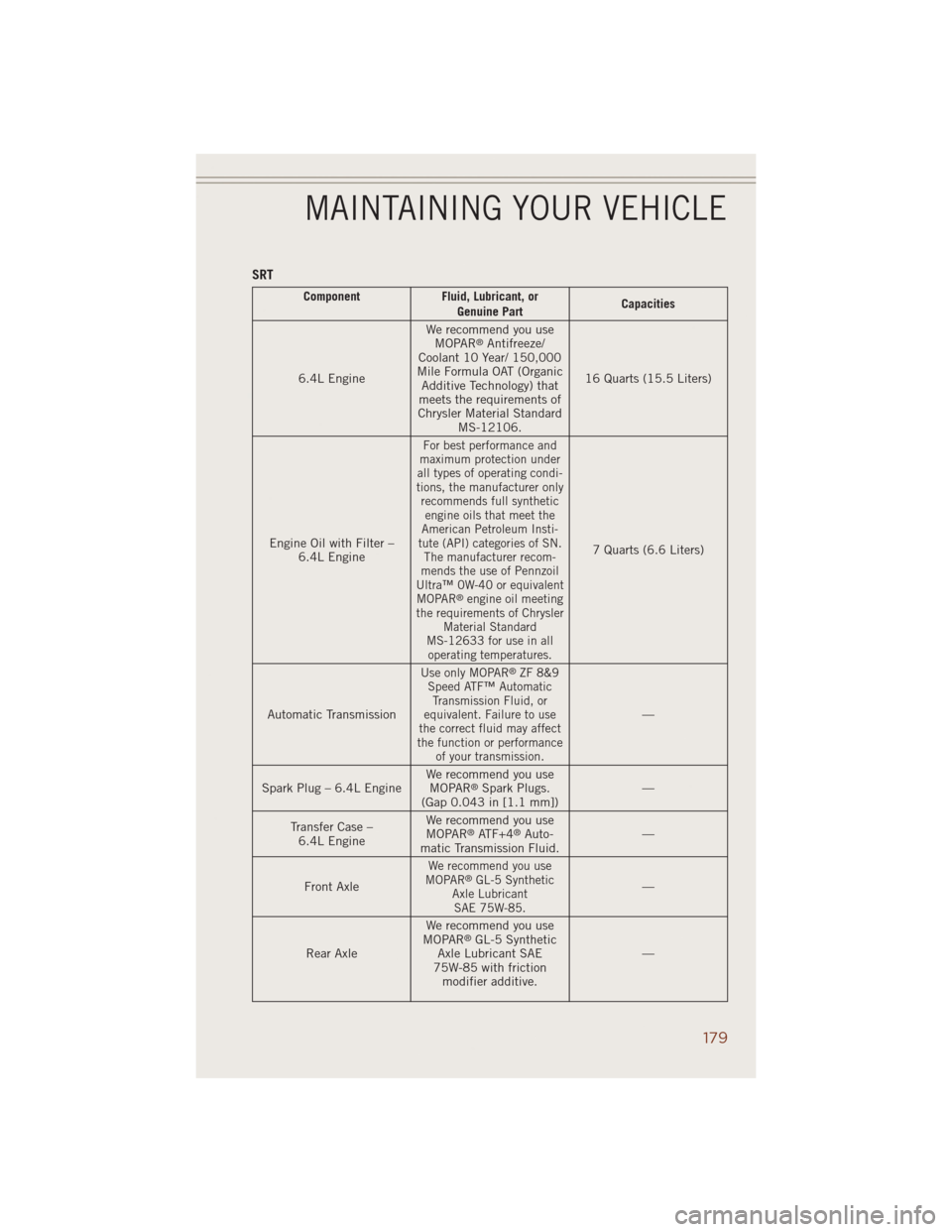
SRT
Component Fluid, Lubricant, or
Genuine PartCapacities
6.4L EngineWe recommend you use
MOPAR
®Antifreeze/
Coolant 10 Year/ 150,000
Mile Formula OAT (Organic
Additive Technology) that
meets the requirements of
Chrysler Material Standard
MS-12106.16 Quarts (15.5 Liters)
Engine Oil with Filter –
6.4L Engine
For best performance and
maximum protection under
all types of operating condi-
tions, the manufacturer only
recommends full synthetic
engine oils that meet the
American Petroleum Insti-
tute (API) categories of SN.
The manufacturer recom-
mends the use of Pennzoil
Ultra™ 0W-40 or equivalent
MOPAR
®engine oil meeting
the requirements of Chrysler
Material Standard
MS-12633 for use in all
operating temperatures.
7 Quarts (6.6 Liters)
Automatic Transmission
Use only MOPAR®ZF 8&9
Speed ATF™ Automatic
Transmission Fluid, or
equivalent. Failure to use
the correct fluid may affect
the function or performance
of your transmission.
—
Spark Plug – 6.4L EngineWe recommend you use
MOPAR
®Spark Plugs.
(Gap 0.043 in [1.1 mm])—
Transfer Case –
6.4L EngineWe recommend you use
MOPAR
®ATF+4®Auto-
matic Transmission Fluid.—
Front Axle
We recommend you use
MOPAR®GL-5 Synthetic
Axle Lubricant
SAE 75W-85.—
Rear AxleWe recommend you use
MOPAR
®GL-5 Synthetic
Axle Lubricant SAE
75W-85 with friction
modifier additive.—
MAINTAINING YOUR VEHICLE
179
Page 182 of 220
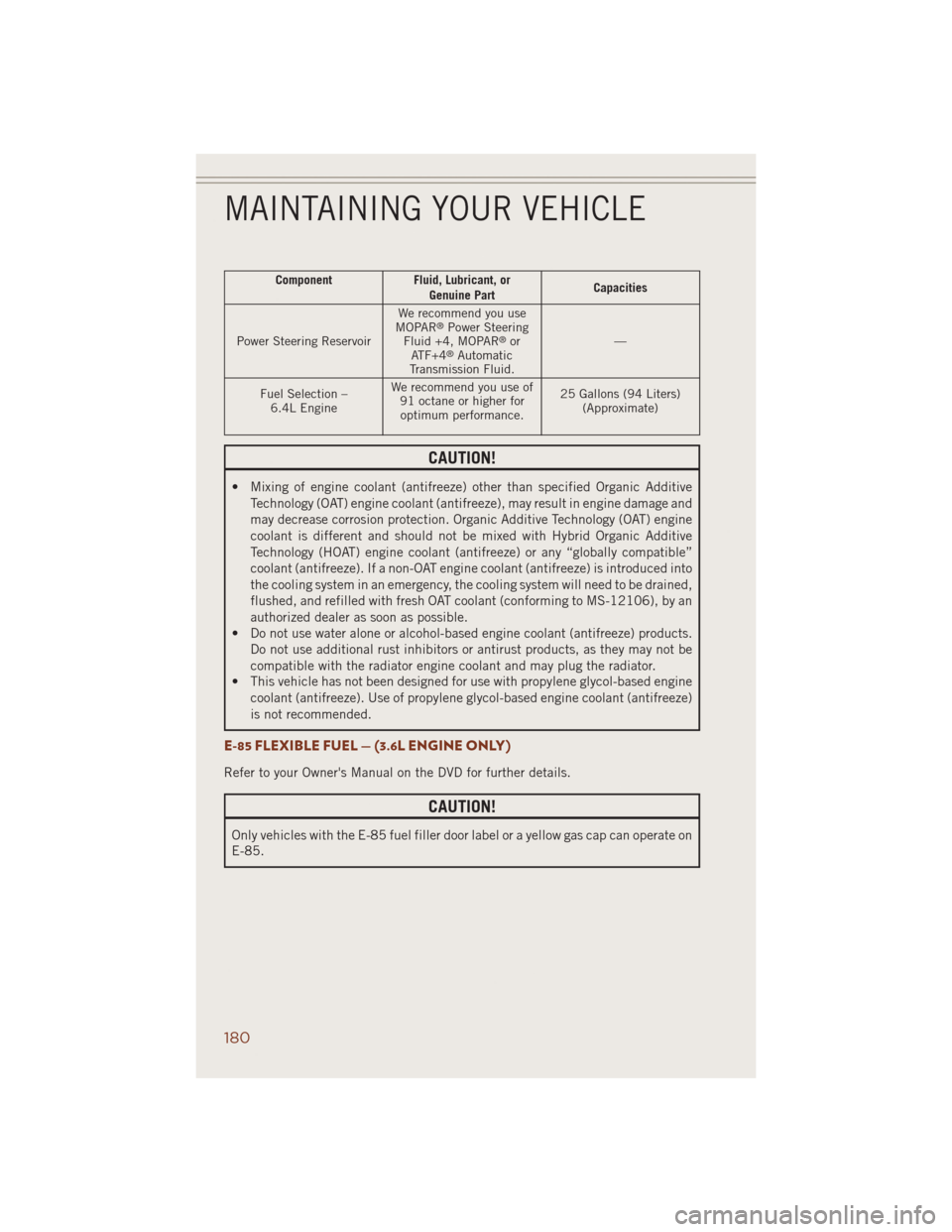
Component Fluid, Lubricant, or
Genuine PartCapacities
Power Steering ReservoirWe recommend you use
MOPAR
®Power Steering
Fluid +4, MOPAR®or
ATF+4®Automatic
Transmission Fluid.—
Fuel Selection –
6.4L EngineWe recommend you use of
91 octane or higher for
optimum performance.25 Gallons (94 Liters)
(Approximate)
CAUTION!
• Mixing of engine coolant (antifreeze) other than specified Organic Additive
Technology (OAT) engine coolant (antifreeze), may result in engine damage and
may decrease corrosion protection. Organic Additive Technology (OAT) engine
coolant is different and should not be mixed with Hybrid Organic Additive
Technology (HOAT) engine coolant (antifreeze) or any “globally compatible”
coolant (antifreeze). If a non-OAT engine coolant (antifreeze) is introduced into
the cooling system in an emergency, the cooling system will need to be drained,
flushed, and refilled with fresh OAT coolant (conforming to MS-12106), by an
authorized dealer as soon as possible.
• Do not use water alone or alcohol-based engine coolant (antifreeze) products.
Do not use additional rust inhibitors or antirust products, as they may not be
compatible with the radiator engine coolant and may plug the radiator.
• This vehicle has not been designed for use with propylene glycol-based engine
coolant (antifreeze). Use of propylene glycol-based engine coolant (antifreeze)
is not recommended.
E-85 FLEXIBLE FUEL — (3.6L ENGINE ONLY)
Refer to your Owner's Manual on the DVD for further details.
CAUTION!
Only vehicles with the E-85 fuel filler door label or a yellow gas cap can operate on
E-85.
MAINTAINING YOUR VEHICLE
180
Page 183 of 220
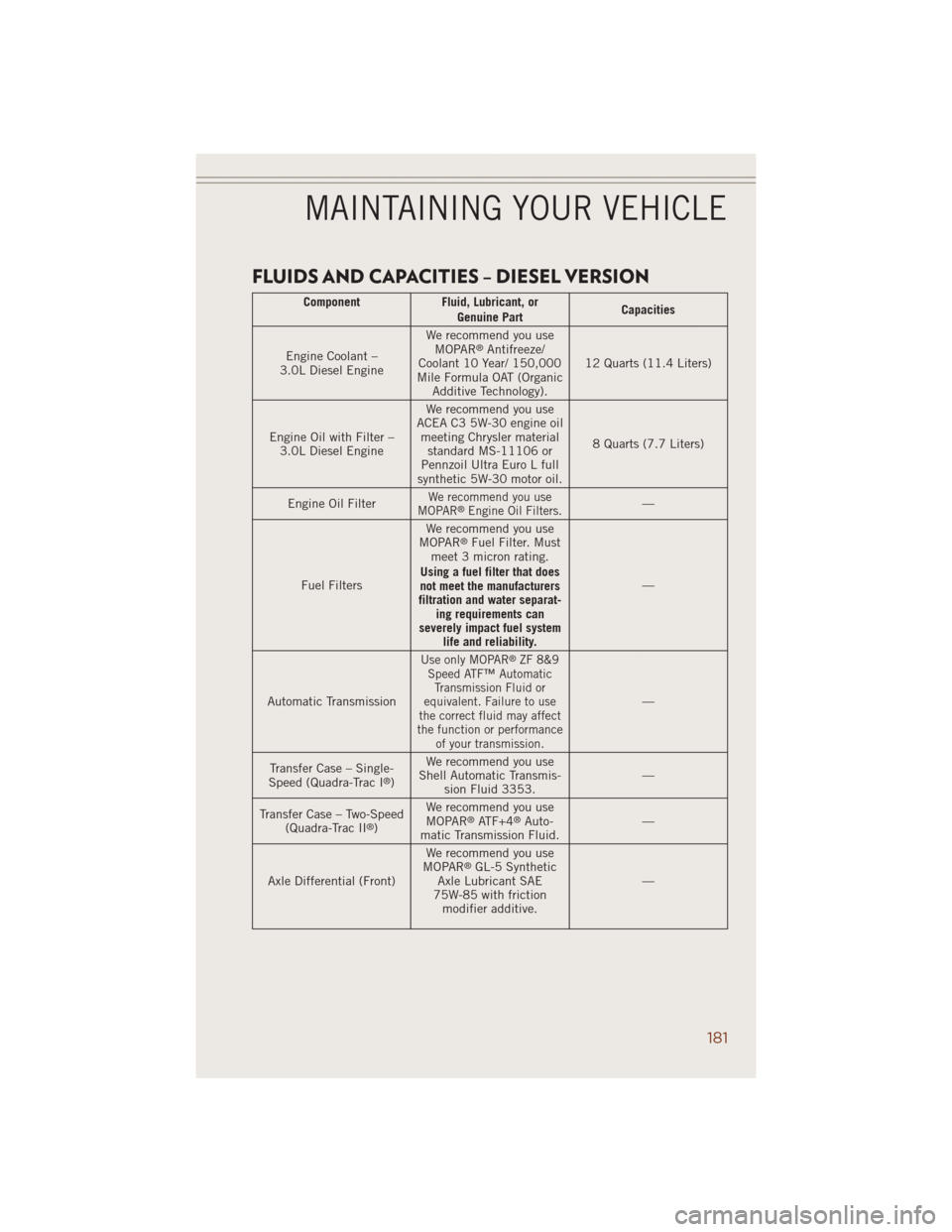
FLUIDS AND CAPACITIES – DIESEL VERSION
Component Fluid, Lubricant, or
Genuine PartCapacities
Engine Coolant –
3.0L Diesel EngineWe recommend you use
MOPAR
®Antifreeze/
Coolant 10 Year/ 150,000
Mile Formula OAT (Organic
Additive Technology).12 Quarts (11.4 Liters)
Engine Oil with Filter –
3.0L Diesel EngineWe recommend you use
ACEA C3 5W-30 engine oil
meeting Chrysler material
standard MS-11106 or
Pennzoil Ultra Euro L full
synthetic 5W-30 motor oil.8 Quarts (7.7 Liters)
Engine Oil Filter
We recommend you use
MOPAR®Engine Oil Filters.—
Fuel FiltersWe recommend you use
MOPAR
®Fuel Filter. Must
meet 3 micron rating.
Using a fuel filter that does
not meet the manufacturers
filtration and water separat-
ing requirements can
severely impact fuel system
life and reliability.—
Automatic Transmission
Use only MOPAR®ZF 8&9
Speed ATF™ Automatic
Transmission Fluid or
equivalent. Failure to use
the correct fluid may affect
the function or performance
of your transmission.
—
Transfer Case – Single-
Speed (Quadra-Trac I
®)We recommend you use
Shell Automatic Transmis-
sion Fluid 3353.—
Transfer Case – Two-Speed
(Quadra-Trac II
®)We recommend you use
MOPAR®ATF+4®Auto-
matic Transmission Fluid.—
Axle Differential (Front)We recommend you use
MOPAR
®GL-5 Synthetic
Axle Lubricant SAE
75W-85 with friction
modifier additive.—
MAINTAINING YOUR VEHICLE
181
Page 187 of 220
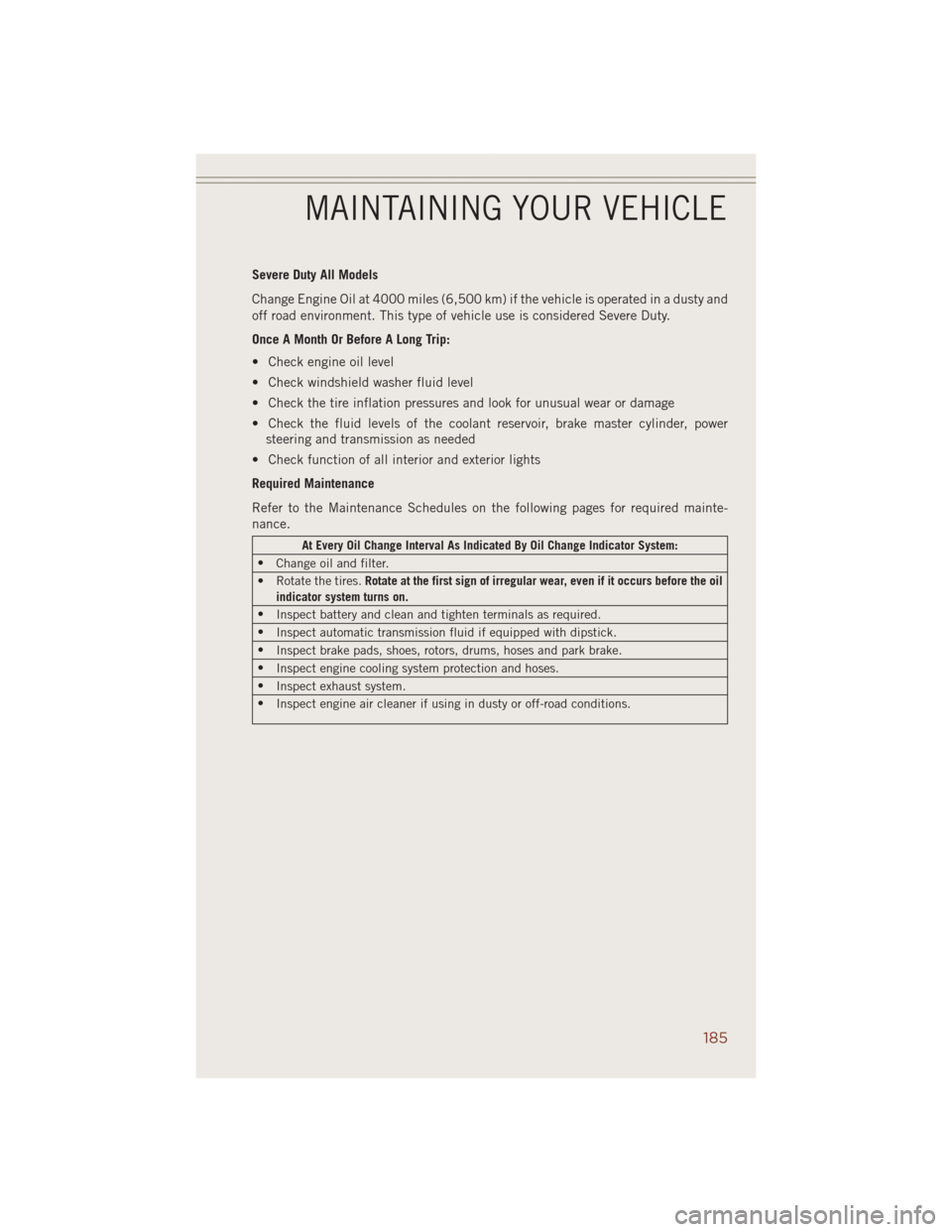
Severe Duty All Models
Change Engine Oil at 4000 miles (6,500 km) if the vehicle is operated in a dusty and
off road environment. This type of vehicle use is considered Severe Duty.
Once A Month Or Before A Long Trip:
• Check engine oil level
• Check windshield washer fluid level
• Check the tire inflation pressures and look for unusual wear or damage
• Check the fluid levels of the coolant reservoir, brake master cylinder, power
steering and transmission as needed
• Check function of all interior and exterior lights
Required Maintenance
Refer to the Maintenance Schedules on the following pages for required mainte-
nance.
At Every Oil Change Interval As Indicated By Oil Change Indicator System:
•
Change oil and filter.
• Rotate the tires.Rotate at the first sign of irregular wear, even if it occurs before the oil
indicator system turns on.
•
Inspect battery and clean and tighten terminals as required.
•
Inspect automatic transmission fluid if equipped with dipstick.
•
Inspect brake pads, shoes, rotors, drums, hoses and park brake.
•
Inspect engine cooling system protection and hoses.
•
Inspect exhaust system.
•
Inspect engine air cleaner if using in dusty or off-road conditions.
MAINTAINING YOUR VEHICLE
185