cooling JEEP GRAND CHEROKEE 2018 Owner handbook (in English)
[x] Cancel search | Manufacturer: JEEP, Model Year: 2018, Model line: GRAND CHEROKEE, Model: JEEP GRAND CHEROKEE 2018Pages: 368, PDF Size: 5.72 MB
Page 256 of 368
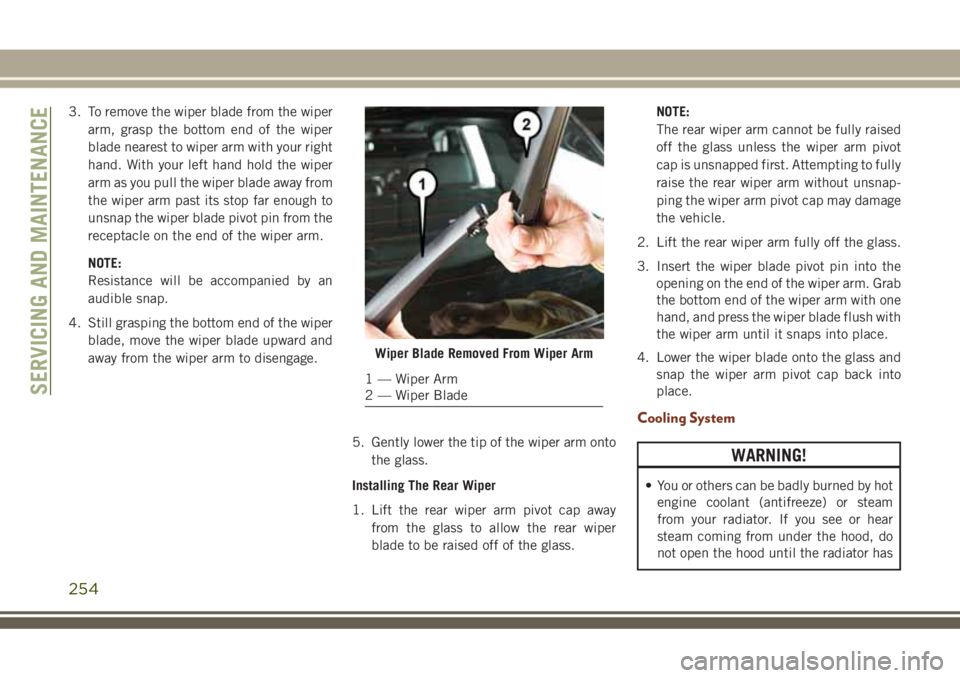
3. To remove the wiper blade from the wiper
arm, grasp the bottom end of the wiper
blade nearest to wiper arm with your right
hand. With your left hand hold the wiper
arm as you pull the wiper blade away from
the wiper arm past its stop far enough to
unsnap the wiper blade pivot pin from the
receptacle on the end of the wiper arm.
NOTE:
Resistance will be accompanied by an
audible snap.
4. Still grasping the bottom end of the wiper
blade, move the wiper blade upward and
away from the wiper arm to disengage.
5. Gently lower the tip of the wiper arm onto
the glass.
Installing The Rear Wiper
1. Lift the rear wiper arm pivot cap away
from the glass to allow the rear wiper
blade to be raised off of the glass.NOTE:
The rear wiper arm cannot be fully raised
off the glass unless the wiper arm pivot
cap is unsnapped first. Attempting to fully
raise the rear wiper arm without unsnap-
ping the wiper arm pivot cap may damage
the vehicle.
2. Lift the rear wiper arm fully off the glass.
3. Insert the wiper blade pivot pin into the
opening on the end of the wiper arm. Grab
the bottom end of the wiper arm with one
hand, and press the wiper blade flush with
the wiper arm until it snaps into place.
4. Lower the wiper blade onto the glass and
snap the wiper arm pivot cap back into
place.
Cooling System
WARNING!
• You or others can be badly burned by hot
engine coolant (antifreeze) or steam
from your radiator. If you see or hear
steam coming from under the hood, do
not open the hood until the radiator has
Wiper Blade Removed From Wiper Arm
1 — Wiper Arm
2 — Wiper BladeSERVICING AND MAINTENANCE
254
Page 257 of 368
WARNING!
had time to cool. Never open a cooling
system pressure cap when the radiator
or coolant bottle is hot.
• Keep hands, tools, clothing, and jewelry
away from the radiator cooling fan when
the hood is raised. The fan starts auto-
matically and may start at any time,
whether the engine is running or not.
• When working near the radiator cooling
fan, disconnect the fan motor lead or
turn the ignition to the OFF mode. The
fan is temperature controlled and can
start at any time the ignition is in the ON
mode.
Engine Coolant Checks
Check the engine coolant (antifreeze) protec-
tion every 12 months (before the onset of
freezing weather, where applicable). If the
engine coolant (antifreeze) is dirty, the sys-
tem should be drained, flushed, and refilled
with fresh OAT coolant (conforming to
MS.90032) by an authorized dealer. Check
the front of the A/C condenser for any accu-mulation of bugs, leaves, etc. If dirty, clean
by gently spraying water from a garden hose
vertically down the face of the condenser.
Check the engine cooling system hoses for
brittle rubber, cracking, tears, cuts, and
tightness of the connection at the coolant
recovery bottle and radiator. Inspect the en-
tire system for leaks. DO NOT REMOVE THE
COOLANT PRESSURE CAP WHEN THE
COOLING SYSTEM IS HOT.
RAISING THE VEHICLE
In the case where it is necessary to raise the
vehicle, go to an authorized dealer or service
station.
TIRES
Tires — General Information
Tire Pressure
Proper tire inflation pressure is essential to
the safe and satisfactory operation of your
vehicle. Four primary areas are affected by
improper tire pressure:
• Safety and Vehicle Stability• Economy
• Tread Wear
• Ride Comfort
Safety
WARNING!
• Improperly inflated tires are dangerous
and can cause collisions.
• Underinflation increases tire flexing and
can result in overheating and tire failure.
• Overinflation reduces a tire's ability to
cushion shock. Objects on the road and
chuckholes can cause damage that re-
sult in tire failure.
• Overinflated or underinflated tires can
affect vehicle handling and can fail sud-
denly, resulting in loss of vehicle control.
• Unequal tire pressures can cause steer-
ing problems. You could lose control of
your vehicle.
• Unequal tire pressures from one side of
the vehicle to the other can cause the
vehicle to drift to the right or left.
255
Page 267 of 368
These effects can be reduced by timely rota-
tion of tires. The benefits of rotation are
especially worthwhile with aggressive tread
designs such as those on On/Off-Road type
tires. Rotation will increase tread life, help to
maintain mud, snow, and wet traction levels,
and contribute to a smooth, quiet ride.
Refer to the “Maintenance Plan” for the
proper maintenance intervals. More frequent
rotation is permissible if desired. The reasons
for any rapid or unusual wear should be
corrected prior to rotation being performed.
NOTE:
The premium Tire Pressure Monitor System
will automatically locate the pressure values
displayed in the correct vehicle position fol-
lowing a tire rotation.
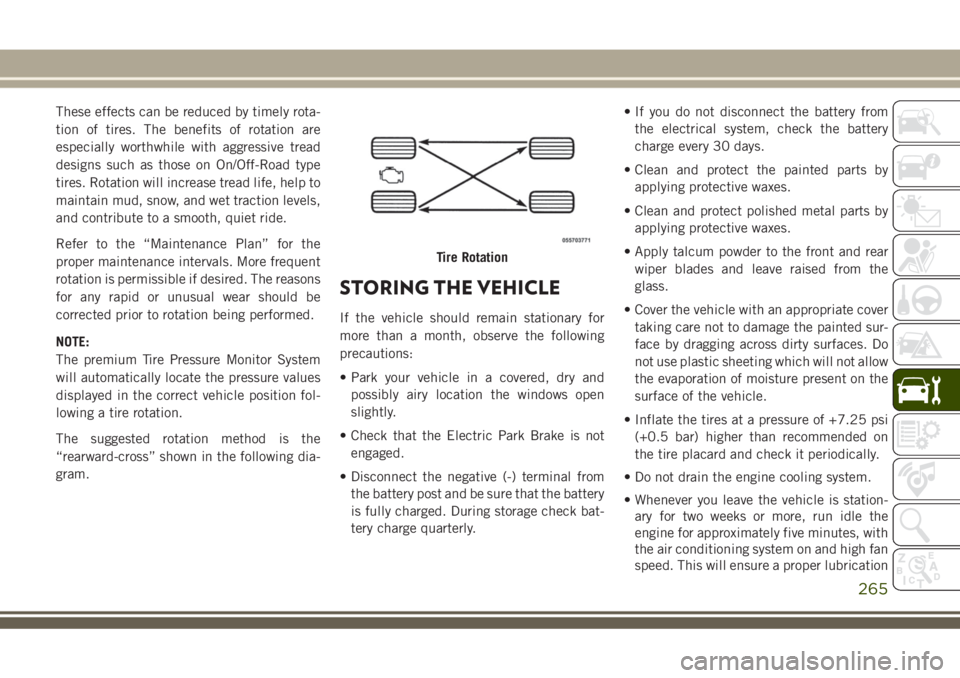
The suggested rotation method is the
“rearward-cross” shown in the following dia-
gram.
STORING THE VEHICLE
If the vehicle should remain stationary for
more than a month, observe the following
precautions:
• Park your vehicle in a covered, dry and
possibly airy location the windows open
slightly.
• Check that the Electric Park Brake is not
engaged.
• Disconnect the negative (-) terminal from
the battery post and be sure that the battery
is fully charged. During storage check bat-
tery charge quarterly.• If you do not disconnect the battery from
the electrical system, check the battery
charge every 30 days.
• Clean and protect the painted parts by
applying protective waxes.
• Clean and protect polished metal parts by
applying protective waxes.
• Apply talcum powder to the front and rear
wiper blades and leave raised from the
glass.
• Cover the vehicle with an appropriate cover
taking care not to damage the painted sur-
face by dragging across dirty surfaces. Do
not use plastic sheeting which will not allow
the evaporation of moisture present on the
surface of the vehicle.
• Inflate the tires at a pressure of +7.25 psi
(+0.5 bar) higher than recommended on
the tire placard and check it periodically.
• Do not drain the engine cooling system.
• Whenever you leave the vehicle is station-
ary for two weeks or more, run idle the
engine for approximately five minutes, with
the air conditioning system on and high fan
speed. This will ensure a proper lubrication
Tire Rotation
265
Page 280 of 368
NON-SRT FLUID CAPACITIES
U.S. Metric
Fuel (Approximate)
All Engines24.6 Gallons 93.1 Liters
AdBlue Fluid Tank8 Gallons 30.3 Liters
Engine Oil with Filter
3.6L Engine (SAE 0W-20, API Certified) 6 Quarts 5.6 Liters
5.7L Engine (SAE 5W-20, API Certified) 7 Quarts 6.6 Liters
3.0L Diesel Engine (SAE 5W-40 Synthetic, ACEA A3/B4 or API CJ-4/SM) 8 Quarts 7.7 Liters
Cooling System *
3.6L Engine (Mopar Engine Coolant/Antifreeze 10-Year/150,000 Mile Formula) 10.4 Quarts 9.9 Liters
5.7 Liter Engine (Mopar Engine Coolant/Antifreeze 10-Year/150,000 Mile For-
mula) – Without Trailer Tow Package15.4 Quarts 14.6 Liters
5.7 Liter Engine (Mopar Engine Coolant/Antifreeze 10-Year/150,000 Mile For-
mula) – With Trailer Tow Package16 Quarts 15.2 Liters
3.0L Diesel Engine (Mopar Engine Coolant/Antifreeze 10-Year/150,000 Mile For-
mula)12 Quarts 11.4 Liters
* Includes heater and coolant recovery bottle filled to MAX level.
TECHNICAL SPECIFICATIONS
278
Page 281 of 368
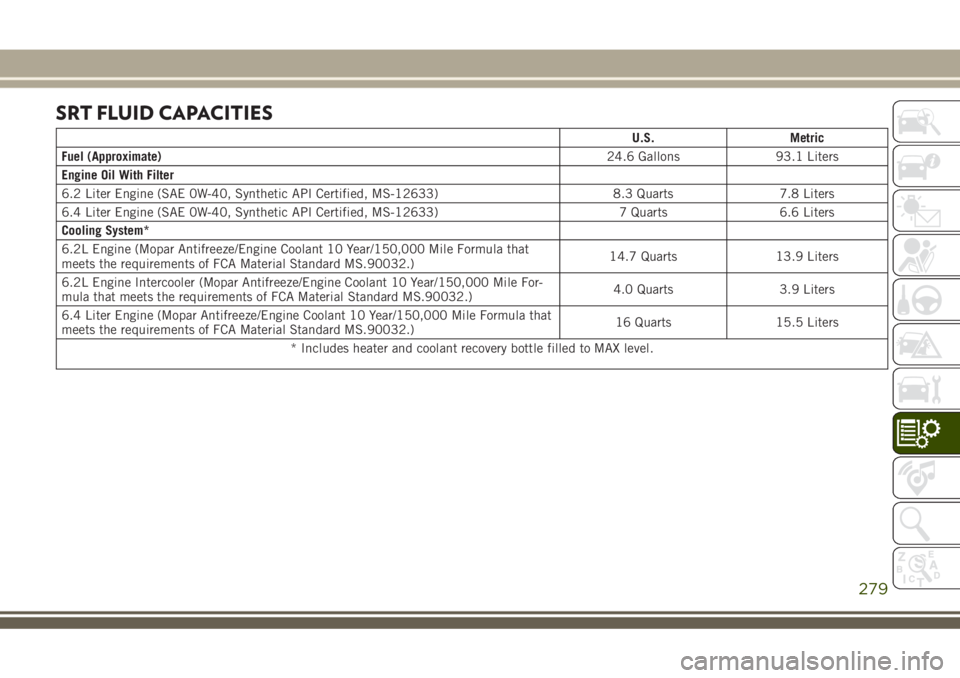
SRT FLUID CAPACITIES
U.S. Metric
Fuel (Approximate)
24.6 Gallons 93.1 Liters
Engine Oil With Filter
6.2 Liter Engine (SAE 0W-40, Synthetic API Certified, MS-12633) 8.3 Quarts 7.8 Liters
6.4 Liter Engine (SAE 0W-40, Synthetic API Certified, MS-12633) 7 Quarts 6.6 Liters
Cooling System*
6.2L Engine (Mopar Antifreeze/Engine Coolant 10 Year/150,000 Mile Formula that
meets the requirements of FCA Material Standard MS.90032.)14.7 Quarts 13.9 Liters
6.2L Engine Intercooler (Mopar Antifreeze/Engine Coolant 10 Year/150,000 Mile For-
mula that meets the requirements of FCA Material Standard MS.90032.)4.0 Quarts 3.9 Liters
6.4 Liter Engine (Mopar Antifreeze/Engine Coolant 10 Year/150,000 Mile Formula that
meets the requirements of FCA Material Standard MS.90032.)16 Quarts 15.5 Liters
* Includes heater and coolant recovery bottle filled to MAX level.
279
Page 360 of 368
Caps, Filler
Fuel....................220
Oil (Engine)...............242
Carbon Monoxide Warning.....131, 275
Car Washes..................266
Chains, Tire..............263, 264
Changing A Flat Tire............255
Checking Your Vehicle For Safety. . . .131
Checks, Safety................131
Child Restraints
How To Stow An Unused ALR Seat
Belt....................129
Child Safety Locks..............24
Clean Air Gasoline.............273
Cleaning
Wheels..................262
Climate Control................40
Manual...................40
Compact Spare Tire.............261
Computer, Trip/Travel.............66
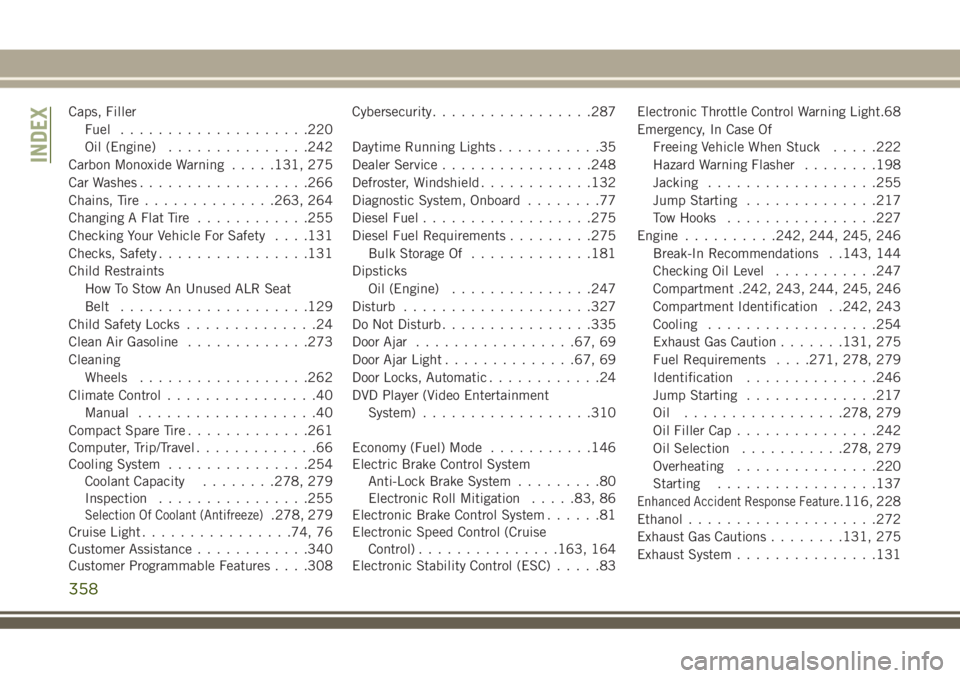
Cooling System...............254
Coolant Capacity........278, 279
Inspection................255
Selection Of Coolant (Antifreeze).278, 279
Cruise Light................74, 76
Customer Assistance............340
Customer Programmable Features. . . .308Cybersecurity.................287
Daytime Running Lights...........35
Dealer Service................248
Defroster, Windshield............132
Diagnostic System, Onboard........77
Diesel Fuel..................275
Diesel Fuel Requirements.........275
Bulk Storage Of.............181
Dipsticks
Oil (Engine)...............247
Disturb....................327
Do Not Disturb................335
Door Ajar.................67, 69
Door Ajar Light..............67, 69
Door Locks, Automatic............24
DVD Player (Video Entertainment
System)..................310
Economy (Fuel) Mode...........146
Electric Brake Control System
Anti-Lock Brake System.........80
Electronic Roll Mitigation.....83, 86
Electronic Brake Control System......81
Electronic Speed Control (Cruise
Control)...............163, 164
Electronic Stability Control (ESC).....83Electronic Throttle Control Warning Light.68
Emergency, In Case Of
Freeing Vehicle When Stuck.....222
Hazard Warning Flasher........198
Jacking..................255
Jump Starting..............217
Tow Hooks................227
Engine..........242, 244, 245, 246
Break-In Recommendations . .143, 144
Checking Oil Level...........247
Compartment .242, 243, 244, 245, 246
Compartment Identification . .242, 243
Cooling..................254
Exhaust Gas Caution......
.131, 275
Fuel Requirements. . . .271, 278, 279
Identification..............246
Jump Starting..............217
Oil .................278, 279
Oil Filler Cap...............242
Oil Selection...........278, 279
Overheating...............220
Starting.................137
Enhanced Accident Response Feature.116, 228
Ethanol....................272
Exhaust Gas Cautions........131, 275
Exhaust System...............131
INDEX
358