climate control JEEP GRAND CHEROKEE 2023 Owner's Manual
[x] Cancel search | Manufacturer: JEEP, Model Year: 2023, Model line: GRAND CHEROKEE, Model: JEEP GRAND CHEROKEE 2023Pages: 424, PDF Size: 15.48 MB
Page 245 of 424

MULTIMEDIA243
REAR CLIMATE CONTROLS
The Rear Climate Controls can also be controlled using Rear Seat Entertainment with Fire TV built-in Ú page 66.
Rear Climate Controls can be accessed by using the Vehicle menu. Tap on either rear screen and select the Vehicle icon or press the Vehicle button on the Voice
Remote with Alexa. Then select the Rear Climate Controls option.
Options within Rear Climate Controls are:
Icon Description
ON Climate Control ON Button
Press and release this button to turn the Rear Climate Controls on.
OFF Climate Control OFF Button
Press and release this button to turn the Rear Climate Controls off.
SYNC SYNC Button
Pressing this button will sync both sides of the Rear Climate Controls.
AUTO Button
Automatically controls the rear interior cabin temperature by adjusting airflow distribution and amount. Toggling this function will cause the
system to switch between Manual mode and Automatic mode.
Rear Passenger Temperature Up and Down Buttons
Provides the rear passengers with independent temperature control. Press the button on the touchscreen to increase or decrease the
temperature. The temperature will get warmer as you move up toward the red arrow and colder as you move down toward the blue arrow.
5
23_WL_OM_EN_USC_t.book Page 243
Page 246 of 424

244MULTIMEDIA
Headliner Mode Headliner Mode
Air comes from the outlets in the headliner. Each of these outlets can be individually adjusted to direct the flow of air. Moving the air vanes of
the outlets to one side will shut off the airflow.
Bi-Level Mode Bi-Level Mode
Air comes from both the headliner outlets and the floor outlets.
NOTE:In many temperature positions, the Bi-Level mode is designed to provide cooler air out of the headliner outlets and warmer air from the floor
outlets.
Floor
Mode Floor Mode
Air comes from the floor outlets.
1,2,3, etc. Blower Control
Blower Control is used to regulate the amount of air forced through the Climate system. There are seven blower speeds available. Adjusting
the blower will cause Automatic mode to switch to Manual operation.
Icon
Description
23_WL_OM_EN_USC_t.book Page 244
Page 307 of 424

SAFETY305
PERIODIC SAFETY CHECKS YOU SHOULD
M
AKE OUTSIDE THE VEHICLE
Tires
Examine tires for excessive tread wear and uneven
wear patterns. Check for stones, nails, glass, or
other objects lodged in the tread or sidewall.
Inspect the tread for cuts and cracks. Inspect
sidewalls for cuts, cracks, and bulges. Check the
lug nut/bolt torque for tightness. Check the tires
(including spare) for proper cold inflation pressure.
Lights
Have someone observe the operation of brake
lights and exterior lights while you work the
controls. Check turn signal and high beam
indicator lights on the instrument panel.
Door Latches
Check for proper closing, latching, and locking.
Fluid Leaks
Check area under the vehicle after overnight
parking for fuel, coolant, oil, or other fluid leaks.
Also, if gasoline fumes are detected or if fuel or
brake fluid leaks are suspected, the cause should
be located and corrected immediately.
EXHAUST GAS
NEVER place any objects under the floor mat
(e.g., towels, keys, etc.). These objects could
change the position of the floor mat and may
cause interference with the accelerator,
brake, or clutch pedals.
If the vehicle carpet has been removed and
re-installed, always properly attach carpet to
the floor and check the floor mat fasteners are
secure to the vehicle carpet. Fully depress
each pedal to check for interference with the
accelerator, brake, or clutch pedals then
re-install the floor mats.
It is recommended to only use mild soap and
water to clean your floor mats. After cleaning,
always check your floor mat has been properly
installed and is secured to your vehicle using
the floor mat fasteners by lightly pulling mat.
WARNING!
WARNING!
Exhaust gases can injure or kill. They contain
carbon monoxide (CO), which is colorless and
odorless. Breathing it can make you
unconscious and can eventually poison you. To
avoid breathing (CO), follow these safety tips:
Do not run the engine in a closed garage or in
confined areas any longer than needed to
move your vehicle in or out of the area.
If you are required to drive with the trunk/lift -
gate/rear doors open, make sure that all
windows are closed and the climate control
BLOWER switch is set at high speed. DO NOT
use the recirculation mode.
If it is necessary to sit in a parked vehicle with
the engine running, adjust your heating or
cooling controls to force outside air into the
vehicle. Set the blower at high speed.
6
23_WL_OM_EN_USC_t.book Page 305
Page 393 of 424
SERVICING AND MAINTENANCE391
TIRE ROTATION RECOMMENDATIONS
The tires on the front and rear of your vehicle
operate at different loads and perform different
steering, handling, and braking functions. For
these reasons, they wear at unequal rates.
These effects can be reduced by timely rotation of
tires. The benefits of rotation are especially
worthwhile with aggressive tread designs such as
those on On/Off-Road type tires. Rotation will
increase tread life, help to maintain mud, snow,
and wet traction levels, and contribute to a
smooth, quiet ride.
Refer to the “Maintenance Plan” for the proper
maintenance intervals. More frequent rotation is
permissible if desired. The reasons for any rapid or
unusual wear should be corrected prior to rotation
being performed.
NOTE:The premium Tire Pressure Monitoring System will
automatically locate the pressure values displayed
in the correct vehicle position following a tire
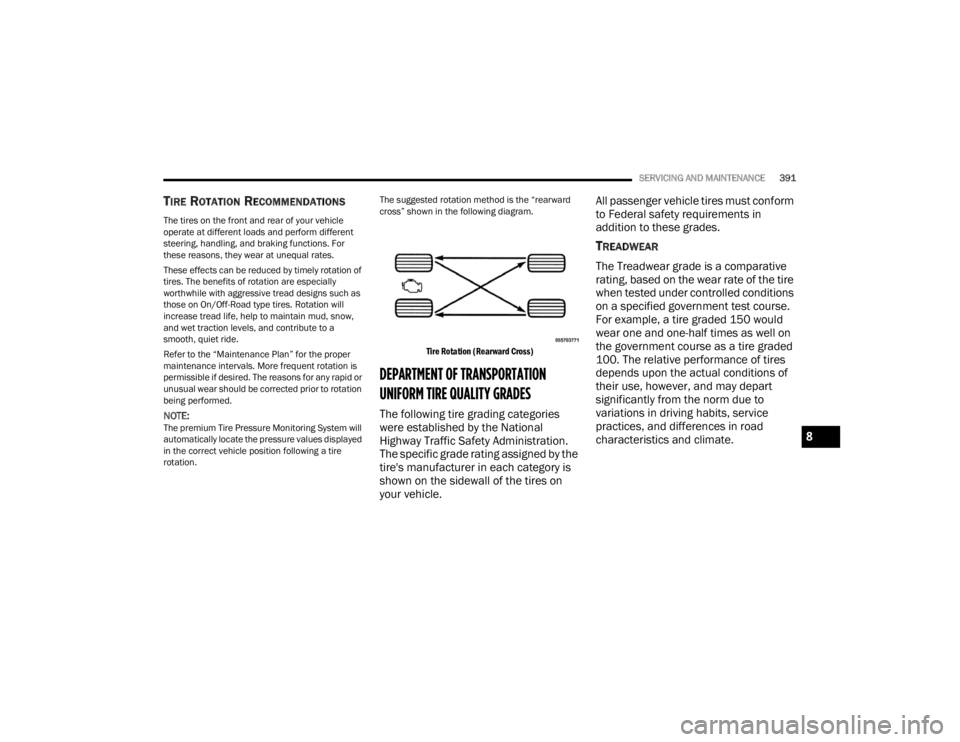
rotation. The suggested rotation method is the “rearward
cross” shown in the following diagram.
Tire Rotation (Rearward Cross)
DEPARTMENT OF TRANSPORTATION
UNIFORM TIRE QUALITY GRADES
The following tire grading categories
were established by the National
Highway Traffic Safety Administration.
The specific grade rating assigned by the
tire's manufacturer in each category is
shown on the sidewall of the tires on
your vehicle. All passenger vehicle tires must conform
to Federal safety requirements in
addition to these grades.
TREADWEAR
The Treadwear grade is a comparative
rating, based on the wear rate of the tire
when tested under controlled conditions
on a specified government test course.
For example, a tire graded 150 would
wear one and one-half times as well on
the government course as a tire graded
100. The relative performance of tires
depends upon the actual conditions of
their use, however, and may depart
significantly from the norm due to
variations in driving habits, service
practices, and differences in road
characteristics and climate.
8
23_WL_OM_EN_USC_t.book Page 391
Page 413 of 424

411
Checking Your Vehicle For Safety
.................. 303Checks, Safety............................................... 303Child Restraint............................................... 289Child Restraints Booster Seats............................................ 291Child Seat Installation............................... 300How To Stow An unused ALR Seat Belt..... 297Infant And Child Restraints....................... 290Locating The LATCH Anchorages............... 295Lower Anchors And Tethers For Children.. 292Older Children And Child Restraints..........291Seating Positions...................................... 292Child Safety Locks........................................... 31Clean Air Gasoline......................................... 398CleaningWheels...................................................... 388Climate Control................................................ 66Automatic.................................................... 66Rear............................................................ 69CNG And LP Fuel System Modifications......... 398Cold Weather Operation................................ 122Compact Spare Tire....................................... 386Contract, Service........................................... 405Cooling Pressure Cap (Radiator Cap).............348
Cooling System............................................. 346Adding Coolant (Antifreeze)...................... 347Coolant Level................................... 348, 349Cooling Capacity....................................... 400Disposal Of Used Coolant......................... 348Drain, Flush, And Refill............................. 347Inspection............................... 347, 348, 349Points To Remember................................ 349Pressure Cap............................................ 348Radiator Cap............................................ 348Selection Of Coolant(Antifreeze)......................... 347, 400, 401Corrosion Protection..................................... 392Cruise Control (Speed Control)..................... 142Cruise Light.......................................... 115, 116Customer Assistance.................................... 403Customer Programmable Features............... 204Cybersecurity................................................ 203
D
Daytime Running Lights................................... 58Defroster, Windshield................................... 304De-Icer, Remote Start...................................... 26De-Icer, Windshield.......................................... 66Diagnostic System, Onboard......................... 117Digital Instrument Cluster ¹.............................. 96
DipsticksOil (Engine)............................................... 337DisposalAntifreeze (Engine Coolant)...................... 348Do Not Use E-85 In Non-Flex Fuel Vehicles... 398Door Ajar....................................................... 109Door Locks................................................27, 31Child-Protection Door Lock — Rear Doors....31Doors...............................................................27Driver’s Seat Back Tilt......................................36Driving........................................................... 199Tips........................................................... 199DrowsyDriverDetection................................. 249
E
Electric Brake Control System....................... 250Anti-Lock Brake System............................ 248Electronic Roll Mitigation................. 251, 257Electric Parking Brake................................... 123Electrical Outlet, Auxiliary (Power Outlet).........78
Electronic Stability Control (ESC)... 111, 112, 251
Electronic Sway Bar Disconnect.................... 133Electronic Throttle Control Warning Light...... 109
11
23_WL_OM_EN_USC_t.book Page 411