bulb JEEP LIBERTY 2002 KJ / 1.G Owners Manual
[x] Cancel search | Manufacturer: JEEP, Model Year: 2002, Model line: LIBERTY, Model: JEEP LIBERTY 2002 KJ / 1.GPages: 1803, PDF Size: 62.3 MB
Page 534 of 1803
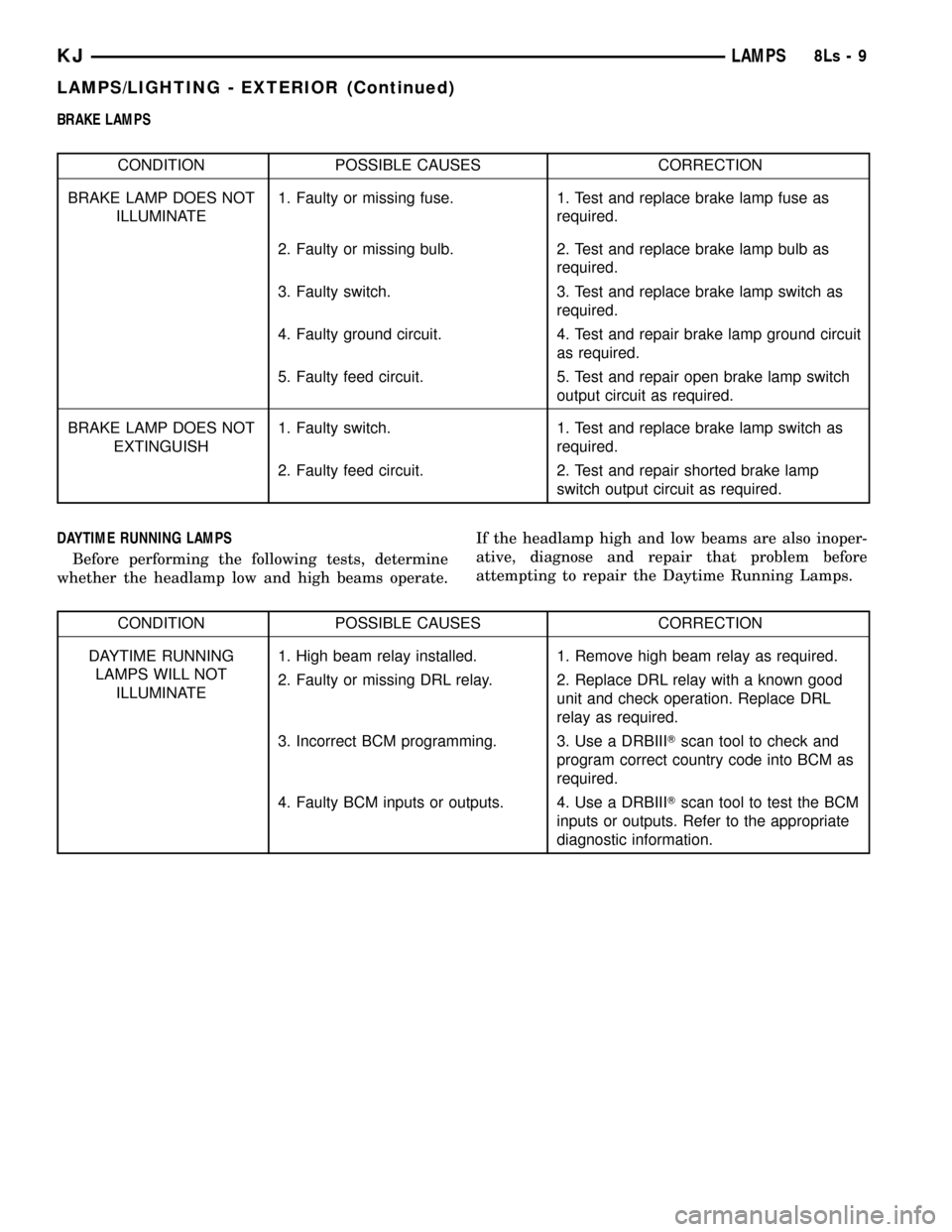
BRAKE LAMPS
CONDITION POSSIBLE CAUSES CORRECTION
BRAKE LAMP DOES NOT
ILLUMINATE1. Faulty or missing fuse. 1. Test and replace brake lamp fuse as
required.
2. Faulty or missing bulb. 2. Test and replace brake lamp bulb as
required.
3. Faulty switch. 3. Test and replace brake lamp switch as
required.
4. Faulty ground circuit. 4. Test and repair brake lamp ground circuit
as required.
5. Faulty feed circuit. 5. Test and repair open brake lamp switch
output circuit as required.
BRAKE LAMP DOES NOT
EXTINGUISH1. Faulty switch. 1. Test and replace brake lamp switch as
required.
2. Faulty feed circuit. 2. Test and repair shorted brake lamp
switch output circuit as required.
DAYTIME RUNNING LAMPS
Before performing the following tests, determine
whether the headlamp low and high beams operate.If the headlamp high and low beams are also inoper-
ative, diagnose and repair that problem before
attempting to repair the Daytime Running Lamps.
CONDITION POSSIBLE CAUSES CORRECTION
DAYTIME RUNNING
LAMPS WILL NOT
ILLUMINATE1. High beam relay installed. 1. Remove high beam relay as required.
2. Faulty or missing DRL relay. 2. Replace DRL relay with a known good
unit and check operation. Replace DRL
relay as required.
3. Incorrect BCM programming. 3. Use a DRBIIITscan tool to check and
program correct country code into BCM as
required.
4. Faulty BCM inputs or outputs. 4. Use a DRBIIITscan tool to test the BCM
inputs or outputs. Refer to the appropriate
diagnostic information.
KJLAMPS8Ls-9
LAMPS/LIGHTING - EXTERIOR (Continued)
Page 535 of 1803
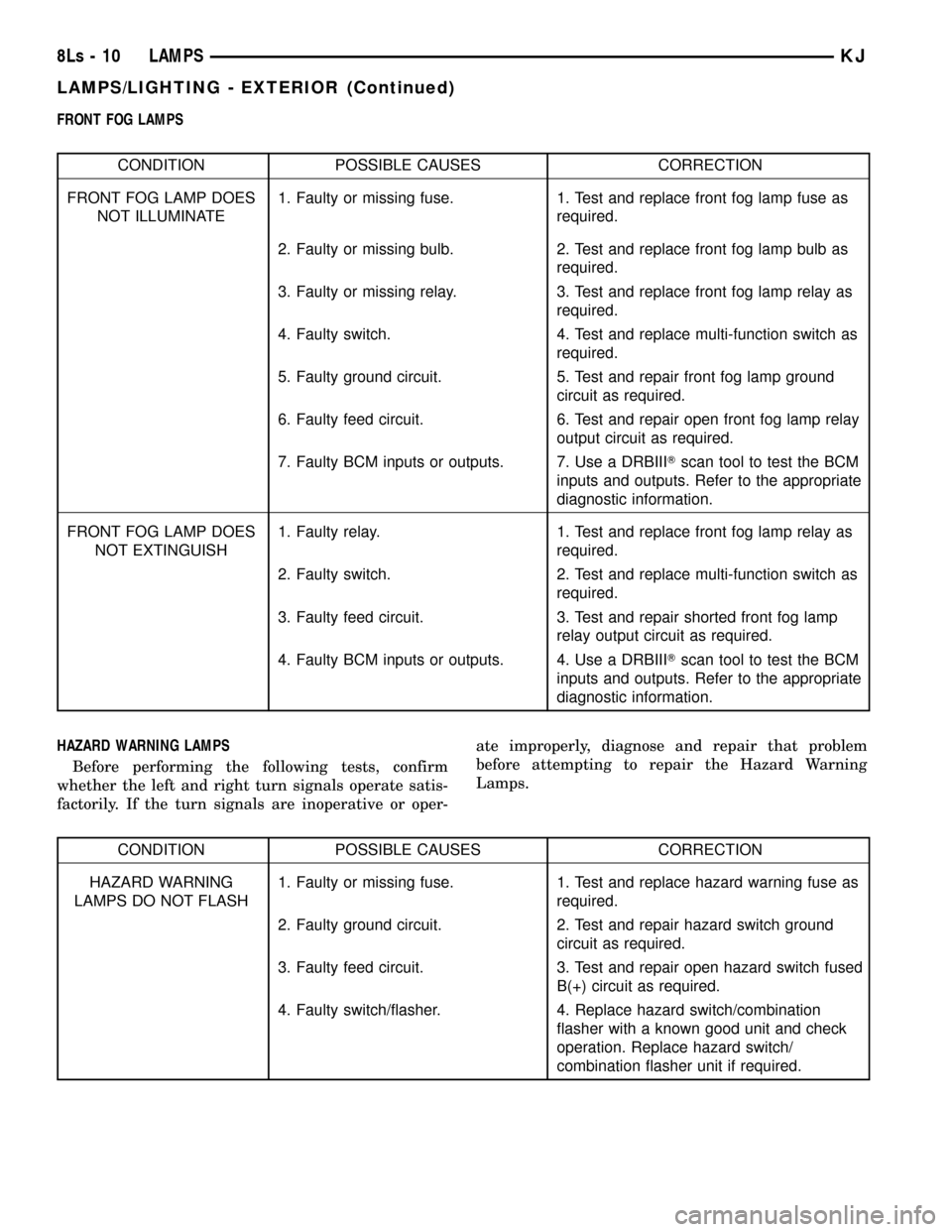
FRONT FOG LAMPS
CONDITION POSSIBLE CAUSES CORRECTION
FRONT FOG LAMP DOES
NOT ILLUMINATE1. Faulty or missing fuse. 1. Test and replace front fog lamp fuse as
required.
2. Faulty or missing bulb. 2. Test and replace front fog lamp bulb as
required.
3. Faulty or missing relay. 3. Test and replace front fog lamp relay as
required.
4. Faulty switch. 4. Test and replace multi-function switch as
required.
5. Faulty ground circuit. 5. Test and repair front fog lamp ground
circuit as required.
6. Faulty feed circuit. 6. Test and repair open front fog lamp relay
output circuit as required.
7. Faulty BCM inputs or outputs. 7. Use a DRBIIITscan tool to test the BCM
inputs and outputs. Refer to the appropriate
diagnostic information.
FRONT FOG LAMP DOES
NOT EXTINGUISH1. Faulty relay. 1. Test and replace front fog lamp relay as
required.
2. Faulty switch. 2. Test and replace multi-function switch as
required.
3. Faulty feed circuit. 3. Test and repair shorted front fog lamp
relay output circuit as required.
4. Faulty BCM inputs or outputs. 4. Use a DRBIIITscan tool to test the BCM
inputs and outputs. Refer to the appropriate
diagnostic information.
HAZARD WARNING LAMPS
Before performing the following tests, confirm
whether the left and right turn signals operate satis-
factorily. If the turn signals are inoperative or oper-ate improperly, diagnose and repair that problem
before attempting to repair the Hazard Warning
Lamps.
CONDITION POSSIBLE CAUSES CORRECTION
HAZARD WARNING
LAMPS DO NOT FLASH1. Faulty or missing fuse. 1. Test and replace hazard warning fuse as
required.
2. Faulty ground circuit. 2. Test and repair hazard switch ground
circuit as required.
3. Faulty feed circuit. 3. Test and repair open hazard switch fused
B(+) circuit as required.
4. Faulty switch/flasher. 4. Replace hazard switch/combination
flasher with a known good unit and check
operation. Replace hazard switch/
combination flasher unit if required.
8Ls - 10 LAMPSKJ
LAMPS/LIGHTING - EXTERIOR (Continued)
Page 536 of 1803
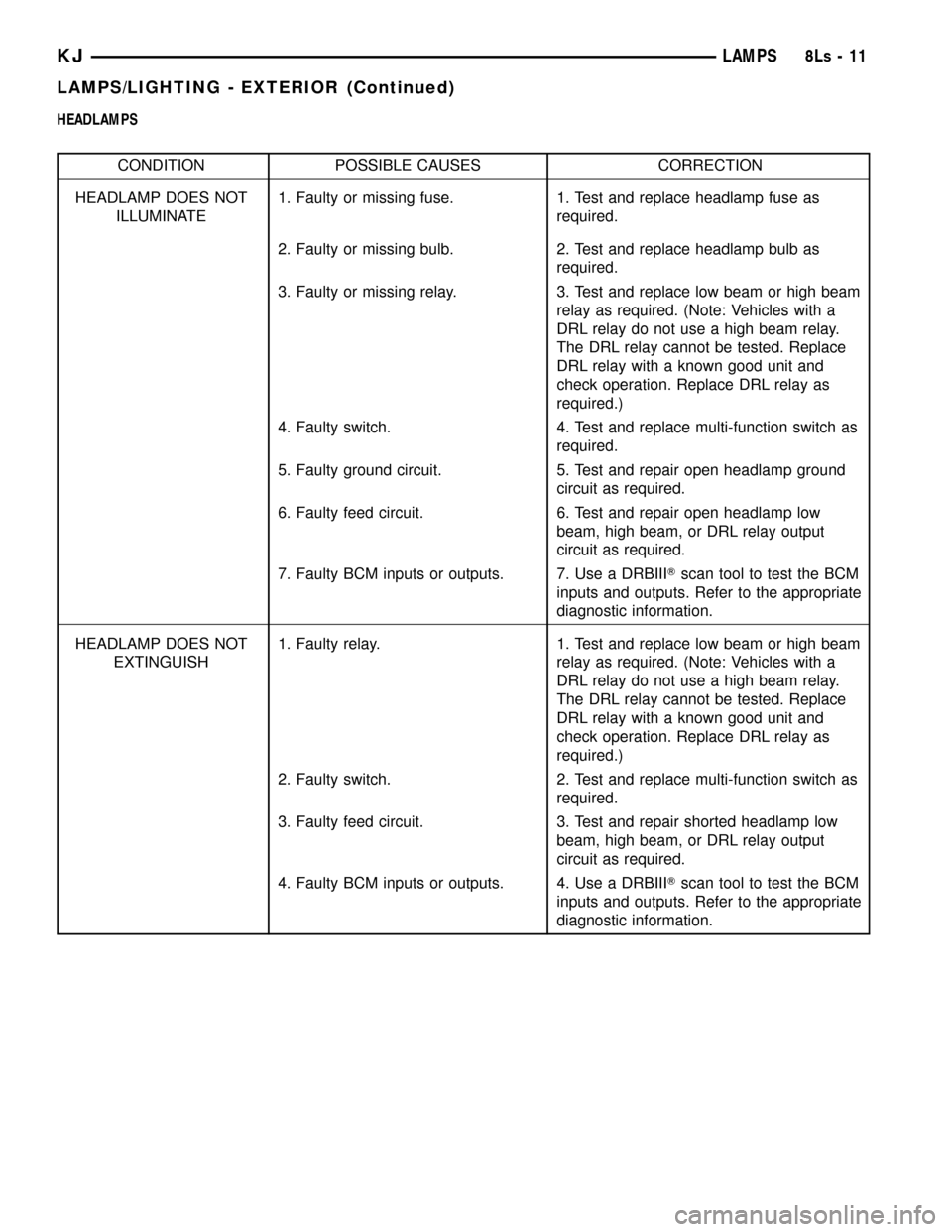
HEADLAMPS
CONDITION POSSIBLE CAUSES CORRECTION
HEADLAMP DOES NOT
ILLUMINATE1. Faulty or missing fuse. 1. Test and replace headlamp fuse as
required.
2. Faulty or missing bulb. 2. Test and replace headlamp bulb as
required.
3. Faulty or missing relay. 3. Test and replace low beam or high beam
relay as required. (Note: Vehicles with a
DRL relay do not use a high beam relay.
The DRL relay cannot be tested. Replace
DRL relay with a known good unit and
check operation. Replace DRL relay as
required.)
4. Faulty switch. 4. Test and replace multi-function switch as
required.
5. Faulty ground circuit. 5. Test and repair open headlamp ground
circuit as required.
6. Faulty feed circuit. 6. Test and repair open headlamp low
beam, high beam, or DRL relay output
circuit as required.
7. Faulty BCM inputs or outputs. 7. Use a DRBIIITscan tool to test the BCM
inputs and outputs. Refer to the appropriate
diagnostic information.
HEADLAMP DOES NOT
EXTINGUISH1. Faulty relay. 1. Test and replace low beam or high beam
relay as required. (Note: Vehicles with a
DRL relay do not use a high beam relay.
The DRL relay cannot be tested. Replace
DRL relay with a known good unit and
check operation. Replace DRL relay as
required.)
2. Faulty switch. 2. Test and replace multi-function switch as
required.
3. Faulty feed circuit. 3. Test and repair shorted headlamp low
beam, high beam, or DRL relay output
circuit as required.
4. Faulty BCM inputs or outputs. 4. Use a DRBIIITscan tool to test the BCM
inputs and outputs. Refer to the appropriate
diagnostic information.
KJLAMPS8Ls-11
LAMPS/LIGHTING - EXTERIOR (Continued)
Page 538 of 1803
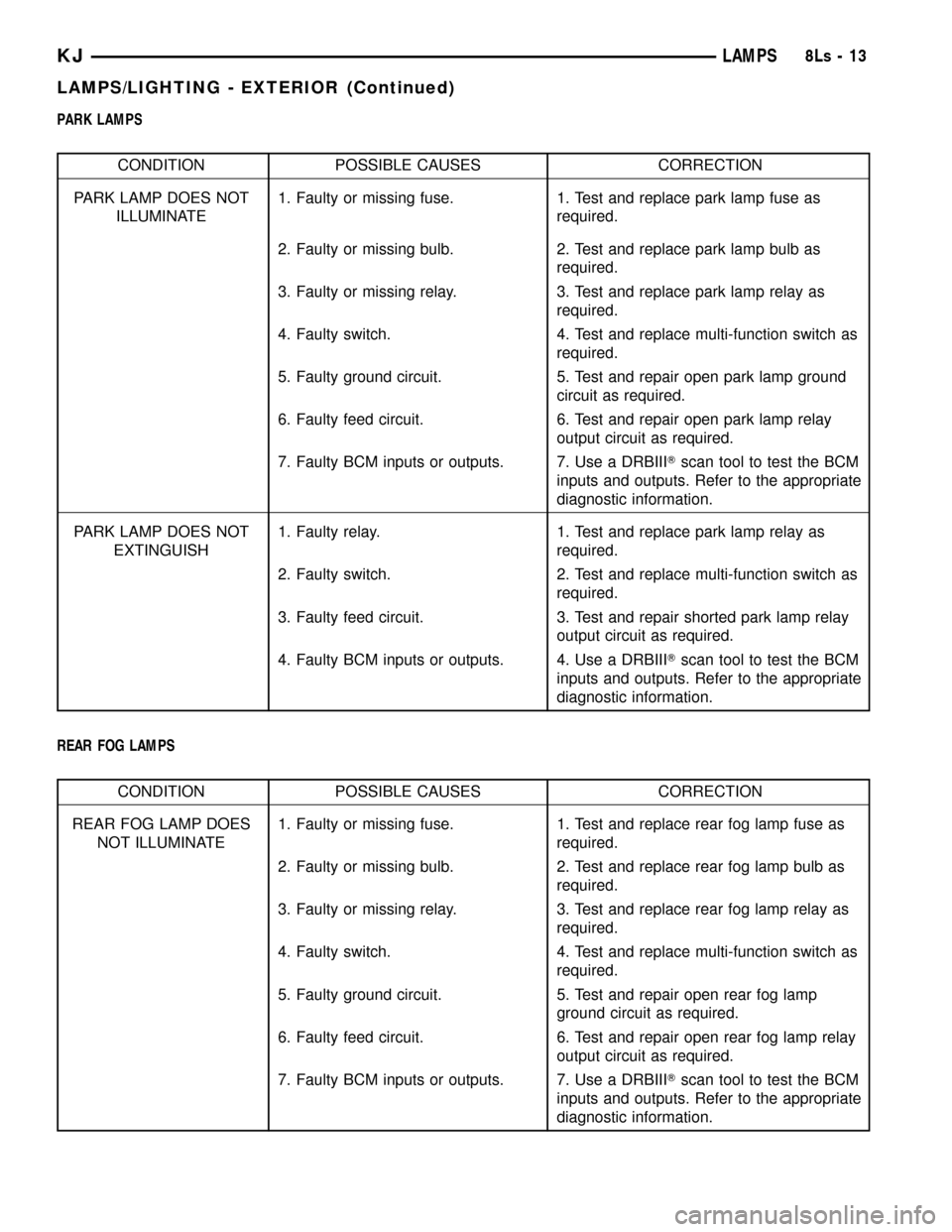
PARK LAMPS
CONDITION POSSIBLE CAUSES CORRECTION
PARK LAMP DOES NOT
ILLUMINATE1. Faulty or missing fuse. 1. Test and replace park lamp fuse as
required.
2. Faulty or missing bulb. 2. Test and replace park lamp bulb as
required.
3. Faulty or missing relay. 3. Test and replace park lamp relay as
required.
4. Faulty switch. 4. Test and replace multi-function switch as
required.
5. Faulty ground circuit. 5. Test and repair open park lamp ground
circuit as required.
6. Faulty feed circuit. 6. Test and repair open park lamp relay
output circuit as required.
7. Faulty BCM inputs or outputs. 7. Use a DRBIIITscan tool to test the BCM
inputs and outputs. Refer to the appropriate
diagnostic information.
PARK LAMP DOES NOT
EXTINGUISH1. Faulty relay. 1. Test and replace park lamp relay as
required.
2. Faulty switch. 2. Test and replace multi-function switch as
required.
3. Faulty feed circuit. 3. Test and repair shorted park lamp relay
output circuit as required.
4. Faulty BCM inputs or outputs. 4. Use a DRBIIITscan tool to test the BCM
inputs and outputs. Refer to the appropriate
diagnostic information.
REAR FOG LAMPS
CONDITION POSSIBLE CAUSES CORRECTION
REAR FOG LAMP DOES
NOT ILLUMINATE1. Faulty or missing fuse. 1. Test and replace rear fog lamp fuse as
required.
2. Faulty or missing bulb. 2. Test and replace rear fog lamp bulb as
required.
3. Faulty or missing relay. 3. Test and replace rear fog lamp relay as
required.
4. Faulty switch. 4. Test and replace multi-function switch as
required.
5. Faulty ground circuit. 5. Test and repair open rear fog lamp
ground circuit as required.
6. Faulty feed circuit. 6. Test and repair open rear fog lamp relay
output circuit as required.
7. Faulty BCM inputs or outputs. 7. Use a DRBIIITscan tool to test the BCM
inputs and outputs. Refer to the appropriate
diagnostic information.
KJLAMPS8Ls-13
LAMPS/LIGHTING - EXTERIOR (Continued)
Page 539 of 1803
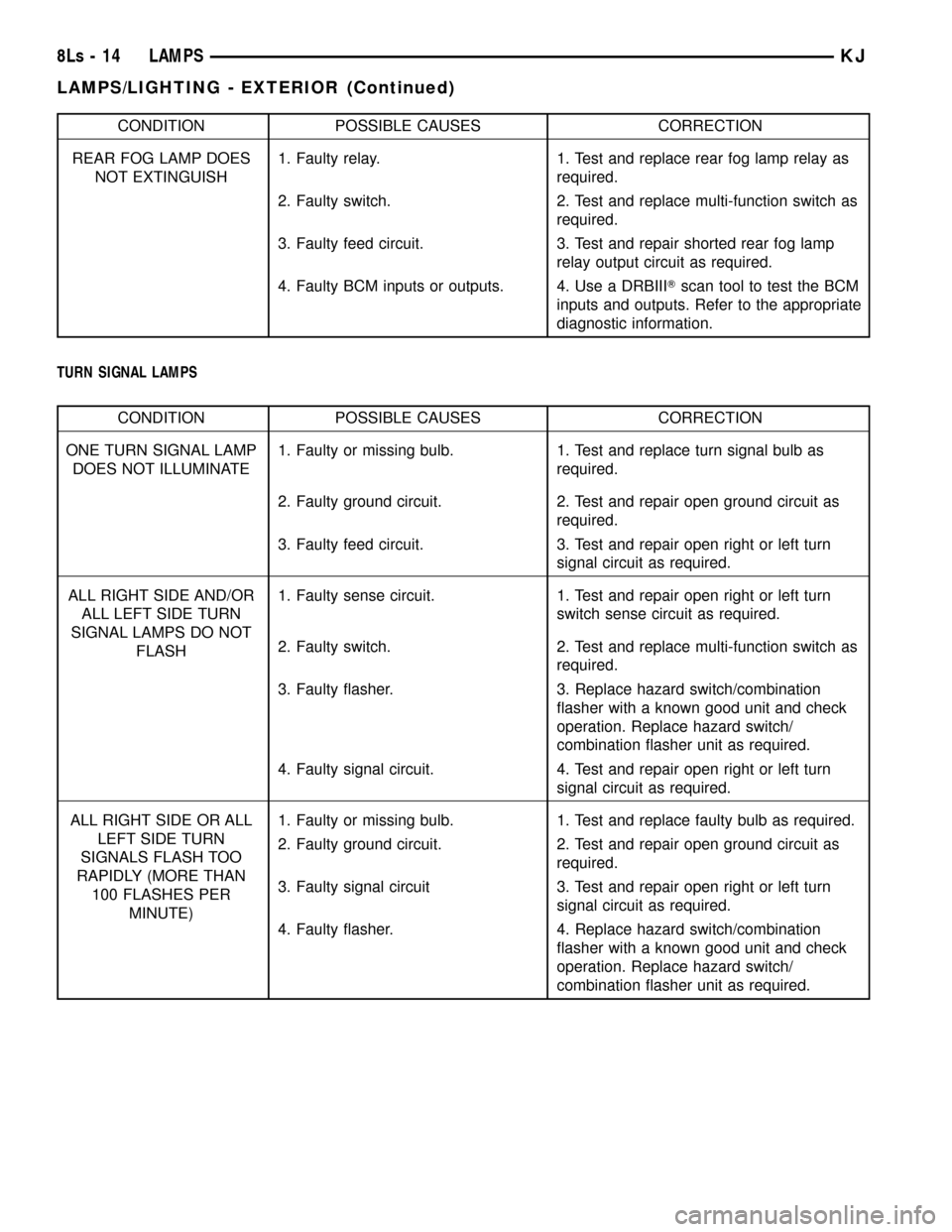
CONDITION POSSIBLE CAUSES CORRECTION
REAR FOG LAMP DOES
NOT EXTINGUISH1. Faulty relay. 1. Test and replace rear fog lamp relay as
required.
2. Faulty switch. 2. Test and replace multi-function switch as
required.
3. Faulty feed circuit. 3. Test and repair shorted rear fog lamp
relay output circuit as required.
4. Faulty BCM inputs or outputs. 4. Use a DRBIIITscan tool to test the BCM
inputs and outputs. Refer to the appropriate
diagnostic information.
TURN SIGNAL LAMPS
CONDITION POSSIBLE CAUSES CORRECTION
ONE TURN SIGNAL LAMP
DOES NOT ILLUMINATE1. Faulty or missing bulb. 1. Test and replace turn signal bulb as
required.
2. Faulty ground circuit. 2. Test and repair open ground circuit as
required.
3. Faulty feed circuit. 3. Test and repair open right or left turn
signal circuit as required.
ALL RIGHT SIDE AND/OR
ALL LEFT SIDE TURN
SIGNAL LAMPS DO NOT
FLASH1. Faulty sense circuit. 1. Test and repair open right or left turn
switch sense circuit as required.
2. Faulty switch. 2. Test and replace multi-function switch as
required.
3. Faulty flasher. 3. Replace hazard switch/combination
flasher with a known good unit and check
operation. Replace hazard switch/
combination flasher unit as required.
4. Faulty signal circuit. 4. Test and repair open right or left turn
signal circuit as required.
ALL RIGHT SIDE OR ALL
LEFT SIDE TURN
SIGNALS FLASH TOO
RAPIDLY (MORE THAN
100 FLASHES PER
MINUTE)1. Faulty or missing bulb. 1. Test and replace faulty bulb as required.
2. Faulty ground circuit. 2. Test and repair open ground circuit as
required.
3. Faulty signal circuit 3. Test and repair open right or left turn
signal circuit as required.
4. Faulty flasher. 4. Replace hazard switch/combination
flasher with a known good unit and check
operation. Replace hazard switch/
combination flasher unit as required.
8Ls - 14 LAMPSKJ
LAMPS/LIGHTING - EXTERIOR (Continued)
Page 540 of 1803
SPECIFICATIONS - LAMPS/LIGHTING -
EXTERIOR
BULB SPECIFICATIONS
LAMP BULB
Backup 3157 P27/7W
Brake 3157 P27/7W
Center High Mounted
Stop921/W16W
Front Fog 9145
Front Park 3157 P27/7W
Front Position W5W
Front Side Marker 168
Front Turn 3157 P27/7W
Headlamp (North
America)9007QL
Headlamp (Rest-Of-
World)H-4 W0W6
License Plate (North
America)168
License Plate (Rest-Of-
World)W5W
Rear Fog 3157 P27/7W
Rear Park/Tail 3157 P27/7W
Rear Turn 3157 P27/7W
Side Repeater W5W
BACKUP LAMP SWITCH
DESCRIPTION
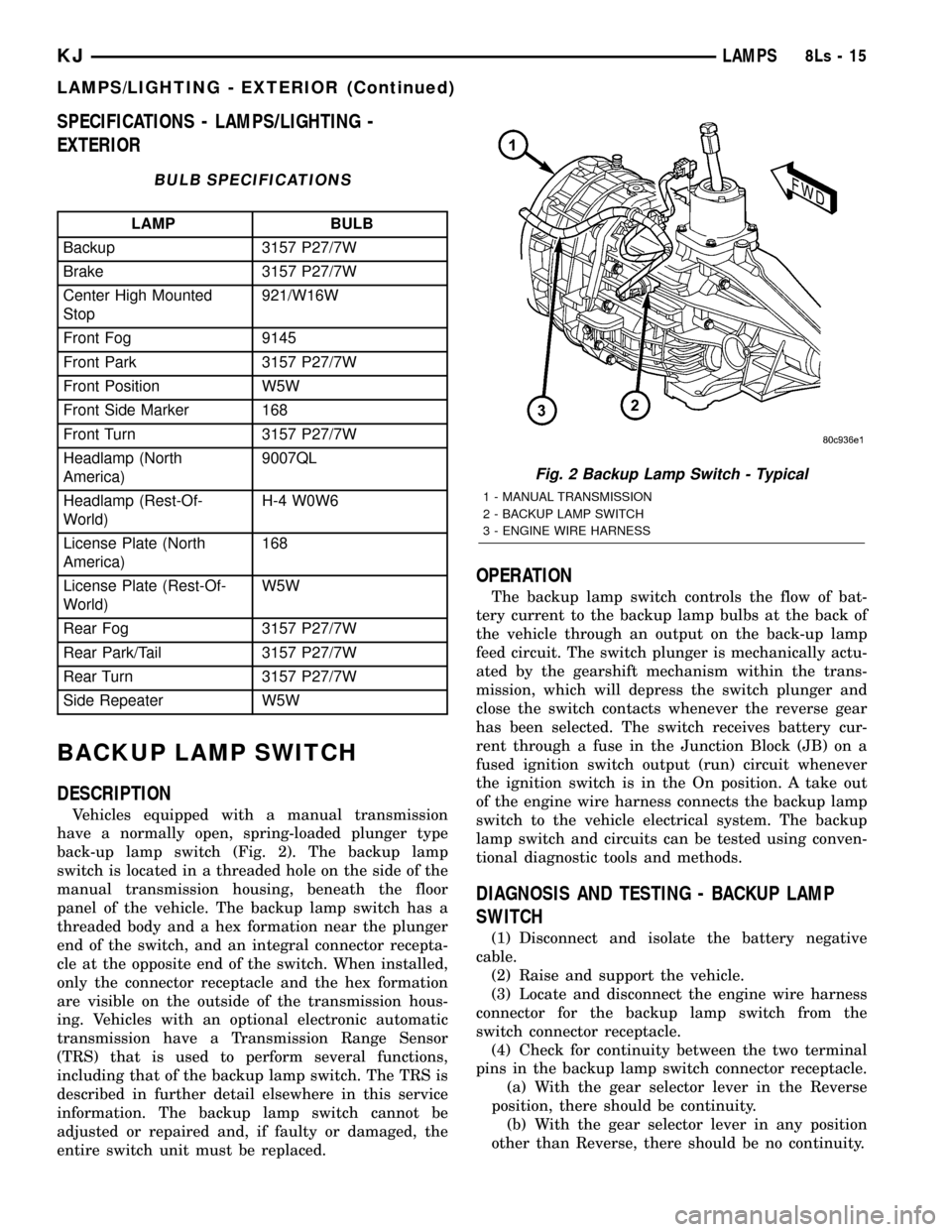
Vehicles equipped with a manual transmission
have a normally open, spring-loaded plunger type
back-up lamp switch (Fig. 2). The backup lamp
switch is located in a threaded hole on the side of the
manual transmission housing, beneath the floor
panel of the vehicle. The backup lamp switch has a
threaded body and a hex formation near the plunger
end of the switch, and an integral connector recepta-
cle at the opposite end of the switch. When installed,
only the connector receptacle and the hex formation
are visible on the outside of the transmission hous-
ing. Vehicles with an optional electronic automatic
transmission have a Transmission Range Sensor
(TRS) that is used to perform several functions,
including that of the backup lamp switch. The TRS is
described in further detail elsewhere in this service
information. The backup lamp switch cannot be
adjusted or repaired and, if faulty or damaged, the
entire switch unit must be replaced.
OPERATION
The backup lamp switch controls the flow of bat-
tery current to the backup lamp bulbs at the back of
the vehicle through an output on the back-up lamp
feed circuit. The switch plunger is mechanically actu-
ated by the gearshift mechanism within the trans-
mission, which will depress the switch plunger and
close the switch contacts whenever the reverse gear
has been selected. The switch receives battery cur-
rent through a fuse in the Junction Block (JB) on a
fused ignition switch output (run) circuit whenever
the ignition switch is in the On position. A take out
of the engine wire harness connects the backup lamp
switch to the vehicle electrical system. The backup
lamp switch and circuits can be tested using conven-
tional diagnostic tools and methods.
DIAGNOSIS AND TESTING - BACKUP LAMP
SWITCH
(1) Disconnect and isolate the battery negative
cable.
(2) Raise and support the vehicle.
(3) Locate and disconnect the engine wire harness
connector for the backup lamp switch from the
switch connector receptacle.
(4) Check for continuity between the two terminal
pins in the backup lamp switch connector receptacle.
(a) With the gear selector lever in the Reverse
position, there should be continuity.
(b) With the gear selector lever in any position
other than Reverse, there should be no continuity.
Fig. 2 Backup Lamp Switch - Typical
1 - MANUAL TRANSMISSION
2 - BACKUP LAMP SWITCH
3 - ENGINE WIRE HARNESS
KJLAMPS8Ls-15
LAMPS/LIGHTING - EXTERIOR (Continued)
Page 543 of 1803

CAUTION: Always replace a removed brake lamp
switch with a new unit. This is a one time compo-
nent and is not intended for reinstallation.
INSTALLATION
WARNING: ON VEHICLES EQUIPPED WITH AIR-
BAGS, DISABLE THE SUPPLEMENTAL RESTRAINT
SYSTEM BEFORE ATTEMPTING ANY STEERING
WHEEL, STEERING COLUMN, DRIVER AIRBAG,
PASSENGER AIRBAG, SEAT BELT TENSIONER,
FRONT IMPACT SENSORS, SIDE CURTAIN AIRBAG,
OR INSTRUMENT PANEL COMPONENT DIAGNOSIS
OR SERVICE. DISCONNECT AND ISOLATE THE
BATTERY NEGATIVE (GROUND) CABLE, THEN
WAIT TWO MINUTES FOR THE SYSTEM CAPACI-
TOR TO DISCHARGE BEFORE PERFORMING FUR-
THER DIAGNOSIS OR SERVICE. THIS IS THE ONLY
SURE WAY TO DISABLE THE SUPPLEMENTAL
RESTRAINT SYSTEM. FAILURE TO TAKE THE
PROPER PRECAUTIONS COULD RESULT IN ACCI-
DENTAL AIRBAG DEPLOYMENT AND POSSIBLE
PERSONAL INJURY.
CAUTION: Always replace a removed brake lamp
switch with a new unit. This is a one time compo-
nent and is not intended for reinstallation.
(1) While holding the brake pedal depressed, align
the tabs on the brake lamp switch locking collar with
the keyed mounting hole in the steering column sup-
port bracket (Fig. 5).
(2) Still holding the brake pedal depressed, insert
the tabs on the brake lamp switch housing through
the keyed mounting hole in the steering column sup-
port bracket until the switch is firmly seated against
the bracket.
(3) Still holding the brake pedal depressed, rotate
the switch clockwise about 30 degrees to lock the
tabs on the brake lamp switch locking collar to the
keyed mounting hole in the steering column support
bracket.
(4) Release the brake pedal.
CAUTION: Do not pull up on the brake pedal before
the switch plunger adjustment has been completed.
(5) Rotate the plunger adjustment release lever
clockwise until it locks into place parallel to the
brake lamp switch connector receptacle. This action
will set the switch plunger length to a final adjust-
ment position and cannot be undone. If not per-
formed properly the first time, a new brake lamp
switchmustbe installed.(6) Reconnect the instrument panel wire harness
connector for the brake lamp switch to the switch
connector receptacle.
(7) Reconnect the battery negative cable.
CENTER HIGH MOUNTED
STOP LAMP BULB
REMOVAL
(1) Disconnect and isolate the battery negative
cable.
(2) Remove the Center High Mounted Stop Lamp
(CHMSL) unit from the roof panel. (Refer to 8 -
ELECTRICAL/LAMPS/LIGHTING - EXTERIOR/
CENTER HIGH MOUNTED STOP LAMP UNIT -
REMOVAL).
(3) Firmly grasp the socket on the back of the
CHMSL unit housing.
(4) Rotate the socket on the back of the CHMSL
unit housing counterclockwise about 30 degrees (Fig.
6).
(5) Pull the socket and bulb straight out of the
back of CHMSL unit housing.
(6) Pull the bulb straight out of the CHMSL unit
socket.
Fig. 6 Center High Mounted Stop Lamp Bulb
Remove/Install
1 - CHMSL UNIT
2 - BULB
3 - SOCKET
4 - BODY WIRE HARNESS CONNECTOR
8Ls - 18 LAMPSKJ
BRAKE LAMP SWITCH (Continued)
Page 544 of 1803

INSTALLATION
CAUTION: Always use the correct bulb size and
type for replacement. An incorrect bulb size or type
may overheat and cause damage to the lamp, the
socket and/or the lamp wiring.
(1) Align the base of the bulb with the receptacle
in the Center High Mounted Stop Lamp (CHMSL)
unit socket.
(2) Push the bulb straight into the CHMSL unit
socket until it is firmly seated.
(3) Align the socket and bulb with the socket open-
ing on the back of CHMSL unit housing.
(4) Push the socket and bulb straight into the
CHMSL unit housing until it is firmly seated (Fig. 6).
(5) Rotate the socket on the back of the CHMSL
unit housing clockwise about 30 degrees.
(6) Reinstall the CHMSL unit onto the roof panel.
(Refer to 8 - ELECTRICAL/LAMPS/LIGHTING -
EXTERIOR/CENTER HIGH MOUNTED STOP
LAMP UNIT - INSTALLATION).
(7) Reconnect the battery negative cable.
CENTER HIGH MOUNTED
STOP LAMP UNIT
REMOVAL
(1) Disconnect and isolate the battery negative
cable.
(2) Remove the two screws that secure the Center
High Mounted Stop Lamp (CHMSL) unit to the rear
of the roof panel (Fig. 7).
(3) Pull the CHMSL unit away from the roof panel
far enough to access and disconnect the wire harness
connector for the CHMSL unit from the lamp socket
pigtail wire.
(4) Remove the CHMSL unit from the roof panel.
INSTALLATION
(1) Position the Center High Mounted Stop Lamp
(CHMSL) unit to the roof panel.
(2) Reconnect the wire harness connector for the
CHMSL unit to the lamp socket pigtail wire (Fig. 7).
(3) Position the CHMSL unit into the roof panel
opening.
(4) Install and tighten the two screws that secure
the CHMSL unit to the rear of the roof panel.
Tighten the screws to 2 N´m (21 in. lbs.).
(5) Reconnect the battery negative cable.
COMBINATION FLASHER
DESCRIPTION
The combination flasher for this model is integral
to the hazard switch located in the center of the
instrument panel, just above the radio. The combina-
tion flasher is a smart relay that functions as both
the turn signal system and the hazard warning sys-
tem flasher. The combination flasher contains active
electronic Integrated Circuitry (IC) elements. This
flasher is designed to handle the current flow
requirements of the factory-installed lighting. If sup-
plemental lighting is added to the turn signal lamp
circuits, such as when towing a trailer with lights,
the combination flasher will automatically try to
compensate to keep the flash rate the same.
The combination flasher cannot be repaired or
adjusted and, if faulty or damaged, the hazard switch
unit must be replaced.
OPERATION
The combination flasher has the following inputs and
outputs: fused B(+), fused ignition switch output, right
turn signal sense, left turn signal sense, and one out-
put each for the right and left turn signal circuits. The
combination flasher also receives an internal input
through the closed contacts of the hazard switch and,
on vehicles equipped with the optional Vehicle Theft
Security System (VTSS), the flasher receives an input
from the Body Control Module (BCM) in order to flash
the turn signal lamps as an optical alert feature of that
Fig. 7 Center High Mounted Stop Lamp Remove/
Install
1 - ROOF PANEL
2 - BODY WIRE HARNESS CONNECTOR
3 - BULB SOCKET
4 - CHMSL
5 - SCREW (2)
6 - PLASTIC NUT (2)
KJLAMPS8Ls-19
CENTER HIGH MOUNTED STOP LAMP BULB (Continued)
Page 545 of 1803

system. Constant battery voltage is supplied to the
flasher so that it can perform the hazard warning func-
tion, and ignition switched battery voltage is supplied
for the turn signal function. The Integrated Circuit (IC)
within the combination flasher contains the logic that
controls the flasher operation and the flash rate. The
IC receives separate sense ground inputs from the
multi-function switch for the right and left turn sig-
nals, and from the hazard switch contacts or the BCM
for the hazard warning signals. A special design feature
of the combination flasher allows it to9sense9that a
turn signal circuit or bulb is not operating, and provide
the driver an indication of the condition by flashing the
remaining bulbs in the affected circuit at a higher rate
(120 flashes-per-minute or higher). Conventional flash-
ers either continue flashing at their typical rate (heavy-
duty type), or discontinue flashing the affected circuit
entirely (standard-duty type).
Because of the active electronic elements within
the combination flasher, it cannot be tested with con-
ventional automotive electrical test equipment. If the
combination flasher is believed to be faulty, test the
turn signal and hazard warning system. Then
replace the hazard switch with a known good unit to
confirm system operation.
DAYTIME RUNNING LAMP
RELAY
DESCRIPTION
The Daytime Running Lamp (DRL) relay (Fig. 8) is
a solid state relay that is used only on vehicles man-
ufactured for sale in Canada. The DRL relay featuresa die cast aluminum housing with integral cooling
fins that act as a heat sink for the solid state DRL
circuitry. Four male spade terminals extend from the
base of the relay through a potting material that
encloses and protects the DRL circuitry. Although the
DRL relay has four terminals that are laid out in a
footprint that is similar to that of a conventional
International Standards Organization (ISO) relay, a
standard ISO relay should never be installed in place
of the DRL relay. The DRL relay is installed in the
Junction Block (JB) on the driver side outboard end
of the instrument panel. Vehicles equipped with this
relay do not have a headlamp high beam relay
installed in the JB.
The DRL relay cannot be adjusted or repaired and,
if faulty or damaged, the unit must be replaced.
OPERATION
The Daytime Running Lamp (DRL) relay is a solid
state relay that controls the flow of battery current
to the high beam filaments of both headlamp bulbs
based upon a duty cycled control input received from
the Body Control Module (BCM) of vehicles equipped
with the DRL feature. By cycling the DRL relay out-
put, the BCM controls the illumination intensity of
the high beam filaments. The DRL relay terminals
are connected to the vehicle electrical system through
a connector receptacle in the Junction Block (JB).
The inputs and outputs of the DRL relay include:
²Battery Current Input- The DRL relay
receives battery current on a fused B(+) circuit from
a fuse in the Power Distribution Center (PDC).
²Ground Input- The DRL relay receives a path
to ground through a splice block located in the
instrument panel wire harness with an eyelet termi-
nal connector that is secured by a nut to a ground
stud on the driver side instrument panel end bracket
near the Junction Block (JB).
²Control Input- The DRL relay control input is
received from the BCM and/or the momentary optical
horn (flash-to-pass) output of the multi-function
switch through a high beam relay control circuit.
²Control Output- The DRL relay supplies bat-
tery current output to the headlamp high beam fila-
ments through the high beam relay output circuit.
Because of active electronic elements within the
DRL relay, it cannot be tested with conventional
automotive electrical test equipment. If the DRL
relay is believed to be faulty, replace the relay with a
known good unit to confirm system operation.
Fig. 8 Daytime Running Lamp Relay
1 - DRL RELAY
2 - HEAT SINK
3 - POTTING MATERIAL
4 - TERMINAL (4)
8Ls - 20 LAMPSKJ
COMBINATION FLASHER (Continued)
Page 546 of 1803

REMOVAL
WARNING: ON VEHICLES EQUIPPED WITH AIR-
BAGS, DISABLE THE SUPPLEMENTAL RESTRAINT
SYSTEM BEFORE ATTEMPTING ANY STEERING
WHEEL, STEERING COLUMN, DRIVER AIRBAG,
PASSENGER AIRBAG, SEAT BELT TENSIONER,
FRONT IMPACT SENSORS, SIDE CURTAIN AIRBAG,
OR INSTRUMENT PANEL COMPONENT DIAGNOSIS
OR SERVICE. DISCONNECT AND ISOLATE THE
BATTERY NEGATIVE (GROUND) CABLE, THEN
WAIT TWO MINUTES FOR THE SYSTEM CAPACI-
TOR TO DISCHARGE BEFORE PERFORMING FUR-
THER DIAGNOSIS OR SERVICE. THIS IS THE ONLY
SURE WAY TO DISABLE THE SUPPLEMENTAL
RESTRAINT SYSTEM. FAILURE TO TAKE THE
PROPER PRECAUTIONS COULD RESULT IN ACCI-
DENTAL AIRBAG DEPLOYMENT AND POSSIBLE
PERSONAL INJURY.
(1) Disconnect and isolate the battery negative
cable.
(2) Remove the end cap from the driver side out-
board end of the instrument panel. (Refer to 23 -
BODY/INSTRUMENT PANEL/INSTRUMENT
PANEL END CAP - REMOVAL).
(3) Remove the Daytime Running Lamp (DRL)
relay by grasping it firmly and pulling it straight out
from the receptacle in the Junction Block (JB) (Fig.
9).
INSTALLATION
WARNING: ON VEHICLES EQUIPPED WITH AIR-
BAGS, DISABLE THE SUPPLEMENTAL RESTRAINT
SYSTEM BEFORE ATTEMPTING ANY STEERING
WHEEL, STEERING COLUMN, DRIVER AIRBAG,
PASSENGER AIRBAG, SEAT BELT TENSIONER,
FRONT IMPACT SENSORS, SIDE CURTAIN AIRBAG,
OR INSTRUMENT PANEL COMPONENT DIAGNOSIS
OR SERVICE. DISCONNECT AND ISOLATE THE
BATTERY NEGATIVE (GROUND) CABLE, THEN
WAIT TWO MINUTES FOR THE SYSTEM CAPACI-
TOR TO DISCHARGE BEFORE PERFORMING FUR-
THER DIAGNOSIS OR SERVICE. THIS IS THE ONLY
SURE WAY TO DISABLE THE SUPPLEMENTAL
RESTRAINT SYSTEM. FAILURE TO TAKE THE
PROPER PRECAUTIONS COULD RESULT IN ACCI-
DENTAL AIRBAG DEPLOYMENT AND POSSIBLE
PERSONAL INJURY.
(1) Position the Daytime Running Lamp (DRL)
relay to the proper receptacle in the Junction Block
(JB) (Fig. 9).
(2) Align the DRL relay terminals with the termi-
nal cavities in the JB receptacle.
(3) Push firmly and evenly on the top of the DRL
relay until the terminals are fully seated in the ter-
minal cavities in the JB receptacle.
(4) Reinstall the end cap onto the driver side out-
board end of the instrument panel. (Refer to 23 -
BODY/INSTRUMENT PANEL/INSTRUMENT
PANEL END CAP - INSTALLATION).
(5) Reconnect the battery negative cable.
FRONT FOG LAMP BULB
REMOVAL
(1) Turn the front wheels full lock in the direction
of the fog lamp bulb that is to be changed.
(2) Disconnect and isolate the battery negative
cable.
(3) Reach into the front wheel opening to unsnap
and lift the cover over the access hole at the front of
the front wheelhouse splash shield (Fig. 10).
(4) Reach through the access hole and firmly grasp
the socket on the back of the front fog lamp unit
housing.
(5) Rotate the socket on the back of the front fog
lamp unit housing counterclockwise about 30
degrees.
CAUTION: Do not contaminate the bulb glass by
touching it with your fingers or by allowing it to
contact other oily surfaces. Shortened bulb life will
result.
Fig. 9 Junction Block - Outboard Side (RHD Shown
- Rotate 180É for LHD)
1 - JB/BCM CONNECTOR
2 - HIGH BEAM RELAY
3 - DRL RELAY
KJLAMPS8Ls-21
DAYTIME RUNNING LAMP RELAY (Continued)