Fuse block JEEP LIBERTY 2002 KJ / 1.G Workshop Manual
[x] Cancel search | Manufacturer: JEEP, Model Year: 2002, Model line: LIBERTY, Model: JEEP LIBERTY 2002 KJ / 1.GPages: 1803, PDF Size: 62.3 MB
Page 1122 of 1803
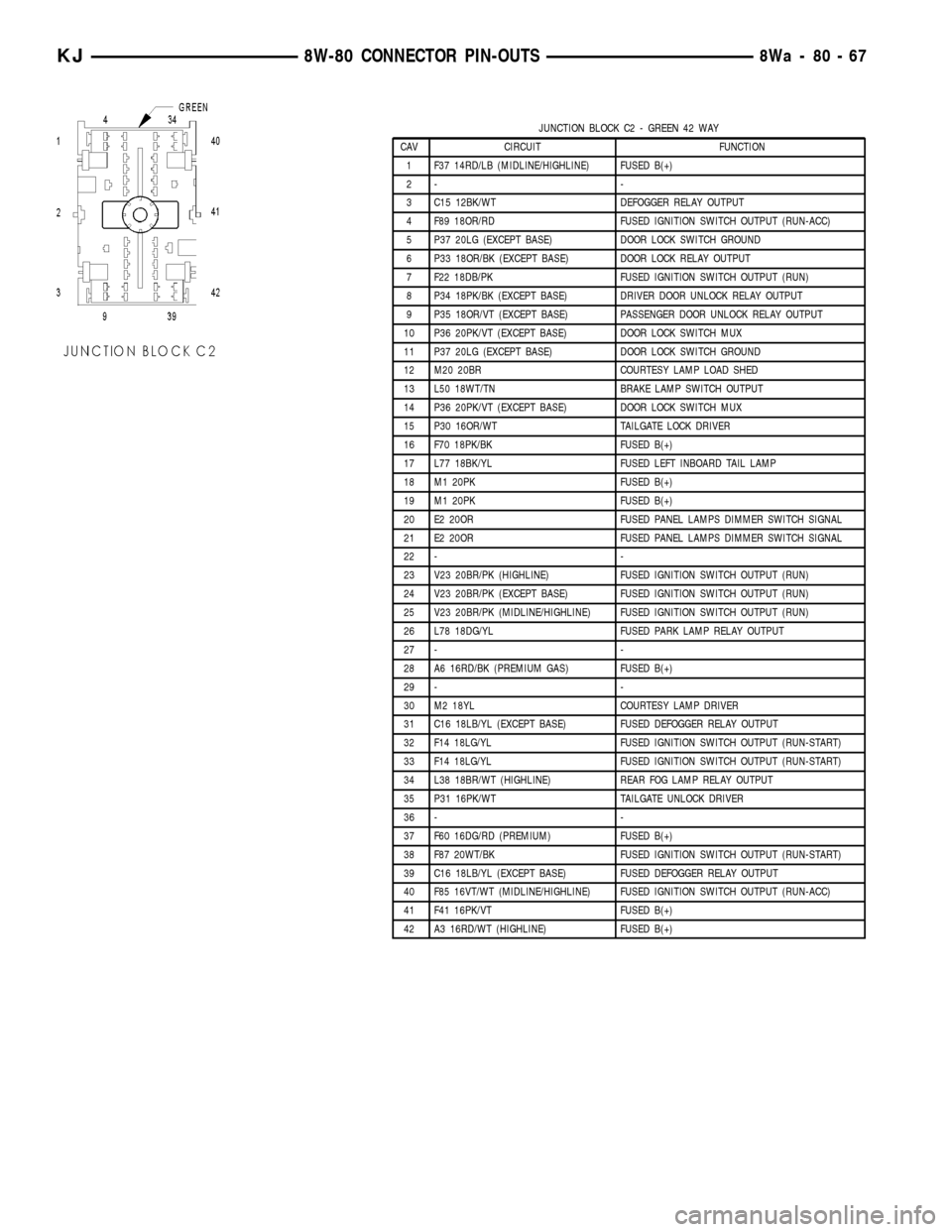
JUNCTION BLOCK C2 - GREEN 42 WAY
CAV CIRCUIT FUNCTION
1 F37 14RD/LB (MIDLINE/HIGHLINE) FUSED B(+)
2- -
3 C15 12BK/WT DEFOGGER RELAY OUTPUT
4 F89 18OR/RD FUSED IGNITION SWITCH OUTPUT (RUN-ACC)
5 P37 20LG (EXCEPT BASE) DOOR LOCK SWITCH GROUND
6 P33 18OR/BK (EXCEPT BASE) DOOR LOCK RELAY OUTPUT
7 F22 18DB/PK FUSED IGNITION SWITCH OUTPUT (RUN)
8 P34 18PK/BK (EXCEPT BASE) DRIVER DOOR UNLOCK RELAY OUTPUT
9 P35 18OR/VT (EXCEPT BASE) PASSENGER DOOR UNLOCK RELAY OUTPUT
10 P36 20PK/VT (EXCEPT BASE) DOOR LOCK SWITCH MUX
11 P37 20LG (EXCEPT BASE) DOOR LOCK SWITCH GROUND
12 M20 20BR COURTESY LAMP LOAD SHED
13 L50 18WT/TN BRAKE LAMP SWITCH OUTPUT
14 P36 20PK/VT (EXCEPT BASE) DOOR LOCK SWITCH MUX
15 P30 16OR/WT TAILGATE LOCK DRIVER
16 F70 18PK/BK FUSED B(+)
17 L77 18BK/YL FUSED LEFT INBOARD TAIL LAMP
18 M1 20PK FUSED B(+)
19 M1 20PK FUSED B(+)
20 E2 20OR FUSED PANEL LAMPS DIMMER SWITCH SIGNAL
21 E2 20OR FUSED PANEL LAMPS DIMMER SWITCH SIGNAL
22 - -
23 V23 20BR/PK (HIGHLINE) FUSED IGNITION SWITCH OUTPUT (RUN)
24 V23 20BR/PK (EXCEPT BASE) FUSED IGNITION SWITCH OUTPUT (RUN)
25 V23 20BR/PK (MIDLINE/HIGHLINE) FUSED IGNITION SWITCH OUTPUT (RUN)
26 L78 18DG/YL FUSED PARK LAMP RELAY OUTPUT
27 - -
28 A6 16RD/BK (PREMIUM GAS) FUSED B(+)
29 - -
30 M2 18YL COURTESY LAMP DRIVER
31 C16 18LB/YL (EXCEPT BASE) FUSED DEFOGGER RELAY OUTPUT
32 F14 18LG/YL FUSED IGNITION SWITCH OUTPUT (RUN-START)
33 F14 18LG/YL FUSED IGNITION SWITCH OUTPUT (RUN-START)
34 L38 18BR/WT (HIGHLINE) REAR FOG LAMP RELAY OUTPUT
35 P31 16PK/WT TAILGATE UNLOCK DRIVER
36 - -
37 F60 16DG/RD (PREMIUM) FUSED B(+)
38 F87 20WT/BK FUSED IGNITION SWITCH OUTPUT (RUN-START)
39 C16 18LB/YL (EXCEPT BASE) FUSED DEFOGGER RELAY OUTPUT
40 F85 16VT/WT (MIDLINE/HIGHLINE) FUSED IGNITION SWITCH OUTPUT (RUN-ACC)
41 F41 16PK/VT FUSED B(+)
42 A3 16RD/WT (HIGHLINE) FUSED B(+)
KJ8W-80 CONNECTOR PIN-OUTS8Wa-80-67
Page 1123 of 1803
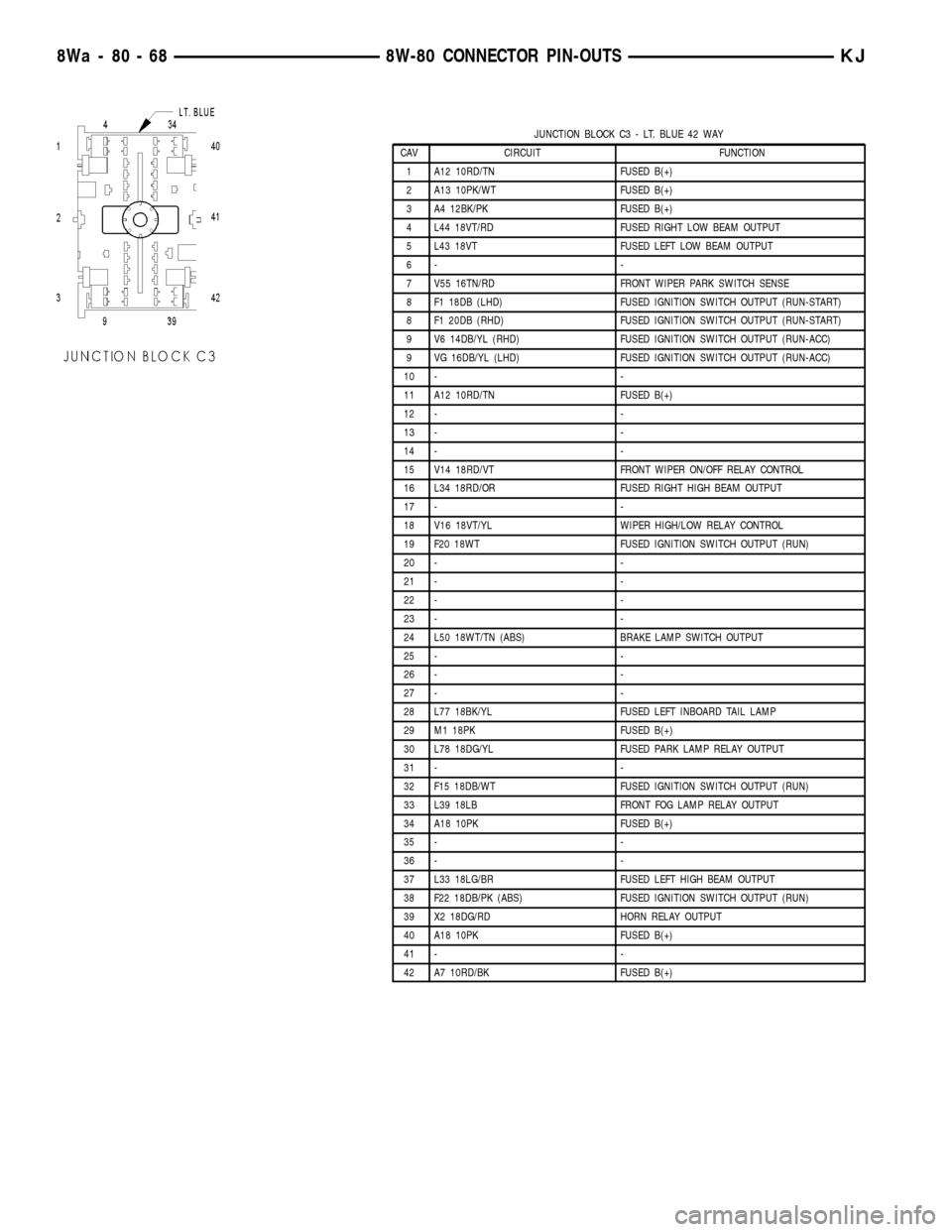
JUNCTION BLOCK C3 - LT. BLUE 42 WAY
CAV CIRCUIT FUNCTION
1 A12 10RD/TN FUSED B(+)
2 A13 10PK/WT FUSED B(+)
3 A4 12BK/PK FUSED B(+)
4 L44 18VT/RD FUSED RIGHT LOW BEAM OUTPUT
5 L43 18VT FUSED LEFT LOW BEAM OUTPUT
6- -
7 V55 16TN/RD FRONT WIPER PARK SWITCH SENSE
8 F1 18DB (LHD) FUSED IGNITION SWITCH OUTPUT (RUN-START)
8 F1 20DB (RHD) FUSED IGNITION SWITCH OUTPUT (RUN-START)
9 V6 14DB/YL (RHD) FUSED IGNITION SWITCH OUTPUT (RUN-ACC)
9 VG 16DB/YL (LHD) FUSED IGNITION SWITCH OUTPUT (RUN-ACC)
10 - -
11 A12 10RD/TN FUSED B(+)
12 - -
13 - -
14 - -
15 V14 18RD/VT FRONT WIPER ON/OFF RELAY CONTROL
16 L34 18RD/OR FUSED RIGHT HIGH BEAM OUTPUT
17 - -
18 V16 18VT/YL WIPER HIGH/LOW RELAY CONTROL
19 F20 18WT FUSED IGNITION SWITCH OUTPUT (RUN)
20 - -
21 - -
22 - -
23 - -
24 L50 18WT/TN (ABS) BRAKE LAMP SWITCH OUTPUT
25 - -
26 - -
27 - -
28 L77 18BK/YL FUSED LEFT INBOARD TAIL LAMP
29 M1 18PK FUSED B(+)
30 L78 18DG/YL FUSED PARK LAMP RELAY OUTPUT
31 - -
32 F15 18DB/WT FUSED IGNITION SWITCH OUTPUT (RUN)
33 L39 18LB FRONT FOG LAMP RELAY OUTPUT
34 A18 10PK FUSED B(+)
35 - -
36 - -
37 L33 18LG/BR FUSED LEFT HIGH BEAM OUTPUT
38 F22 18DB/PK (ABS) FUSED IGNITION SWITCH OUTPUT (RUN)
39 X2 18DG/RD HORN RELAY OUTPUT
40 A18 10PK FUSED B(+)
41 - -
42 A7 10RD/BK FUSED B(+)
8Wa - 80 - 68 8W-80 CONNECTOR PIN-OUTSKJ
Page 1656 of 1803

Pressure Diagnosis
Condition Possible Causes Correction
Rapid compressor clutch
cycling (ten or more cycles
per minute).1. Low refrigerant system
charge.1. See Plumbing/Diagnosis and Testing -
Refrigerant System Leaks in this group. Test the
refrigerant system for leaks. Repair, evacuate and
charge the refrigerant system, if required.
Equal pressures, but the
compressor clutch does not
engage.1. No refrigerant in the
refrigerant system.1. See Plumbing/Diagnosis and Testing -
Refrigerant System Leaks in this group. Test the
refrigerant system for leaks. Repair, evacuate and
charge the refrigerant system, if required.
2. Faulty fuse. 2. Check the fuses in the Power Distribution
Center and the junction block. Repair the shorted
circuit or component and replace the fuses, if
required.
3. Faulty a/c compressor
clutch coil.3. See A/C Compressor/Diagnosis and Testing -
Compressor Clutch Coil in this group. Test the
compressor clutch coil and replace, if required.
4. Faulty a/c compressor
clutch relay.4. See A/C Compressor Clutch Relay/Diagnosis
and Testing - Compressor Clutch Relay in this
group. Test the compressor clutch relay and relay
circuits. Repair the circuits or replace the relay, if
required.
5. Improperly installed or
faulty a/c low pressure
switch.5. See A/C Low Pressure Switch/Diagnosis and
Testing in this group. Test the a/c low pressure
switch and tighten or replace, if required.
6. Faulty a/c high pressure
switch.6. See A/C High Pressure Switch/Diagnosis and
Testing in this group. Test the a/c high pressure
switch and replace, if required.
7. Faulty Powertrain Control
Module (PCM).7. (Refer to Appropriate Diagnostic Information).
Test the PCM and replace, if required.
Normal pressures, but A/C
Performance Test air
temperatures at center panel
outlet are too high.1. Excessive refrigerant oil in
system.1. See Refrigerant Oil/Standard Procedure -
Refrigerant Oil Level in this group. Recover the
refrigerant from the refrigerant system and
inspect the refrigerant oil content. Restore the
refrigerant oil to the proper level, if required.
2. Blend door inoperative or
sealing improperly.2. See Blend Door in this group. Inspect the
blend door for proper operation and sealing and
correct, if required.
3. Blend door actuator faulty
or inoperative.3. Perform blend door actuator diagnosis, replace
if faulty.
The low side pressure is
normal or slightly low, and
the high side pressure is too
low.1. Low refrigerant system
charge.1. See Plumbing/Diagnosis and Testing -
Refrigerant System Leaks in this group. Test the
refrigerant system for leaks. Repair, evacuate and
charge the refrigerant system, if required.
2. Refrigerant flow through
the accumulator is restricted.2. See Accumulator in this group. Replace the
restricted accumulator, if required.
3. Refrigerant flow through
the evaporator coil is
restricted.3. See A/C Evaporator in this group. Replace the
restricted evaporator coil, if required.
24 - 4 HEATING & AIR CONDITIONINGKJ
HEATING & AIR CONDITIONING (Continued)
Page 1664 of 1803

A/C COMPRESSOR CLUTCH
DESCRIPTION - 3.7L and 2.4L
The compressor clutch assembly consists of a sta-
tionary electromagnetic coil, a rotor bearing and
rotor assembly, and a clutch plate (Fig. 1). The elec-
tromagnetic coil unit and the rotor bearing and rotor
assembly are each retained on the nose of the com-
pressor front housing with snap rings. The clutch
plate is keyed to the compressor shaft and secured
with a nut. These components provide the means to
engage and disengage the compressor from the
engine serpentine accessory drive belt.
OPERATION - 3.7L and 2.4L
When the clutch coil is energized, it magnetically
draws the clutch into contact with the rotor and
drives the compressor shaft. When the coil is not
energized, the rotor freewheels on the clutch rotor
bearing, which is part of the rotor. The compressor
clutch and coil are the only serviced parts on the
compressor.
The compressor clutch engagement is controlled by
several components: the A/C Heater mode control
switch, the A/C low pressure switch, the A/C high
pressure switch, the compressor clutch relay, and the
Powertrain Control Module (PCM). The PCM may
delay compressor clutch engagement for up to thirty
seconds. Refer to Electronic Control Modules for
more information on the PCM controls.
DIAGNOSIS AND TESTING - A/C COMPRESSOR
CLUTCH COIL
For circuit descriptions and diagrams, (Refer to
Appropriate Wiring Information). The battery must
be fully-charged before performing the following
tests. Refer to Battery for more information.
(1) Connect an ammeter (0 to 10 ampere scale) in
series with the clutch coil terminal. Use a voltmeter
(0 to 20 volt scale) with clip-type leads for measuring
the voltage across the battery and the compressor
clutch coil.
(2) With the A/C Heater mode control switch in
any A/C mode, and the blower motor switch in the
lowest speed position, start the engine and run it at
normal idle.
(3) The compressor clutch coil voltage should read
within 0.2 volts of the battery voltage. If there is
voltage at the clutch coil, but the reading is not
within 0.2 volts of the battery voltage, test the clutch
coil feed circuit for excessive voltage drop and repair
as required. If there is no voltage reading at the
clutch coil, use a DRB IIItscan tool and (Refer to
Appropriate Diagnostic Information) for testing of the
compressor clutch circuit and PCM control. The fol-
lowing components must be checked and repaired as
required before you can complete testing of the clutch
coil:
²Fuses in the junction block and the Power Dis-
tribution Center (PDC)
²A/C heater mode control switch
²Compressor clutch relay
²A/C high pressure switch
²A/C low pressure switch
²Powertrain Control Module (PCM).
(4) The compressor clutch coil is acceptable if the
current draw measured at the clutch coil is 2.0 to 3.9
amperes with the electrical system voltage at 11.5 to
12.5 volts. This should only be checked with the work
area temperature at 21É C (70É F). If system voltage
is more than 12.5 volts, add electrical loads by turn-
ing on electrical accessories until the system voltage
drops below 12.5 volts.
(a) If the clutch coil current reading is four
amperes or more, the coil is shorted and should be
replaced.
(b) If the clutch coil current reading is zero, the
coil is open and should be replaced.
STANDARD PROCEDURE - A/C COMPRESSOR
CLUTCH BREAK-IN
After a new compressor clutch has been installed,
cycle the compressor clutch approximately twenty
times (five seconds on, then five seconds off). During
this procedure, set the A/C Heater control to the
Recirculation Mode, the blower motor switch in the
highest speed position, and the engine speed at 1500
Fig. 1 COMPRESSOR CLUTCH - TYPICAL
1 - CLUTCH PLATE
2 - NOT USED ON KJ
3 - ROTOR
4 - COIL
5 - CLUTCH SHIMS
6 - SNAP RING
7 - SNAP RING
24 - 12 CONTROLSKJ
Page 1668 of 1803

(2) Resistance between terminals 85 and 86 (elec-
tromagnet) should be 67.5 to 82.5 ohms. If OK, go to
Step 3. If not OK, replace the faulty relay.
(3) Connect a battery to terminals 85 and 86.
There should now be continuity between terminals
30 and 87, and no continuity between terminals 87A
and 30. If OK, see Relay Circuit Test. If not OK,
replace the faulty relay.
RELAY CIRCUIT TEST
For circuit descriptions and diagrams, (Refer to
Appropriate Wiring Information).
(1) The relay common feed terminal cavity (30) is
connected to fused battery feed. There should be bat-
tery voltage at the cavity for relay terminal 30 at all
times. If OK, go to Step 2. If not OK, repair the open
circuit to the fuse in the PDC as required.
(2) The relay normally closed terminal (87A) is not
used in this application. Go to Step 3.
(3) The relay normally open terminal cavity (87) is
connected to the compressor clutch coil. There should
be continuity between this cavity and the A/C com-
pressor clutch relay output circuit cavity of the com-
pressor clutch coil wire harness connector. If OK, go
to Step 4. If not OK, repair the open circuit as
required.
(4) The relay coil battery terminal (86) is con-
nected to the fused ignition switch output (run/start)circuit. There should be battery voltage at the cavity
for relay terminal 86 with the ignition switch in the
On position. If OK, go to Step 5. If not OK, repair the
open circuit to the fuse in the junction block as
required.
(5) The coil ground terminal cavity (85) is switched
to ground through the Powertrain Control Module
(PCM). There should be continuity between this cav-
ity and the A/C compressor clutch relay control cir-
cuit cavity of the PCM wire harness connector C
(gray) at all times. If not OK, repair the open circuit
as required.
REMOVAL
(1) Disconnect and isolate the battery negative
cable.
(2) Remove the cover from the Power Distribution
Center (PDC).
(3) Refer to the label on the PDC for compressor
clutch relay identification and location.
(4) Unplug the compressor clutch relay from the
PDC.
INSTALLATION
(1) Install the compressor clutch relay by aligning
the relay terminals with the cavities in the PDC and
pushing the relay firmly into place.
(2) Install the PDC cover.
(3) Connect the battery negative cable.
(4) Test the relay operation.
A/C HEATER CONTROL
DESCRIPTION
Both the heater-only and A/C heater systems use a
combination of mechanical, electrical, and vacuum
controls. These controls provide the vehicle operator
with a number of setting options to help control the
climate and comfort within the vehicle. Refer to the
owner's manual in the vehicle glove box for more
information on the features, use, and suggested oper-
ation of these controls.
The heater-only or A/C heater control panel is
located to the right of the instrument cluster on the
instrument panel. The control panel contains a rota-
ry-type temperature control knob, a rotary-type mode
control switch knob, and a rotary-type blower motor
speed switch knob. The control also has a push but-
ton to activate the rear window defogger.
The heater-only or A/C heater control panel cannot
be repaired. If faulty or damaged, the entire unit
must be replaced. The illumination lamps are avail-
able for service replacement.
Fig. 10 COMPRESSOR CLUTCH RELAY
30 - COMMON FEED
85 - COIL GROUND
86 - COIL BATTERY
87 - NORMALLY OPEN
87A - NORMALLY CLOSED
24 - 16 CONTROLSKJ
A/C COMPRESSOR CLUTCH RELAY (Continued)
Page 1673 of 1803

DIAGNOSIS AND TESTING - BLOWER MOTOR
RELAY
WARNING: ON VEHICLES EQUIPPED WITH AIR-
BAGS, DISABLE THE AIRBAG SYSTEM BEFORE
ATTEMPTING ANY STEERING WHEEL, STEERING
COLUMN, OR INSTRUMENT PANEL COMPONENT
DIAGNOSIS OR SERVICE. DISCONNECT AND ISO-
LATE THE BATTERY NEGATIVE (GROUND) CABLE,
THEN WAIT TWO MINUTES FOR THE AIRBAG SYS-
TEM CAPACITOR TO DISCHARGE BEFORE PER-
FORMING FURTHER DIAGNOSIS OR SERVICE. THIS
IS THE ONLY SURE WAY TO DISABLE THE AIRBAG
SYSTEM. FAILURE TO TAKE THE PROPER PRE-
CAUTIONS COULD RESULT IN AN ACCIDENTAL
AIRBAG DEPLOYMENT AND POSSIBLE PERSONAL
INJURY.
RELAY TEST
The blower motor relay (Fig. 15) is located in the
PDC which is located under the hood.. Remove the
relay from the PDC to perform the following tests:
(1) A relay in the de-energized position should
have continuity between terminals 87A and 30, and
no continuity between terminals 87 and 30. If OK, go
to Step 2. If not OK, replace the faulty relay.
(2) Resistance between terminals 85 and 86 (elec-
tromagnet) should be 60.7 to 80.3 ohms. If OK, go to
Step 3. If not OK, replace the faulty relay.
(3) Connect a battery to terminals 85 and 86.
There should now be continuity between terminals
30 and 87, and no continuity between terminals 87A
and 30. If OK, see the Relay Circuit Test. If not OK,
replace the faulty relay.
RELAY CIRCUIT TEST
For circuit descriptions and diagrams, (Refer to
Appropriate Wiring Information).
(1) The relay common feed terminal cavity (30) is
connected to fused battery feed directly from a fuse
in the Power Distribution Center (PDC), and should
be hot at all times. Check for battery voltage at the
connector cavity for relay terminal 30. If OK, go to
Step 2. If not OK, repair the open circuit to the PDC
fuse as required.
(2) The relay normally closed terminal cavity (87A)
is not used for this application. Go to Step 3.
(3) The relay normally open terminal cavity (87) is
connected to the blower motor. When the relay is
energized, terminal 87 is connected to terminal 30
and provides full battery current to the blower motor
feed circuit. There should be continuity between the
connector cavity for terminal 87 and the blower
motor at all times. If OK, go to Step 4. If not OK,
repair the open circuit to the blower motor as
required.
(4) The coil battery terminal cavity (86) is con-
nected to the ignition switch. When the ignition
switch is placed in the On position, fused ignition
switch output is directed from a fuse in the junction
block to the relay electromagnetic coil to energize the
relay. There should be battery voltage at the connec-
tor cavity for relay terminal 86 with the ignition
switch in the On position. If OK, go to Step 5. If not
OK, repair the open circuit to the junction block fuse
as required.
(5) The coil ground terminal cavity (85) is con-
nected to ground. This terminal supplies the ground
for the relay electromagnet coil. There should be con-
tinuity between the connector cavity for relay termi-
nal 85 and a good ground at all times. If not OK,
repair the open circuit as required.
REMOVAL
WARNING: ON VEHICLES EQUIPPED WITH AIR-
BAGS, DISABLE THE AIRBAG SYSTEM BEFORE
ATTEMPTING ANY STEERING WHEEL, STEERING
COLUMN, OR INSTRUMENT PANEL COMPONENT
DIAGNOSIS OR SERVICE. DISCONNECT AND ISO-
LATE THE BATTERY NEGATIVE (GROUND) CABLE,
THEN WAIT TWO MINUTES FOR THE AIRBAG SYS-
TEM CAPACITOR TO DISCHARGE BEFORE PER-
FORMING FURTHER DIAGNOSIS OR SERVICE. THIS
IS THE ONLY SURE WAY TO DISABLE THE AIRBAG
SYSTEM. FAILURE TO TAKE THE PROPER PRE-
CAUTIONS COULD RESULT IN AN ACCIDENTAL
AIRBAG DEPLOYMENT AND POSSIBLE PERSONAL
INJURY.
Fig. 15 BLOWER MOTOR RELAY
30 - COMMON FEED
85 - COIL GROUND
86 - COIL BATTERY
87 - NORMALLY OPEN
87A - NORMALLY CLOSED
KJCONTROLS 24 - 21
BLOWER MOTOR RELAY (Continued)
Page 1702 of 1803

(1) Install the evaporator coil unit into of the lower
half of the HVAC housing. Be certain that the evap-
orator foam insulator wrap and rubber tube seal are
reinstalled.
(2) Reassemble and install the HVAC housing.
(Refer to 24 - HEATING & AIR CONDITIONING/
DISTRIBUTION/HVAC HOUSING - ASSEMBLY)
(Refer to 24 - HEATING & AIR CONDITIONING/
DISTRIBUTION/HVAC HOUSING - INSTALLA-
TION)
NOTE: If the evaporator was replaced, add 60 milli-
liters (2 fluid ounces) of refrigerant oil to the refrig-
erant system. Use only refrigerant oil of the type
recommended for the compressor in the vehicle.
(Refer to 24 - HEATING & AIR CONDITIONING/
PLUMBING/REFRIGERANT OIL - DESCRIPTION)
A/C ORIFICE TUBE
DESCRIPTION
The fixed orifice tube is installed in the liquid line
(left-hand drive) or liquid line jumper (right-hand
drive) between the outlet of the condenser and the
inlet of the evaporator. The fixed orifice tube islocated in the end of the liquid line or liquid line
jumper that is closest to the condenser outlet tube.
The inlet end of the fixed orifice tube has a nylon
mesh filter screen, which filters the refrigerant and
helps to reduce the potential for blockage of the
metering orifice by refrigerant system contaminants
(Fig. 11). The outlet end of the tube has a nylon
mesh diffuser screen. The O-rings on the plastic body
of the fixed orifice tube seal the tube to the inside of
the liquid line and prevent the refrigerant from
bypassing the fixed metering orifice.
OPERATION
The fixed orifice tube is used to meter the flow of
liquid refrigerant into the evaporator coil. The high-
pressure liquid refrigerant from the condenser
expands into a low-pressure liquid as it passes
through the metering orifice and diffuser screen of
the fixed orifice tube.
The fixed orifice tube cannot be repaired and, if
faulty or plugged, the liquid line and fixed orifice
tube unit or liquid line jumper and fixed orifice tube
unit must be replaced.
REMOVAL
The fixed orifice tube is located in the liquid line
(Left-Hand Drive) or the liquid line jumper (Right-
Hand Drive) near the condenser. The orifice has filter
screens on the inlet and outlet ends of the tube body.
If the fixed orifice tube is faulty or plugged, the liq-
uid line unit or liquid line jumper unit must be
replaced. (Refer to 24 - HEATING & AIR CONDI-
TIONING/PLUMBING/LIQUID LINE - REMOVAL)
INSTALLATION
The fixed orifice tube is located in the liquid line
(Left-Hand Drive) or the liquid line jumper (Right-
Hand Drive) near the condenser. The orifice has filter
screens on the inlet and outlet ends of the tube body.
If the fixed orifice tube is faulty or plugged, the liq-
uid line unit or liquid line jumper unit must be
Fig. 10 Blend Door
1 - DEFROSTER DOOR
2- HEATER CORE
3- BLEND DOORS
4- BLOWER MOTOR HOUSING
5- EVAPORATOR (A/C ONLY)
6- LOWER HVAC CASE ASSEMBLY
Fig. 11 FIXED ORIFICE TUBE - TYPICAL
1 - DIFFUSER SCREEN
2-9O9RINGS
3 - INLET FILTER SCREENS
4 - ORIFICE
24 - 50 PLUMBINGKJ
A/C EVAPORATOR (Continued)
Page 1753 of 1803

INTAKE MANIFOLD LEAKS - DIAGNOSIS
AND TESTING........................9-68
INTAKE/EXHAUST VALVES & SEATS -
DESCRIPTION........................9-26
INTAKE/EXHAUST VALVES & SEATS -
INSTALLATION....................9-28,9-36
INTAKE/EXHAUST VALVES & SEATS -
REMOVAL.......................9-27,9-35
INTERIOR - DESCRIPTION, LAMPS/
LIGHTING..........................8L-65
INTERIOR - DIAGNOSIS AND TESTING,
LAMPS/LIGHTING....................8L-68
INTERIOR - OPERATION, LAMPS/
LIGHTING..........................8L-67
INTERIOR - SPECIFICATIONS,
LAMPS/LIGHTING....................8L-71
INTERLOCK CABLE - INSTALLATION,
PARK .............................21-153
INTERLOCK CABLE - REMOVAL, PARK . . . 21-153
INTERLOCK SYSTEM - DESCRIPTION,
BRAKE TRANSMISSION SHIFT.........21-124
INTERLOCK SYSTEM - DIAGNOSIS AND
TESTING, BRAKE TRANSMISSION
SHIFT.............................21-125
INTERLOCK SYSTEM - OPERATION,
BRAKE TRANSMISSION SHIFT.........21-125
INTERMEDIATE SHAFT - INSTALLATION . . . 19-11
INTERMEDIATE SHAFT - REMOVAL......19-11
INTERNATIONAL SYMBOLS -
DESCRIPTION......................Intro.-4
INTERNATIONAL SYMBOLS -
DESCRIPTION.........................0-1
INTRODUCTION - DIAGNOSIS AND
TESTING, ENGINE DIAGNOSIS............9-4
INTRUSION TRANSCEIVER MODULE -
DESCRIPTION.......................8Q-14
INTRUSION TRANSCEIVER MODULE -
INSTALLATION......................8Q-16
INTRUSION TRANSCEIVER MODULE -
OPERATION.........................8Q-15
INTRUSION TRANSCEIVER MODULE -
REMOVAL..........................8Q-15
INVERTED FLARING - STANDARD
PROCEDURE, DOUBLE..................5-8
IOD FUSE - DESCRIPTION...........8W-97-3
IOD FUSE - INSTALLATION...........8W-97-3
IOD FUSE - OPERATION.............8W-97-3
IOD FUSE - REMOVAL..............8W-97-3
ISO FLARING - STANDARD PROCEDURE....5-8
JOINT - DESCRIPTION, UPPER
SUSPENSION ARM, BUSHINGS, AND
BALL...............................2-20
JOINT - DIAGNOSIS AND TESTING,
LOWER BALL........................2-10
JOINT - INSTALLATION, UPPER BALL.....2-20
JOINT - OPERATION, UPPER
SUSPENSION ARM, BUSHINGS, AND
BALL...............................2-20
JOINT - REMOVAL, UPPER BALL.........2-20
JOINT/BOOT-INNER - INSTALLATION, CV . . . 3-17
JOINT/BOOT-INNER - REMOVAL, CV.......3-15
JOINT/BOOT-OUTER - INSTALLATION, CV . . . 3-13
JOINT/BOOT-OUTER - REMOVAL, CV......3-12
JOINTS - ASSEMBLY, SINGLE CARDAN
UNIVERSAL...........................3-9
JOINTS - DISASSEMBLY, SINGLE
CARDAN UNIVERSAL...................3-8
JOUNCE BUMPER - INSTALLATION.......2-19
JOUNCE BUMPER - REMOVAL...........2-19
JUMP STARTING PROCEDURE -
STANDARD PROCEDURE
.................0-5
JUNCTION BLOCK - DESCRIPTION
.....8W-97-4
JUNCTION BLOCK - DESCRIPTION
........5-20
JUNCTION BLOCK - DIAGNOSIS AND
TESTING
.........................8W-97-4
JUNCTION BLOCK - INSTALLATION
.......5-20
JUNCTION BLOCK - OPERATION
......8W-97-4
JUNCTION BLOCK - OPERATION
..........5-20
JUNCTION BLOCK - REMOVAL
...........5-20
KEY - DESCRIPTION, TRANSPONDER
....8Q-18
KEY - OPERATION, TRANSPONDER
......8Q-18
KEY IMMOBILIZER MODULE -
DESCRIPTION, SENTRY
................8E-15
KEY IMMOBILIZER MODULE -
INSTALLATION, SENTRY
...............8E-18
KEY IMMOBILIZER MODULE -
OPERATION, SENTRY
.................8E-16KEY IMMOBILIZER MODULE - REMOVAL,
SENTRY............................8E-17
KEY TRANSPONDER PROGRAMMING -
STANDARD PROCEDURE, SENTRY........8Q-8
KEY-IN IGNITION SWITCH -
DESCRIPTION.......................19-10
KEY-IN IGNITION SWITCH - DIAGNOSIS
AND TESTING.......................19-10
KEYLESS ENTRY MODULE -
DESCRIPTION, REMOTE................8N-7
KEYLESS ENTRY MODULE - DIAGNOSIS
AND TESTING, REMOTE................8N-7
KEYLESS ENTRY MODULE -
INSTALLATION, REMOTE...............8N-7
KEYLESS ENTRY MODULE - OPERATION,
REMOTE............................8N-7
KEYLESS ENTRY MODULE - REMOVAL,
REMOTE............................8N-7
KEYLESS ENTRY TRANSMITTER -
DIAGNOSIS AND TESTING, REMOTE......8N-8
KEYLESS ENTRY TRANSMITTER -
SPECIFICATIONS, REMOTE..............8N-9
KNEE BLOCKER - INSTALLATION.......23-155
KNEE BLOCKER - REMOVAL...........23-155
KNOCK SENSOR - DESCRIPTION.........8I-11
KNOCK SENSOR - INSTALLATION........8I-12
KNOCK SENSOR - OPERATION..........8I-11
KNOCK SENSOR - REMOVAL............8I-12
KNUCKLE - INSTALLATION...............2-9
KNUCKLE - REMOVAL...................2-9
LABEL - DESCRIPTION, VEHICLE
EMISSION CONTROL INFORMATION
(VECI)............................Intro.-8
LABEL - DESCRIPTION, VEHICLE SAFETY
CERTIFICATION.....................Intro.-9
LACE - INSTALLATION, OPENING TRIM . . 23-180
LACE - REMOVAL, OPENING TRIM......23-180
LAMP BULB - INSTALLATION, ASH
RECEIVER..........................8L-71
LAMP BULB - INSTALLATION, CARGO....8L-73
LAMP BULB - INSTALLATION, CENTER
HIGH MOUNTED STOP................8L-19
LAMP BULB - INSTALLATION,
COURTESY.........................8L-76
LAMP BULB - INSTALLATION, FRONT....8L-27
LAMP BULB - INSTALLATION, FRONT
FOG ...............................8L-22
LAMP BULB - INSTALLATION, FRONT
POSITION..........................8L-28
LAMP BULB - INSTALLATION, LICENSE
PLATE .............................8L-45
LAMP BULB - INSTALLATION, READING . . . 8L-79
LAMP BULB - INSTALLATION, REAR.....8L-59
LAMP BULB - INSTALLATION, REPEATER . . 8L-60
LAMP BULB - INSTALLATION, VANITY....8L-84
LAMP BULB - REMOVAL, ASH RECEIVER . . 8L-71
LAMP BULB - REMOVAL, CARGO........8L-72
LAMP BULB - REMOVAL, CENTER HIGH
MOUNTED STOP.....................8L-18
LAMP BULB - REMOVAL, COURTESY.....8L-75
LAMP BULB - REMOVAL, FRONT........8L-26
LAMP BULB - REMOVAL, FRONT FOG....8L-21
LAMP BULB - REMOVAL, FRONT
POSITION..........................8L-28
LAMP BULB - REMOVAL, LICENSE
PLATE .............................8L-44
LAMP BULB - REMOVAL, READING......8L-79
LAMP BULB - REMOVAL, REAR.........8L-58
LAMP BULB - REMOVAL, REPEATER.....8L-60
LAMP BULB - REMOVAL, VANITY........8L-83
LAMP INDICATOR - DESCRIPTION,
FRONT FOG.........................8J-19
LAMP INDICATOR - DESCRIPTION, REAR
FOG ...............................8J-27
LAMP INDICATOR - OPERATION, FRONT
FOG ...............................8J-19
LAMP INDICATOR - OPERATION, REAR
FOG ...............................8J-27
LAMP (MIL) - DESCRIPTION,
MALFUNCTION INDICATOR.............8J-24
LAMP (MIL) - OPERATION,
MALFUNCTION INDICATOR
.............8J-24
LAMP RELAY - DESCRIPTION, DAYTIME
RUNNING
...........................8L-20
LAMP RELAY - DESCRIPTION, FRONT
FOG
...............................8L-22
LAMP RELAY - DESCRIPTION, PARK
.....8L-54
LAMP RELAY - DESCRIPTION, REAR FOG
. 8L-56LAMP RELAY - DIAGNOSIS AND
TESTING, FRONT FOG.................8L-23
LAMP RELAY - DIAGNOSIS AND
TESTING, PARK......................8L-55
LAMP RELAY - DIAGNOSIS AND
TESTING, REAR FOG..................8L-57
LAMP RELAY - INSTALLATION, DAYTIME
RUNNING...........................8L-21
LAMP RELAY - INSTALLATION, FRONT
FOG ...............................8L-24
LAMP RELAY - INSTALLATION, PARK.....8L-56
LAMP RELAY - INSTALLATION, REAR
FOG ...............................8L-58
LAMP RELAY - OPERATION, DAYTIME
RUNNING...........................8L-20
LAMP RELAY - OPERATION, FRONT FOG . . 8L-22
LAMP RELAY - OPERATION, PARK.......8L-54
LAMP RELAY - OPERATION, REAR FOG . . . 8L-57
LAMP RELAY - REMOVAL, DAYTIME
RUNNING...........................8L-21
LAMP RELAY - REMOVAL, FRONT FOG . . . 8L-24
LAMP RELAY - REMOVAL, PARK........8L-55
LAMP RELAY - REMOVAL, REAR FOG....8L-58
LAMP REPLACEMENT - STANDARD
PROCEDURE, CMTC...................8M-2
LAMP REPLACEMENT - STANDARD
PROCEDURE, COURTESY...............8M-2
LAMP SWITCH - DESCRIPTION, BACKUP . . 8L-15
LAMP SWITCH - DESCRIPTION, BRAKE . . . 8L-16
LAMP SWITCH - DIAGNOSIS AND
TESTING, BACKUP.....................8L-15
LAMP SWITCH - DIAGNOSIS AND
TESTING, BRAKE.....................8L-17
LAMP SWITCH - INSTALLATION, BRAKE . . 8L-18
LAMP SWITCH - INSTALLATION, CARGO . . 8L-74
LAMP SWITCH - INSTALLATION,
READING...........................8L-80
LAMP SWITCH - OPERATION, BACKUP . . . 8L-15
LAMP SWITCH - OPERATION, BRAKE.....8L-16
LAMP SWITCH - REMOVAL, BRAKE......8L-17
LAMP SWITCH - REMOVAL, CARGO......8L-73
LAMP SWITCH - REMOVAL, READING....8L-80
LAMP UNIT - ADJUSTMENT, FRONT FOG . . 8L-25
LAMP UNIT - INSTALLATION, ASH
RECEIVER..........................8L-72
LAMP UNIT - INSTALLATION, CARGO.....8L-74
LAMP UNIT - INSTALLATION, CENTER
HIGH MOUNTED STOP................8L-19
LAMP UNIT - INSTALLATION, COURTESY . . 8L-77
LAMP UNIT - INSTALLATION, FRONT.....8L-28
LAMP UNIT - INSTALLATION, FRONT
FOG ...............................8L-25
LAMP UNIT - INSTALLATION, LICENSE
PLATE .............................8L-46
LAMP UNIT - INSTALLATION, READING . . . 8L-81
LAMP UNIT - INSTALLATION, REAR......8L-60
LAMP UNIT - INSTALLATION, REPEATER . . 8L-61
LAMP UNIT - REMOVAL, ASH RECEIVER . . 8L-72
LAMP UNIT - REMOVAL, CARGO........8L-74
LAMP UNIT - REMOVAL, CENTER HIGH
MOUNTED STOP.....................8L-19
LAMP UNIT - REMOVAL, COURTESY.....8L-76
LAMP UNIT - REMOVAL, FRONT.........8L-27
LAMP UNIT - REMOVAL, FRONT FOG.....8L-25
LAMP UNIT - REMOVAL, LICENSE PLATE . . 8L-45
LAMP UNIT - REMOVAL, READING.......8L-81
LAMP UNIT - REMOVAL, REAR..........8L-59
LAMP UNIT - REMOVAL, REPEATER......8L-60
LAMPS/LIGHTING - EXTERIOR -
DESCRIPTION........................8L-2
LAMPS/LIGHTING - EXTERIOR -
DIAGNOSIS AND TESTING..............8L-7
LAMPS/LIGHTING - EXTERIOR -
OPERATION..........................8L-5
LAMPS/LIGHTING - EXTERIOR -
SPECIFICATIONS.....................8L-15
LAMPS/LIGHTING - INTERIOR -
DESCRIPTION.......................8L-65
LAMPS/LIGHTING - INTERIOR -
DIAGNOSIS AND TESTING.............8L-68
LAMPS/LIGHTING - INTERIOR -
OPERATION
.........................8L-67
LAMPS/LIGHTING - INTERIOR -
SPECIFICATIONS
.....................8L-71
LASH ADJUSTER - DIAGNOSIS AND
TESTING, HYDRAULIC
..............9-19,9-30
LATCH - ACCESS PANEL - DESCRIPTION
. 23-139
LATCH - ACCESS PANEL - INSTALLATION
. 23-139
14 INDEXKJ
Description Group-Page Description Group-Page Description Group-Page