warning light JEEP LIBERTY 2002 KJ / 1.G Workshop Manual
[x] Cancel search | Manufacturer: JEEP, Model Year: 2002, Model line: LIBERTY, Model: JEEP LIBERTY 2002 KJ / 1.GPages: 1803, PDF Size: 62.3 MB
Page 753 of 1803
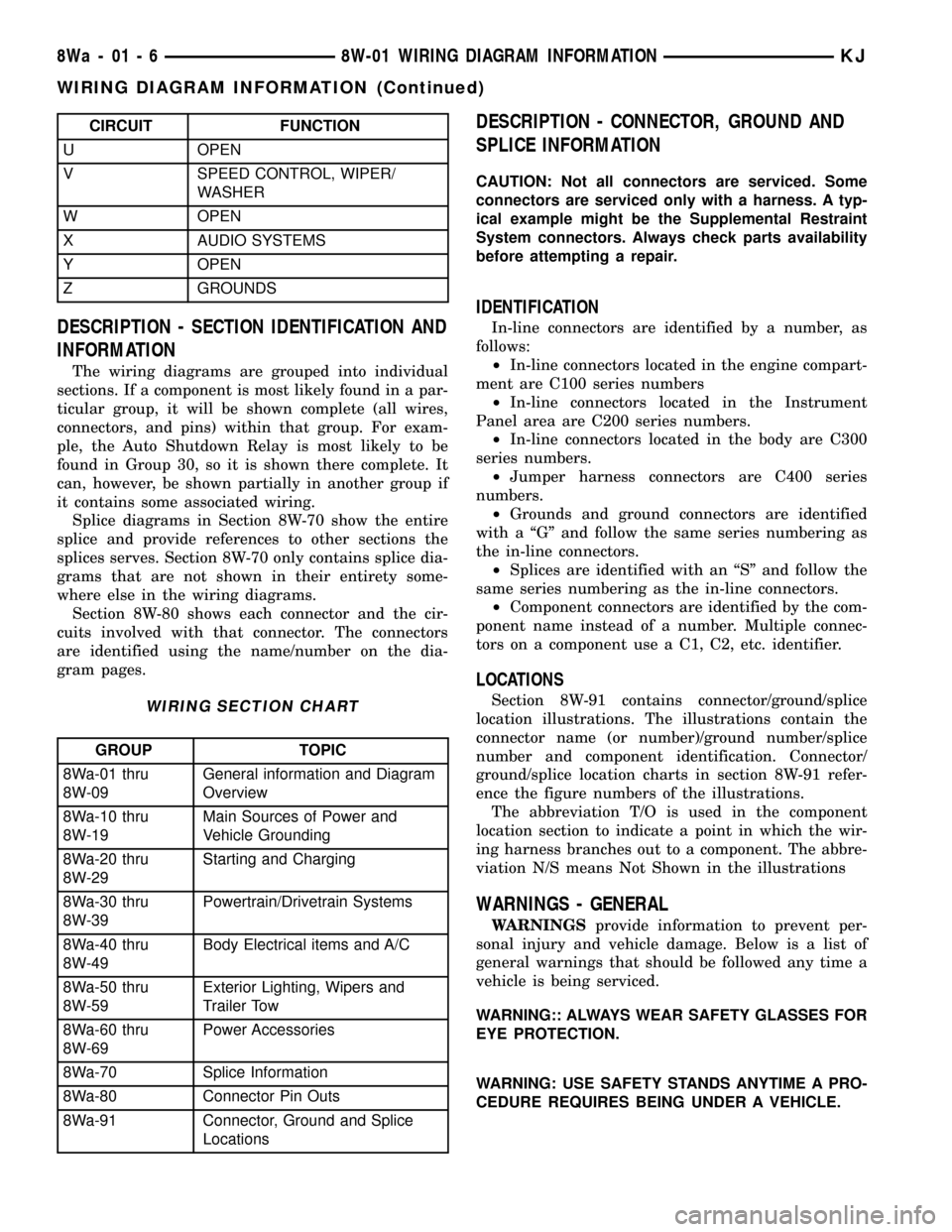
CIRCUIT FUNCTION
U OPEN
V SPEED CONTROL, WIPER/
WASHER
W OPEN
X AUDIO SYSTEMS
Y OPEN
Z GROUNDS
DESCRIPTION - SECTION IDENTIFICATION AND
INFORMATION
The wiring diagrams are grouped into individual
sections. If a component is most likely found in a par-
ticular group, it will be shown complete (all wires,
connectors, and pins) within that group. For exam-
ple, the Auto Shutdown Relay is most likely to be
found in Group 30, so it is shown there complete. It
can, however, be shown partially in another group if
it contains some associated wiring.
Splice diagrams in Section 8W-70 show the entire
splice and provide references to other sections the
splices serves. Section 8W-70 only contains splice dia-
grams that are not shown in their entirety some-
where else in the wiring diagrams.
Section 8W-80 shows each connector and the cir-
cuits involved with that connector. The connectors
are identified using the name/number on the dia-
gram pages.
WIRING SECTION CHART
GROUP TOPIC
8Wa-01 thru
8W-09General information and Diagram
Overview
8Wa-10 thru
8W-19Main Sources of Power and
Vehicle Grounding
8Wa-20 thru
8W-29Starting and Charging
8Wa-30 thru
8W-39Powertrain/Drivetrain Systems
8Wa-40 thru
8W-49Body Electrical items and A/C
8Wa-50 thru
8W-59Exterior Lighting, Wipers and
Trailer Tow
8Wa-60 thru
8W-69Power Accessories
8Wa-70 Splice Information
8Wa-80 Connector Pin Outs
8Wa-91 Connector, Ground and Splice
Locations
DESCRIPTION - CONNECTOR, GROUND AND
SPLICE INFORMATION
CAUTION: Not all connectors are serviced. Some
connectors are serviced only with a harness. A typ-
ical example might be the Supplemental Restraint
System connectors. Always check parts availability
before attempting a repair.
IDENTIFICATION
In-line connectors are identified by a number, as
follows:
²In-line connectors located in the engine compart-
ment are C100 series numbers
²In-line connectors located in the Instrument
Panel area are C200 series numbers.
²In-line connectors located in the body are C300
series numbers.
²Jumper harness connectors are C400 series
numbers.
²Grounds and ground connectors are identified
with a ªGº and follow the same series numbering as
the in-line connectors.
²Splices are identified with an ªSº and follow the
same series numbering as the in-line connectors.
²Component connectors are identified by the com-
ponent name instead of a number. Multiple connec-
tors on a component use a C1, C2, etc. identifier.
LOCATIONS
Section 8W-91 contains connector/ground/splice
location illustrations. The illustrations contain the
connector name (or number)/ground number/splice
number and component identification. Connector/
ground/splice location charts in section 8W-91 refer-
ence the figure numbers of the illustrations.
The abbreviation T/O is used in the component
location section to indicate a point in which the wir-
ing harness branches out to a component. The abbre-
viation N/S means Not Shown in the illustrations
WARNINGS - GENERAL
WARNINGSprovide information to prevent per-
sonal injury and vehicle damage. Below is a list of
general warnings that should be followed any time a
vehicle is being serviced.
WARNING:: ALWAYS WEAR SAFETY GLASSES FOR
EYE PROTECTION.
WARNING: USE SAFETY STANDS ANYTIME A PRO-
CEDURE REQUIRES BEING UNDER A VEHICLE.
8Wa - 01 - 6 8W-01 WIRING DIAGRAM INFORMATIONKJ
WIRING DIAGRAM INFORMATION (Continued)
Page 830 of 1803

8W-15 GROUND DISTRIBUTION
Component Page
A/C Compressor Clutch...................8Wa-15-6
A/C Low Pressure Switch.................8Wa-15-3
A/C- Heater Control...................8Wa-15-7, 8
Airbag Control Module...................8Wa-15-7
Ash Receiver Lamp.....................8Wa-15-8
Battery.............................8Wa-15-2
Blend Door Actuator.....................8Wa-15-8
Blower Motor Relay.....................8Wa-15-4
Body Control Module....................8Wa-15-8
Brake Lamp Switch.....................8Wa-15-8
Cabin Heater.........................8Wa-15-6
Capacitor............................8Wa-15-2
Center High Mounted Stop Lamp...........8Wa-15-14
Cigar Lighter.........................8Wa-15-8
Compass Mini-Trip Computer..............8Wa-15-14
Controller Antilock Brake.................8Wa-15-2
Data Link Connector....................8Wa-15-2
Engine Control Module...................8Wa-15-7
Engine Coolant Level Sensor...............8Wa-15-6
Flip-Up Glass Release Motor..............8Wa-15-14
Front Wiper Motor......................8Wa-15-3
Fuel Heater..........................8Wa-15-6
Fuel Heater Relay......................8Wa-15-4
Fuel Pump Module.....................8Wa-15-15
G100.............................8Wa-15-2, 7
G101...............................8Wa-15-6
G102...............................8Wa-15-2
G103...............................8Wa-15-6
G104...............................8Wa-15-7
G105...............................8Wa-15-2
G106...............................8Wa-15-2
G110...............................8Wa-15-2
G111 .............................8Wa-15-3, 4
G112...............................8Wa-15-3
G200...............................8Wa-15-7
G201...............................8Wa-15-7
G202...............................8Wa-15-8
G300............................8Wa-15-9, 11
G301............................8Wa-15-9, 10
G302............................8Wa-15-9, 12
G310.........................8Wa-15-13, 14, 15
G311 ..............................8Wa-15-14
G312..............................8Wa-15-14
G320..............................8Wa-15-15
Hazard Switch/Combination Flasher..........8Wa-15-8
Headlamp Leveling Switch................8Wa-15-8
Heated Seat Module....................8Wa-15-10
High Note Horn.......................8Wa-15-3
Hood Ajar Switch.......................8Wa-15-4
Ignition Switch........................8Wa-15-8
Instrument Cluster.....................8Wa-15-8
Intrusion Sensor......................8Wa-15-14
Junction Block........................8Wa-15-8
Left Door Lock Switch...................8Wa-15-11
Left Fog Lamp........................8Wa-15-5
Left Front Door Ajar Switch...............8Wa-15-11
Left Front Door Lock Motor/Ajar Switch.......8Wa-15-11
Left Front Door Speaker..................8Wa-15-7
Left Front Park/Turn Signal Lamp...........8Wa-15-5
Left Headlamp........................8Wa-15-3
Left Heated Seat Assembly...............8Wa-15-10
Left Heated Seat Switch.................8Wa-15-10Component Page
Left Leveling Motor.....................8Wa-15-3
Left Position Lamp.....................8Wa-15-3
Left Power Mirror.....................8Wa-15-11
Left Power Seat Switch..................8Wa-15-10
Left Rear Door Ajar Switch...............8Wa-15-11
Left Rear Door Lock Motor/Ajar Switch.......8Wa-15-11
Left Side Impact Airbag Control Module........8Wa-15-9
Left Side Repeater Lamp..................8Wa-15-5
Left Tail/Stop Lamp....................8Wa-15-15
License Lamp........................8Wa-15-15
Line Pressure Sensor....................8Wa-15-2
Low Note Horn........................8Wa-15-3
Multi- Function Switch...................8Wa-15-8
Oxygen Sensor 1/2 Downstream.............8Wa-15-6
Oxygen Sensor 2/2 Downstream.............8Wa-15-6
Power Mirror Switch.................8Wa-15-11, 12
Power Outlet.........................8Wa-15-8
Power Steering Pressure Switch.............8Wa-15-6
Power Window Master Switch.............8Wa-15-10
Powertrain Control Module................8Wa-15-2
Radiator Fan Motor.....................8Wa-15-3
Radiator Fan Relay.....................8Wa-15-3
Radio..............................8Wa-15-7
Radio Choke..........................8Wa-15-9
Rear Power Outlet.....................8Wa-15-15
Rear Window Defogger..................8Wa-15-14
Rear Wiper Motor.....................8Wa-15-14
Red Brake Warning Indicator Switch..........8Wa-15-4
Right Door Lock Switch..................8Wa-15-12
Right Fog Lamp.......................8Wa-15-5
Right Front Door Ajar Switch..............8Wa-15-12
Right Front Door Lock Motor/Ajar Switch......8Wa-15-12
Right Front Door Speaker.................8Wa-15-7
Right Front Park/Turn Signal Lamp..........8Wa-15-5
Right Headlamp.......................8Wa-15-4
Right Heated Seat Assembly..............8Wa-15-10
Right Heated Seat Switch................8Wa-15-10
Right Leveling Motor....................8Wa-15-4
Right Position Lamp....................8Wa-15-4
Right Power Mirror....................8Wa-15-12
Right Power Seat Switch.................8Wa-15-10
Right Rear Door Ajar Switch..............8Wa-15-12
Right Rear Door Lock Motor/Ajar Switch......8Wa-15-12
Right Side Impact Airbag Control Module.......8Wa-15-9
Right Side Repeater Lamp.................8Wa-15-5
Right Tail/Stop Lamp...................8Wa-15-15
Sentry Key Immobilizer Module.............8Wa-15-8
Shifter Assembly.......................8Wa-15-9
Siren...............................8Wa-15-4
Speed Control Servo.....................8Wa-15-3
Starter Motor Relay.....................8Wa-15-4
Sunroof Motor........................8Wa-15-14
Tailgate Flip-Up Ajar Switch..............8Wa-15-14
Trailer Tow Brake Lamp Relay.............8Wa-15-13
Trailer Tow Connector...................8Wa-15-13
Trailer Tow Left Turn Relay...............8Wa-15-13
Trailer Tow Relay......................8Wa-15-13
Trailer Tow Right Turn Relay..............8Wa-15-13
Transmission Control Module...............8Wa-15-2
Transmission Control Relay................8Wa-15-4
Washer Fluid Level Switch................8Wa-15-3
KJ8W-15 GROUND DISTRIBUTION8Wa-15-1
Page 1276 of 1803

DIAGNOSIS AND TESTING - REAR SEAL AREA
LEAKS
Since it is sometimes difficult to determine the
source of an oil leak in the rear seal area of the
engine, a more involved inspection is necessary. The
following steps should be followed to help pinpoint
the source of the leak.
If the leakage occurs at the crankshaft rear oil seal
area:
(1) Disconnect the battery.
(2) Raise the vehicle.
(3) Remove torque converter or clutch housing
cover and inspect rear of block for evidence of oil.
Use a black light to check for the oil leak:
(a) Circular spray pattern generally indicates
seal leakage or crankshaft damage.
(b) Where leakage tends to run straight down,
possible causes are a porous block, camshaft bore
cup plugs, oil galley pipe plugs, oil filter runoff,
and main bearing cap to cylinder block mating sur-
faces. See Engine, for proper repair procedures of
these items.
(4) If no leaks are detected, pressurized the crank-
case as outlined in the section, Inspection (Engine oil
Leaks in general)
CAUTION: Do not exceed 20.6 kPa (3 psi).(5) If the leak is not detected, very slowly turn the
crankshaft and watch for leakage. If a leak is
detected between the crankshaft and seal while
slowly turning the crankshaft, it is possible the
crankshaft seal surface is damaged. The seal area on
the crankshaft could have minor nicks or scratches
that can be polished out with emery cloth.
CAUTION: Use extreme caution when crankshaft
polishing is necessary to remove minor nicks or
scratches. The crankshaft seal flange is specially
machined to complement the function of the rear oil
seal.
(6) For bubbles that remain steady with shaft
rotation, no further inspection can be done until dis-
assembled. (Refer to 9 - ENGINE - DIAGNOSIS AND
TESTING), under the Oil Leak row, for components
inspections on possible causes and corrections.
(7) After the oil leak root cause and appropriate
corrective action have been identified, (Refer to 9 -
ENGINE/ENGINE BLOCK/CRANKSHAFT OIL
SEAL - REAR - REMOVAL).
OIL
STANDARD PROCEDURE - ENGINE OIL
WARNING: NEW OR USED ENGINE OIL CAN BE
IRRITATING TO THE SKIN. AVOID PROLONGED OR
REPEATED SKIN CONTACT WITH ENGINE OIL.
CONTAMINANTS IN USED ENGINE OIL, CAUSED BY
INTERNAL COMBUSTION, CAN BE HAZARDOUS TO
YOUR HEALTH. THOROUGHLY WASH EXPOSED
SKIN WITH SOAP AND WATER. DO NOT WASH
SKIN WITH GASOLINE, DIESEL FUEL, THINNER, OR
SOLVENTS, HEALTH PROBLEMS CAN RESULT. DO
NOT POLLUTE, DISPOSE OF USED ENGINE OIL
PROPERLY.
ENGINE OIL SPECIFICATION
CAUTION: Do not use non-detergent or straight
mineral oil when adding or changing crankcase
lubricant. Engine failure can result.
API SERVICE GRADE CERTIFIED
Use an engine oil that is API Service Grade Certi-
fied. MOPARtprovides engine oils that conform to
this service grade.
SAE VISCOSITY
An SAE viscosity grade is used to specify the vis-
cosity of engine oil. Use only engine oils with multi-
Fig. 70 Oil Pressure Sending Unit -Typical
1 - BELT
2 - OIL PRESSURE SENSOR
3 - OIL FILTER
4 - ELEC. CONNECTOR
KJENGINE - 3.7L 9 - 61
LUBRICATION (Continued)
Page 1448 of 1803

NOTE: Power steering pumps have different pres-
sure rates and are not interchangeable with other
pumps.
STANDARD PROCEDURE - POWER STEERING
PUMP - INITIAL OPERATION
WARNING: THE FLUID LEVEL SHOULD BE
CHECKED WITH ENGINE OFF TO PREVENT INJURY
FROM MOVING COMPONENTS.
CAUTION: Use MOPAR Power Steering Fluid or
equivalent. Do not use automatic transmission fluid
and do not overfill.
Wipe filler cap clean, then check the fluid level.
The dipstick should indicateCOLDwhen the fluid is
at normal ambient temperature.
(1) Fill the pump fluid reservoir to the proper level
and let the fluid settle for at least two minutes.
(2) Raise the front wheels off the ground.
(3) Slowly turn the steering wheel right and left,
lightly contacting the wheel stops at least 20 times.
(4) Check the fluid level add if necessary.
(5) Lower the vehicle, start the engine and turn
the steering wheel slowly from lock to lock.
(6) Stop the engine and check the fluid level and
refill as required.
CAUTION: Do not run a vehicle with foamy fluid for
an extended period. This may cause pump damage.
(7) If the fluid is extremely foamy or milky look-
ing, allow the vehicle to stand a few minutes and
repeat the procedure.
(8) Add fluid if necessary. Repeat the above proce-
dure until the fluid level remains constant after run-
ning the engine.
REMOVAL
REMOVAL - 3.7L
(1) Siphon out as much power steering fluid as
possible.
(2) Remove the radiator cross member (Refer to 23
- BODY/EXTERIOR/RADIATOR CROSSMEMBER -
REMOVAL).
(3) Remove the engine cooling fan (Refer to 7 -
COOLING/ENGINE/RADIATOR FAN - REMOVAL).
(4) Remove the fan shroud
(5) Remove the serpentine drive belt (Refer to 7 -
COOLING/ACCESSORY DRIVE/DRIVE BELTS -
REMOVAL).
(6) Remove the power steering high pressure hose
at the pump.
(7) Remove the return hose at the pump.
(8) Remove the three bolts securing the pump to
the bracket thru the holes in the pulley. (Fig. 3)
(9) Remove the pump from the vehicle.
REMOVAL - 2.4L
CAUTION: On vehicles equipped with the 2.4L, Do
not reuse the old power steering pump pulley it is
not intended for reuse. A new pulley must be
installed if removed.
(1) Siphon out as much power steering fluid as
possible.
(2) Remove the serpentine drive belt.
(3) Remove the power steering high pressure hose
at the pump using care not to remove the flow con-
trol valve.
(4) Remove the return hose at the pump.
Fig. 2 FLUID RESERVOIR - 2.4L
Fig. 3 POWER STEERING PUMP - 3.7L
1 - MOUNTING BOLTS
2 - RESERVOIR
3 - STEEL PULLEY
19 - 18 PUMPKJ
PUMP (Continued)
Page 1467 of 1803

DIAGNOSIS AND TESTING
DIAGNOSIS AND TESTING - WATER LEAKS
Water leaks can be caused by poor sealing,
improper body component alignment, body seam
porosity, missing plugs, or blocked drain holes. Cen-
trifugal and gravitational force can cause water to
drip from a location away from the actual leak point,
making leak detection difficult. All body sealing
points should be water tight in normal wet-driving
conditions. Water flowing downward from the front of
the vehicle should not enter the passenger or luggage
compartment. Moving sealing surfaces will not
always seal water tight under all conditions. At
times, side glass or door seals will allow water to
enter the passenger compartment during high pres-
sure washing or hard driving rain (severe) condi-
tions. Overcompensating on door or glass
adjustments to stop a water leak that occurs under
severe conditions can cause premature seal wear and
excessive closing or latching effort. After completing
a repair, water test vehicle to verify leak has stopped
before returning vehicle to use.
VISUAL INSPECTION BEFORE WATER LEAK TESTS
Verify that floor and body plugs are in place, body
drains are clear, and body components are properly
aligned and sealed. If component alignment or seal-
ing is necessary, refer to the appropriate section of
this group for proper procedures.
WATER LEAK TESTS
WARNING: DO NOT USE ELECTRIC SHOP LIGHTS
OR TOOLS IN WATER TEST AREA. PERSONAL
INJURY CAN RESULT.
When the conditions causing a water leak have
been determined, simulate the conditions as closely
as possible.
²If a leak occurs with the vehicle parked in a
steady light rain, flood the leak area with an open-
ended garden hose.
²If a leak occurs while driving at highway speeds
in a steady rain, test the leak area with a reasonable
velocity stream or fan spray of water. Direct the
spray in a direction comparable to actual conditions.
²If a leak occurs when the vehicle is parked on an
incline, hoist the end or side of the vehicle to simu-
late this condition. This method can be used when
the leak occurs when the vehicle accelerates, stops or
turns. If the leak occurs on acceleration, hoist the
front of the vehicle. If the leak occurs when braking,
hoist the back of the vehicle. If the leak occurs on left
turns, hoist the left side of the vehicle. If the leak
occurs on right turns, hoist the right side of the vehi-cle. For hoisting recommendations refer to Group 0,
Lubrication and Maintenance, General Information
section.
WATER LEAK DETECTION
To detect a water leak point-of-entry, do a water
test and watch for water tracks or droplets forming
on the inside of the vehicle. If necessary, remove inte-
rior trim covers or panels to gain visual access to the
leak area. If the hose cannot be positioned without
being held, have someone help do the water test.
Some water leaks must be tested for a considerable
length of time to become apparent. When a leak
appears, find the highest point of the water track or
drop. The highest point usually will show the point of
entry. After leak point has been found, repair the
leak and water test to verify that the leak has
stopped.
Locating the entry point of water that is leaking
into a cavity between panels can be difficult. The
trapped water may splash or run from the cavity,
often at a distance from the entry point. Most water
leaks of this type become apparent after accelerating,
stopping, turning, or when on an incline.
MIRROR INSPECTION METHOD
When a leak point area is visually obstructed, use
a suitable mirror to gain visual access. A mirror can
also be used to deflect light to a limited-access area
to assist in locating a leak point.
BRIGHT LIGHT LEAK TEST METHOD
Some water leaks in the luggage compartment can
be detected without water testing. Position the vehi-
cle in a brightly lit area. From inside the darkened
luggage compartment inspect around seals and body
seams. If necessary, have a helper direct a drop light
over the suspected leak areas around the luggage
compartment. If light is visible through a normally
sealed location, water could enter through the open-
ing.
PRESSURIZED LEAK TEST METHOD
When a water leak into the passenger compart-
ment cannot be detected by water testing, pressurize
the passenger compartment and soap test exterior of
the vehicle. To pressurize the passenger compart-
ment, close all doors and windows, start engine, and
set heater control to high blower in HEAT position. If
engine can not be started, connect a charger to the
battery to ensure adequate voltage to the blower.
With interior pressurized, apply dish detergent solu-
tion to suspected leak area on the exterior of the
vehicle. Apply detergent solution with spray device or
soft bristle brush. If soap bubbles occur at a body
seam, joint, seal or gasket, the leak entry point could
be at that location.
23 - 2 BODYKJ
BODY (Continued)
Page 1614 of 1803

(1) Open the glove box.
(2) Remove the two striker screws and remove the
latch striker.
INSTALLATION
WARNING: ON VEHICLES EQUIPPED WITH AIR-
BAGS, DISABLE THE AIRBAG SYSTEM BEFORE
ATTEMPTING ANY STEERING WHEEL, STEERING
COLUMN, SEAT BELT TENSIONER, OR INSTRU-
MENT PANEL COMPONENT DIAGNOSIS OR SER-
VICE. DISCONNECT AND ISOLATE THE BATTERY
NEGATIVE (GROUND) CABLE, THEN WAIT TWO
MINUTES FOR THE AIRBAG SYSTEM CAPACITOR
TO DISCHARGE BEFORE PERFORMING FURTHER
DIAGNOSIS OR SERVICE. THIS IS THE ONLY SURE
WAY TO DISABLE THE AIRBAG SYSTEM. FAILURE
TO TAKE THE PROPER PRECAUTIONS COULD
RESULT IN ACCIDENTAL AIRBAG DEPLOYMENT
AND POSSIBLE PERSONAL INJURY.
(1) Install the striker and install the two screws.
(2) Loosen the screws to adjust if necessary.
INSTRUMENT PANEL
ASSEMBLY
REMOVAL
WARNING: ON VEHICLES EQUIPPED WITH AIR-
BAGS, DISABLE THE AIRBAG SYSTEM BEFORE
ATTEMPTING ANY STEERING WHEEL, STEERING
COLUMN, OR INSTRUMENT PANEL COMPONENT
DIAGNOSIS OR SERVICE. DISCONNECT AND ISO-
LATE THE BATTERY NEGATIVE (GROUND) CABLE,
THEN WAIT TWO MINUTES FOR THE AIRBAG SYS-
TEM CAPACITOR TO DISCHARGE BEFORE PER-
FORMING FURTHER DIAGNOSIS OR SERVICE. THIS
IS THE ONLY SURE WAY TO DISABLE THE AIRBAG
SYSTEM. FAILURE TO TAKE THE PROPER PRE-
CAUTIONS COULD RESULT IN ACCIDENTAL AIR-
BAG DEPLOYMENT AND POSSIBLE PERSONAL
INJURY.
NOTE: Before starting this procedure, be certain to
turn the steering wheel until the front wheels are in
the straight-ahead position.(1) Disconnect and isolate the battery negative
cable.
(2) Remove the instrument panel top cover. (Refer
to 23 - BODY/INSTRUMENT PANEL/INSTRUMENT
PANEL TOP COVER - REMOVAL)
(3) Remove the speakers.
(4) Remove the floor console. (Refer to 23 - BODY/
INTERIOR/FLOOR CONSOLE - REMOVAL)
(5) Remove the radio. (Refer to 8 - ELECTRICAL/
AUDIO/RADIO - REMOVAL)
(6) Remove the four nuts and remove the center
support bracket. (Fig. 6)
(7) Remove the steering column. (Refer to 19 -
STEERING/COLUMN - REMOVAL)
(8) Remove the drivers side cowl trim cover. (Refer
to 23 - BODY/INTERIOR/COWL TRIM COVER -
REMOVAL)
(9) Disconnect the wire harness connector behind
the drivers side cowl trim cover.
(10) Disconnect the green and light blue wire har-
ness bulk connectors at the junction block. (Fig. 1)
(11) Disconnect the electrical connector at the
inner side of the pedal support bracket. (Fig. 2)
(12) Remove the two bolts at the front of the pedal
support bracket. (Fig. 2)
(13) Remove the two bolts from the bottom side of
the pedal support bracket. (Fig. 2)
Fig. 1 JUNCTION BLOCK CONNECTORS
1 - ELECTRICAL CONNECTOR
2 - ELECTRICAL CONNECTOR
3 - PEDAL SUPPORT BRACKET
4 - JUNCTION BLOCK
KJINSTRUMENT PANEL 23 - 149
GLOVE BOX LATCH STRIKER (Continued)
Page 1628 of 1803

CAUTION: Do not use abrasive chemicals or com-
pounds on painted surfaces. Damage to finish can
result.
Do not use harsh alkaline based cleaning solvents
on painted surfaces. Damage to finish or color can
result.
PAINT TOUCH-UP
DESCRIPTION
When a painted metal surface has been scratched
or chipped, it should be touched-up as soon as possi-
ble to avoid corrosion. For best results, use Mopart
Scratch Filler/Primer, Touch-Up Paints and Clear Top
Coat. Refer to Introduction group of this manual for
Body Code Plate information.
WARNING: USE AN OSHA APPROVED BREATHING
FILTER WHEN SPRAYING PAINT OR SOLVENTS IN
A CONFINED AREA. PERSONAL INJURY CAN
RESULT.
OPERATION
(1) Scrape loose paint and corrosion from inside
scratch or chip.
(2) Clean affected area with MopartTar/Road Oil
Remover, and allow to dry.
(3) Fill the inside of the scratch or chip with a coat
of filler/primer. Do not overlap primer onto good sur-
face finish. The applicator brush should be wet
enough to puddle-fill the defect without running. Do
not stroke brush applicator on body surface. Allow
the filler/primer to dry hard.
(4) Cover the filler/primer with color touch-up
paint. Do not overlap touch-up color onto the originalcolor coat around the scratch or chip. Butt the new
color to the original color, if possible. Do not stroke
applicator brush on body surface. Allow touch-up
paint to dry hard.
(5) On vehicles without clear coat, the touch-up
color can be lightly finesse sanded (1500 grit) and
polished with rubbing compound.
(6) On vehicles with clear coat, apply clear top coat
to touch-up paint with the same technique as
described in Step 4. Allow clear top coat to dry hard.
If desired, Step 5 can be performed on clear top coat.
WARNING: AVOID PROLONGED SKIN CONTACT
WITH PETROLEUM OR ALCOHOL ± BASED CLEAN-
ING SOLVENTS. PERSONAL INJURY CAN RESULT.
AVOID PROLONGED SKIN CONTACT WITH PETRO-
LEUM OR ALCOHOL ± BASED CLEANING SOL-
VENTS. PERSONAL INJURY CAN RESULT.
FINESSE SANDING/BUFFING &
POLISHING
DESCRIPTION
Minor acid etching, orange peel, or smudging in
clear coat or single-stage finishes can be reduced
with light finesse sanding, hand buffing, and polish-
ing.If the finish has been finesse sanded in the
past, it cannot be repeated. Finesse sanding
operation should be performed by a trained
automotive paint technician.
CAUTION: Do not remove clear coat finish, if
equipped. Base coat paint must retain clear coat for
durability.
KJPAINT 23 - 163
BASE COAT/CLEAR COAT FINISH (Continued)
Page 1669 of 1803

REMOVAL
WARNING: ON VEHICLES EQUIPPED WITH AIR-
BAGS, DISABLE THE AIRBAG SYSTEM BEFORE
ATTEMPTING ANY STEERING WHEEL, STEERING
COLUMN, OR INSTRUMENT PANEL COMPONENT
DIAGNOSIS OR SERVICE. DISCONNECT AND ISO-
LATE THE BATTERY NEGATIVE (GROUND) CABLE,
THEN WAIT TWO MINUTES FOR THE AIRBAG SYS-
TEM CAPACITOR TO DISCHARGE BEFORE PER-
FORMING FURTHER DIAGNOSIS OR SERVICE. THIS
IS THE ONLY SURE WAY TO DISABLE THE AIRBAG
SYSTEM. FAILURE TO TAKE THE PROPER PRE-
CAUTIONS COULD RESULT IN AN ACCIDENTAL
AIRBAG DEPLOYMENT AND POSSIBLE PERSONAL
INJURY.
(1) Disconnect and isolate the battery negative
cable.
(2) Remove the center bezel from the instrument
panel(Refer to 23 - BODY/INSTRUMENT PANEL/IN-
STRUMENT PANEL CENTER BEZEL - REMOVAL).
(3) Release the vacuum harness from the A/C
Heater control.
(4) Remove the four screws that secure the A/C
Heater control to the instrument panel (Fig. 11).(5) Pull the A/C Heater control assembly away
from the instrument panel far enough to access the
connections on the back of the control.
(6) Unplug the wire harness connectors from the
back of the A/C Heater control (Fig. 12).
INSTALLATION
(1) Plug the two wire harness connectors and one
vacuum connector into the back of the A/C Heater
control.
(2) Position the A/C Heater control in the instru-
ment panel bezel and secure it with four screws.
Tighten the screws to 2.2 N´m (20 in. lbs.).
(3) Reinstall the center bezel onto the instrument
panel(Refer to 23 - BODY/INSTRUMENT PANEL/IN-
STRUMENT PANEL CENTER BEZEL - INSTALLA-
TION).
(4) Connect the battery negative cable.
A/C HIGH PRESSURE SWITCH
DESCRIPTION
The A/C high pressure switch controls both A/C
compressor clutch engagement/disengagement, and
Fig. 11 A/C HEATER CONTROL
1 - REAR WINDOW DEFOGGER SWITCH
2 - BLOWER SPEED CONTROL
3 - MODE SELECT CONTROL
4 - TEMPERATURE SELECT CONTROL
Fig. 12 A/C HEATER CONTROL HEAD (Rear View)
1 - A/C HEATER CONTROL HEAD
2 - A/C HEATER CONTROL HEAD LIGHT
3 - REAR WINDOW DEFOGGER SWITCH AND TEMPERATURE
BLEND DOOR- CONNECTOR B (12 PIN)
4 - A/C HEATER CONTROL HEAD LIGHT
5 - MODE SELECT CONTROL
6 - BLOWER SPEED CONTROL- CONNECTOR A (7 PIN)
7 - MOUNTING SCREWS (4)
KJCONTROLS 24 - 17
A/C HEATER CONTROL (Continued)
Page 1690 of 1803

PLUMBING
TABLE OF CONTENTS
page page
PLUMBING
DESCRIPTION - REFRIGERANT LINE.......38
WARNING
SERVICE WARNINGS..................39
CAUTION
SERVICE CAUTIONS..................39
CAUTION - REFRIGERANT HOSES/LINES/
TUBES PRECAUTIONS.................40
STANDARD PROCEDURE
STANDARD PROCEDURE - REFRIGERANT
SYSTEM SERVICE EQUIPMENT..........40
STANDARD PROCEDURE - REFRIGERANT
RECOVERY..........................41
STANDARD PROCEDURE - REFRIGERANT
SYSTEM EVACUATE...................41
STANDARD PROCEDURE - REFRIGERANT
SYSTEM CHARGE.....................41
SPECIFICATIONS - CHARGE CAPACITY.....42
A/C COMPRESSOR
DESCRIPTION
DESCRIPTION........................42
DESCRIPTION - HIGH PRESSURE RELIEF
VALVE..............................42
OPERATION
OPERATION.........................42
OPERATION - HIGH PRESSURE RELIEF
VALVE..............................42
DIAGNOSIS AND TESTING - A/C
COMPRESSOR NOISE.................42
REMOVAL.............................43
INSTALLATION.........................44
A/C CONDENSER
DESCRIPTION.........................45
OPERATION...........................45
REMOVAL.............................45
INSTALLATION.........................46
A/C DISCHARGE LINE
REMOVAL.............................46INSTALLATION.........................47
A/C LIQUID LINE
REMOVAL.............................47
INSTALLATION.........................47
A/C SUCTION LINE
REMOVAL.............................48
INSTALLATION.........................49
A/C EVAPORATOR
DESCRIPTION.........................49
OPERATION...........................49
REMOVAL.............................49
INSTALLATION.........................49
A/C ORIFICE TUBE
DESCRIPTION.........................50
OPERATION...........................50
REMOVAL.............................50
INSTALLATION.........................50
ACCUMULATOR
DESCRIPTION.........................51
OPERATION...........................51
REMOVAL.............................51
INSTALLATION.........................51
HEATER CORE
DESCRIPTION.........................52
OPERATION...........................52
REMOVAL.............................52
INSTALLATION.........................53
REFRIGERANT
DESCRIPTION.........................53
OPERATION...........................53
REFRIGERANT OIL
DESCRIPTION.........................53
OPERATION...........................54
STANDARD PROCEDURE - REFRIGERANT
OIL LEVEL...........................54
PLUMBING
DESCRIPTION - REFRIGERANT LINE
The refrigerant lines and hoses are used to carry
the refrigerant between the various air conditioning
system components. A barrier hose design with a
nylon tube, which is sandwiched between rubber lay-
ers, is used for the R-134a air conditioning system on
this vehicle. This nylon tube helps to further containthe R-134a refrigerant, which has a smaller molecu-
lar structure than R-12 refrigerant. The ends of the
refrigerant hoses are made from lightweight alumi-
num or steel, and commonly use braze-less fittings.
Any kinks or sharp bends in the refrigerant plumb-
ing will reduce the capacity of the entire air condi-
tioning system. Kinks and sharp bends reduce the
flow of refrigerant in the system. A good rule for the
flexible hose refrigerant lines is to keep the radius of
all bends at least ten times the diameter of the hose.
24 - 38 PLUMBINGKJ
Page 1744 of 1803

CASE BEARINGS - REMOVAL,
DIFFERENTIAL...............3-110,3-43,3-79
CASE, NV231 - TRANSFER............21-206
CASE, NV242 - TRANSFER............21-244
CASE SKID PLATE - INSTALLATION,
TRANSFER...........................13-7
CASE SKID PLATE - REMOVAL,
TRANSFER...........................13-7
CASE, SPECIFICATIONS - NV242
TRANSFER.........................21-244
CASTER ADJUSTMENT - STANDARD
PROCEDURE, CAMBER..................2-5
CASTER AND TOE ADJUSTMENT -
STANDARD PROCEDURE, CAMBER........2-5
CATALYTIC CONVERTER - DESCRIPTION . . . 11-2
CATALYTIC CONVERTER - INSPECTION....11-3
CATALYTIC CONVERTER - INSTALLATION . . . 11-3
CATALYTIC CONVERTER - REMOVAL......11-2
CAUSES OF BURNT FLUID - DIAGNOSIS
AND TESTING......................21-125
CAUTION - SERVICE CAUTIONS.........24-39
CAUTION, HALF SHAFT.................3-10
CAUTION, REFRIGERANT HOSES/LINES/
TUBES PRECAUTIONS.................24-40
CAUTIONS, CAUTION - SERVICE.........24-39
CD CHANGER - DESCRIPTION...........8A-7
CD CHANGER - INSTALLATION...........8A-7
CD CHANGER - OPERATION.............8A-7
CD CHANGER - REMOVAL..............8A-7
CENTER - DESCRIPTION, POWER
DISTRIBUTION....................8W-97-6
CENTER - OPERATION, POWER
DISTRIBUTION....................8W-97-7
CENTER - REMOVAL, POWER
DISTRIBUTION....................8W-97-7
CENTER ASSEMBLY, ASSEMBLY -
POWER DISTRIBUTION.............8W-97-10
CENTER BEZEL - INSTALLATION,
INSTRUMENT PANEL.................23-154
CENTER BEZEL - REMOVAL,
INSTRUMENT PANEL.................23-154
CENTER DISASSEMBLY, DISASSEMBLY -
POWER DISTRIBUTION..............8W-97-7
CENTER HIGH MOUNTED STOP LAMP
BULB - INSTALLATION................8L-19
CENTER HIGH MOUNTED STOP LAMP
BULB - REMOVAL....................8L-18
CENTER HIGH MOUNTED STOP LAMP
UNIT - INSTALLATION.................8L-19
CENTER HIGH MOUNTED STOP LAMP
UNIT - REMOVAL....................8L-19
CENTER SEAT BELT & RETRACTOR -
INSTALLATION, REAR.................8O-33
CENTER SEAT BELT & RETRACTOR -
REMOVAL, REAR....................8O-32
CENTERING - STANDARD PROCEDURE,
CLOCKSPRING......................8O-14
CERTIFICATION LABEL - DESCRIPTION,
VEHICLE SAFETY...................Intro.-9
CHAIN COVER(S) - INSTALLATION,
TIMING BELT.........................9-76
CHAIN COVER(S) - REMOVAL, TIMING
BELT ...............................9-74
CHAIN WEAR, STANDARD PROCEDURE -
MEASURING TIMING...................9-71
CHANGER - DESCRIPTION, CD...........8A-7
CHANGER - INSTALLATION, CD..........8A-7
CHANGER - OPERATION, CD.............8A-7
CHANGER - REMOVAL, CD..............8A-7
CHANNEL - INSTALLATION, GLASS RUN . 23-123,
23-130
CHANNEL - REMOVAL, GLASS RUN....23-123,
23-130
CHARGE - STANDARD PROCEDURE,
REFRIGERANT SYSTEM...............24-41
CHARGE CAPACITY - SPECIFICATIONS....24-42
CHARGING - STANDARD PROCEDURE,
BATTERY............................8F-8
CHARGING INDICATOR - DESCRIPTION . . . 8J-15
CHARGING INDICATOR - OPERATION.....8J-15
CHARGING SYSTEM - DESCRIPTION
.....8F-22
CHARGING SYSTEM - DIAGNOSIS AND
TESTING
...........................8F-22
CHARGING SYSTEM - OPERATION
.......8F-22
CHART - DIAGNOSIS AND TESTING,
COOLING SYSTEM DIAGNOSIS
............7-6
CHART, SPECIFICATIONS - TORQUE
.....19-15,
19-19,19-8CHART, SPECIFICATIONS - TORQUE....2-17,2-8
CHECK - STANDARD PROCEDURE, FLUID
LEVEL............................21-126
CHECK - STANDARD PROCEDURE, OIL
PUMP VOLUME.....................21-148
CHECK STRAP - INSTALLATION . . 23-121,23-128,
23-135
CHECK STRAP - REMOVAL.....23-121,23-128,
23-135
CHECK VALVE - DESCRIPTION, FRONT....8R-8
CHECK VALVE - DESCRIPTION, FUEL
TANK ..............................14-28
CHECK VALVE - DESCRIPTION, REAR....8R-34
CHECK VALVE - DESCRIPTION, VACUUM . . 24-28
CHECK VALVE - INSTALLATION, FRONT....8R-9
CHECK VALVE - INSTALLATION, FUEL
TANK ..............................14-28
CHECK VALVE - INSTALLATION, REAR....8R-35
CHECK VALVE - INSTALLATION, VACUUM . 24-28
CHECK VALVE - OPERATION, FRONT......8R-9
CHECK VALVE - OPERATION, FUEL TANK . . 14-28
CHECK VALVE - OPERATION, REAR......8R-34
CHECK VALVE - OPERATION, VACUUM....24-28
CHECK VALVE - REMOVAL, FRONT.......8R-9
CHECK VALVE - REMOVAL, FUEL TANK . . . 14-28
CHECK VALVE - REMOVAL, REAR.......8R-34
CHECK VALVE - REMOVAL, VACUUM.....24-28
CHECKING TRANSMISSION CLUTCH
OPERATION - DIAGNOSIS AND
TESTING, AIR.......................21-80
CHECKS - DIAGNOSIS AND TESTING,
PRELIMINARY.........................7-3
CHILD TETHER ANCHOR - DESCRIPTION . . 8O-13
CHILD TETHER ANCHOR - OPERATION . . . 8O-13
CHIME WARNING SYSTEM -
DESCRIPTION........................8B-1
CHIME WARNING SYSTEM - DIAGNOSIS
AND TESTING........................8B-6
CHIME WARNING SYSTEM - OPERATION . . . 8B-2
CHOKE AND RELAY - DESCRIPTION,
AMPLIFIER..........................8A-3
CHOKE AND RELAY - DIAGNOSIS AND
TESTING, AMPLIFIER..................8A-4
CHOKE AND RELAY - INSTALLATION,
AMPLIFIER..........................8A-4
CHOKE AND RELAY - OPERATION,
AMPLIFIER..........................8A-3
CHOKE AND RELAY - REMOVAL,
AMPLIFIER..........................8A-4
CIGAR LIGHTER OUTLET -
DESCRIPTION.....................8W-97-2
CIGAR LIGHTER OUTLET - DIAGNOSIS
AND TESTING.....................8W-97-2
CIGAR LIGHTER OUTLET - OPERATION . 8W-97-2
CLEVIS BRACKET - INSTALLATION........2-13
CLEVIS BRACKET - REMOVAL...........2-13
CLOCKSPRING - DESCRIPTION.........8O-13
CLOCKSPRING - INSTALLATION.........8O-16
CLOCKSPRING - OPERATION...........8O-14
CLOCKSPRING - REMOVAL............8O-15
CLOCKSPRING CENTERING - STANDARD
PROCEDURE........................8O-14
CLUSTER - ASSEMBLY, INSTRUMENT....8J-10
CLUSTER - DESCRIPTION, INSTRUMENT . . . 8J-2
CLUSTER - DIAGNOSIS AND TESTING,
INSTRUMENT........................8J-7
CLUSTER - DISASSEMBLY, INSTRUMENT . . . 8J-9
CLUSTER - INSTALLATION, INSTRUMENT . 8J-11
CLUSTER - OPERATION, INSTRUMENT.....8J-4
CLUSTER - REMOVAL, INSTRUMENT......8J-9
CLUSTER BEZEL - INSTALLATION.......23-147
CLUSTER BEZEL - REMOVAL..........23-147
CLUTCH - ASSEMBLY, LOW/REVERSE
. . . 21-146
CLUTCH - CLEANING, LOW/REVERSE
....21-146
CLUTCH - DESCRIPTION
.................6-1
CLUTCH - DIAGNOSIS AND TESTING
.......6-2
CLUTCH - DISASSEMBLY, LOW/REVERSE
. 21-145
CLUTCH - INSPECTION, A/C
COMPRESSOR
.......................24-14
CLUTCH - INSPECTION, LOW/REVERSE
. . 21-146
CLUTCH - INSTALLATION, A/C
COMPRESSOR
.......................24-14
CLUTCH - OPERATION
..................6-1
CLUTCH - REMOVAL, A/C COMPRESSOR
. . 24-13
CLUTCH - SPECIFICATIONS
...............6-5
CLUTCH - WARNING
....................6-2
CLUTCH ASSEMBLY - ASSEMBLY, INPUT
. 21-138CLUTCH ASSEMBLY - DESCRIPTION,
INPUT............................21-133
CLUTCH ASSEMBLY - DISASSEMBLY,
INPUT............................21-135
CLUTCH ASSEMBLY - OPERATION,
INPUT............................21-135
CLUTCH BREAK-IN - STANDARD
PROCEDURE, A/C COMPRESSOR........24-12
CLUTCH COIL - DIAGNOSIS AND
TESTING, A/C COMPRESSOR...........24-12
CLUTCH DISC - INSTALLATION............6-6
CLUTCH DISC - REMOVAL...............6-6
CLUTCH OPERATION - DIAGNOSIS AND
TESTING, AIR CHECKING
TRANSMISSION......................21-80
CLUTCH PEDAL - INSTALLATION.........6-10
CLUTCH PEDAL - REMOVAL.............6-10
CLUTCH PEDAL POSITION SWITCH -
DESCRIPTION........................6-11
CLUTCH PEDAL POSITION SWITCH -
DIAGNOSIS AND TESTING..............6-11
CLUTCH PEDAL POSITION SWITCH -
OPERATION..........................6-11
CLUTCH RELAY - DESCRIPTION, A/C
COMPRESSOR.......................24-15
CLUTCH RELAY - DIAGNOSIS AND
TESTING, COMPRESSOR...............24-15
CLUTCH RELAY - INSTALLATION, A/C
COMPRESSOR.......................24-16
CLUTCH RELAY - OPERATION, A/C
COMPRESSOR.......................24-15
CLUTCH RELAY - REMOVAL, A/C
COMPRESSOR........................24-16
CLUTCH RELEASE BEARING -
INSTALLATION.........................6-6
CLUTCH RELEASE BEARING - REMOVAL....6-6
CLUTCH SWITCH OVERRIDE RELAY -
DESCRIPTION........................6-10
CLUTCH SWITCH OVERRIDE RELAY -
INSTALLATION........................6-10
CLUTCH SWITCH OVERRIDE RELAY -
OPERATION..........................6-10
CLUTCH SWITCH OVERRIDE RELAY -
REMOVAL...........................6-10
CLUTCHES - DESCRIPTION, HOLDING . . . 21-131
CLUTCHES - OPERATION, HOLDING.....21-132
CMTC LAMP REPLACEMENT -
STANDARD PROCEDURE...............8M-2
COAT FINISH - DESCRIPTION, BASE
COAT/CLEAR.......................23-162
COAT/CLEAR COAT FINISH -
DESCRIPTION, BASE.................23-162
CODE - DESCRIPTION, PAINT..........23-162
CODES - DESCRIPTION, DIAGNOSTIC
TROUBLE............................25-2
CODES - SPECIFICATIONS, PAINT.......23-162
CODES - STANDARD PROCEDURE,
ERASING TRANSMITTER...............8M-8
CODES - STANDARD PROCEDURE,
SETTING TRANSMITTER...............8M-9
COIL - DESCRIPTION, IGNITION..........8I-9
COIL - DIAGNOSIS AND TESTING, A/C
COMPRESSOR CLUTCH...............24-12
COIL - INSTALLATION, IGNITION.........8I-10
COIL - OPERATION, IGNITION............8I-9
COIL - REMOVAL, IGNITION............8I-10
COIL CAPACITOR - DESCRIPTION,
IGNITION...........................8I-16
COIL CAPACITOR - INSTALLATION,
IGNITION...........................8I-16
COIL CAPACITOR - OPERATION,
IGNITION...........................8I-16
COIL CAPACITOR - REMOVAL, IGNITION . . . 8I-16
COIL RESISTANCE, 2.4L - IGNITION
.......8I-2
COIL RESISTANCE, 3.7L V-6 - IGNITION
....8I-3
COLLAPSIBLE SPACER - INSTALLATION
....3-70
COLLAPSIBLE SPACER - REMOVAL
.......3-70
COLUMN - DESCRIPTION
...............19-5
COLUMN - INSTALLATION
...............19-7
COLUMN - REMOVAL
..................19-5
COLUMN, SPECIAL TOOLS - STEERING
....19-8
COMBINATION FLASHER - DESCRIPTION
. . 8L-19
COMBINATION FLASHER - OPERATION
. . . 8L-19
COMBUSTION PRESSURE LEAKAGE -
DIAGNOSIS AND TESTING, CYLINDER
......9-8
COMMUNICATION - DESCRIPTION
........8E-8
COMMUNICATION - OPERATION
..........8E-8
KJINDEX 5
Description Group-Page Description Group-Page Description Group-Page