Anti JEEP LIBERTY 2002 KJ / 1.G User Guide
[x] Cancel search | Manufacturer: JEEP, Model Year: 2002, Model line: LIBERTY, Model: JEEP LIBERTY 2002 KJ / 1.GPages: 1803, PDF Size: 62.3 MB
Page 167 of 1803

CAUTION: Never use gasoline, kerosene, alcohol,
motor oil, transmission fluid, or any fluid containing
mineral oil to clean the system components. These
fluids damage rubber cups and seals. Use only
fresh brake fluid or Mopar brake cleaner to clean or
flush brake system components. These are the only
cleaning materials recommended. If system contam-
ination is suspected, check the fluid for dirt, discol-
oration, or separation into distinct layers. Also
check the reservoir cap seal for distortion. Drain
and flush the system with new brake fluid if con-
tamination is suspected.
CAUTION: Use Mopar brake fluid, or an equivalent
quality fluid meeting SAE/DOT standards J1703 and
DOT 3. Brake fluid must be clean and free of con-
taminants. Use fresh fluid from sealed containers
only to ensure proper antilock component opera-
tion.
CAUTION: Use Mopar multi-mileage or high temper-
ature grease to lubricate caliper slide surfaces,
drum brake pivot pins, and shoe contact points on
the backing plates. Use multi-mileage grease or GE
661 or Dow 111 silicone grease on caliper slide pins
to ensure proper operation.
DIAGNOSIS AND TESTING - BASE BRAKE
SYSTEM
Base brake components consist of the brake shoes,
calipers, wheel cylinders, brake drums, rotors, brake
lines, master cylinder, booster, and parking brake
components.
Brake diagnosis involves determining if the prob-
lem is related to a mechanical, hydraulic, or vacuum
operated component.
The first diagnosis step is the preliminary check.
PRELIMINARY BRAKE CHECK
(1) Check condition of tires and wheels. Damaged
wheels and worn, damaged, or underinflated tires
can cause pull, shudder, vibration, and a condition
similar to grab.
(2) If complaint was based on noise when braking,
check suspension components. Jounce front and rear
of vehicle and listen for noise that might be caused
by loose, worn or damaged suspension or steering
components.
(3) Inspect brake fluid level and condition. Note
that the brake reservoir fluid level will decrease in
proportion to normal lining wear.Also note that
brake fluid tends to darken over time. This is
normal and should not be mistaken for contam-
ination.(a) If fluid level is abnormally low, look for evi-
dence of leaks at calipers, wheel cylinders, brake
lines, and master cylinder.
(b) If fluid appears contaminated, drain out a
sample to examine. System will have to be flushed
if fluid is separated into layers, or contains a sub-
stance other than brake fluid. The system seals
and cups will also have to be replaced after flush-
ing. Use clean brake fluid to flush the system.
(4) Check parking brake operation. Verify free
movement and full release of cables and pedal. Also
note if vehicle was being operated with parking
brake partially applied.
(5) Check brake pedal operation. Verify that pedal
does not bind and has adequate free play. If pedal
lacks free play, check pedal and power booster for
being loose or for bind condition. Do not road test
until condition is corrected.
(6) Check booster vacuum check valve and hose.
(7) If components checked appear OK, road test
the vehicle.
ROAD TESTING
(1) If complaint involved low brake pedal, pump
pedal and note if it comes back up to normal height.
(2) Check brake pedal response with transmission
in Neutral and engine running. Pedal should remain
firm under constant foot pressure.
(3) During road test, make normal and firm brake
stops in 25-40 mph range. Note faulty brake opera-
tion such as low pedal, hard pedal, fade, pedal pulsa-
tion, pull, grab, drag, noise, etc.
(4) Attempt to stop the vehicle with the parking
brake only and note grab, drag, noise, etc.
PEDAL FALLS AWAY
A brake pedal that falls away under steady foot
pressure is generally the result of a system leak. The
leak point could be at a brake line, fitting, hose, or
caliper/wheel cylinder. If leakage is severe, fluid will
be evident at or around the leaking component.
Internal leakage (seal by-pass) in the master cylin-
der caused by worn or damaged piston cups, may
also be the problem cause.
An internal leak in the ABS or RWAL system may
also be the problem with no physical evidence.
LOW PEDAL
If a low pedal is experienced, pump the pedal sev-
eral times. If the pedal comes back up worn linings,
rotors, drums, or rear brakes out of adjustment are
the most likely causes. The proper course of action is
to inspect and replace all worn component and make
the proper adjustments.
KJBRAKES - BASE 5 - 3
BRAKES - BASE (Continued)
Page 190 of 1803

FLUID RESERVOIR
REMOVAL
(1) Install prop rod on brake pedal to keep pres-
sure on the brake system.
(2) Remove reservoir cap and siphon fluid into
drain container.
(3) Remove the electrical connector from the fluid
level switch in the reservoir.
(4) Remove the reservoir mounting bolt.
(5) Remove the reservoir from the master cylinder
by pulling upwards.
(6) Remove old grommets from cylinder body.
INSTALLATION
(1) Fill and bleed master cylinder on bench before
installation in vehicle.
CAUTION: Do not use any type of tool to install the
grommets. Tools may cut, or tear the grommets cre-
ating a leak problem after installation. Install the
grommets using finger pressure only.
(2) Lubricate new grommets with clean brake fluid
and Install new grommets in cylinder body. Use fin-
ger pressure to install and seat grommets.
(3) Start reservoir in grommets. Then rock reser-
voir back and forth while pressing downward to seat
it in grommets.
(4) Install the mounting bolt for the reservoir to
the master cylinder.
(5) Reconnect the electrical connector to the fluid
reservoir level switch.(6) Remove the prop rod from the vehicle.
(7) Fill and bleed base brake system,(Refer to 5 -
BRAKES - STANDARD PROCEDURE).
FLUID
DIAGNOSIS AND TESTING - BRAKE FLUID
CONTAMINATION
Indications of fluid contamination are swollen or
deteriorated rubber parts.
Swollen rubber parts indicate the presence of
petroleum in the brake fluid.
To test for contamination, put a small amount of
drained brake fluid in clear glass jar. If fluid sepa-
rates into layers, there is mineral oil or other fluid
contamination of the brake fluid.
If brake fluid is contaminated, drain and thor-
oughly flush system. Replace master cylinder, propor-
tioning valve, caliper seals, wheel cylinder seals,
Antilock Brakes hydraulic unit and all hydraulic
fluid hoses.
STANDARD PROCEDURES - MASTER
CYLINDER FLUID LEVEL
Always clean the master cylinder reservoir and cap
before adding fluid. This will prevent dirt from fall-
ing in the reservoir and contaminating the brake
fluid.
The reservoir has a ADD and a FULL mark on the
side (Fig. 42) fill to the FULL mark.
Fig. 41 MASTER CYLINDER
1 - FLUID RESERVOIR
2 - BOOSTER
3 - FLUID LEVEL SWITCH
4 - MASTER CYLINDER
5 - FLUID LEVEL MARKS
Fig. 42 TYPICAL - MASTER CYLINDER FLUID
LEVEL
1 - FLUID LEVEL MARKS
2 - RESERVOIR
5 - 26 BRAKES - BASEKJ
MASTER CYLINDER (Continued)
Page 196 of 1803

BRAKES - ABS
TABLE OF CONTENTS
page page
BRAKES - ABS
DESCRIPTION.........................32
OPERATION...........................32
DIAGNOSIS AND TESTING - ANTILOCK
BRAKING SYSTEM....................33
STANDARD PROCEDURE - ABS BRAKE
BLEEDING...........................33
SPECIFICATIONS.......................33
ELECTRICAL
DESCRIPTION.........................34
OPERATION...........................34FRONT WHEEL SPEED SENSOR
REMOVAL.............................34
INSTALLATION.........................34
REAR WHEEL SPEED SENSOR
REMOVAL.............................35
INSTALLATION.........................35
HCU (HYDRAULIC CONTROL UNIT)
DESCRIPTION.........................35
OPERATION...........................35
REMOVAL.............................36
INSTALLATION.........................36
BRAKES - ABS
DESCRIPTION
ANTILOCK BRAKING SYSTEM
The purpose of the antilock system is to prevent
wheel lockup during periods of high wheel slip. Pre-
venting lockup helps maintain vehicle braking action
and steering control.
The antilock CAB activates the system whenever
sensor signals indicate periods of high wheel slip.
High wheel slip can be described as the point where
wheel rotation begins approaching 20 to 30 percent of
actual vehicle speed during braking. Periods of high
wheel slip occur when brake stops involve high pedal
pressure and rate of vehicle deceleration.
Battery voltage is supplied to the CAB ignition ter-
minal when the ignition switch is turned to Run posi-
tion. The CAB performs a system initialization
procedure at this point. Initialization consists of a
static and dynamic self check of system electrical
components.
The static check occurs after the ignition switch is
turned to Run position. The dynamic check occurs
when vehicle road speed reaches approximately 30
kph (18 mph). During the dynamic check, the CAB
briefly cycles the pump and solenoids to verify oper-
ation.
If an ABS component exhibits a fault during ini-
tialization, the CAB illuminates the amber warning
light and registers a fault code in the microprocessor
memory.
ELECTRONIC BRAKE DISTRIBUTION
The electronic brake distribution (EBD) functions
like a rear proportioning valve. The EBD system usesthe ABS system to control the slip of the rear wheels
in partial braking range. The braking force of the
rear wheels is controlled electronically by using the
inlet and outlet valves located in the HCU.
OPERATION
ANTILOCK BRAKING SYSTEM
During normal braking, the master cylinder, power
booster and wheel brake units all function as they
would in a vehicle without ABS. The HCU compo-
nents are not activated.
During antilock braking fluid pressure is modu-
lated according to wheel speed, degree of slip and
rate of deceleration. A sensor at each wheel converts
wheel speed into electrical signals. These signals are
transmitted to the CAB for processing and determi-
nation of wheel slip and deceleration rate.
The ABS system has three fluid pressure control
channels. The front brakes are controlled separately
and the rear brakes in tandem. A speed sensor input
signal indicating a high slip condition activates the
CAB antilock program. Two solenoid valves are used
in each antilock control channel. The valves are all
located within the HCU valve body and work in pairs
to either increase, hold, or decrease apply pressure as
needed in the individual control channels. The sole-
noid valves are not static during antilock braking.
They are cycled continuously to modulate pressure.
Solenoid cycle time in antilock mode can be mea-
sured in milliseconds.
ELECTRONIC BRAKE DISTRIBUTION
Upon entry into EBD the inlet valve for the rear
brake circuit is switched on so that the fluid supply
from the master cylinder is shut off. In order to
decrease the rear brake pressure the outlet valve for
5 - 32 BRAKES - ABSKJ
Page 197 of 1803
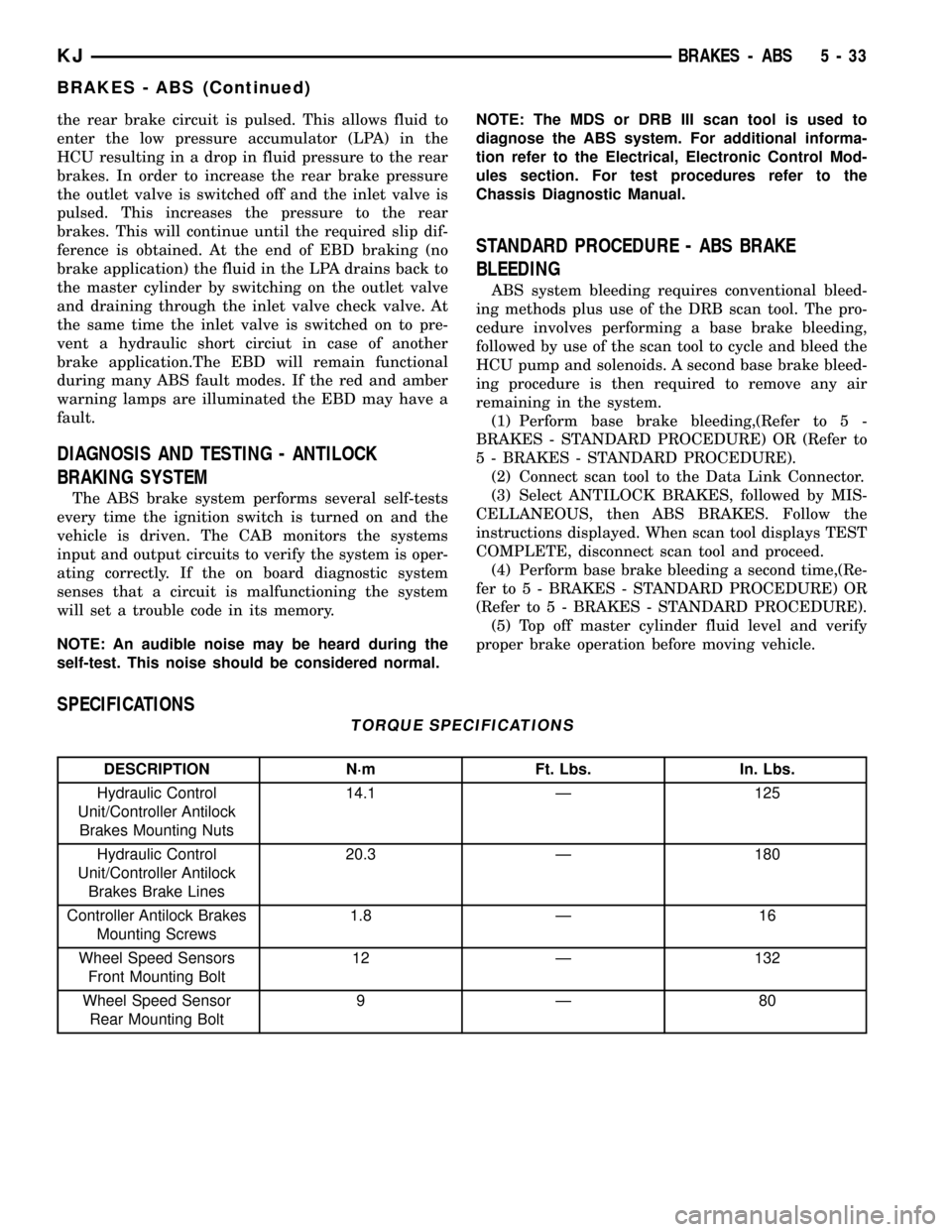
the rear brake circuit is pulsed. This allows fluid to
enter the low pressure accumulator (LPA) in the
HCU resulting in a drop in fluid pressure to the rear
brakes. In order to increase the rear brake pressure
the outlet valve is switched off and the inlet valve is
pulsed. This increases the pressure to the rear
brakes. This will continue until the required slip dif-
ference is obtained. At the end of EBD braking (no
brake application) the fluid in the LPA drains back to
the master cylinder by switching on the outlet valve
and draining through the inlet valve check valve. At
the same time the inlet valve is switched on to pre-
vent a hydraulic short circiut in case of another
brake application.The EBD will remain functional
during many ABS fault modes. If the red and amber
warning lamps are illuminated the EBD may have a
fault.
DIAGNOSIS AND TESTING - ANTILOCK
BRAKING SYSTEM
The ABS brake system performs several self-tests
every time the ignition switch is turned on and the
vehicle is driven. The CAB monitors the systems
input and output circuits to verify the system is oper-
ating correctly. If the on board diagnostic system
senses that a circuit is malfunctioning the system
will set a trouble code in its memory.
NOTE: An audible noise may be heard during the
self-test. This noise should be considered normal.NOTE: The MDS or DRB III scan tool is used to
diagnose the ABS system. For additional informa-
tion refer to the Electrical, Electronic Control Mod-
ules section. For test procedures refer to the
Chassis Diagnostic Manual.
STANDARD PROCEDURE - ABS BRAKE
BLEEDING
ABS system bleeding requires conventional bleed-
ing methods plus use of the DRB scan tool. The pro-
cedure involves performing a base brake bleeding,
followed by use of the scan tool to cycle and bleed the
HCU pump and solenoids. A second base brake bleed-
ing procedure is then required to remove any air
remaining in the system.
(1) Perform base brake bleeding,(Refer to 5 -
BRAKES - STANDARD PROCEDURE) OR (Refer to
5 - BRAKES - STANDARD PROCEDURE).
(2) Connect scan tool to the Data Link Connector.
(3) Select ANTILOCK BRAKES, followed by MIS-
CELLANEOUS, then ABS BRAKES. Follow the
instructions displayed. When scan tool displays TEST
COMPLETE, disconnect scan tool and proceed.
(4) Perform base brake bleeding a second time,(Re-
fer to 5 - BRAKES - STANDARD PROCEDURE) OR
(Refer to 5 - BRAKES - STANDARD PROCEDURE).
(5) Top off master cylinder fluid level and verify
proper brake operation before moving vehicle.
SPECIFICATIONS
TORQUE SPECIFICATIONS
DESCRIPTION N´m Ft. Lbs. In. Lbs.
Hydraulic Control
Unit/Controller Antilock
Brakes Mounting Nuts14.1 Ð 125
Hydraulic Control
Unit/Controller Antilock
Brakes Brake Lines20.3 Ð 180
Controller Antilock Brakes
Mounting Screws1.8 Ð 16
Wheel Speed Sensors
Front Mounting Bolt12 Ð 132
Wheel Speed Sensor
Rear Mounting Bolt9Ð80
KJBRAKES - ABS 5 - 33
BRAKES - ABS (Continued)
Page 199 of 1803

REAR WHEEL SPEED SENSOR
REMOVAL
(1) Raise vehicle on hoist.
(2) Disconnect the sensor wire harness.
(3) Remove mounting stud from the sensor (Fig. 2).
(4) Remove sensor.
INSTALLATION
(1) Connect harness to sensor.Be sure seal is
securely in place between sensor and wiring
connector.
(2) Install O-ring on sensor (if removed).
(3) Insert sensor in differential housing.
(4) Install the sensor mounting stud and tighten to
9 N´m (80 in. lbs.).
(5) Install the sensor electical connector.
(6) Lower vehicle.
HCU (HYDRAULIC CONTROL
UNIT)
DESCRIPTION
The HCU consists of a valve body, pump motor,
and wire harness.
OPERATION
Accumulators in the valve body store extra fluid
released to the system for ABS mode operation. The
pump provides the fluid volume needed and is oper-
ated by a DC type motor. The motor is controlled by
the CAB.The valves modulate brake pressure during
antilock braking and are controlled by the CAB.
The HCU provides three channel pressure control
to the front and rear brakes. One channel controls
the rear wheel brakes in tandem. The two remaining
channels control the front wheel brakes individually.
During antilock braking, the solenoid valves are
opened and closed as needed. The valves are not
static. They are cycled rapidly and continuously to
modulate pressure and control wheel slip and decel-
eration.
During normal braking, the HCU solenoid valves
and pump are not activated. The master cylinder and
power booster operate the same as a vehicle without
an ABS brake system.
During antilock braking, solenoid valve pressure
modulation occurs in three stages, pressure increase,
pressure hold, and pressure decrease. The valves are
all contained in the valve body portion of the HCU.
PRESSURE DECREASE
The outlet valve is opened and the inlet valve is
closed during the pressure decrease cycle.
A pressure decrease cycle is initiated when speed
sensor signals indicate high wheel slip at one or
more wheels. At this point, the CAB closes the inlet
then opens the outlet valve, which also opens the
return circuit to the accumulators. Fluid pressure is
allowed to bleed off (decrease) as needed to prevent
wheel lock.
Once the period of high wheel slip has ended, the
CAB closes the outlet valve and begins a pressure
increase or hold cycle as needed.
PRESSURE HOLD
Both solenoid valves are closed in the pressure
hold cycle. Fluid apply pressure in the control chan-
nel is maintained at a constant rate. The CAB main-
tains the hold cycle until sensor inputs indicate a
pressure change is necessary.
PRESSURE INCREASE
The inlet valve is open and the outlet valve is
closed during the pressure increase cycle. The pres-
sure increase cycle is used to counteract unequal
wheel speeds. This cycle controls re-application of
fluid apply pressure due to changing road surfaces or
wheel speed.
Fig. 2 REAR WHEEL SPEED SENSOR
1 - DIFFERENTIAL HOUSING
2 - MOUNTING BOLT
3 - WHEEL SPEED SENSOR
KJBRAKES - ABS 5 - 35
Page 227 of 1803

STANDARD PROCEDURE
STANDARD PROCEDURE - DRAINING COOLING
SYSTEM 3.7L ENGINE
WARNING: DO NOT REMOVE THE CYLINDER
BLOCK DRAIN PLUGS (Fig. 5) OR LOOSEN THE
RADIATOR DRAINCOCK WITH SYSTEM HOT AND
UNDER PRESSURE. SERIOUS BURNS FROM
COOLANT CAN OCCUR.
(1) DO NOT remove radiator cap first. With engine
cold, raise vehicle on a hoist and locate radiator
draincock.
NOTE: Radiator draincock is located on the left/
lower side of radiator facing to rear of vehicle.
(2) Attach one end of a hose to the draincock. Put
the other end into a clean container. Open draincock
and drain coolant from radiator. This will empty the
coolant reserve/overflow tank. The coolant does not
have to be removed from the tank unless the system
is being refilled with a fresh mixture. When tank is
empty, remove radiator cap and continue draining
cooling system.
STANDARD PROCEDURE - REFILLING
COOLING SYSTEM 3.7L ENGINE
(1) Tighten the radiator draincock and the cylinder
block drain plug(s) (if removed).CAUTION: Failure to purge air from the cooling sys-
tem can result in an overheating condition and
severe engine damage.
(2) .Fill system using a 50/50 mixture of ethylene-
glycol antifreeze and low mineral content water.Fill
pressure bottle to service line.and install cap.
NOTE: The engine cooling system will push any
remaining air into the coolant bottle within about an
hour of normal driving. As a result, a drop in cool-
ant level in the pressure bottle may occur. If the
engine cooling system overheats and pushes cool-
ant into the overflow side of the coolant bottle, this
coolant will be sucked back into the cooling system
ONLY IF THE PRESSURE CAP IS LEFT ON THE
BOTTLE. Removing the pressure cap breaks the
vacuum path between the two bottle sections and
the coolant will not return to cooling system.
(3) With heater control unit in the HEAT position,
operate engine with pressure bottle cap in place.
(4) Add coolant to pressure bottle as necessary.
Only add coolant to the pressure bottle when
the engine is cold. Coolant level in a warm
engine will be higher due to thermal expansion.
NOTE: The coolant bottle has two chambers. Cool-
ant will normally only be in the outboard (larger) of
the two. The inboard chamber is only to recover
coolant in the event of an overheat or after a recent
service fill. The inboard chamber should normally
be empty. If there is coolant in the overflow side of
the coolant bottle (after several warm/cold cycles of
the engine) and coolant level is above cold full
when cold, disconnect the end of the overflow hose
at the fill neck and lower it into a clean container.
Allow coolant to drain into the container until emp-
tied. Reconnect overflow hose to fill neck.
STANDARD PROCEDURE - COOLING SYSTEM -
REVERSE FLUSHING
CAUTION: The cooling system normally operates at
97-to-110 kPa (14-to -16 psi) pressure. Exceeding
this pressure may damage the radiator or hoses.
Reverse flushing of the cooling system is the forc-
ing of water through the cooling system. This is done
using air pressure in the opposite direction of normal
coolant flow. It is usually only necessary with very
dirty systems with evidence of partial plugging.
CHEMICAL CLEANING
If visual inspection indicates the formation of
sludge or scaly deposits, use a radiator cleaner
Fig. 5 Drain Plug - 3.7L Engine
1 - CYLINDER BLOCK DRAIN PLUG
2 - EXHAUST MANIFOLD AND HEAT SHIELD
7 - 12 COOLINGKJ
COOLING (Continued)
Page 228 of 1803
(Mopar Radiator Kleen or equivalent) before flushing.
This will soften scale and other deposits and aid the
flushing operation.
CAUTION: Be sure instructions on the container are
followed.
REVERSE FLUSHING RADIATOR
Disconnect the radiator hoses from the radiator fit-
tings. Attach a section of radiator hose to the radia-
tor bottom outlet fitting and insert the flushing gun.
Connect a water supply hose and air supply hose to
the flushing gun.
CAUTION: The cooling system normally operates at
97-to-110 kPa (14- to-16 psi) pressure. Exceeding
this pressure may damage the radiator or hoses.
Allow the radiator to fill with water. When radiator
is filled, apply air in short blasts allowing radiator to
refill between blasts. Continue this reverse flushing
until clean water flows out through rear of radiator
cooling tube passages. For more information, refer to
operating instructions supplied with flushing equip-
ment. Have radiator cleaned more extensively by a
radiator repair shop.
REVERSE FLUSHING ENGINE
Drain the cooling system (Refer to 7 - COOLING -
STANDARD PROCEDURE). Remove the thermostat
housing and thermostat. Install the thermostat hous-
ing. Disconnect the radiator upper hose from the
radiator and attach the flushing gun to the hose. Dis-
connect the radiator lower hose from the water
pump. Attach a lead away hose to the water pump
inlet fitting.
CAUTION: Be sure that the heater control valve is
closed (heat off). This is done to prevent coolant
flow with scale and other deposits from entering
the heater core.
Connect the water supply hose and air supply hose
to the flushing gun. Allow the engine to fill with
water. When the engine is filled, apply air in short
blasts, allowing the system to fill between air blasts.
Continue until clean water flows through the lead
away hose. For more information, refer to operating
instructions supplied with flushing equipment.
Remove the lead away hose, flushing gun, water
supply hose and air supply hose. Remove the thermo-
stat housing (Refer to 7 - COOLING/ENGINE/EN-
GINE COOLANT THERMOSTAT - REMOVAL).
Install the thermostat and housing with a replace-
ment gasket (Refer to 7 - COOLING/ENGINE/EN-
GINE COOLANT THERMOSTAT -INSTALLATION). Connect the radiator hoses. Refill
the cooling system with the correct antifreeze/water
mixture (Refer to 7 - COOLING - STANDARD PRO-
CEDURE).
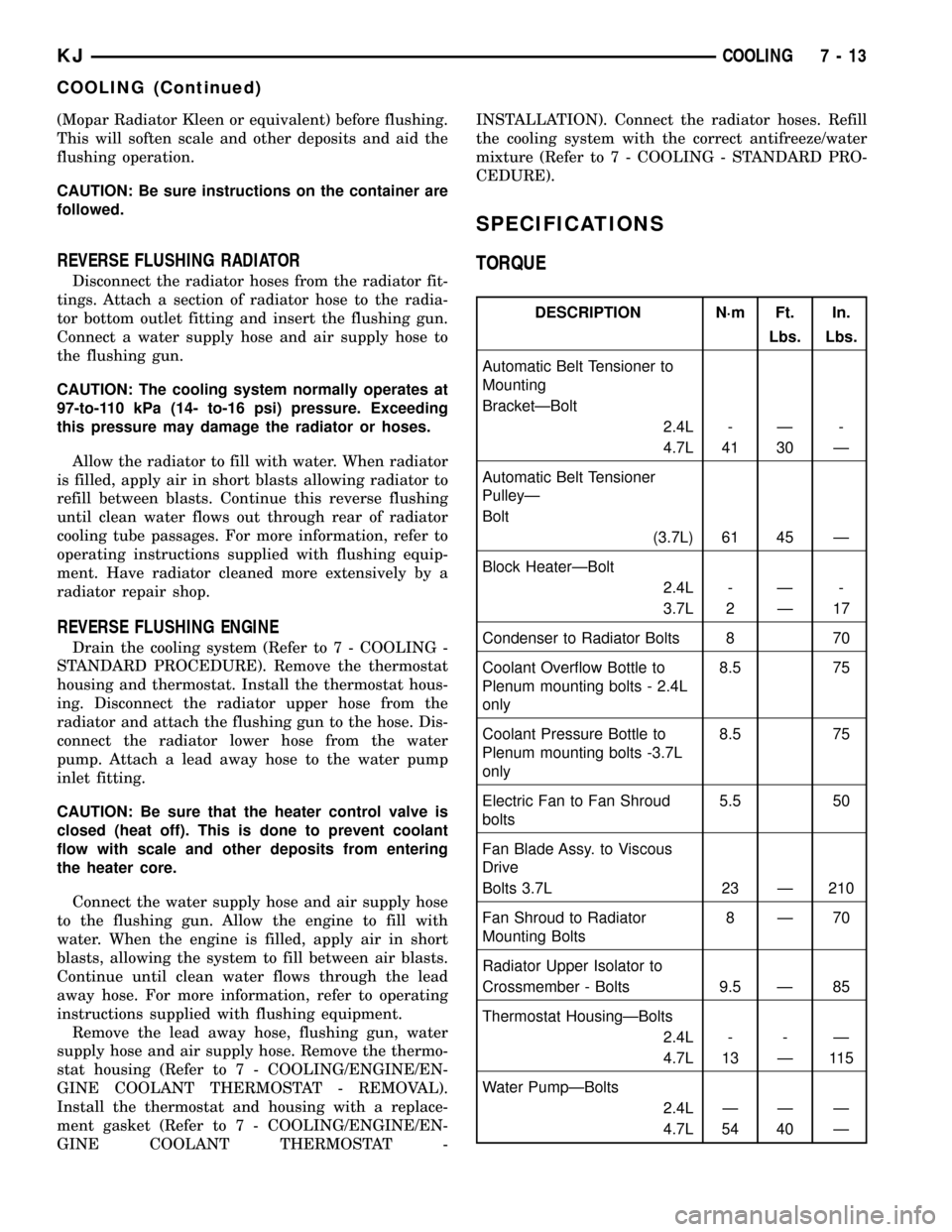
SPECIFICATIONS
TORQUE
DESCRIPTION N´m Ft. In.
Lbs. Lbs.
Automatic Belt Tensioner to
Mounting
BracketÐBolt
2.4L - Ð -
4.7L 41 30 Ð
Automatic Belt Tensioner
PulleyÐ
Bolt
(3.7L) 61 45 Ð
Block HeaterÐBolt
2.4L - Ð -
3.7L 2 Ð 17
Condenser to Radiator Bolts 8 70
Coolant Overflow Bottle to
Plenum mounting bolts - 2.4L
only8.5 75
Coolant Pressure Bottle to
Plenum mounting bolts -3.7L
only8.5 75
Electric Fan to Fan Shroud
bolts5.5 50
Fan Blade Assy. to Viscous
Drive
Bolts 3.7L 23 Ð 210
Fan Shroud to Radiator
Mounting Bolts8Ð70
Radiator Upper Isolator to
Crossmember - Bolts 9.5 Ð 85
Thermostat HousingÐBolts
2.4L - - Ð
4.7L 13 Ð 115
Water PumpÐBolts
2.4L Ð Ð Ð
4.7L 54 40 Ð
KJCOOLING 7 - 13
COOLING (Continued)
Page 244 of 1803

CAUTION: Do not remove water pump pulley-to-wa-
ter pump bolts. This pulley is under belt tension.
(8) Remove four bolts securing fan blade assembly
to viscous fan drive.
CLEANING
Clean the fan blades using a mild soap and water.
Do not use an abrasive to clean the blades.
INSPECTION
WARNING: DO NOT ATTEMPT TO BEND OR
STRAIGHTEN FAN BLADES IF FAN IS NOT WITHIN
SPECIFICATIONS.
CAUTION: If fan blade assembly is replaced
because of mechanical damage, water pump and
viscous fan drive should also be inspected. These
components could have been damaged due to
excessive vibration.
(1) Remove fan blade assembly from viscous fan
drive unit (four bolts).
(2) Lay fan on a flat surface with leading edge fac-
ing down. With tip of blade touching flat surface,
replace fan if clearance between opposite blade and
surface is greater than 2.0 mm (.090 inch). Rocking
motion of opposite blades should not exceed 2.0 mm
(.090 inch). Test all blades in this manner.
(3) Inspect fan assembly for cracks, bends, loose
rivets or broken welds. Replace fan if any damage is
found.
INSTALLATION
(1) Assemble fan blade to viscous fan drive.
Tighten mounting bolts to 27 N´m (20 ft. lbs.) torque.
NOTE: The vicous fan and fan shroud must be
installed as an assembly.
(2) Gently lay vicous fan into fan shroud.
(3) Install the fan shroud to radiator mounting
bolts, torque bolts to (5.5N´M or 50 in´lbs).
(4) Thread the fan and fan drive onto the water
pump pulley, and tighten nut using special tool 6958
spanner wrench and 8346 adapters.
(5) Connect the electrical connector for the electric
fan.
CAUTION: When installing a serpentine accessory
drive belt, the belt MUST be routed correctly. If not,
the engine may overheat due to the water pump
rotating in the wrong direction. (Refer to 7 - COOL-
ING/ACCESSORY DRIVE/DRIVE BELTS - REMOVAL)
for correct belt routing.
WATER PUMP
DESCRIPTION
DESCRIPTION - WATER PUMP
A centrifugal water pump circulates coolant
through the water jackets, passages, intake manifold,
radiator core, cooling system hoses and heater core.
The pump is driven from the engine crankshaft by a
single serpentine drive belt.
The water pump impeller is pressed onto the rear
of a shaft that rotates in bearings pressed into the
housing. The housing has two small holes to allow
seepage to escape. The water pump seals are lubri-
cated by the antifreeze in the coolant mixture. No
additional lubrication is necessary.
Both heater hoses are connected to fittings on the
timing chain front cover. The water pump is also
mounted directly to the timing chain cover and is
equipped with a non serviceable integral pulley (Fig.
17).
DESCRIPTION
The 3.7L engine uses an internal water/coolant
bypass system. The design uses galleries in the tim-
ing chain cover to circulate coolant during engine
warm-up preventing the coolant from flowing
Fig. 17 Water Pump and Timing Chain Cover
1 - INTEGRAL WATER PUMP PULLEY
2 - TIMING CHAIN COVER
3 - THERMOSTAT HOUSING
4 - HEATER HOSE FITTINGS
5 - WATER PUMP
KJENGINE 7 - 29
RADIATOR - FAN - VISCOUS (Continued)
Page 258 of 1803
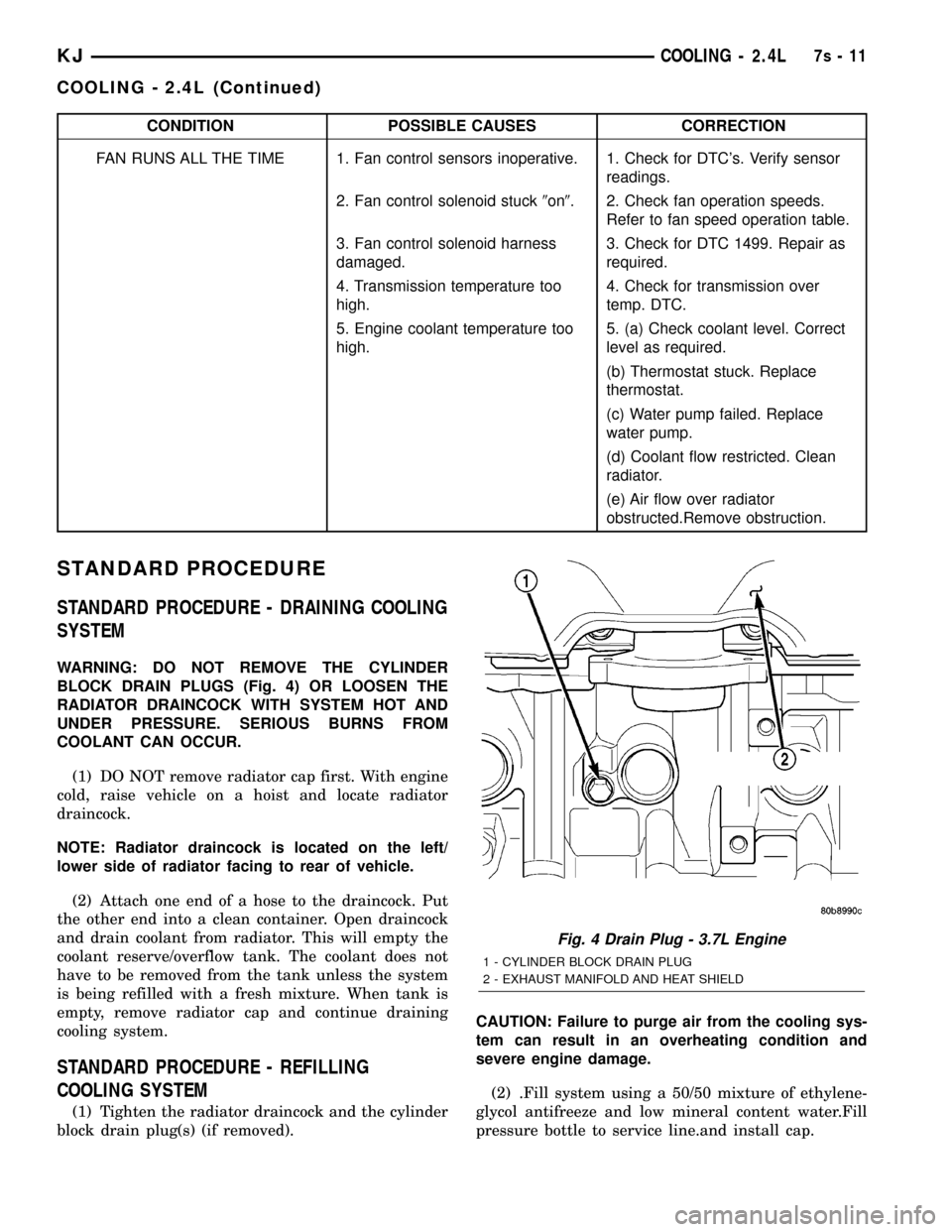
CONDITION POSSIBLE CAUSES CORRECTION
FAN RUNS ALL THE TIME 1. Fan control sensors inoperative. 1. Check for DTC's. Verify sensor
readings.
2. Fan control solenoid stuck9on9. 2. Check fan operation speeds.
Refer to fan speed operation table.
3. Fan control solenoid harness
damaged.3. Check for DTC 1499. Repair as
required.
4. Transmission temperature too
high.4. Check for transmission over
temp. DTC.
5. Engine coolant temperature too
high.5. (a) Check coolant level. Correct
level as required.
(b) Thermostat stuck. Replace
thermostat.
(c) Water pump failed. Replace
water pump.
(d) Coolant flow restricted. Clean
radiator.
(e) Air flow over radiator
obstructed.Remove obstruction.
STANDARD PROCEDURE
STANDARD PROCEDURE - DRAINING COOLING
SYSTEM
WARNING: DO NOT REMOVE THE CYLINDER
BLOCK DRAIN PLUGS (Fig. 4) OR LOOSEN THE
RADIATOR DRAINCOCK WITH SYSTEM HOT AND
UNDER PRESSURE. SERIOUS BURNS FROM
COOLANT CAN OCCUR.
(1) DO NOT remove radiator cap first. With engine
cold, raise vehicle on a hoist and locate radiator
draincock.
NOTE: Radiator draincock is located on the left/
lower side of radiator facing to rear of vehicle.
(2) Attach one end of a hose to the draincock. Put
the other end into a clean container. Open draincock
and drain coolant from radiator. This will empty the
coolant reserve/overflow tank. The coolant does not
have to be removed from the tank unless the system
is being refilled with a fresh mixture. When tank is
empty, remove radiator cap and continue draining
cooling system.
STANDARD PROCEDURE - REFILLING
COOLING SYSTEM
(1) Tighten the radiator draincock and the cylinder
block drain plug(s) (if removed).CAUTION: Failure to purge air from the cooling sys-
tem can result in an overheating condition and
severe engine damage.
(2) .Fill system using a 50/50 mixture of ethylene-
glycol antifreeze and low mineral content water.Fill
pressure bottle to service line.and install cap.
Fig. 4 Drain Plug - 3.7L Engine
1 - CYLINDER BLOCK DRAIN PLUG
2 - EXHAUST MANIFOLD AND HEAT SHIELD
KJCOOLING - 2.4L7s-11
COOLING - 2.4L (Continued)
Page 259 of 1803

NOTE: The engine cooling system will push any
remaining air into the coolant bottle within about an
hour of normal driving. As a result, a drop in cool-
ant level in the pressure bottle may occur. If the
engine cooling system overheats and pushes cool-
ant into the overflow side of the coolant bottle, this
coolant will be sucked back into the cooling system
ONLY IF THE PRESSURE CAP IS LEFT ON THE
BOTTLE. Removing the pressure cap breaks the
vacuum path between the two bottle sections and
the coolant will not return to cooling system.
(3) With heater control unit in the HEAT position,
operate engine with pressure bottle cap in place.
(4) Add coolant to pressure bottle as necessary.
Only add coolant to the pressure bottle when
the engine is cold. Coolant level in a warm
engine will be higher due to thermal expansion.
NOTE: The coolant bottle has two chambers. Cool-
ant will normally only be in the outboard (larger) of
the two. The inboard chamber is only to recover
coolant in the event of an overheat or after a recent
service fill. The inboard chamber should normally
be empty. If there is coolant in the overflow side of
the coolant bottle (after several warm/cold cycles of
the engine) and coolant level is above cold full
when cold, disconnect the end of the overflow hose
at the fill neck and lower it into a clean container.
Allow coolant to drain into the container until emp-
tied. Reconnect overflow hose to fill neck.
STANDARD PROCEDURE - COOLING SYSTEM -
REVERSE FLUSHING
CAUTION: The cooling system normally operates at
97-to-110 kPa (14-to -16 psi) pressure. Exceeding
this pressure may damage the radiator or hoses.
Reverse flushing of the cooling system is the forc-
ing of water through the cooling system. This is done
using air pressure in the opposite direction of normal
coolant flow. It is usually only necessary with very
dirty systems with evidence of partial plugging.
CHEMICAL CLEANING
If visual inspection indicates the formation of
sludge or scaly deposits, use a radiator cleaner
(Mopar Radiator Kleen or equivalent) before flushing.
This will soften scale and other deposits and aid the
flushing operation.
CAUTION: Be sure instructions on the container are
followed.
REVERSE FLUSHING RADIATOR
Disconnect the radiator hoses from the radiator fit-
tings. Attach a section of radiator hose to the radia-
tor bottom outlet fitting and insert the flushing gun.
Connect a water supply hose and air supply hose to
the flushing gun.
CAUTION: The cooling system normally operates at
97-to-110 kPa (14- to-16 psi) pressure. Exceeding
this pressure may damage the radiator or hoses.
Allow the radiator to fill with water. When radiator
is filled, apply air in short blasts allowing radiator to
refill between blasts. Continue this reverse flushing
until clean water flows out through rear of radiator
cooling tube passages. For more information, refer to
operating instructions supplied with flushing equip-
ment. Have radiator cleaned more extensively by a
radiator repair shop.
REVERSE FLUSHING ENGINE
Drain the cooling system (Refer to 7 - COOLING -
STANDARD PROCEDURE). Remove the thermostat
housing and thermostat. Install the thermostat hous-
ing. Disconnect the radiator upper hose from the
radiator and attach the flushing gun to the hose. Dis-
connect the radiator lower hose from the water
pump. Attach a lead away hose to the water pump
inlet fitting.
CAUTION: Be sure that the heater control valve is
closed (heat off). This is done to prevent coolant
flow with scale and other deposits from entering
the heater core.
Connect the water supply hose and air supply hose
to the flushing gun. Allow the engine to fill with
water. When the engine is filled, apply air in short
blasts, allowing the system to fill between air blasts.
Continue until clean water flows through the lead
away hose. For more information, refer to operating
instructions supplied with flushing equipment.
Remove the lead away hose, flushing gun, water
supply hose and air supply hose. Remove the thermo-
stat housing (Refer to 7 - COOLING/ENGINE/EN-
GINE COOLANT THERMOSTAT - REMOVAL).
Install the thermostat and housing with a replace-
ment gasket (Refer to 7 - COOLING/ENGINE/EN-
GINE COOLANT THERMOSTAT -
INSTALLATION). Connect the radiator hoses. Refill
the cooling system with the correct antifreeze/water
mixture (Refer to 7 - COOLING - STANDARD PRO-
CEDURE).
7s - 12 COOLING - 2.4LKJ
COOLING - 2.4L (Continued)