Ignition coil JEEP LIBERTY 2002 KJ / 1.G User Guide
[x] Cancel search | Manufacturer: JEEP, Model Year: 2002, Model line: LIBERTY, Model: JEEP LIBERTY 2002 KJ / 1.GPages: 1803, PDF Size: 62.3 MB
Page 390 of 1803
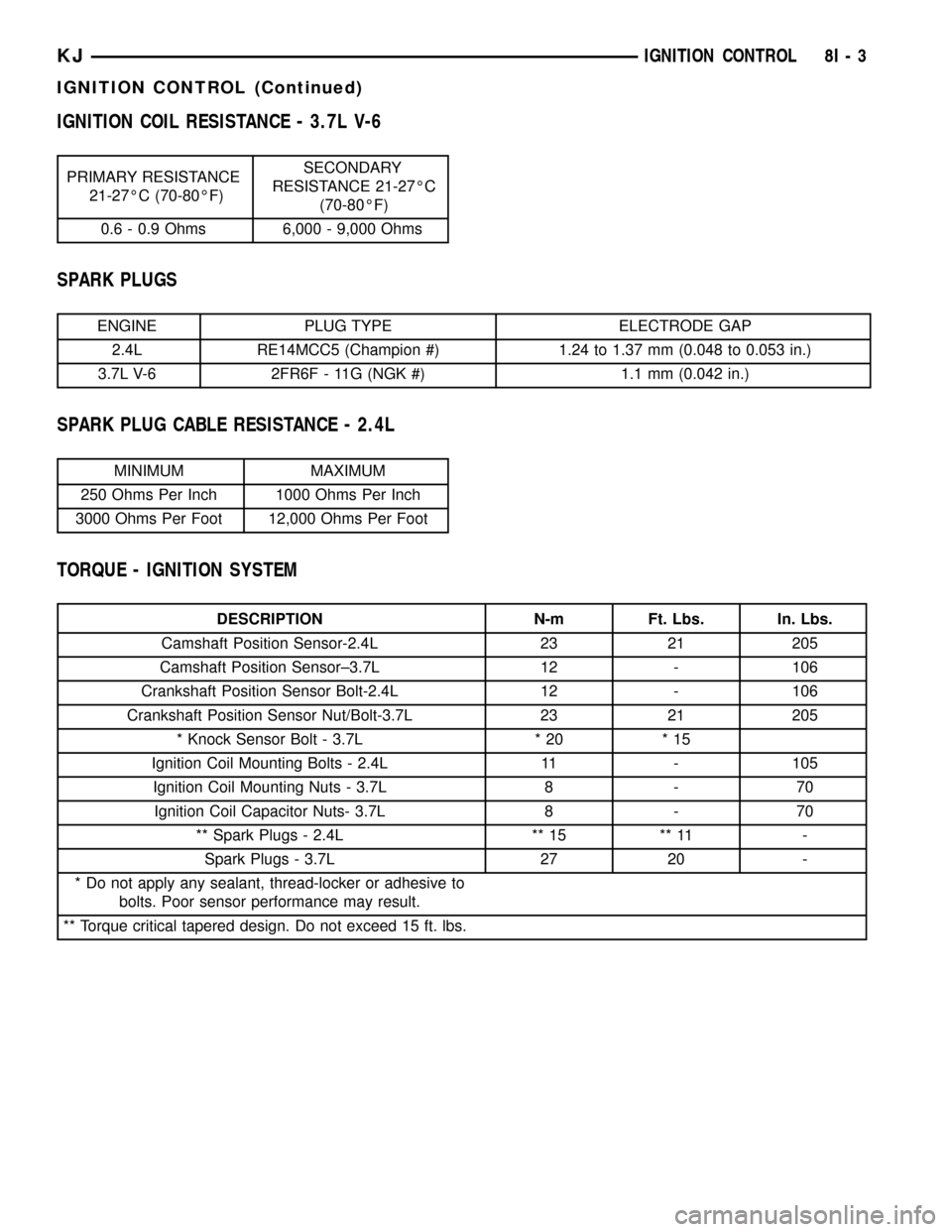
IGNITION COIL RESISTANCE - 3.7L V-6
PRIMARY RESISTANCE
21-27ÉC (70-80ÉF)SECONDARY
RESISTANCE 21-27ÉC
(70-80ÉF)
0.6 - 0.9 Ohms 6,000 - 9,000 Ohms
SPARK PLUGS
ENGINE PLUG TYPE ELECTRODE GAP
2.4L RE14MCC5 (Champion #) 1.24 to 1.37 mm (0.048 to 0.053 in.)
3.7L V-6 2FR6F - 11G (NGK #) 1.1 mm (0.042 in.)
SPARK PLUG CABLE RESISTANCE - 2.4L
MINIMUM MAXIMUM
250 Ohms Per Inch 1000 Ohms Per Inch
3000 Ohms Per Foot 12,000 Ohms Per Foot
TORQUE - IGNITION SYSTEM
DESCRIPTION N-m Ft. Lbs. In. Lbs.
Camshaft Position Sensor-2.4L 23 21 205
Camshaft Position Sensor±3.7L 12 - 106
Crankshaft Position Sensor Bolt-2.4L 12 - 106
Crankshaft Position Sensor Nut/Bolt-3.7L 23 21 205
* Knock Sensor Bolt - 3.7L * 20 * 15
Ignition Coil Mounting Bolts - 2.4L 11 - 105
Ignition Coil Mounting Nuts - 3.7L 8 - 70
Ignition Coil Capacitor Nuts- 3.7L 8 - 70
** Spark Plugs - 2.4L ** 15 ** 11 -
Spark Plugs - 3.7L 27 20 -
* Do not apply any sealant, thread-locker or adhesive to
bolts. Poor sensor performance may result.
** Torque critical tapered design. Do not exceed 15 ft. lbs.
KJIGNITION CONTROL 8I - 3
IGNITION CONTROL (Continued)
Page 391 of 1803

AUTO SHUT DOWN RELAY
DESCRIPTION - PCM OUTPUT
The 5±pin, 12±volt, Automatic Shutdown (ASD)
relay is located in the Power Distribution Center
(PDC). Refer to label on PDC cover for relay location.
OPERATION
OPERATION - ASD SENSE - PCM INPUT
A 12 volt signal at this input indicates to the PCM
that the ASD has been activated. The relay is used to
connect the oxygen sensor heater elements, oxygen
sensor heater relay, ignition coil and fuel injectors to
12 volt + power supply.
This input is used only to sense that the ASD relay
is energized. If the Powertrain Control Module
(PCM) does not see 12 volts at this input when the
ASD should be activated, it will set a Diagnostic
Trouble Code (DTC).
OPERATION - PCM OUTPUT
The ASD relay supplies battery voltage (12+ volts)
to the fuel injectors and ignition coil(s). With certain
emissions packages it also supplies 12±volts to the
oxygen sensor heating elements and the oxygen sen-
sor heater relay.
The ground circuit for the coil within the ASD
relay is controlled by the Powertrain Control Module
(PCM). The PCM operates the ASD relay by switch-
ing its ground circuit on and off.
The ASD relay will be shut±down, meaning the
12±volt power supply to the ASD relay will be de-ac-
tivated by the PCM if the ignition key is left in the
ON position. This is if the engine has not been run-
ning for approximately 1.8 seconds.
DIAGNOSIS AND TESTING - ASD AND FUEL
PUMP RELAYS
The following description of operation and
tests apply only to the Automatic Shutdown
(ASD) and fuel pump relays. The terminals on the
bottom of each relay are numbered. Two different
types of relays may be used, (Fig. 2) or (Fig. 3).
²Terminal number 30 is connected to battery volt-
age. For both the ASD and fuel pump relays, termi-
nal 30 is connected to battery voltage at all times.
²The PCM grounds the coil side of the relay
through terminal number 85.
²Terminal number 86 supplies voltage to the coil
side of the relay.
²When the PCM de-energizes the ASD and fuel
pump relays, terminal number 87A connects to termi-
nal 30. This is the Off position. In the off position,voltage is not supplied to the rest of the circuit. Ter-
minal 87A is the center terminal on the relay.
²When the PCM energizes the ASD and fuel
pump relays, terminal 87 connects to terminal 30.
This is the On position. Terminal 87 supplies voltage
to the rest of the circuit.
The following procedure applies to the ASD and
fuel pump relays.
(1) Remove relay from connector before testing.
(2) With the relay removed from the vehicle, use
an ohmmeter to check the resistance between termi-
nals 85 and 86. The resistance should be 75 ohms +/-
5 ohms.
(3) Connect the ohmmeter between terminals 30
and 87A. The ohmmeter should show continuity
between terminals 30 and 87A.
Fig. 2 TYPE 1 RELAY (ISO MICRO RELAY)
Fig. 3 ASD AND FUEL PUMP RELAY TERMINALSÐ
TYPE 2
TERMINAL LEGEND
NUMBER IDENTIFICATION
30 COMMON FEED
85 COIL GROUND
86 COIL BATTERY
87 NORMALLY OPEN
87A NORMALLY CLOSED
8I - 4 IGNITION CONTROLKJ
Page 396 of 1803

3.7L
The Camshaft Position Sensor (CMP) on the 3.7L
V-6 engine is bolted to the front/top of the right cyl-
inder head.
(1) Clean out machined hole in cylinder head.
(2) Apply a small amount of engine oil to sensor
o-ring.
(3) Install sensor into cylinder head with a slight
rocking and twisting action.
CAUTION: Before tightening sensor mounting bolt,
be sure sensor is completely flush to cylinder head.
If sensor is not flush, damage to sensor mounting
tang may result.
(4) Install mounting bolt and tighten. Refer to
torque specifications.
(5) Connect electrical connector to sensor.
IGNITION COIL
DESCRIPTION
2.4L
The coil assembly consists of 2 different coils
molded together. The assembly is mounted to the top
of the engine (Fig. 14).
3.7L
The 3.7L V-6 engine uses 6 dedicated, and individ-
ually fired coil for each spark plug (Fig. 15). Each
coil is mounted directly into the cylinder head and
onto the top of each spark plug (Fig. 16).
OPERATION
2.4L
The coil fires two spark plugs simultaneously. One
plug is under compression, the other plug fires on the
exhaust stroke (lost spark). Coil number one fires
Fig. 14 IGNITION COIL - 2.4L
1 - IGNITION COIL
2 - MOUNTING BOLTS (4)
Fig. 15 IGNITION COIL - 3.7L
1 - O-RING
2 - IGNITION COIL
3 - ELECTRICAL CONNECTOR
Fig. 16 IGNITION COIL LOCATION - 3.7L
1 - IGNITION COIL
2 - COIL MOUNTING NUT
KJIGNITION CONTROL 8I - 9
CAMSHAFT POSITION SENSOR (Continued)
Page 397 of 1803

cylinders 1 and 4, and coil number two fires cylinders
2 and 3.
The Auto Shutdown (ASD) relay provides battery
voltage to the ignition coil. The PCM provides a
ground contact (circuit) for energizing the coil(s). The
PCM will de-energize the ASD relay if it does not
receive the crankshaft position sensor and camshaft
position sensor inputs.
Base ignition timing is not adjustable.By con-
trolling the coil ground circuit, the PCM is able to set
the base timing and adjust the ignition timing
advance. This is done to meet changing engine oper-
ating conditions.
The ignition coil is not oil filled. The windings are
embedded in an epoxy compound. This provides heat
and vibration resistance that allows the ignition coil
to be mounted on the engine.
Spark plug cables (secondary wires or cables) are
used with the 2.4L engine.
3.7L
Battery voltage is supplied to the 6 ignition coils
from the ASD relay. The Powertrain Control Module
(PCM) opens and closes each ignition coil ground cir-
cuit at a determined time for ignition coil operation.
Base ignition timing is not adjustable.By con-
trolling the coil ground circuit, the PCM is able to set
the base timing and adjust the ignition timing
advance. This is done to meet changing engine oper-
ating conditions.
The ignition coil is not oil filled. The windings are
embedded in an epoxy compound. This provides heat
and vibration resistance that allows the ignition coil
to be mounted on the engine.
Because of coil design, spark plug cables (second-
ary cables) are not used with the 3.7L engine.
REMOVAL
2.4L
(1) Disconnect electrical connector at rear of coil.
(2) Remove all secondary cables from coil.
(3) Remove 4 coil mounting bolts (Fig. 17).
(4) Remove coil from vehicle.
3.7L
An individual ignition coil is used for each spark
plug (Fig. 19). The coil fits into machined holes in the
cylinder head. A mounting stud/nut secures each coil
to the top of the intake manifold (Fig. 18). The bot-
tom of the coil is equipped with a rubber boot to seal
the spark plug to the coil. Inside each rubber boot is
a spring. The spring is used for a mechanical contact
between the coil and the top of the spark plug. These
rubber boots and springs are a permanent part of the
coil and are not serviced separately. An o-ring (Fig.19) is used to seal the coil at the opening into the cyl-
inder head.
(1) Depending on which coil is being removed, the
throttle body air intake tube or intake box may need
to be removed to gain access to coil.
(2) Disconnect electrical connector from coil by
pushing downward on release lock on top of connec-
tor and pull connector from coil.
(3) Clean area at base of coil with compressed air
before removal.
(4) Remove coil mounting nut from mounting stud
(Fig. 18).
(5) Carefully pull up coil from cylinder head open-
ing with a slight twisting action.
(6) Remove coil from vehicle.
INSTALLATION
2.4L
(1) Position coil to engine.
(2) Install 4 mounting bolts. Refer to torque speci-
fications.
(3) Install secondary cables.
(4) Install electrical connector at rear of coil.
(5) Install air cleaner tube and housing.
3.7L
(1) Using compressed air, blow out any dirt or con-
taminants from around top of spark plug.
(2) Check condition of coil o-ring and replace as
necessary. To aid in coil installation, apply silicone to
coil o-ring.
Fig. 17 IGNITION COIL - 2.4L
1 - IGNITION COIL
2 - MOUNTING BOLTS (4)
8I - 10 IGNITION CONTROLKJ
IGNITION COIL (Continued)
Page 398 of 1803

(3) Position ignition coil into cylinder head opening
and push onto spark plug. Do this while guiding coil
base over mounting stud.
(4) Install coil mounting stud nut. Refer to torque
specifications.(5) Connect electrical connector to coil by snapping
into position.
(6) If necessary, install throttle body air tube or
box.
KNOCK SENSOR
DESCRIPTION
The 2 knock sensors are bolted into the cylinder
block under the intake manifold. The sensors are
used only with the 3.7L engine.
OPERATION
Two knock sensors are used on the 3.7L V-6
engine; one for each cylinder bank. When the knock
sensor detects a knock in one of the cylinders on the
corresponding bank, it sends an input signal to the
Powertrain Control Module (PCM). In response, the
PCM retards ignition timing for all cylinders by a
scheduled amount.
Knock sensors contain a piezoelectric material
which constantly vibrates and sends an input voltage
(signal) to the PCM while the engine operates. As the
intensity of the crystal's vibration increases, the
knock sensor output voltage also increases.
The voltage signal produced by the knock sensor
increases with the amplitude of vibration. The PCM
receives the knock sensor voltage signal as an input.
If the signal rises above a predetermined level, the
PCM will store that value in memory and retard
ignition timing to reduce engine knock. If the knock
sensor voltage exceeds a preset value, the PCM
retards ignition timing for all cylinders. It is not a
selective cylinder retard.
The PCM ignores knock sensor input during engine
idle conditions. Once the engine speed exceeds a
specified value, knock retard is allowed.
Knock retard uses its own short term and long
term memory program.
Long term memory stores previous detonation
information in its battery-backed RAM. The maxi-
mum authority that long term memory has over tim-
ing retard can be calibrated.
Short term memory is allowed to retard timing up
to a preset amount under all operating conditions (as
long as rpm is above the minimum rpm) except at
Wide Open Throttle (WOT). The PCM, using short
term memory, can respond quickly to retard timing
when engine knock is detected. Short term memory
is lost any time the ignition key is turned off.
Fig. 18 IGNITION COIL LOCATION - 3.7L
1 - IGNITION COIL
2 - COIL MOUNTING NUT
Fig. 19 IGNITION COIL - 3.7L
1 - O-RING
2 - IGNITION COIL
3 - ELECTRICAL CONNECTOR
KJIGNITION CONTROL 8I - 11
IGNITION COIL (Continued)
Page 402 of 1803

REMOVAL
2.4L
If spark plug for #2 or #3 cylinder is being
removed, throttle body must be removed. Refer to
Throttle Body Removal.
(1) Remove air cleaner tube and housing.
(2) Twist secondary cable at cylinder head to break
loose at spark plug. Remove cable from plug.
(3) Prior to removing spark plug, spray com-
pressed air into cylinder head opening. This will help
prevent foreign material from entering combustion
chamber.
(4) Remove spark plug from cylinder head using a
quality socket with a rubber or foam insert.
(5) Inspect spark plug condition. Refer to Spark
Plug Conditions.
3.7L
Each individual spark plug is located under each
ignition coil. Each individual ignition coil must be
removed to gain access to each spark plug. Refer to
Ignition Coil Removal/Installation.
(1) Prior to removing ignition coil, spray com-
pressed air around coil base at cylinder head.
(2) Prior to removing spark plug, spray com-
pressed air into cylinder head opening. This will help
prevent foreign material from entering combustion
chamber.
(3) Remove spark plug from cylinder head using a
quality socket with a rubber or foam insert. Also
check condition of ignition coil o-ring and replace as
necessary.
(4) Inspect spark plug condition. Refer to Spark
Plug Conditions.
CLEANING SPARK PLUGS
The plugs may be cleaned using commercially
available spark plug cleaning equipment. After clean-
ing, file the center electrode flat with a small point
file or jewelers file before adjusting gap.
CAUTION: Never use a motorized wire wheel brush
to clean the spark plugs. Metallic deposits will
remain on the spark plug insulator and will cause
plug misfire.
INSTALLATION
2.4L
CAUTION: Spark plug tightening on the 2.4L is
torque critical. The plugs are equipped with tapered
seats. Do not exceed 15 ft. lbs. torque.
Special care should be taken when installing spark
plugs into the cylinder head spark plug wells. Be
sure the plugs do not drop into the plug wells as elec-
trodes can be damaged.
Always tighten spark plugs to the specified torque.
Over tightening can cause distortion resulting in a
change in the spark plug gap or a cracked porcelain
insulator.
(1) Start the spark plug into the cylinder head by
hand to avoid cross threading.
(2) Tighten spark plugs. Refer to torque specifica-
tions.
(3) Install throttle body. Refer to Throttle Body
Installation.
(4) Install air cleaner tube and housing.
3.7L
Special care should be taken when installing spark
plugs into the cylinder head spark plug wells. Be
Fig. 26 Preignition Damage
1 - GROUND ELECTRODE STARTING TO DISSOLVE
2 - CENTER ELECTRODE DISSOLVED
Fig. 27 Spark Plug Overheating
1 - BLISTERED WHITE OR GRAY COLORED INSULATOR
KJIGNITION CONTROL 8I - 15
SPARK PLUG (Continued)
Page 403 of 1803

sure the plugs do not drop into the plug wells as elec-
trodes can be damaged.
Always tighten spark plugs to the specified torque.
Over tightening can cause distortion resulting in a
change in the spark plug gap or a cracked porcelain
insulator.
(1) Start the spark plug into the cylinder head by
hand to avoid cross threading.
(2) Tighten spark plugs. Refer to torque specifica-
tions.
(3) Before installing coil(s), check condition of coil
o-ring and replace as necessary. To aid in coil instal-
lation, apply silicone to coil o-ring.
(4) Install ignition coil(s). Refer to Ignition Coil
Removal/Installation.
IGNITION COIL CAPACITOR
DESCRIPTION
One coil capacitor is used. It is located in the
engine compartment and attached (clipped) to a wir-
ing trough near the brake power booster.
OPERATION
The coil capacitor(s) help dampen the amount of
conducted electrical noise to the camshaft position
sensor, crankshaft position sensor, and throttle posi-
tion sensor. This noise is generated on the 12V sup-
ply wire to the ignition coils and fuel injectors.
REMOVAL
The coil capacitor is located in the engine compart-
ment and is attached (clipped) to a wiring harness
trough near the brake power booster (graphic not
available).
(1) Unclip capacitor from wiring harness trough.
(2) Disconnect electrical connector at capacitor.
INSTALLATION
(1) Connect electrical connector to coil capacitor.
(2) Position capacitor into v-clip on wiring harness
trough.
8I - 16 IGNITION CONTROLKJ
SPARK PLUG (Continued)
Page 408 of 1803

gauge readings during normal operation that are con-
sistent with customer expectations. However, when
abnormal conditions exist such as high coolant tem-
perature, the algorithm can drive the gauge pointer
to an extreme position and the microprocessor can
sound a chime through the on-board chime tone gen-
erator to provide distinct visual and audible indica-
tions of a problem to the vehicle operator. The
instrument cluster circuitry may also perform chime
service for other electronic modules in the vehicle
based upon electronic chime tone request messages
received over the PCI data bus to provide the vehicle
operator with an audible alert to supplement a visual
indication. One such alert is a door ajar warning
chime, which the EMIC provides by monitoring PCI
bus messages from the Body Control Module (BCM).
The EMIC circuitry operates on battery current
received through a fused B(+) fuse in the Junction
Block (JB) on a non-switched fused B(+) circuit, and
on battery current received through a fused ignition
switch output (run-start) fuse in the JB on a fused
ignition switch output (run-start) circuit. This
arrangement allows the EMIC to provide some fea-
tures regardless of the ignition switch position, while
other features will operate only with the ignition
switch in the On or Start positions. The EMIC
receives a ground input from the BCM as a wake-up
signal in order to provide the ignition-off features.
The EMIC circuitry is grounded through a ground
circuit and take out of the instrument panel wire
harness with an eyelet terminal connector that is
secured by a nut to a ground stud located on the left
instrument panel end bracket.
The EMIC also has a self-diagnostic actuator test
capability, which will test each of the PCI bus mes-
sage-controlled functions of the cluster by lighting
the appropriate indicators (except the airbag indica-
tor), sweeping the gauge needles to several calibra-
tion points across the gauge faces, and stepping the
odometer display sequentially from all ones through
all nines. (Refer to 8 - ELECTRICAL/INSTRUMENT
CLUSTER - DIAGNOSIS AND TESTING). See the
owner's manual in the vehicle glove box for more
information on the features, use and operation of the
EMIC.
GAUGES All gauges receive battery current
through the EMIC circuitry when the ignition switch
is in the On or Start positions. With the ignition
switch in the Off position battery current is not sup-
plied to any gauges, and the EMIC circuitry is pro-
grammed to move all of the gauge needles back to
the low end of their respective scales. Therefore, the
gauges do not accurately indicate any vehicle condi-
tion unless the ignition switch is in the On or Start
positions. All of the EMIC gauges, except the odome-
ter, are air core magnetic units. Two fixed electro-magnetic coils are located within each gauge. These
coils are wrapped at right angles to each other
around a movable permanent magnet. The movable
magnet is suspended within the coils on one end of a
pivot shaft, while the gauge needle is attached to the
other end of the shaft. One of the coils has a fixed
current flowing through it to maintain a constant
magnetic field strength. Current flow through the
second coil changes, which causes changes in its
magnetic field strength. The current flowing through
the second coil is changed by the EMIC circuitry in
response to messages received over the PCI data bus.
The gauge needle moves as the movable permanent
magnet aligns itself to the changing magnetic fields
created around it by the electromagnets.
The gauges are diagnosed using the EMIC self-di-
agnostic actuator test. (Refer to 8 - ELECTRICAL/
INSTRUMENT CLUSTER - DIAGNOSIS AND
TESTING). Proper testing of the PCI data bus and
the electronic data bus message inputs to the EMIC
that control each gauge require the use of a DRBIIIt
scan tool. Refer to the appropriate diagnostic infor-
mation. Specific operation details for each gauge may
be found elsewhere in this service information.
VACUUM-FLUORESCENT DISPLAY The Vacu-
um-Fluorescent Display (VFD) module is soldered to
the EMIC circuit board. The display is active when
the driver door is opened with the ignition switch in
the Off or Accessory positions (Rental Car mode), and
with the ignition switch in the On or Start positions.
The VFD is inactive when the ignition switch is in
the Off or Accessory positions and the driver door is
closed. The illumination intensity of the VFD is con-
trolled by the EMIC circuitry based upon electronic
dimming level messages received from the BCM over
the PCI data bus, and is synchronized with the illu-
mination intensity of other VFDs in the vehicle. The
BCM provides dimming level messages based upon
internal programming and inputs it receives from the
control knob and control ring on the left (lighting)
control stalk of the multi-function switch on the
steering column.
The VFD has several display capabilities including
odometer, trip odometer, and warning messages
whenever the appropriate conditions exist. The VFD
warning messages include:
²ªdoorº- indicating a door is ajar.
²ªgateº- indicating the tailgate is ajar.
²ªglassº- indicating the tailgate glass is ajar.
²ªlowashº- indicating that the washer fluid
level is low.
²ªno busº- indicating there is no PCI data bus
communication detected.
An odometer/trip odometer switch on the EMIC cir-
cuit board is used to control the display modes. This
switch is actuated manually by depressing the odom-
KJINSTRUMENT CLUSTER 8J - 5
INSTRUMENT CLUSTER (Continued)
Page 447 of 1803

DRL relay is energized, it provides battery current
from a fused B(+) fuse in the JB to the headlamp
high beam filament through the DRL relay output
circuit.
FRONT FOG LAMPS
Vehicles equipped with optional front fog lamps
have a premium Body Control Module (BCM), a front
fog lamp relay installed in the Junction Block (JB),
and a front fog lamp switch integral to the left (light-
ing) control stalk of the multi-function switch. The
front fog lamps have a path to ground at all times
through their connection to the front fascia wire har-
ness from two take outs of the headlamp and dash
wire harness with eyelet terminal connectors that
are secured by ground screws to the left inner fender
shield in the engine compartment. The BCM controls
front fog lamp operation by monitoring the exterior
lighting switch input from the multi-function switch,
then energizing or de-energizing the front fog lamp
relay control coil; and, by sending the appropriate
electronic message to the instrument cluster over the
Programmable Communications Interface (PCI) data
bus to turn the front fog lamp indicator on or off.
When the front fog lamp relay is energized, it pro-
vides battery current from a fused B(+) fuse in the
JB to the front fog lamps through the front fog lamp
relay output circuit. The BCM provides a battery
saver (load shedding) feature for the front fog lamps,
which will turn these lamps off if they are left on for
more than about eight minutes with the ignition
switch in the Off position. In certain markets where
required, the front fog lamps are also turned off by
the BCM whenever the headlamp high beams are
selected. Each front fog lamp includes an integral
adjustment screw to be used for static aiming the fog
lamp beams.
HAZARD WARNING LAMPS
With the hazard switch in the On position, the
hazard warning system is activated causing the haz-
ard switch button illumination lamp, the right and
left turn signal indicators, and the right and left turn
signal lamps to flash on and off. When the hazard
warning system is activated, the circuitry within the
hazard switch and electronic combination flasher
unit will repeatedly energize and de-energize two
internal relays that switch battery current from a
fused B(+) fuse in the Junction Block (JB) to the
right side and left side turn signal indicators, and
turn signal lamps through the right and left turn sig-
nal circuits. The flashing of the hazard switch button
illumination lamp is performed internally by the haz-
ard switch and combination flasher unit circuit
board. The hazard warning lamps can also be ener-
gized by the Body Control Module (BCM) through ahazard lamp control circuit input to the hazard
switch and combination flasher unit.
HEADLAMPS
The headlamp system includes the Body Control
Module (BCM), a low beam relay installed in the
Junction Block (JB), a high beam relay installed in
the JB (except Canada), a solid state Daytime Run-
ning Lamps (DRL) relay installed in the JB (Canada
only), and the exterior lighting (headlamp and dim-
mer) switches integral to the left (lighting) control
stalk of the multi-function switch. The headlamp
bulbs have a path to ground at all times through
their connection to the grille opening reinforcement
wire harness from two take outs of the headlamp and
dash wire harness with eyelet terminal connectors
that are secured by ground screws to the left inner
fender shield in the engine compartment. The BCM
controls the headlamp operation by monitoring the
exterior lighting switch inputs from the multi-func-
tion switch, then energizing or de-energizing the con-
trol coils of the low beam relay, the high beam relay,
or the solid state circuitry of the DRL relay; and, by
sending the appropriate electronic message to the
instrument cluster over the Programmable Commu-
nications Interface (PCI) data bus to turn the high
beam indicator on or off. When each respective relay
is energized, it provides battery current from a fused
B(+) fuse in the Power Distribution Center (PDC)
through a relay (low beam, high beam, or DRL) out-
put circuit and four separate fuses in the JB through
individual fused right and left, low and high beam
output circuits to the appropriate headlamp bulb fil-
aments. The BCM provides a battery saver (load
shedding) feature for the headlamps, which will turn
these lamps off if they are left on for more than
about eight minutes with the ignition switch in the
Off position; and, a headlamp delay feature with a
DRBIIItscan tool programmable delay interval.
Each headlamp includes an integral adjustment
screw to be used for static aiming of the headlamp
beams.
HEADLAMP LEVELING
In certain markets where required, a headlamp
leveling system is provided on the vehicle. The head-
lamp leveling system includes unique headlamp units
equipped with a headlamp leveling actuator motor,
and a rotary thumbwheel actuated headlamp leveling
switch on the instrument panel. The headlamp level-
ing system allows the headlamp beams to be
adjusted to one of four vertical positions to compen-
sate for changes in inclination caused by the loading
of the vehicle suspension. The actuator motors are
mechanically connected through an integral pushrod
to an adjustable headlamp reflector. The headlamp
8L - 6 LAMPS/LIGHTING - EXTERIORKJ
LAMPS/LIGHTING - EXTERIOR (Continued)
Page 448 of 1803

leveling switch is a resistor multiplexed unit that
provides one of four voltage outputs to the headlamp
leveling motors. The headlamp leveling motors will
move the headlamps to the selected position based
upon the voltage input received from the switch. The
headlamp leveling motors and switch have a path to
ground at all times. The headlamp leveling compo-
nents operate on battery current received through
the fused park lamp relay output circuit so that the
system will only operate when the exterior lighting is
turned on.
PARK LAMPS
The park lamps system includes the Body Control
Module (BCM), a park lamp relay installed in the
Junction Block (JB), and the exterior lighting switch
integral to the left (lighting) control stalk of the
multi-function switch. The front park lamp and side
marker or, if equipped, the front position lamp bulbs
each have a path to ground at all times through their
connections to the grille opening reinforcement wire
harness from two take outs of the headlamp and
dash wire harness with eyelet terminal connectors
that are secured by ground screws to the left inner
fender shield in the engine compartment. The rear
park lamp bulbs and license plate lamp have a path
to ground at all times through their connection to the
rear lighting wire harness from a take out of the rear
body wire harness with an eyelet terminal connector
that is secured by a ground screw to the base of the
right D-pillar behind the quarter trim panel. The
BCM controls the park lamp operation by monitoring
the exterior lighting switch inputs from the multi-
function switch, then energizing or de-energizing the
control coil of the park lamp relay. When the park
lamp relay is energized, it provides battery current
from a fused B(+) fuse in the Power Distribution
Center (PDC) through a park lamp relay output cir-
cuit and a separate fuse in the JB through a fused
park lamp relay output circuit to the appropriate
lamp bulb filaments. The BCM provides a battery
saver (load shedding) feature for the park lamps,
which will turn these lamps off if they are left on for
more than about eight minutes with the ignition
switch in the Off position.
REAR FOG LAMPS
Rear fog lamps are installed on vehicles manufac-
tured for certain markets where they are required.
The rear fog lamp system includes a premium Body
Control Module (BCM), a rear fog lamp relay
installed in the Junction Block (JB), and a rear fog
lamp switch integral to the left (lighting) control
stalk of the multi-function switch. The rear fog lamps
have a path to ground at all times through their con-
nection to the rear lighting wire harness from a takeout of the rear body wire harness with an eyelet ter-
minal connector that is secured by a ground screw to
the base of the right D-pillar behind the quarter trim
panel. The BCM controls rear fog lamp operation by
monitoring the exterior lighting switch input from
the multi-function switch, then energizing or de-ener-
gizing the rear fog lamp relay control coil; and, by
sending the appropriate electronic message to the
instrument cluster over the Programmable Commu-
nications Interface (PCI) data bus to turn the rear
fog lamp indicator on or off. When the rear fog lamp
relay is energized, it provides battery current from a
fused B(+) fuse in the JB to the rear fog lamps
through the rear fog lamp relay output circuit. The
BCM provides a battery saver (load shedding) feature
for the rear fog lamps, which will turn these lamps
off if they are left on for more than about eight min-
utes with the ignition switch in the Off position.
TURN SIGNAL LAMPS
When the left control stalk of the multi-function
switch is moved up (right turn) or down (left turn),
the turn signal system is activated causing the
selected right or left turn signal indicator, and right
or left turn signal lamps to flash on and off. When
the turn signal system is activated, the circuitry
within the turn signal switch and the hazard switch/
electronic combination flasher unit will repeatedly
energize and de-energize one of two internal relays
that switch battery current from a fused ignition
switch output (run) fuse in the Junction Block (JB) to
the right side or left side turn signal indicators and
turn signal lamps through the right or left turn sig-
nal circuits. The ElectroMechanical Instrument Clus-
ter (EMIC) chime tone generator will generate an
audible turn signal cancel warning each time the
vehicle is driven for a distance of about 3.2 kilome-
ters (about two miles) with a turn signal indicator
flashing. The EMIC uses Programmable Communica-
tions Interface (PCI) data bus distance messages
from the Powertrain Control Module (PCM) and a
hard wired input from the turn signal switch cir-
cuitry of the multi-function switch to determine when
to sound the turn signal cancel warning.
DIAGNOSIS AND TESTING - LAMPS/LIGHTING
- EXTERIOR
The hard wired circuits and components of the
exterior lighting systems may be diagnosed and
tested using conventional diagnostic tools and proce-
dures. However, conventional diagnostic methods
may not prove conclusive in the diagnosis of the Body
Control Module (BCM), the ElectroMechanical
Instrument Cluster (EMIC), the Powertrain Control
Module (PCM), or the Programmable Communica-
tions Interface (PCI) data bus network. The most
KJLAMPS/LIGHTING - EXTERIOR 8L - 7
LAMPS/LIGHTING - EXTERIOR (Continued)