The JEEP LIBERTY 2002 KJ / 1.G User Guide
[x] Cancel search | Manufacturer: JEEP, Model Year: 2002, Model line: LIBERTY, Model: JEEP LIBERTY 2002 KJ / 1.GPages: 1803, PDF Size: 62.3 MB
Page 14 of 1803

API QUALITY CLASSIFICATION
This symbol (Fig. 2) on the front of an oil container
means that the oil has been certified by the Ameri-
can Petroleum Institute (API) to meet all the lubri-
cation requirements specified by DaimlerChrysler
Corporation.
GEAR LUBRICANTS
SAE ratings also apply to multigrade gear lubri-
cants. In addition, API classification defines the
lubricants usage. Such as API GL-5 and SAE 75W-
90.
LUBRICANTS AND GREASES
Lubricating grease is rated for quality and usage
by the NLGI. All approved products have the NLGI
symbol (Fig. 3) on the label. At the bottom NLGI
symbol is the usage and quality identification letters.
Wheel bearing lubricant is identified by the letter
ªGº. Chassis lubricant is identified by the latter ªLº.
The letter following the usage letter indicates the
quality of the lubricant. The following symbols indi-
cate the highest quality.
SPECIALIZED LUBRICANTS AND OILS
Some maintenance or repair procedures may
require the use of specialized lubricants or oils. Con-
sult the appropriate sections in this manual for the
correct application of these lubricants.
DESCRIPTION - AXLE
A multi-purpose, hypoid gear lubricant which con-
forms to MIL-L-2105C and API GL 5 quality specifi-
cations should be used. Mopar Hypoid Gear
Lubricants conforms to these specifications.
FRONT AXLE
²Lubricant for 186FIA (Model 30) axle is SAE
75W-140 SYNTHETIC.
REAR AXLE
²Lubricant for 198RBI (Model 35) axle is SAE
75W-140 SYNTHETIC.
²Lubricant for 8 1/4 axle is a thermally stable
SAE 75W-90. For trailer tow or heavy duty applica-
tions the lubricant should be replaced with SAE
75W-140 SYNTHETIC.
NOTE: Trac-lokTequipped axles require a friction
modifier be added to the lubricant.
CAUTION: If axle is submerged in water, lubricant
must be replaced immediately to avoid possible
premature axle failure.
DESCRIPTION - MANUAL TRANSMISSION
Mopartmanual transmission fluid is the lubricant
recommended for the NV1500 and the NV3550 trans-
missions.
DESCRIPTION - AUTOMATIC TRANSMISSION
FLUID
NOTE: Refer to the maintenance schedules in this
group for the recommended maintenance (fluid/filter
change) intervals for this transmission.
NOTE: Refer to Service Procedures in this group for
fluid level checking procedures.
MopartATF +4, type 9602, Automatic Transmis-
sion Fluid is the recommended fluid for
DaimlerChrysler automatic transmissions.
Dexron II fluid IS NOT recommended. Clutch
chatter can result from the use of improper
fluid.
MopartATF +4, type 9602, Automatic Transmis-
sion Fluid when new is red in color. The ATF is dyed
red so it can be identified from other fluids used in
the vehicle such as engine oil or antifreeze. The red
color is not permanent and is not an indicator of fluid
condition. As the vehicle is driven, the ATF will begin
to look darker in color and may eventually become
brown.This is normal.ATF+4 also has a unique
Fig. 2 API Symbol
Fig. 3 NLGI Symbol
1 - WHEEL BEARINGS
2 - CHASSIS LUBRICATION
3 - CHASSIS AND WHEEL BEARINGS
0 - 2 LUBRICATION & MAINTENANCEKJ
FLUID TYPES (Continued)
Page 15 of 1803

odor that may change with age. Consequently, odor
and color cannot be used to indicate the fluid condi-
tion or the need for a fluid change.
FLUID ADDITIVES
DaimlerChrysler strongly recommends against the
addition of any fluids to the transmission, other than
those automatic transmission fluids listed above.
Exceptions to this policy are the use of special dyes
to aid in detecting fluid leaks.
Various ªspecialº additives and supplements exist
that claim to improve shift feel and/or quality. These
additives and others also claim to improve converter
clutch operation and inhibit overheating, oxidation,
varnish, and sludge. These claims have not been sup-
ported to the satisfaction of DaimlerChrysler and
these additivesmust not be used.The use of trans-
mission ªsealersº should also be avoided, since they
may adversely affect the integrity of transmission
seals.
DESCRIPTION - TRANSFER CASE - NV231
Recommended lubricant for the NV231 transfer
case is MopartATF +4, type 9602, Automatic Trans-
mission Fluid.
DESCRIPTION - TRANSFER CASE - NV242
Recommended lubricant for the NV242 transfer
case is MopartATF+4, type 9602 Automatic Trans-
mission Fluid.
DESCRIPTION - ENGINE COOLANT
WARNING: ANTIFREEZE IS AN ETHYLENE GLYCOL
BASE COOLANT AND IS HARMFUL IF SWAL-
LOWED OR INHALED. IF SWALLOWED, DRINK
TWO GLASSES OF WATER AND INDUCE VOMIT-
ING. IF INHALED, MOVE TO FRESH AIR AREA.
SEEK MEDICAL ATTENTION IMMEDIATELY. DO NOT
STORE IN OPEN OR UNMARKED CONTAINERS.
WASH SKIN AND CLOTHING THOROUGHLY AFTER
COMING IN CONTACT WITH ETHYLENE GLYCOL.
KEEP OUT OF REACH OF CHILDREN. DISPOSE OF
GLYCOL BASE COOLANT PROPERLY, CONTACT
YOUR DEALER OR GOVERNMENT AGENCY FOR
LOCATION OF COLLECTION CENTER IN YOUR
AREA. DO NOT OPEN A COOLING SYSTEM WHEN
THE ENGINE IS AT OPERATING TEMPERATURE OR
HOT UNDER PRESSURE, PERSONAL INJURY CAN
RESULT. AVOID RADIATOR COOLING FAN WHEN
ENGINE COMPARTMENT RELATED SERVICE IS
PERFORMED, PERSONAL INJURY CAN RESULT.
CAUTION: Use of Propylene Glycol based coolants
is not recommended, as they provide less freeze
protection and less corrosion protection.The cooling system is designed around the coolant.
The coolant must accept heat from engine metal, in
the cylinder head area near the exhaust valves and
engine block. Then coolant carries the heat to the
radiator where the tube/fin radiator can transfer the
heat to the air.
The use of aluminum cylinder blocks, cylinder
heads, and water pumps requires special corrosion
protection. MopartAntifreeze/Coolant, 5
Year/100,000 Mile Formula (MS-9769), or the equiva-
lent ethylene glycol base coolant with organic corro-
sion inhibitors (called HOAT, for Hybrid Organic
Additive Technology) is recommended. This coolant
offers the best engine cooling without corrosion when
mixed with 50% Ethylene Glycol and 50% distilled
water to obtain a freeze point of -37ÉC (-35ÉF). If it
loses color or becomes contaminated, drain, flush,
and replace with fresh properly mixed coolant solu-
tion.
CAUTION: MoparTAntifreeze/Coolant, 5
Year/100,000 Mile Formula (MS-9769) may not be
mixed with any other type of antifreeze. Mixing of
coolants other than specified (non-HOAT or other
HOAT), may result in engine damage that may not
be covered under the new vehicle warranty, and
decreased corrosion protection.
COOLANT PERFORMANCE
The required ethylene-glycol (antifreeze) and water
mixture depends upon climate and vehicle operating
conditions. The coolant performance of various mix-
tures follows:
Pure Water-Water can absorb more heat than a
mixture of water and ethylene-glycol. This is for pur-
pose of heat transfer only. Water also freezes at a
higher temperature and allows corrosion.
100 percent Ethylene-Glycol-The corrosion
inhibiting additives in ethylene-glycol need the pres-
ence of water to dissolve. Without water, additives
form deposits in system. These act as insulation
causing temperature to rise to as high as 149ÉC
(300ÉF). This temperature is hot enough to melt plas-
tic and soften solder. The increased temperature can
result in engine detonation. In addition, 100 percent
ethylene-glycol freezes at -22ÉC (-8ÉF).
50/50 Ethylene-Glycol and Water-Is the recom-
mended mixture, it provides protection against freez-
ing to -37ÉC (-34ÉF). The antifreeze concentration
must alwaysbe a minimum of 44 percent, year-
round in all climates. If percentage is lower, engine
parts may be eroded by cavitation. Maximum protec-
tion against freezing is provided with a 68 percent
antifreeze concentration, which prevents freezing
down to -67.7ÉC (-90ÉF). A higher percentage will
freeze at a warmer temperature. Also, a higher per-
KJLUBRICATION & MAINTENANCE 0 - 3
FLUID TYPES (Continued)
Page 16 of 1803

centage of antifreeze can cause the engine to over-
heat because specific heat of antifreeze is lower than
that of water.
CAUTION: Richer antifreeze mixtures cannot be
measured with normal field equipment and can
cause problems associated with 100 percent ethyl-
ene-glycol.
CAUTION: Do not use coolant additives that are
claimed to improve engine cooling.
OPERATION - AUTOMATIC TRANSMISSION
FLUID
The automatic transmission fluid is selected based
upon several qualities. The fluid must provide a high
level of protection for the internal components by
providing a lubricating film between adjacent metal
components. The fluid must also be thermally stable
so that it can maintain a consistent viscosity through
a large temperature range. If the viscosity stays con-
stant through the temperature range of operation,
transmission operation and shift feel will remain con-
sistent. Transmission fluid must also be a good con-
ductor of heat. The fluid must absorb heat from the
internal transmission components and transfer that
heat to the transmission case.
FLUID CAPACITIES
SPECIFICATIONS - FLUID CAPACITIES
DESCRIPTION SPECIFICATION
FUEL TANK 18.5 U.S. Gallons (70
Liters)****
ENGINE OIL
Engine Oil - with Filter -
2.4L2.4L (5.0 qts.)
Engine Oil - with Filter -
3.7L3.7L (5.0 qts.)
Engine Oil - With Filter -
2.5L Diesel6.5L (6.9 qts.)
ENGINE COOLANT
Cooling System - 2.4L 9.6L (10.1 qts.)
Cooling System - 3.7L 12.3L (13.0 qts.)
Cooling System - 2.5L
Diesel12.5L (13.2 qts.)
AUTOMATIC TRANSMISSION
Service Fill - 45RFE 4.73L (10.0 pts)
O-haul Fill - 45RFE 13.33L (28.0 pts)
Dry fill capacity Depending on type and size of
internal cooler, length and inside diameter of cooler
lines, or use of an auxiliary cooler, these figures may
vary. (Refer to 21 - TRANSMISSION/TRANSAXLE/
AUTOMATIC/FLUID - STANDARD PROCEDURE)
TRANSFER CASE
NV231 1.4L (2.95 pts.)
NV242 1.6L (3.4 pts.)
MANUAL TRANSMISSION
NV1500 (Approximate dry
fill or fill to bottom edge of
the fill plug hole.)2.28L (2.41 qts.)
NV3550 (Approximate dry
fill or fill to bottom edge of
fill plug hole.)2.28L (2.41 qts.)
FRONT AXLE
186 FIA (Model 30) 1.24L (41.9 fl. oz.)
REAR AXLE
198 RBI (Model 35) 1.78L (60.2 fl. oz.)*
8 1/4 2.08L (4.4 pts.)*
* When equipped with Trac-lok, include 4.0 ounces of
Friction Modifier.
****Nominal refill capacities are shown. A variation
may be observed from vehicle to vehicle due to
manufacturing tolerance and refill procedure.
0 - 4 LUBRICATION & MAINTENANCEKJ
FLUID TYPES (Continued)
Page 17 of 1803

FLUID FILL/CHECK
LOCATIONS
DESCRIPTION
The fluid check/fill point locations are located in
each applicable service manual section.
MAINTENANCE SCHEDULES
DESCRIPTION
9Maintenance Schedule Information not included in
this section, is located in the appropriate Owner's
Manual.9
HOISTING
STANDARD PROCEDURE - HOISTING
RECOMMENDATIONS
Refer to the Owner's Manual for emergency vehicle
lifting procedures.
When properly positioned, a floor jack can be used
to lift a Jeep vehicle (Fig. 4). Support the vehicle in
the raised position with jack stands at the front and
rear ends of the frame rails.CAUTION: Do not attempt to lift a Jeep vehicle with
a floor jack positioned under:
²A body side sill.
²A steering linkage component.
²A drive shaft.
²The engine or transmission oil pan.
²The fuel tank.
²A front suspension arm.
²Transfer case.
NOTE: Use the correct sub-frame rail or frame rail
lifting locations only.
HOIST
Refer to the Owner's Manual for emergency vehicle
lifting procedures.
A vehicle can be lifted with:
²A single-post, frame-contact hoist.
²A twin-post, chassis hoist.
²A ramp-type, drive-on hoist.
NOTE: When a frame-contact type hoist is used,
verify that the lifting pads are positioned properly.
WARNING: THE HOISTING AND JACK LIFTING
POINTS PROVIDED ARE FOR A COMPLETE VEHI-
CLE. WHEN A CHASSIS OR DRIVETRAIN COMPO-
NENT IS REMOVED FROM A VEHICLE, THE
CENTER OF GRAVITY IS ALTERED MAKING SOME
HOISTING CONDITIONS UNSTABLE. PROPERLY
SUPPORT OR SECURE VEHICLE TO HOISTING
DEVICE WHEN THESE CONDITIONS EXIST.
Fig. 4 Correct Vehicle Lifting Locations
1 - Frame Contact Lift (Single Post)
Chassis Lift (Non-Axle Dual Post)
Outboard Lift (Dual Post)
Floor Jack
2 - Floor Jack
KJLUBRICATION & MAINTENANCE 0 - 5
Page 18 of 1803

JUMP STARTING
STANDARD PROCEDURE - JUMP STARTING
PROCEDURE
WARNING: REVIEW ALL SAFETY PRECAUTIONS
AND WARNINGS IN GROUP 8A, BATTERY/START-
ING/CHARGING SYSTEMS DIAGNOSTICS.
²DO NOT JUMP START A FROZEN BATTERY,
PERSONAL INJURY CAN RESULT.
²DO NOT JUMP START WHEN BATTERY INDI-
CATOR DOT IS YELLOW OR BRIGHT COLOR. BAT-
TERY CAN EXPLODE.
²DO NOT ALLOW JUMPER CABLE CLAMPS TO
TOUCH EACH OTHER WHEN CONNECTED TO A
BOOSTER SOURCE.
²DO NOT USE OPEN FLAME NEAR BATTERY.
²REMOVE METALLIC JEWELRY WORN ON
HANDS OR WRISTS TO AVOID INJURY BY ACCI-
DENTAL ARCHING OF BATTERY CURRENT.
²WHEN USING A HIGH OUTPUT BOOSTING
DEVICE, DO NOT ALLOW DISABLED VEHICLE'S
BATTERY TO EXCEED 16 VOLTS. PERSONAL
INJURY OR DAMAGE TO ELECTRICAL SYSTEM
CAN RESULT.
CAUTION: When using another vehicle as a
booster, do not allow vehicles to touch. Electrical
systems can be damaged on either vehicle.
TO JUMP START A DISABLED VEHICLE:
(1) Raise hood on disabled vehicle and visually
inspect engine compartment for:
²Generator drive belt condition and tension.
²Fuel fumes or leakage, correct if necessary.
²Frozen battery.
²Yellow or bright color test indicator, if equipped.
²Low battery fluid level.
CAUTION: If the cause of starting problem on dis-
abled vehicle is severe, damage to booster vehicle
charging system can result.
(2) When using another vehicle as a booster
source, turn off all accessories, place gear selector in
park or neutral, set park brake or equivalent and
operate engine at 1200 rpm.
(3) On disabled vehicle, place gear selector in park
or neutral and set park brake or equivalent. Turn
OFF all accessories.
(4) Connect jumper cables to booster battery. RED
clamp to positive terminal (+). BLACK clamp to neg-
ative terminal (-). DO NOT allow clamps at opposite
end of cables to touch, electrical arc will result (Fig.
5). Review all warnings in this procedure.(5) On disabled vehicle, connect RED jumper cable
clamp to battery positive (+) terminal. Connect
BLACK jumper cable clamp to the engine as close to
the ground cable connection as possible (Fig. 5).
CAUTION: Do not crank starter motor on disabled
vehicle for more than 15 seconds, starter will over-
heat and could fail.
(6) Allow battery in disabled vehicle to charge to
at least 12.4 volts (75% charge) before attempting to
start engine. If engine does not start within 15 sec-
onds, stop cranking engine and allow starter to cool
(15 min.), before cranking again.
DISCONNECT CABLE CLAMPS AS FOLLOWS:
²Disconnect BLACK cable clamp from engine
ground on disabled vehicle.
²When using a Booster vehicle, disconnect
BLACK cable clamp from battery negative terminal.
Disconnect RED cable clamp from battery positive
terminal.
²Disconnect RED cable clamp from battery posi-
tive terminal on disabled vehicle.
TOWING
STANDARD PROCEDURE - TOWING
A vehicle equipped with SAE approved wheel lift-
type towing equipment can be used to tow Jeep vehi-
cles. When towing a 4WD vehicle using a wheel-lift
Fig. 5 Jumper Cable Clamp Connections
1 - BOOSTER BATTERY
2 - NEGATIVE JUMPER CABLE
3 - ENGINE GROUND
4 - DO NOT ALLOW VEHICLES TO TOUCH
5 - BATTERY NEGATIVE CABLE
6 - DISCHARGED BATTERY
7 - POSITIVE JUMPER CABLE
0 - 6 LUBRICATION & MAINTENANCEKJ
Page 19 of 1803

towing device, use tow dollies under the opposite end
of the vehicle. A vehicle with flatbed device can also
be used to transport a disabled vehicle (Fig. 6).
SAFETY PRECAUTIONS
CAUTION: The following safety precautions must be
observed when towing a vehicle:
²Secure loose and protruding parts.
²Always use a safety chain system that is inde-
pendent of the lifting and towing equipment.
²Do not allow towing equipment to contact the
disabled vehicle's fuel tank.
²Do not allow anyone under the disabled vehicle
while it is lifted by the towing device.
²Do not allow passengers to ride in a vehicle
being towed.
²Always observe state and local laws regarding
towing regulations.
²Do not tow a vehicle in a manner that could
jeopardize the safety of the operator, pedestrians or
other motorists.
²Do not attach tow chains, T-hooks, or J-hooks to
a bumper, steering linkage, drive shafts or a non-re-
inforced frame hole.
²Do not tow a heavily loaded vehicle. Use a flat-
bed device to transport a loaded vehicle.
TWO-WHEEL-DRIVE VEHICLE TOWING
DaimlerChrysler Corporation recommends that a
vehicle be towed with the rear end lifted, whenever
possible.
WARNING: WHEN TOWING A DISABLED VEHICLE
AND THE DRIVE WHEELS ARE SECURED IN A
WHEEL LIFT OR TOW DOLLIES, ENSURE THE
TRANSMISSION IS IN THE PARK POSITION (AUTO-
MATIC TRANSMISSION) OR A FORWARD DRIVE
GEAR (MANUAL TRANSMISSION).WARNING: ENSURE VEHICLE IS ON A LEVEL SUR-
FACE OR THE WHEELS ARE BLOCKED TO PRE-
VENT VEHICLE FROM ROLLING.
TWO WHEEL DRIVE TOWING-REAR END LIFTED
CAUTION: Do not use steering column lock to
secure steering wheel during towing operation.
2WD vehicles can be towed with the front wheels
on the surface for extended distances at speeds not
exceeding 48 km/h (30 mph).
(1) Attach wheel lift device to rear wheels.
(2) Place the transmission in neutral.
(3) Raise vehicle to towing position.
(4) Attach safety chains. Route chains so not to
interfere with tail pipe when vehicle is lifted.
(5) Turn the ignition switch to the OFF position to
unlock the steering wheel.
CAUTION: Do not use steering column lock to
secure steering wheel during towing operation.
(6) Secure steering wheel in straight ahead posi-
tion with a clamp device designed for towing.
(7) Place transmission in park.
TWO WHEEL DRIVE TOWING-FRONT END LIFTED
CAUTION: Many vehicles are equipped with air
dams, spoilers, and/or ground effect panels. To
avoid component damage, a wheel-lift towing vehi-
cle or a flat-bed hauling vehicle is recommended.
(1) Attach wheel lift device to rear wheels.
(2) Place the transmission in neutral.
(3) Raise the rear of the vehicle off the ground and
install tow dollies under rear wheels.
(4) Attach wheel lift device to front wheels and
raise vehicle to towing position.
(5) Attach the safety chains.
CAUTION: Do not use steering column lock to
secure steering wheel during towing operation.
(6) Turn the ignition switch to the OFF position to
unlock the steering wheel.
(7) Secure steering wheel in straight ahead posi-
tion with a clamp device designed for towing.
(8) Place transmission in park.
FOUR-WHEEL-DRIVE VEHICLE TOWING
DaimlerChrysler Corporation recommends that a
4WD vehicle be transported on a flat-bed device. A
Wheel-lift device can be used providedthe trailing
wheels are off the ground and positioned in
tow dollies.
Fig. 6 Tow Vehicles With Approved Equipment
KJLUBRICATION & MAINTENANCE 0 - 7
TOWING (Continued)
Page 20 of 1803

WARNING: WHEN TOWING A DISABLED VEHICLE
AND THE DRIVE WHEELS ARE SECURED IN A
WHEEL LIFT OR TOW DOLLIES, ENSURE THE
TRANSMISSION IS IN THE PARK POSITION.
CAUTION: Many vehicles are equipped with air
dams, spoilers, and/or ground effect panels. To
avoid component damage, a wheel-lift towing vehi-
cle or a flat-bed hauling vehicle is recommended.
FOUR WHEEL DRIVE TOWINGÐREAR END LIFTED
WARNING: ENSURE VEHICLE IS ON A LEVEL SUR-
FACE OR THE WHEELS ARE BLOCKED TO PRE-
VENT VEHICLE FROM ROLLING.
(1) Attach wheel lift device to front wheels.
(2) Place the transmission in neutral.
(3) Raise the front of the vehicle off the ground
and install tow dollies under front wheels.
(4) Attach wheel lift device to rear wheels and
raise vehicle to towing position.
(5) Attach safety chains. Route chains so not to
interfere with tail pipe when vehicle is lifted.
(6) Turn the ignition switch to the OFF position to
unlock the steering wheel.
CAUTION: Do not use steering column lock to
secure steering wheel during towing operation.(7) Secure steering wheel in straight ahead posi-
tion with a clamp device designed for towing.
(8) Place transmission in park.
FOUR WHEEL DRIVE TOWINGÐFRONT END
LIFTED
WARNING: ENSURE VEHICLE IS ON A LEVEL SUR-
FACE OR THE WHEELS ARE BLOCKED TO PRE-
VENT VEHICLE FROM ROLLING.
(1) Attach wheel lift device to rear wheels.
(2) Place the transmission in neutral.
(3) Raise the rear of the vehicle off the ground and
install tow dollies under rear wheels.
(4) Attach wheel lift device to front wheels and
raise vehicle to towing position.
(5) Attach the safety chains.
CAUTION: Do not use steering column lock to
secure steering wheel during towing operation.
(6) Turn the ignition switch to the OFF position to
unlock the steering wheel.
(7) Secure steering wheel in straight ahead posi-
tion with a clamp device designed for towing.
(8) Place transmission in park.
0 - 8 LUBRICATION & MAINTENANCEKJ
TOWING (Continued)
Page 23 of 1803

WHEEL ALIGNMENT
TABLE OF CONTENTS
page page
WHEEL ALIGNMENT
DESCRIPTION..........................3
OPERATION............................3
STANDARD PROCEDURE
STANDARD PROCEDURE - HEIGHT
MEASUREMENT.......................4
STANDARD PROCEDURE - CAMBER AND
CASTER ADJUSTMENT..................5STANDARD PROCEDURE - TOE
ADJUSTMENT.........................5
STANDARD PROCEDURE - CAMBER,
CASTER AND TOE ADJUSTMENT..........5
SPECIFICATIONS
ALIGNMENT..........................6
WHEEL ALIGNMENT
DESCRIPTION
Wheel alignment involves the correct positioning of
the wheels in relation to the vehicle. The positioning
is accomplished through suspension and steering
linkage adjustments. An alignment is considered
essential for efficient steering, good directional stabil-
ity and to minimize tire wear. The most important
measurements of an alignment are caster, camber
and toe (Fig. 1).
CAUTION: Never attempt to modify suspension or
steering components by heating or bending.
NOTE: Periodic lubrication of the front suspension/
steering system components may be required. Rub-
ber bushings must never be lubricated. Refer to
Lubrication And Maintenance for the recommended
maintenance schedule.
OPERATION
²CASTERis the forward or rearward tilt of the
steering knuckle from vertical. Tilting the top of the
knuckle forward provides negative caster. Tilting the
top of the knuckle rearward provides positive caster.
Positive caster promotes directional stability. This
angle enables the front wheels to return to a straight
ahead position after turns (Fig. 1)
²CAMBERis the inward or outward tilt of the
wheel relative to the center of the vehicle. Tilting the
top of the wheel inward provides negative camber.
Tilting the top of the wheel outward provides positive
camber. Incorrect camber will cause wear on the
inside or outside edge of the tire (Fig. 1)²TOEis the difference between the leading inside
edges and trailing inside edges of the front tires.
Wheel toe position out of specification cause's unsta-
ble steering, uneven tire wear and steering wheel off-
center. The wheel toe position is thefinalfront
wheel alignment adjustment (Fig. 1)
²THRUST ANGLEis the angle of the rear axle
relative to the centerline of the vehicle. Incorrect
thrust angle can cause off-center steering and exces-
sive tire wear. This angle is not adjustable, damaged
component(s) must be replaced to correct the thrust
angle (Fig. 1)
Fig. 1 Wheel Alignment Measurements
1 - FRONT OF VEHICLE
2 - STEERING AXIS INCLINATION
3 - PIVOT POINT
4 - TOE-IN
KJWHEEL ALIGNMENT 2 - 3
Page 24 of 1803
STANDARD PROCEDURE
STANDARD PROCEDURE - HEIGHT
MEASUREMENT
RIDE HEIGHT
NOTE: The suspension is non-adjustable.
The vehicle suspension height should be measured
before performing wheel alignment procedure. Also
when front suspension components have been
replaced. This measure must be performed with the
vehicle supporting it's own weight and taken on both
sides of the vehicle.
Front and rear ride heights are not adjustable. The
spring selections at assembly determine ride height
for acceptable appearance of the vehicle. Ride height
dimensions assume full fluids (including fuel) and
zero passengers. Refer to the table below for front
ride height dimensions.
Vehicle ride height audits should be performed uti-
lizing the following procedure:
(1) Drive the vehicle straight and forward on a
non-tacky surface for a minimum of 20 feet to neu-
tralize track width.
(2) Bounce the front of the vehicle five times.
(3) Measure and record the dimensions
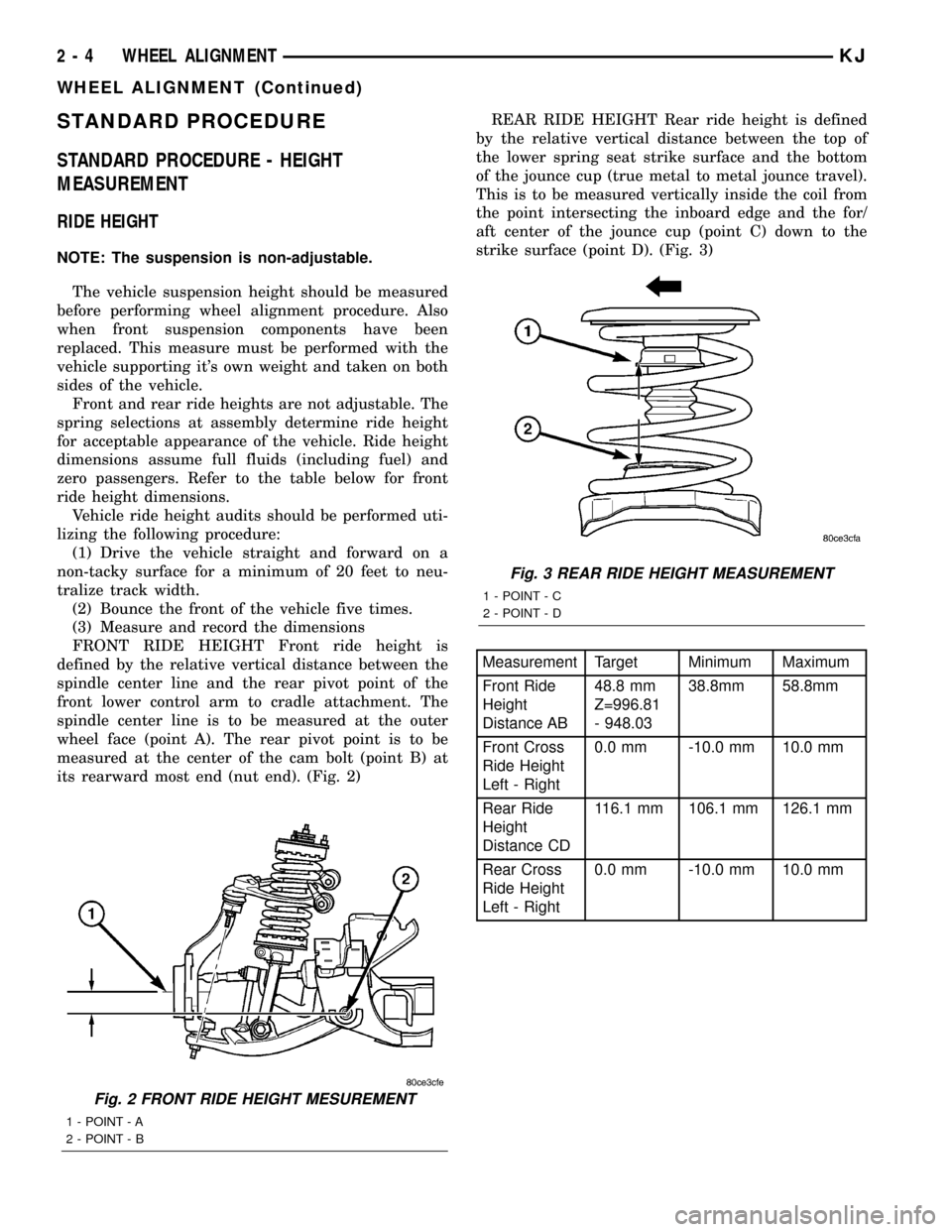
FRONT RIDE HEIGHT Front ride height is
defined by the relative vertical distance between the
spindle center line and the rear pivot point of the
front lower control arm to cradle attachment. The
spindle center line is to be measured at the outer
wheel face (point A). The rear pivot point is to be
measured at the center of the cam bolt (point B) at
its rearward most end (nut end). (Fig. 2)REAR RIDE HEIGHT Rear ride height is defined
by the relative vertical distance between the top of
the lower spring seat strike surface and the bottom
of the jounce cup (true metal to metal jounce travel).
This is to be measured vertically inside the coil from
the point intersecting the inboard edge and the for/
aft center of the jounce cup (point C) down to the
strike surface (point D). (Fig. 3)
Measurement Target Minimum Maximum
Front Ride
Height
Distance AB48.8 mm
Z=996.81
- 948.0338.8mm 58.8mm
Front Cross
Ride Height
Left - Right0.0 mm -10.0 mm 10.0 mm
Rear Ride
Height
Distance CD116.1 mm 106.1 mm 126.1 mm
Rear Cross
Ride Height
Left - Right0.0 mm -10.0 mm 10.0 mm
Fig. 2 FRONT RIDE HEIGHT MESUREMENT
1 - POINT - A
2 - POINT - B
Fig. 3 REAR RIDE HEIGHT MEASUREMENT
1 - POINT - C
2 - POINT - D
2 - 4 WHEEL ALIGNMENTKJ
WHEEL ALIGNMENT (Continued)
Page 25 of 1803

STANDARD PROCEDURE - CAMBER AND
CASTER ADJUSTMENT
Camber and caster angle adjustments involve
changing the position of the lower suspension arm
cam bolts. (Fig. 4)
STANDARD PROCEDURE - TOE ADJUSTMENT
4X4 SUSPENSION HEIGHT MESUREMENT MUST
BE PERFORMED BEFORE AN ALIGNMENT.
The wheel toe position adjustment is the final
adjustment.
(1) Start the engine and turn wheels both ways
before straightening the wheels. Secure the steering
wheel with the front wheels in the straight-ahead
position.
(2) Loosen the tie rod jam nuts.
NOTE: Each front wheel should be adjusted for
one-half of the total toe position specification. This
will ensure the steering wheel will be centered
when the wheels are positioned straight-ahead.
(3) Adjust the wheel toe position by turning the tie
rod as necessary (Fig. 5).
(4)
Tighten the tie rod jam nut to 75 N´m (55 ft. lbs.).
(5) Verify the specifications
(6) Turn off engine.
STANDARD PROCEDURE - CAMBER, CASTER
AND TOE ADJUSTMENT
Camber and caster angle adjustments involve
changing the position of the lower suspension arm
cam bolts. (Fig. 4)
CASTER
Moving the rear position of the cam bolt in or out,
will change the caster angle significantly and camber
angle only slightly. To maintain the camber angle
while adjusting caster, move the rear of the cam bolt
in or out. Then move the front of the cam bolt
slightly in the opposite direction. (Fig. 4)
To increase positive caster angle, move the rear posi-
tion of the cam bolt outward (from the engine). Move
the front of cam bolt inward (toward the engine) slightly
until the original camber angle is obtained. (Fig. 4)
CAMBER
Move both of the cam bolts together in or out. This
will change the camber angle significantly and caster
angle slightly. (Fig. 4)
After adjustment is made tighten the cam bolt nuts
to proper torque specification.
TOE ADJUSTMENT
The wheel toe position adjustment is the final
adjustment.
(1)
Start the engine and turn wheels both ways before
straightening the wheels. Secure the steering wheel with
the front wheels in the straight-ahead position.
(2) Loosen the tie rod jam nuts.
NOTE: Each front wheel should be adjusted for
one-half of the total toe position specification. This
will ensure the steering wheel will be centered
when the wheels are positioned straight-ahead.
(3) Adjust the wheel toe position by turning the tie
rod as necessary (Fig. 5).
(4)
Tighten the tie rod jam nut to 75 N´m (55 ft. lbs.).
(5) Verify the specifications
(6) Turn off engine.
Fig. 5 TIE ROD END
1 - JAM NUT
2 - TIE ROD - INNER
3 - TIE ROD END - OUTER
Fig. 4 LOWER CONTROL ARM
1 - FRONT CAM BOLT
2 - OUTER TIE ROD END
3 - LOWER BALL JOINT NUT
4 - LOWER CONTROL ARM
5 - REAR CAM BOLT
KJWHEEL ALIGNMENT 2 - 5
WHEEL ALIGNMENT (Continued)